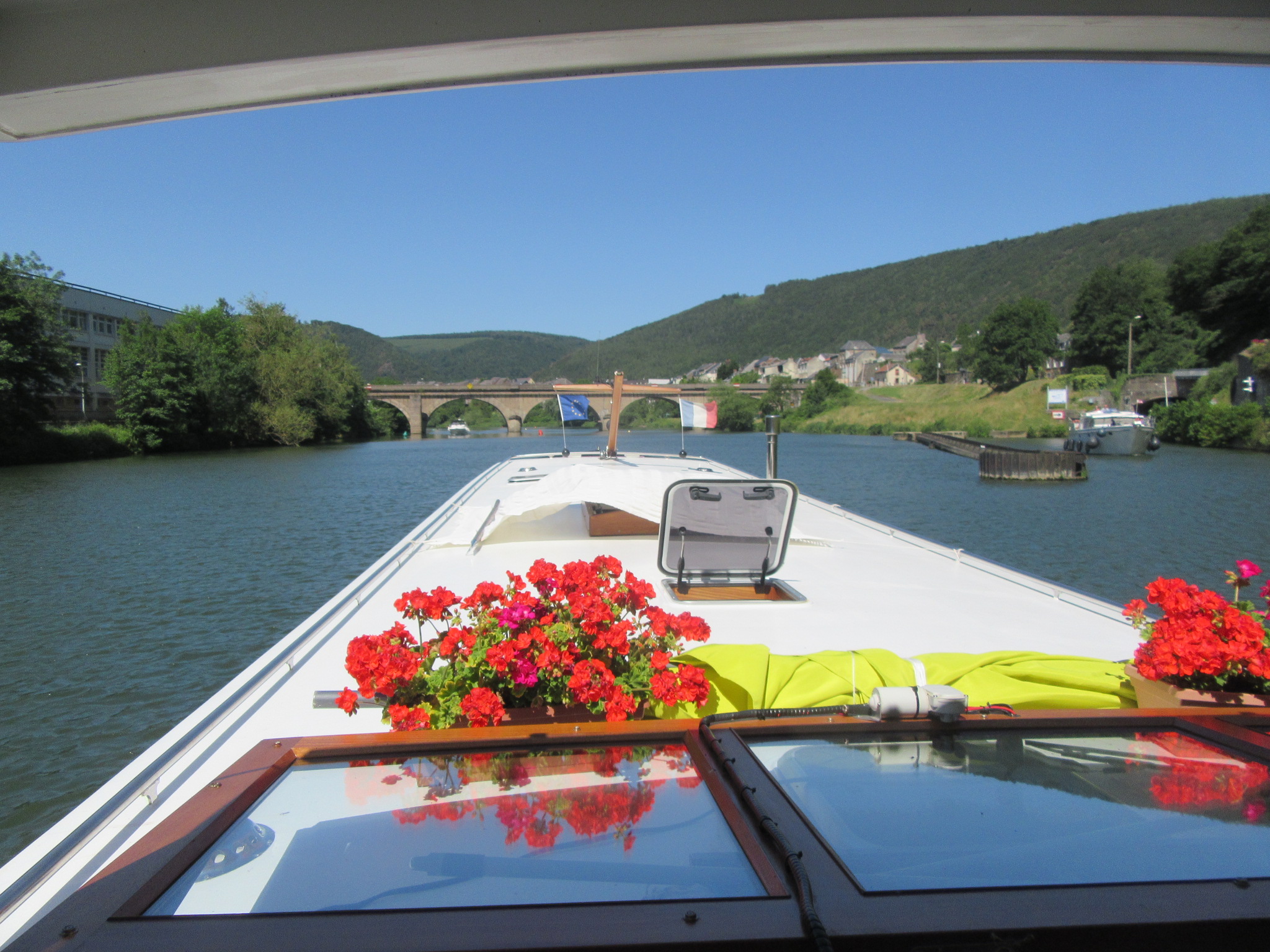
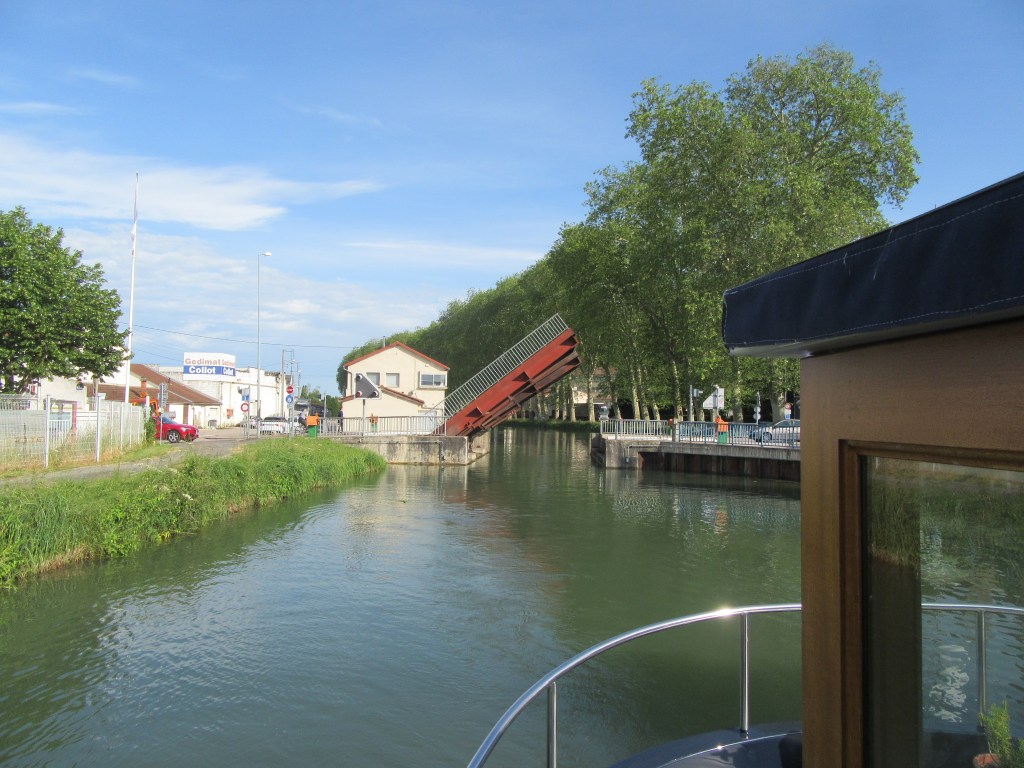
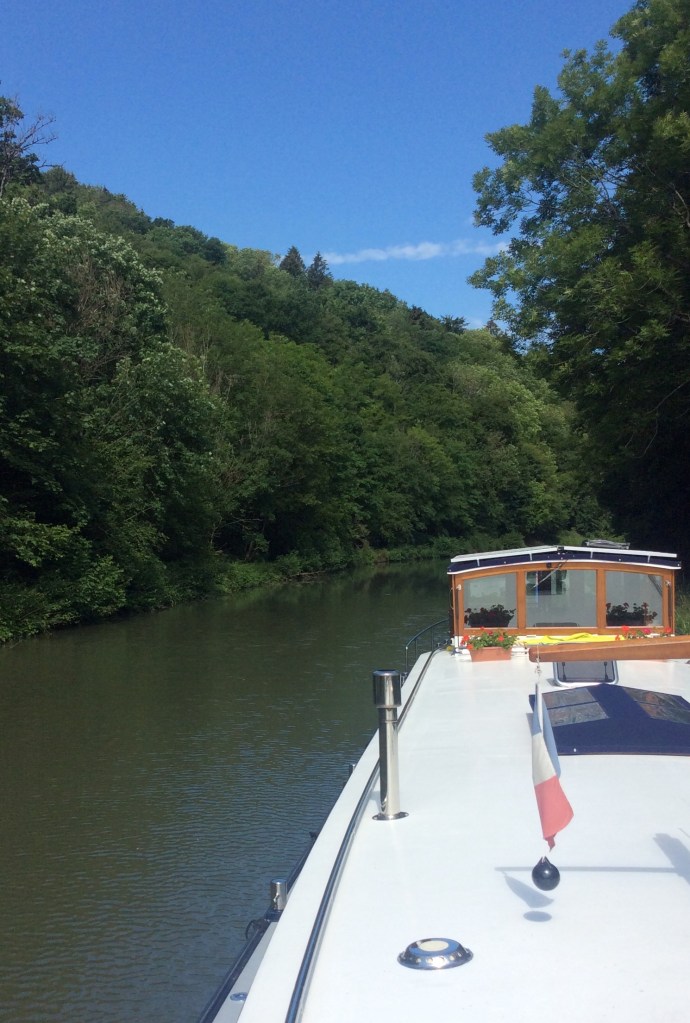
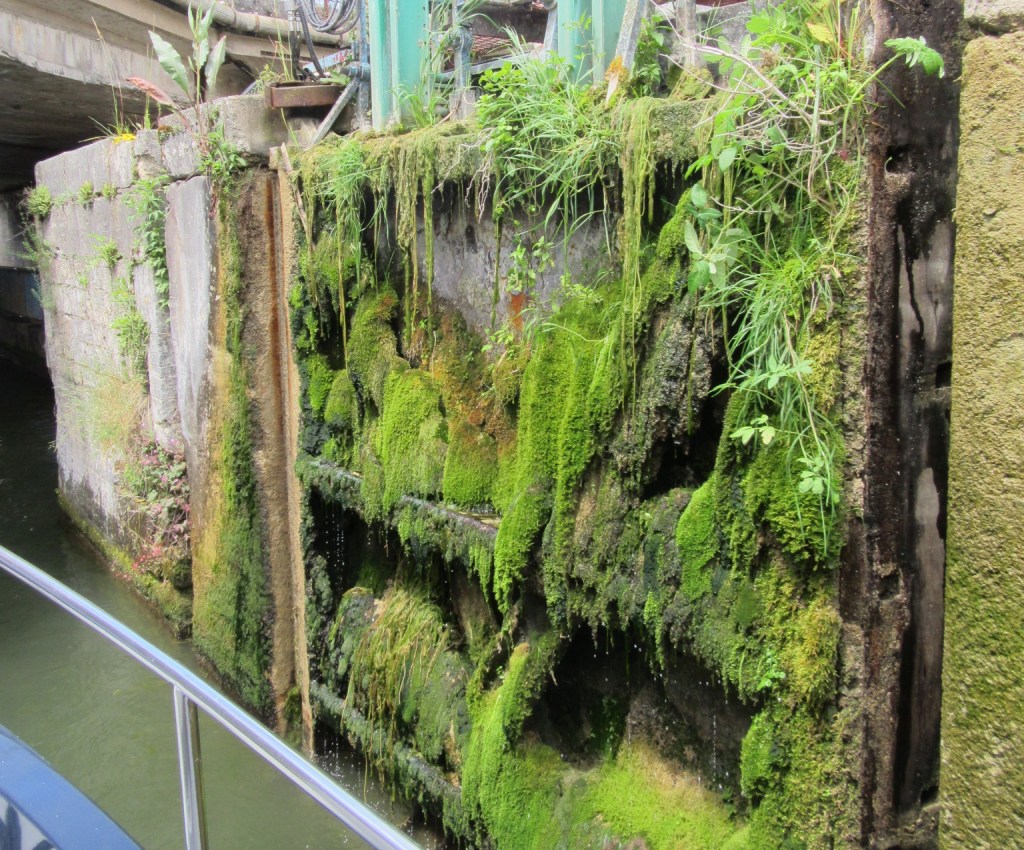
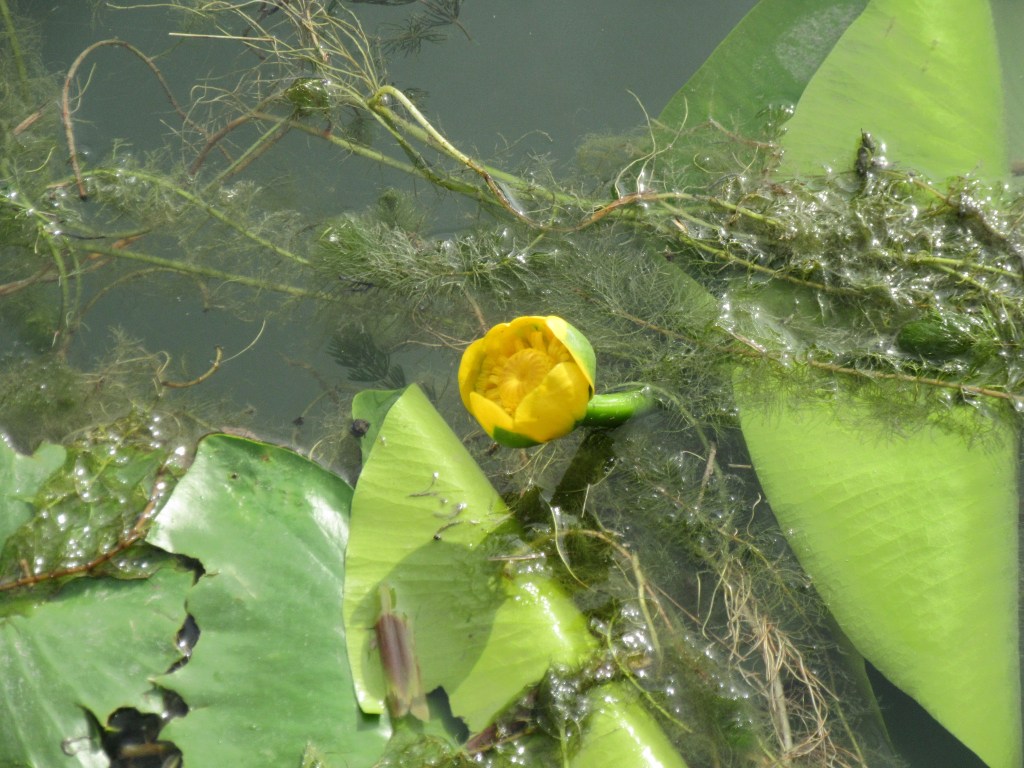
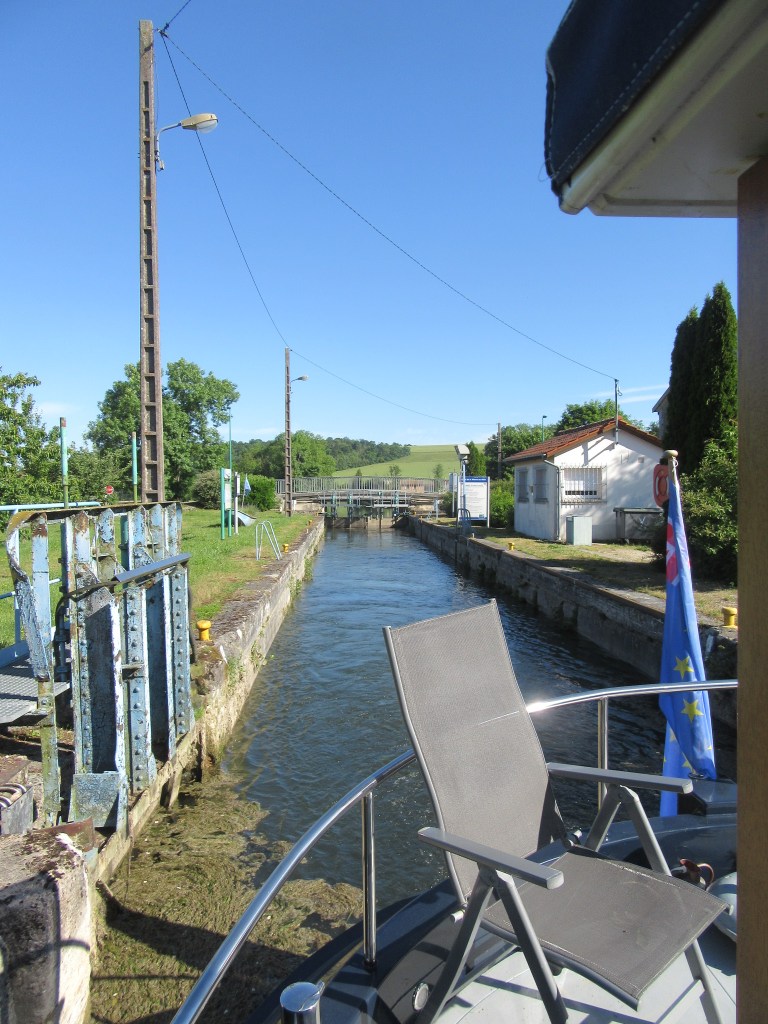
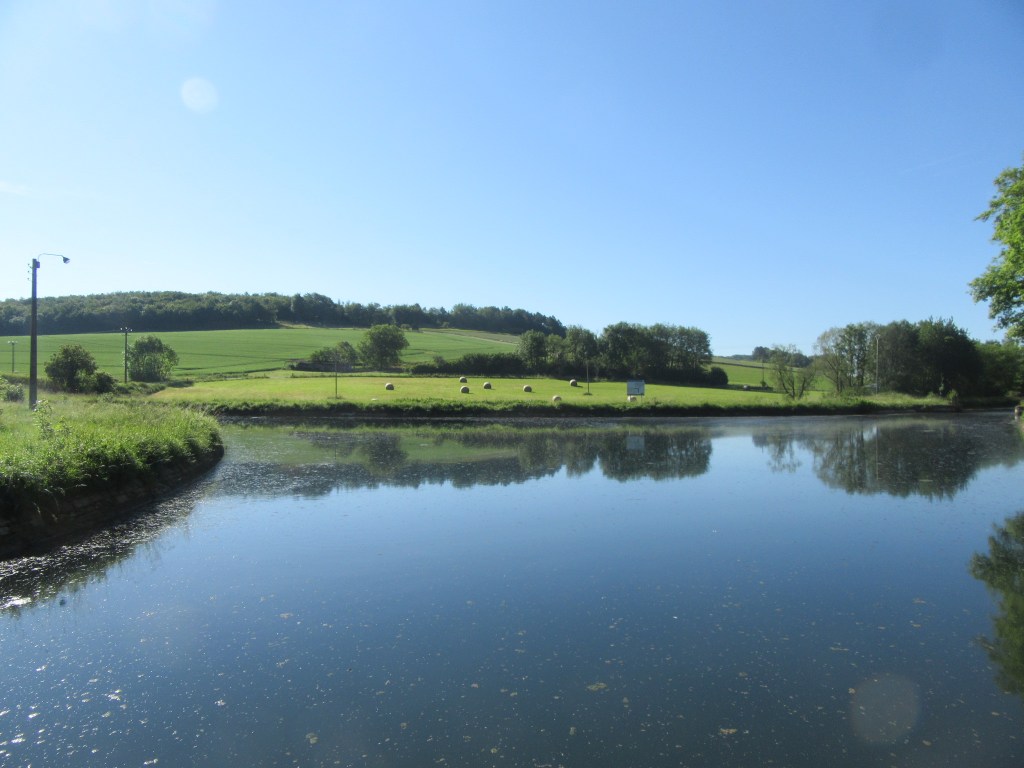
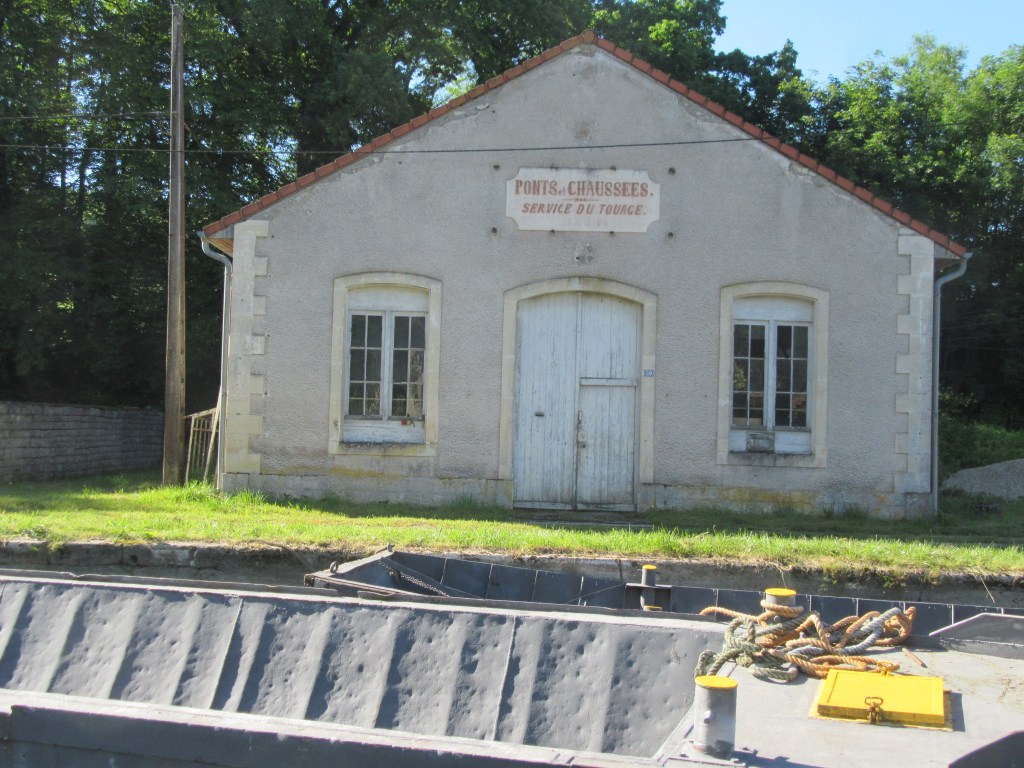
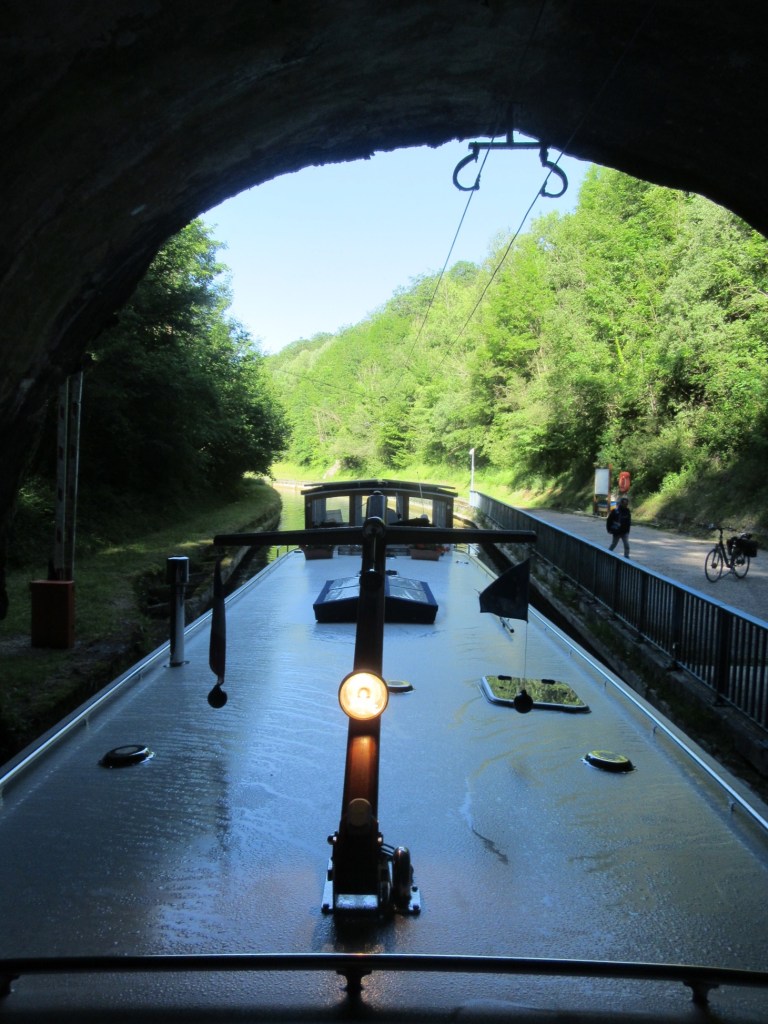
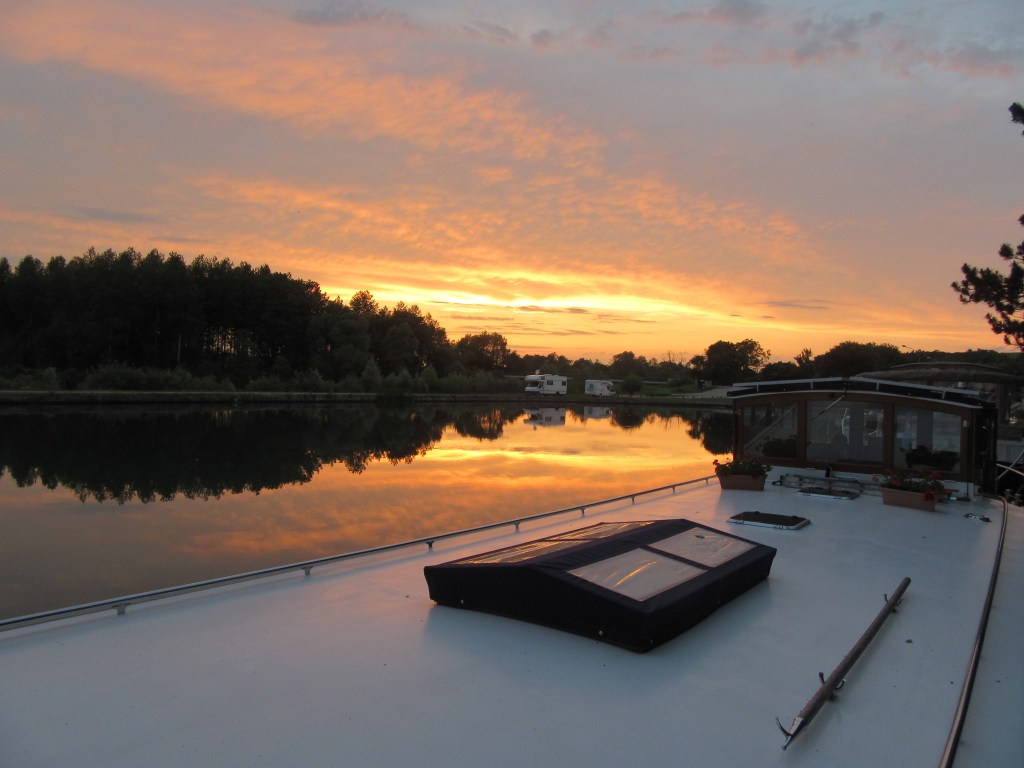
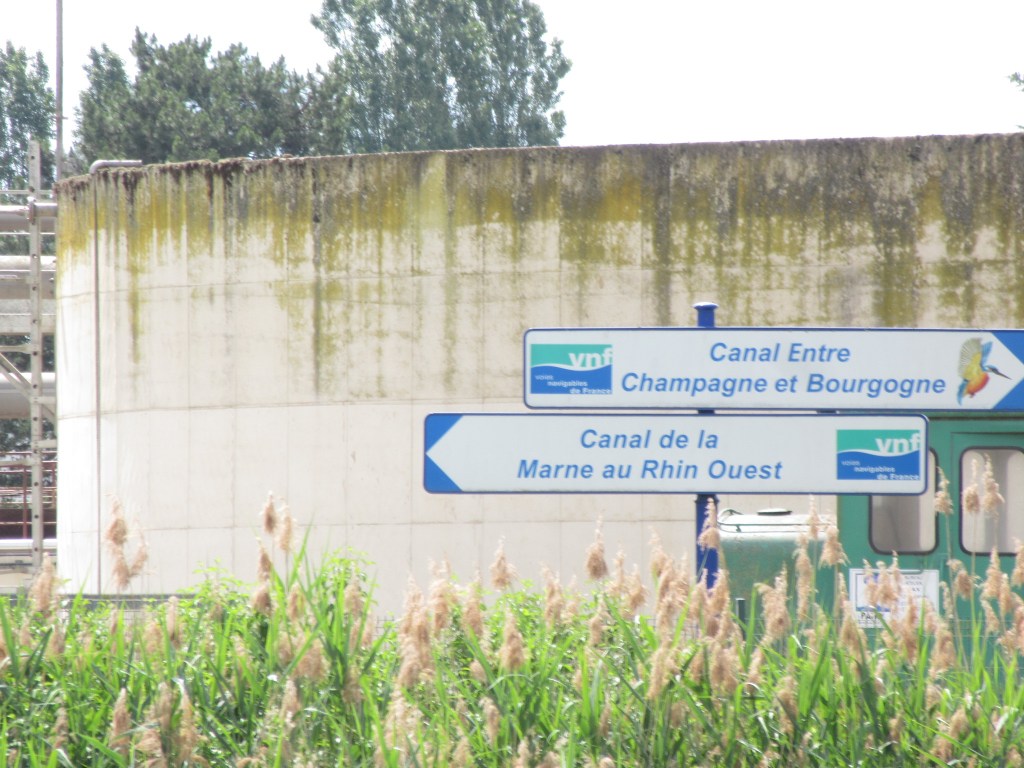
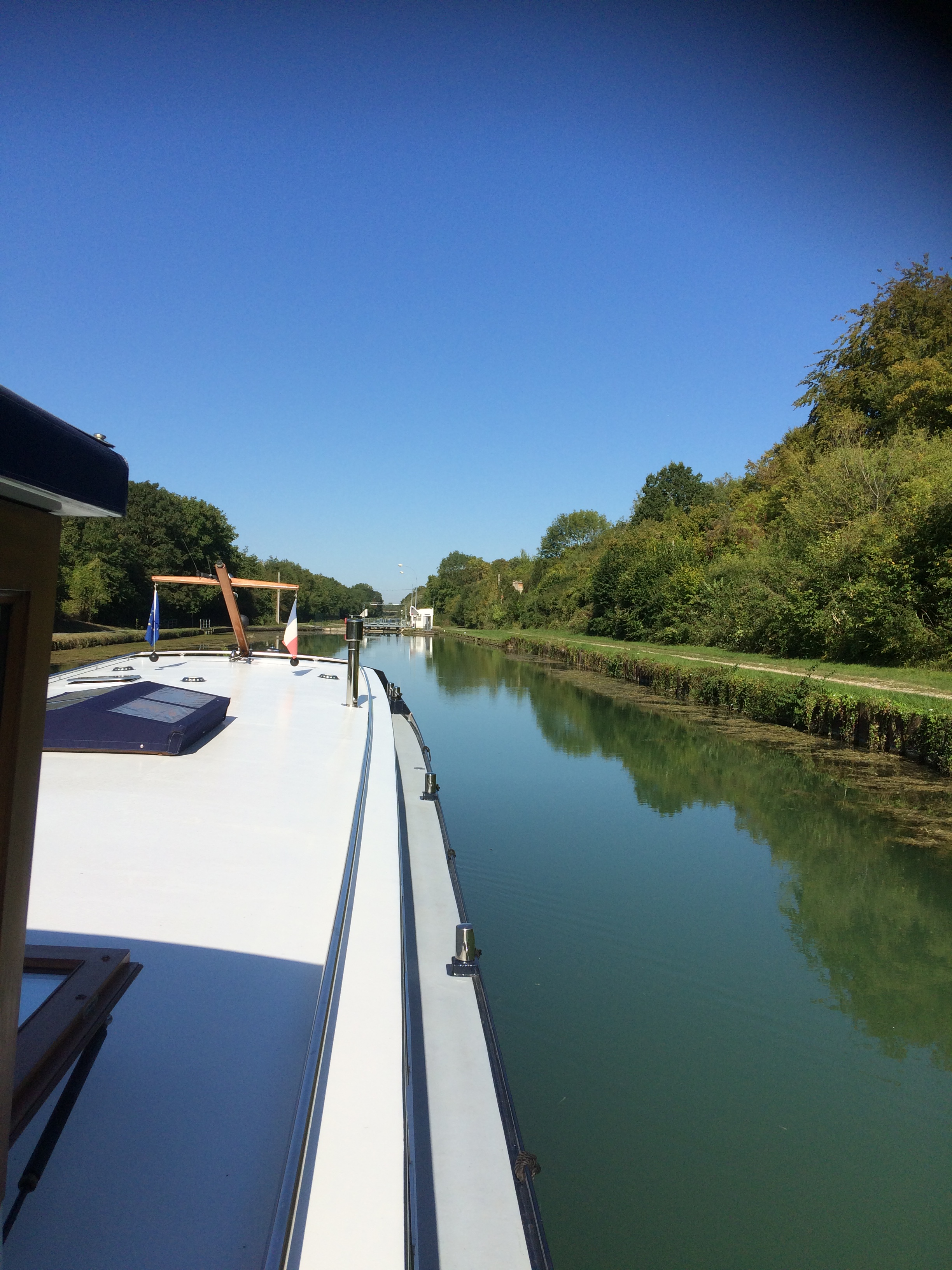
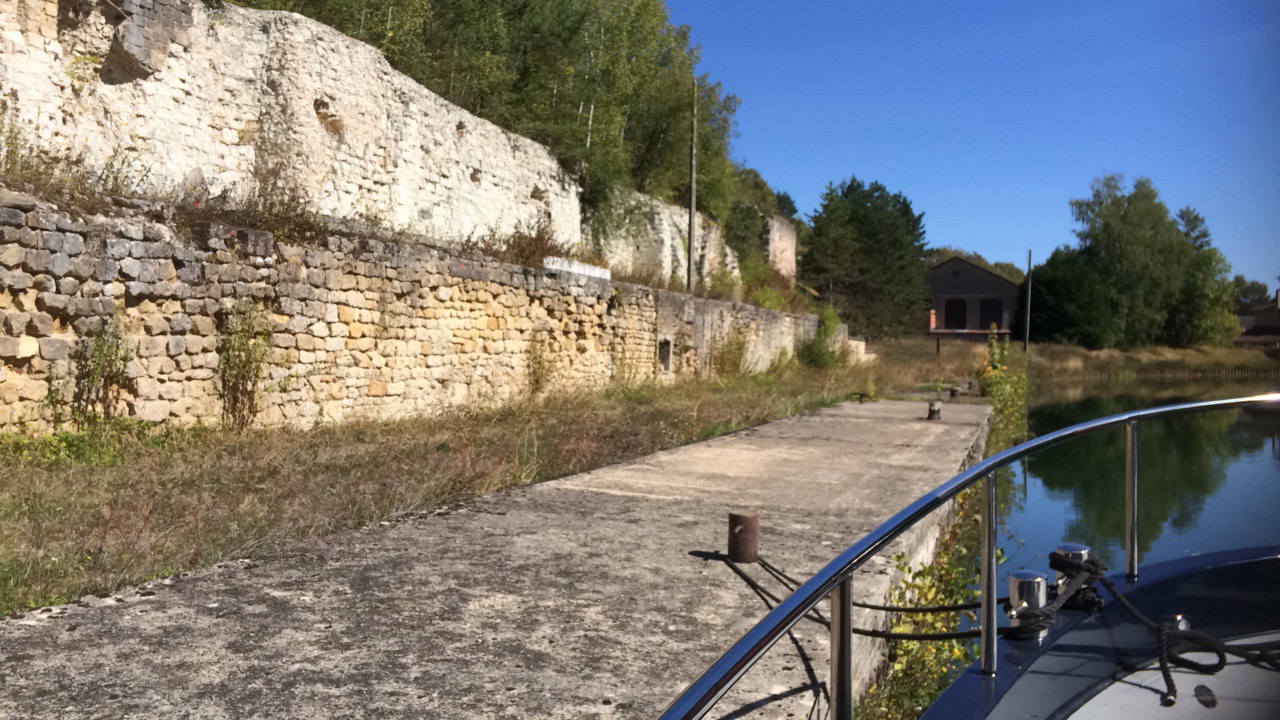
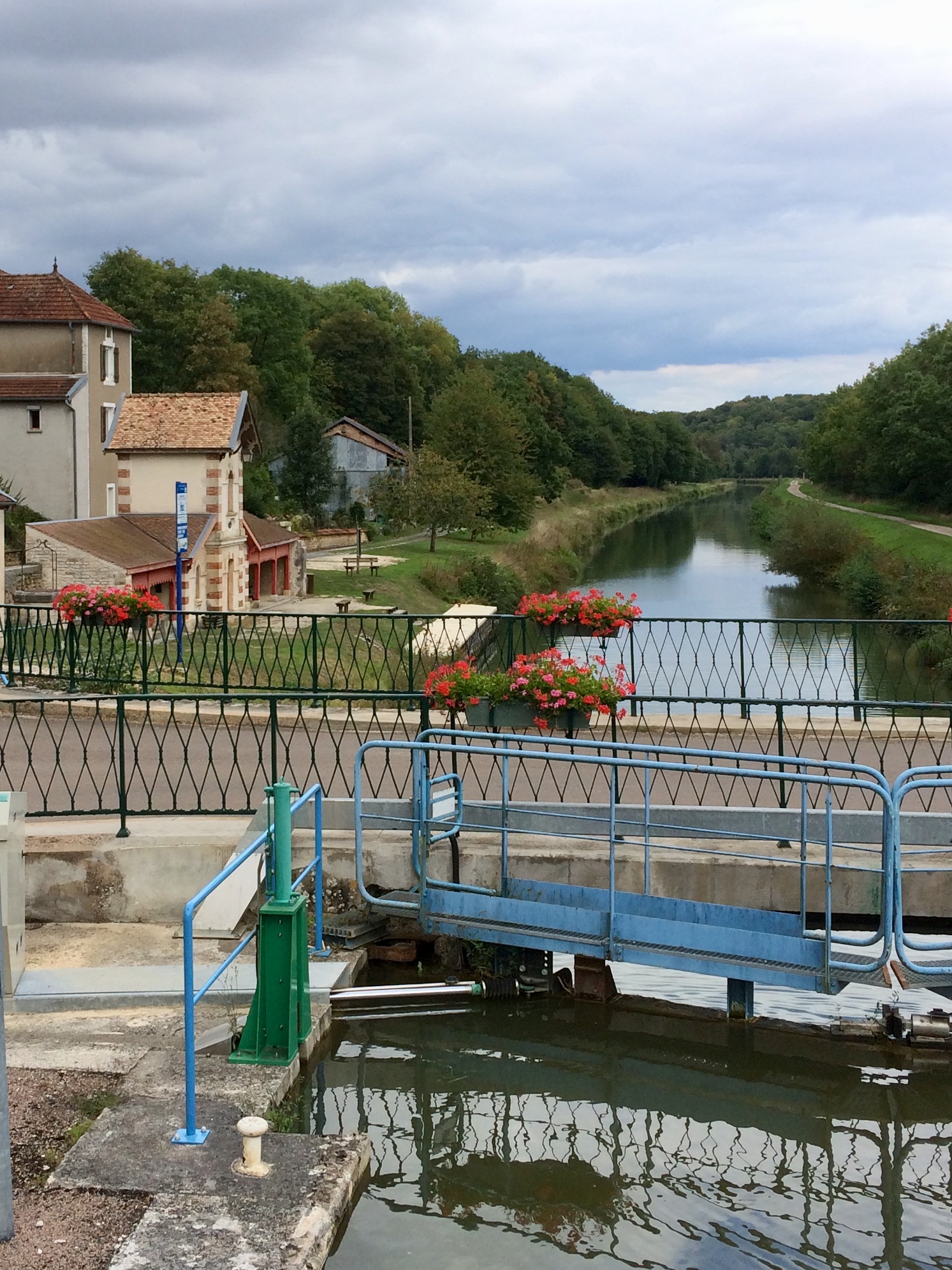
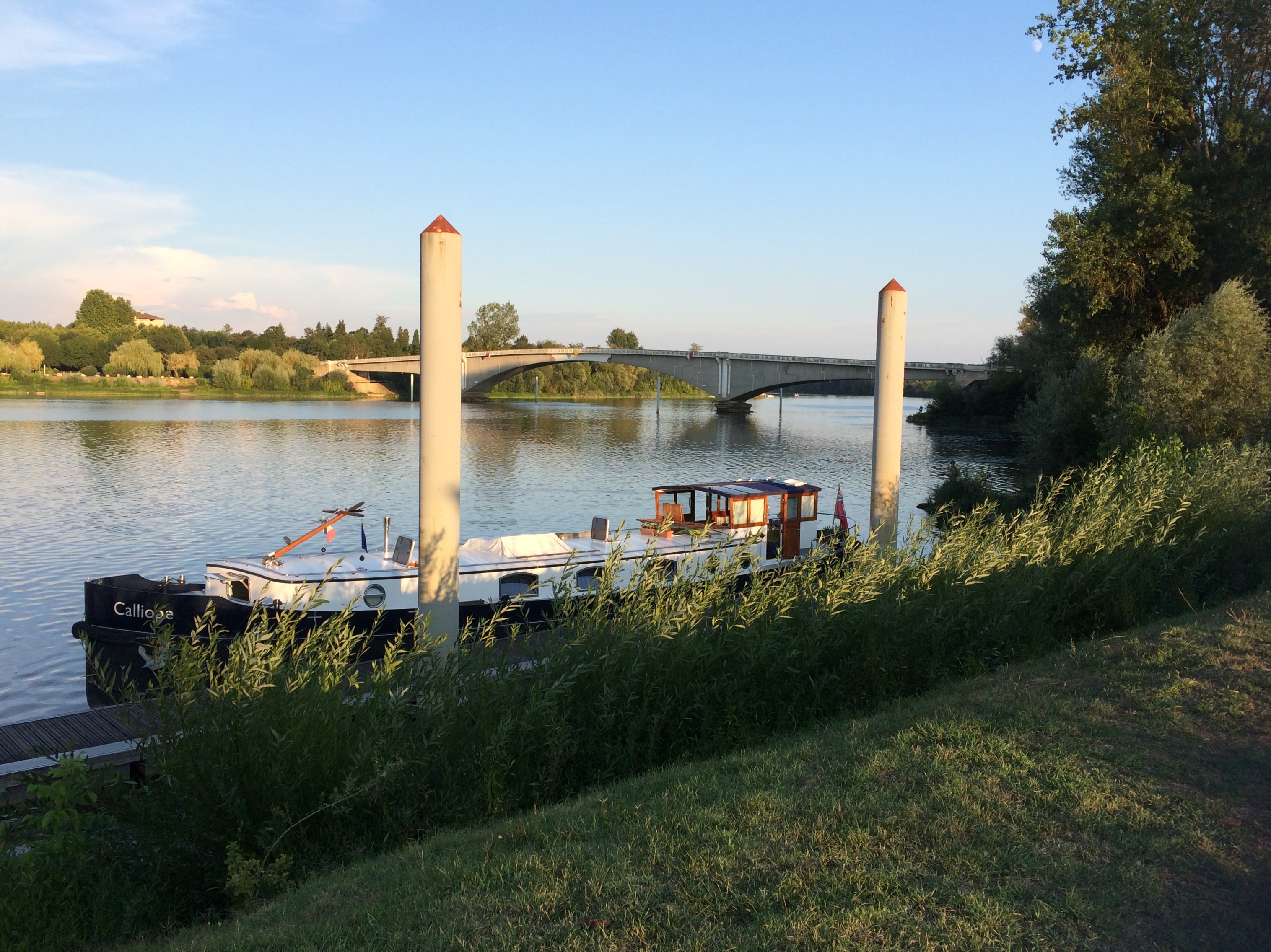
The Upper Lys, Leie and Mitoeyenne

15 – 24 August 2019

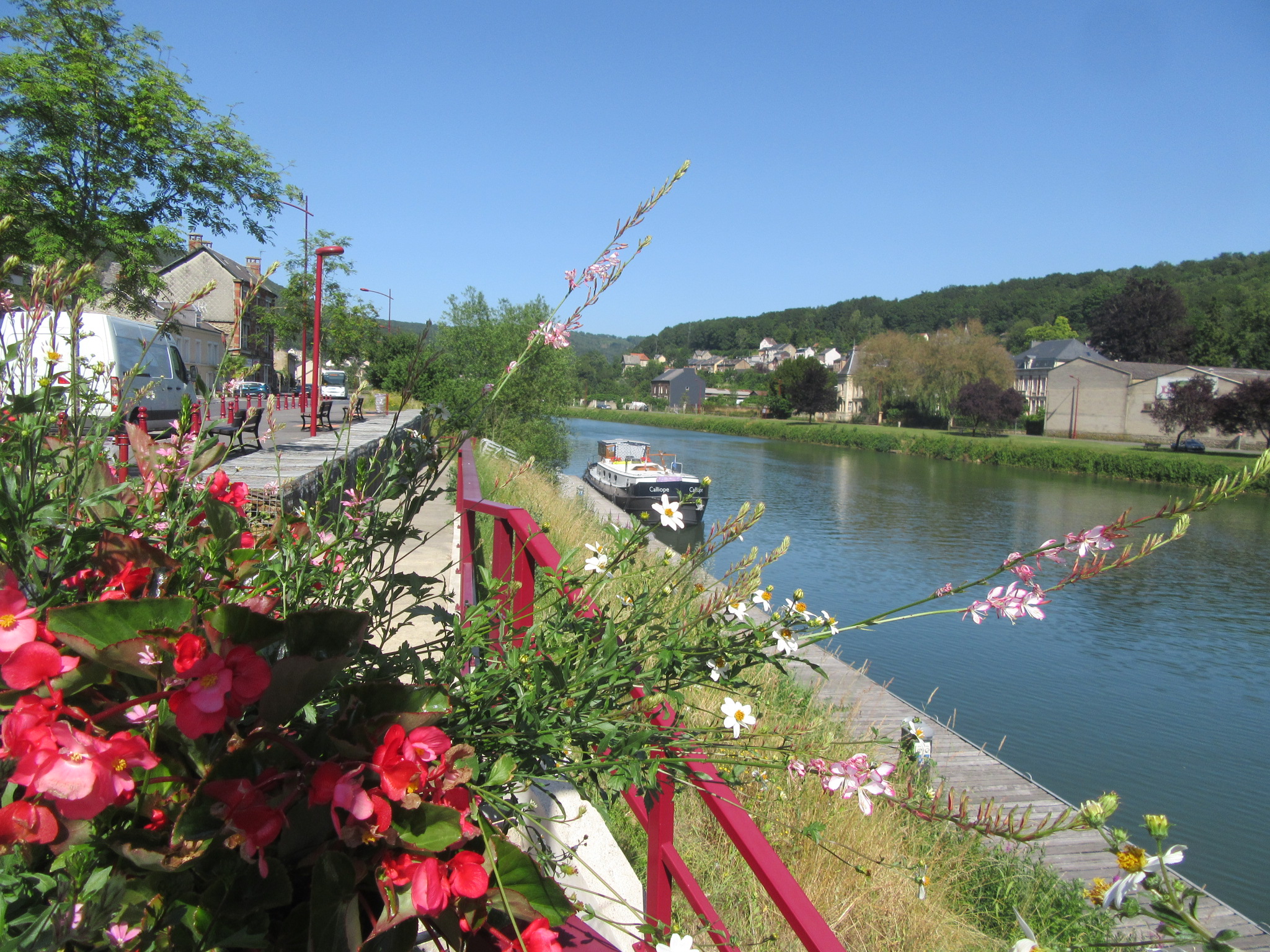
We returned to the boat in Kortrijk on August 13th, full of fatigue after a week of long road trips and an excellent South of France party weekend. There was 10 days to fill until our next family visitors arrived in Kortrijk so we set out for a short and enjoyable cruise.

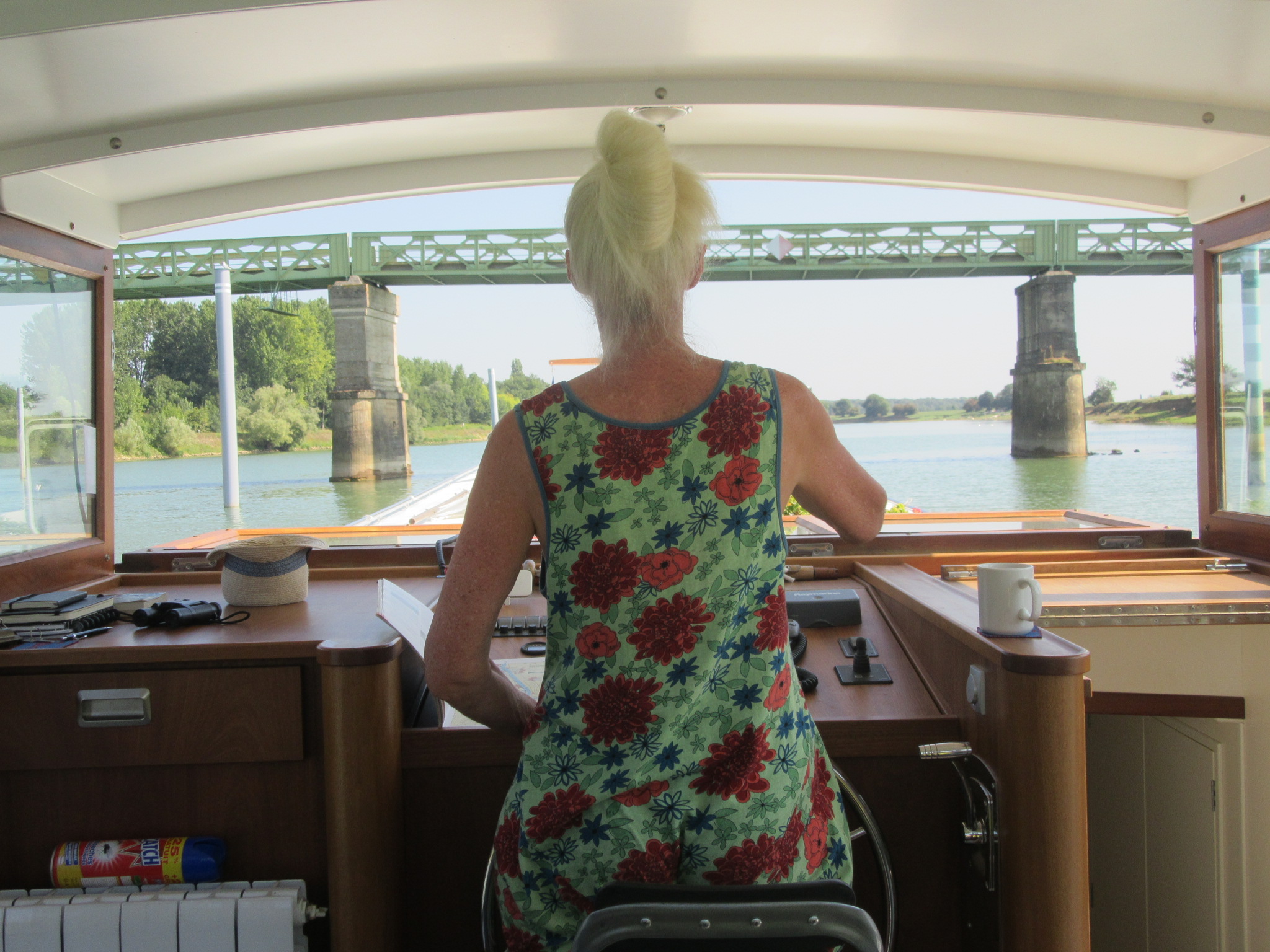
Despite the dull skies we immediately felt a sense of peace and tranquility – that gentle movement on the water, the open views from the wheelhouse, the wild birds, and just the two of us together for a while.

It took a day’s acclimatisation and rest before we set off along the river. There was some re-provisioning to do, some cleaning, new fenders to tie on and, most exciting, new navigation maps to explore.

So it was on Thursday that we eventually slipped our ropes and backed (yes, reversed, astern) out of the comfortable arm of the River Leie where we had been moored for over a month.

I was immensely proud of the Captain, taking us under the low bridge with PV panels intact and out onto the river.

My only part in the manoeuvre was to call the Flemish waterways man and ask if we could leave, and go through the red light at the end of the port.
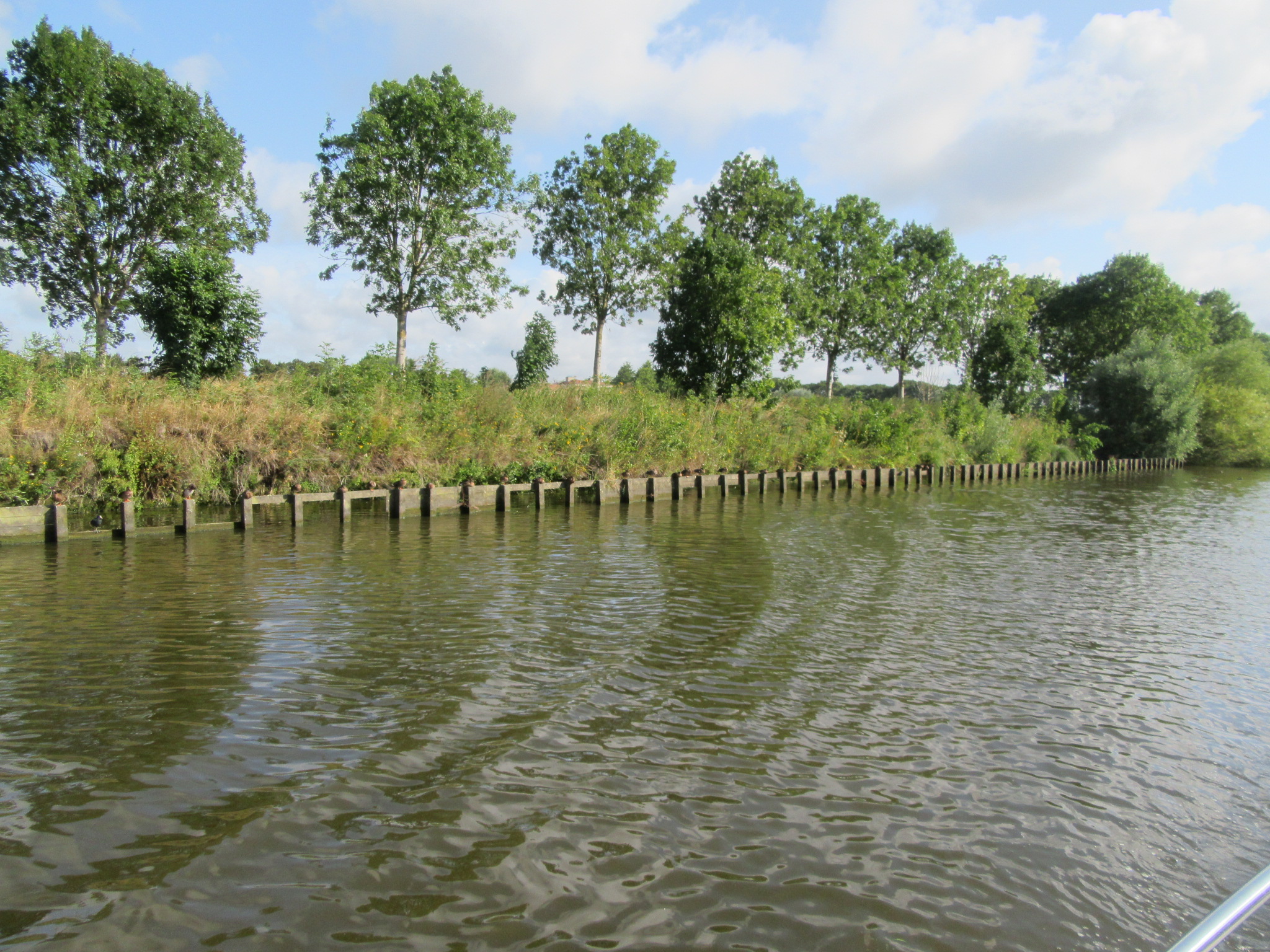
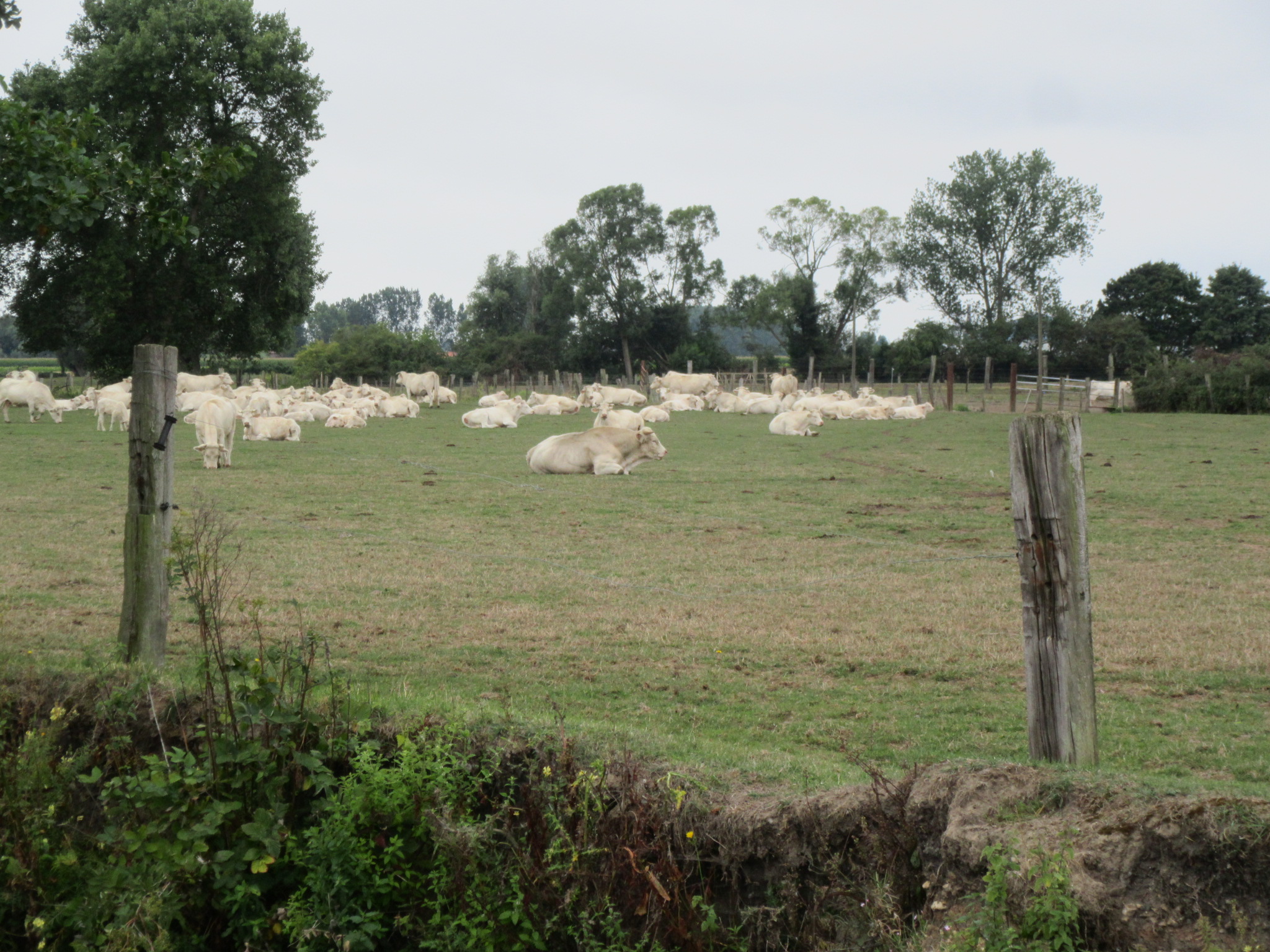
It was so lovely to be on the move again, initially watching Kortrijk slip away before the vista opened up onto broad open countryside, cows, horses, farms and villages.

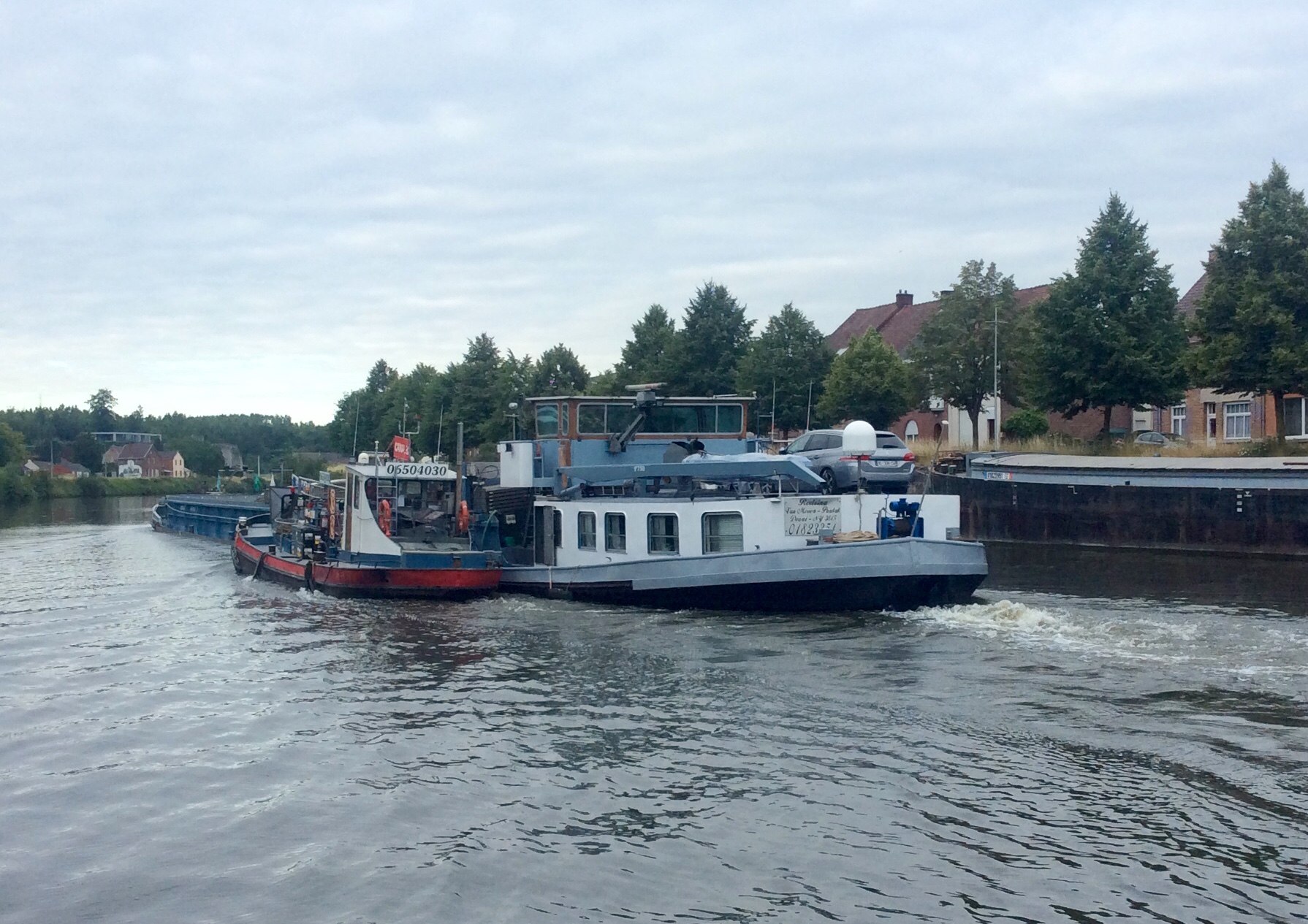
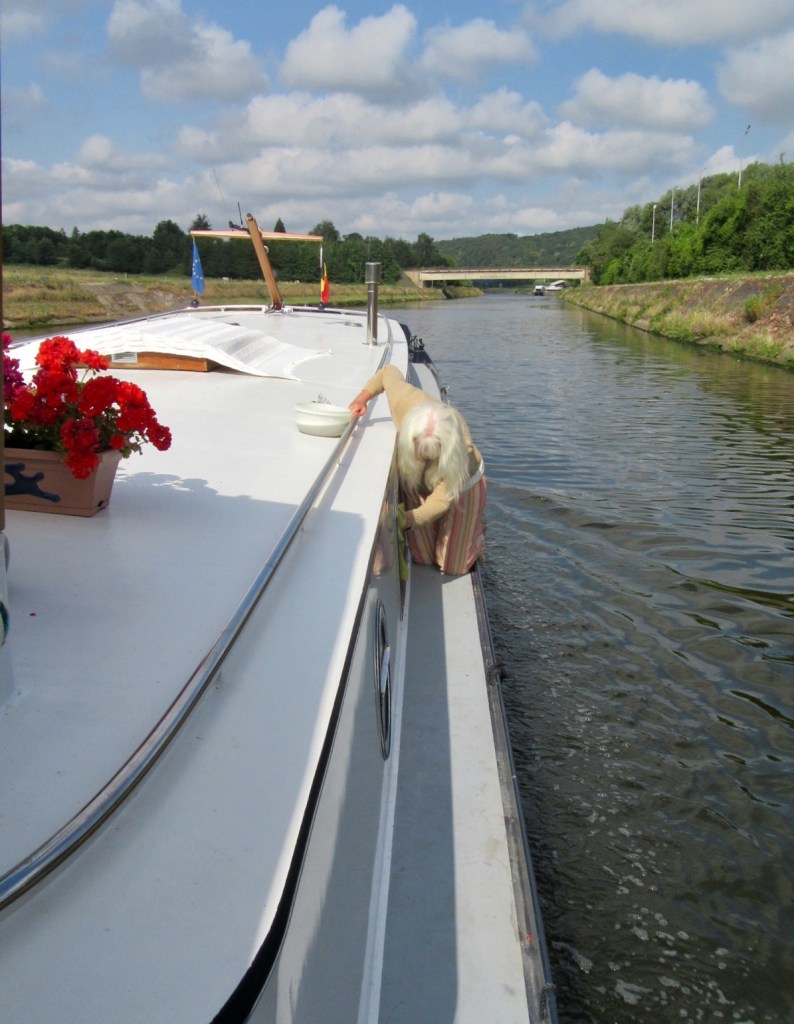
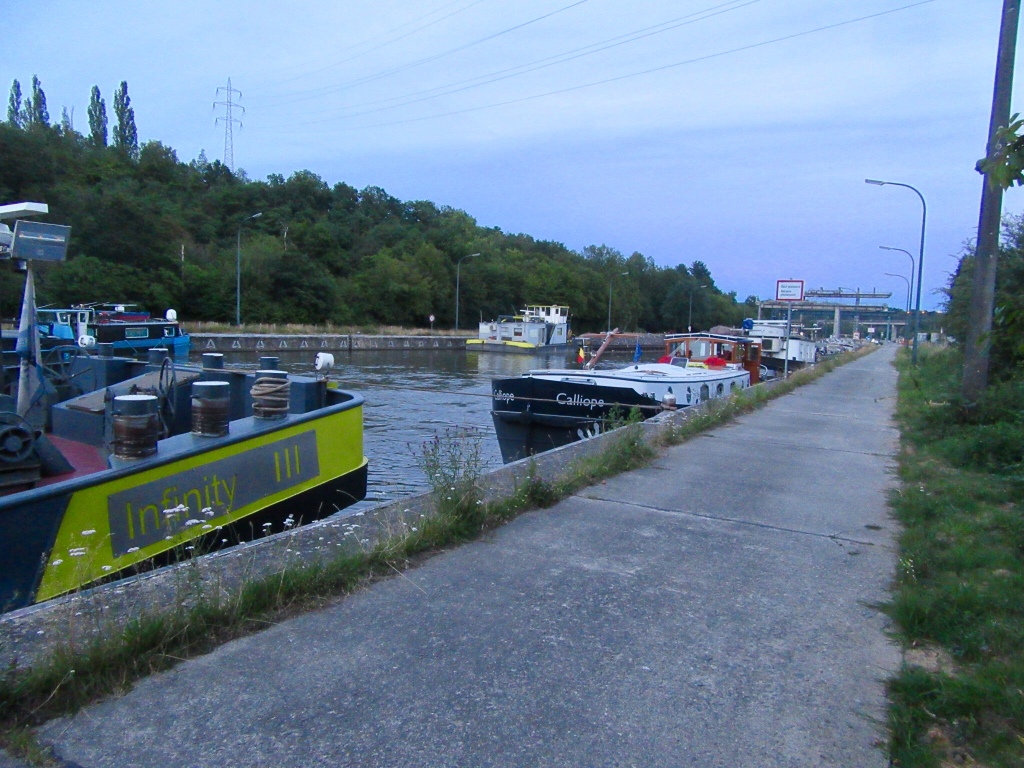
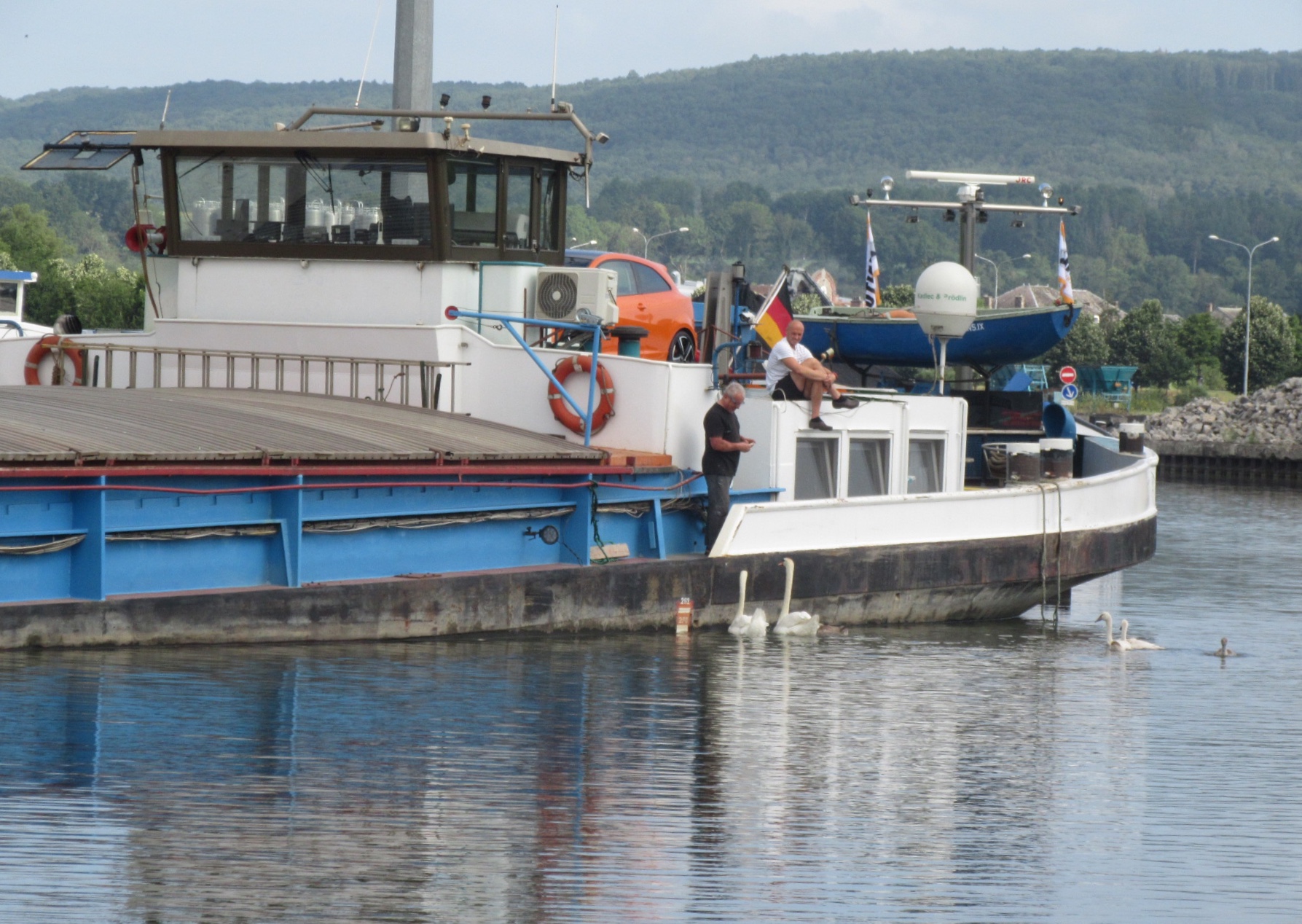
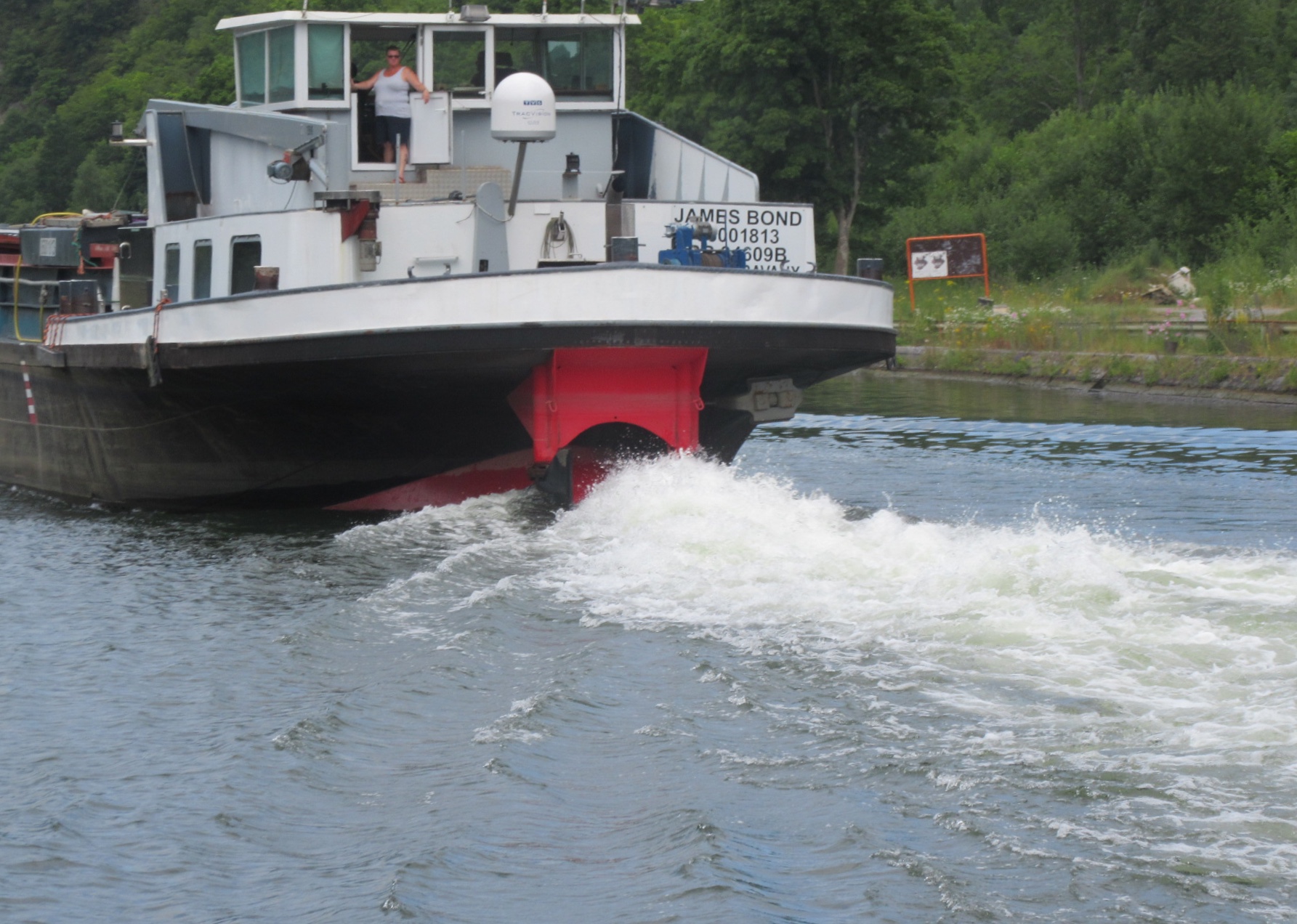
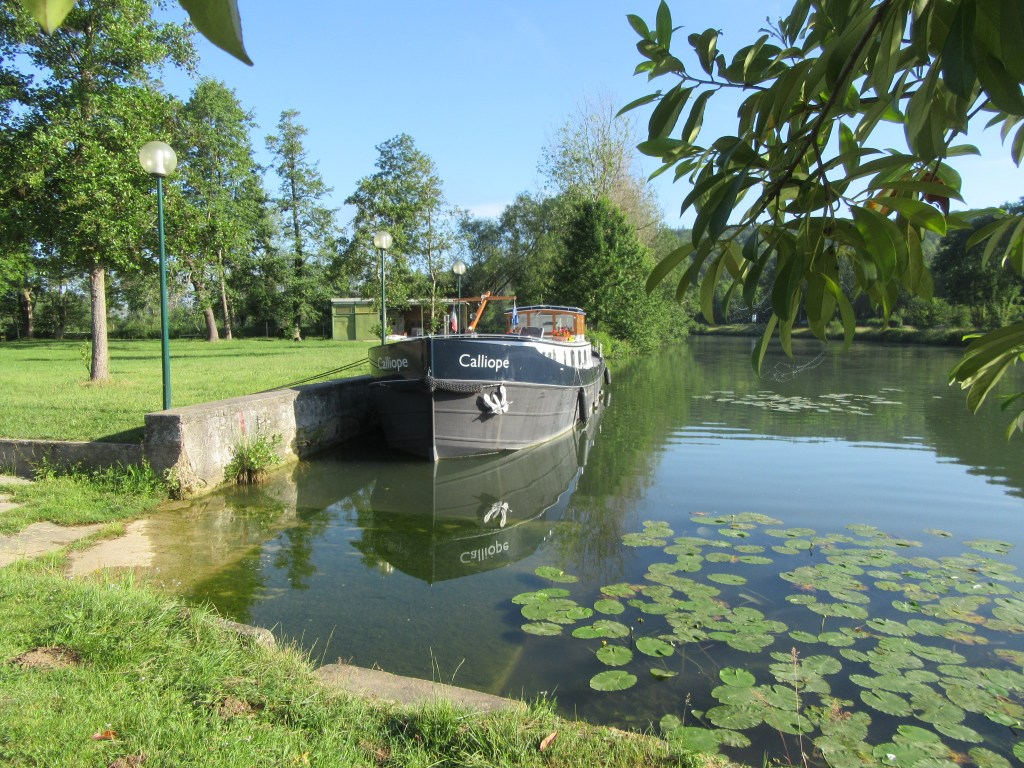
Calliope felt small as she passed by one commercial barge after another – this is a busy, friendly, waterway, with industrial captains waving their greetings as they go by. There is a wonderful irony to the perspective in this photo, making us seem at least as large – it is a mirage!

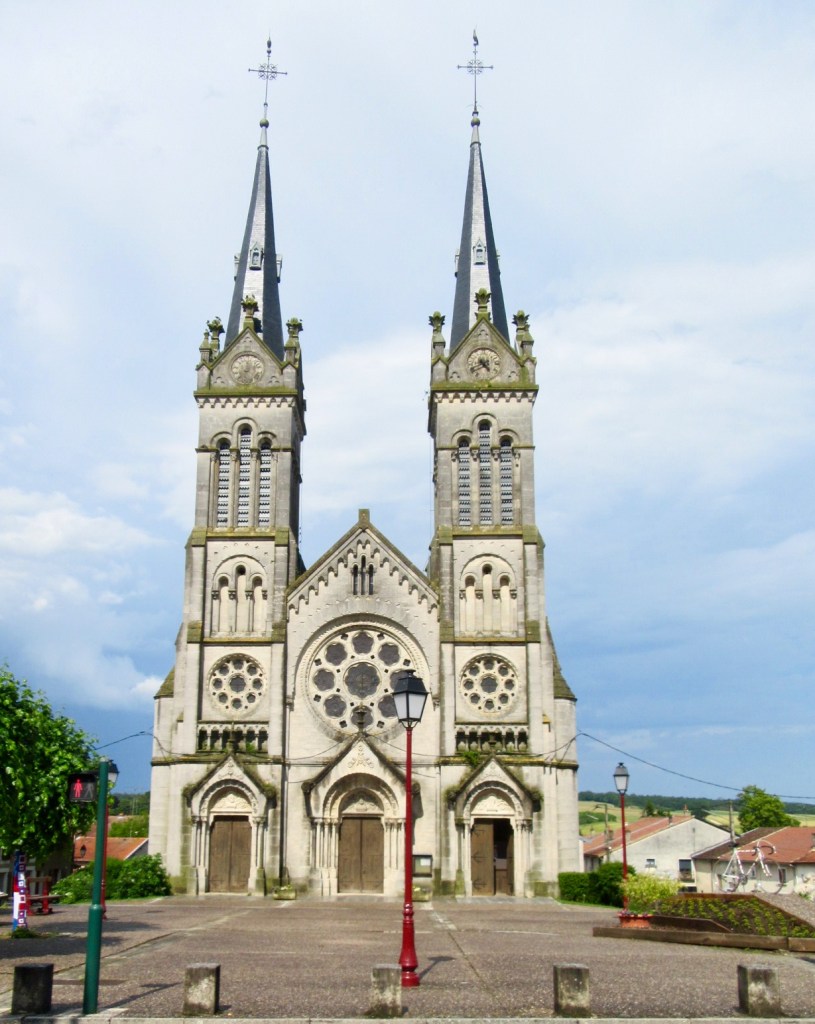
We were aiming for Wervik and after a couple of hours the huge church of this relatively small town came into view. As always a bit of PMT (pre-mooring tension) kicked in. Would there be space for us on the wharf at Wervik?

We were lucky – only one large barge on the wall and plenty of room for us. We were prepared for the widely spaced bollards, knowing that we would be making use of stout railing posts too. We soon made fast and had lunch.

t was after lunch that a little fun began. As the big barges passed up and down stream some slowed down past the moor boats, and others didn’t. Our lines creaked and groaned with strain. There was only one thing for it – break out the Haslar ropes!
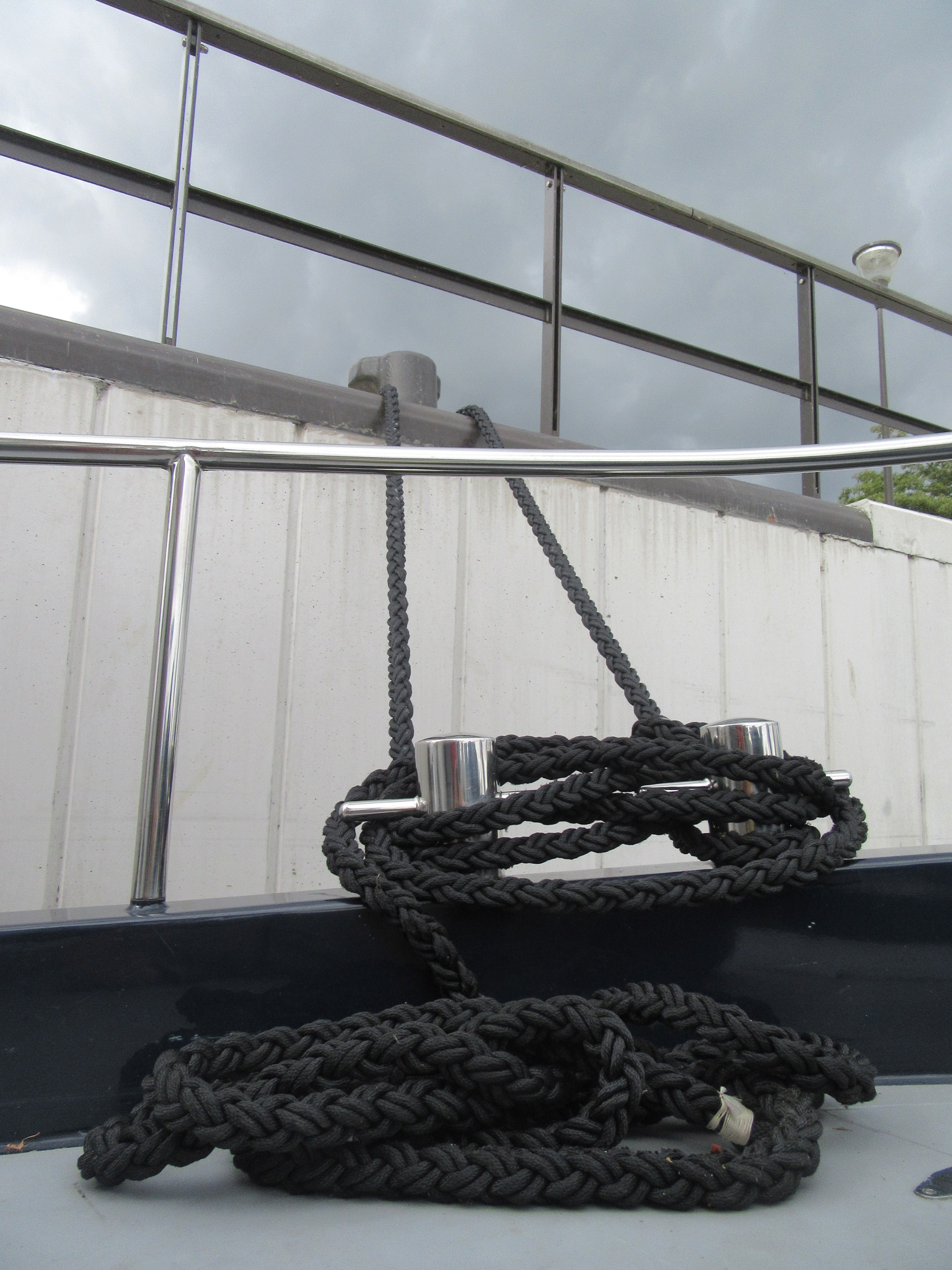
When we were moored at Haslar Marina in Portsmouth Harbour for a full winter we invested in some much thicker ropes to see us through the gales and storms, Once we deployed these fore and aft, plus a couple of springs, Calliope rocked as gently as a baby in a crib.
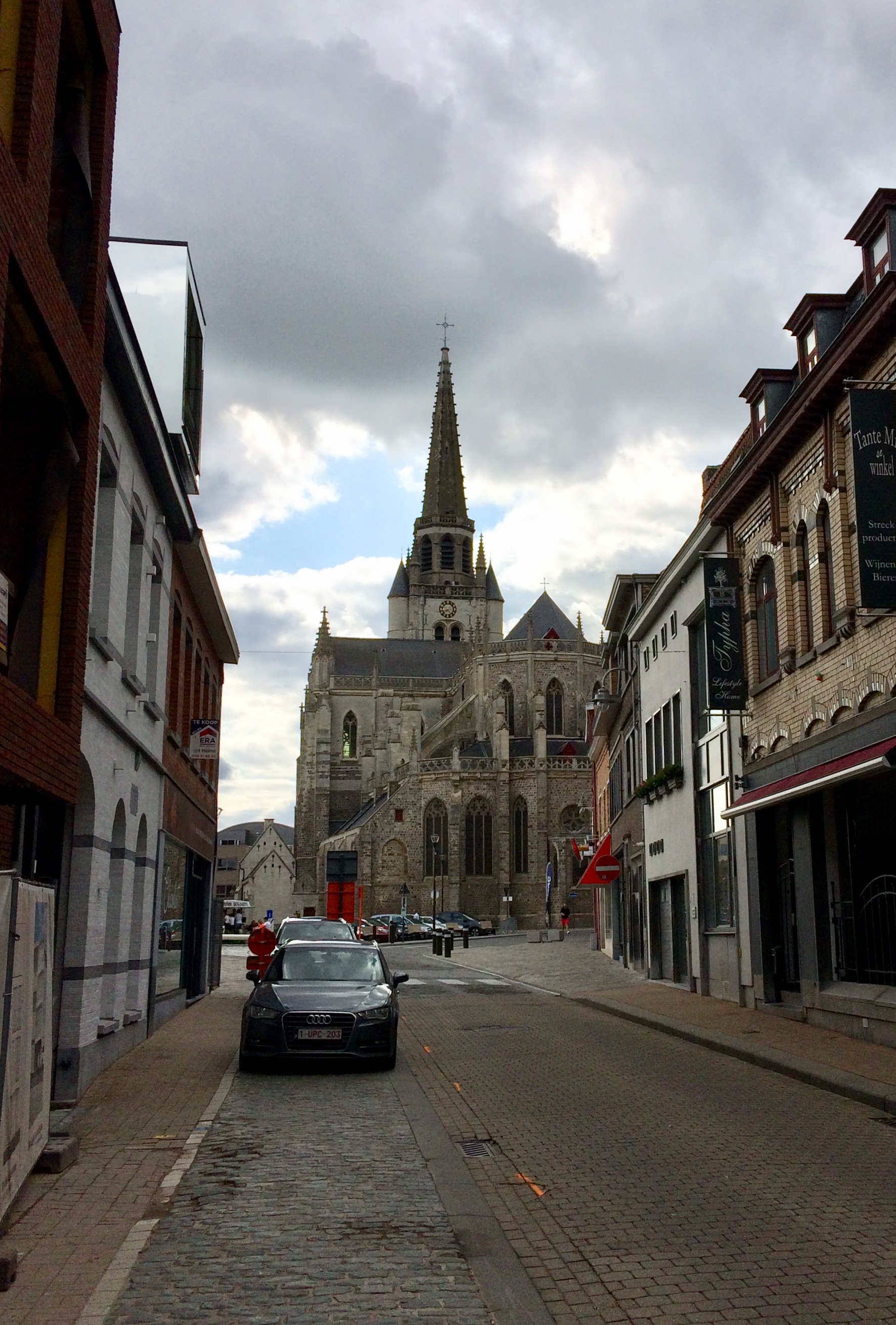
This was our cue for a quiet walk round a grey-skied town. It was very quiet to start with as it turned out to be a public holiday (Assumption of Mary) and everything apart from some of the bars was shut. We did study the church, finding it even bigger than it had appeared from the water.

And then the quietness was overturned by raucous happy singing, music, and one of the oddest vehicles we had ever seen.
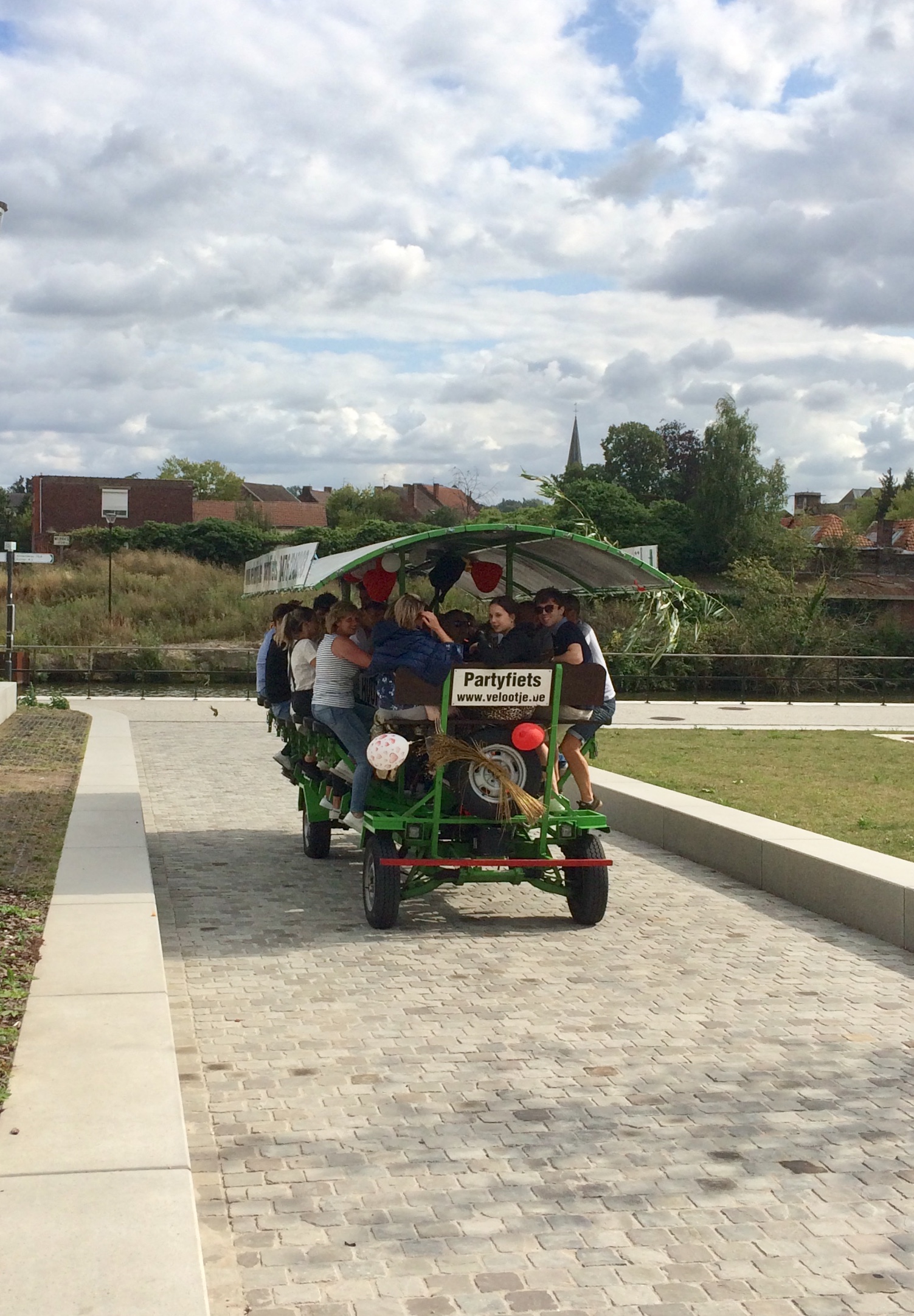
It was a sort of truck powered by six cyclists each side who were all sitting at, and enjoying the products of, a bar in the centre. Others sat around the edge, singing and drinking, laughing and shouting.
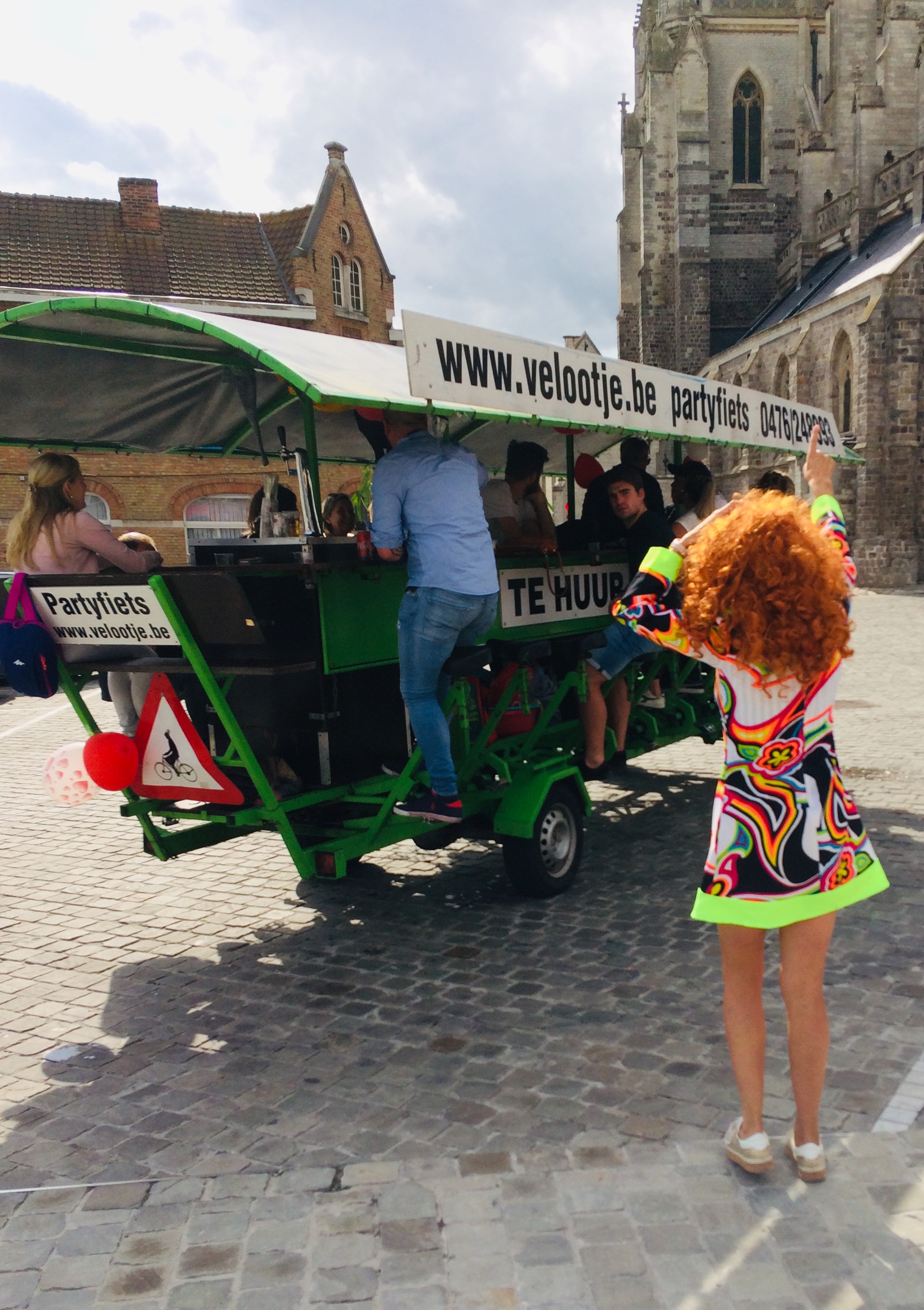
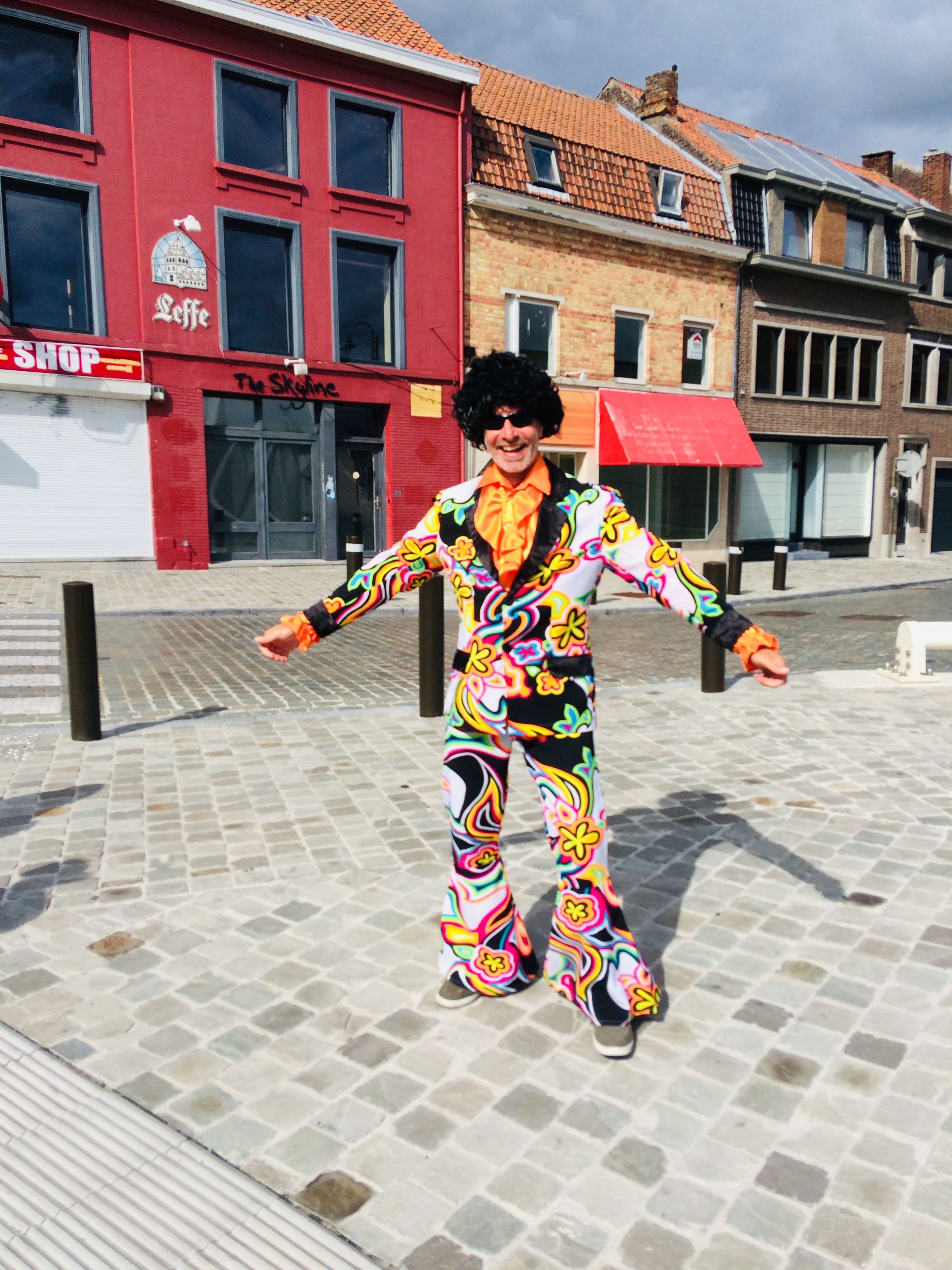
It was a wedding – a couple who had lived together 27 years and decided to get married. They stopped next to us, bridge and groom jumped down, and invited is to join in dancing. So ensued a few crazy minutes before the trundled on their very merry way!
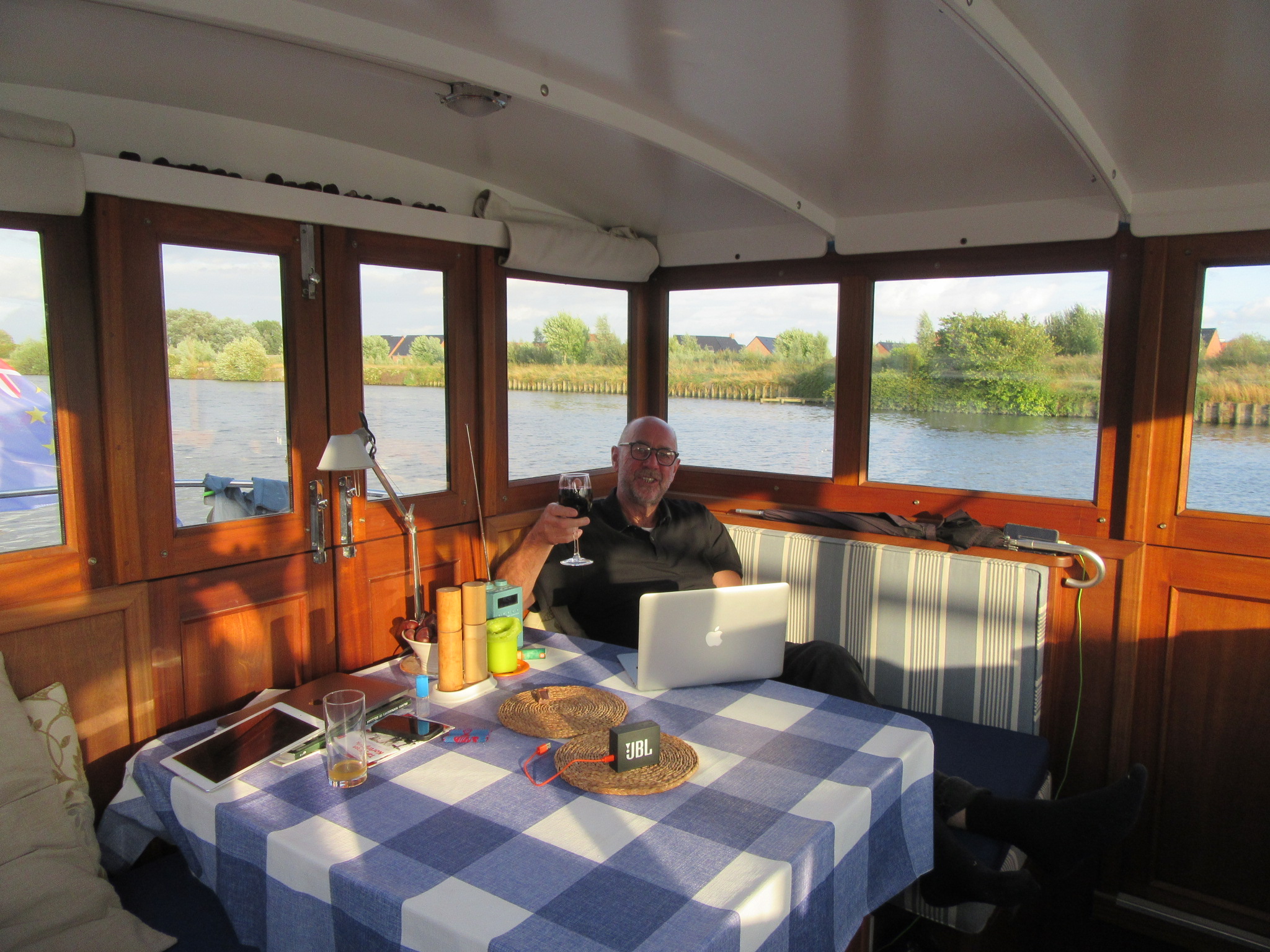
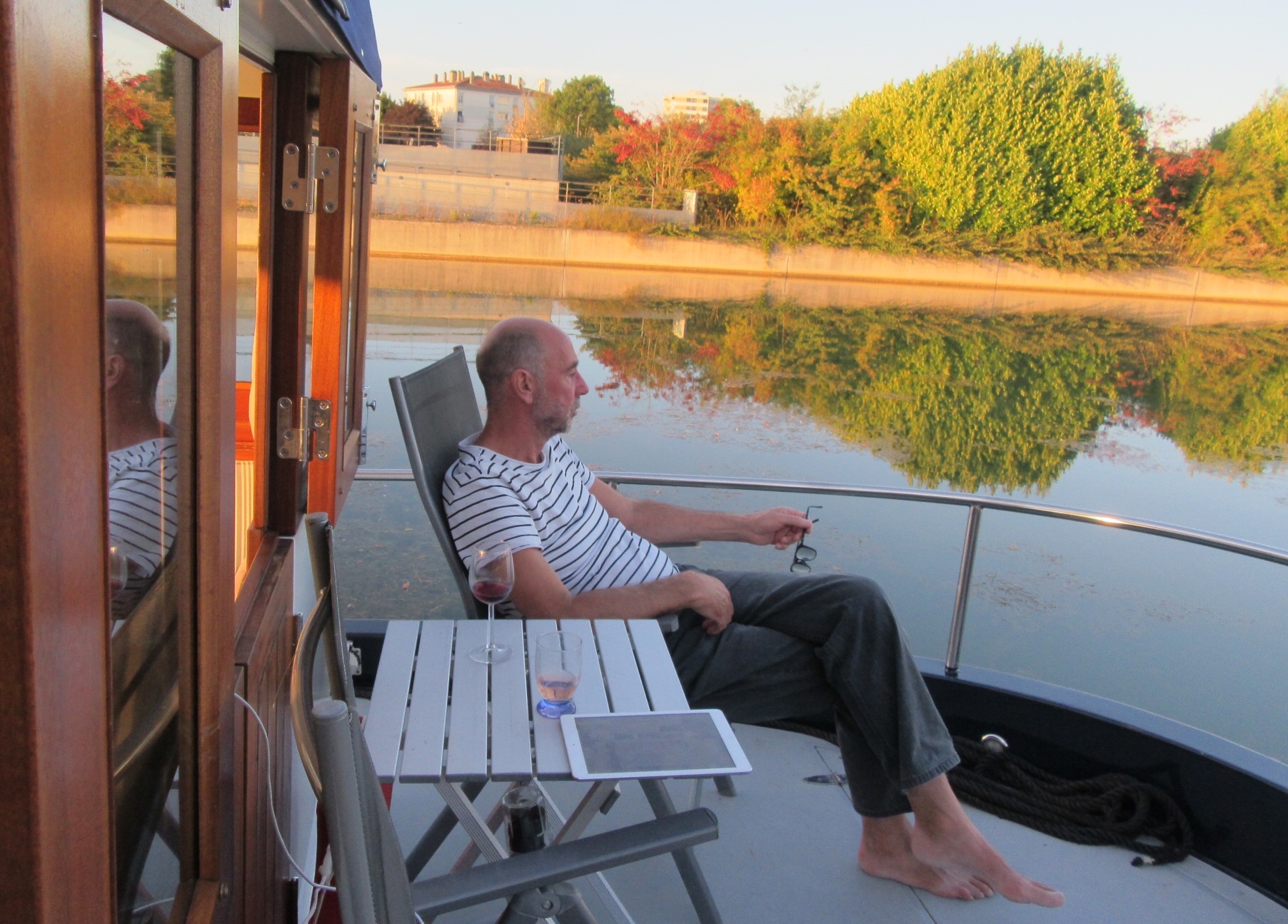
Back on the boat we had a quiet evening, with a happy Captain sipping wine while the wonderful sunlight cast interesting shadows and brightened the riverbank colours as the dark clouds swept by.

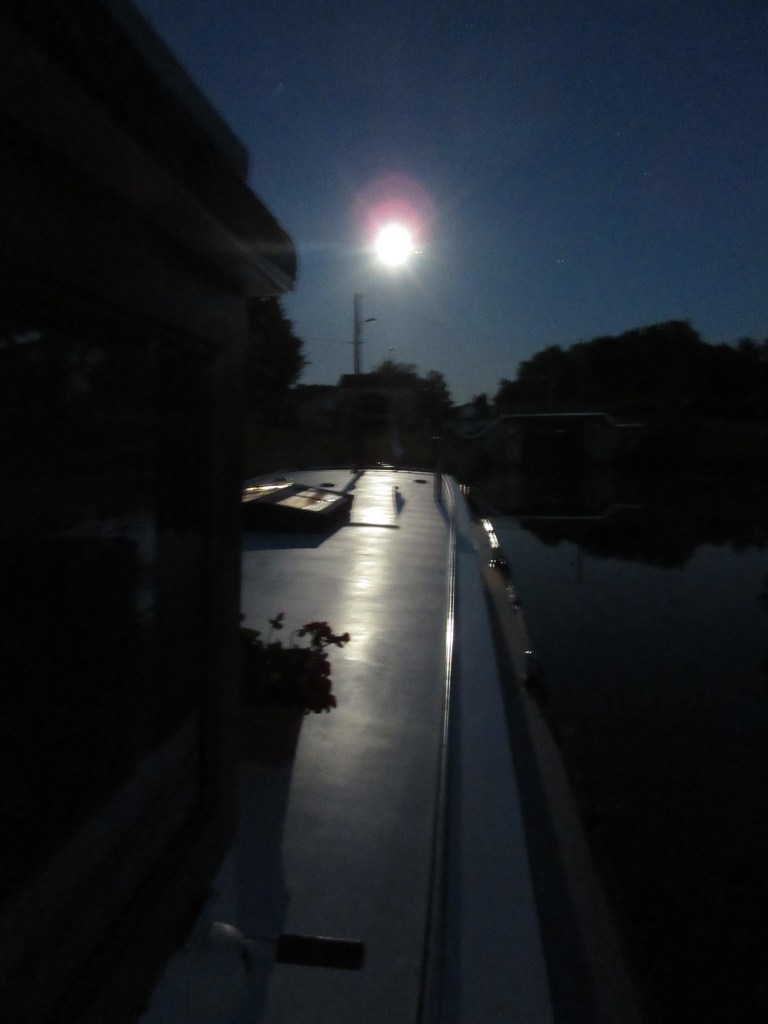
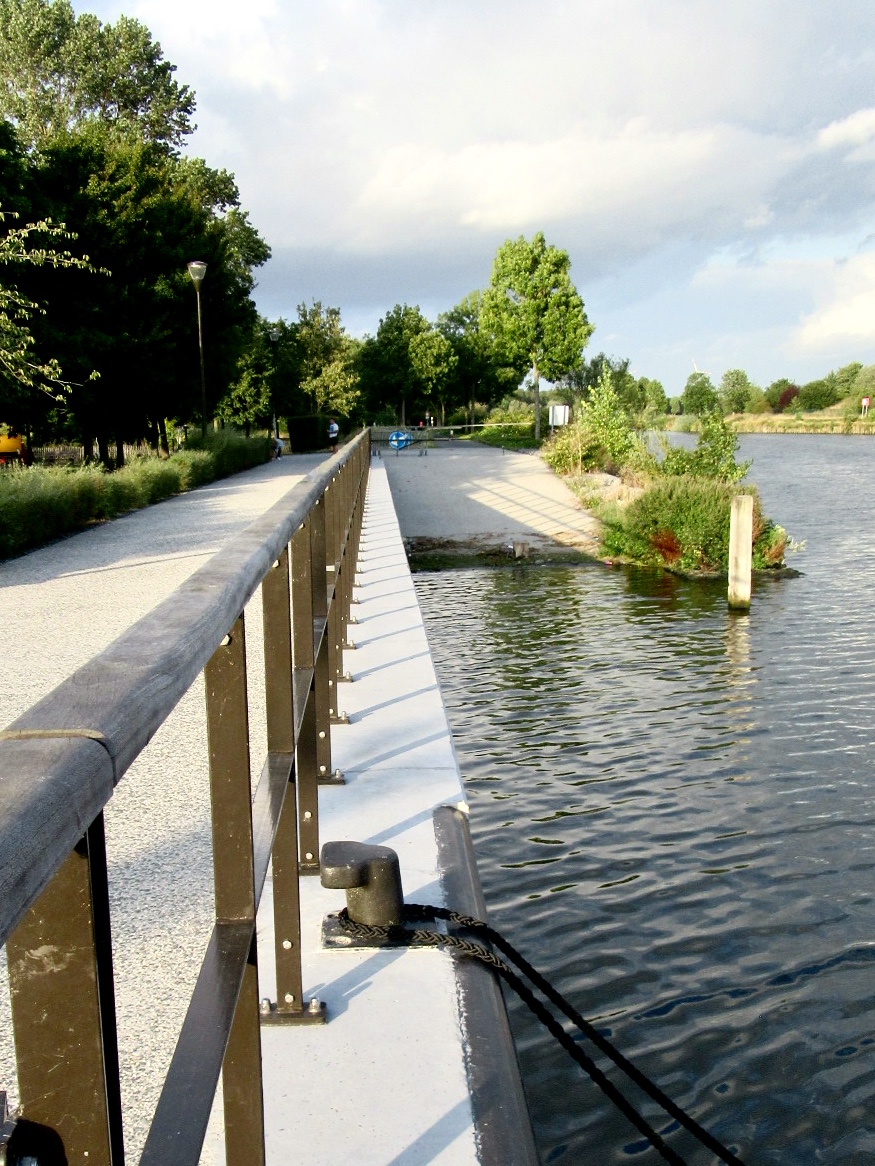
Later, as I sat up waiting for two noisy fishermen to steady down and maybe go home, I noticed the neon lines of the bridge and the nearby lamp post reflecting along our grab rail.
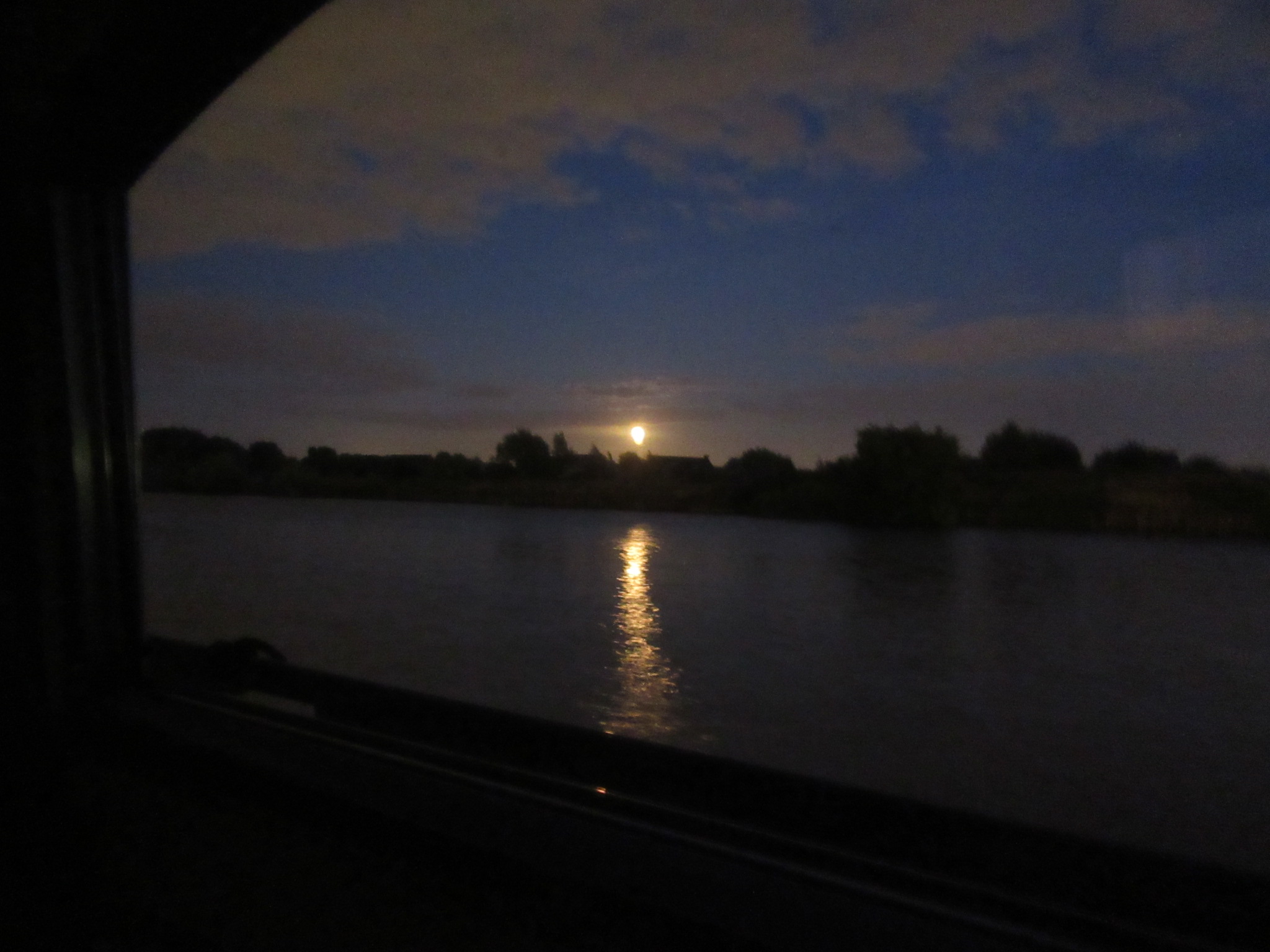
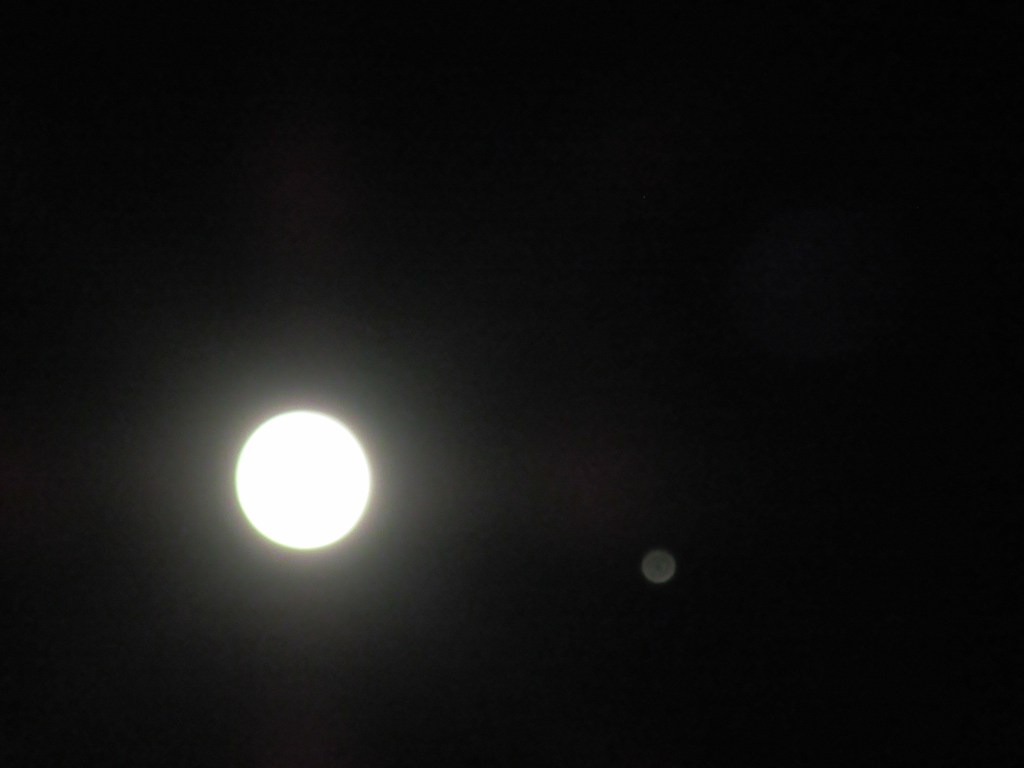
And later still, through the window and still waiting to go to bed, the moon rose across the water.

Next day, Friday, Calliope and crew carried on up the river, at this point still called the Leie as we were mostly in Belgium, and still mostly in Flanders. But as we continued we found ourselves moving between France and Belgium, Wallonia and Flanders. The border follows the north bank of the original course of the river, but due to a series of man made deeper wider sections, to accommodate commercial craft, boats now weave between the two countries. Thanks to the EU there are no customs posts, tariffs or passports required!

It was fascinating to see the very different church and town hall spire and dome shapes along this journey. I show here those from Comines (the French side) and more will follow. Much of Comines was rebuilt between the wars and this colourful church and more austere town hall were built during that time.

The river was still quite broad at this point, but narrowing – wide enough yet for the big commercial barges that would turn off towards Lille at the Canal de Deûle junction. The countryside was peaceful, pastoral, with grazing cattle and horses here and there.

The Deûle to the left and the Leie to the right.

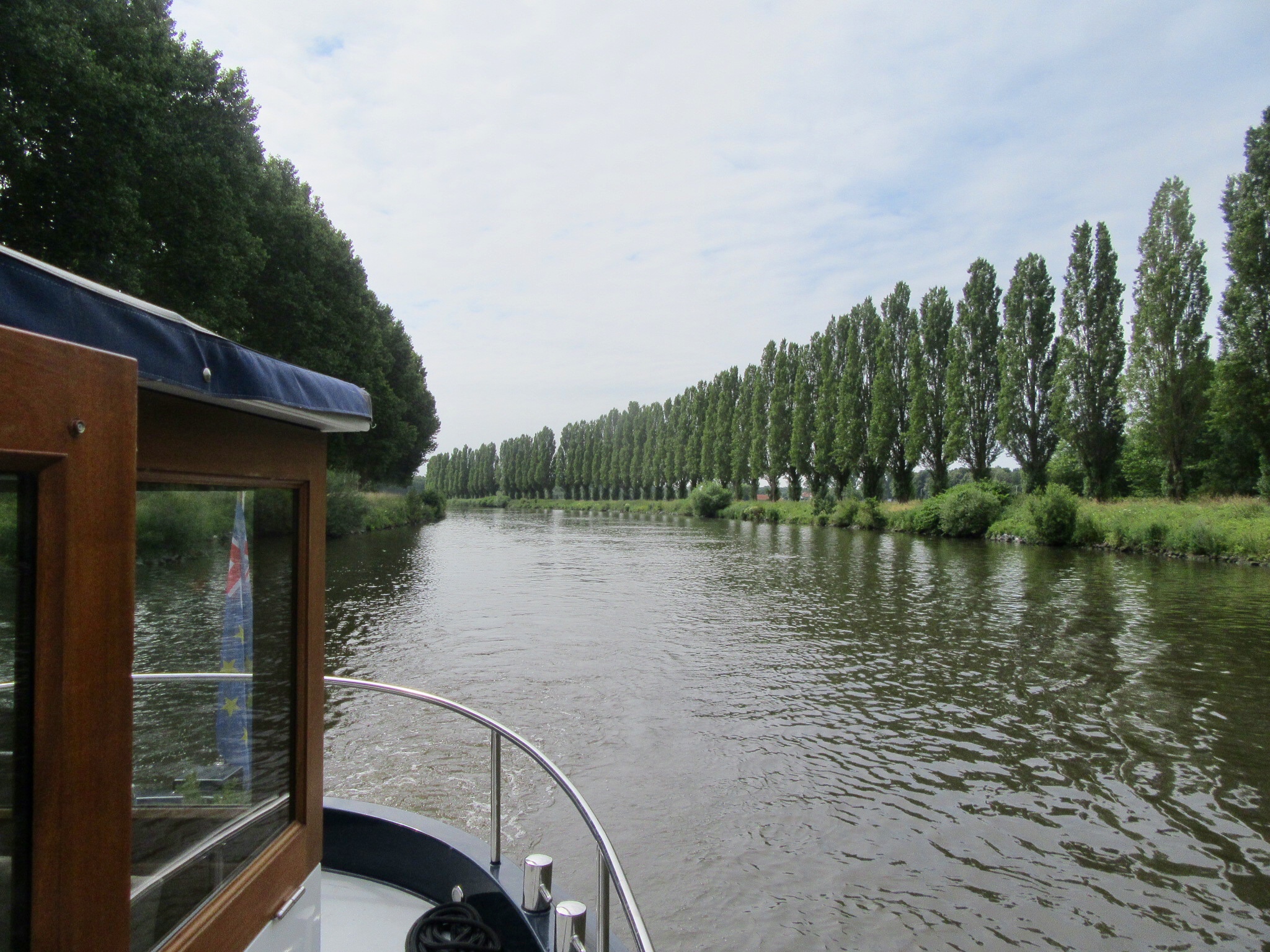
As we turned away, under grey skies, from the more industrial Deûle to enjoy more of the rural Leie we certainly noticed the difference. It became more bendy, more overgrown with trees and bushes at the edges, gently closing in around us.
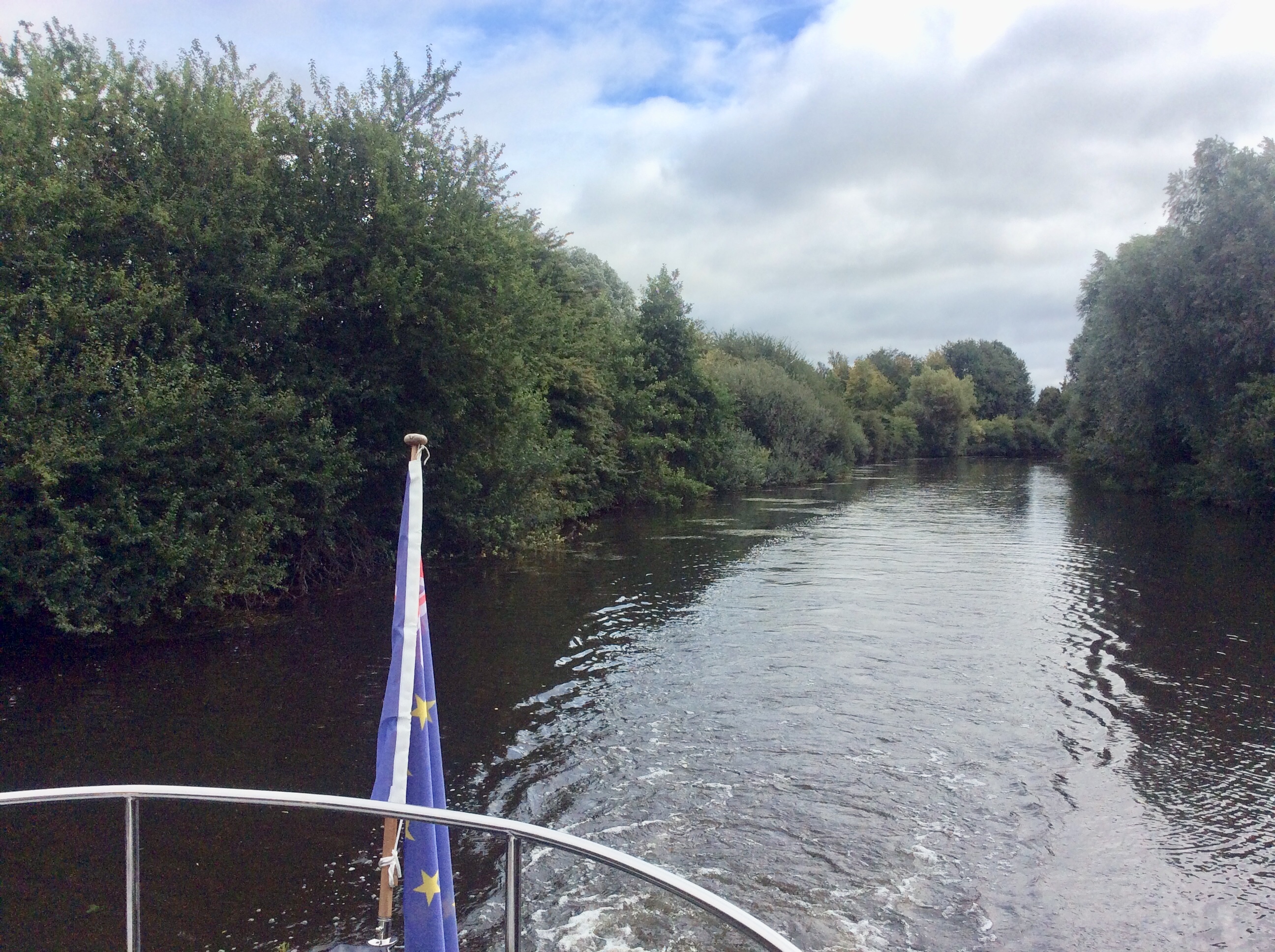
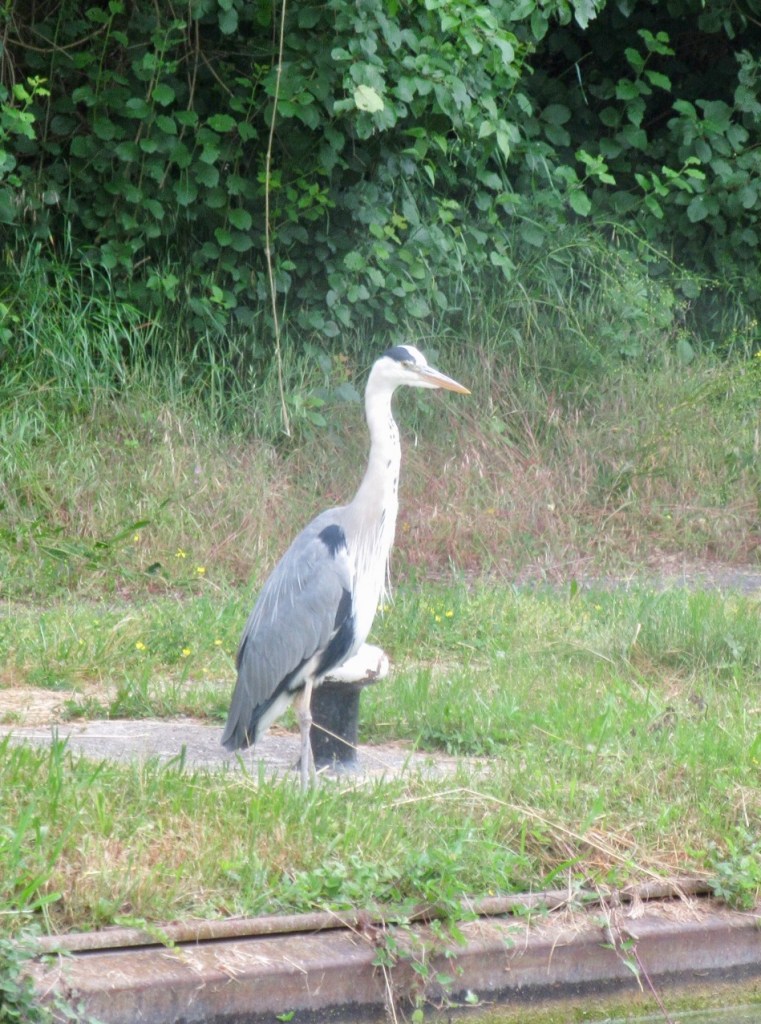
At this point, sort of between the Belgian Leie and French Lys, the river becomes known as the Lys Mittoyenne. It is full of water birds – mostly coots and ducks as usual, but with a good sprinkling of kingfishers (saw them every day), grebes AND little grebes (!), moorhen, heron and cormorants. Sadly none of my photos were good enough to include.

Our aim was to moor at Armentières, which necessitated one more lock just at the edge of the town. As we approached I radioed ahead, expecting to be heard because we had done a radio check at the previous lock. But no response. So I tried the phone, allowing it to ring and ring until it just stopped.
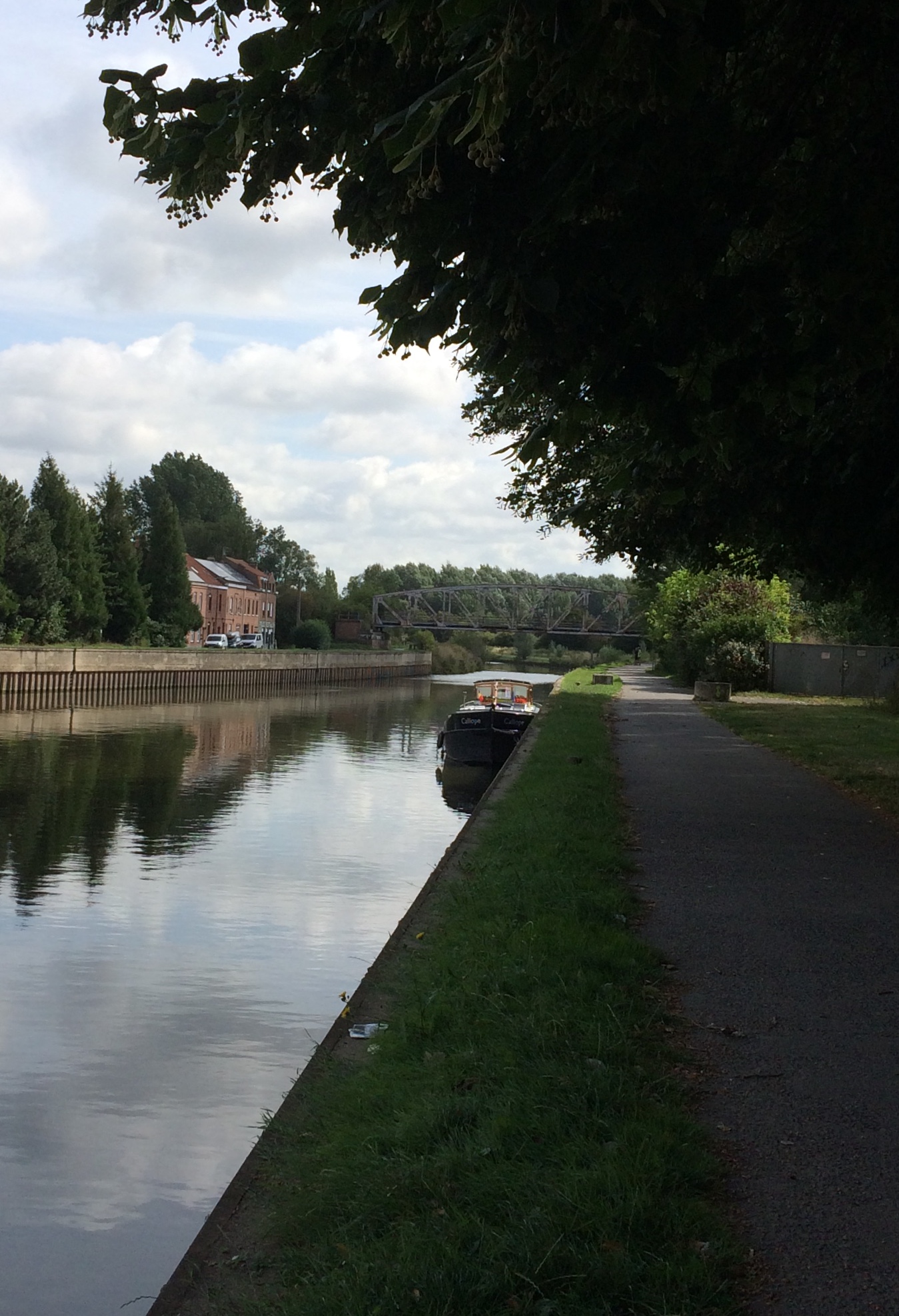
waiting before écluse Armentières

The lock came into view; no lights of any colour to indicate its operating status. Maybe it was a holiday – the previous day had been a French national holiday. Maybe sit was a strike day. With some difficulty we managed to moor to a bollard and a very narrow ladder. I climbed out and walked to wards the lock to enquire.

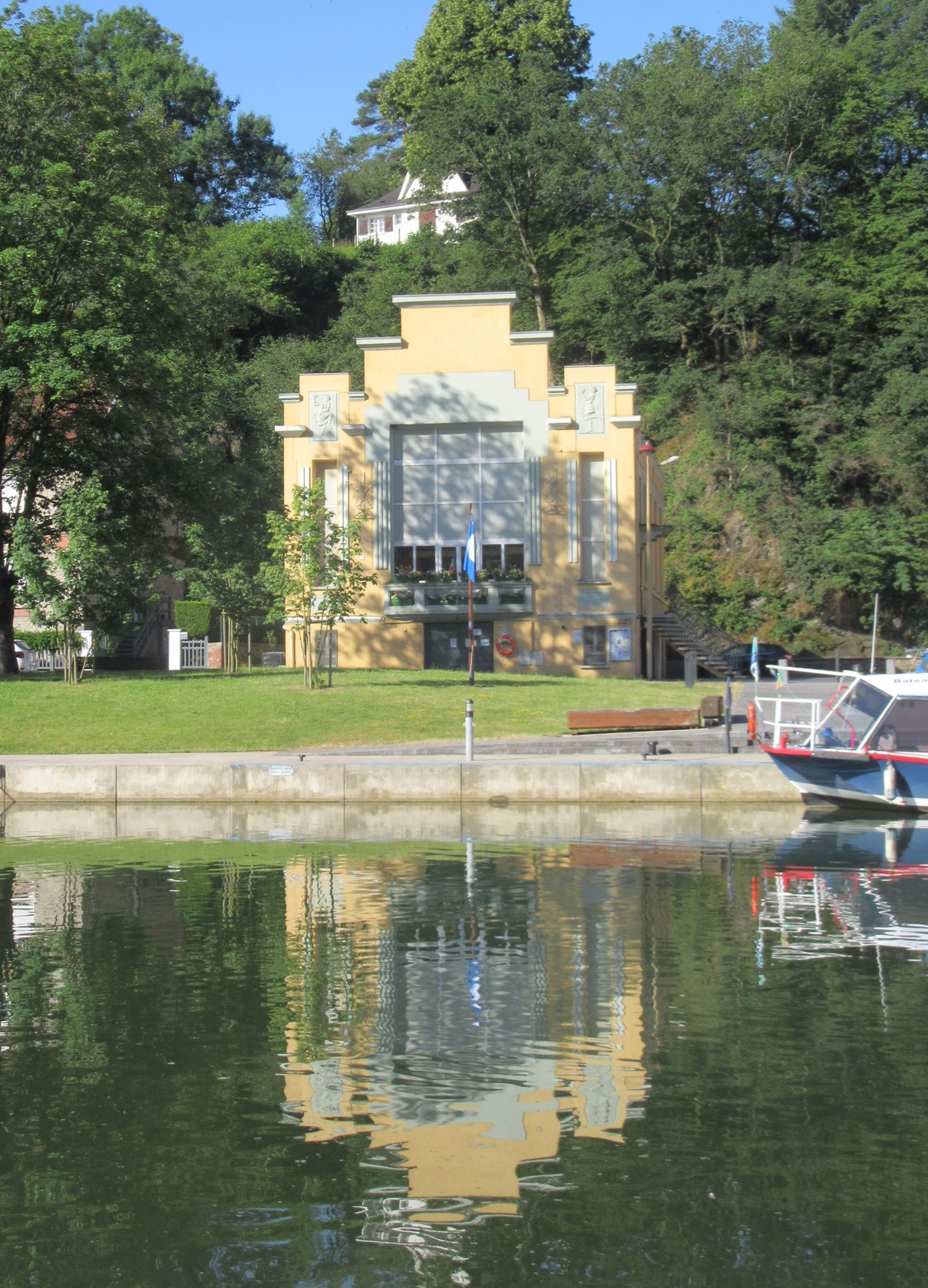
This jolted the young girl holiday-job éclusier into action! The doors began to open and I ran back to the barge to join the Captain for the run into the lock space. The lock and weir buildings must have been rebuilt between the two world wars, such is their beautiful art deco design.

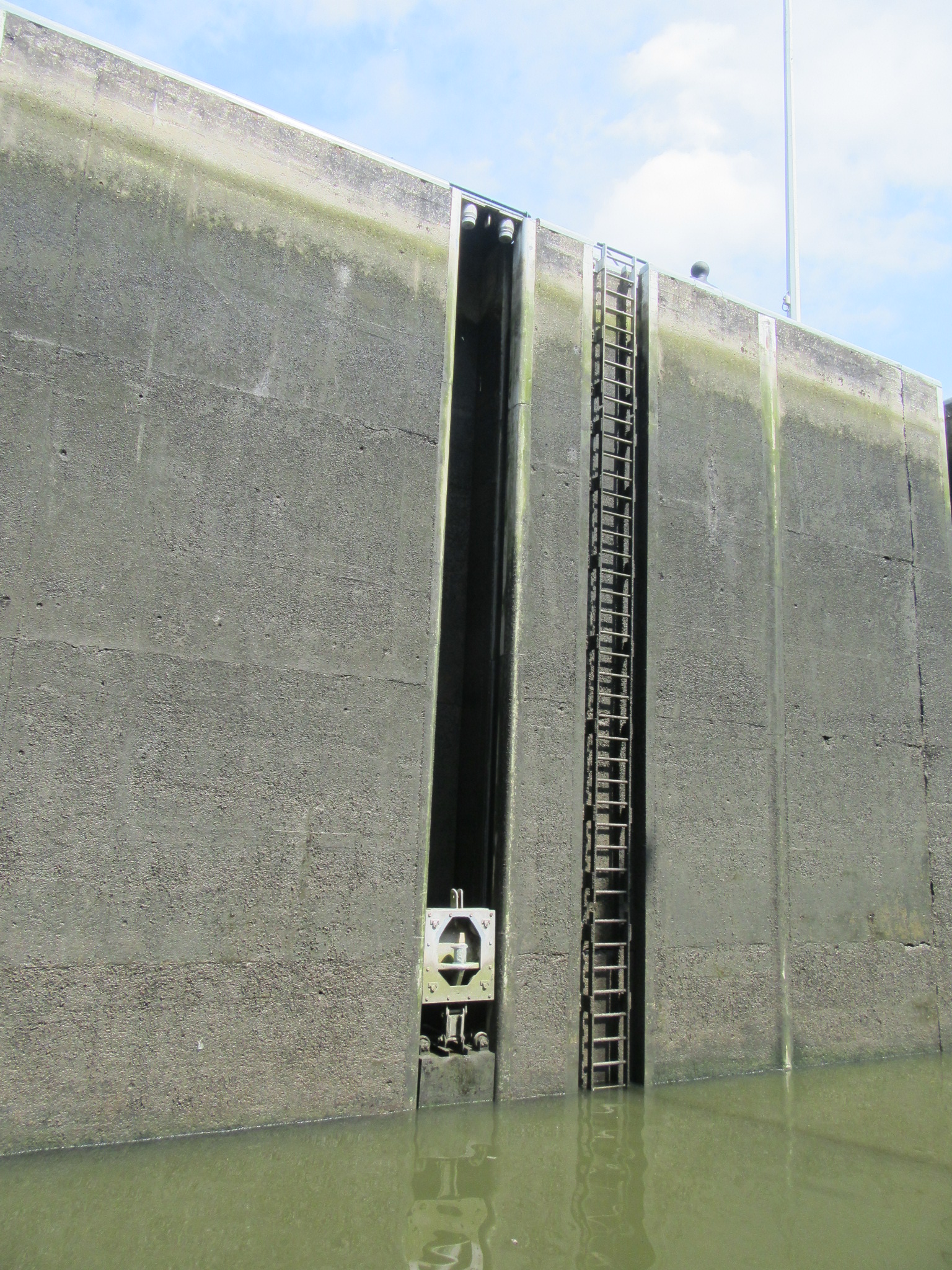
And we were also jolted – into a reminder of the size of ‘narrow-gauge’ locks! All went well and we were handed a zapper to use on the next lock, then hand in at the subsequent one. It was to be a short electronic journey.

The hoped for pontoon mooring was empty and waiting for us, so within a few minutes we were tied up, re-fendered, and getting our lunch together.

Our customary walk round the town was a little on the dull side – sorry Armentières. Then town was one of the many that was devastated in both world wars and despite a few monumental buildings remaining (mostly banks) the town somehow seemed a bit down-at-heel. To be fair there were nice flower displays everywhere to brighten it. A fair ground to enliven things also spoilt my view of the town hall! (And in the way back down stream I caught the big Friday market all across the space.)

However the people were friendly and that is what counts most.
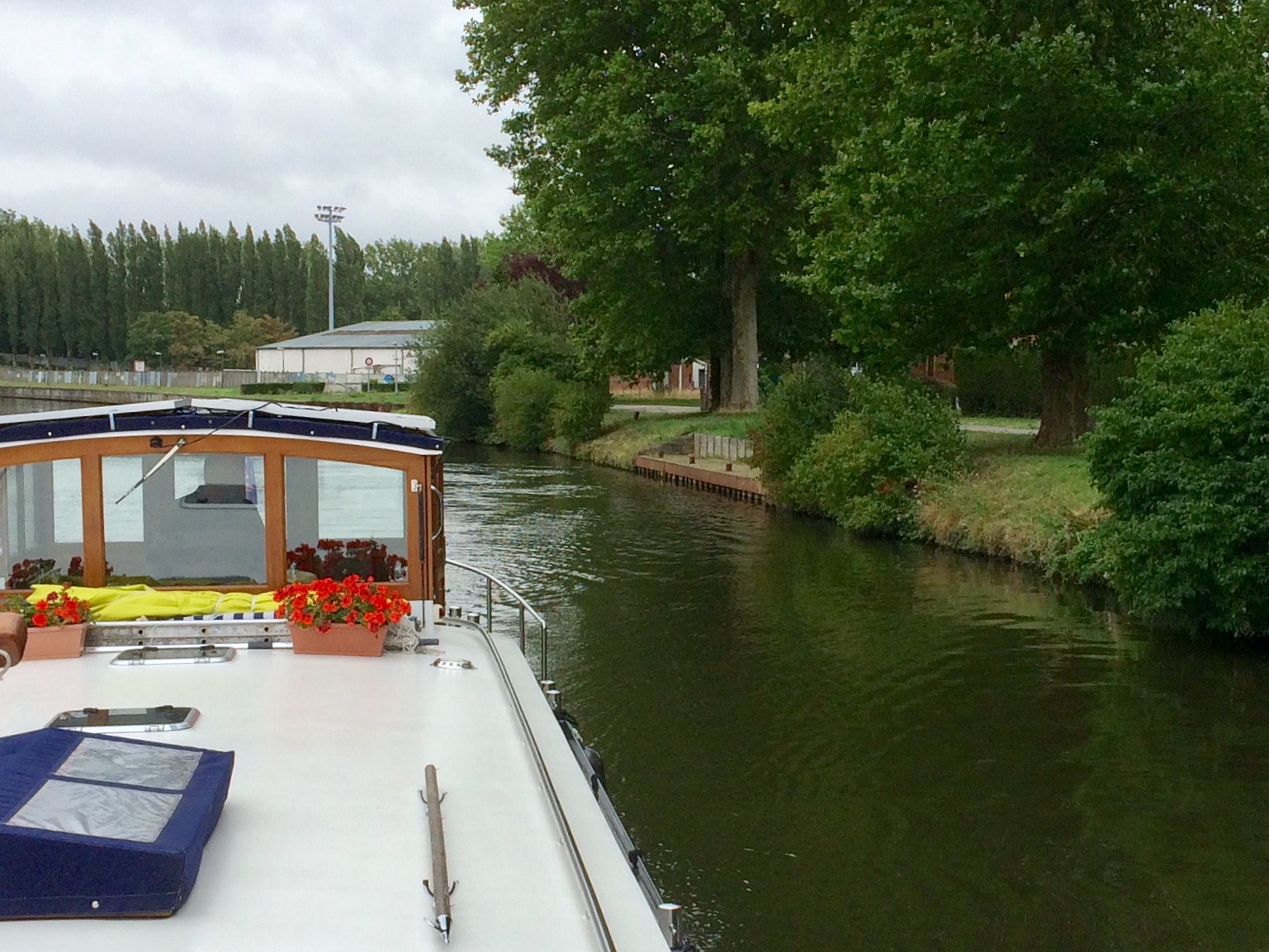
leaving the pontoon at Armentières

Next morning, after a rapid walk to the boulangerie and back (ha! we are back in France!) we left the mooring and were ‘Westward ho’ on another grey drizzly day. Is this really August?

As we left Armentières we could not but help notice a monumental set of buildings – the old malting and brewery of Motte-Cordonnier. There has been a brewery on or near this site since 1650 so it was with great sadness that this one closed on the 1990s. However the Family Motte have recently decided to start brewing again. For this keen to know, here is a link, in French, to their endeavours. I wish them Bon Chance.

We soon reached Bas Saint Maur écluse and used our tele commander with aplomb!

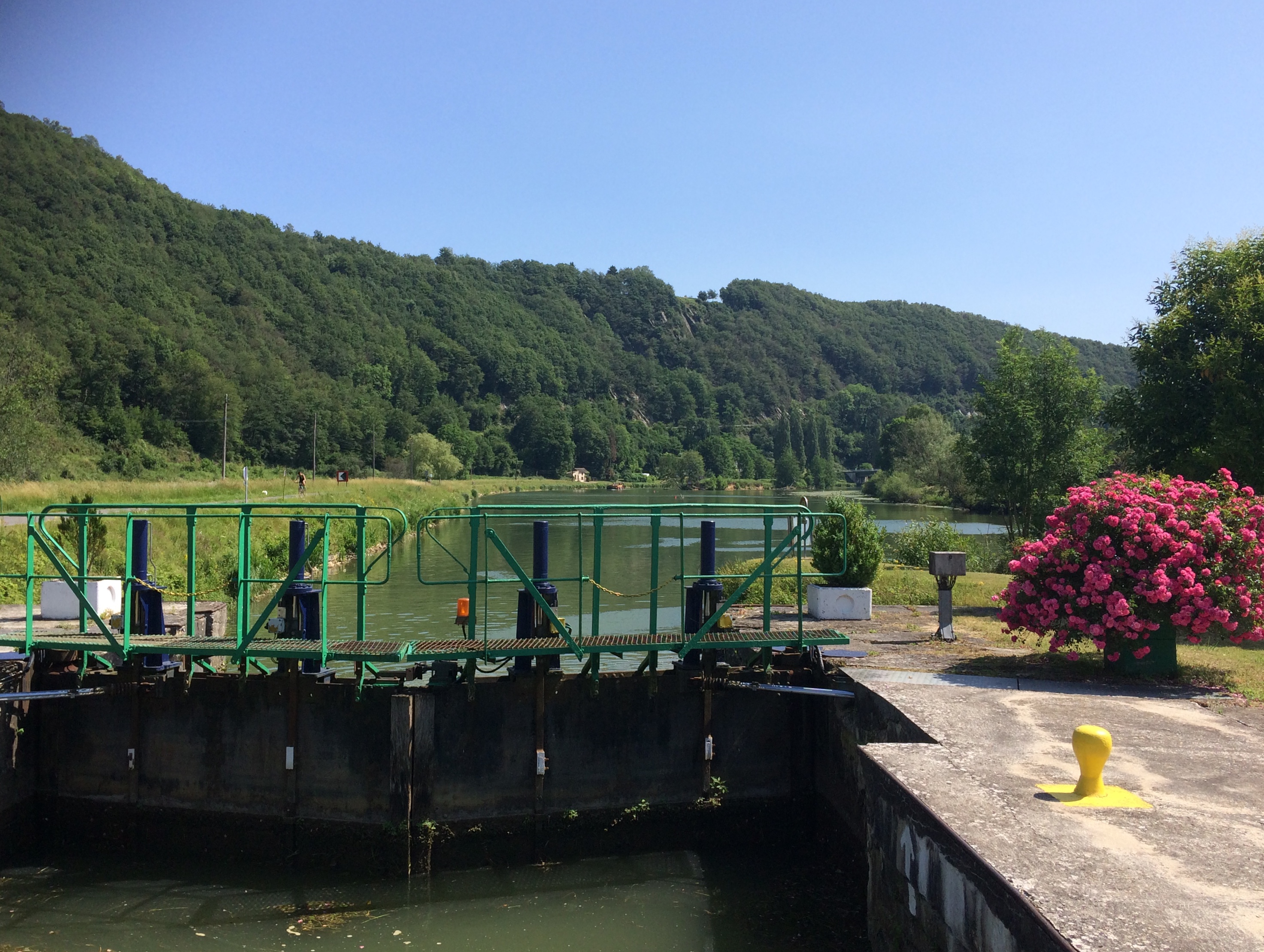
The lock was a ‘massive’ 60cms rise, in a very pretty location with plants and trees adding to the landscape.

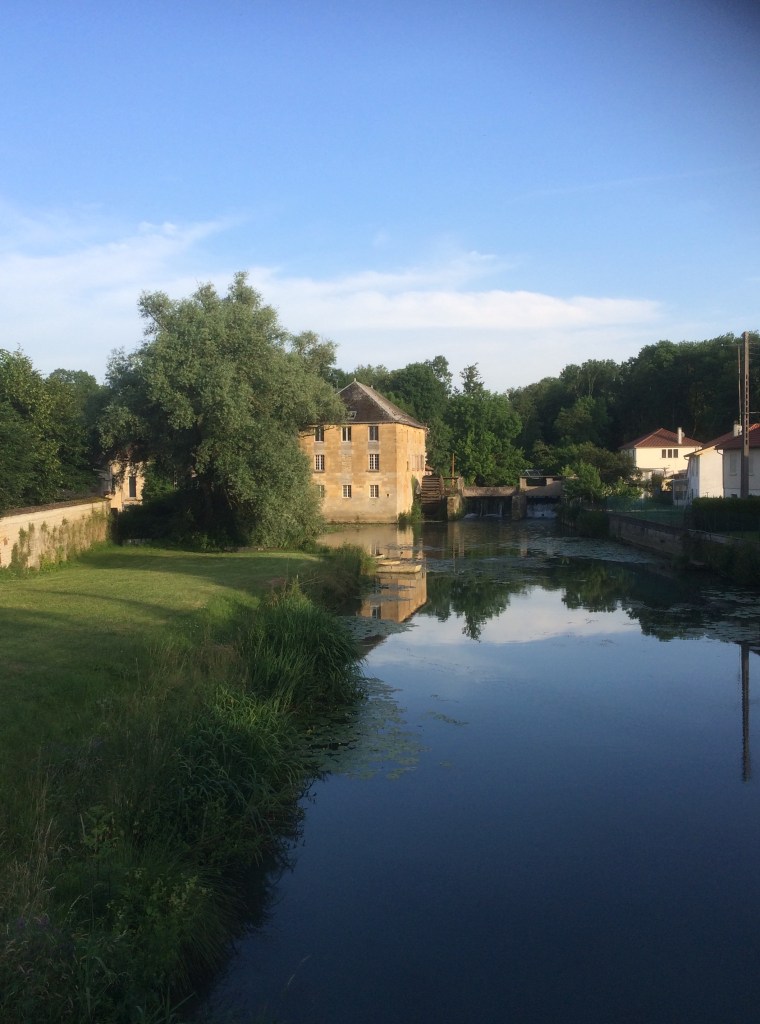
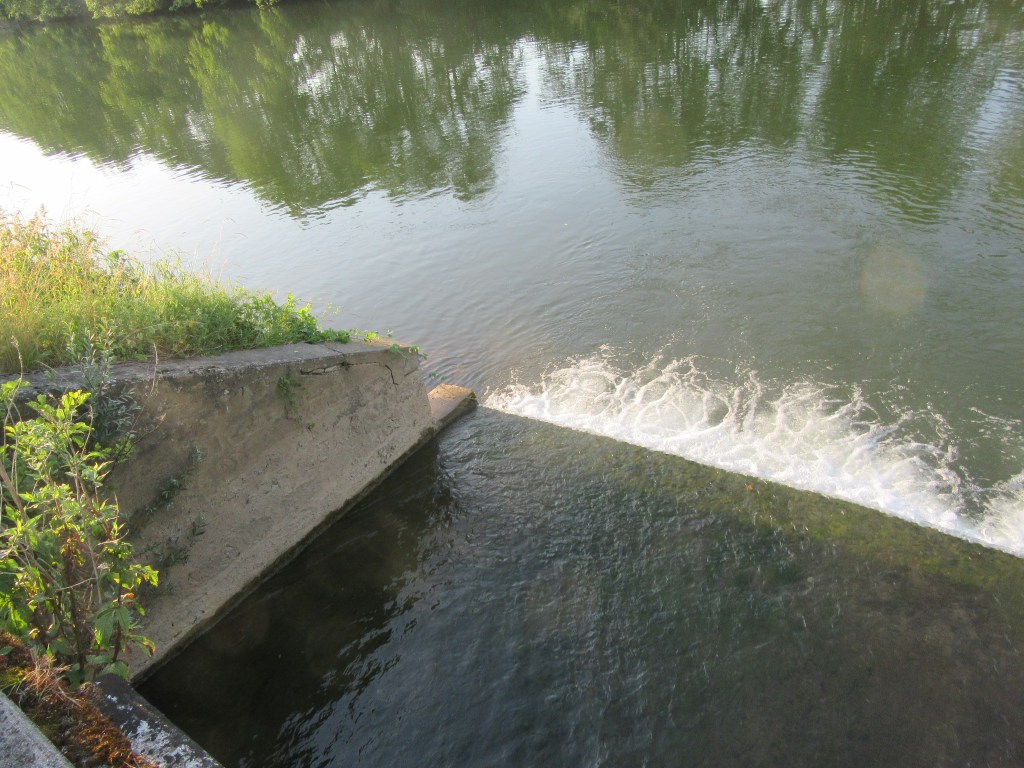
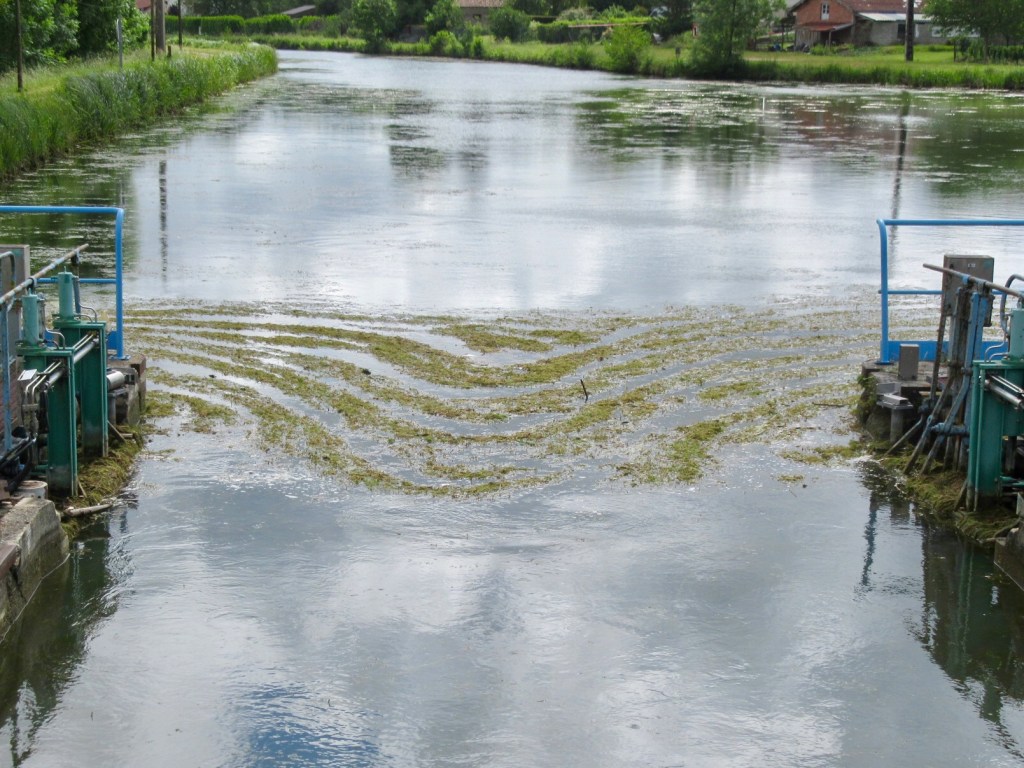
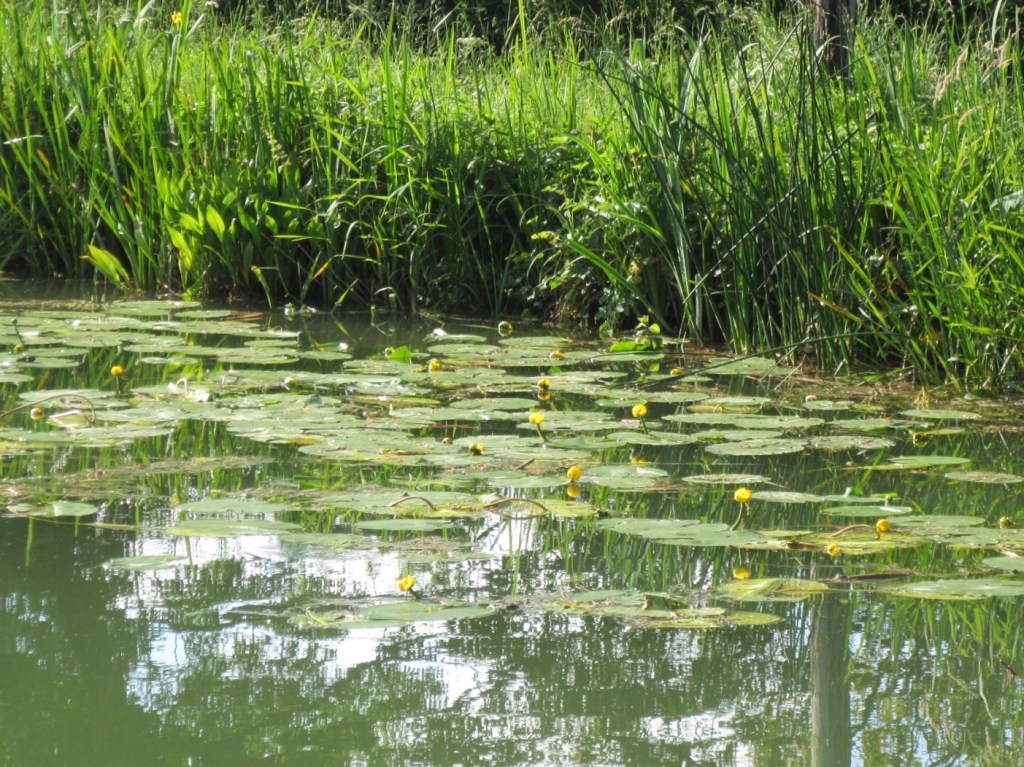
Immediately above the lock there is a pond leading to the small weir that managed to be incredibly photographic, due to some old wooden posts, lucky repflections and calm waters. (Remember this scene – it recurs later).

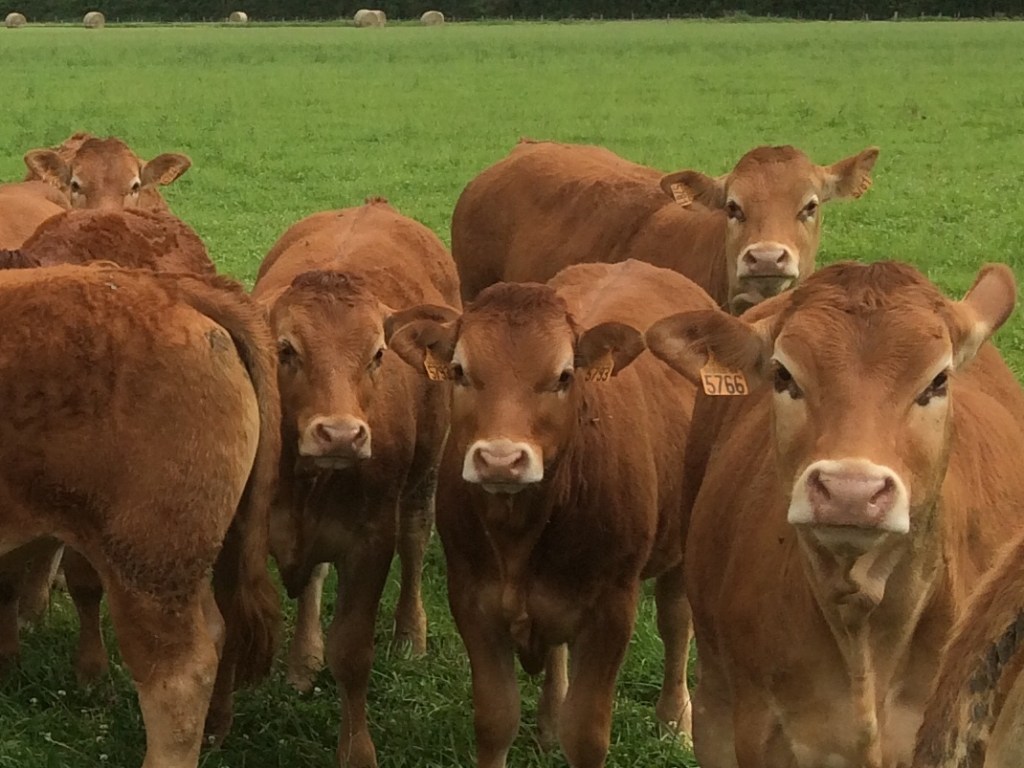
Farmland took over the landscape, mainly Charolais cattle probably for beef. The French are proud of their Charolais beef. I loved the big ol’ bull lying at the front of his herd, watching out for danger while his cows and calves fed, slept and played.

On an animal theme, I continuously and hopelessly take photos of water fowl and their your – moorhens, coots, crested grebes, ducks, little grebes, herons, swans ….. and all are out of focus because we are moving along! Grebes are also notoriously shy, diving under water the moment a camera or human eye turns their way. Anyway I caught one grebe as we were waiting to go into the lock and I was hiding behind the gunnel. Hooray.

arriving in Estaires

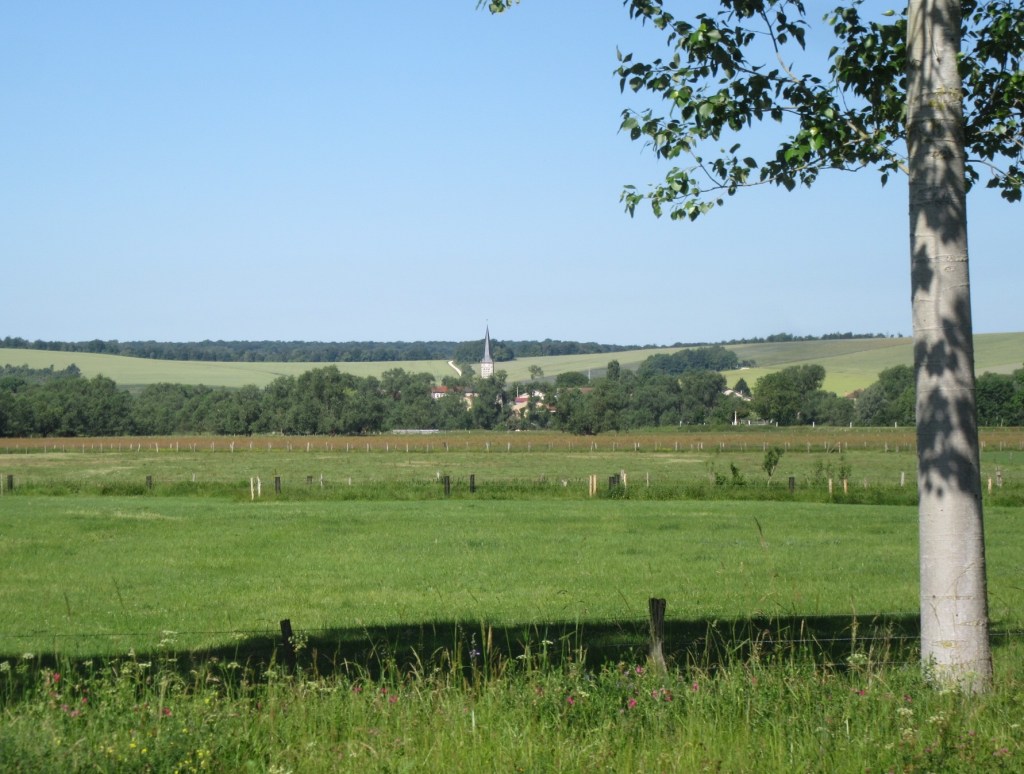
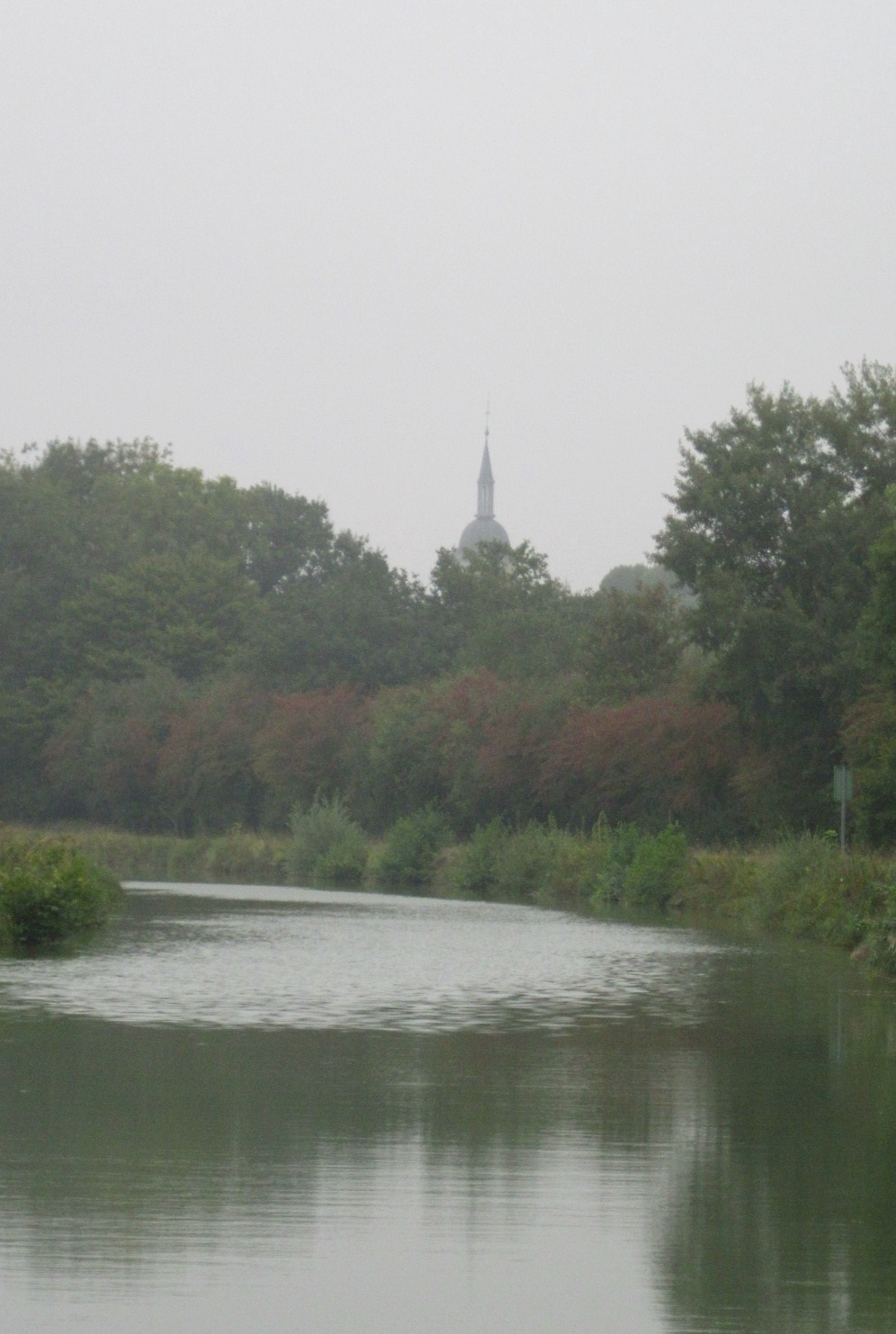
We reached Estaire and its 30m pontoon soon afterwards. As we were heading towards the town we noticed an amazing white steeple to a church in the distance way off to the right, and were amazed to find that after the bends and turns of the river our mooring was literally in the shadow off the said church – but white steeples against grey skies do not make good photos.

But on the way back blue skies prevailed!
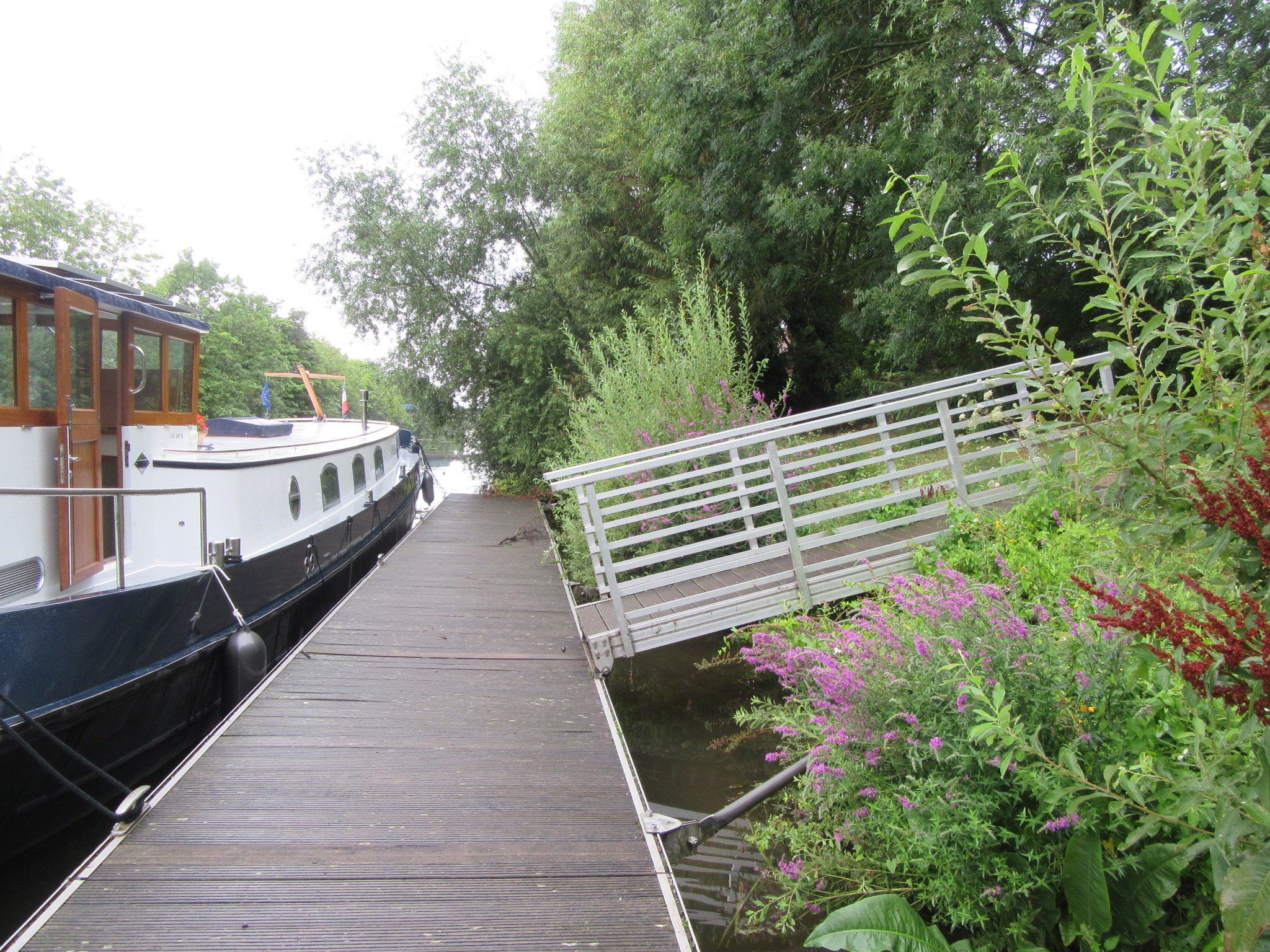
The pontoon seemed quiet at first. It was pretty with lots of purple and yellow flowers along the bank.

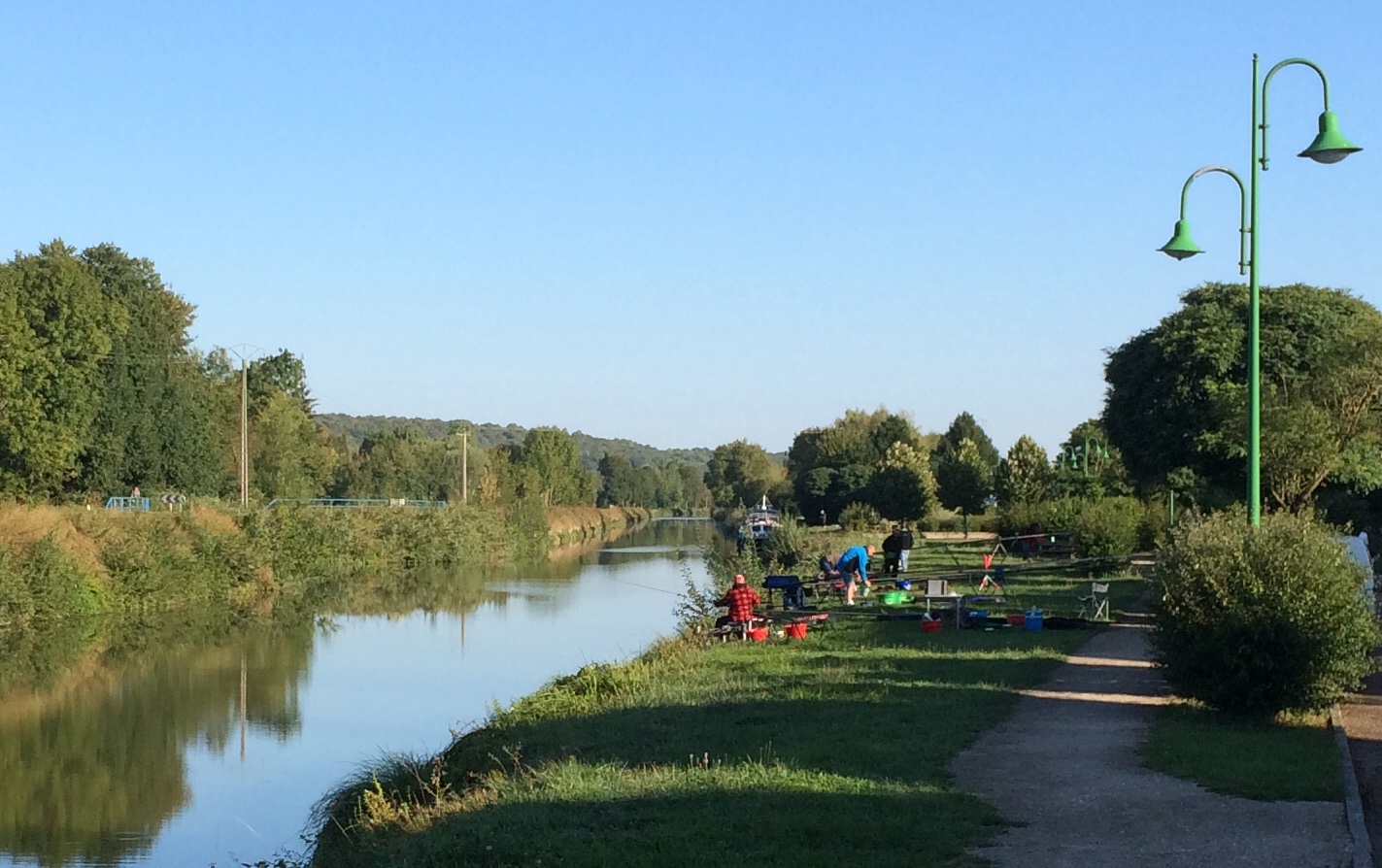
By the time we had finished lunch we had been joined by several friendly fishers, and realised that in a way we were ‘trespassing’ on their usual angling platform. We were all able to share the space happily and several fish were caught.
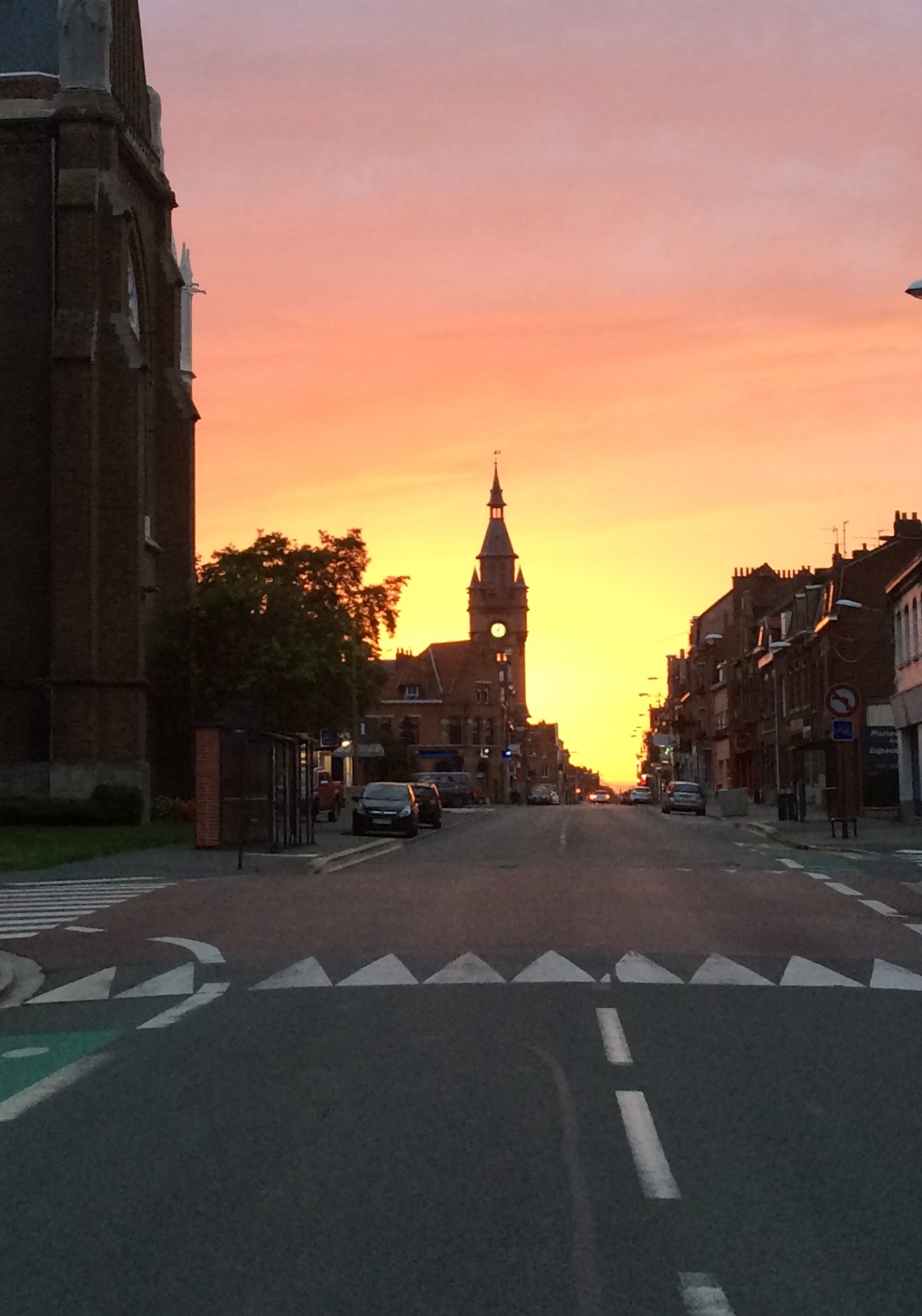
Captain with crew went for a short walk into Estaires. It was a little plain, although we found a pleasant park and three good boulangeries. The town hall played a sweet little carillon tune and when I went for a second walk in the evening it stood out against the golden evening sky beautifully.

There had been discussions about how far up the river we would navigate – would be go all the way to Canal d’Aire and down to Lille, up the Deûle and back to Kortrijk? Or get as far as Saint-Venant and turn round? The latter plan won, especially when we got to Saint-Venant and saw how nice it was!

Not far out of Estaires, and expecting to be in the country, Calliope passed a huge chemical works of some kind. I googled them – a company called Roquette – and was amused to discover that their strapline is “Voyage au couer de la nature!” To be fair they are a worldwide company who overall are researching to find more natural ways to produce food, make up etc. And they do transport at least some of their goods away by barge.

Riverside farms

Overall it was a pleasant day’s cruising through flat farming land with plenty of bird life. In fact it ws the fourth day in a row that we saw kingfishers! But I reckon that to get a photo of them you need to be a wildlife pro.

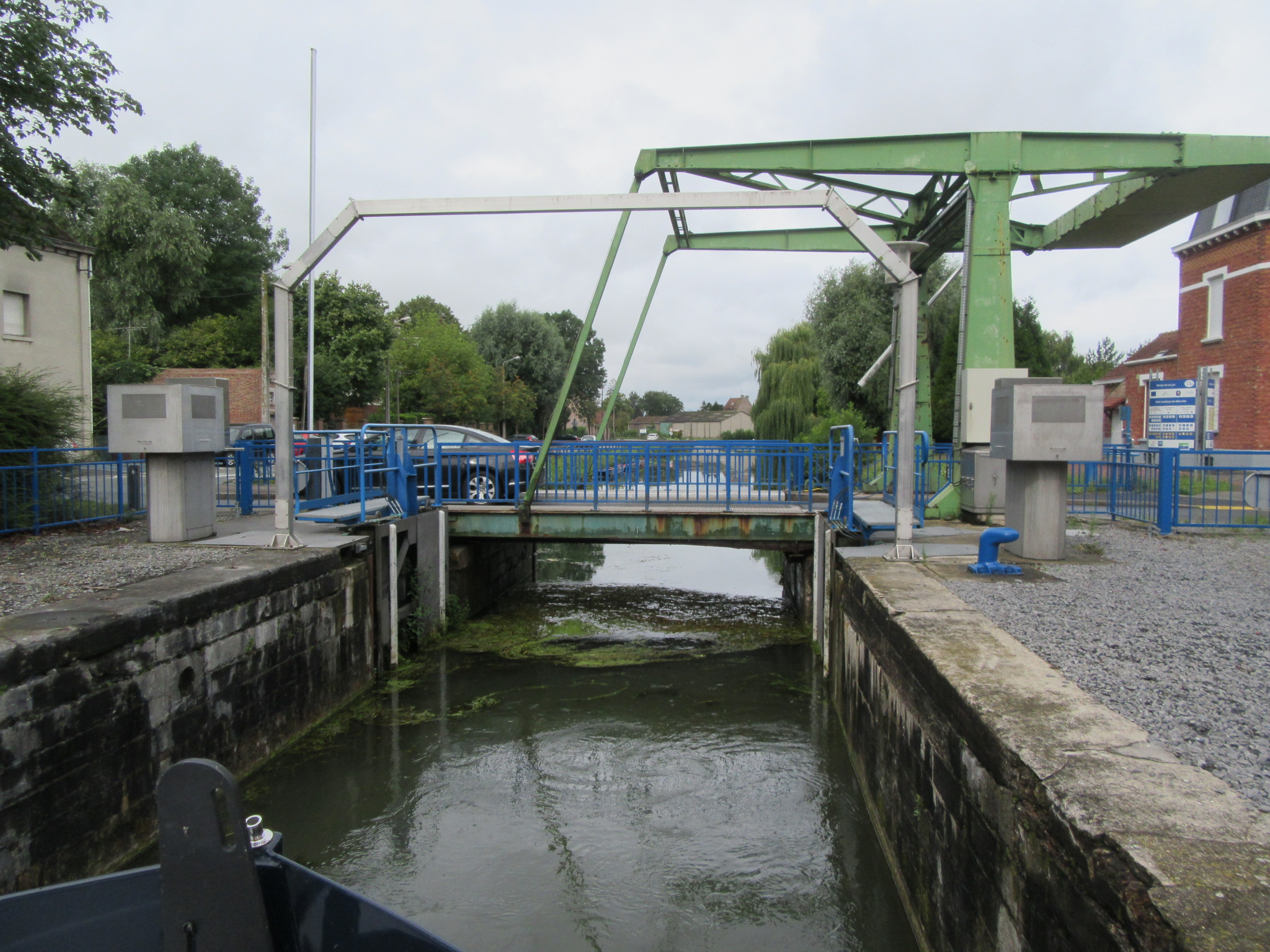
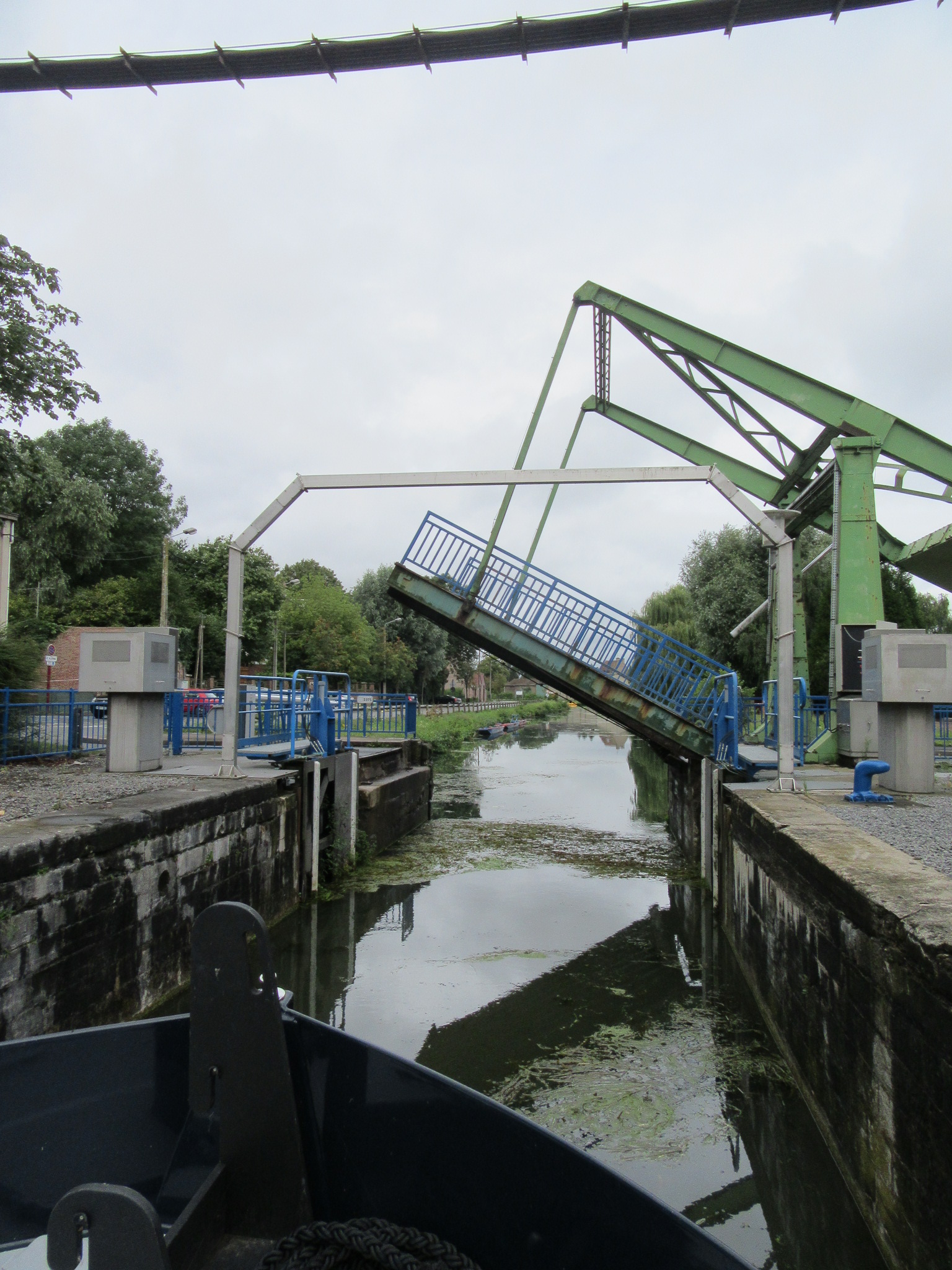
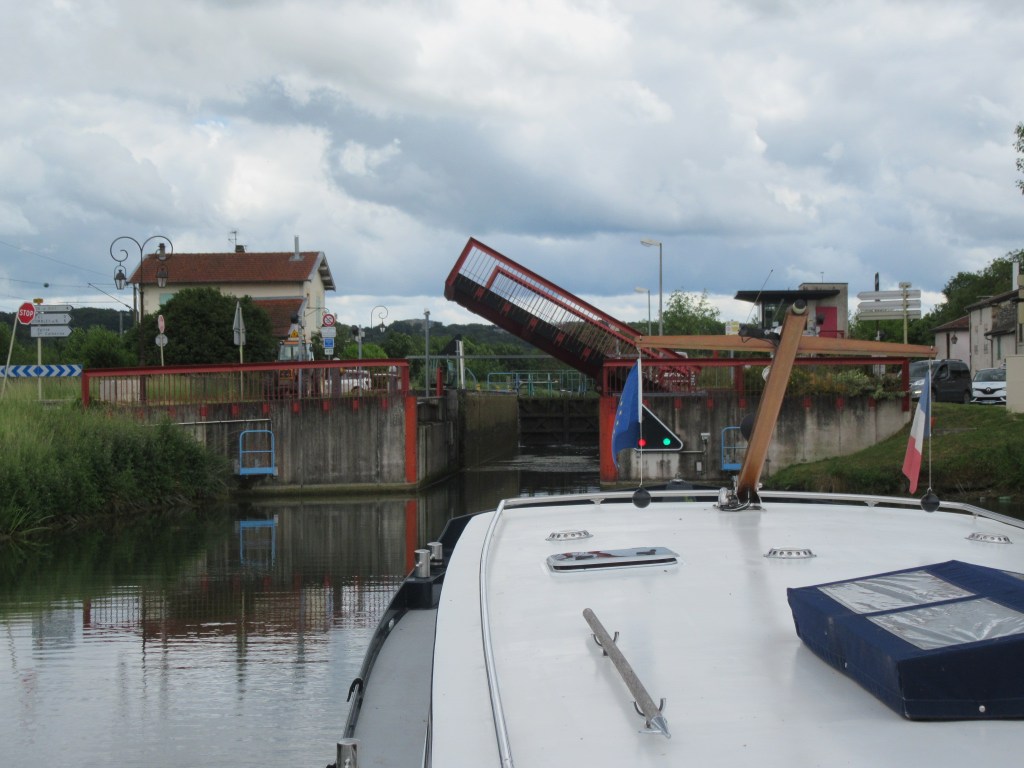
The one uniquely interesting thing along the way was the lock at Merville. We have never seen a lock with lift bridges at either end – traffic flowing one way over one end and the opposite over the other; in fact a whole roundabout surrounded the lock! It meant waiting for each bridge to lift, but we were in no hurry.

Coming up and put of the lock at Saint-Venant was a total and wonderful surprise. We had no idea that we would be entering a wide basin with plenty of room to moor (with stakes) on a long grassy bank, or the option of going into a decent size port de plaisance (although there probably wasn’t room for a 20m barge!)

it’s a long time since we used stakes, but the old habits of leaping ashore holding a lump hammer and two unwieldy stakes still remained deep in my soul and before too long we were safely moored, managing to share a low stone bollard with the boat behind. Lunch came next.

Of course after lunch came the walk round the village. This one has plenty of stories to tell! During WW1 one of the buildings became the HQ of the local British Army, later taken over by the Portugese. There is an ancient hospital, some amazing old barracks, and some rows of cottages at whose previous use we could only guess.

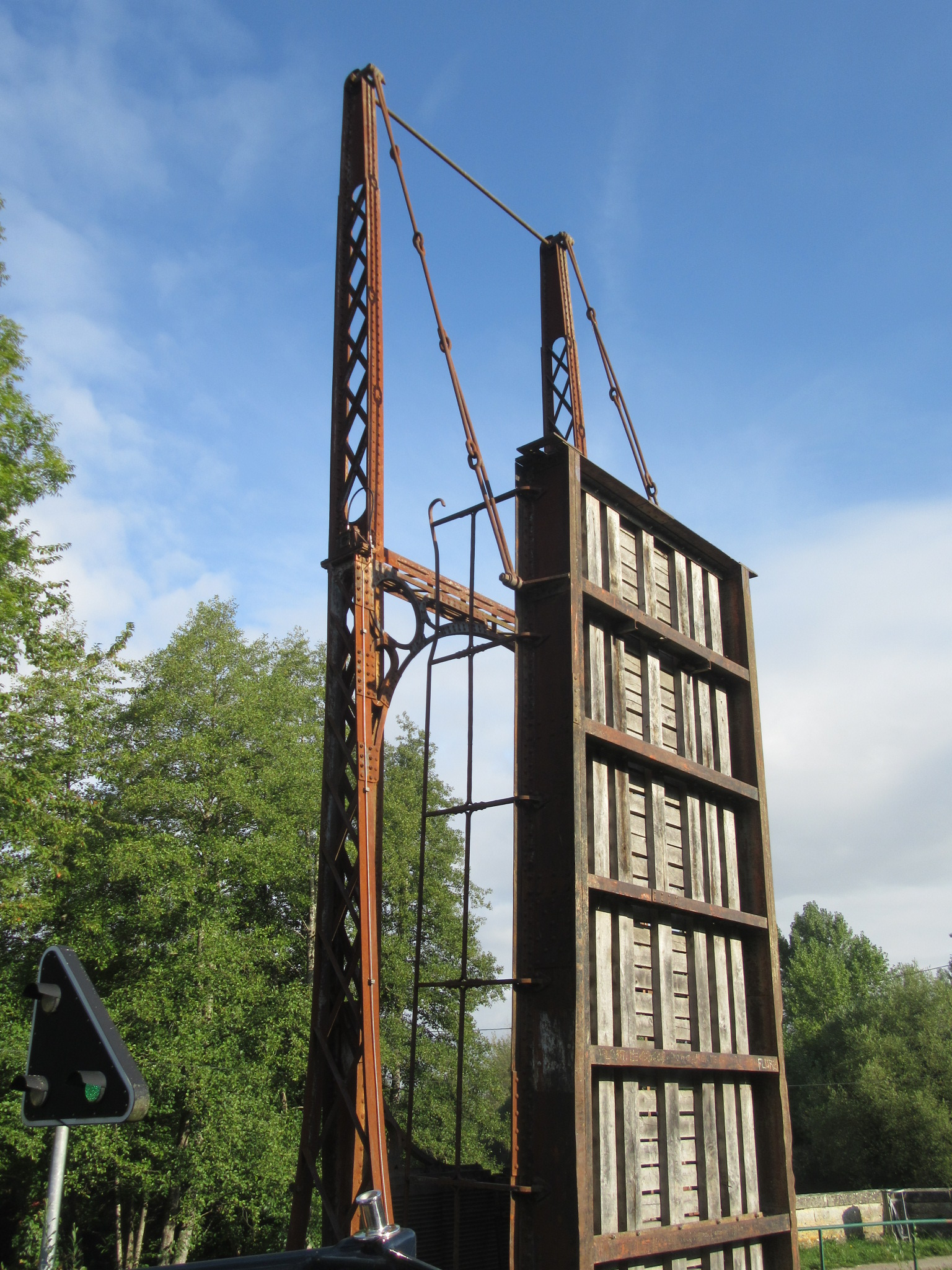
There is also a small basin off the main one which used to have a granary on the wharf side. Now all that is left is an unusual turntable bridge at the entrance, forever stuck on the open position, and dating back to 1887.
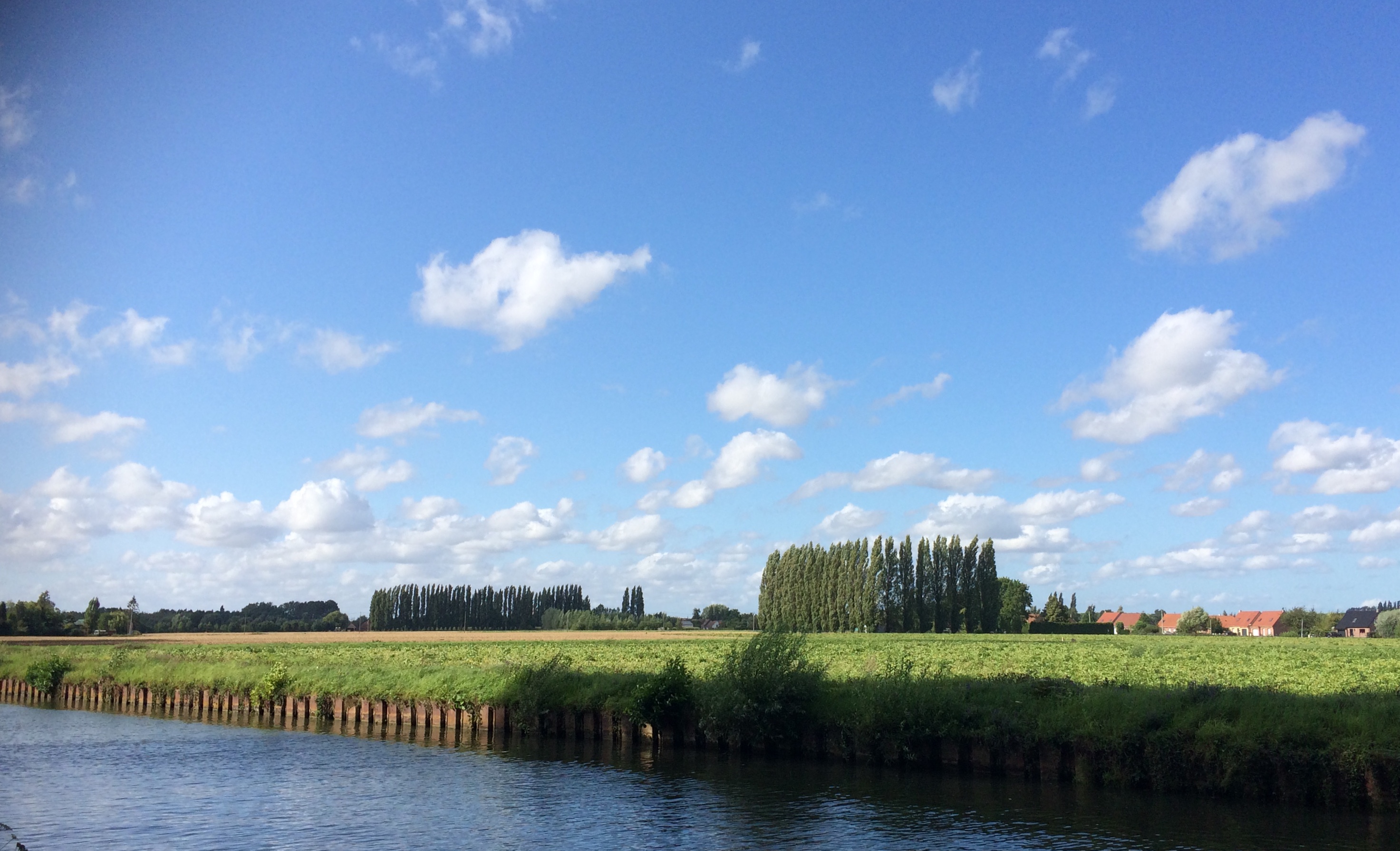
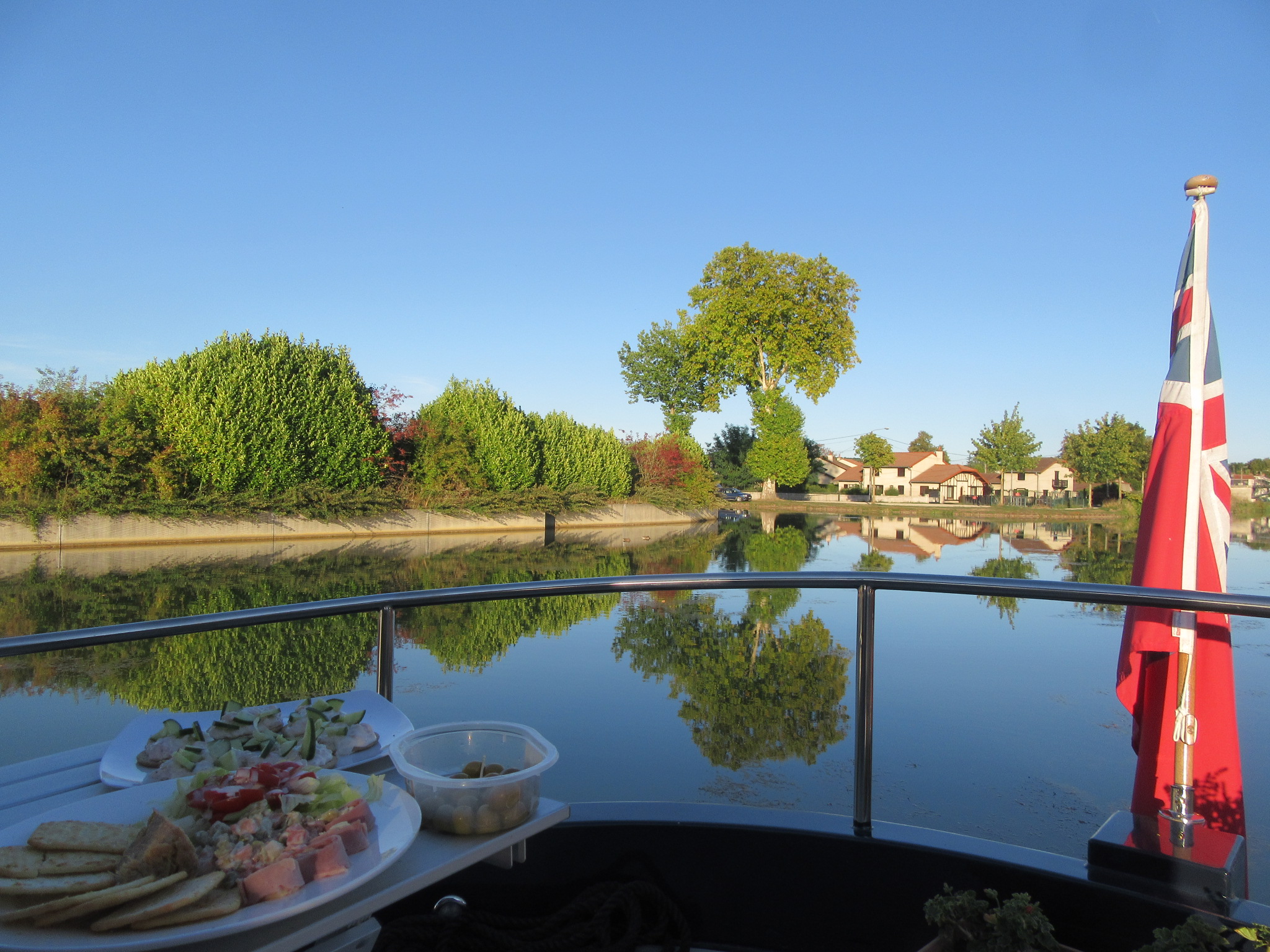
The clouds gradually and completely cleared and the flat landscape meant we had huge skies to look at from the barge.
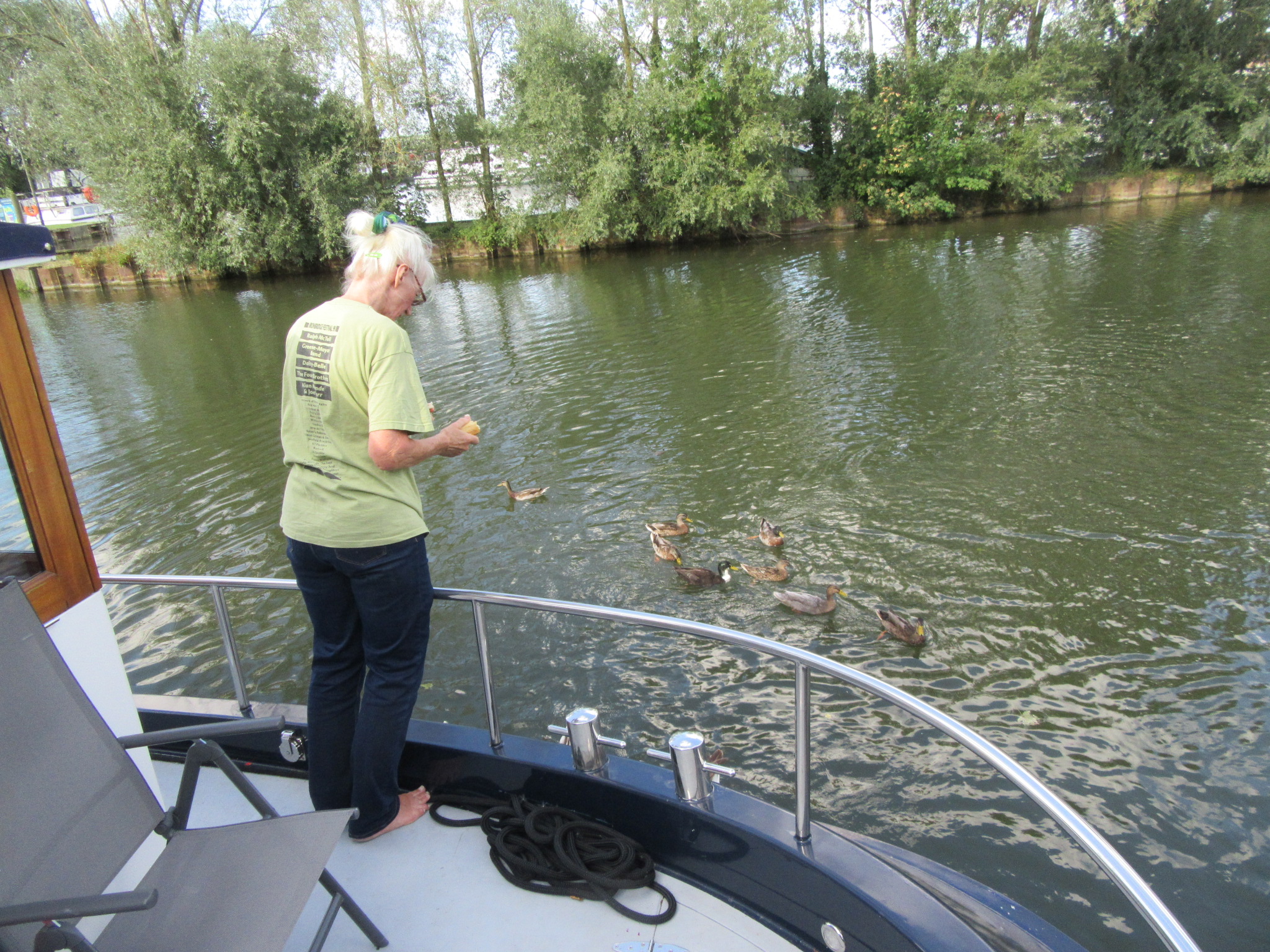
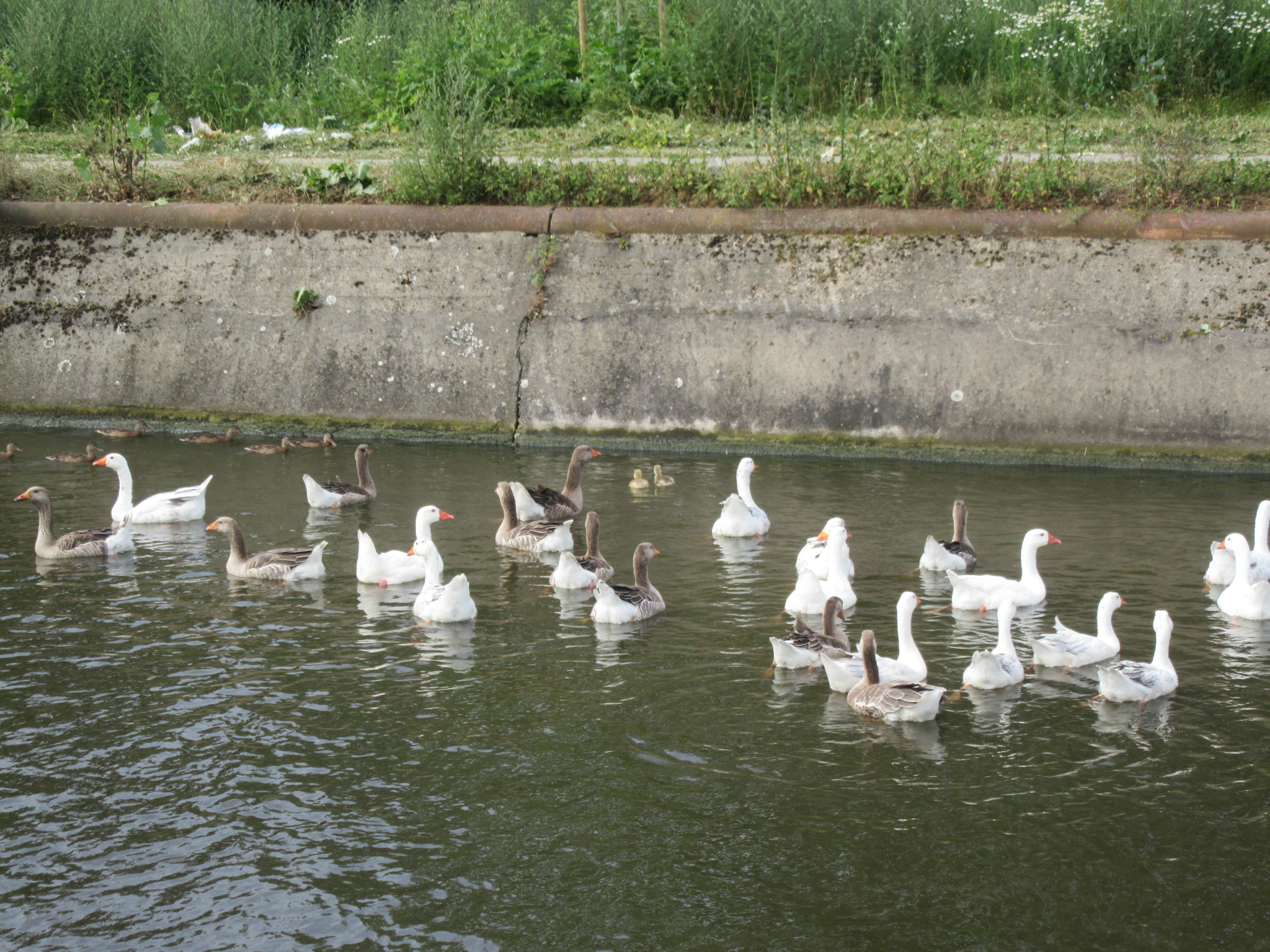
The braver of the wildfowl were all around and I took the opportunity to get rid of some sections of baguette that we had not managed to mop up. Two geese, one Greylag and one Brent I think, had made a love match and were continuously together. A family of swans inhabited one of the many wide drainage ditches dug all over the place.

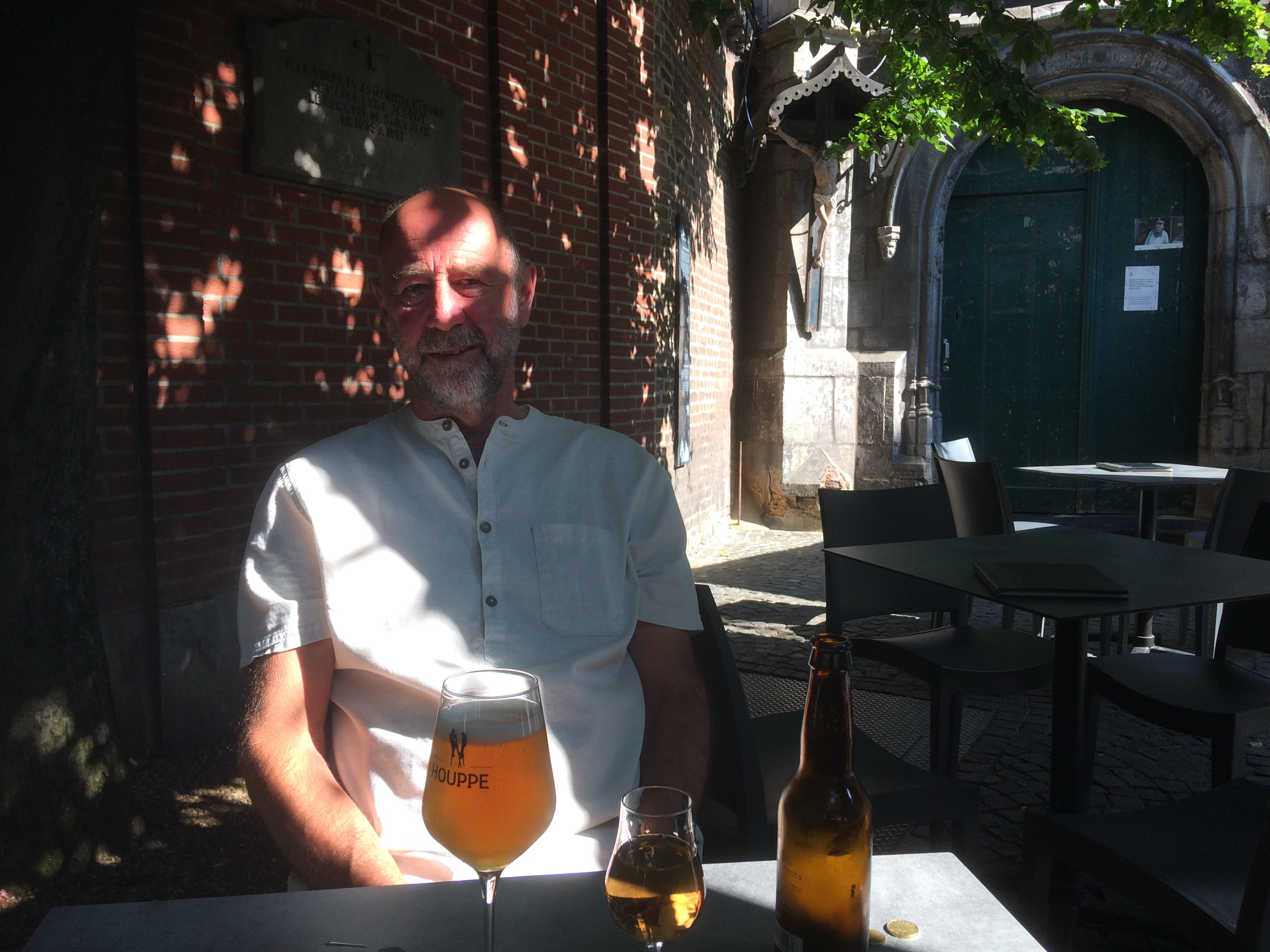
Stu and I had had a walk over to look at the port as well as the village; we had discovered a bar restaurant that seemed to just fit the bill for supper. We strolled over at about 5.45 in time for drinks in the evening sun. Somehow the sun allowed a funky photo of me drinking Kriek cherry beer.
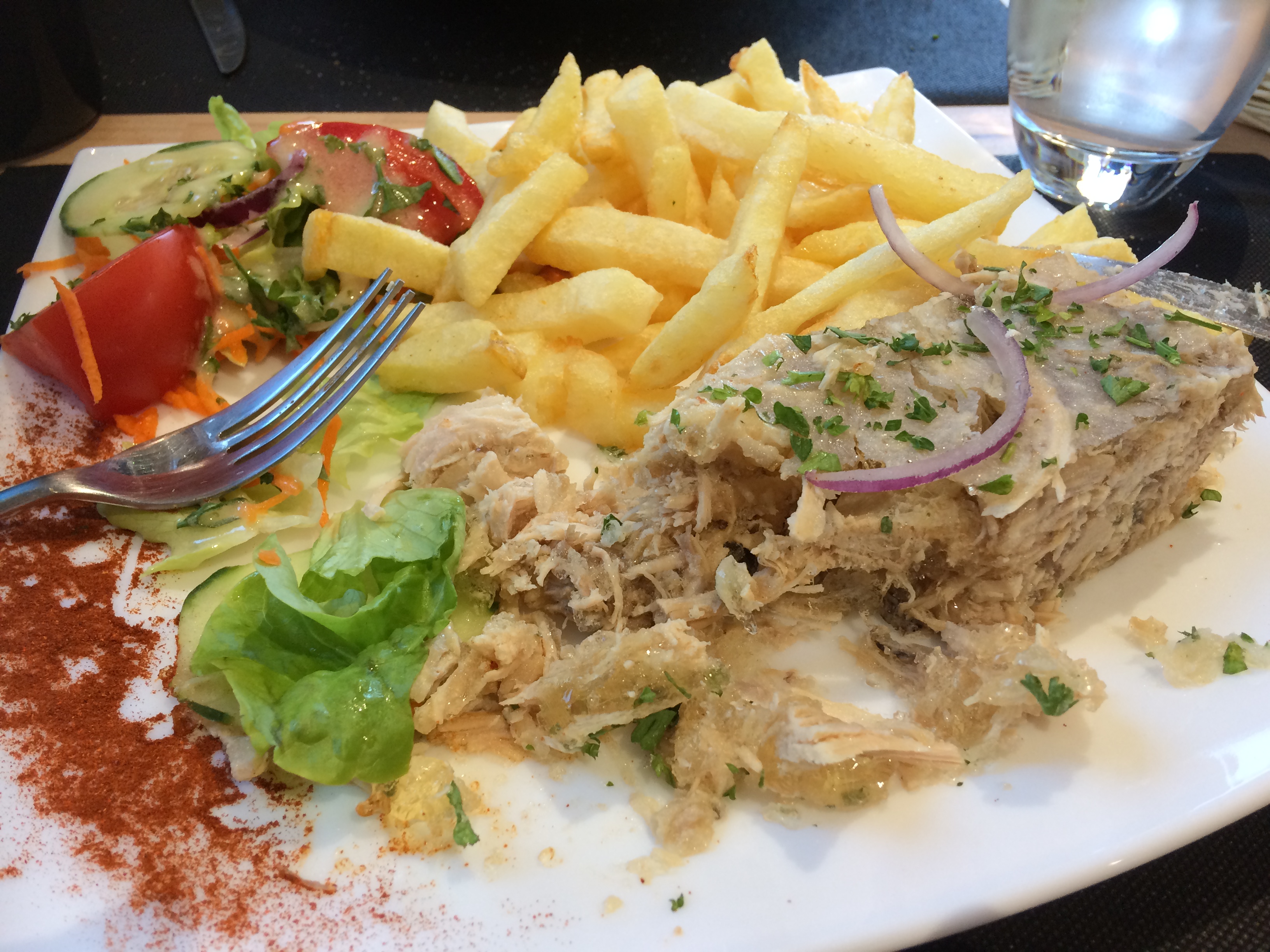
Then the meal; I am a sucker for trying regional dishes. Potj was in the menu and I asked what it was. The explanation was of a mix of cold chicken and pork set in gelatine, with fries. I had to try, and I was not disappointed. I would definitely eat it again m- I think the gelatine was the natural jelly from the bones when cooking the meat – much nicer than aspic.

On the way back to the boat and just before we crossed the lock gates the view of the church, sky, and trees all composed themselves into a nice arrangement for my last photo of the day.
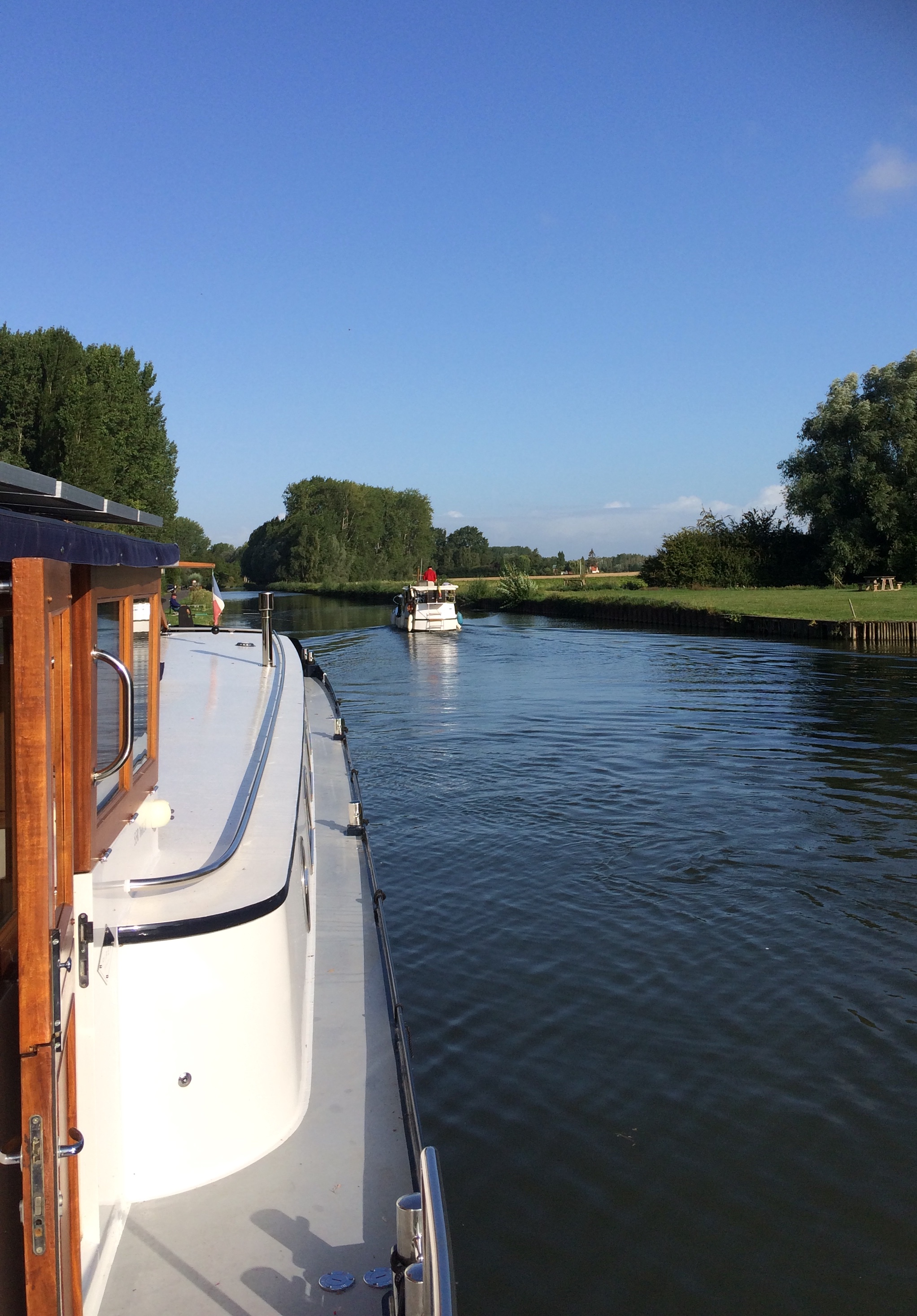
Unusual for us on this trip, we decided we liked it so much here in Saint-Venant that we would stay another night. This meant a nice slow start to our morning and it began as blue as you like. A young moorhen came calling and one of our neighbours departed into the blue as I sat on the back deck with my breakfast.

Little jobs started being done around the boat – fuel additive, clean out of the shower trap, good sweep of the stairs, turn the boat so that we could fill up with water, and another spider hunt.

(Have I mentioned the spiders? In the six days since we returned too the boat we have between us taken over 100 spiders to find a new life ashore. We have never had so many on board before and can only imagine that several nests of spiders hatched out while we were away. I think we are down to our usual dozen or so now, whose job is to catch flies and mosquitoes.)
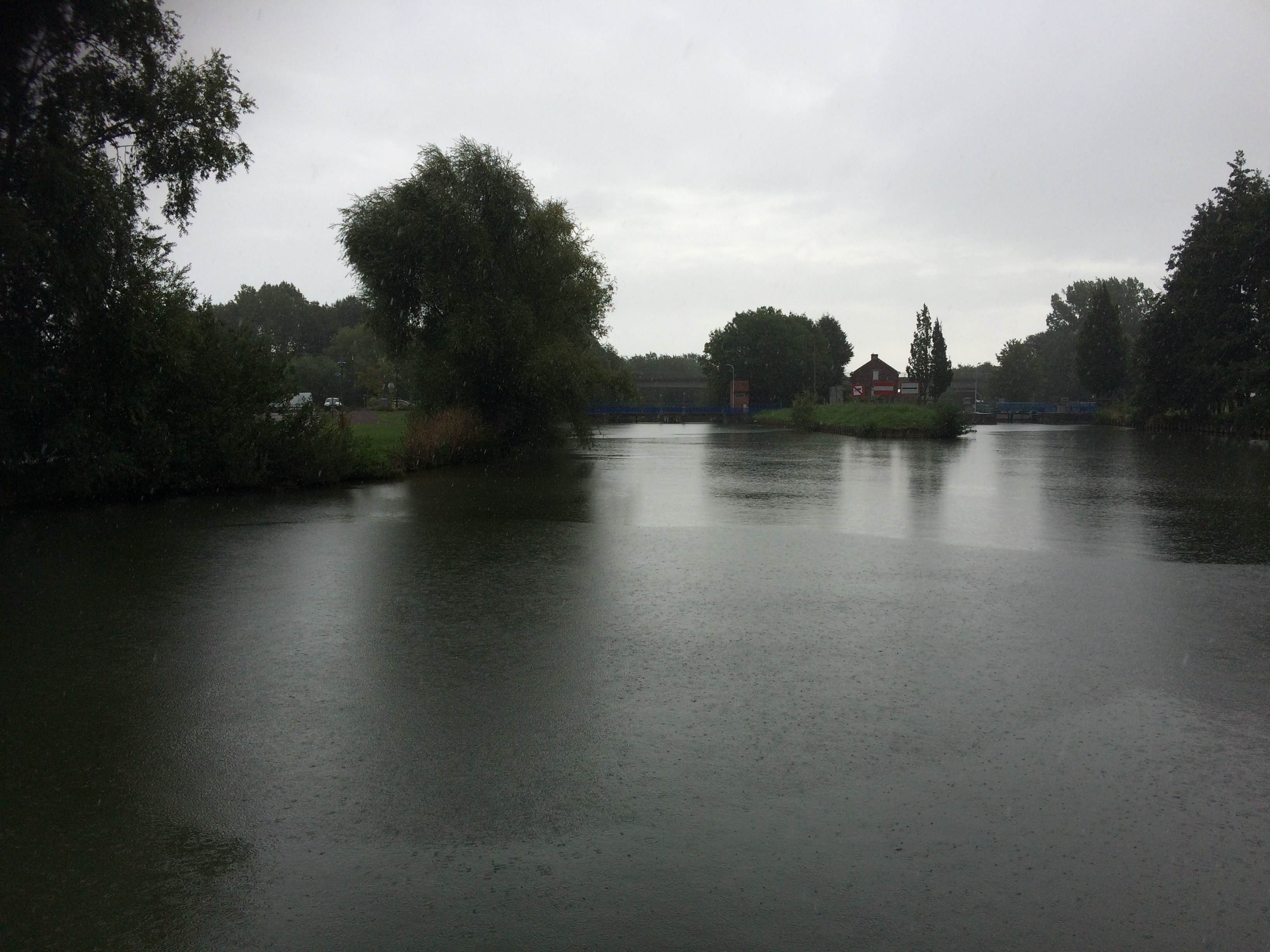
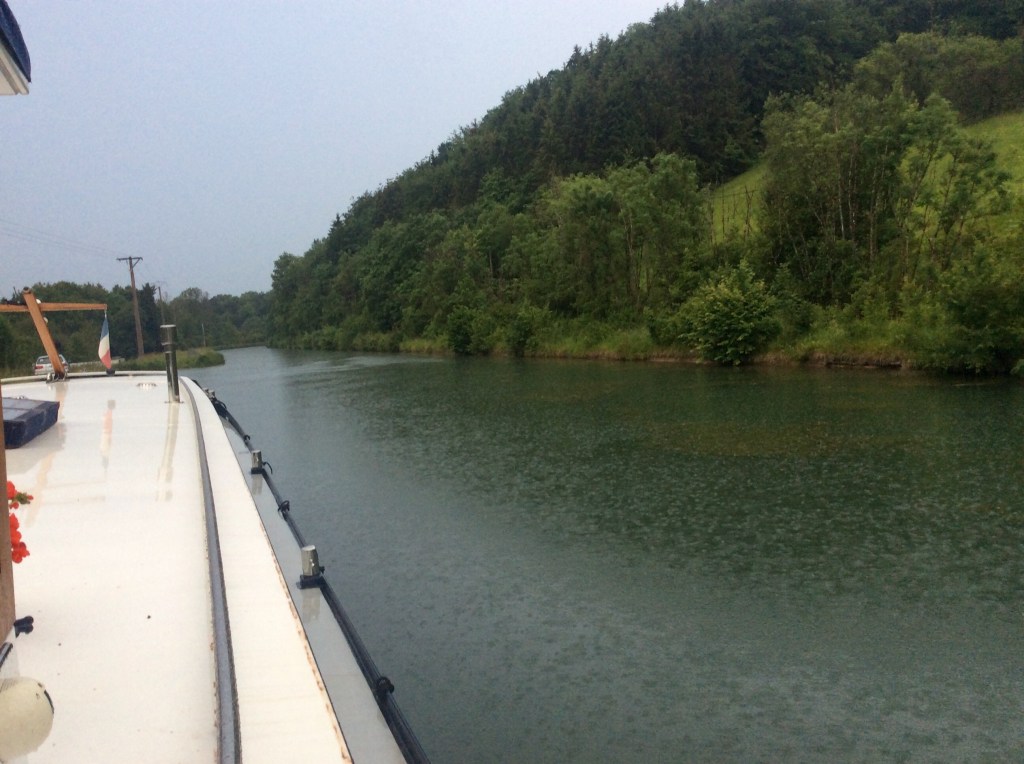
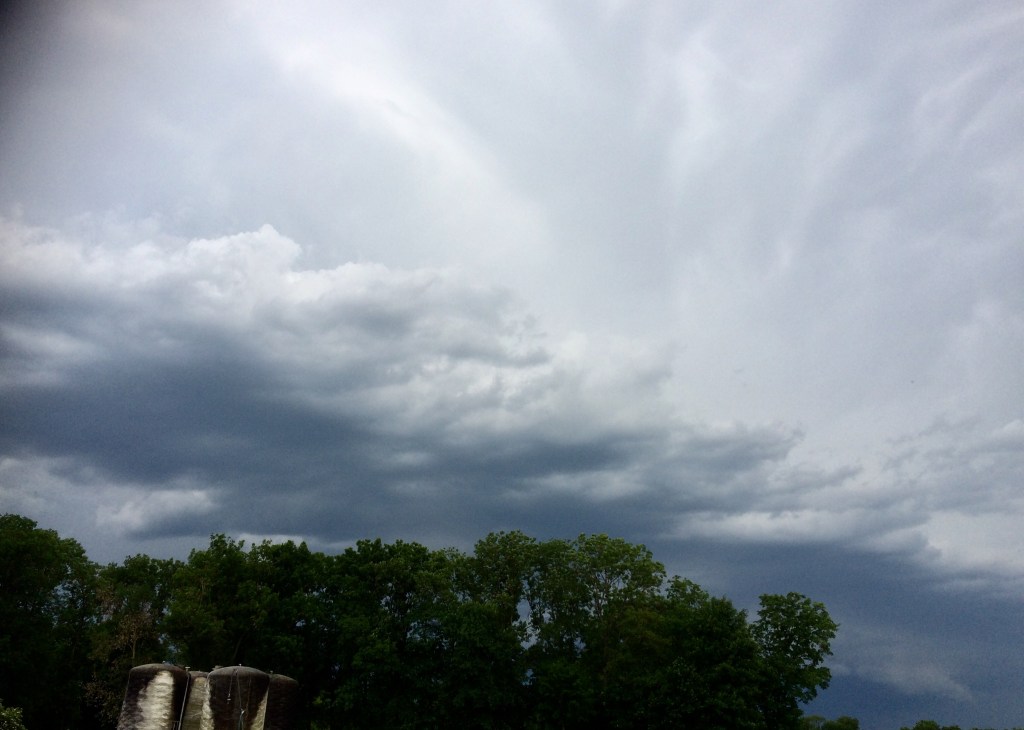
And then the squalls started swirling in, one after another. Each time we thought we could risk a run to the boulangerie the sky darkened, the wind whipped up and the rain drove down onto the water.

Eventually we were able to buy our daily bread, have a good lunch aboard, and after a digestive half hour we went for a walk. It was sunny but with a stiff breeze, making us a little chilly at times. Stu was pleased to leap back aboard when we returned.

We stayed on Calliope for the rest of the day and had a surprise visitor. A French lady stopped by with her two year old and started to talk to us, because her daughter’s name was also Calliope! Of course she had to have a tour of the boat, and went off seemingly very pleased.

looking at the weir to the left and the lock to the right

The evening was quiet and still. A time to finish writing this and be ready for a 9.30 lock in the morning, arranged earlier with the éclusier.

We are turning back on ourselves now, back East and downstream, starting off on a blue sky day with so few locks that I can sit on the back deck with a cup of tea and enjoy the unfolding view.

I don’t plan to do a full blog of the return journey, but if we stop at new places or anything monumental happens I will record it below.


Well we did stop at new places – Sailly-sur-la-Lys for two nights, because we really liked it, and mid stream just before Bac-Saint-Maur lock, for the pure isolation of it.

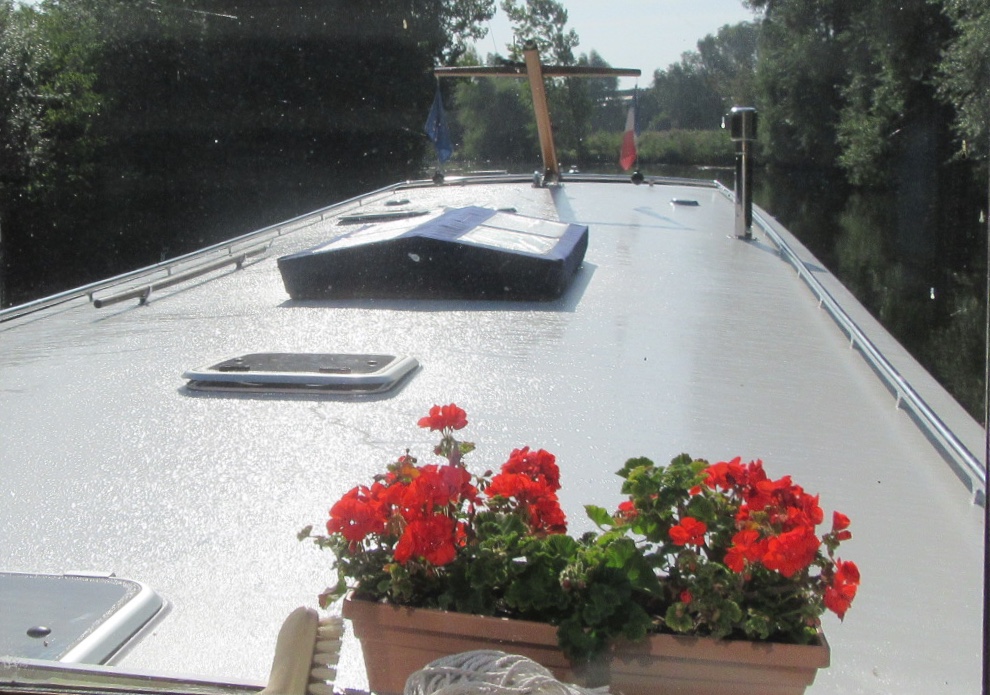
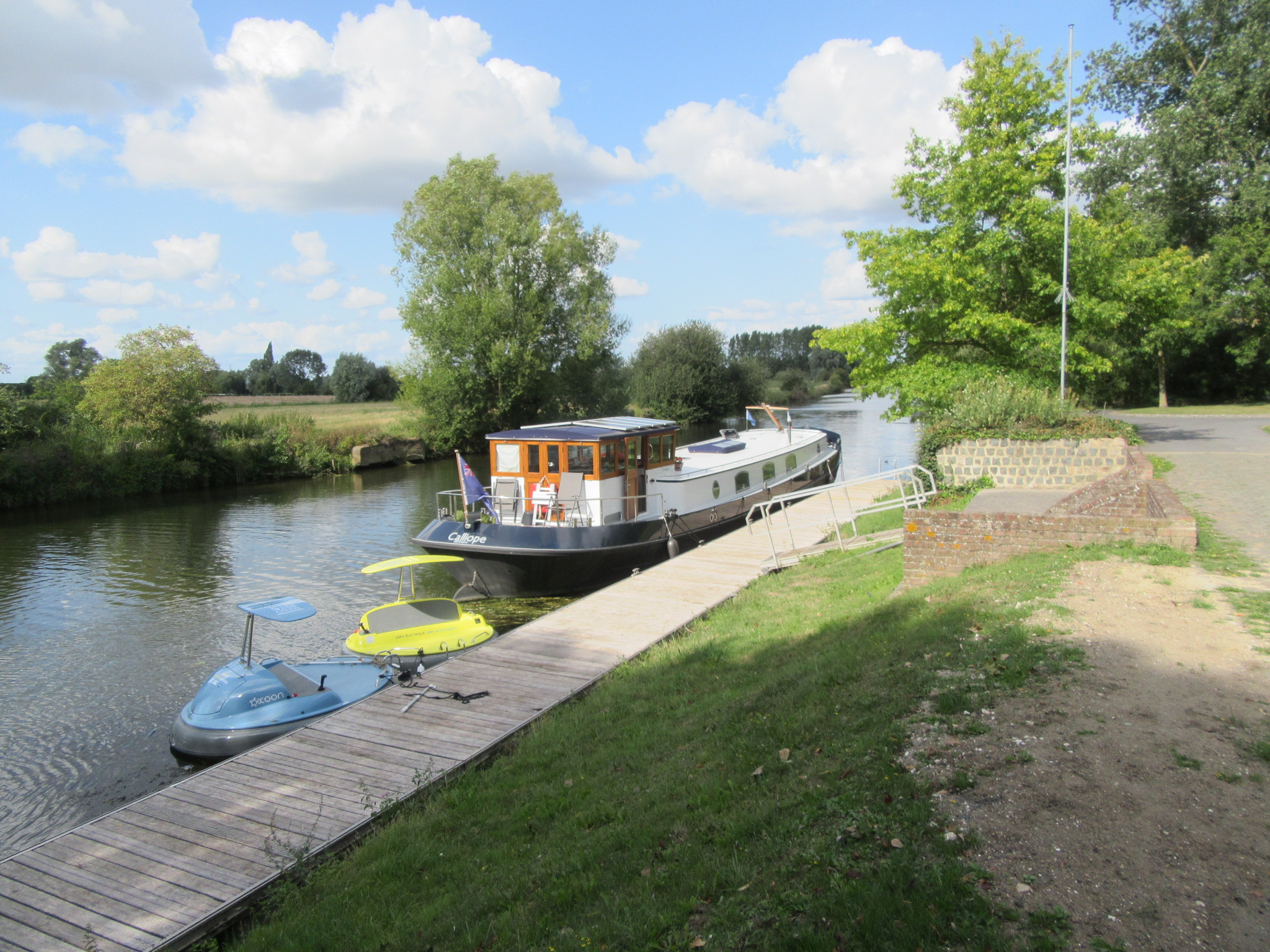
Sailly is a relatively unremarkable village, although it took its share of suffering in the two world wars. We were moored on a comfortable pontoon which we shared each afternoon with three round electric boats that people can hire. It was generally quiet – just occasional friendly passers by – and the views of the river were peaceful transitions from dawn to dusk.

On our in-between day we went for a good walk through an orchard of apples, pears, plums, sloes and everything delicious – then along the river bank, at a pace that is easier for the camera!

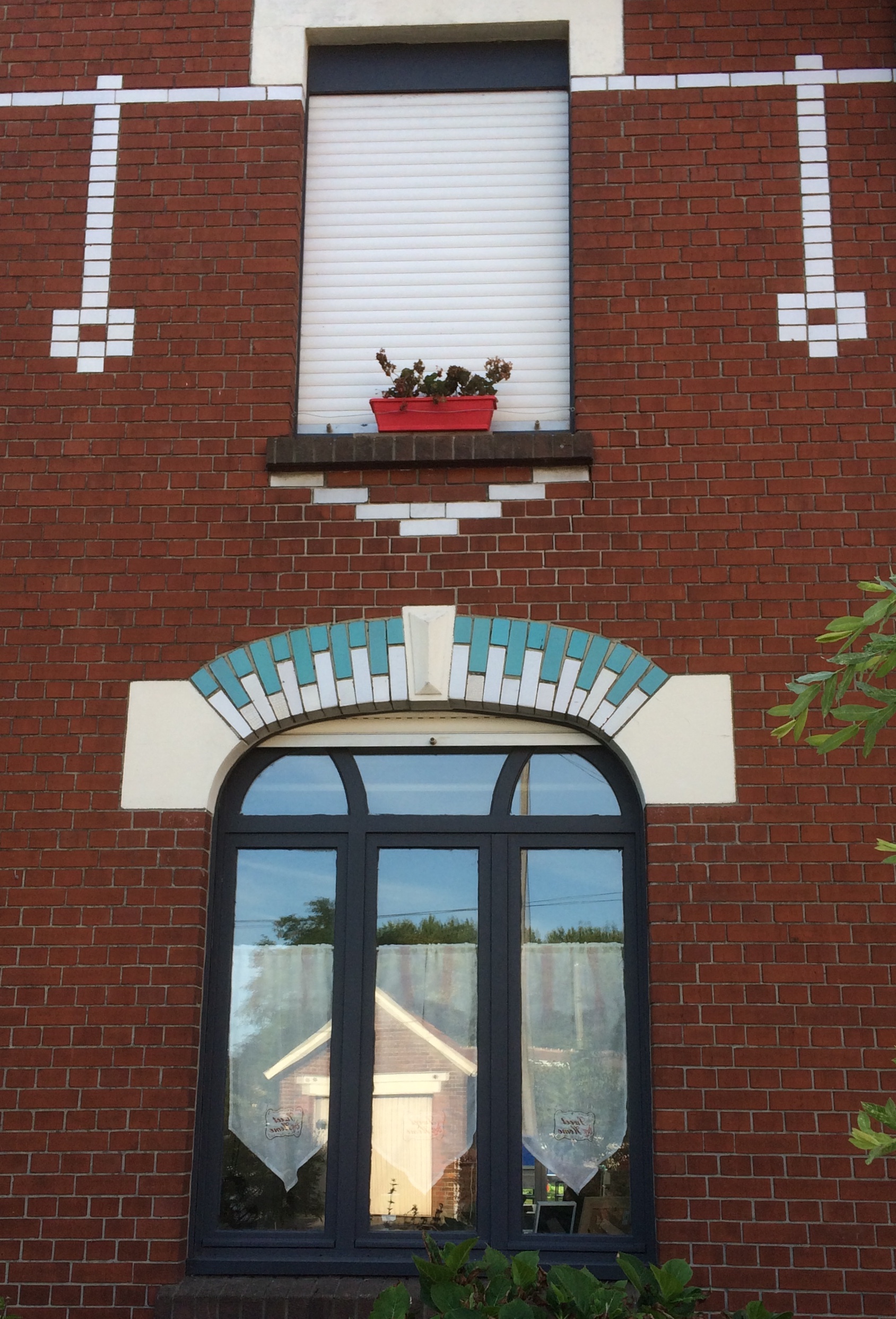
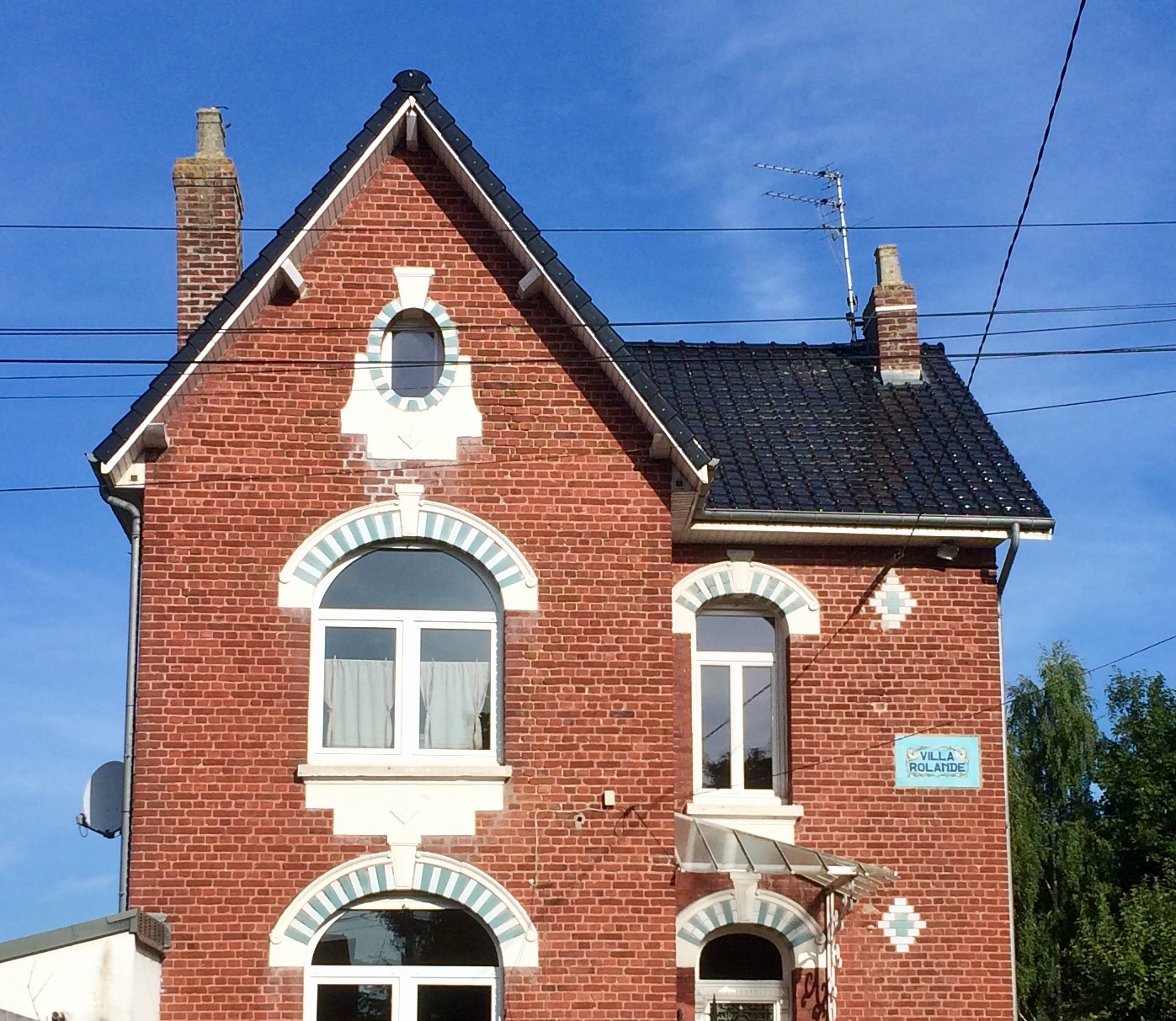
Before we left Sailly, on my quick trek to the Carrefour Contact for bread, I took photos of some of the houses – many have delightful coloured tiles above the windows and seem to have art deco references.

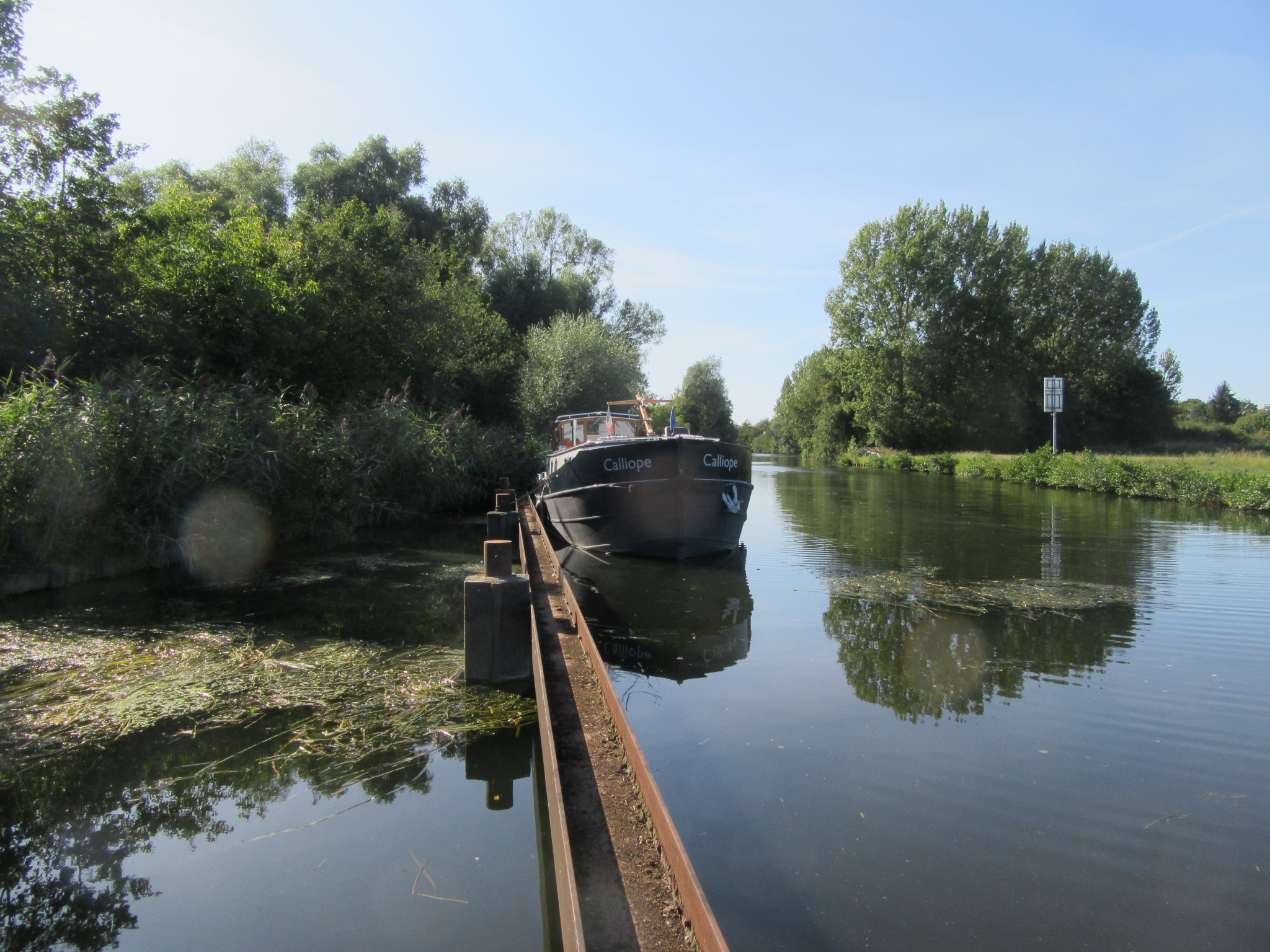
Then at Bac Saint Maur lock – simple tranquility tied onto the iron divider between the weir and the lock.

Armentières was the same as one the way upstream, but I mention it again because of the lock. Once again we phoned to say we were on our way, and once again initially had no reply. When we did reach the éclusier, who was based at Merville, we discovered that we would be waiting over two hours for her. This gave us a relaxing pause in our journey!

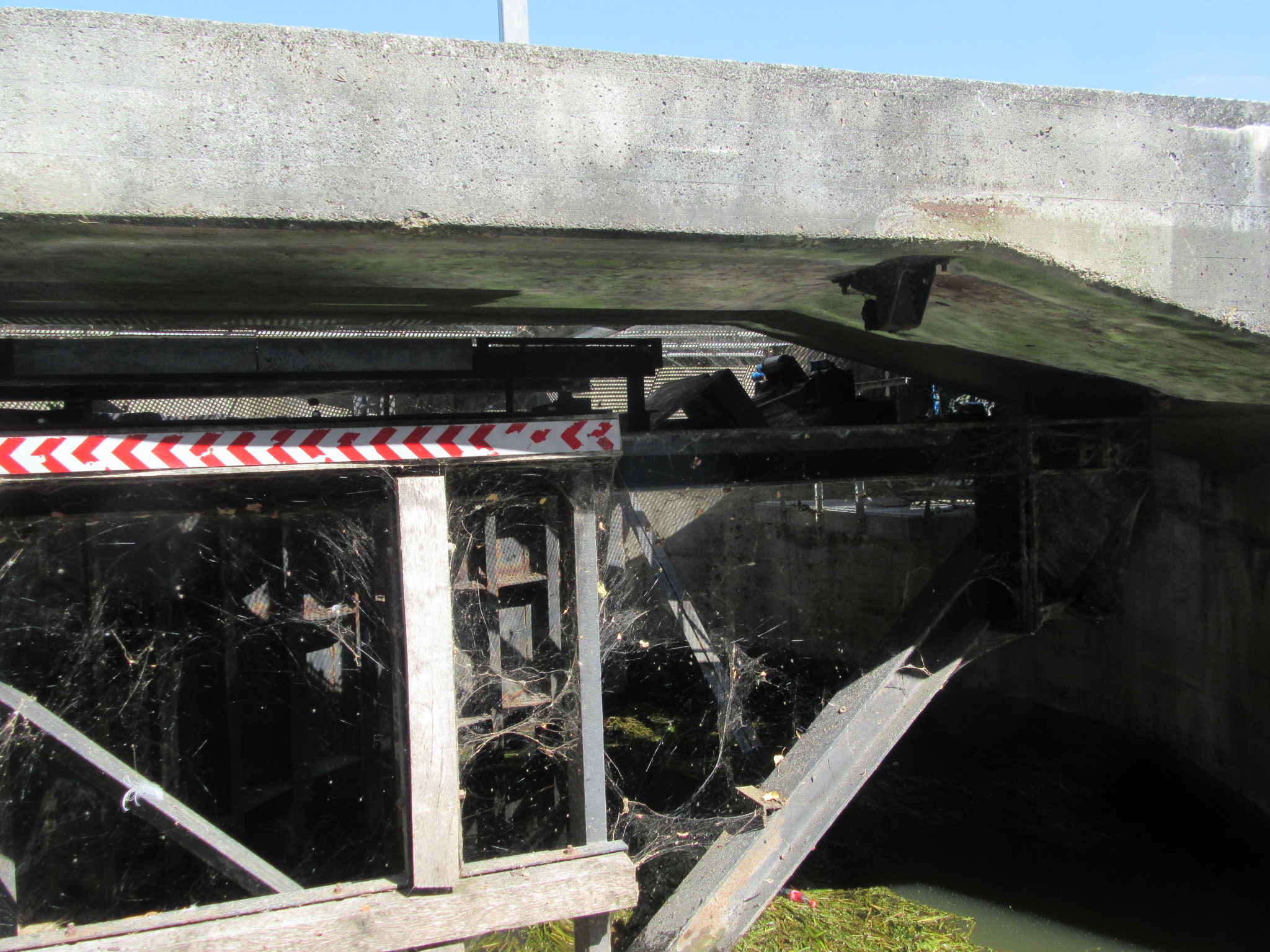
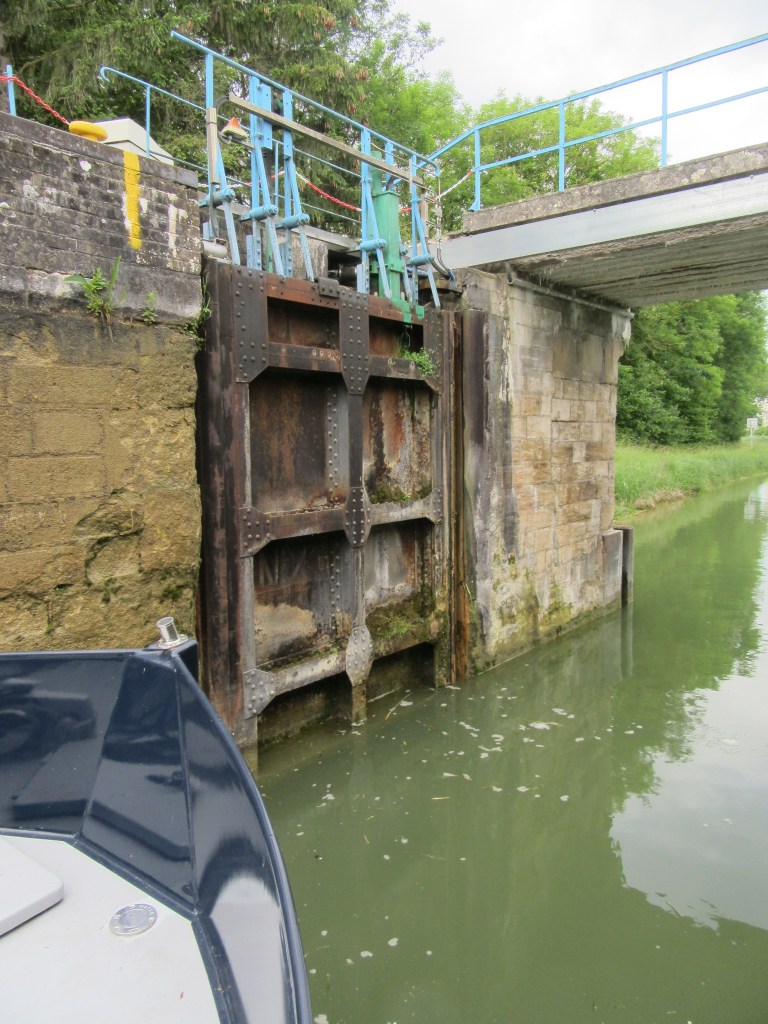
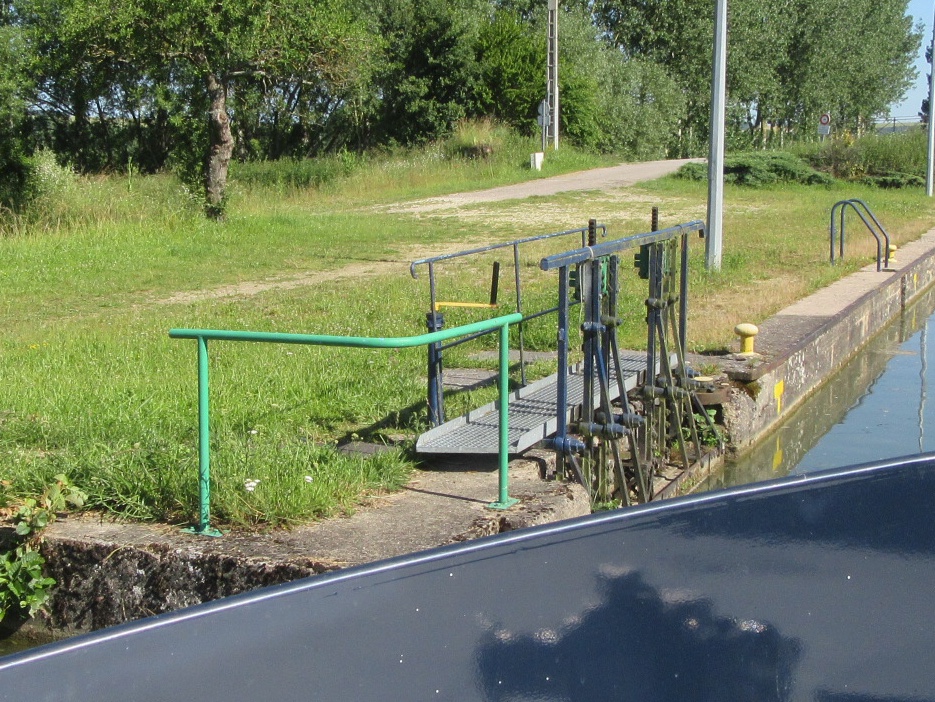
Then on going through the lock I discovered something I had missed on the way up! The lock gates are slightly curved and when open they swivel under the lock wall. These photos adopt really explain it! But it is fairly unique in my experience.
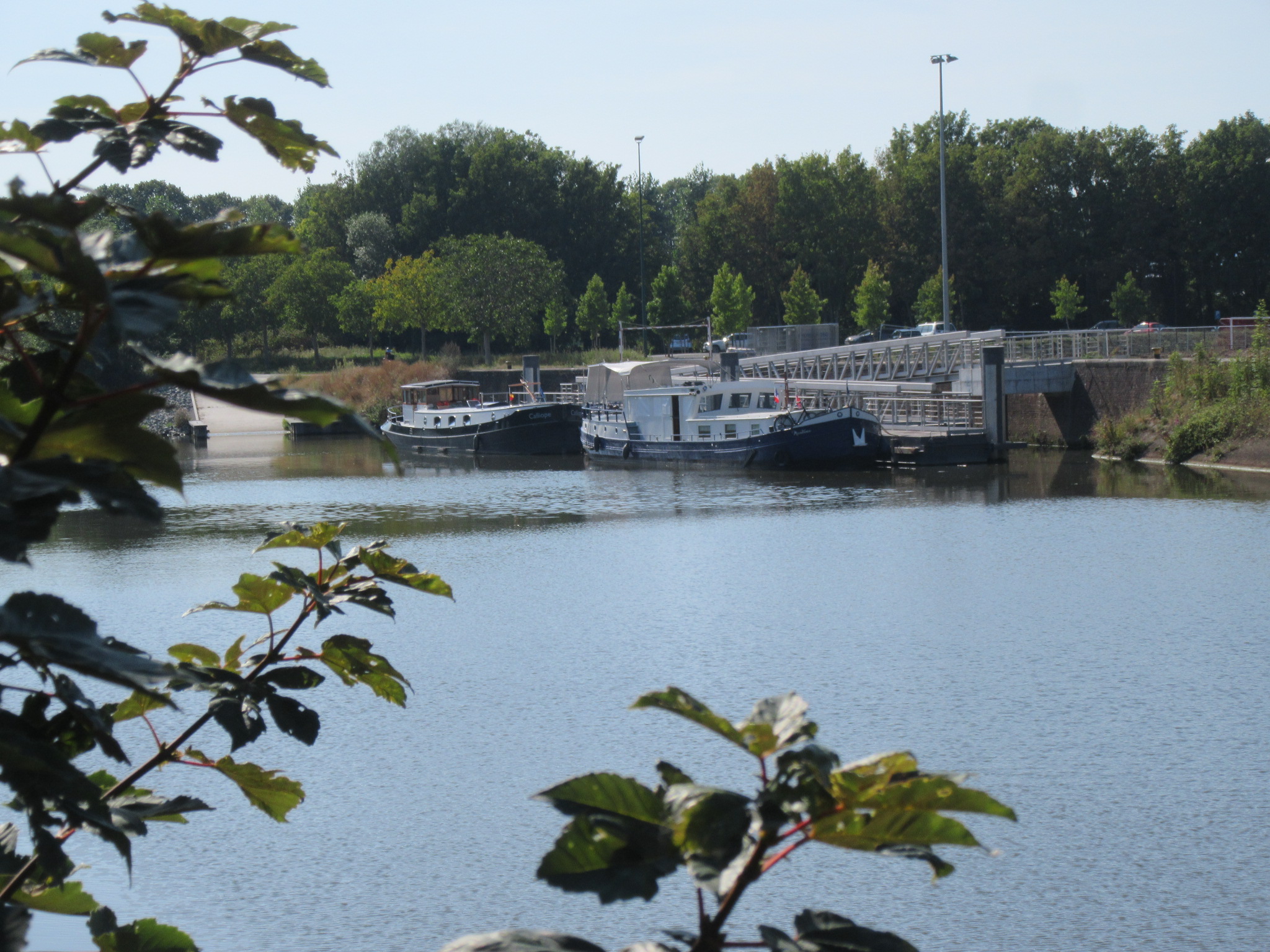
Comines mooring

The third new place we stopped at was Comines, a town of two halves and two nations! With the river Lys running between them, there has been a Comines France and a Comines Belgium since 1713, and a chequered history of nationality for centuries before that. Thanks to the EU they are now becoming Comines Europe.

French Comines church and town hall

We moored on the Belgian side behind dutch barge Moon Dance, and had a walk round both towns, discovering that the multicoloured dome belonged to a fascinating church, and the slate clad belfry to the town hall – both built between the wars.

The weather had become quite hot again – so much so that the slipway was inviting and I enjoyed a bit of a splash. Later we enjoyed a drink and stories of barging in Europe with MoonDance crew, then picked an excellent Chinese/Belgian restaurant for supper.

Our last morning before steaming back to Kortrijk dawned fair, with the sun behind the famous Comines towers.

It was a sunny Sunday and the river was busier than ever. It is interesting to be following a dutch barge as two big commercial barges come towards you, a flotilla of canoes is trying to over- and under-take you, whilst families in speed boats weave in and out creating crazy wakes and parties of cyclists, walkers and horse riders watch on from the banks!

Where is the peaceful Lys now????
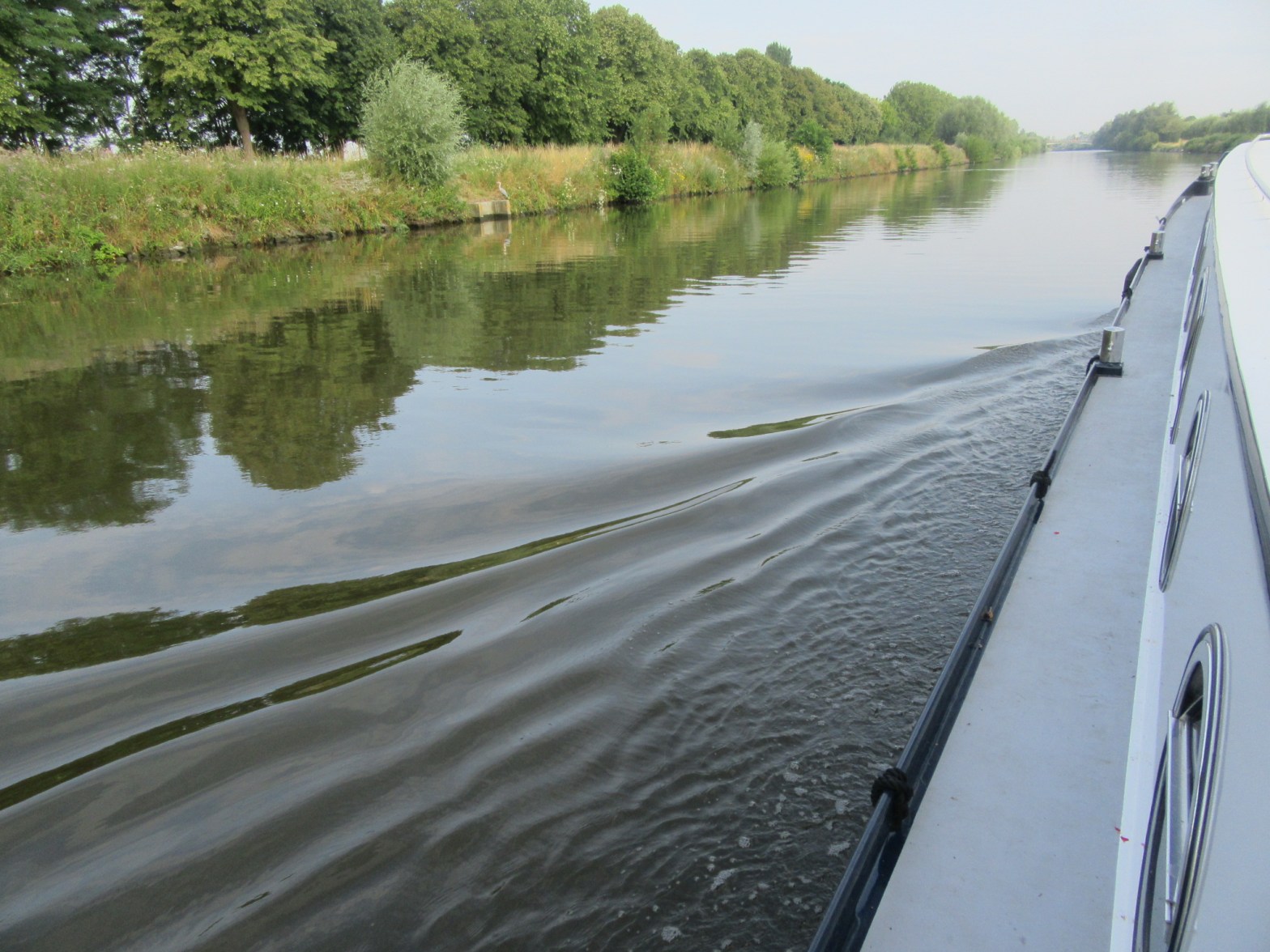
Moving on to Kortrijk- along the Upper Scheldt and Kanaal Bossuit-Kortrijk

10 – 12 July 2019

I am going to try to bring brevity into this edition. It is after all only 3 days long.

At 7.40am we turned into the Upper Scheldt, known as the Haut Escaut at its other end in France. We had been surprised at 6.30am to find we were going down the two big Peronnes locks immediately, and therefore were turning into the river less than an hour later. (see previous blog post)

The advantage to this? It meant we would arrive at the Neptune Chandlery and gasoil barge before it opened at 8, and be first in queue.

We pulled in alongside, tied up and had a cup of tea while we waited, only to find we were waiting at the BIG commercial barge pump (red diesel) and had to pull along to the the little leisure boat pump (white diesel).

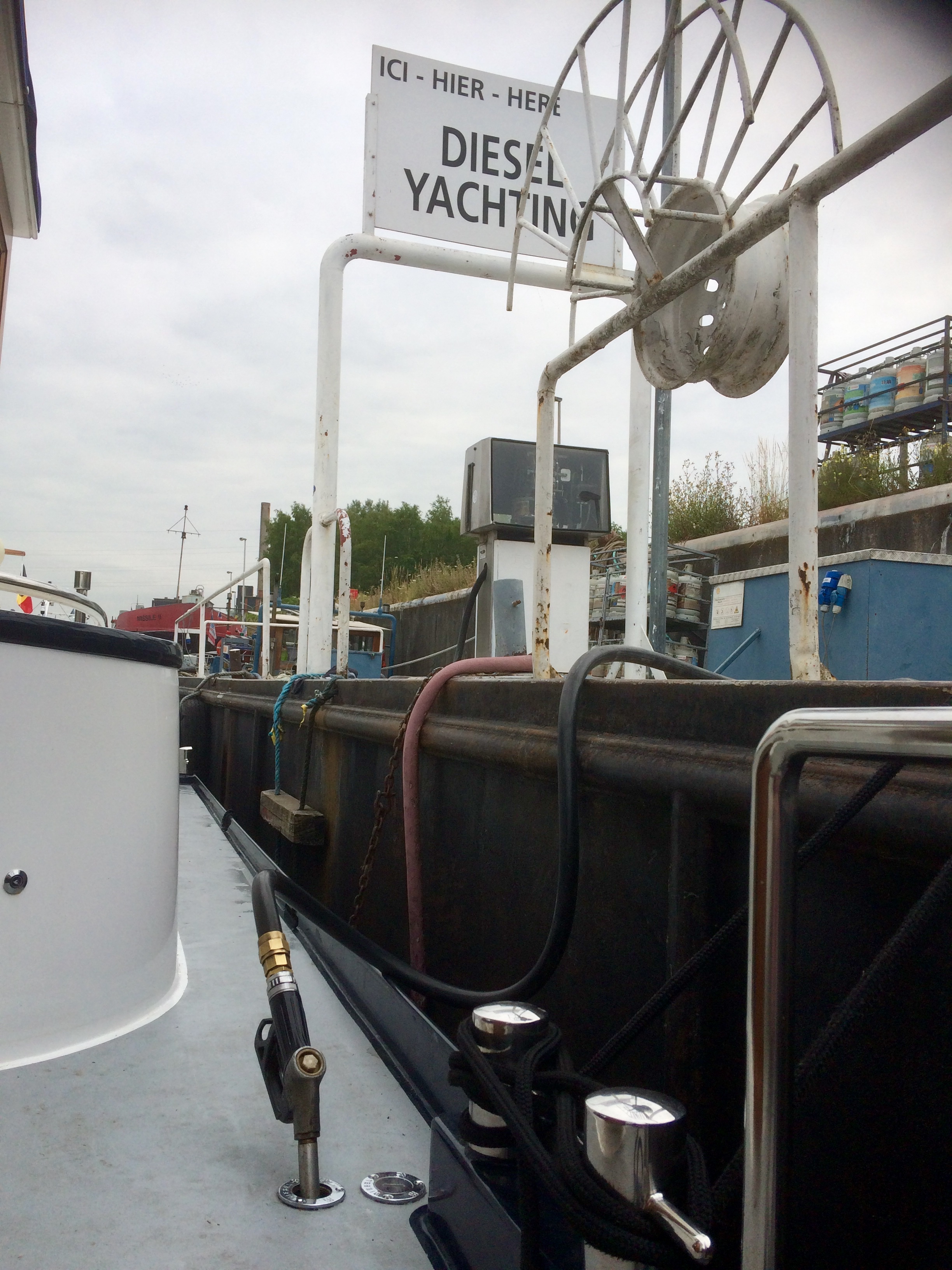
Not a problem. By 8.45 both tanks were filled, I had bought bread at the adjacent Aldi, and we had added the two volumes of the De Rouck waterways map from Reims to Rotterdam plus a mop to our gazoil bill.

Calliope headed down the river, and towards Tournai, passing fortifications with a historical tale to tell, families of mixed geese, and working barges.

Tournai has been a favourite place for people to moor, but this year the whole pontoon is undergoing restoration work.

What amazed me is how the ancient 13th century three arched bridge is still standing with so many huge boats passing through over the centuries. Apparently it was raised 2.4m in 1948 to allow the bigger barges, but now it may need to be widened for today’s even larger working traffic.

After Tournai the riverside was more rural – poplars, villages, wild birds and fields.

But still plenty of boats, commercial and pleasure, queuing for the low drop locks along the way, that seemed to be very slow in operation,

Maybe because of the work being done alongside them.

Leaving the waiting area below Bossuit lock

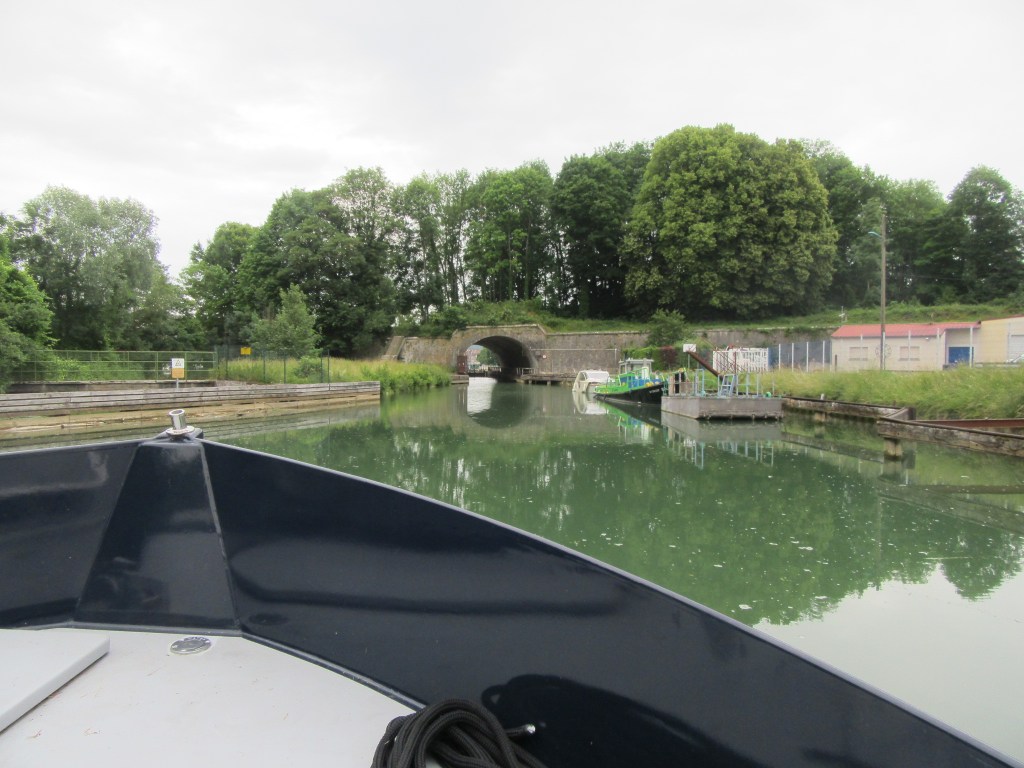
Finally we made it to the Bossuit lock, and the turning into the canal. A quick chat with the lock keeper ascertained that they would like us to wait an hour and go up through the lock with a commercial barge. Naturally we agreed and moored up to wait.

I took the opportunity to go to the lock office and buy our Flanders vignette. Whilst it is free to cruise in Wallonia, there is a charge in Flanders (€85 for 3 months or €135 for 15 months). The two lock keepers were very pleasant and helpful, and before I left they suggested that we should lock-up immediately as the commercial barge had been delayed – probably back at the locks we had eventually passed through that afternoon!

So up we went, 9.49m, using good floating bollards that had a sloping cone on top to help the rope slip down properly. Good idea.

The reach above the lock was wide, calm, tree and duck lined, and with a pontoon mooring just waiting for two weary travellers who had been up since 6!

Is it any wonder that we decided to stay there an extra day and rest?

Although the rest was a bit more tiring than expected. We were still on a mission to get fresh milk for Stewart and I found a small Intermarche supermarket about a half hour’s bike ride away, according to Google Maps.

We obviously do not cycle at Google Map speed; after an hours ride, albeit mainly through lanes and farmland, we arrived. And they did not have fresh milk! But they did have sandwiches and cold drinks, so after finding a seat along the road we had lunch with close up view of the N391.

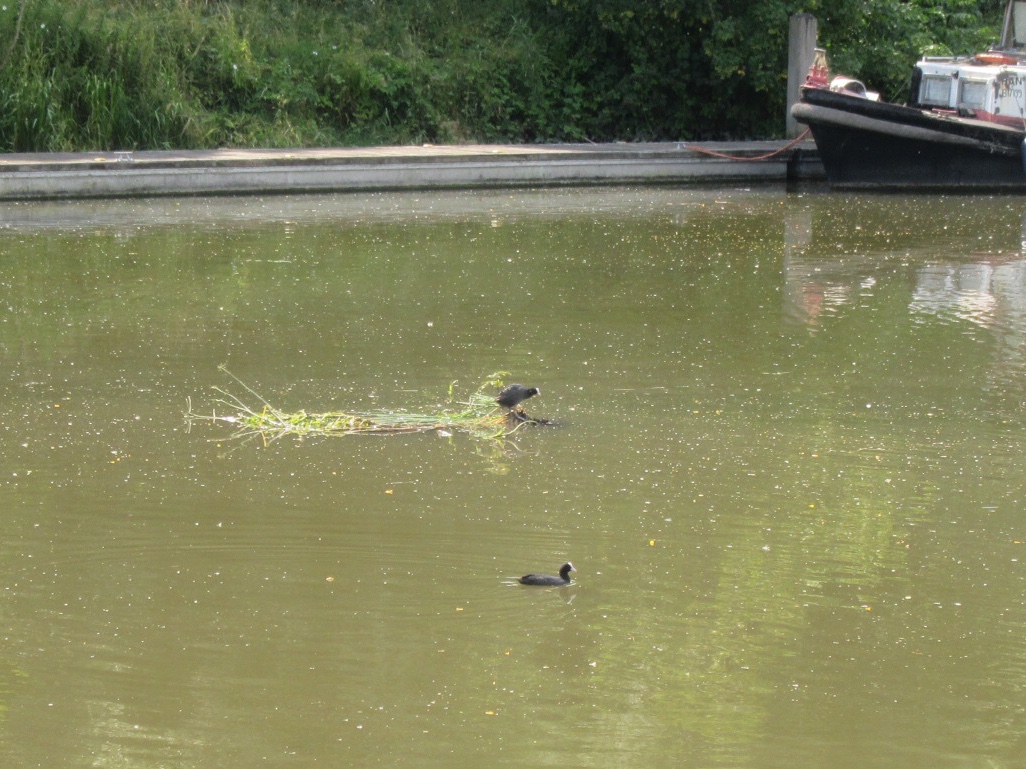
We did get back eventually and after a snooze we settled down to a mesmeric mindlessness, watching first a little red survey boat chug slowly in and out of the lock. Then later watching two coots doing what coots do best – work hard at making a totally inappropriate nest, even though it is all drifting up and down the canal as the flow changed direction.

Next day Kortrijk! I was up and ready, for a change, mariner’s pigtail a-flap. We knew the route – two more biggish wide locks in the company of the Bossuit lock keepers, and then 3 shallow narrow locks with a bicycling lock keeper alongside.

We were soon up through the first lock – one of those where you shift your rope up onto higher bollards in the wall as the lock fills – then the second, and reached the narrowing of the canal an hour before our appointed meeting with the cycling lock keeper.

There was nowhere at all to moor by the lock so the Captain turned round and we tied up by a road about 200 yards back. This gave me two opportunities. One was to walk rapidly to and from a bakery for good fresh Belgian bread.

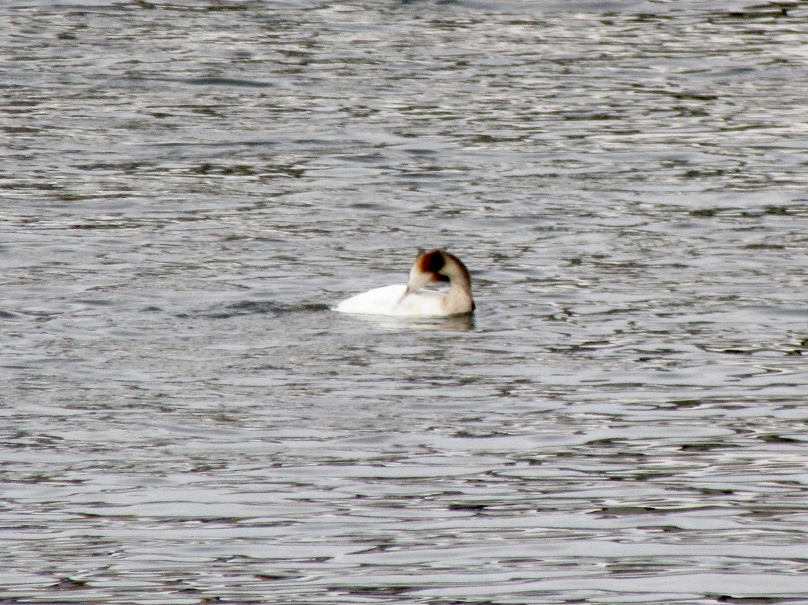
The other was to grab photos of some wonderful bird life – families of baby coots with their red and yellow crowns, young moorhen walking on lily pads, and, never quite in focus, a grebe that was albino white on one side – very strange.

45 minutes later we saw the lock doors ahead opening – manually. We hadn’t seen that for a while. And what a narrow lock entrance it seemed! We went from 12.5m wide to 5.15m, and Cap’n Stu steered us in perfectly, missing the coot family swimming lesson.

After the ‘massive’ drop of 1.8m we came out into what felt far more like a UK canal in days gone by, narrow, overgrown and beautiful. It was a similar scene beyond lock 10, and by then we were in the outskirts of Kortrijk, passing old warehouses and barges.

Out onto the River Leie

Then the final little lock, still with our cheerful talkative lock keeper and his bike, at Sluis 11, out onto the river Leie and a hairpin turn to port into the original river bend where we were to moor. The main river now bypasses this short stretch to accommodate the large modern working barges.

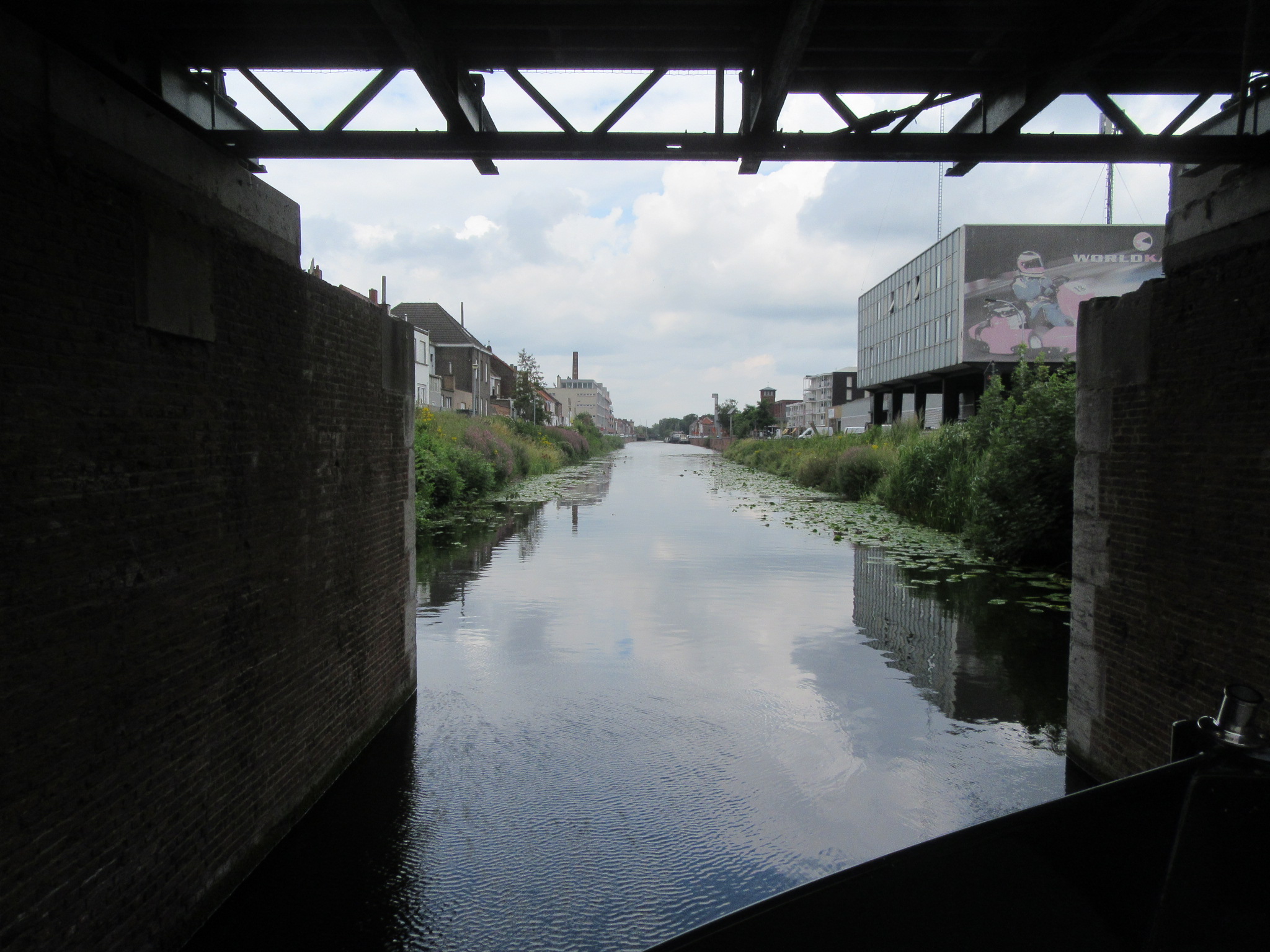
We carefully went under the 3m bridge, watching intently our new PV panels on the wheelhouse roof. Phew, they fit. And glided into a lovely pontoon mooring from where we could explore the old town and watch the birds on the water.

First evening out in the town provided moor good Belgium beer, and this time the frites and mayo Stewart had been hoping for.

We stayed in Kortrijk for about 4 weeks, so a separate chapter will describe this lovely place, and then back to cruising. So just a taste of our Kortrijk experience for now.

So I regret it wasn’t brief, but hope it’s been enjoyable.

A river and three canals in a week!

Well not exactly complete rivers or canals, but we did steam along 53 kms of the Base Sambre river, 20kms of the Canal Charleroi à Brussels, and 24 kms of the Canal de Centre and 40kms of the Canal Nimy-Blaton-Péronnes

And that included an unplanned en panne two night stop, but more of that later.


This was the week that we left Namur on July 3rd, and on July 10th turned onto the Haut Escuaut river. It seems like a rush but there was still plenty to enjoy, including giving Calliope a bit of a scrub down as went along.

We quickly discovered that we were into a new kind of canal, far more industrial than we had been used to on the Meuse.

We were mostly sharing locks with huge 80m+ barges, and the locks themselves were larger, with massive doors, sometimes running sideways on gantries. We often felt very small!

The frequent juxtaposition of ancient, in this case an abbey, and modern waterways transport kept me on my camera toes.

Our first night out of Namur found us at Auvelais – a little town with enough of an edge to make it interesting. Of course Stu and I went for a walk round, and it was quickly apparent that a festival of some kind, including live music, would be taking place that weekend.

There was a second, road, bridge into the village that made it clear that quite rightly the UK was still a welcome part off the EU.

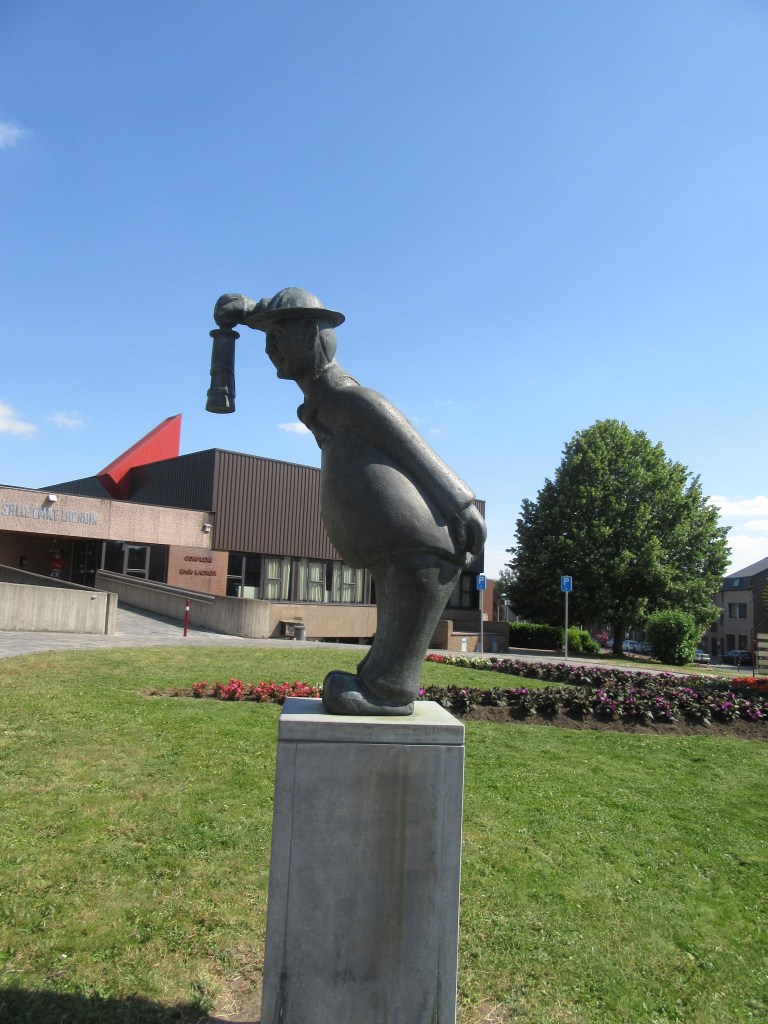
We also saw a somewhat strange statue; we had seen a similar one in Namur, including two large snails as well as the little man. I have Googled this and have not come up with much.

It’s labelled Jean le Porion.

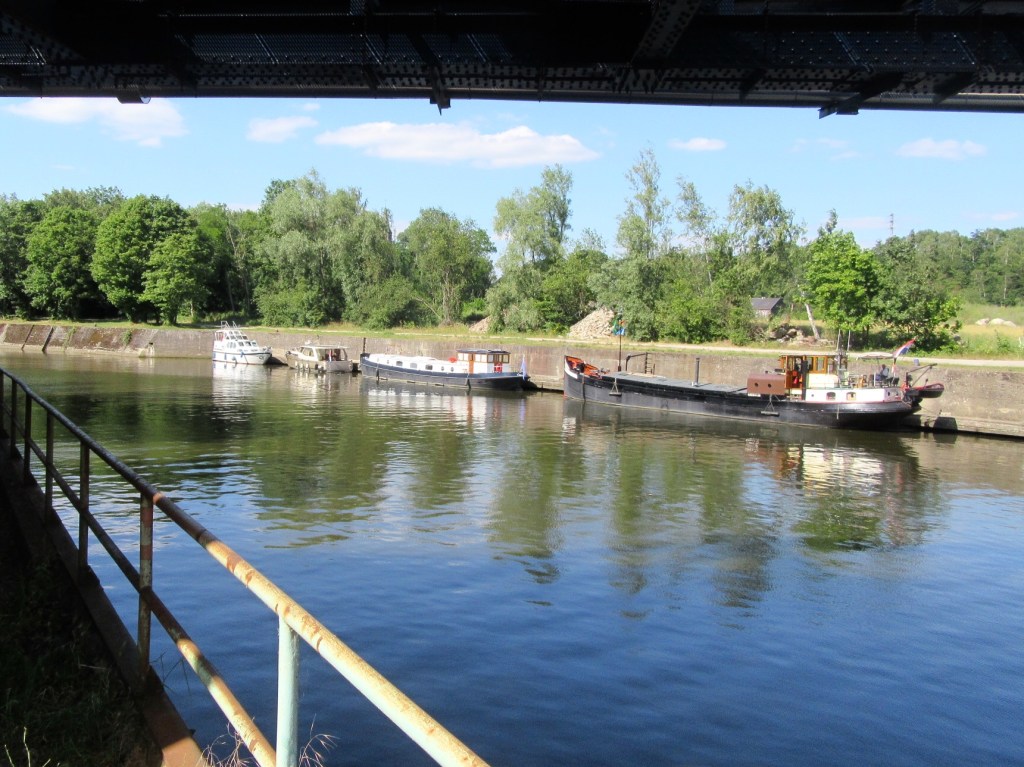
Our actual mooring was in a short indent in the canalised – just big enough for us, another, old, beautiful barge and two cruisers; all friendly, but no time to make real friends.It was a mooring of two halves – the water was mostly peaceful and quiet; the trains running over the adjacent metal railway bridge were clattering and noisy.

Next morning we were the first ones away, with a lock waiting for us just round the corner and wanting to avoid joining a queue to get through. It was our anniversary that day, so we look forward to finding a nice peaceful mooring to gently celebrate.

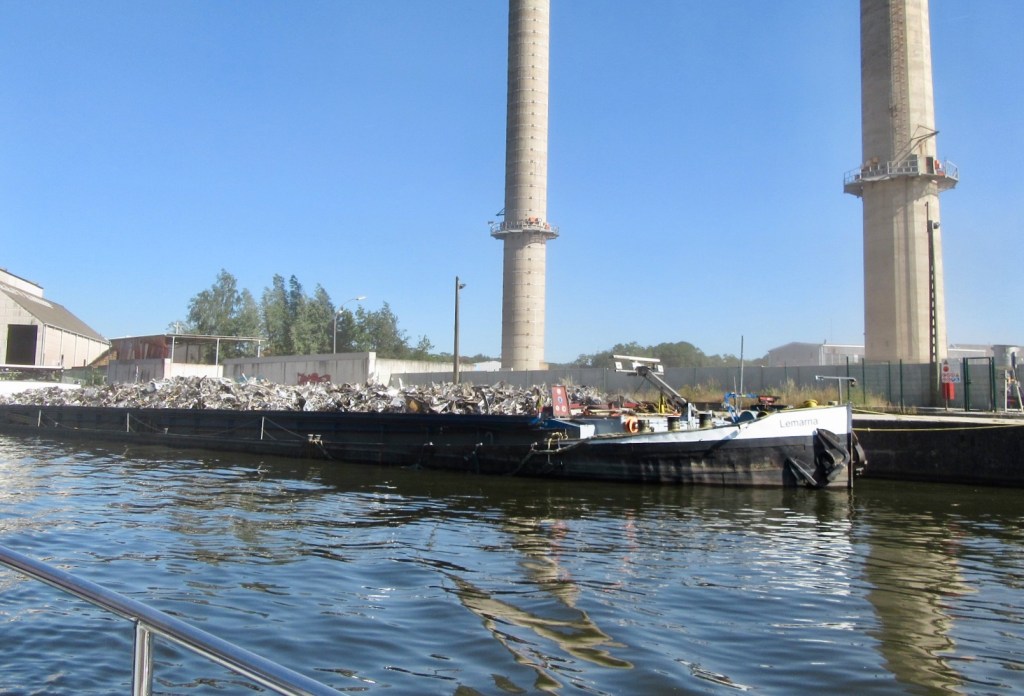
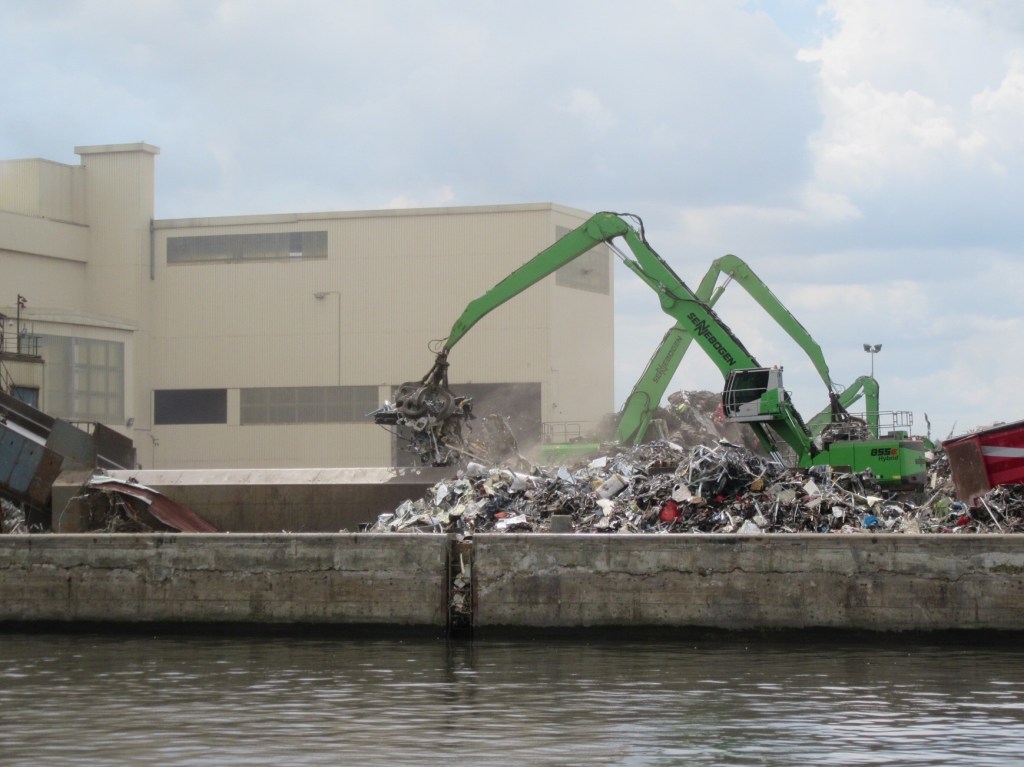
The journey was along the Sambre until we reached Charleroi where we turned à droite to join the Charleroi-Brussels canal. Moving through Charleroi was a sad shock to the system. It has had a huge steelworks history, pretty much now all gone. It has been replaced by a scrap metal industry with barges moving different size pieces off metal up and down the river, gradually diminishing in size from whole cars to glittering fragments.

That evening turned out to be above Viesville lock, initially very peaceful, but later with giant barges gradually piling in around us. We raised our glasses to 32 years together, watching the boats, full of scrap metal, float by.

As we went to bed a HUGE barge came in to almost touch our bow; ten minutes later another came in at our stern, in a space that should not have been big enough, but, phew, it was!

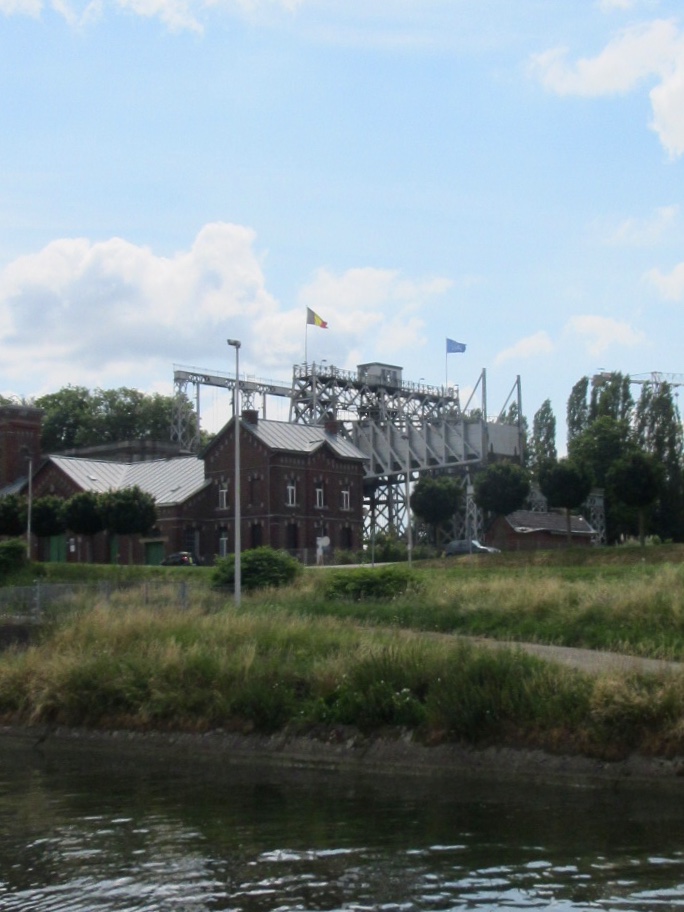
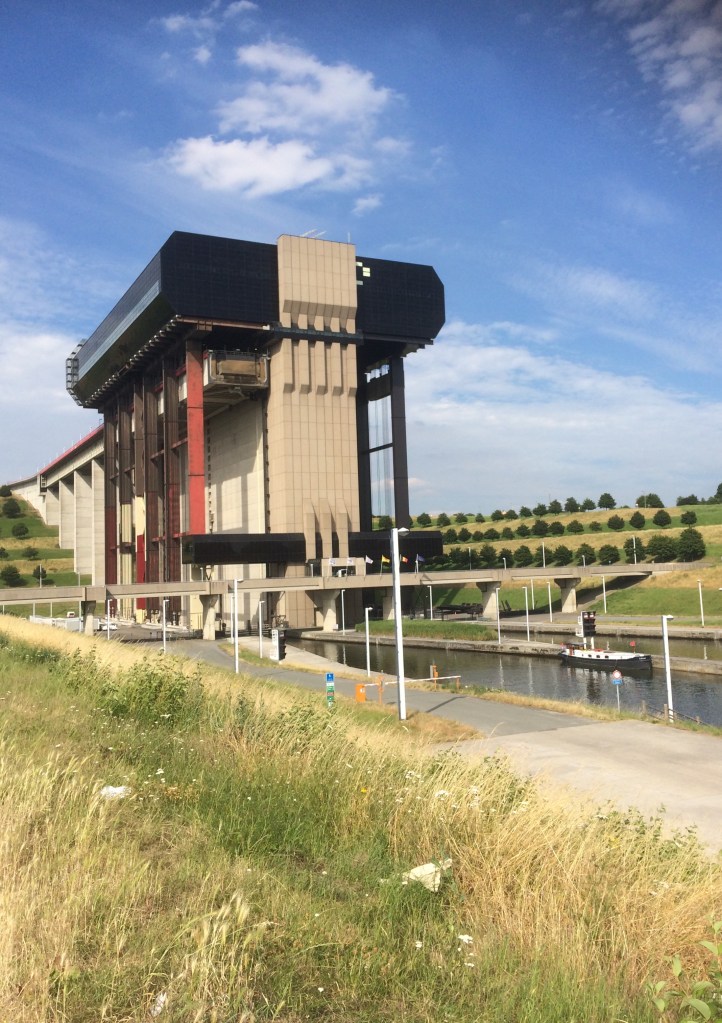
Friday was to be and exciting day, our first ever in a boat lift, and this one is the second highest on the world! We cruised towards the boat lift on a perfect day – perfect for holidaying youngsters to be to learning to sail, canoe and wind surf.

As we approached they were gathered to one side of the canal by clucking smiley ‘mother hen’ tutors, and in some cases we seemed to leave young wind surfers scattered in our wake.

Just after this we turned onto canal 2 – the Canal de Centre. The waterway opened out wide and clear as we joined the new part of this canal, towards the boat lift. The old historic, narrower, branch of the canal is still open, where the descent of 240ft is actioned by 4 separate beautiful old boat lifts.

The original canal dates back to 1879; its locks and lifts were able to accommodate vessels of up to 300 tonnes. By the 1960s the European standard for barge traffic was 1350 tonnes, so a replacement was needed.

The new gate, or ‘porte’ leading to the boat lift

Not only was the new boat lift required, but also the width and the depth of the canal leading to it had to be increased plus a huge ‘gate’ to close of the water in case of damage to the boat lift structures. It has all worked, with river traffic going up from 256 kT in 2001 to 2,295 kT by 2006!

The 4 older lifts on the original canal became bypassed by the new canal and are now on the UNESCO World Heritage list, because of their architectural and historical value. They are well worth seeing and next time we will travel via the ‘historic canal’.

This is a not-very-good photo of the most downstream of the 4 old lifts, still in use.

As we excitedly approached the boat lift it became apparent that it was not working, with red lights everywhere. There were 2 commercial barges waiting and a small German yacht, so we moored up behind them and had lunch.

arriving at the top of Strepy-Thieu boat lift

Then we suddenly realised that only one side of the pair of lifts was out of operation. The lift on the side where we were waiting had been descending and coming back up while we ate lunch, and was now here to collect the first of two waiting commercial barges. I made a quick radio call to the lift operators and discovered there was room for us and the yacht to fit in as well.

Down we went – what an expereience, what engineering! Look it up – the L’Ascenseur Funiculaire de Strepy-Thieu.

https://www.youtube.com/watch?v=usUwiL2NJiQ

leaving the boat lift

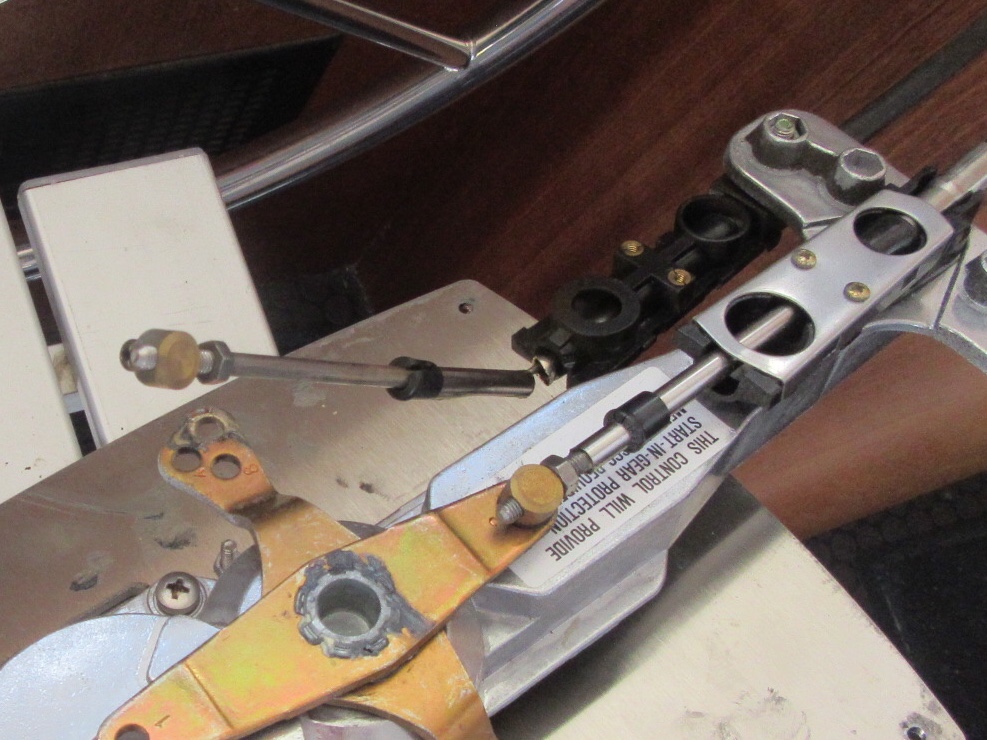
It was less of a good experience when we came out of the lift at the bottom. The Morse control (throttle and direction) became stuck in forward; the German yacht was dithering in front of us, and all Captain Stu could do was switch the engine off completely and glide, with no propulsion or steering, into the quay between the two lifts.

With a bit of adept rope throwing we managed to moor up. And there we were, stranded, broken down. A boat lift operator came to find out why we had moored in this inconvenient place, and on understanding the problem he became very helpful.

We were advised to raise a red distress flag – not the sort of thing we have on board, but a folded round red ensign worked on the mast, and my red dressing gown was ok at the stern!

After Stewart had done several checks, and I had made a few phone calls and requests to other Piper owners for advice, we realised that it was most likely the gear cable that had snapped of jammed. Of course it was a Friday afternoon. If anything goes wrong for us it is always a Friday afternoon, and you cannot get help until Monday.

Never mind; we reached a fabulous lady boat yard owner who said the would come on Monday with her mechanic and the correct Vetus cable; all would be well. In the meantime we could enjoy a weekend beneath the boas lift, once we had discovered how we could get out to buy food, and more importantly get back in. (We had moored within the fenced and locked compound of the boat lift where only those authorised could get in).

We got that sorted and my first walk discovered a friendly little supermarket in Thieu on one side of the canal.

The next day, Saturday, we walked to Strépy on the other side of the canal – and discovered that it was the weekend of the local fête, all along the side of the historic canal.  You want waffles?  You want frites? You want good Belgian beer, or kebabs, or dried sausages, or pastries?  It was all here, plus music, entertainment, and jolly people

That day we simply looked all round, bought lunch to much along the canal, and walked back to our stranded barge.

Next day we had a plan, starting with a visit to the Ascenseur visitor centre, which was just as interesting as you can imagine. Well worth the time and money, unless you don’t have a head for heights – the visitor centre is a long way up!

One of the boat lift machine rooms, seen from visitor centre

Then a walk back into Strèpy for the continuation of the fun.

It was even busier than the day before and after a good look round we found a quietest place with a seat, by a music stage and bought beer.

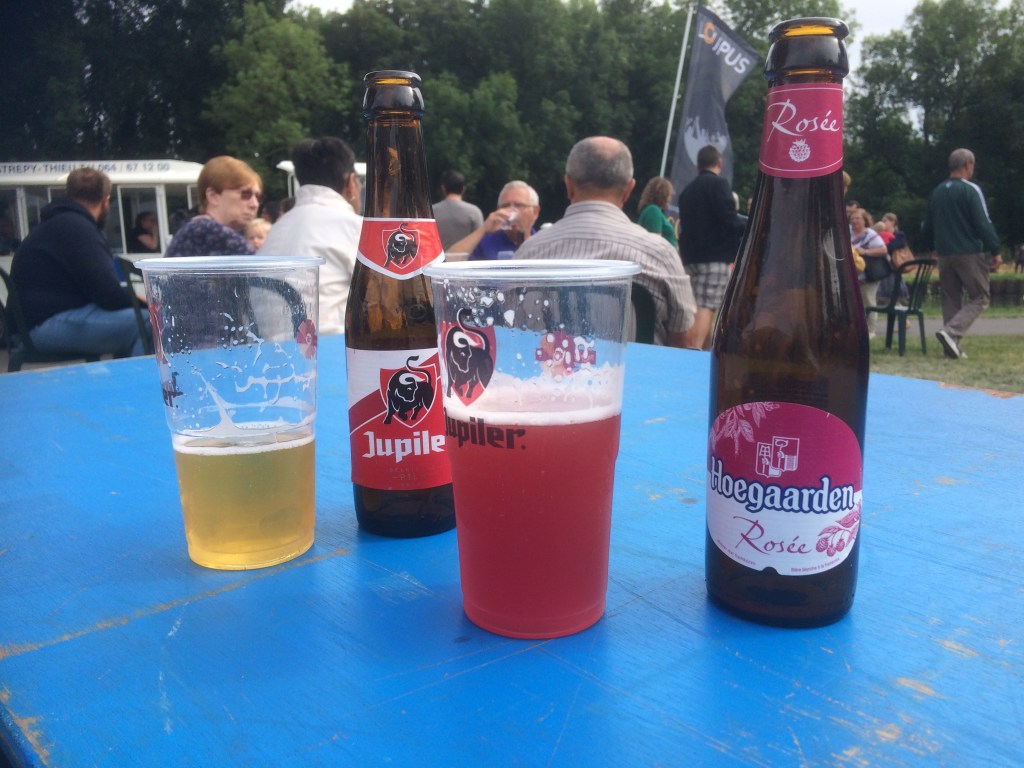
I was on a mission to try all the cherry flavoured Belgian beers I could find – not in one day!

We came happily back to Calliope, past one of the old lock houses on the historic canal.

Its a lovely walk, whether along the canal or though the outskirts of the village.

It was easy to find or way back – the boat lift towers over everything in there area. We snuck into the compound by moving Heras fencing, as instructed by the helpful boat lift operator. Without her help we would have had to be back by 1730 when they all go home on a Sunday.

And then it was Monday – boat repair day! We were so pleased to see Majorie and Julian, and even more pleased when it was evident that we had a snapped cable and that Julian could fix it for us. In no time at all, what we had waited for for two and half days was done, and we were able to sail away once more.

More work with scrap metal

Our last section of the Canal de Centre was industrial again. Two green grabbers having fun picking up and throwing graspfuls of old cars, bikes, and unrecognisable metallic mess – it looked like someone’s birthday Red Letter Day experience!

We discovered yet another way to open and close huge lock doors – this time by having them disappear underwater, only to reappear once the boats are in the lock. The photo doesn’t capture the majesty of the movement! (though it does show where a boat had tried to leave before he got the green light indicating the door was fully down and took out a section of the top railing; oops)

Then on to the end of the canal at Mons, where a huge basin includes a yacht club where we moored. There was a very strong wind blowing, luckily onto the low quay where we tied up. It was a pleasant place to stay the night, listening to waved slapping onto the side of the boat, reminiscent of our winter in Portsmouth Harbour.

We did do a bit of a walk in towards Mons town centre, mainly looking for a supermarket, but regret we did not get to the interesting parts – leave that for another day.

Mons is the point where Canal de Centre ends and Canal Nimy-Blatant-Peronnes begins, therefore on the Tuesday morning we were on the last of the 4 waterways in this chapter.

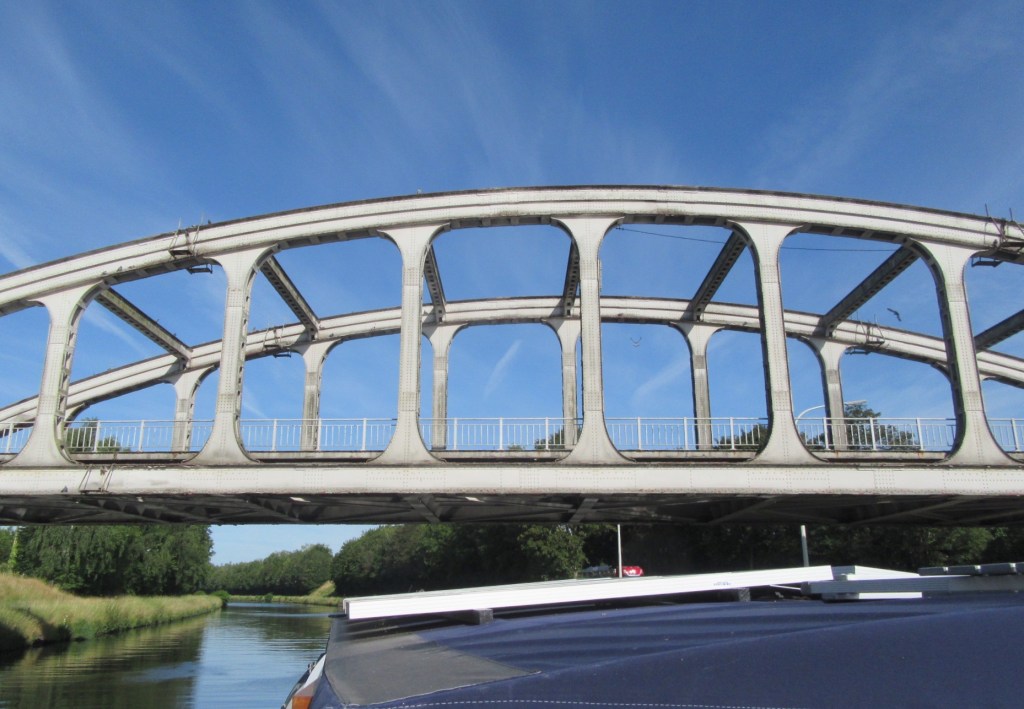
It was a day of bridges against the sky – one delightful outline after another. Here are a few to sample.

The cruising plan was to get most of the way along our 40kms of this canal, and finish it next day – and that is sort of what we did. We reached our plotted mooring at Weirs at about lunch time and, leaving the Captain to sort out our ropes (see above!) and in quite hot sun I marched the kilometre or two towards the village. I luckily found a Spar with ready made sandwiches after 20 minutes. That was lunch sorted!

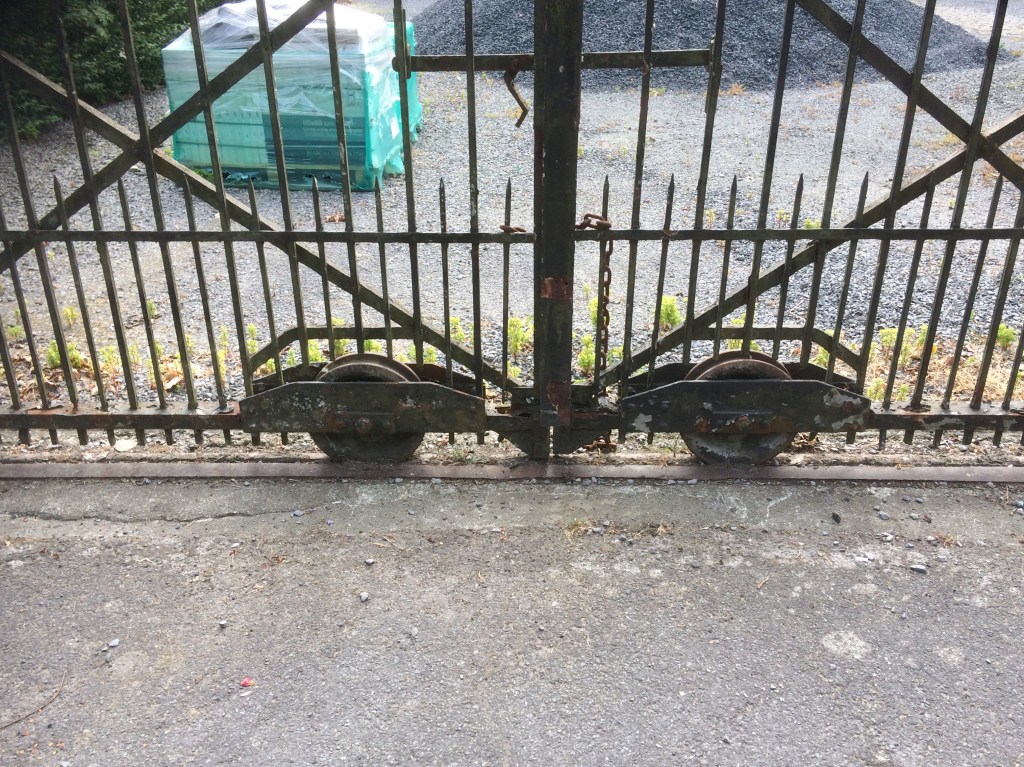
Later that afternoon I took a walk over the bridge to a distillery marked on the map. It was a small family run business making liqueurs from fruit and spirits, including an excellent pear brandy! The entrance to the ‘maison’ was through a gate on wheels that must have stood there since the start of the company.

So there we were, heading towards evening, a dot below the bridge, and talking to our Swedish yachting neighbours. They had heard that there was a 6 hour queue to go down the next lock, and this was corroborated by friends who went by and sent back a message.

After 7pm, when the locks closed, the Swede decided to get down to the lock ready for the morning to be, he hoped, first in queue. Soon after one then another huge commercial barge went by, then another.

By 9pm my Captain had decided that we too should get down there too and be near the front of the next day’s queue, so, with dusk closing in around us, and with or navigation lights aglow, we steamed the 4kms to Pommereuil lock.

Would we find anywhere too moor or not – that was one questions, closely followed by what wold we do if there was no space? As we approached through the gloom it looked as if we had finally lucked out. We could see through our binoculars about 6 large 80m barges – three old them rafters up against each other due to lack of mooring space.

We knew there was also a small quay for leisure boats and hopes we could fit next to the Swedish yacht, but there was a second boat there. Then, as we closed in on the lock, a space opened up between barges 4 and 5! In almost darkness we tied up to a strange high quay, moving fenders into unusual places to protect us overnight. And so to bed, expecting a lie in and a long wait to lock down next day.

between the two Péronne locks

But the next day began somewhat differently. The skipper got up at 5.45 to monitor progress. Two more 80m commercials had arrived and were floating about midstream as the first in the queue opposite us had fired up his engines, slipped his ropes and started edging towards the gate. Interestingly though, there was also movement on the two smaller boats and when Stewart radioed the lock to tentatively ask if there might be room for the third little boat he was told ‘Ouis si vous est rapide!’

Well rapide we were, and being woken by our engines starting and a loud ‘Ey up we’re off’ I threw some clothes on and climbed up the the wheelhouse to find the skipper in his slippers squeezing us into the tightest of spaces beside the stern of the giant peniche.

leaving Péronne 1 at 6.13am

We came out of Péronnes lock 1 (12.5m) and across the pond towards Péronnes 2 (5.6m) as dawn began to clear the sky.

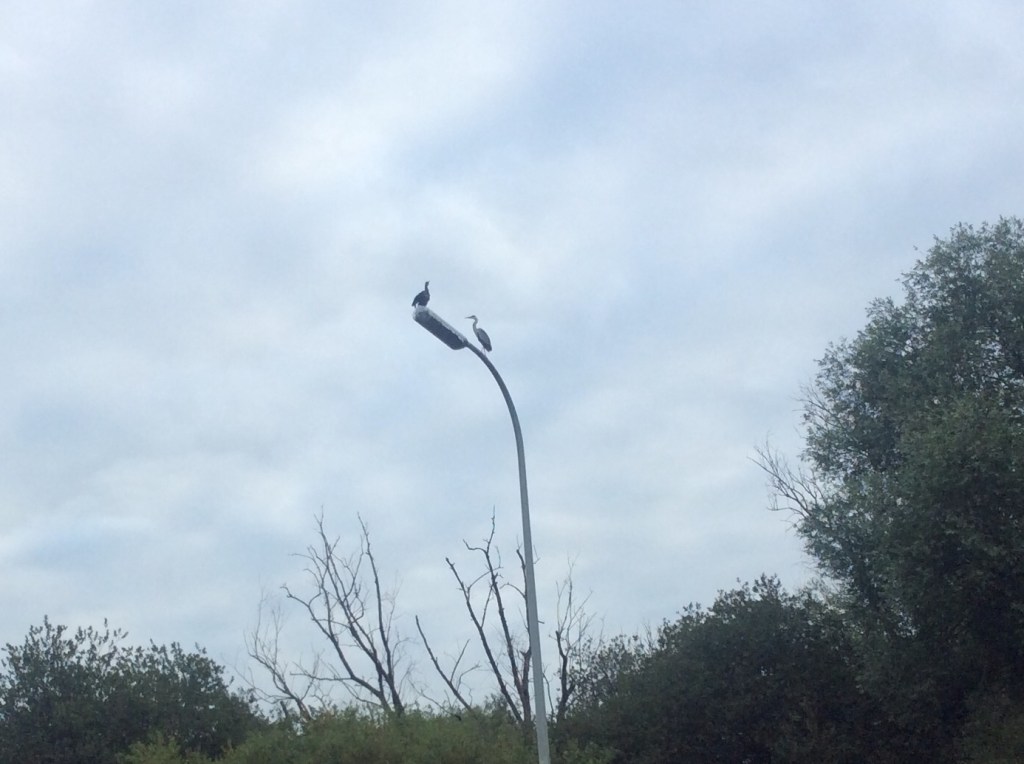
Not many up apart from the birds! This meeting between a heron and a cormorant looked conversational.

turning into the Haute Escaut river

And once through them both it was hard a’starboard onto the Haute Escaute river where a new adventure begins, and all still before 7am!

The river Meuse – La France a Belgique

Initially it didn’t seem so different, the change from the Canal de La Meuse to the actual river, probably because a lot of the canal section is actually on the river itself.

However as we progressed the geography changed hugely and spectacularly, as you will see.

We left Stenay after my early morning mammoth cycle ride up hill (again) to an Intermarché for a few essential supplies, including batteries for the bathroom scales s that I could find out of my diet and exercise efforts were making any difference at all. It was so nice to cycle before the heat rose – we were still in the middle of a major heatwave.

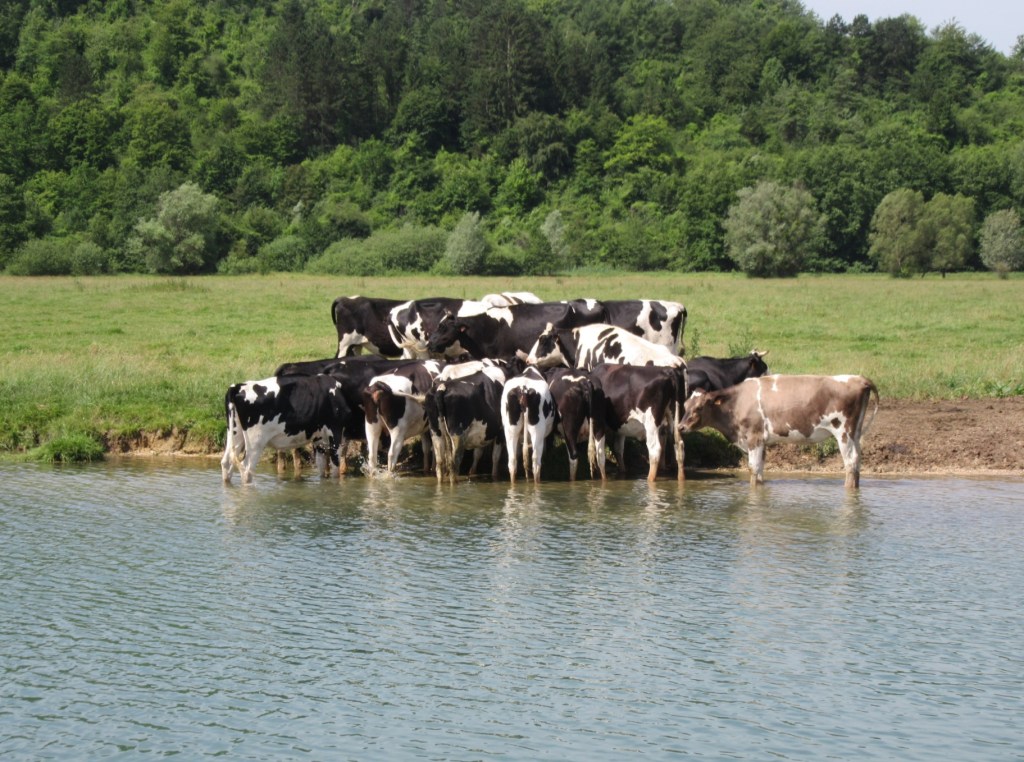
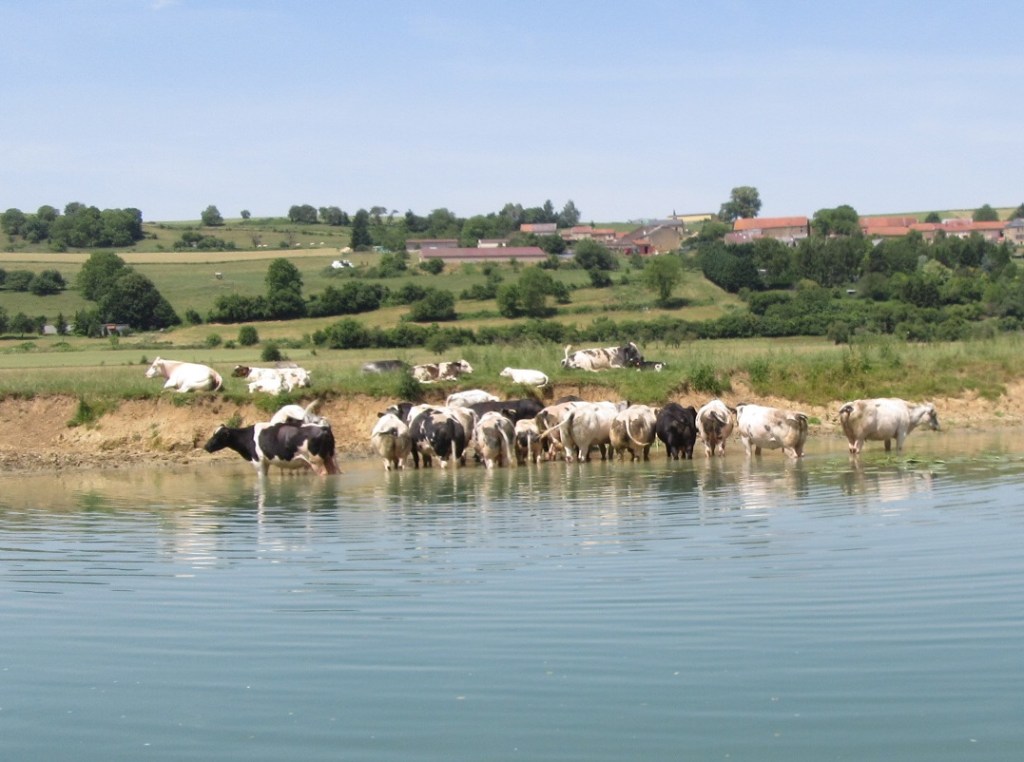
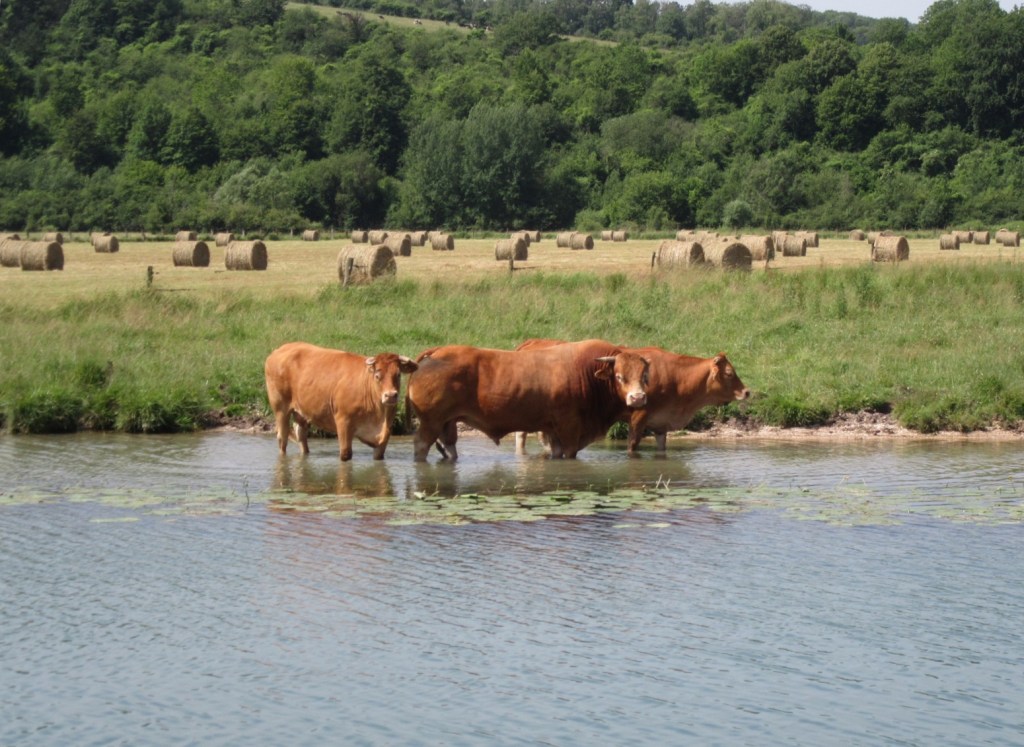
As we passed down the river we saw plenty of cows (and bulls) taking the sen foible choice, keeping cool in the river.

The day’s trip wound smoothly through meadows, past distant hills, and punctuated by stops at the locks. The high temperatures (34-36C) led to more than just cattle cooling off on the water!

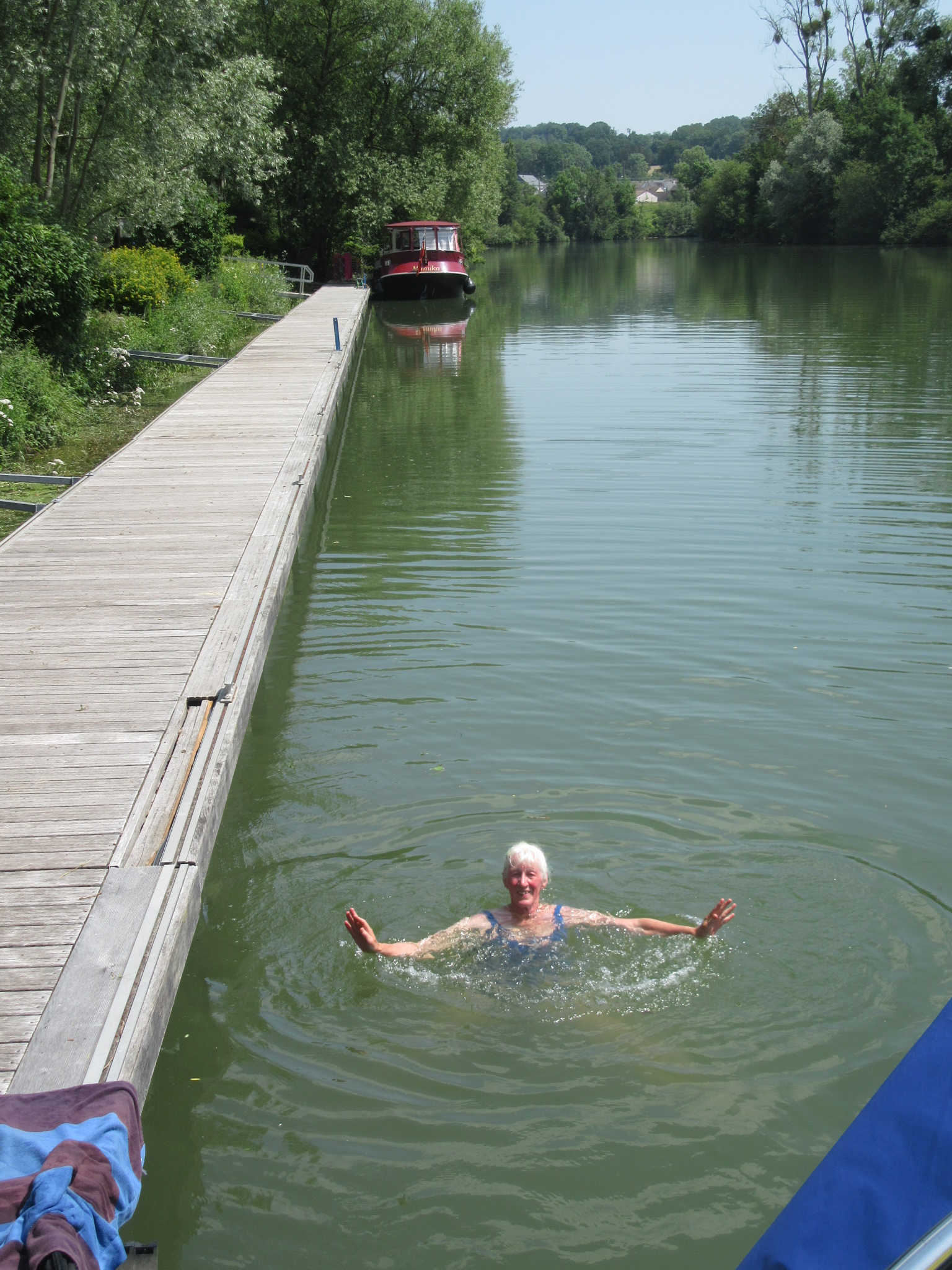
By the time we reached our semi-wild mooring at Pont Maugis I too was ready for a dip. But first we moored up to two far apart bollards, half hidden in the grass and put up the parasol.

I left Captain Stu to have his siesta while I wandered off to have a swim. Should be easy enough when you are travelling on a river! But in fact I struggled to find a place where I could enter, and more importantly exit, the water. Eventually I found nice smooth stones down to the water’s edge next to the overflow from above the lock – mmmmm – cold clear bubbling water.

Later, after supper, I was off for a camera walk to see what I could make of the reflections and the sunset. The light was amazing, and everything so still.

In the morning we were off to Lumes. We had hoped for an early starter at least a 9am get away when the lock opened. But we were faced with a red light and had to wait until a lock keeper came at about 9.20, first to bring a boat up, before we could lock down.

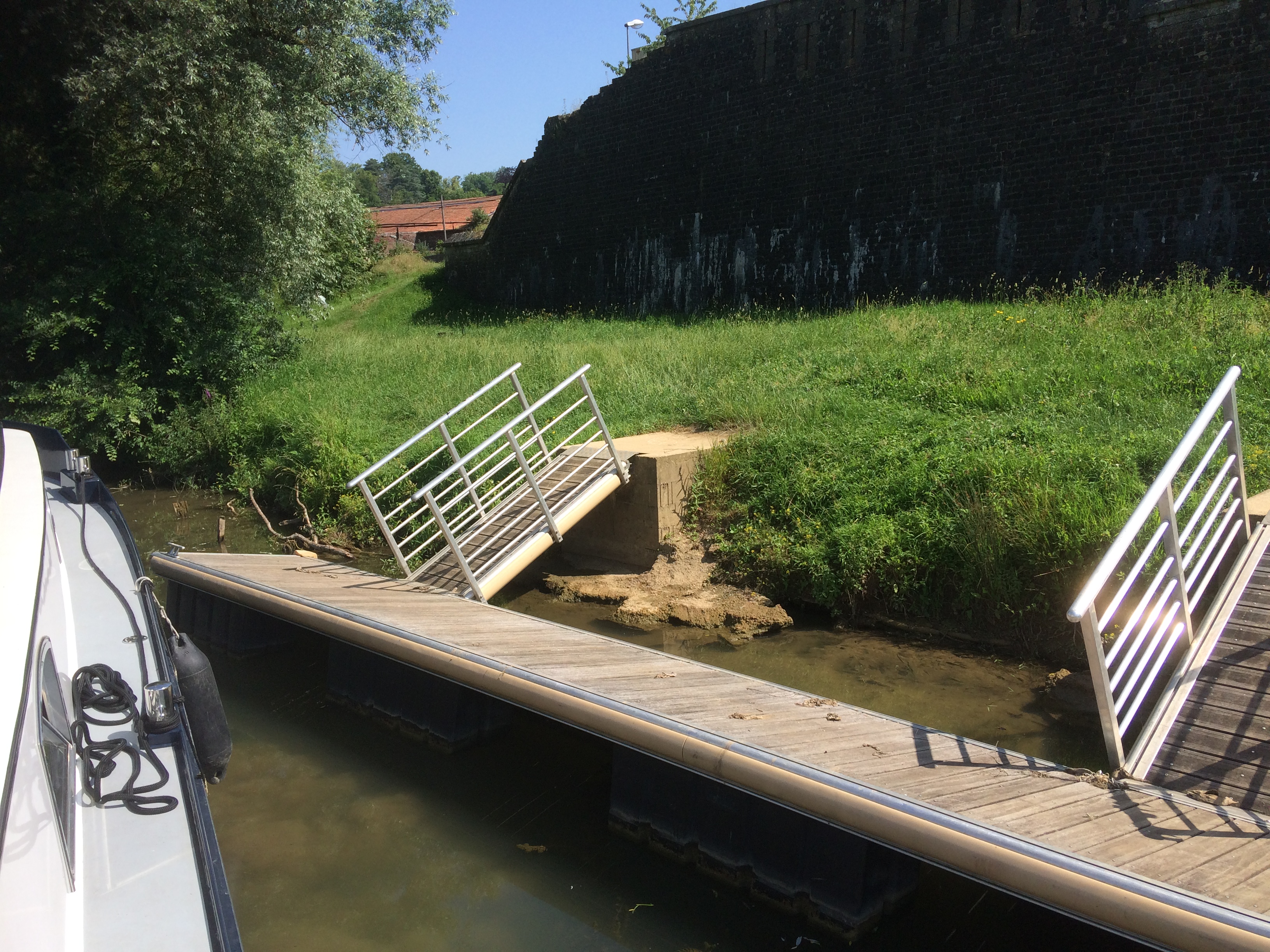
We stopped along the way for a little shopping (beer running low with all this hot weather). We knew there was a pontoon by a supermarket, but when we got there we found that it was at a very strange angle, due to the low water in the river.

And soon after that we saw some goats on the bank – not a usual sight along the Marne.

We found the excellent Lumes pontoon without any problem, immediately recognising the one other boat moored up at the other end, but before reacquainting ourselves with our Piper friends it was time to get over the sweltering heat with another swim in the marvellous Meuse.

The next cool down was cold beer – Cherry beer for me once the froth died down! It was a new one from Borgogne; highly recommended to those who like fruit flavoured beer.

The evening continued by taking advantage of the unexpected and delightful meeting with Vicky and Guy on Manuka; a great catch up on French barging experiences over the past three years.

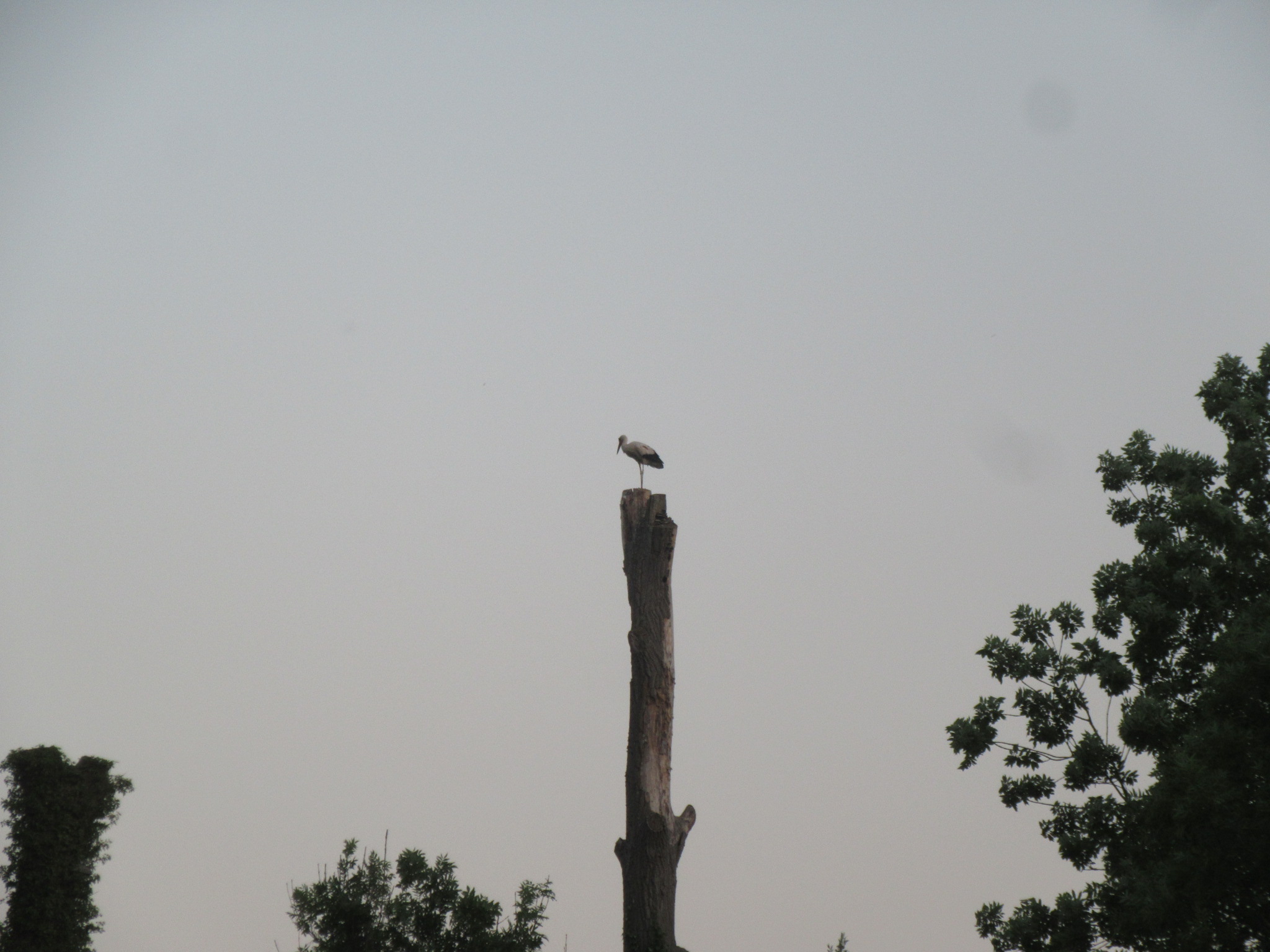
The DBA guide had an entry telling us to expect lots of kingfishers; sadly we did not see any, and in fact this year has been particularly devoid of them, but at twilight we did get a roosting stork just across the river.

Even after the beer, rosé wine and jollity I still managed a quick walk round Lumes before nightfall – a small village, but evidently one with some history.

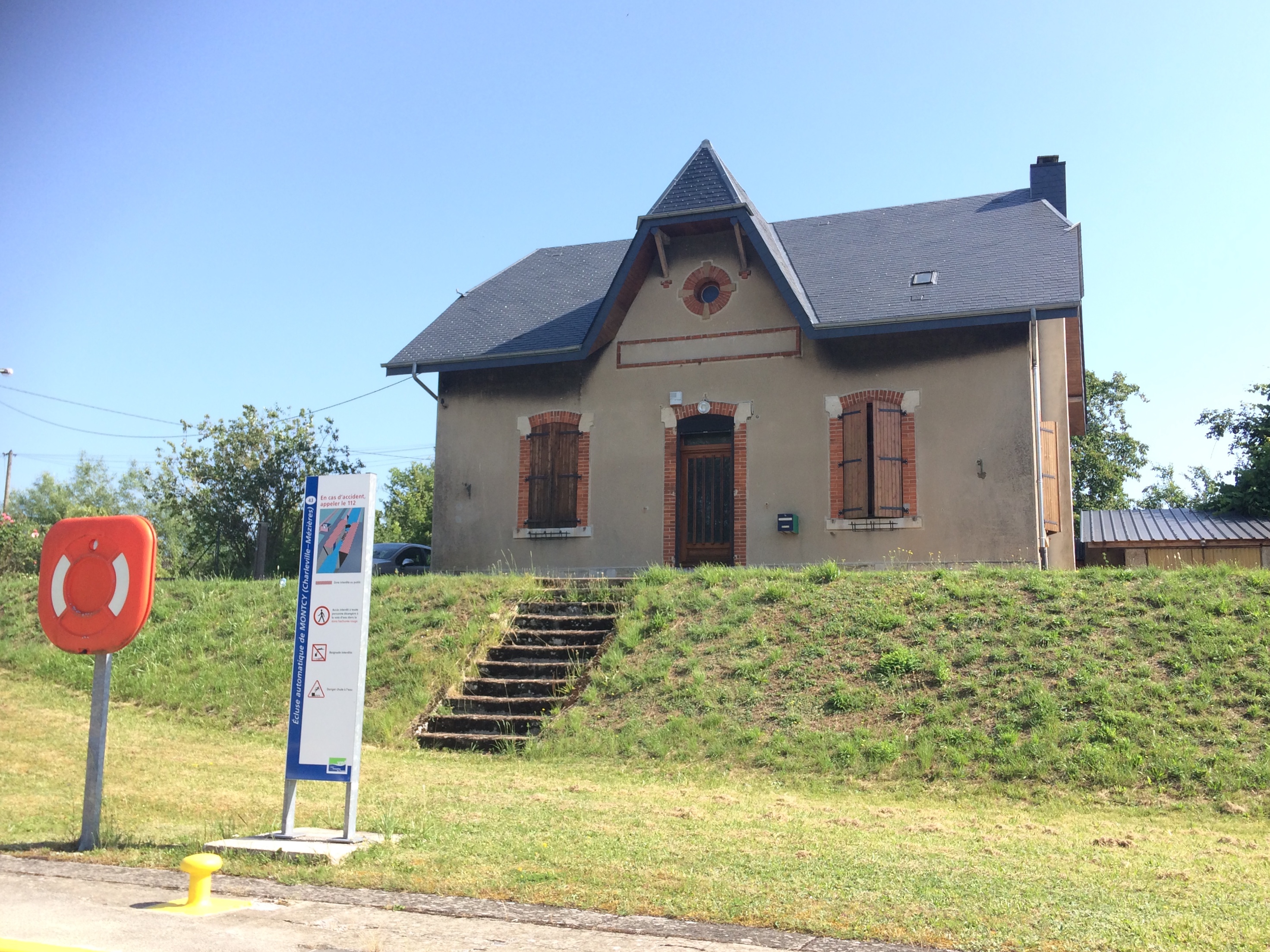
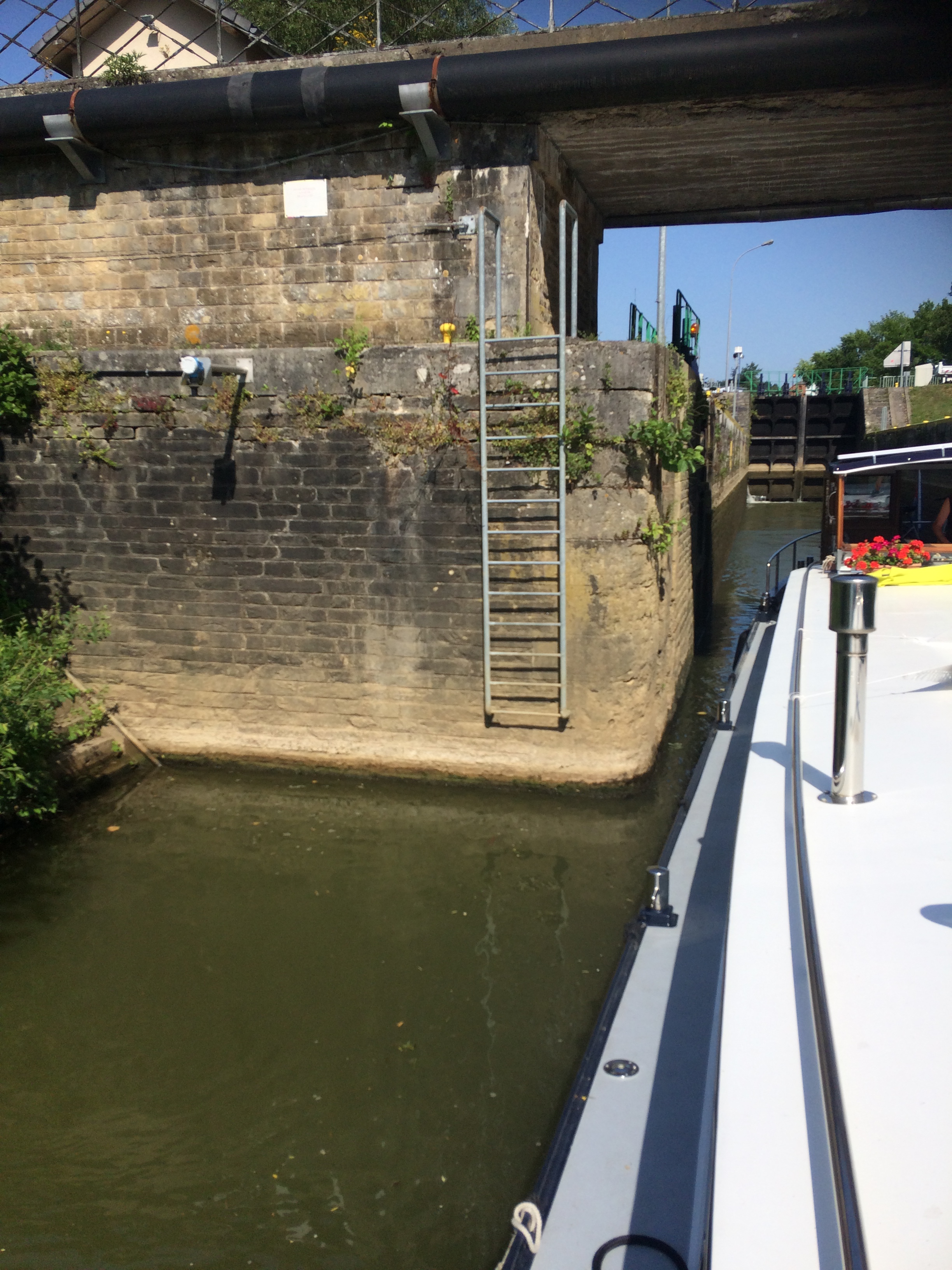
It was just a one night stop, setting off towards Chateau-Regnaut next day. The style of lock houses changed again, and we really began to notice the drop in water level in the river. At the lock on the photo above the ladder steps that should reach down under the water to help people get out, now end above the water level. Hope I don’t fall in!

We came down through the deeper locks of Charleville, but saw almost nothing of the town because the main loop of the river through the city has been cut off by a new shortcut.

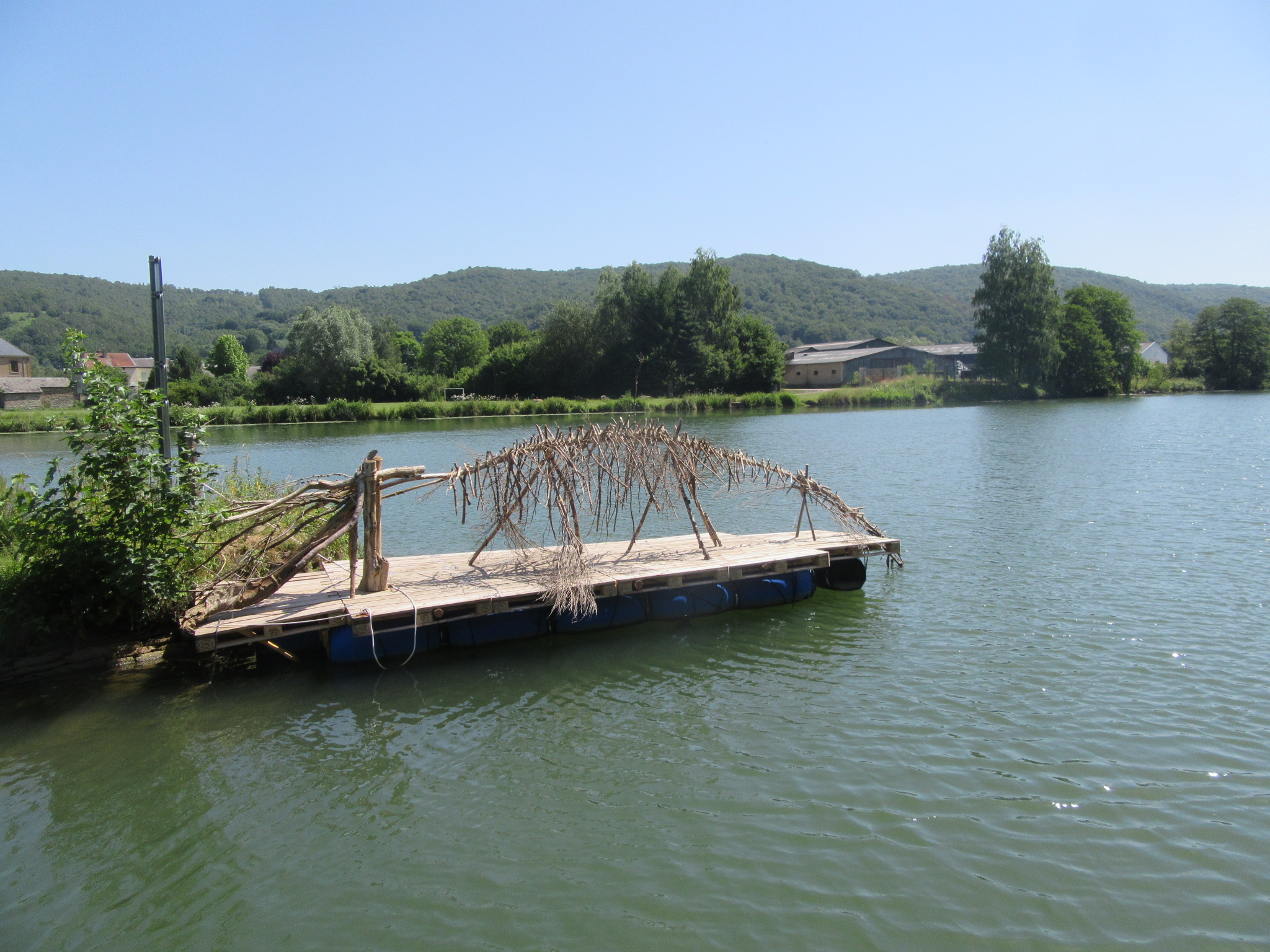
We started to see ever more spectacular views laid out before us from the top of each lock, and a wonderful stick dinosaur skeleton at the entrance to a lock cut!

We were lucky again with a nice pontoon mooring at Chateau-Regnaut, with a neighbourly noisy frog in the evening , and inquisitive greedy geese in the morning.

It was still very hot – so much so that it was affecting the geraniums, which usually thrive in a Mediterranean style climate, so much soaking required. Suits me – anything that gets me into or almost into the water.

We went for our customary walk around village as usual, calling in at the Capitainerie on the other side of the river next to the camper van park. She had helpfully lent us the correct connector to the water supply when she came for the tarif. As we crossed back over the bridge our shadows were starkly delineated by the high bright sun.

There was a fair amount of crashing and banging early next morning, from the opposite bank. I had read that the region was famous for its metal work; I should have recognised the logo symbol on the factory wall!

The village obviously celebrated its metal-ness with this fabulous 9 foot high horse.

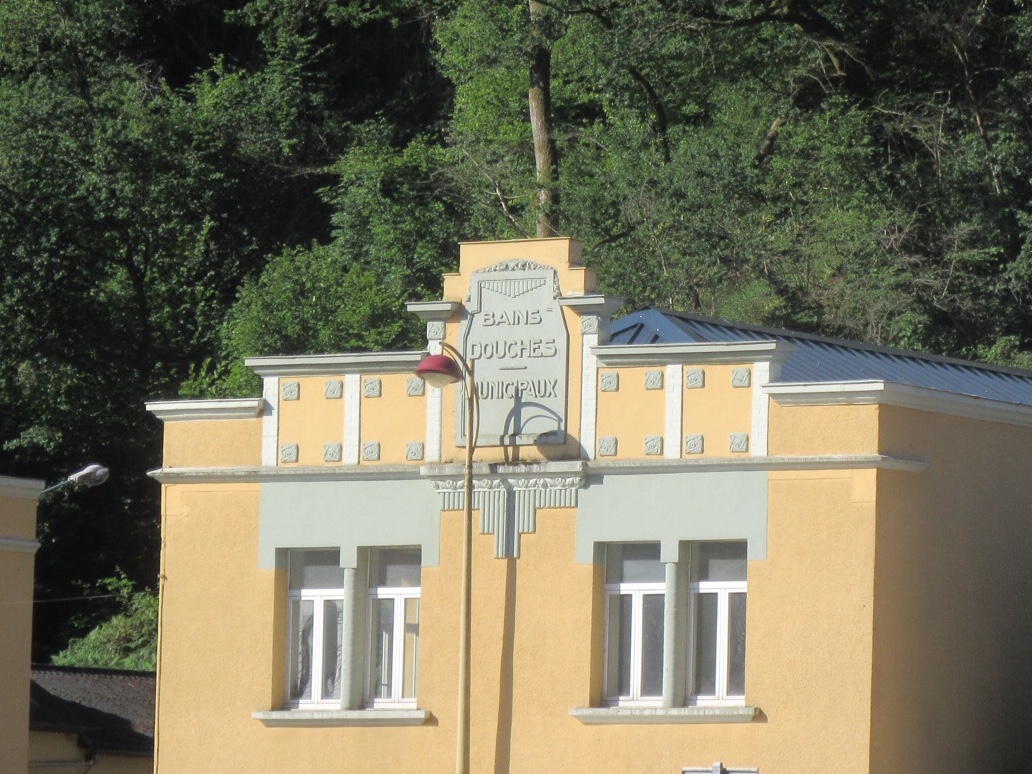
As we left Chateau-Regnaut we were starting to see the Belgian influence in the gable ends of houses, and also rather liked the very art deco municipal baths

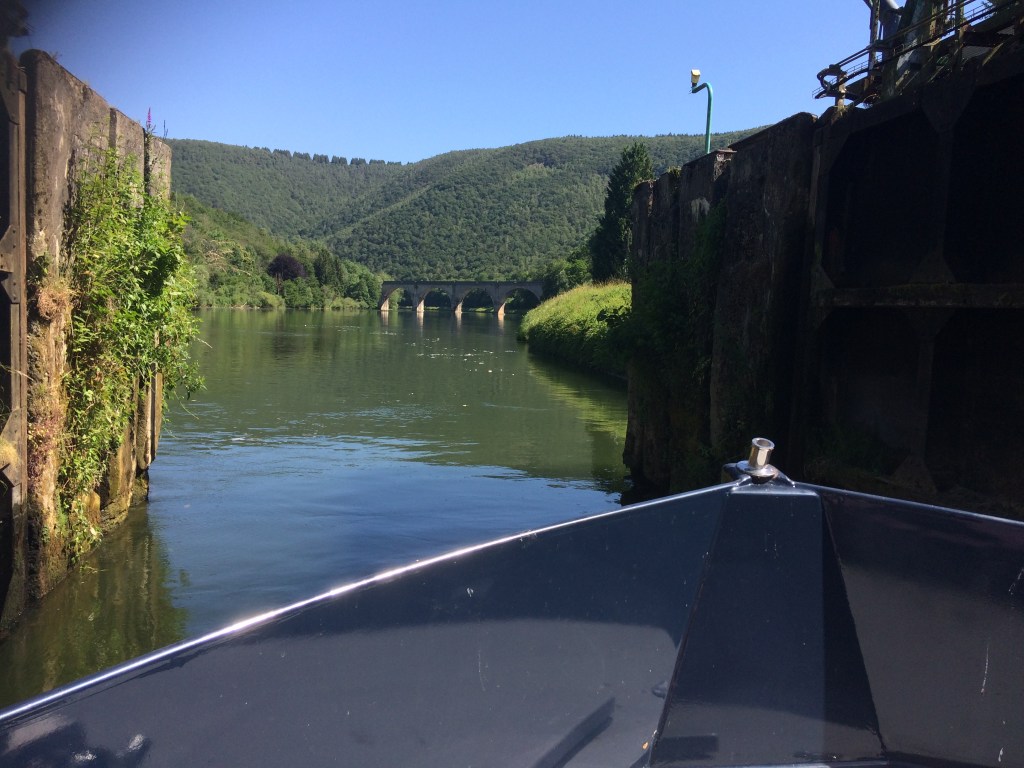
A bit further along the river bank I saw some intriguing parts of the river’s history. Above are photos of a lovely old lock wall, made of individual stones. We also passed a fascinating, complicated, still in use, sluice mechanism; it was being used as we went by.

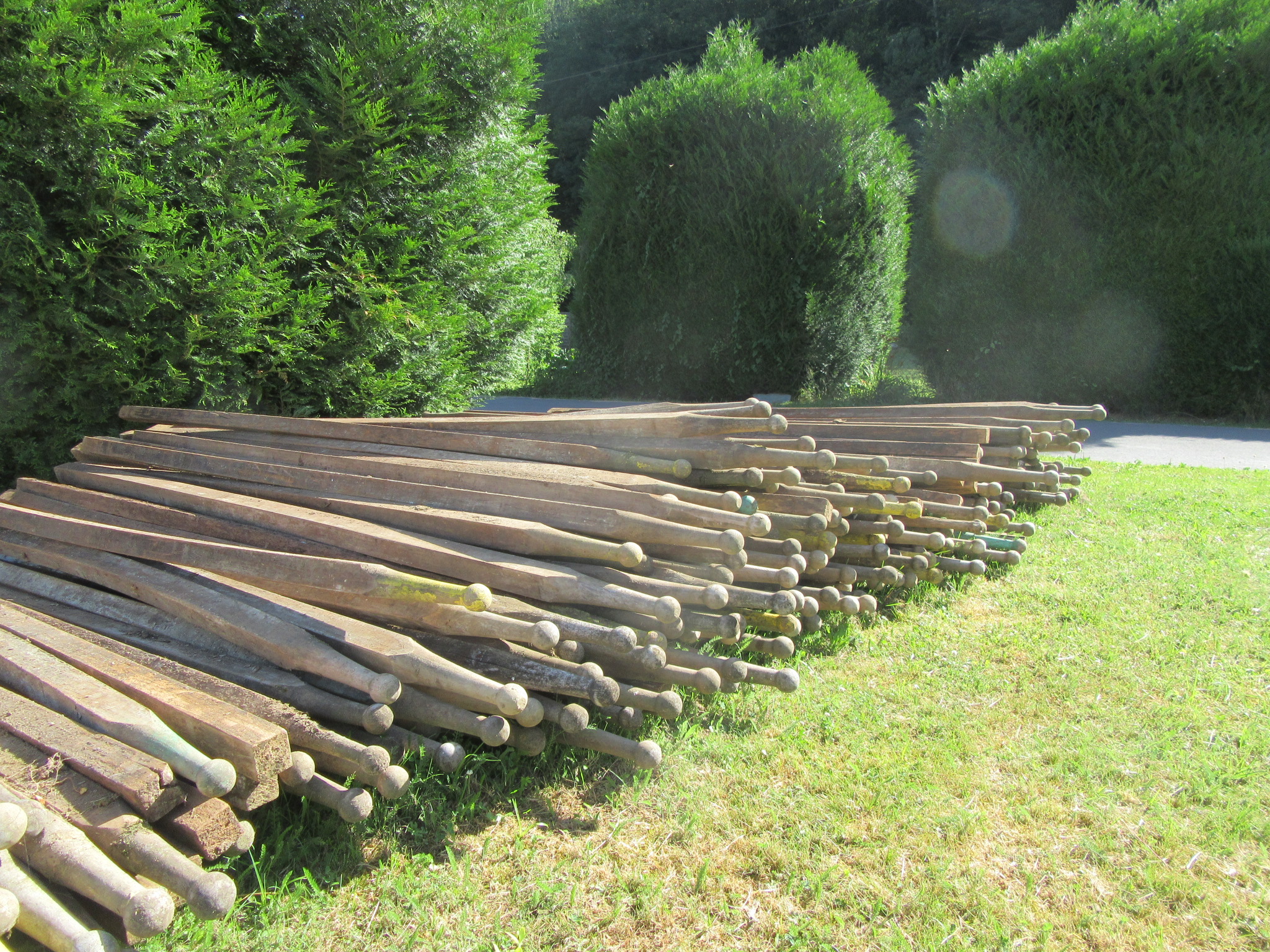
Then there was my greatest excitement – a pile of needles for an aiguille (or needle) weir. These weirs have always appeared to me, but have largely disappeared and are replaced with modern technology weirs.

They comprise of a complete wall of wooden needles, with walkway behind, and were operated by a man (think it was always a man) walking along and adding or removing needles to control the flow of water – a very dangerous job in some weathers.

There’s link below to a 9 minute explanation (in French) of how they are built.

We kept being amazed by the wondrous scenery. Round every bend, and from the top of each lock, we were stunned into silence by yet another vista of blues and greens, with occasional villages and spires.

At Dames des Meuses lock there is an old pont-levée, seemingly always open, pushing its rusty metalwork into the sky, and just nicely setting off the Captains’s neat rope work.

And we glided out of that lock into more scenery to gawp at, including a lovely topiary effect on the top of the hill.

Later that morning we arrived in Revin, passing the tunnel on our right that we would go through the next day (see boat just coming out of the tunnel channel) and wondering if we would find a place to moor the other side of the bridge.

Our hot spirits raised as we saw a long empty stretch of quay! (Yes, the heatwave was still on). Not long before I had found a boulangerie with a ham baguette for Stewart’s lunch and some delicious ‘pain complet’ for me to have with hummus and salad.

Revin is a very well run port. It is totally enclosed, with code numbers for the gates, a pleasant garden, tables and chairs in the shade, and the usual showers etc. It was €14 a night for our 20m boat, worth every penny.

Once fed, watered and rested we went shopping. That’s met a usual past time for us but Stu needed some cool short sleeved shirts and there was a clothing superstore within a 5 minute walk.

We also managed a good food shop, stocking up so that we could aim for rural moorings over the next few days.

Work done we decided that our walking tour of the old town, the other side of the river, should include a beer and a pizza. Both were easy to find, and worth the walk.

Back on board, with the sun going down and night drawing in, Stewart spotted a young cormorant that had flown up onto a high branch instead of going back to nest with its mother. It was there for ages – and not there in the morning, so we presume all was well in the end.

There was a shiny metallic smooth sheen to the water in the morning; a lovely backdrop to breakfast, before another boulangerie trip, which this time included some galettes de Revin, to be enjoyed next time we have visitors.

Off we set for our trip through the tunnel , which began by Calliope needing to make a 180 degree turn into the tunnel channel. Always fun being cross ways to the stream, wondering if anything will come speeding round a bend into you. But all was well and we were back onto the river with its mountain high tree covered banks, blue sky, and more hot hot sun.

We hadn’t encountered a broken lock for some time, so it was a bit of a surprise. Stewart managed to out me ashore to walk up and phone for assistance (no mobile reception out where we were), at which point I discovered a cross and overheated German man, whose boat was stuck at the bottom of the lock; he had been waiting for an hour for service, (‘shitting in the shade’ as he told me!)

The wait was not so bad for me with shade, several ripe cherry trees, and an old sluice to keep me amused. In fact the VNF man arrived within ten minutes and we were soon on our way again.

We arrived in Heybes, thinking we would stop there just for lunch, but we settled into the mooring, realised it was still hot and we were tired, and decided to stay the night.

Heybes and surrounding area is famous for its slate mines, so it was not surprising to see some wonderful slate roofs, this one being the town hall.

What a history this village has. Heybes is another of these villages totally destroyed in WW1. across a period of just 3 days in August 1914 the village was bombed and burnt to the ground with 600 houses destroyed and 61 civilians killed. I am pleased to say that it is now rebuilt and thriving.

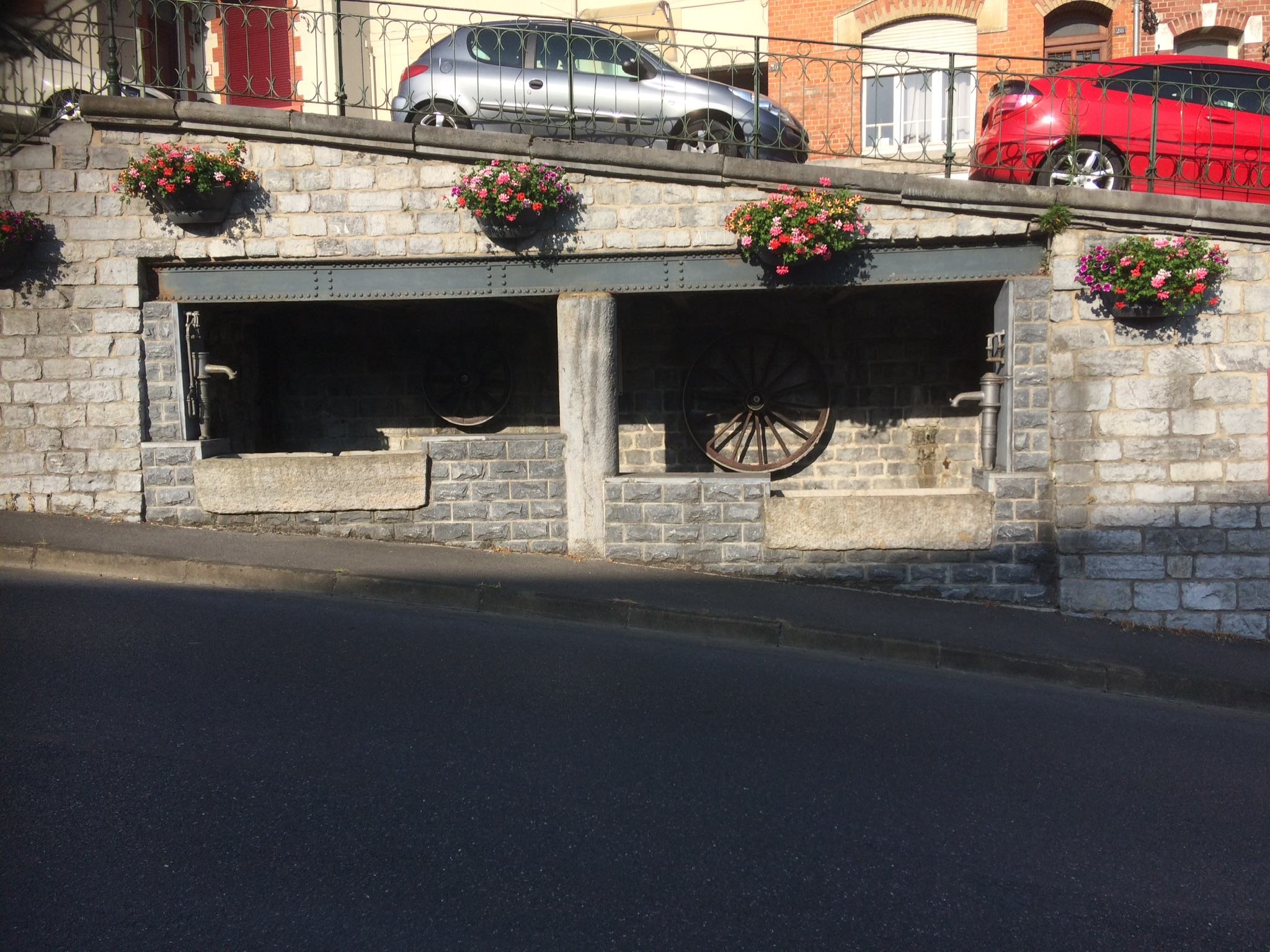
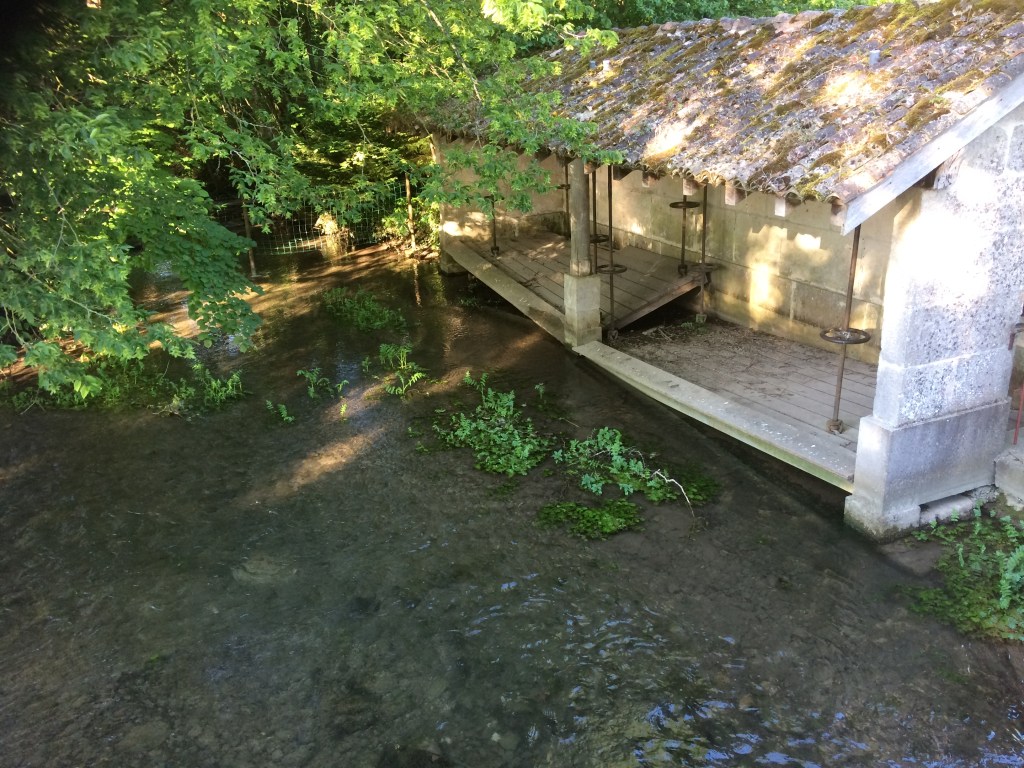
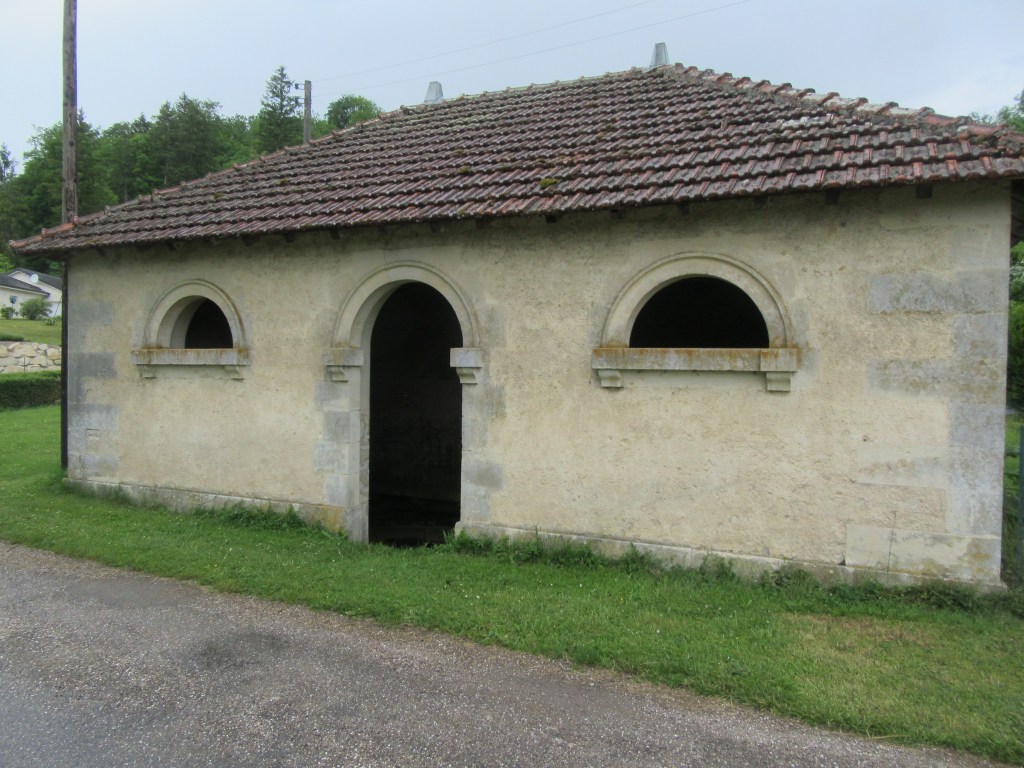
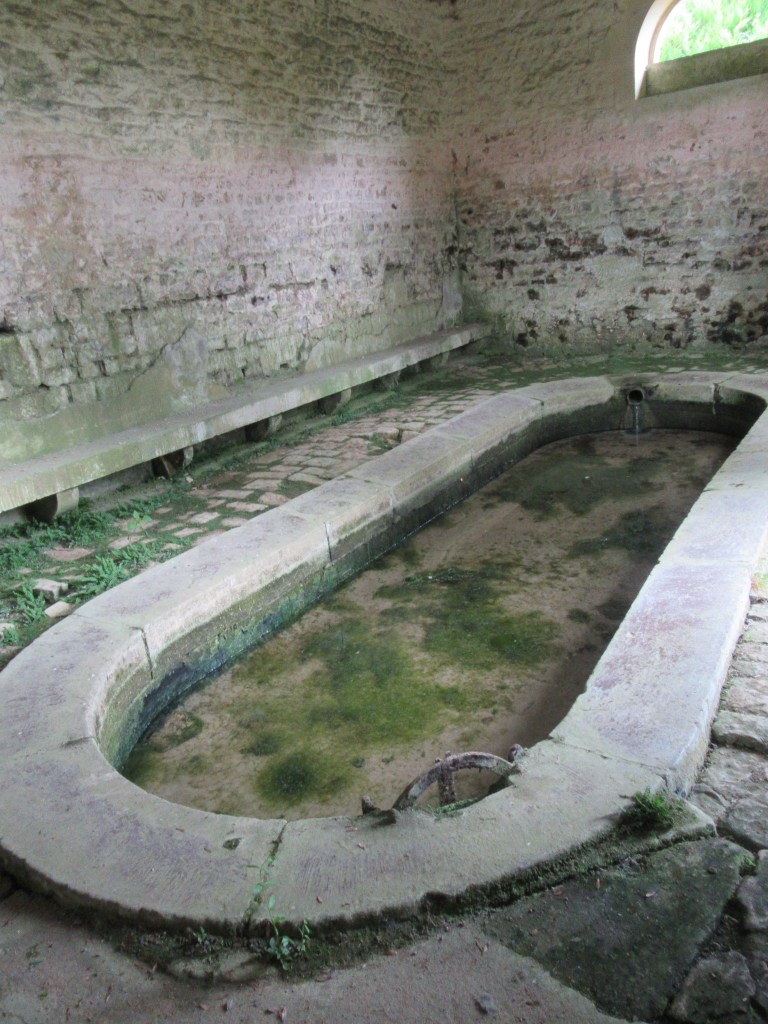
Prior to the war the village had 8 lavoirs. Once there was a new water supply it was thought that only one was needed, and this was rebuilt into the slope up to a higher row of houses. The image on the left is as it is now; the one on the right is from the past, with lavoir half way down the hill in the same position.

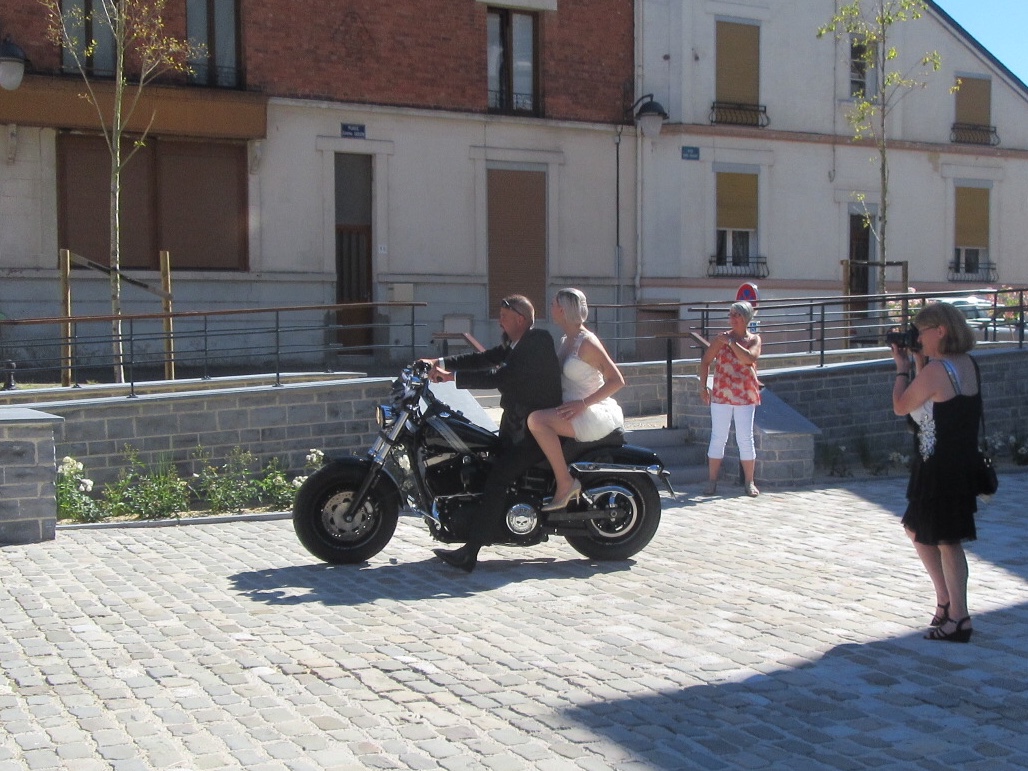
The walk round this village was disturbed by a loud revving of motor bike engines. Closer inspection revealed a biker’s wedding at the church, with all their friends outside revving their bikes. The bride and groom sped away helmet-less on a Harley, she in high heels.

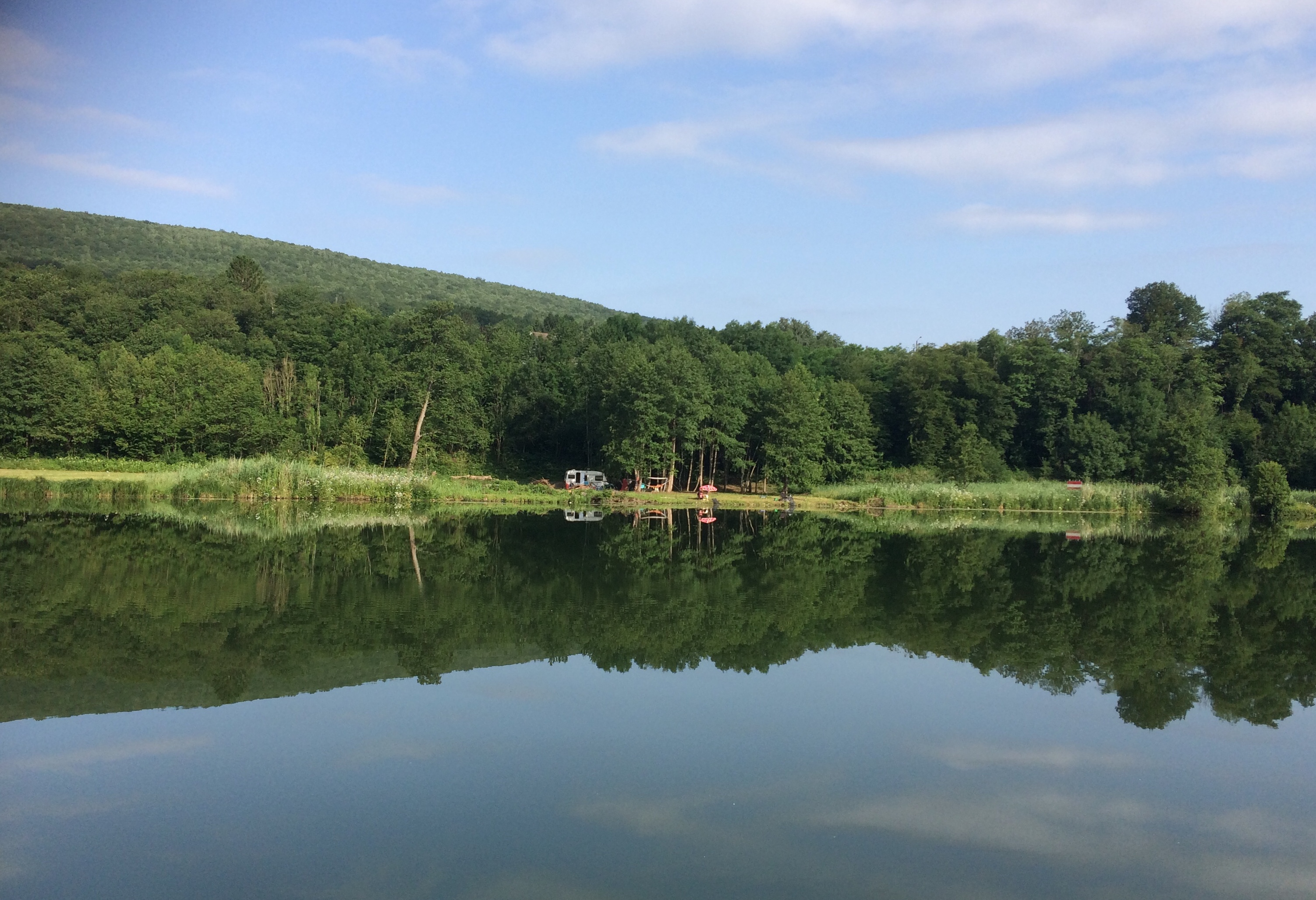
Still on our mission to reach Lille we again only stayed the one night. As we began the next day’s journey I spotted a fishing party camped out in a picturesque curve of the river – a heavenly spot.

We were now heading for the Ham tunnel, a 500m tunnel that saves a 8km loop in the river.

The entrance to the cut leading to the tunnel had an other old pont levée, left continuously in a part open position, maybe signifying the height of the tunnel to come!

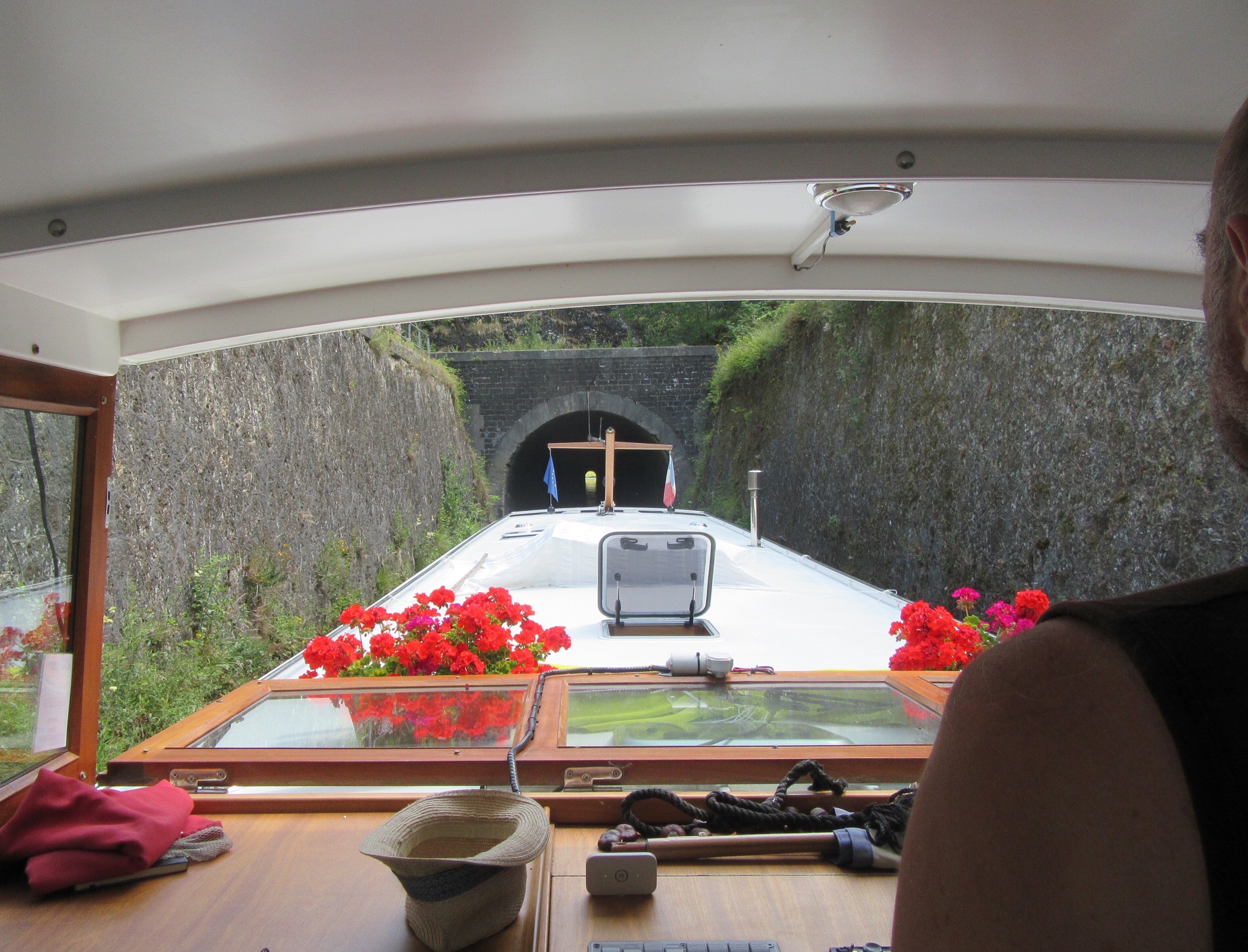
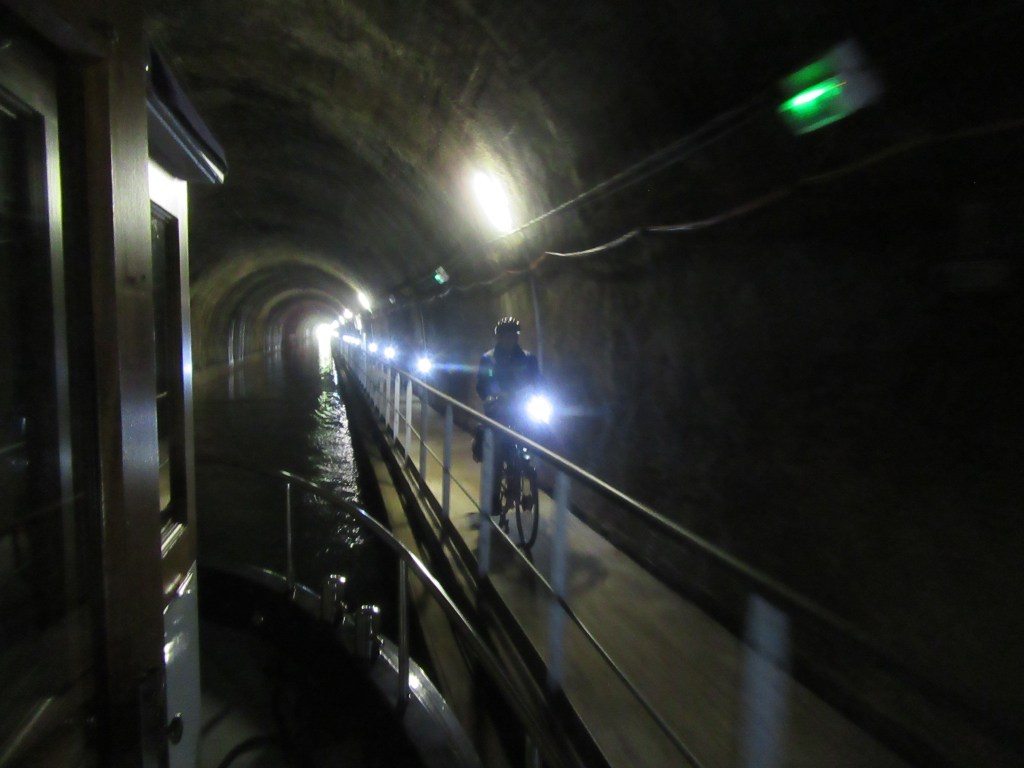
Here we are going into the tunnel entrance. It has an interesting ‘ceiling’ roughly hewn out of the solid rock and unlined most of the way through, among for rather uneven heights along the way.

Coming out of the tunnel is quite an experience as you go straight into a lock, and look out over a wide valley, with a different landscape.

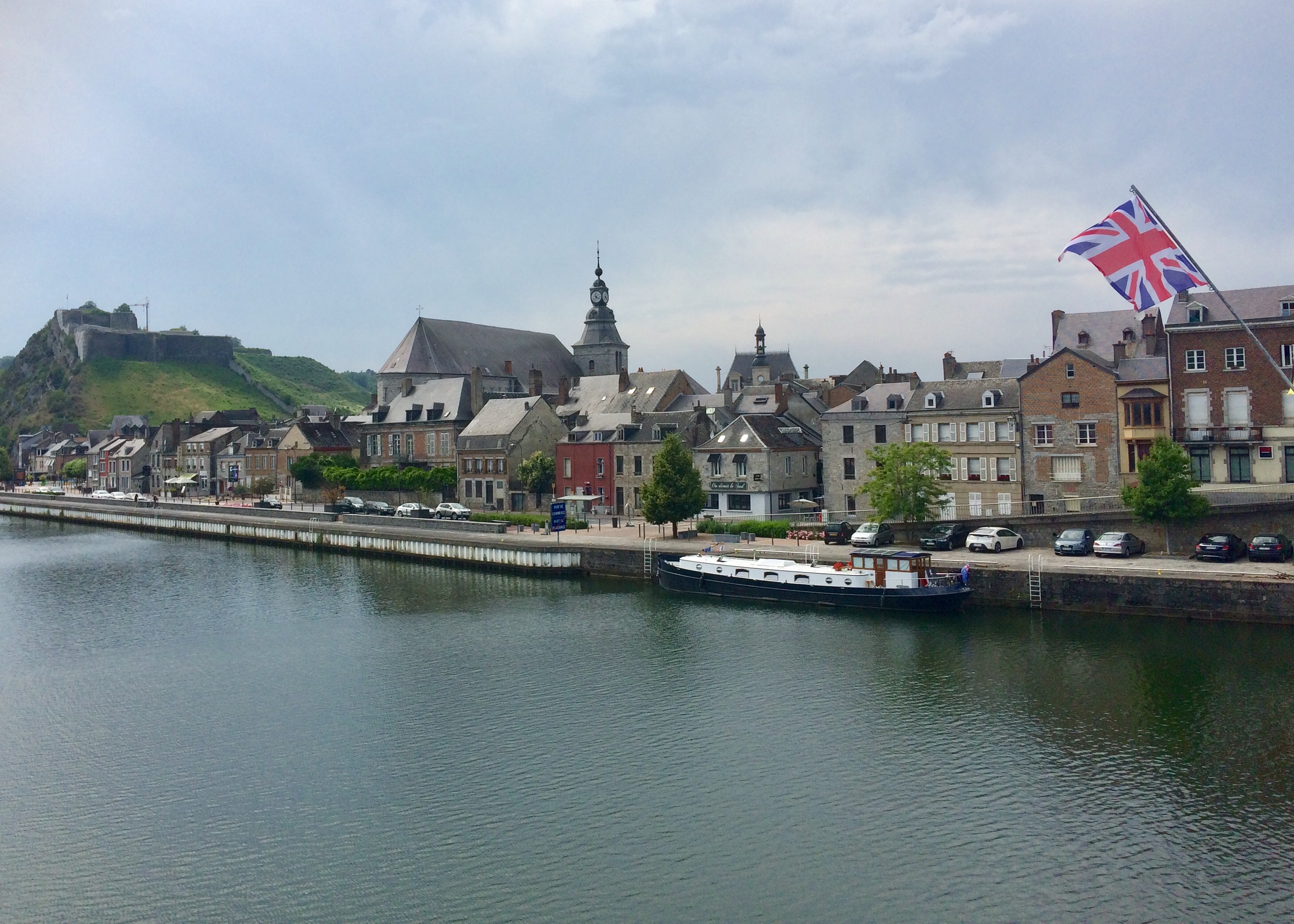
That was our last lock down into the town of Givet with its towers and its citadel up on the hill – but more spectacular citadels are to come.

We moored on the quay opposite the main marina, which only has space for smaller boats, but we had our very own ladder to climb off and on and were quite happy there.

As evening drew on we watched storm clouds gather – and indeed rain did, at last, fall that night, thank goodness! The heatwave was ending.

Next day saw another change. Suddenly we were amongst the big boys! Just down from Givet is the écluse named les 4 Chiminées. This has been brought up to European standards, so the large commercial barges can now come to the port there, loading, unloading, and feeding the swans!

From now on we would be sharing the water and locks with these sturdy guys.

And a third big change was the change of country. Our last lock in France and into Belgium we go! Wallonia to be precise.

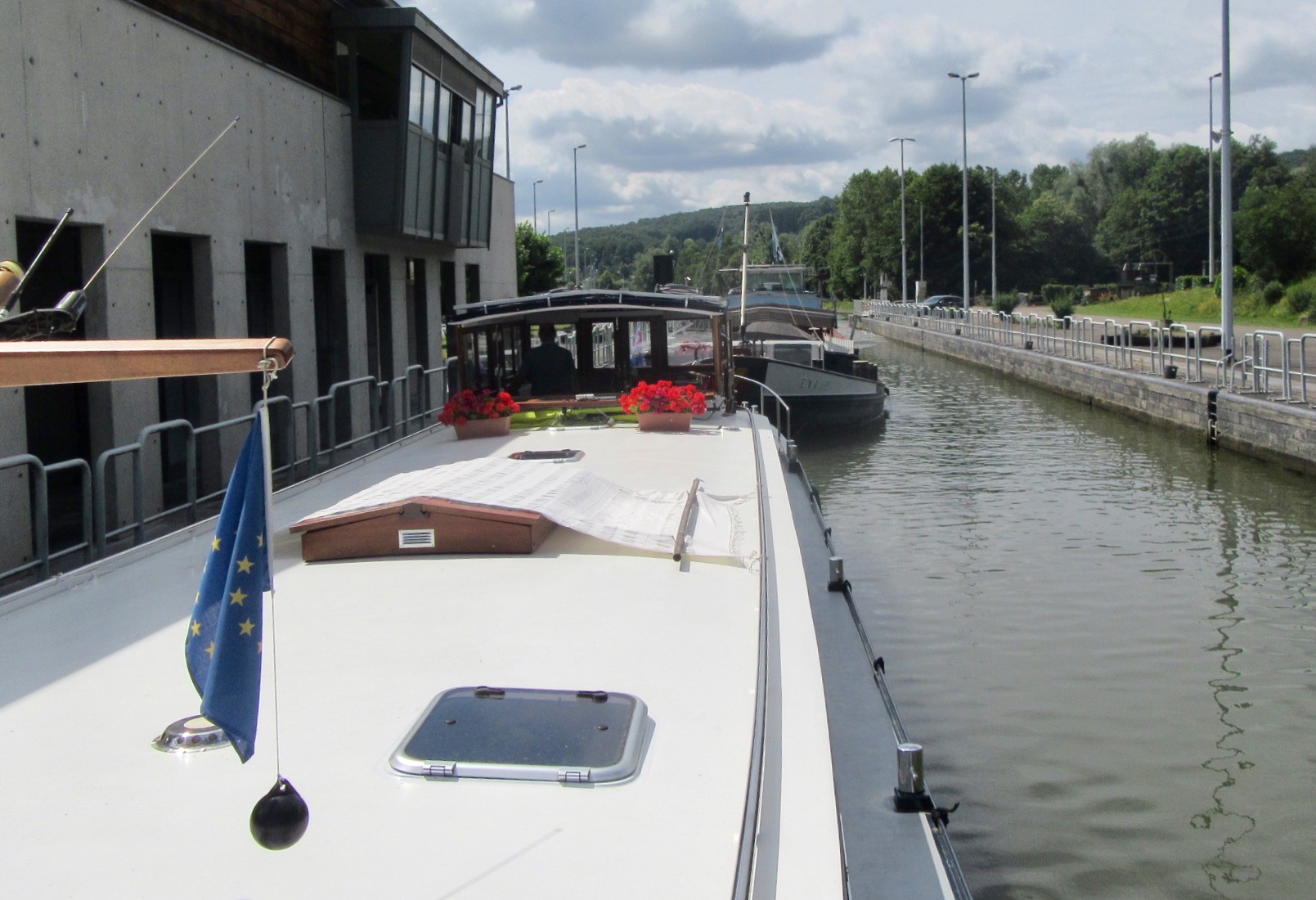
Lots of things seemed different – the width and length of the locks, the shape and size of the lock gates, the sudden surprise when a huge quiet barge creeps up behind to share the lock with you.

Commercials have the right of way, and this definitely slowed our progress on this stretch. We waited 40 minutes at the forest lock, another 30 at the next, both for barges to come up, and for barges to join us to go down.

All good testing experiences. (ok that’s not a sentence because it hasn’t got a verb, but it works for me.)

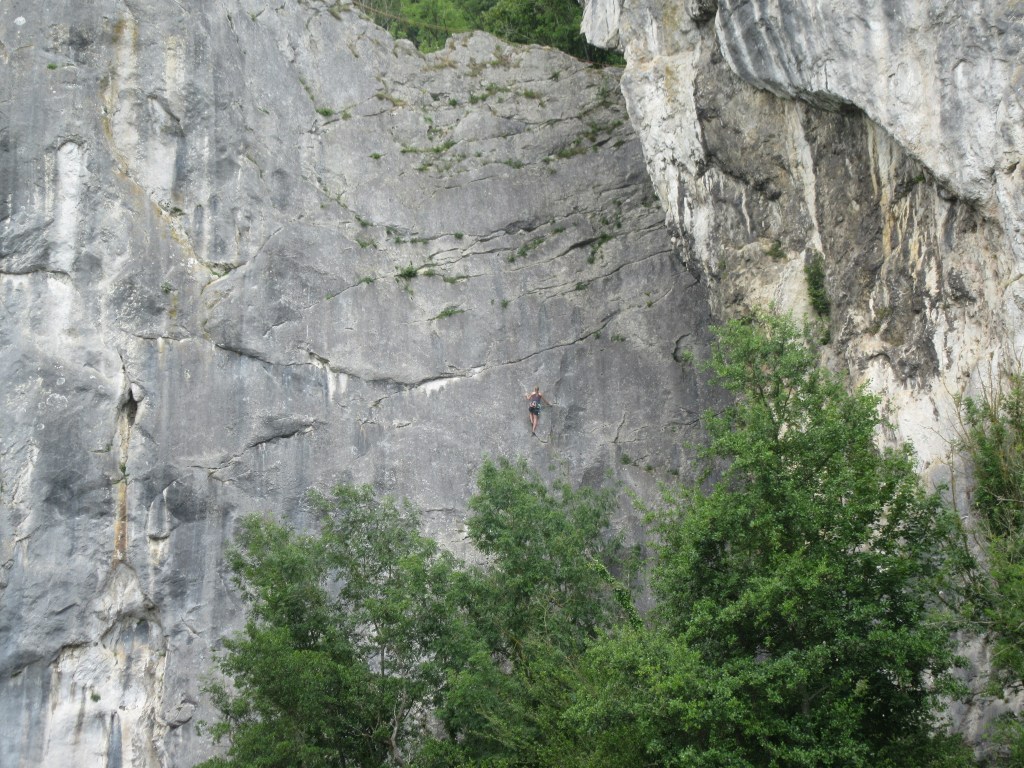
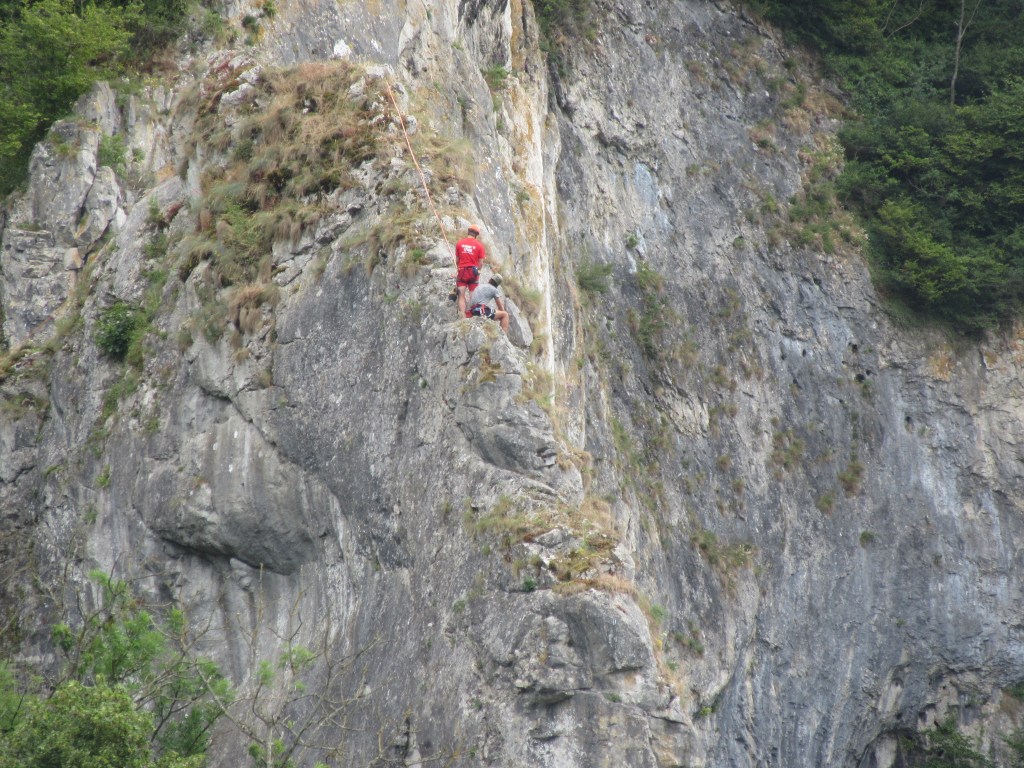
I have mentioned the landscape becoming more cliff like, and so much so that it attracts lots of climbers. These are the Rochers de Freyr, south of Dinant. There is a climber in the top left photo, so small she was like a spider on a wall.

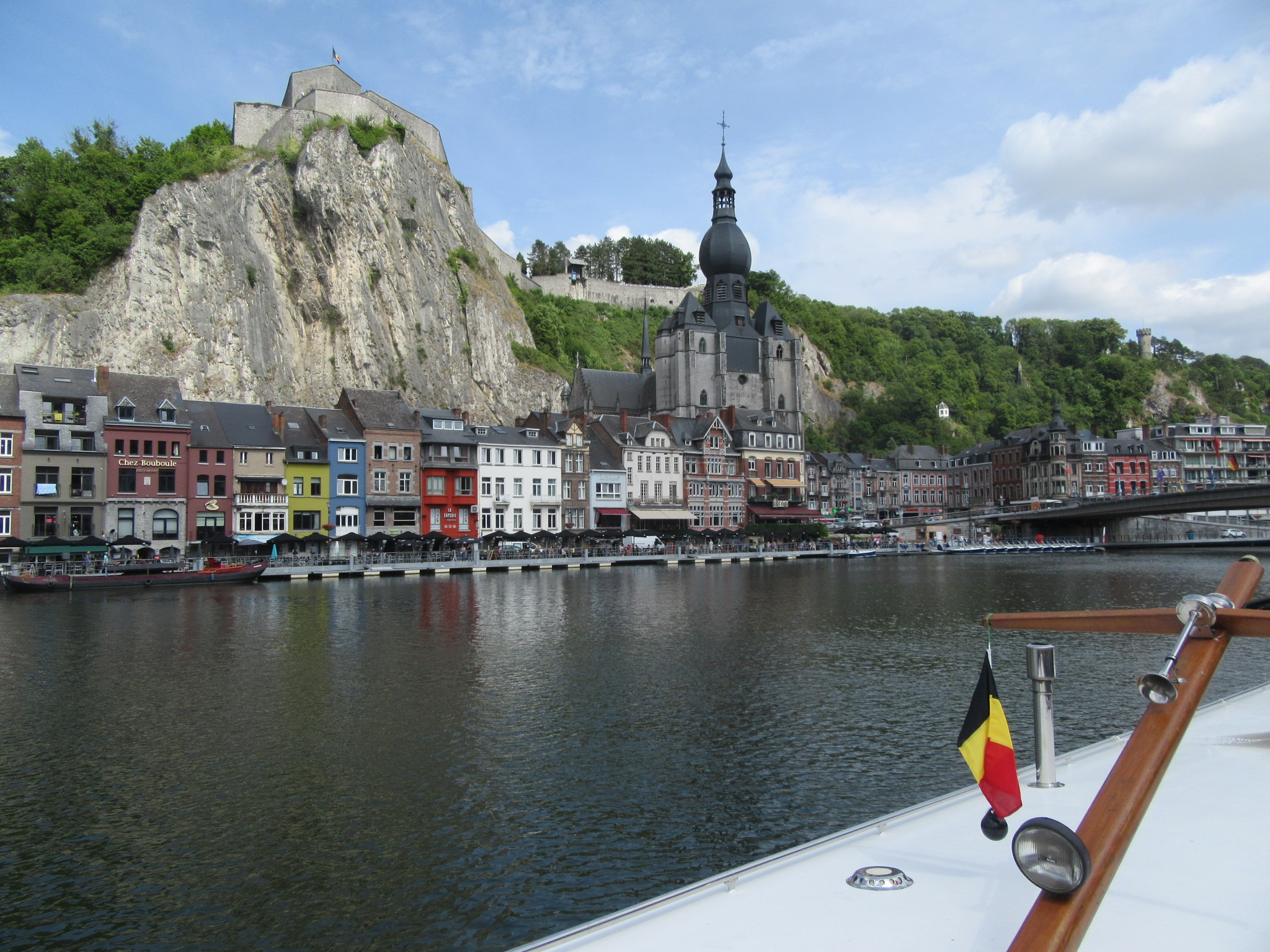
It turned out to be a long long day, mainly due to waiting at locks, so we were pleased to arrive at Dinant. We used advice from another bargee about where to moor and were pleased we had used his choice. We had the best views across the river to the Dinant citadel and church, away from the bustle of quayside bars and restaurants. And – after looking at an increasingly faded French courtesy flag for 3 or 4 years – we have a new shiny Belgian one.

I think we all know that the Belgians are famous for their beer, so no surprise that we found this shop, but did not dare go inside! It turns out that Dinant is the famed home of one of the most widespread Belgian beers – Leffe – which was brewed at the Abbey on the outskirts of the town. I dont know what the monks would think of the modern brews like Rituel (subtle flavours of fruit and bitter spices) or Radieuse (delicate hints of citrus and coriander seeds), but I plan to try them.

Stewart began the tasting experience with a Leffe blond outside the restaurant where we had our dinner. I had a Picon beer, more common in the north where it they also serve Picon wine.

And for me the first dinner in Belgium had to be moules, this time with garlic and cream. Mmmmm. Tasty.

But Dinant is famous for something else too – something I had no idea about beforehand.

The saxophone.

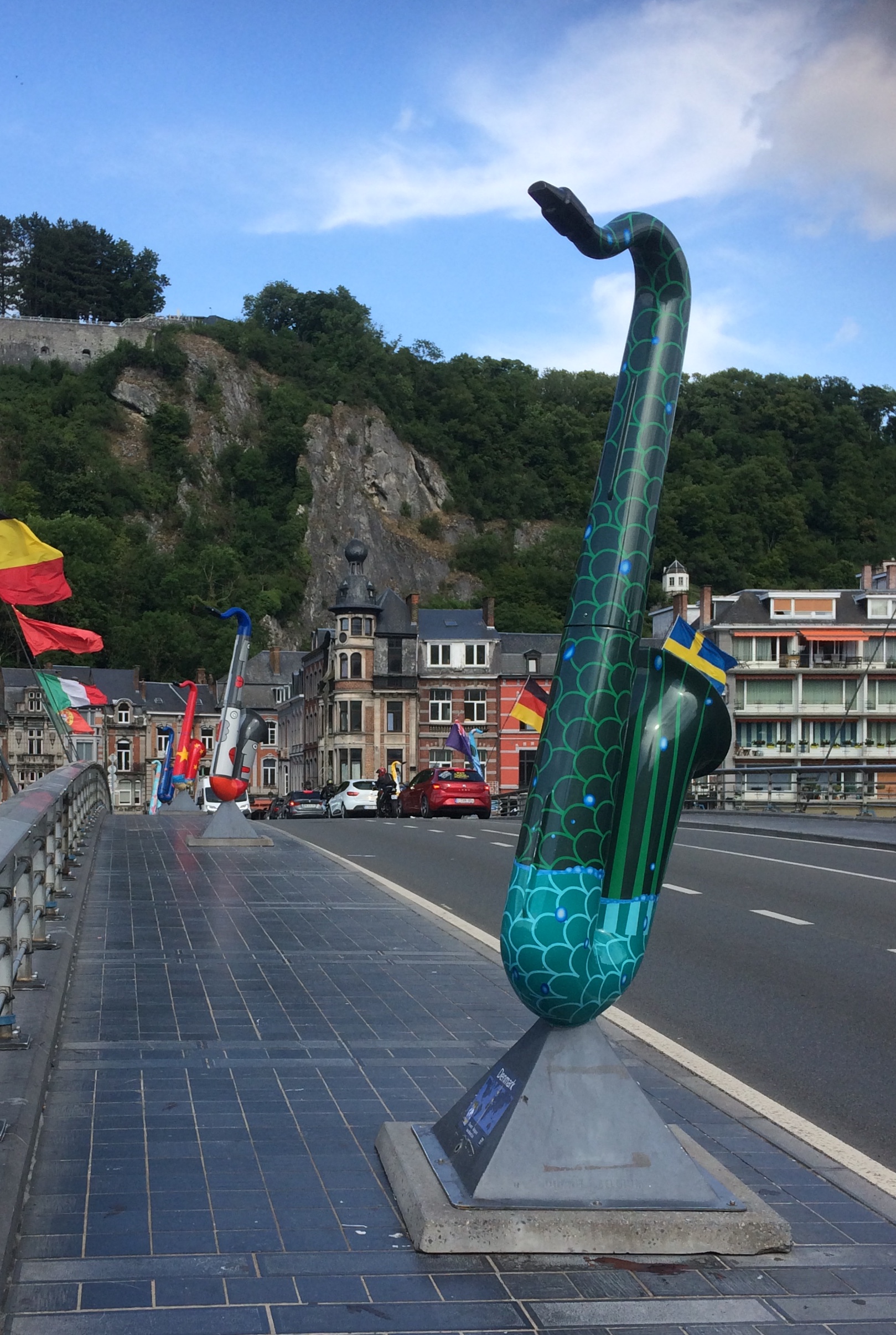
There were saxophones everywhere – madly coloured ones that somehow represented all different countries round the world, silhouettes attached to lamp posts, a huge glass one in front of the town hall, and one in the arms of Adolph Sax’s statue next to where he was born.

The moules gave me such energy that I washed down one side of the boat with these amazing views to keep me company as evening wore on.

We set off early (for us) with our first Belgian baguette, in the hope of avoiding too many commercials – we love them really and think it is great that so much is transported on the water, but …… it can seriously delay our journey.

As we left we saw the Leffe abbey, in the distance, so not a good photo.

The shapes of the roofs became more and more ‘Belgian’ – of course. There were some lovely designs, and only a very few shown here. I do love the bell shapes either side of the house in the bottom photo.

Although the scenery had changed to a degree we still saw some high tree clad hills, often with a row of houses clinging near the top. They must have fabulous views down over the river valley.

It was not to far to cruise the final part of our La Meuse journey. Arriving in Namur, we chose to go round the corner into the start of the Basse Sambre river where a) it seemed quieter, b) no fee to pay, and c) away from the big commercial barges, or so we thought!

Within minutes we discovered out was not as quiet as we thought! Barge after barge, laden and empty, growled past, but not upsetting in any way. Didn’t even upset my mug of tea.

In habitual form we went off to take a look at the city, and sample more Belgian beer in a different shady square – this time an Houppo beer for Stu – and for me a Pineau de Charente; very nice.

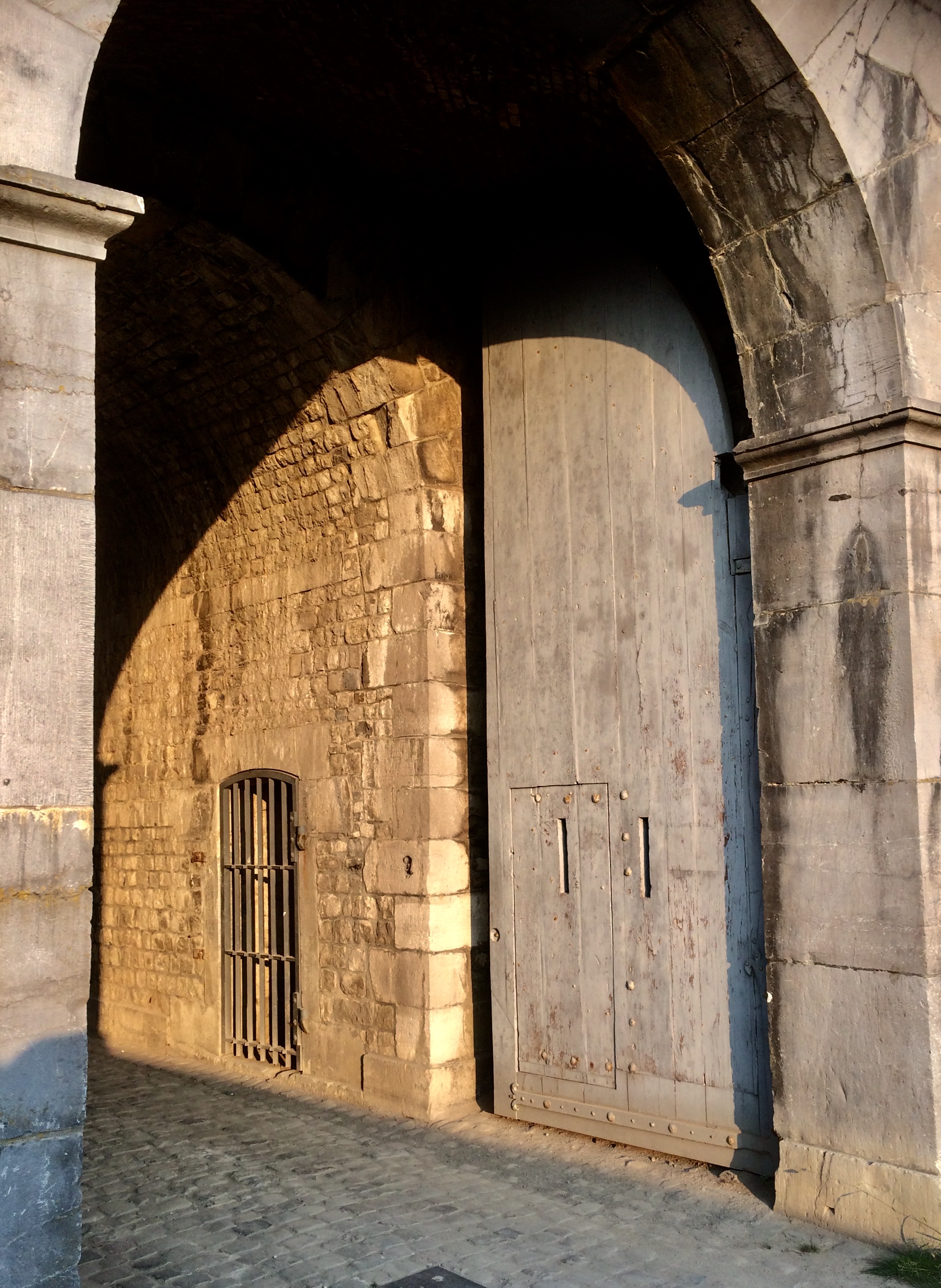
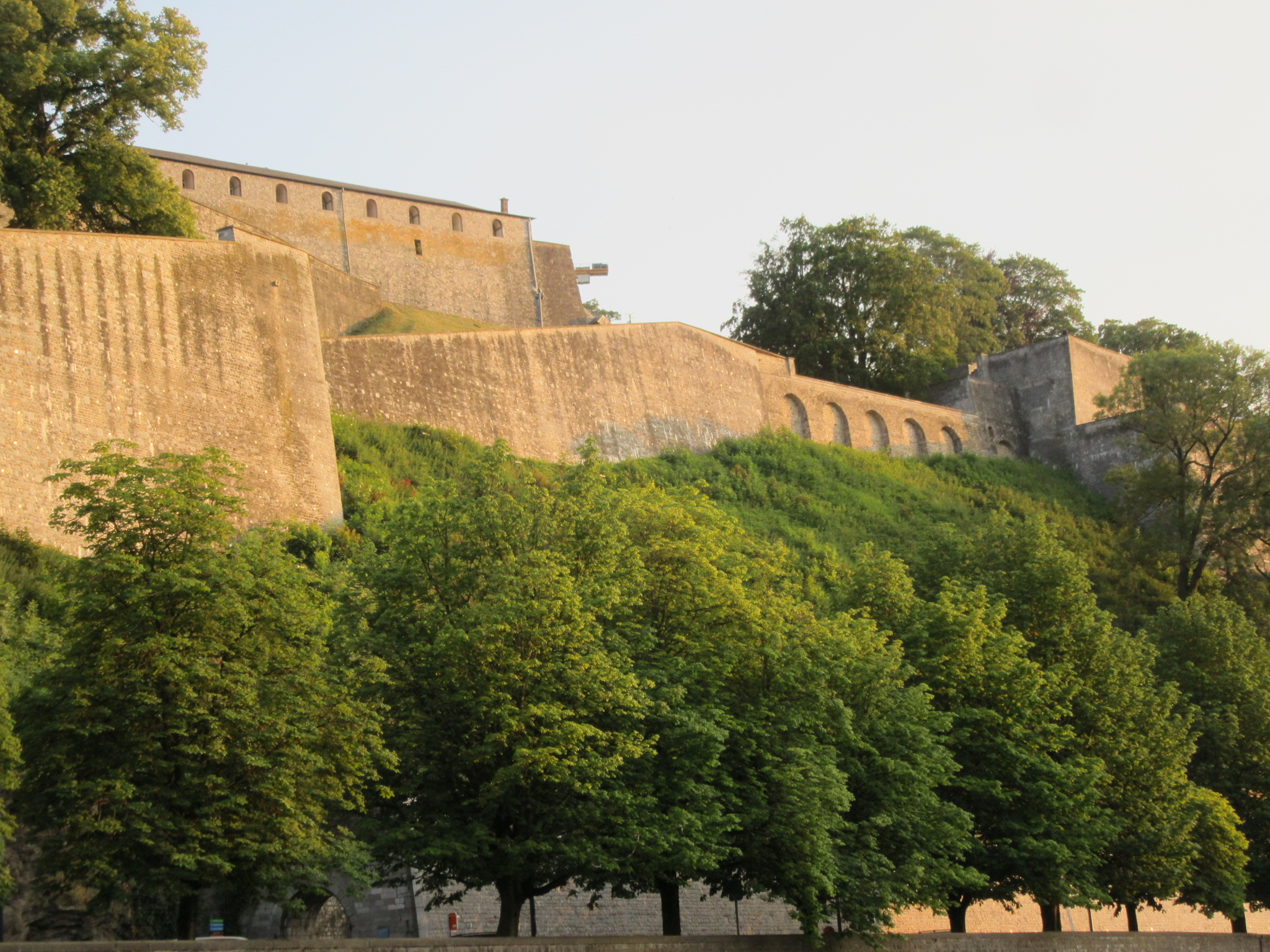
We were moored beneath the Citadel – an amazing piece of architectural fortification and history. The signs around the citadel approach told me that the original citadel dates to Roman times. It achieved its present extent in the 17th century. under Dutch control. Eventually it became part of a new ring of forts around Namur to prevent the city from being attacked with artillery.

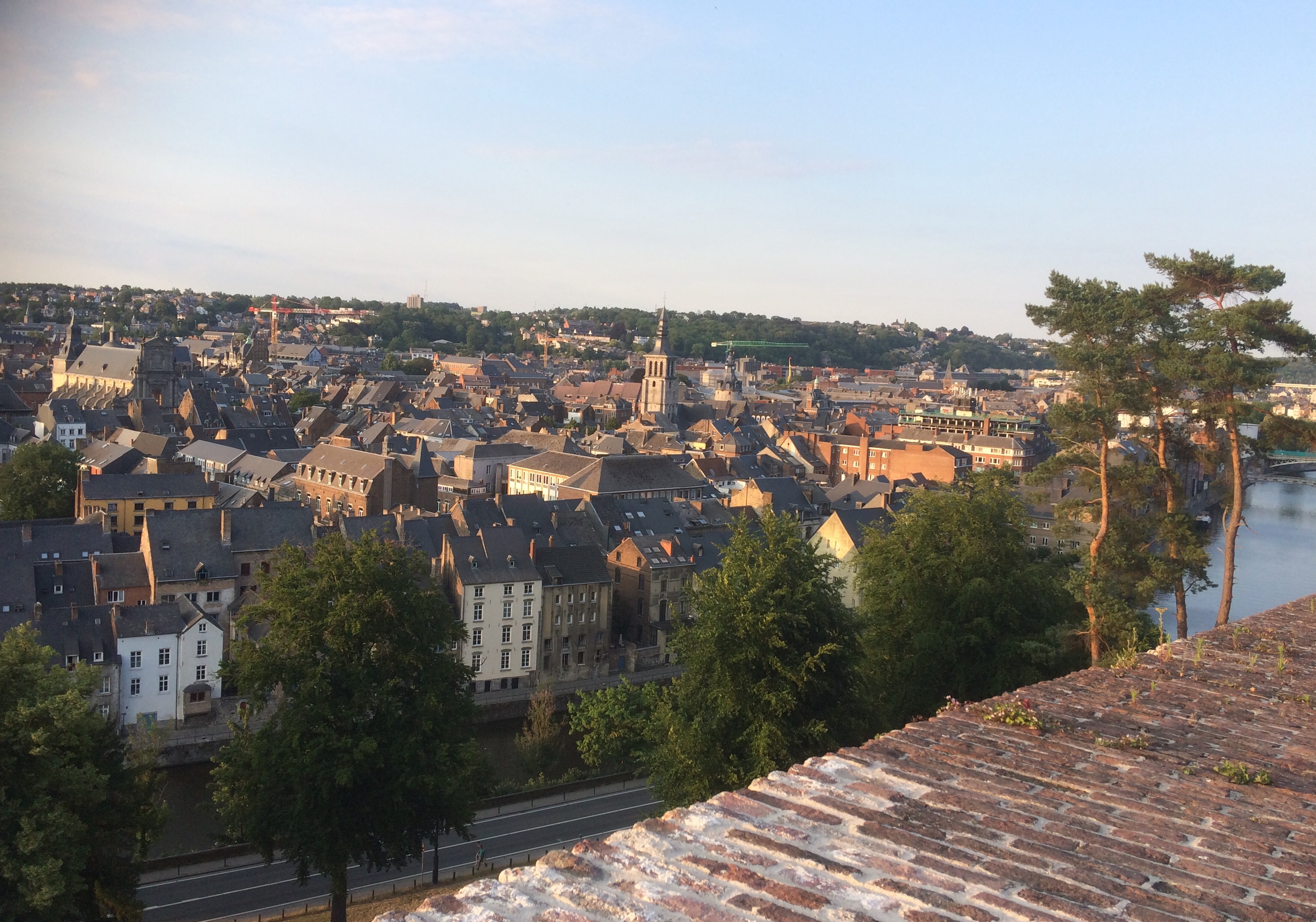
My evening walk was a march up to the top of the hill and a march down again, swapping photos with Stewart who was on the boat down below. One or other of us is in each of these photos (mostly me, sorry)

The view from the top out across the city roofs is panoramic and worth the climb. I would spend longer there next time, and go in the day time when the locked up bits are open!

So ends our Meuse meander, although to be fair, turning the corner onto the Sambre meant that we had already left the Meuse; maybe I should not have included these final photos. Well Namur is on the Meuse; it was just us who were now on the Sambre, which is the next, shorter, chapter.

Heading north up La Meuse part 1

The waterways comprising La Meuse include the river itself, the Canal de la Meuse, called, prior to 2003, the Canal de l’Est Northern branch. At the same time the southern branch was renamed the Canal des Vosges. Together they formed a 245 mile long canal within the Franco Prussian border.

This part, Part 1, is about our travels on the Canal de la Meuse – the northern branch.

June 19 – June 26 2019

Leaving Void-Vacun under storm skies

It was time to change canals – always interesting to find out what the new waterway will be like.

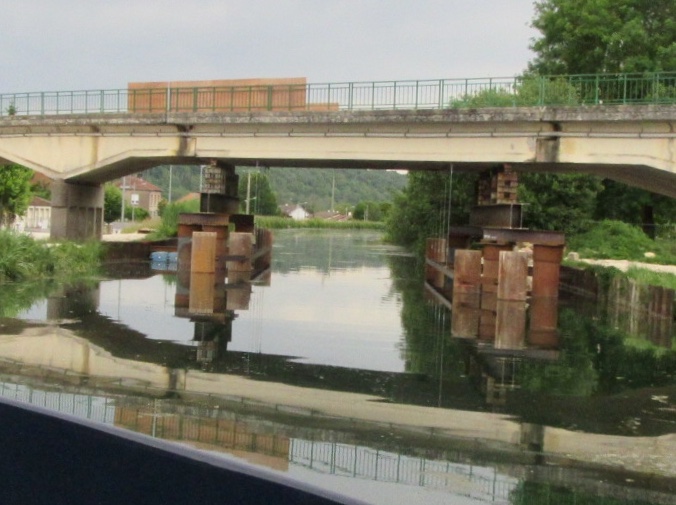
Propping up the bridge

We left Void, still on the Canal de La Marne au Rhin, first thing, passing under the bridge that was closed the day before, and which clearly still has more work to be done.

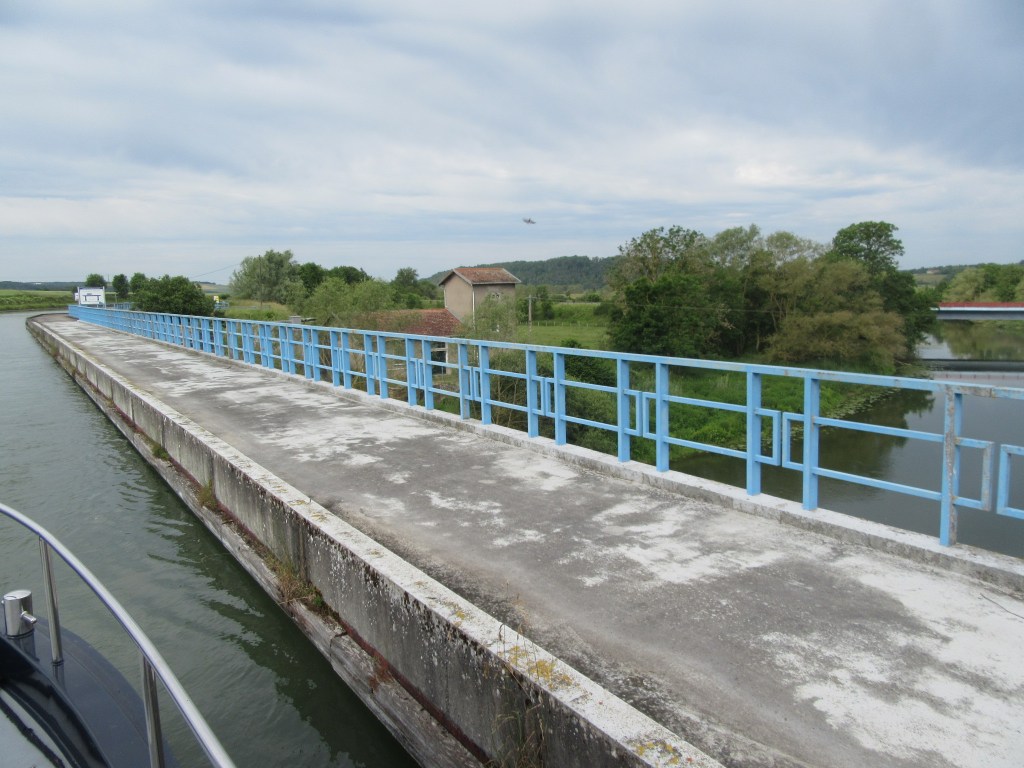
After a sort stretch we found ourselves on a short aqueduct over a river (was it La Meuse) before needing to take a share left hand turn onto our new canal. I rather liked the geometric Art Deco style of the aqueduct railings.

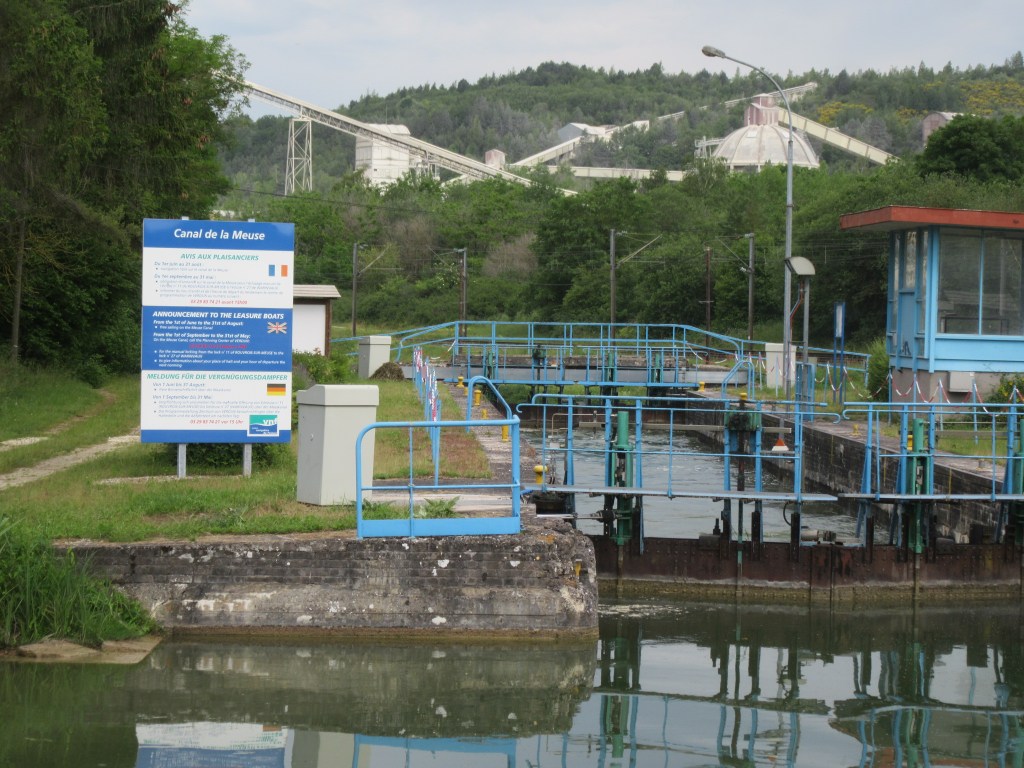
And immediately our first lock was upon us, opened by our nice new yellow zapper. We could see close by a huge cement factory that appeared to utilise stone and/or chalk from close by quarries.

When we got to the second lock we were right alongside the said cement factory, listening to the grinding of its huge evolving tubes. Everything, and I mean everything, was covered by varying depths of fine white powder. The whole factory was white, almost ghostly.

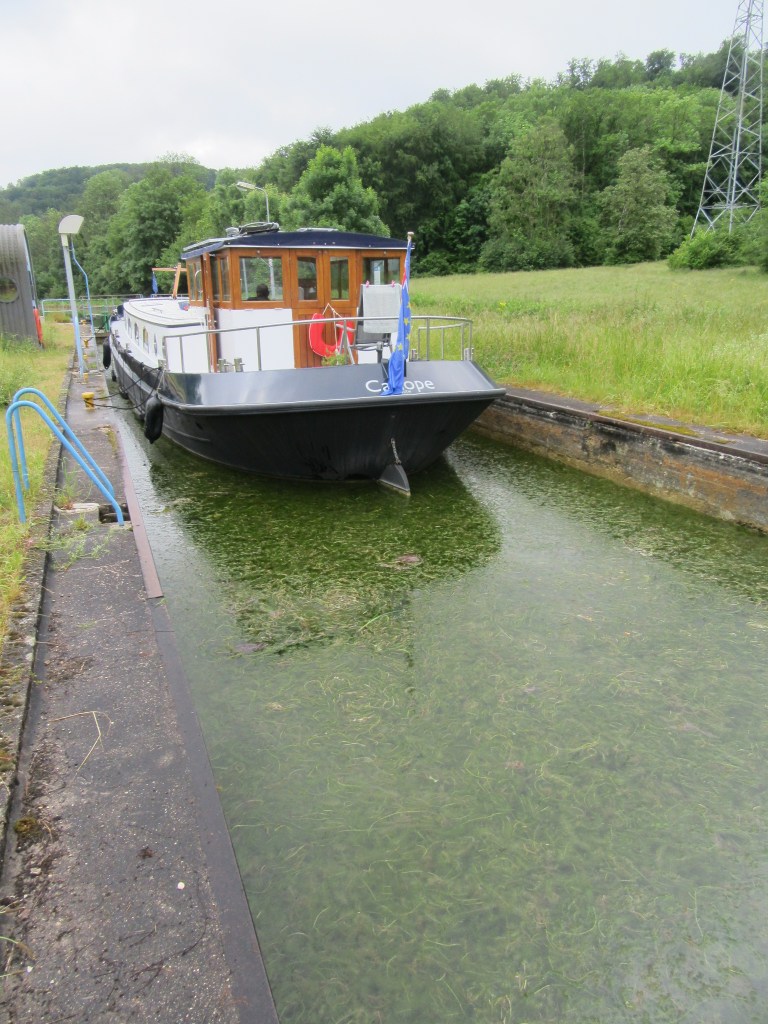
Our zapper quickly had the lock doors open, we were in, tied up, and Calliope decended to the bottom …. but the down stream lock doors remained closed.

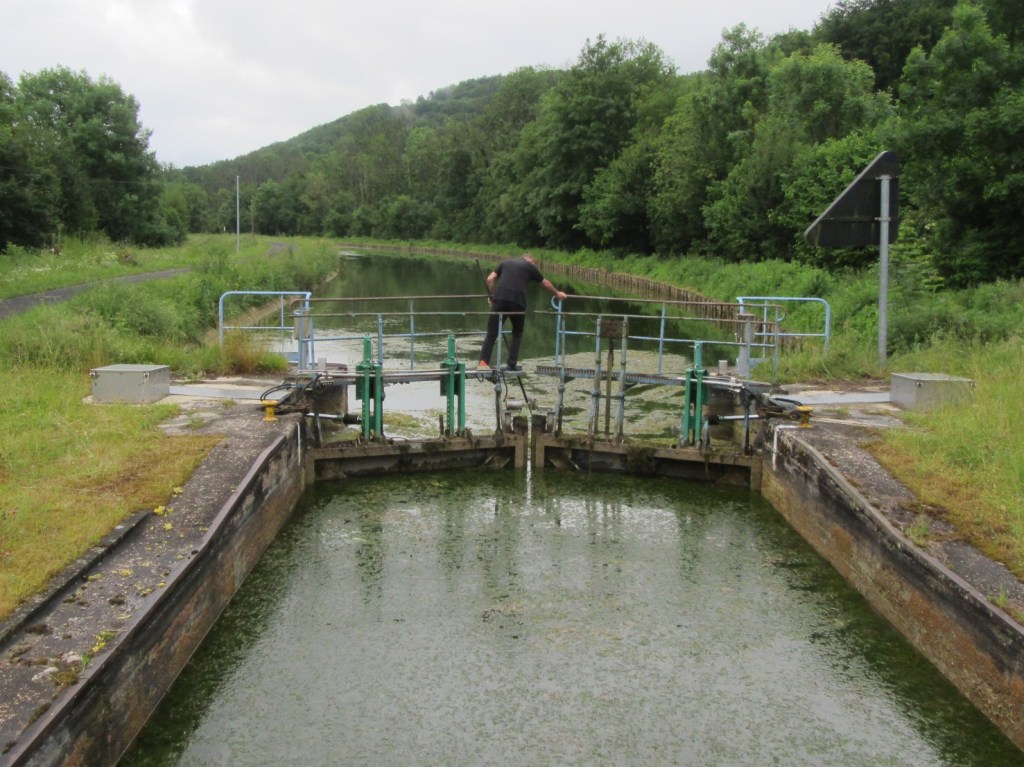
Luckily I was above the lock, waiting to walk the kilometre to the next one, so could easily go to the ‘Aide’ button and call for help. But poor Stu was down in the depths, and then it began to rain! No matter – within a few minutes the VNF Service van arrived and we were on our way – all the way to lock 3 where the upstream lock doors didn’t open.

Once more I was above the lock, having walked from the previous one, and on the intercom again for Service!

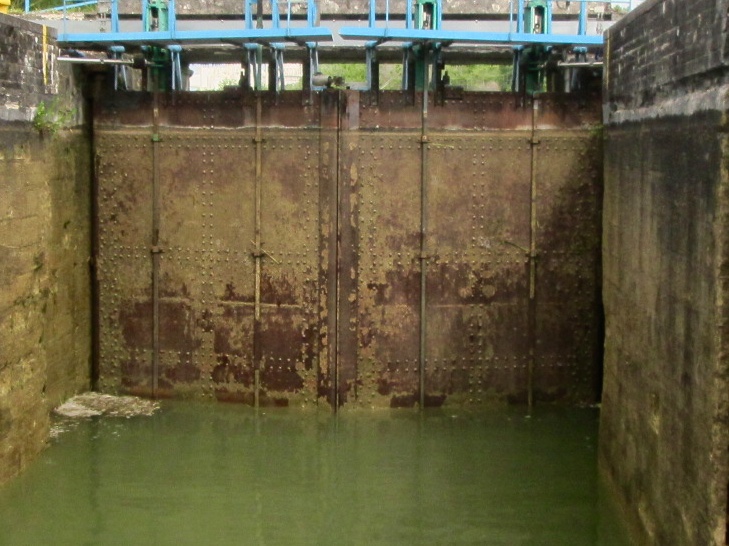
All of these halts gave me a chance to take a look at the lock door make-up on this canal – and we were back to the metal doors that I had not see for some time; great big plates of metal, riveted together.

We did far better from then on, and at lock 4 we enjoyed the shapes and arches of the three bridges after the lock. (Touch to port skipper….)

We arrived at Eaville where we wanted to stop, and after a French family kindly moved their cruiser back a couple of bollards we were able to tie up for lunch and for the night – just before the next lock.

Those morning storm clouds continued to gather and soon after lunch the first of several thunderstorms passed across and we were pleased we’d elected to stay put.

Eaville church

We found time during one of the drier moments to walk the kilometre up to the village of Eaville, looking for fresh milk (no luck). We did find quite a grand church for such a small place, with a bike on display in front, (see bottom left) to promote the fact that the Tour de France would be passing through the village soon.

Next day we set off as soon as the locks opened, but not as early as the three boats already waiting below the lock to ascend once we were out of the way. Where had they come from??
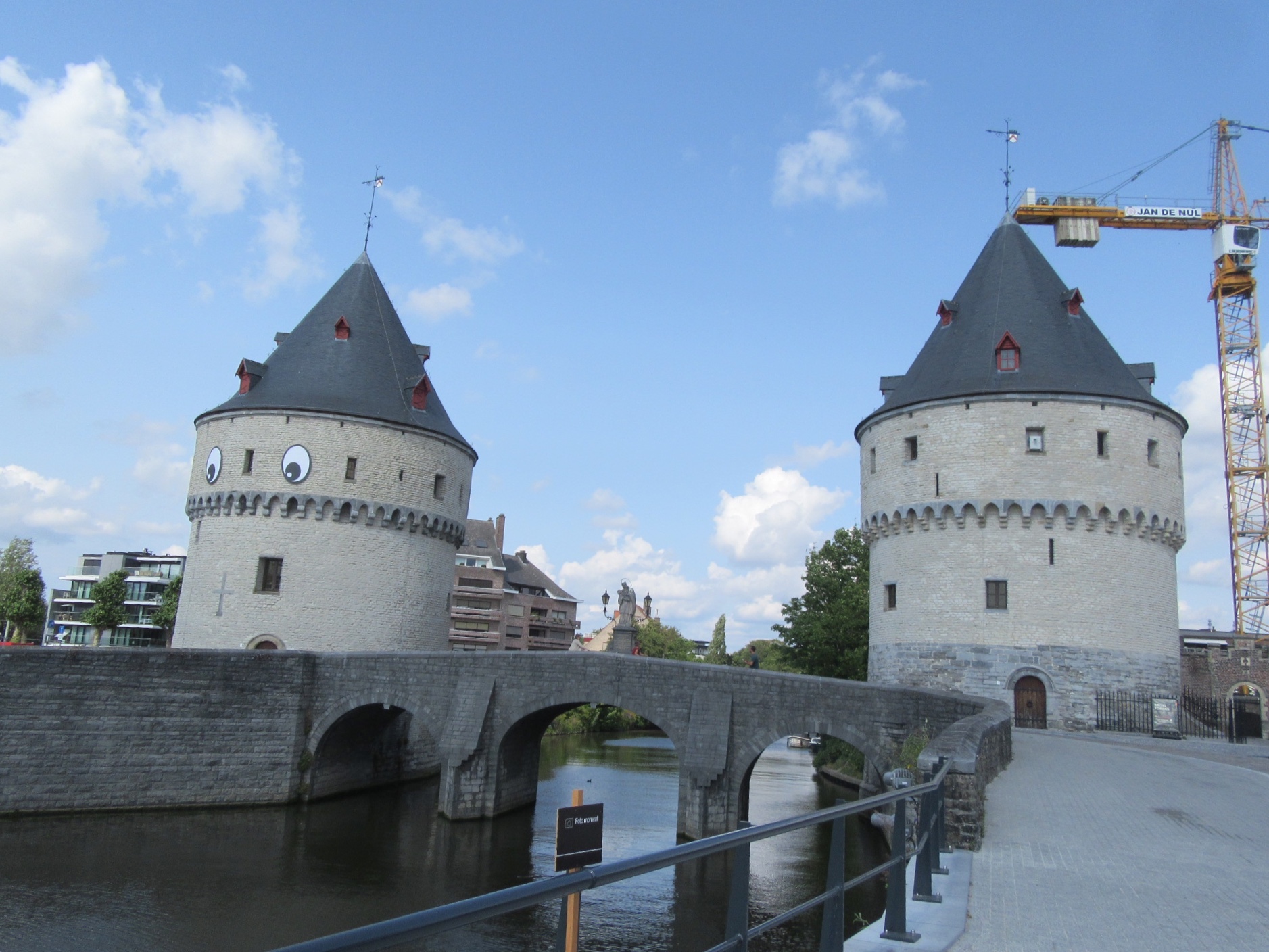
We were moving along between pastures and villages in a distinctly river fashion, rather than canal …

…. and indeed the Meuse river joined and left us as she meandered slowly down hill. The junctions were all different – and as the weather kept changing the light in the photos is all different too.

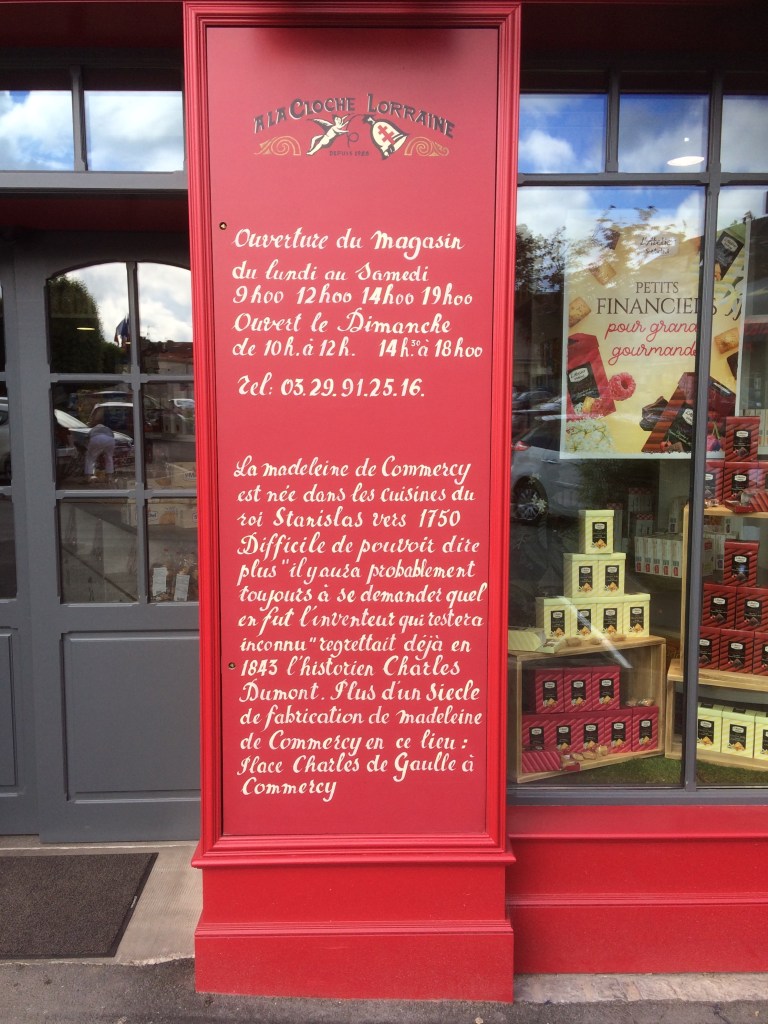
Stopped off in Commercy long enough to do a quick shop in Aldi, which is right by the quay (no fresh milk there either), and then I walked up into town to look for madeleines as this is the town where they were invented. But would you believe it, unless I wanted to buy a kilo of them I couldn’t have any – except fancy gift wrapped ones!

One woman lavoir – I can’t help but wonder who it was for.

Then on we went downstream, passing at one lock the smallest lavoir I have seen so far – a one person lavoir!

The river/canal had some interesting quirks, like this railway bridge on an S bend, which as you come downstream you can hardly see! It is overhung with foliage, and the railings to the walkway through bear testimony to the number of boats that have bumped along the side on their way through.

I enjoy seeing the differences between canals in all kinds of ways. On this canal the lock houses are more cottage like, but still have an extra floor at the back on the slope down from the canal. They have the name of the lock engraved in stone above the door, a nice touch in this area of quarries.

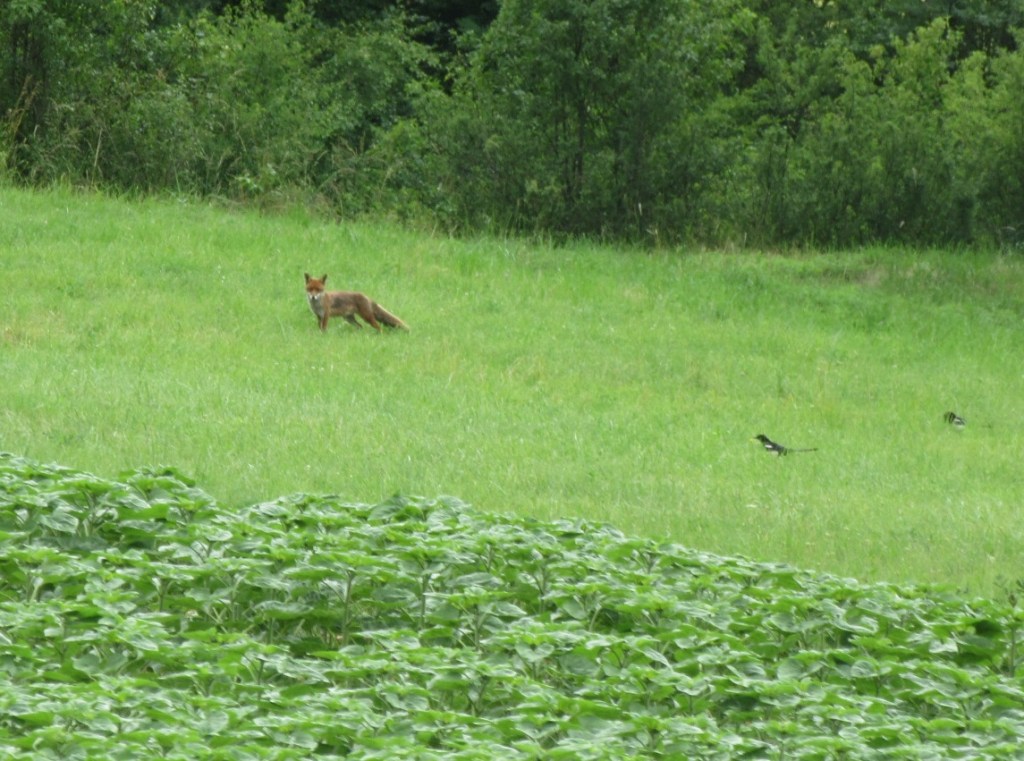
We do get animal moments along the way! This little collection includes a young fox being seen off by a pair of magpies (the fox seems slightly bemused); a nesting grebe guarding an entrance to La Meuse river; and some inquisitive young cattle that I encountered on a rural bike ride to a supermarket!

Back to the journey! We were heading for St Mihiel, and hopefully a mooring in the town – but that was not to be. At least I caught sight of the local lavoir, unusual with its two slender central columns supporting the roof.

Just beyond St Mihiel we saw a possible mooring, at the edge of a rather run down looking campsite. It looked a bit shallow and the bollards were set back from the edge, so we came in slowly and all was doing well until I dropped a fender in the water, and got stranded on the land, and lost my rope all while the current was gently easing the boat back out into the river. Oops. Second time round was thankfully accomplished with more dignity.

The manager was out playing table tennis 50 yards from the quay, so I asked him if it was ok to moor. “bien sûr” was the reply.

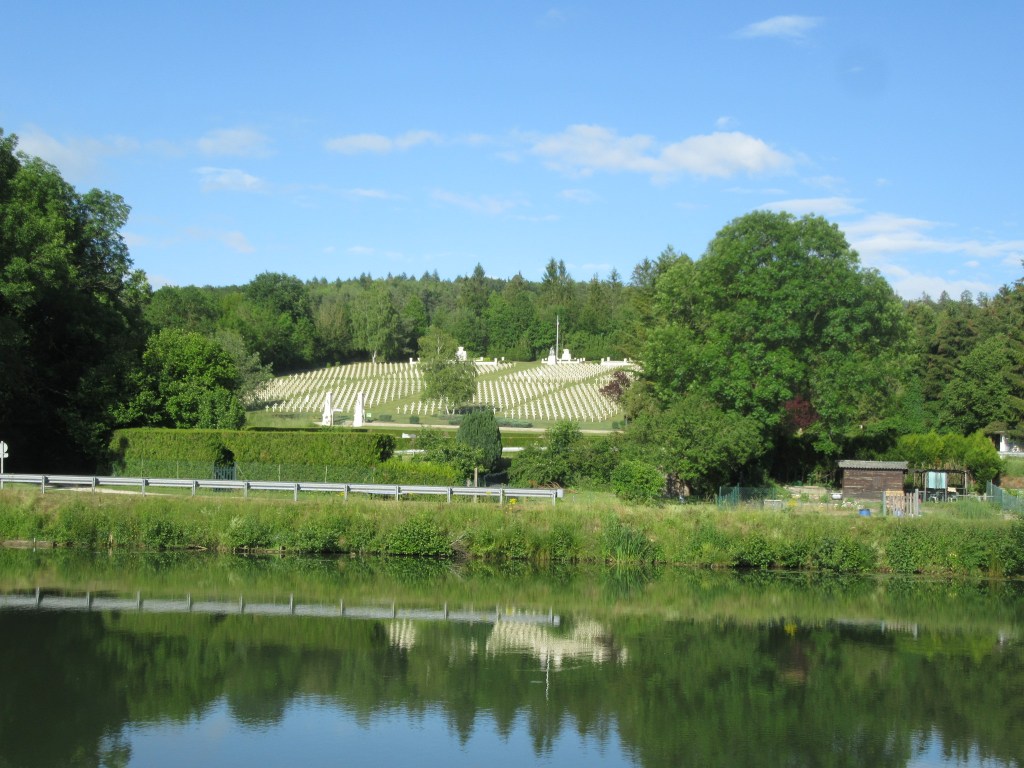
Settling down with a cup of tea we noticed wed were directly opposite a peaceful WW1 cemetery, the white crosses and Islam markers shining against the grass. So many of these in the area – such a waste of young lives.

Before the afternoon was over I jumped on the bike and cycled off to the Intermarché while the skipper did manly things down in the engine room – a 9 minutes cycle ride from the boat according to Google Maps. After 25 minutes, much uphill, and getting lost twice I found it and hooray, they had fresh milk! It was on the way back down tracked between fields that I found the aforementioned cattle.

Next day, and the next lock, held a surprise – we had forgotten that the zapper was to be redundant for a while and we were back to manual lock keeping.

This has disadvantages – progress is slower – and advantages – we get to step off and do some turning of handles to open and close the lock gates.

The scenery along the Meuse is superb, pastoral, open and wide, often with a church spire or two to break up the horizon. There will be more examples to follow!

And we saw strange things like a tractor being ‘storked’ and an old tree that from a distance looked like an olive tree – perhaps someone will put me right as I don’t expect an olive tree in the middle of of a field of cows in north east France.

Lunch time was spent at Ambly-sure-Meuse, a grassy mooring at the edge of a small village recreation ground. Despite its small size Ambly does have a boulangerie so déjeuner requirements were met.

We hadn’t seen a boat since we left St Mihiel, but suddenly after lunch we passed quite a few, all in pairs – maybe on their way to find Noah’s ark (rather a tenuous connection). Many were cruisers, many looking similar and many from Holland, so we began to wonder if they were hire boats. But also a pleasant surprise – another Piper Boat, Tadham Castle.

Calliope passes on down stream

And Tadham Castle took a photo of us too – a passing Piper photo shoot.

Afternoon brought us in Dieue, and luck was with us as there was just space for us to squeeze in in front of an Australian catamaran on the quay. It turns out that Dieue has quite a history, and there were two sign-guided tours, one around the village itself and one around its neighbour Rattentout across the canal. We set off round the Dieue tour.

We saw where the embroiderers lived, the cobbler (now in semi ruins), the miller (now a brewery and bar), and lots of lovely old building with various functions of old. And of course a lavoir.

Later I went for a walk round Rattentout, somehow less quaint, but with a couple of interesting sights.

I followed the signs up a steep lane called Rue de les Carrièrers (quarries) wondering if anything would be at the top. At first all I could see was a path into a wood.

Then I saw a sign half hidden amongst tall nettles. Surging forward bravely I read that there was a statue to the virgin Mary, looking out over the valley. Sure enough as I walked into the wood I suddenly found her, on a mound of rounded stones. And from there, a great view across the Meuse.

Lavoir de Rattentout with raising floor

The second special find was a lavoir the likes of which I have never seen!

The water flows under the lavoir, rather than in front as is normally the case. And because the water level could change frequently depending on the activity of the turbines in a local factory a system of Archimedes screws and cast iron wheels allowed the floor to be raised or lowered. Amazing!

Our day at Dieue was Midsummers Day, the longest day of the year, so at sundown I took a photo to celebrate the solstice.

Next day was Saturday and we were heading to Verdun. The river was lovely along the way, plain easy sailing, and by 11am we arrived at the interesting tunnel through the fortifications built around the city by Vauban in the 17th century. The tunnel leads immediately to the lock down into the town.

It was an interesting manoeuvre for the Captain as we approached the tunnel from a right angle and could not be sure if there was a boat coming towards us, or in the lock. There did not seem to be the usual traffic light system to let us know whether to proceed or not, so we moved forwards cautiously until we could see that the lock gates were open for us – then full steam ahead(ish).

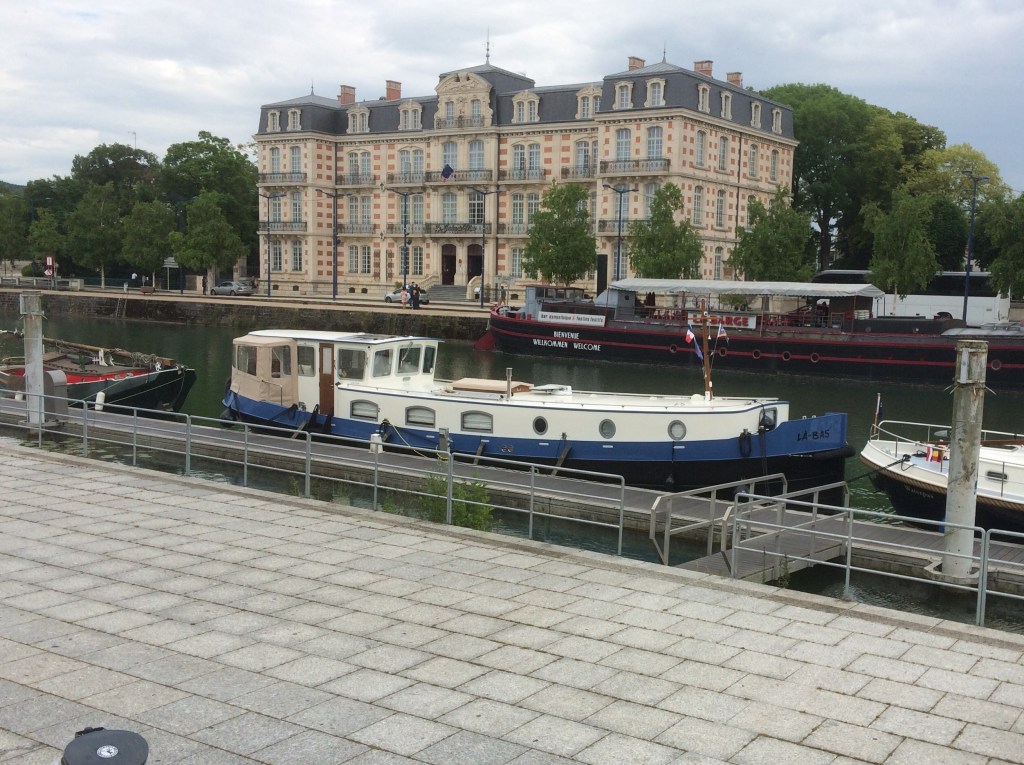
We had hoped to find a space in Verdun but the only spaces on the long pontoon were too short for Calliope. We did note another Piper barge, La Bas, on the pontoon, and they offered for us to raft up against them, but too late for Captain Stu to change course. It did have one good result – Patrice on La Bas took a photo of us as we passed on.

Belleville mooring in the morning sun

We headed on another kilometre to Belleville-sur-Meuse and made fast with ease to a pleasant little pontoon at the edge of a small park. After lunch and a siesta we were ready for a walk back into Verdun.

Gate of Verdun

We walked by the huge gateway to the town and explored some of the old narrow streets.

We walked up to the top of the hill by the huge statue of Charlemagne, looked in a few shops for shirts for the Captain (did you know that French for a short sleeved shirt is chemisette?).

We also found a restaurant that looked worth returning to later.

Then back down to the quay in the hope of finding the crew of La Bas aboard – and they were.

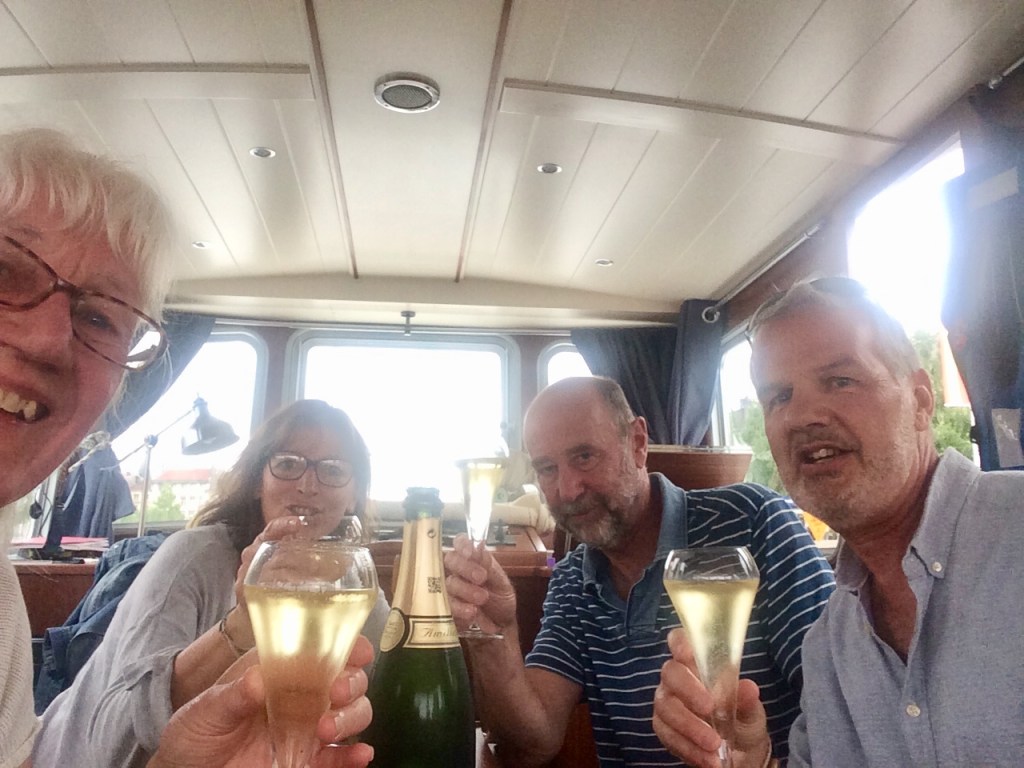
After a good bit of Piper boat, waterways, and general barge conversation we were treated to a glass of absolutely delicious champagne – very special because it is only made with white grapes. We also heard of an imminent heatwave set to sweep across Europe, including France, in a few days time.

The railway bridge at Belleville-sur-Meuse

Stu and I left them in peace and after a beer on the quay and a wonderful traditional meal at the little restaurant we had found we walked back down the river to Belleville, passing one of many beautiful bridges.

(Although it is not easy to see in the photo, this bridge must only be passed under by the right hand arch, which then leads into a 20 km canalised section of the river, whilst the other arches lead towards a long weir.)

It is now Sunday and a morning visit to the boulangerie for a baguette is essential as they all tend to close at noon. With bread safely aboard we carried on our journey on another glorious day, and with countryside stretching to either side. The only sadness in all of this was knowing how this same countryside and surrounding hills were the scene of the Battle of Verdun during WW1.

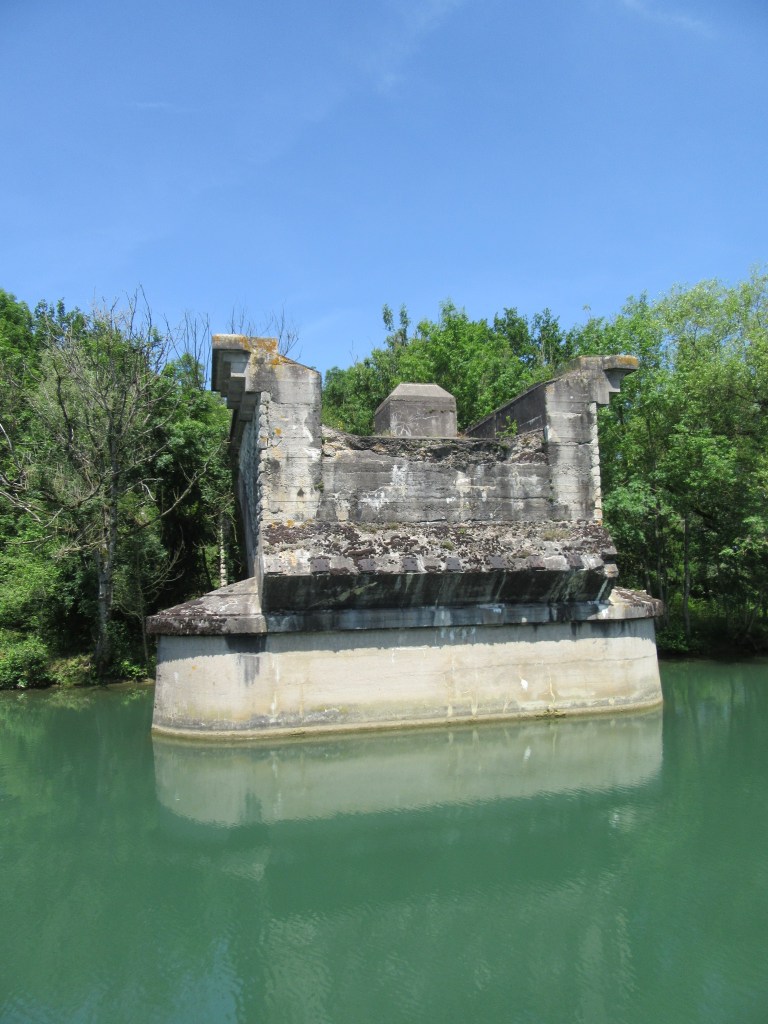
A hundred years on, and in addition to the military cemeteries there is still some evidence, such as the remains of blown up bridges, decimated villages and memorials.

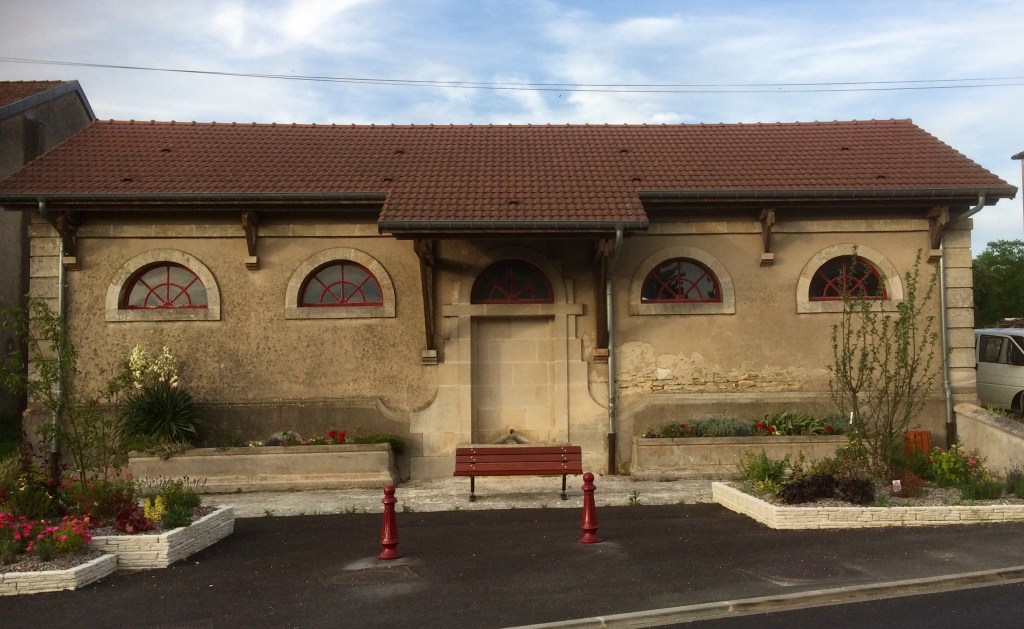
Our next stop was Consenvoye, a village occupied by the invading army a century ago. It was here we saw an interesting tiny part of the post war reparations. On a walk round the village Stewart and I saw a building at the top of town that we both thought looked like a modern lavoir, but it was impossible to get in or even to see through the windows. I did ask if I could sit on Stu’s shoulders, but he declined!

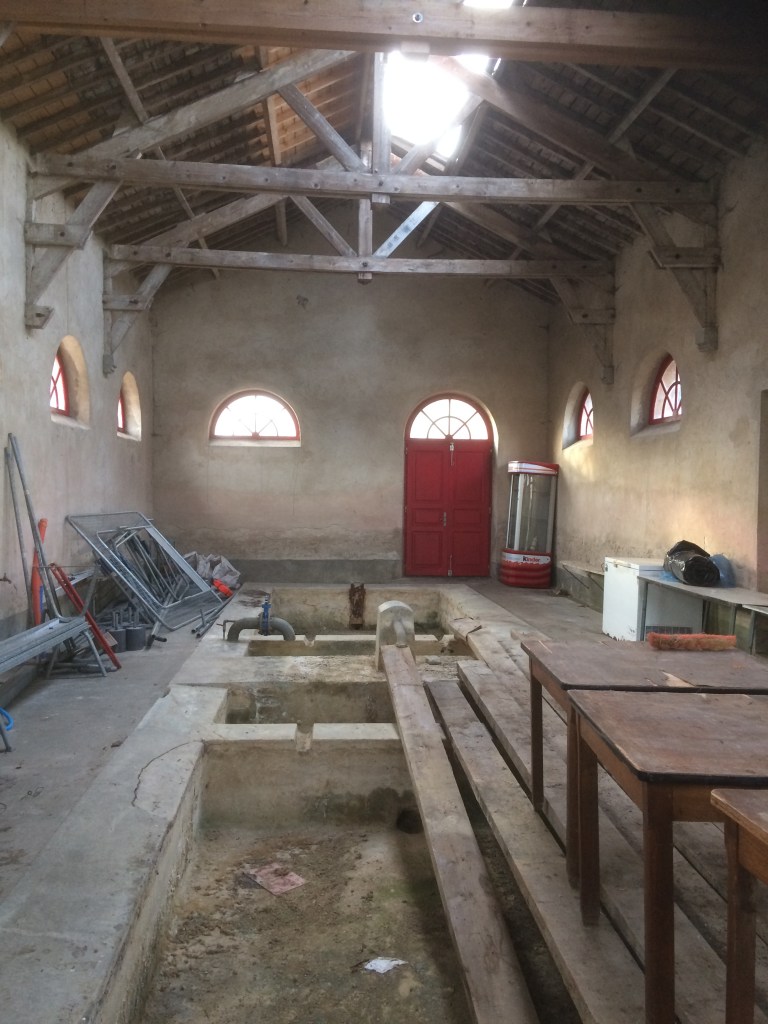
Later, in the evening, I went for a second walk and this time saw a van pull up by the building so I used my best school girl French to ask about the building. On hearing that it had indeed been a lavoir, built after the war, I asked to see inside. It is now a village store, but it is clear that this was a very modern lavoir compared to many I have seen. And interesting to me that in 1919, when my grandmothers were in their twenties, a lavoir was still considered to be the way to wash ones clothes in rural France.

So enough of war, important though it is to remember.

The mooring at Consenvoye is on a small loop of the river that passes close to the village. The village was in there middle of a major brocante (like a car boot sale) when we arrived. We were surrounded by cheerful stalls on both sides of the narrow channel, so initially not the quiet mooring we had anticipated! But all good fun.

It was a hot day and we needed to fill up with water with the heatwave on its way.

Such a shame that the tap sent a fine spray in all directions from the connector, and that I had to sit and wait until the tank was full!

By early evening the brocante had ended, the stalls packed up, and quiet descended.

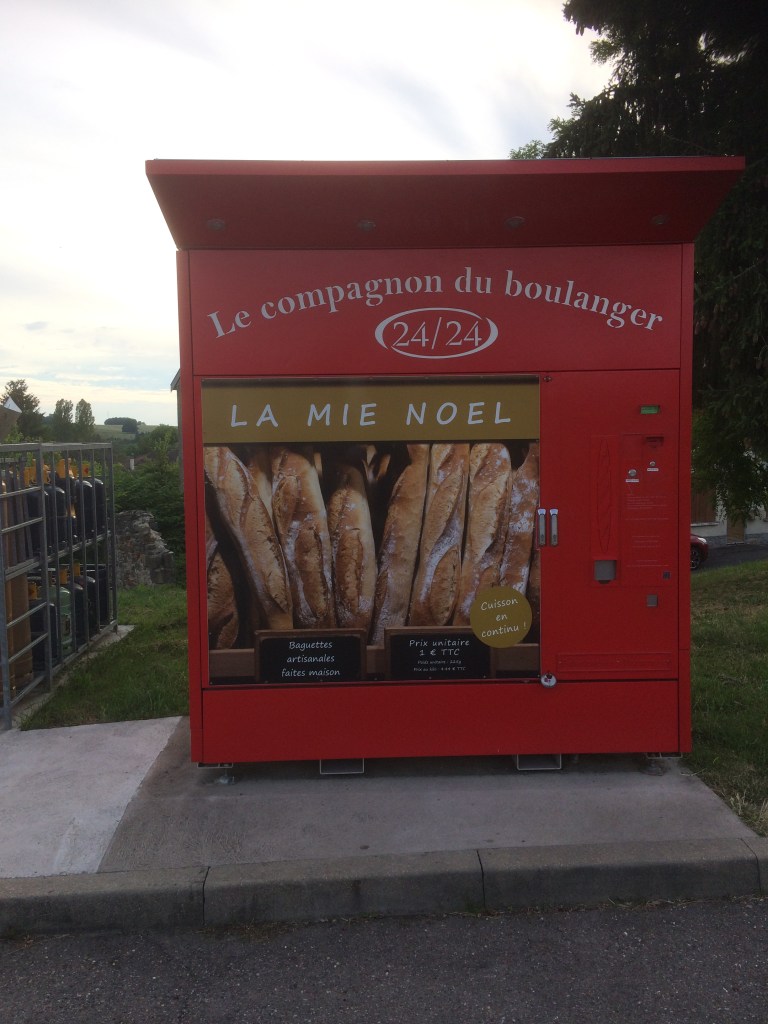
There was another interesting find at Consenvoye – a vending machine that apparently baked fresh baguettes 24/7 so for a Euro one could get your daily bread in a village that no longer had a boulangerie. We did not buy one, although I was keen to try the experience.

Next day I walked over to the adjacent lock to see if the éclusier had arrived at 9am as promised; the previous day they were a bit late. Stewart meantime reversed out of our mooring channel and came round to face the lock

We then discovered something that we have not seen since the Yonne river, three years ago. The lock here has sloping sides and a floating pontoon to attach to during the locking process. It all seemed very modern, easy and tidy.

While I am on the subject of ‘les écluses’, or locks, here are a couple of observations from this canal/river.

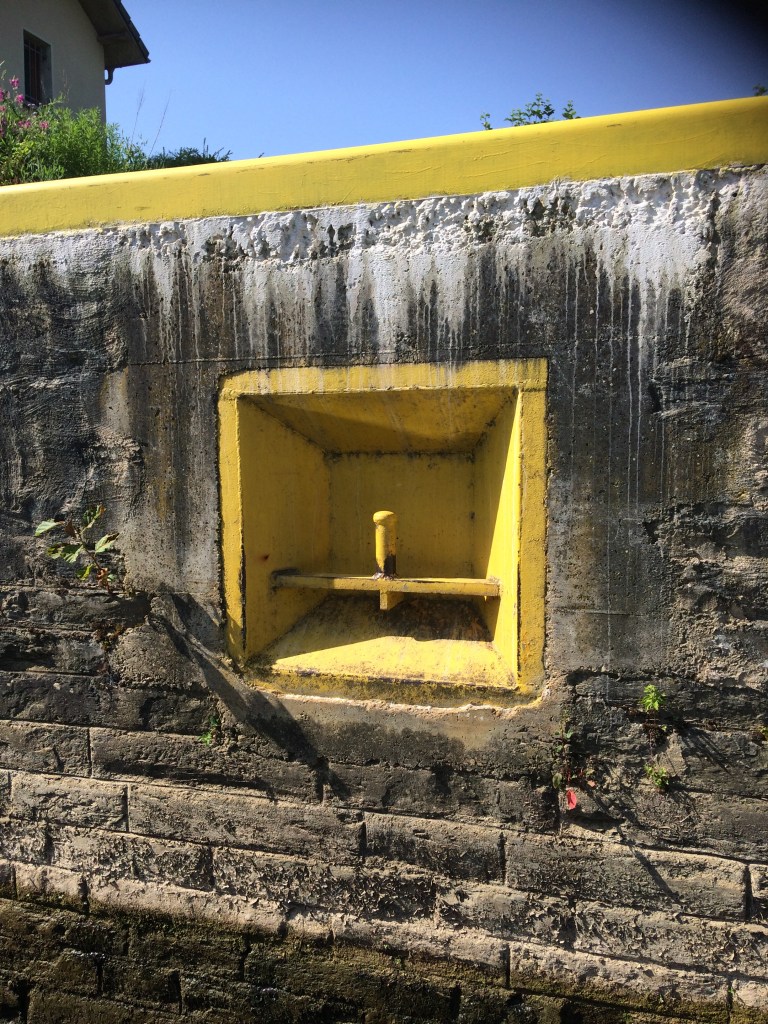
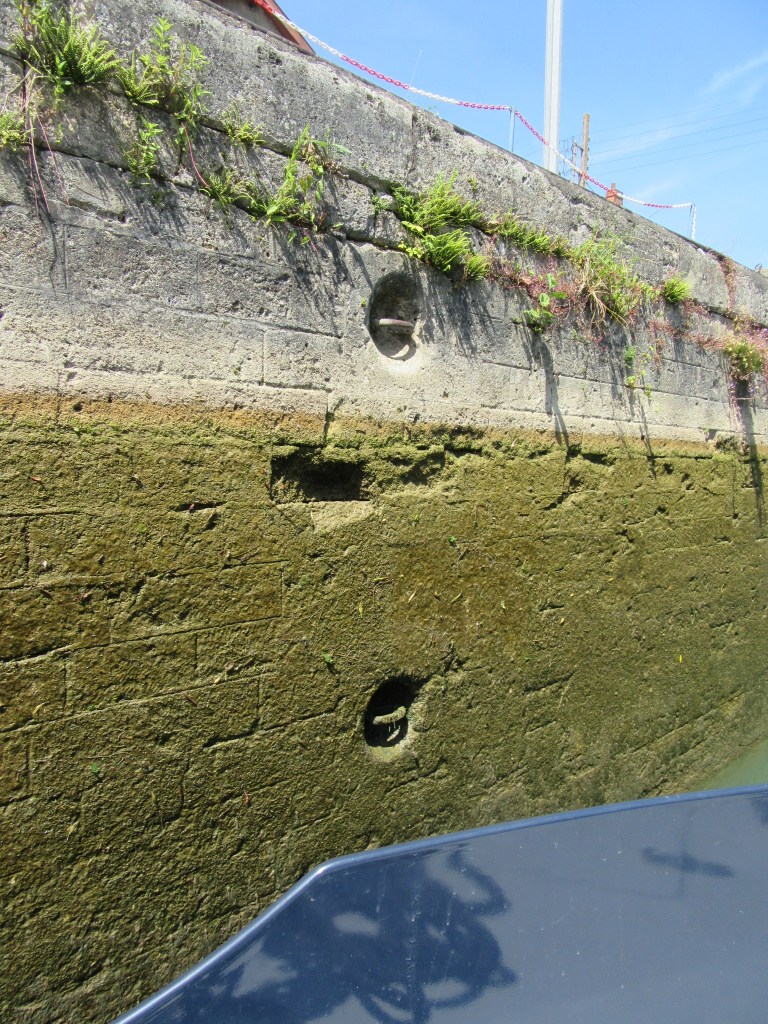
We have become used to bollards inset into the walls of deep locks so that you can move your ropes up (or down) as you go. On this canal there were a few alternatives to the inset bollard. There have been crosses, half-rings, bars and the good old sliding pole, but much broader than before.

old lock house with current itinerant éclusier’s hut next door

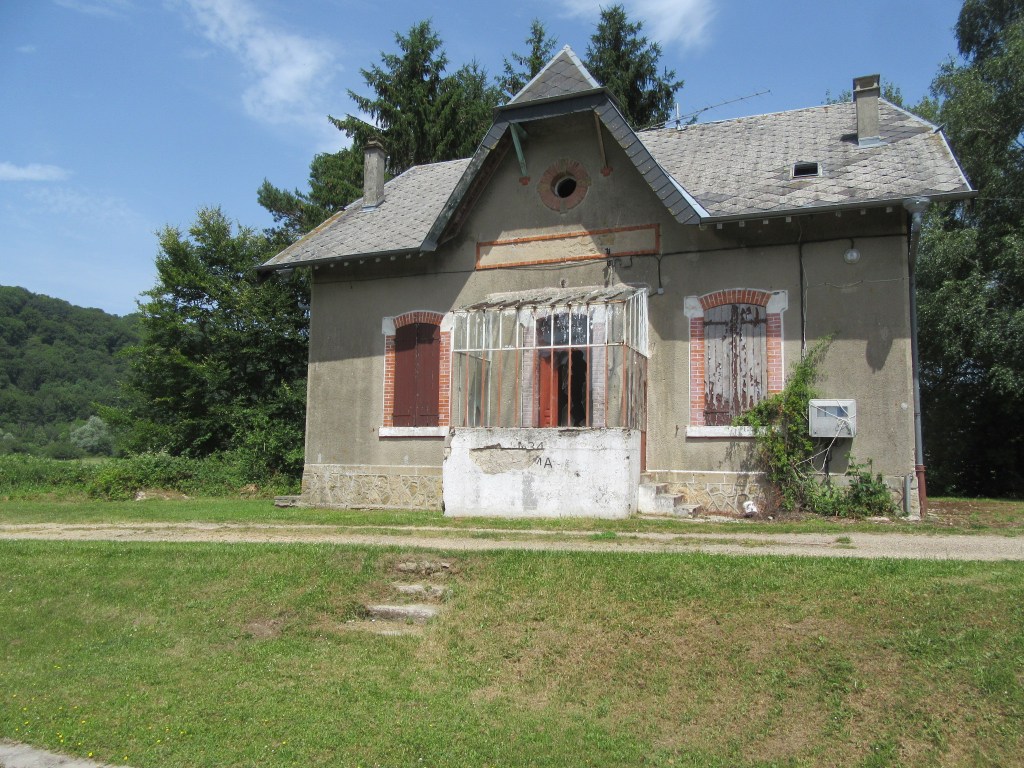
There have also been changes on the lock houses, the later ones being smaller and with gables above the front door.

These seem to be the more rural, remote, locks, with bigger houses attached to locks on towns and cities.

And the names of the locks, originally carved in stone above the door, as mentioned before, are gradually being replaced with blue metal signs, sometimes placed straight on top of the stone one as here at Sep.

Now that the éclusiers travel between locks and no longer live in the lock houses, unless they have bought them, they are provided with a little ‘hut’ instead, where they can make coffee, phone calls and have a loo.

My last bit of lock info for now is two photos of rusty old lock ‘gear’

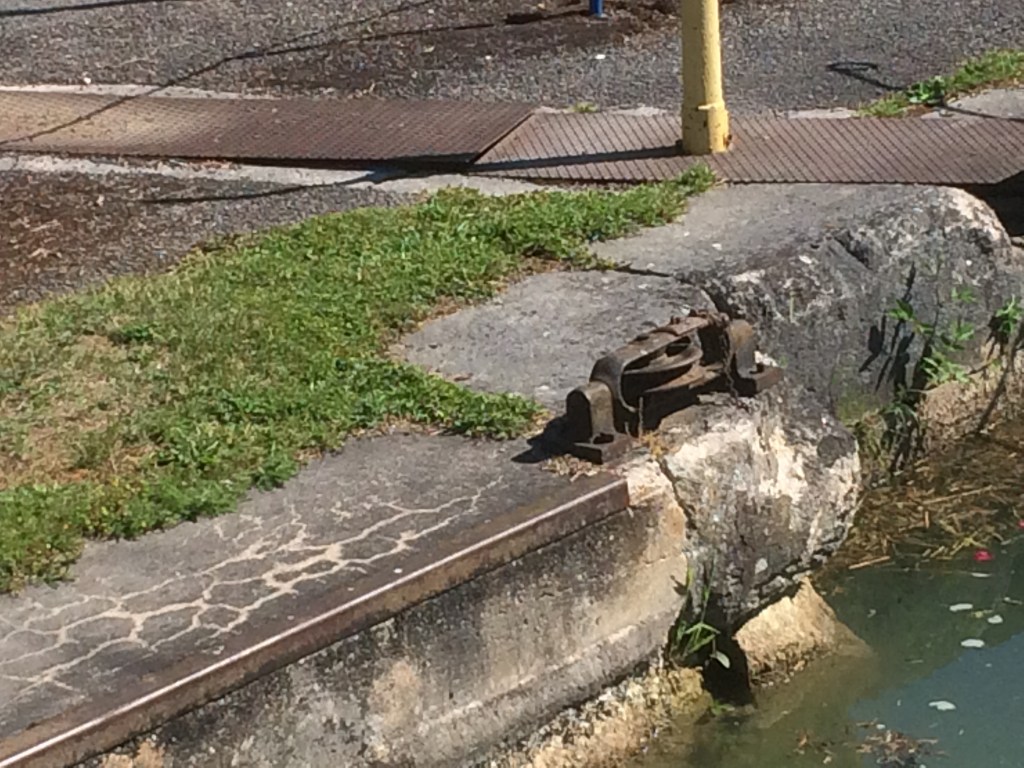
The first is some kind of pulley system attached to the quay of a lock. We have seen these just a few times and must be linked to pulling laden barges into locks, maybe after horses had disappeared and various narrow gauge railway engines had taken their place on some canals.

The second is a winch at Remilly-Aillicourt lock, where we were moored up for the night – you can just see Calliope framed in the triangle of the winch.

Now back to the journey.

Soon after Consenvoye, in fact 4 locks after at Warinvaux, we moved from manual locks with cheerful éclusiers arriving in vans to do the work, back to ones operated with our yellow zapper.

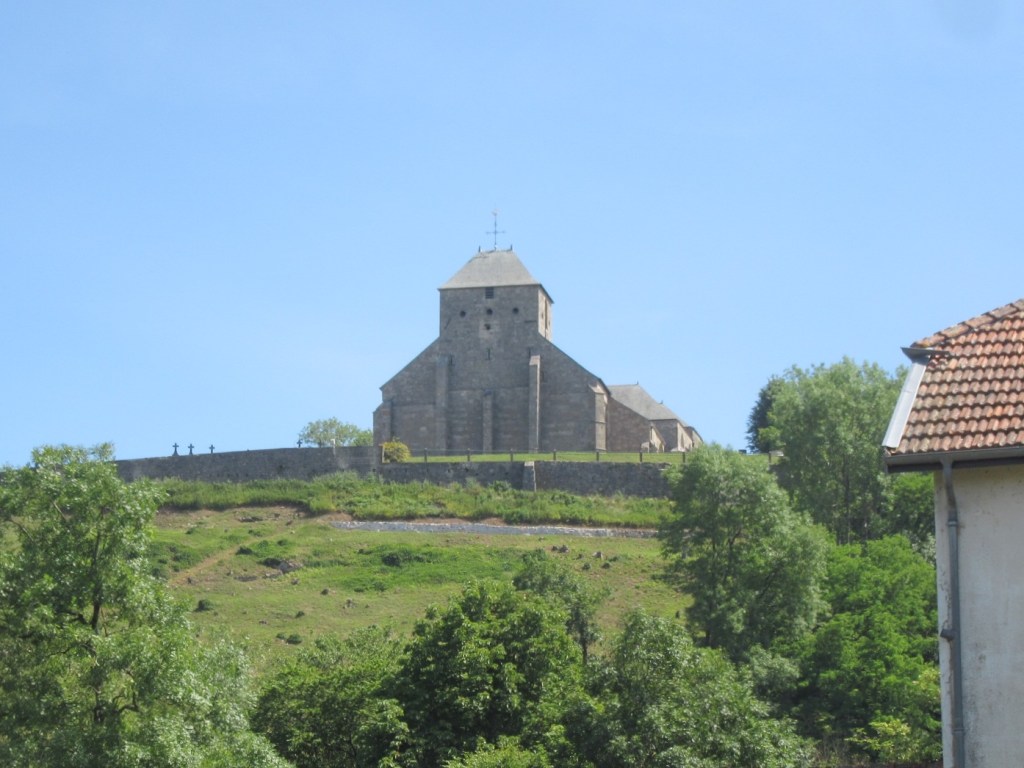
We stopped briefly at Dan-sur-Meuse, in the lock (a bit naughty that) because I had seen that there was a boulangerie on the lock island. I rushed off and within 10 minutes had the daily bread. As we left the lock there were lovely views of the Dan-sur-Meuse church placed high above the river. No risk of flood up there!

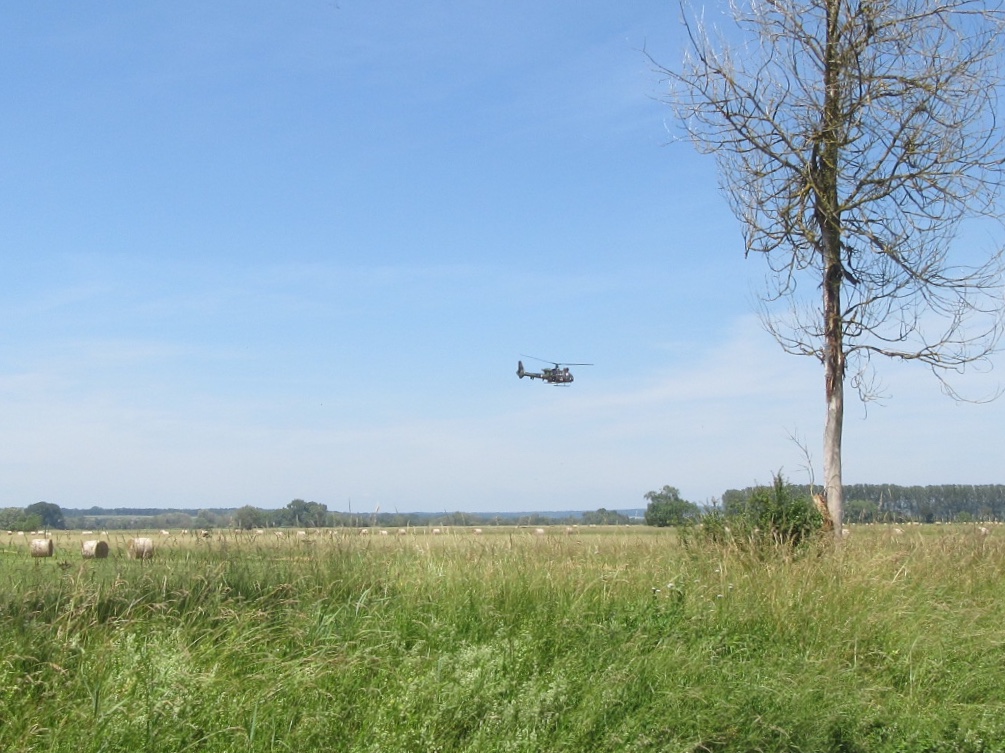
For part of the day’s trip we were buzzed repeatedly by a slinky military helicopter that was virtually on its side as it went round tight corners. We think it was the new Guepard helicopter, maybe on secret trials as it was working above a large flat field with no military installations in sight.

Eventually, after a long day for us – almost 30 kilometres in what was becoming a heat wave – we reached the outskirts of Stenay and were delighted to see that the mooring we hoped for, an old factory mooring opposite a small weir, was free.

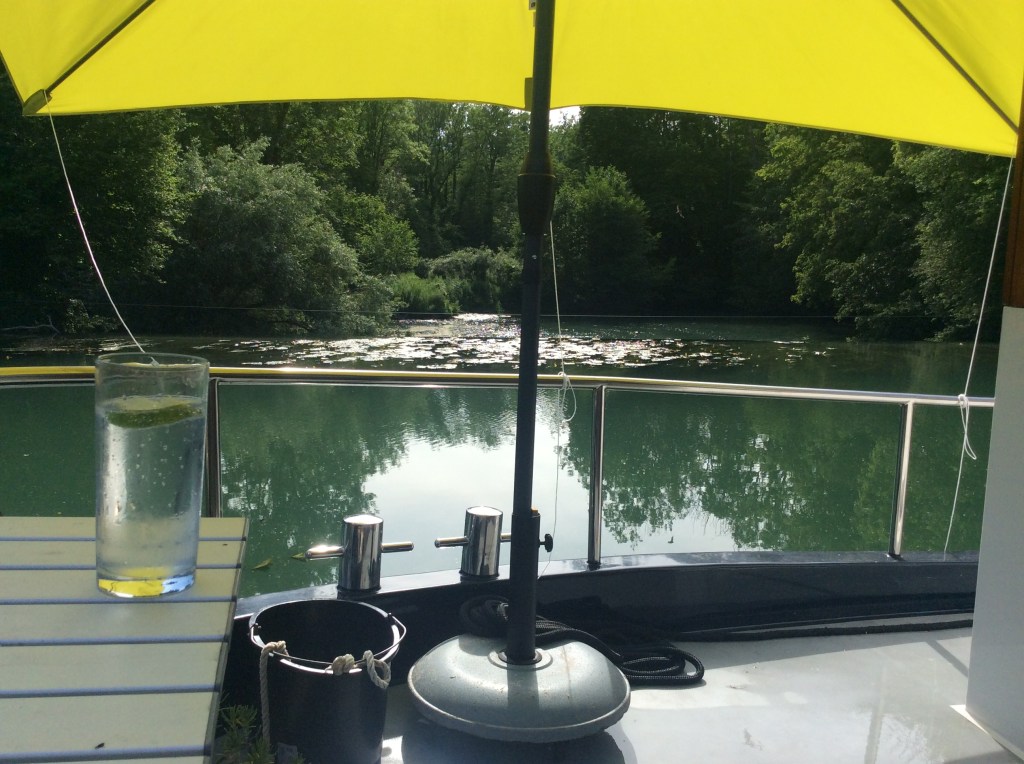
Phew! Tied up, parasol up, cool drinks up on the back deck and we were sorted for the evening.

It has to be said that I was ready for all of the above. This is how hot I had got.

Whereas later in the evening, with parasol down, Captain Cool was looking good.

I did take an evening walk round Stenay once it had cooled down to about 28 and there was plenty of shade. There were some interesting buildings, but nothing special until I saw the old mill in the last in the sun’s rays.

Calliope moored against a high old industrial wharf, opposite a weir

We were now onto our last day on the Canal stretch of La Meuse. The day started with me gallantly cycling to the local Intermarché, a mere two kilometres – but Google maps failed to tell me that it was up hill again! I walked up part of the distance, between fields of wheat so no unpleasant.

Once back on board we cast off and were away to the first lock, just round the corner. There were only 5 locks for the day, but 36 kilometres, on another of the heatwave days. No wonder we saw so many cows paddling in the water.

We found a relaxing place to stop for lunch before the voyage went on.

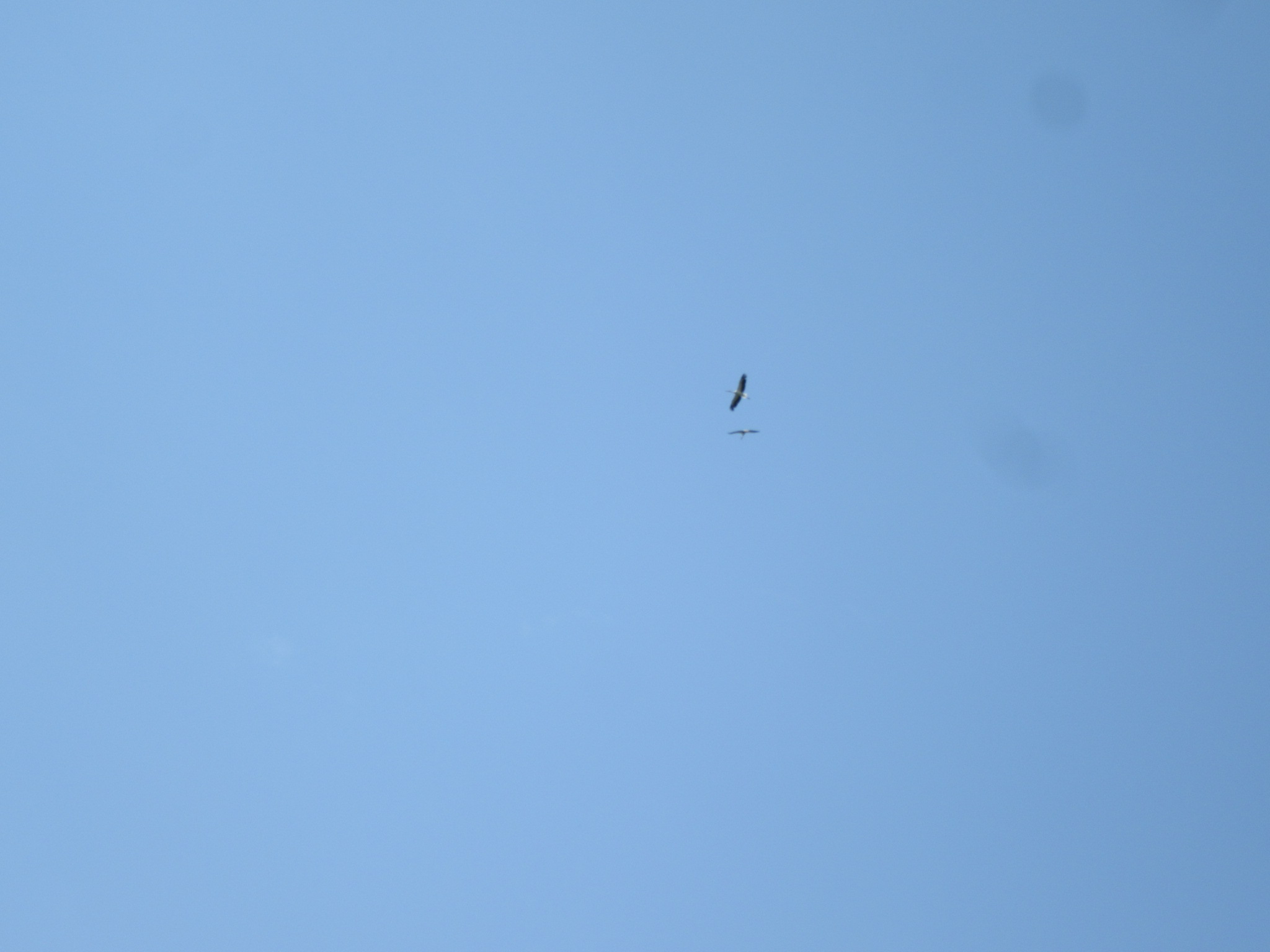
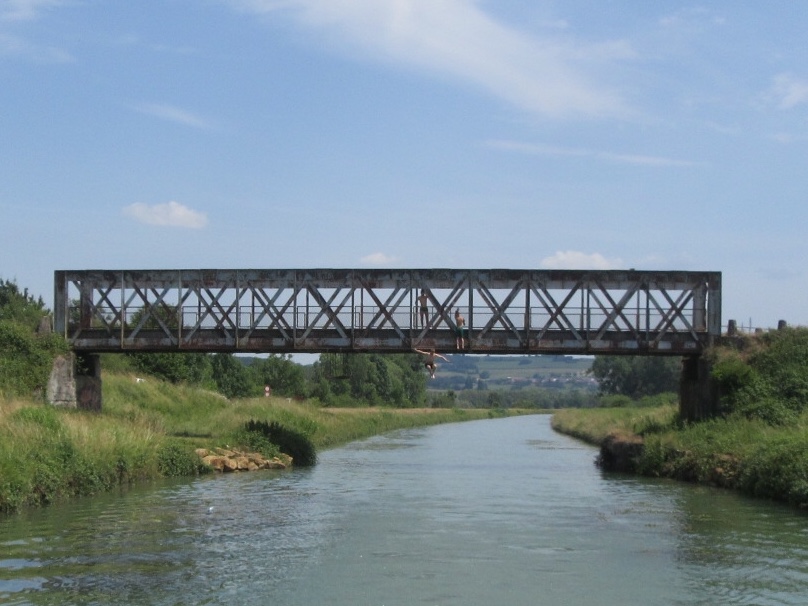
We passed storks circling in the sky (yes there is a stork up there), a church with a definite change of shape at Remilly-Aillicourt, and boys making the most of the hot weather by jumping in from a bridge over the (canalised) river.

Moored for the night above Ramilly-Aillicourt lock

When we moored up just before Ramilly-Aillicourt lock we were once again very hot – about 34 degrees in the wheelhouse even with the windscreen down and a reasonable breeze blowing in.

Stewart had a siesta. I went to find somewhere to swim, but finding a place to get in, or rather get out, of the river was not so easy. Eventually I found I could climb down next to the overflow from above the lock – delicious cool clear water to flump and splash about in!

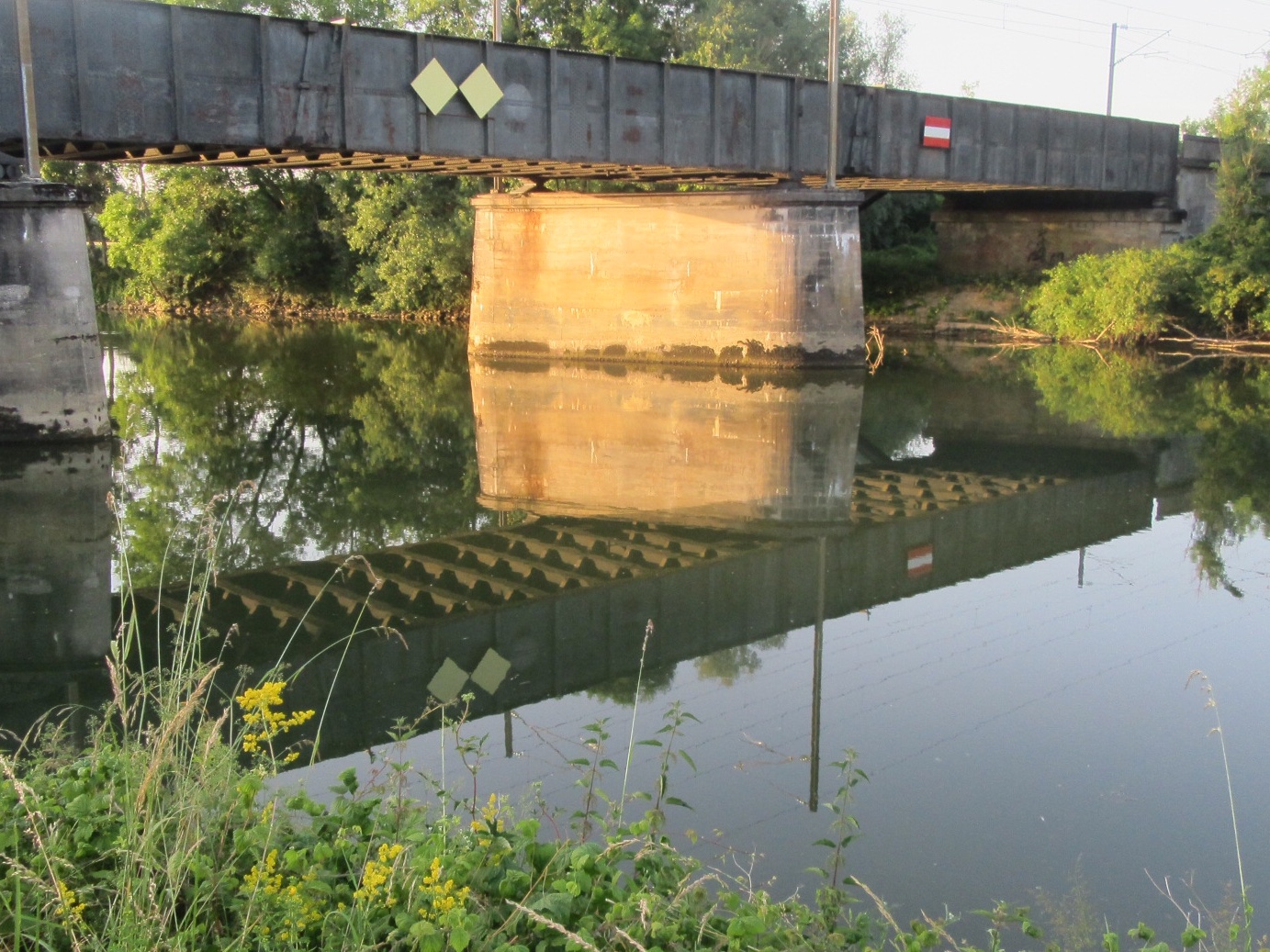
After supper, when the air had lost its heat, I took off with the camera and took a couple of reflective photos that seemed too work quite well. One was of the railway bridge, where not only did the stone supports reflect well, but also the track of the bridge, looking almost real across the surface of the water.

The other was simply of Calliope, gently swaying in the evening sun.

And then there was the comfy Captain waiting to welcome me back home, with all the paraphernalia .

So just one more thing before we leave the Canal de l’Est Northern Branch, alias the Canal de la Meuse, we have yet another change in the look and feel of the levers used to set the lock operations in motion, caught in its full glory at Remilly-Aillicourt lock

We were 6 kilometres from Sedan where the next day we would enter the official La Meuse river, taking us on to Belgium. A fiery sunset was a reminder of the heat of the day gone by, and the heat of the day to come, destined to be the hottest of the heatwave.

June on the Canal de la Marne au Rhin – weedy in parts; ultimately glorious

June 10 – 18 2019

Monday 10th June – we had left Soulanges on the Canal de L’Aisne á la Marne in the morning and by lunchtime we had turned to port at the T junction at Vitry-en François and were heading up the Oest (West) section of the Canal de la Marne au Rhin.

Leaving industrial Vitry

We had 111 kilometres to travel uphill to Void, with 70 locks to help us. We had been warned by other boaters that the canal was full of weed, growing and floating, and indeed the VNF issued a warning to battle.

Before long the blue skies turned to grey and the rain that was to be with us for several days, on and off, began to fall. With locks to negotiate every kilometre this is not as much fun as it might seem.

We were following a commercial barge that was making particularly slow progress; however slowly we tried to go we kept catching her up, and then had to hang around at a lock waiting for our turn, but that’s what sharing canal space is all about.

And it is good to see he canals still being used for commercial purposes – taking freight of the road.

It was not too long before we reached the very pleasant mooring we had picked out on the map – Bignicourt-sur-Saulx. It is a delightfully peaceful place to stay the night, and a walk round the village elucidated some history from World War 1, when the village tried desperately to hold back a German advance across the river and canal, but were overcome and many lives were lost.

The village includes a chateau that is a small hotel, and opens its gardens to the public on a Saturday.

This was Sunday!

This bridge over the Saulx was a focal point of the fighting.

This beautiful snail was my other major find of the evening.

The next morning seemed drier so we drew in our ropes and went on our way. There was a need to find a baguette for lunch if possible. Google maps located one in the next village, where there was also a good long jetty so we felt our luck was in. However every space was taken apart from a short length at the far end, quite close to the next lock.

A plan was hatched – Stewart would put the bow into the small space, I would (somehow) jump off and rush to the boulangerie and back while he hung about mid stream waiting for me and the lock.

It worked! I arrived back with baguette in the wet weather baguette bag just in time to watch the lock gates open and Calliope glide in.

When will the sun shine again?

We continued in the rain, eating lunch along the way. By the tenth lock of the day we were wondering if it would every stop – and still 5 more to go to the night’s mooring.

It got so chilly that we thanked Piper for the heater that blows warm air up from the engine room!

This kept the Captain warm – I meantime was out in the elements. Lucky I like water.

Things got interesting around Sermaize-les-Bains, where a lock is followed in short succession by two bridges, a sharp S shape bend under a third, followed by a basin leading into the next lock, out of which was reversing a large commercial barge!

Astern astern

Uo until now sensors either side of the canal had detected our approach to a lock and begun to prepare it for us, but as we reached lock 55 the system changed.

Now we could put to use the telecommander, or zapper as we preferred to call it, pointing it at each lock when we reached the command sign on the edge of the canal.

On up through another three locks and we reached Revigny-sur-Ornaine where we hoped to stop for the night. We had been warned that the wooden jetty was taped off, but still usable, so headed towards it. But the owner of the Belgian cruiser already tied up there, came gingerly towards us to want us off – most planks of the jetty had rotted through – so Plan B came into operation.

Plan B – moor up against the VNF ice breaker, Asterix

Plan B came to be the best plan! At about 8pm, in great agitation, our Belgian friend came to our boat to point out that the water level in the bief was rapidly dropping and they were already aground! He phoned the pompiers (fire service) and gendarmes, the latter of whom duly arrived looking very perplexed. Raising the water in a canal had not been in their training.

ut they were trained in making phone calls to useful people and after another 20 minutes two VNF cars sped up. By then we had discovered that several of the ‘vantelles’ which allow water into and out of the adjacent lock had remained open and water was simply pouring out of our stretch of the canal (bief). The VNF cavalry got to work once more, partly opening up three next locks up the canal and over night the level gradually rose.

And us? Well moored to Asterix we were further out into the channel in deeper water, and unharmed by the experience.

I like to note the different style of lock-keeper houses on the different canals. On this canal the houses are built on 3 levels at the back, and two at the front – reflecting the fact that the canal is built up on a levée

Some are no longer occupied and left in varying degrees of decay and neglect.

This one has almost been captured by nature – it’s glazed entrance porch scarcely visible.

We had been told that the pont-levée (lift bridge) at Mussey would not be lifted between 11am and 2pm, so although only 6 kms away we set off at 8am in case there were problems at any of the 4 locks between us and the bridge.

And as luck would have it, we got stuck in the first lock!

Stewart tried to clear the masses of weeds that were stuck around the sensors on the lower lock gate; the lock was not filling with water and our best idea was that the system did not know that the lock gates had shut – but to no avail.

So Lesley’s ‘lock French’ to the rescue, phoning the éclusier’s office to explain where we were and what the problem was.

It worked, and we were soon free and on our way, enjoying an artistic array of canal weed as we left the lock.

The art of floating weeds
Mussey Pont-Levée

We reached Mussey pont-levée in time to get through and onward before lunch. And then two further lift bridges to arrive at Bar Le Duc.

We moored up on the quay alongside the camper van park – all very civilised. It was possible to see the old town in the distance on top of a hill so once rested from our cruising exertions we started walking towards it.

We went over the river Ornain, and began to go upwards – steps and roads – onto a rampart style walk with stunning views of the roofs of the newer, but still old, town below.

The ‘higher’ town, dating from medieval times hosts so many interesting buildings, so here are a few – the Chateau, now a museum, the church (where we had a private tour from an enthusiastic guide in his eighties, and pretending did to understand),and the c13 covered market, the clock tower.

My favourite weird story from Bar de Luc is about the wife of a Prince of Orange who, when he was killed in the siege of St Dizier asked for a sculpture to be made of what he would look like 3 years after he died (if dug up!)

Here is the strange (full size) result!

So weird to my mind.

We strolled and rolled back down the steep roads to the newer town below and found a pavement bar to revive us before and relaxation before returning to the barge for the remainder of the evening.

Next day was mainly a boat day – filling with water, cleaning winter green from window edges, and re-stocking with provisions.

Then we went out to walk round another part of town before beer and pizza.

This took us over the lovely Notre Dame bridge over the Ornaine river, with old houses flanking the banks.

Michaux, inventor of the bicycle

We discovered another of Bar de Luc’s famous son’s – Michaux – though I am sure he did not look like this!

We found a second bar with Stewart’s favourite game! And he came up against a mini pinball wizard; they enjoyed what was apparently a good pinball game.

The pizza itself was interesting on three levels/Police outside pizza place, and lovely old church. First, it was delicious, and cooked by a Tunisian, not an Italian. Second, whilst eating a table on the pavement we were suddenly disturbed by two police cars, sirens screeching, once of which drove onto the pavement. The police jumped out and arrested a young lad who looked quite innocent, but unsurprised.

And then there was this lovely old church – a complete mish-mash of styles.

Easterly leaving of Bar de Luc

We continued our journey on Friday, following a yacht at first, under a pont levée. We soon lost sight of them, being surprised by a big barge after an S bend under a bridge!

Bye bye Bar de Luc, as the bridge comes down

Later that day we had another lock that would not open – leading to an hour’s wait in a peaceful spot – then the same again 3 locks later!

On this one I had to scramble ashore from the bow into who knows what undergrowth, in order to reach the lock and use their phone.

It was too remote for us to have reception on the mobiles!

We were unable to tie up, even to a tree trunk, and with the engine off we drifted pleasantly and quietly from side to side.

But all good fun!

Once we were on our way again we passed by many moss laden lock doors, water lilies, and pieces of old lock keeper’s equipment, (I think these structures were to hold the long barge poles). Ah, this is the life!

Reached Tonville-en Barrois and found a delightful mooring just at the edge of the village, but out of sound of any road. Just birds, and later rain drops, to soothe us.

We took a walk round the village and were pleased to find a boulangeries for the morning, plus an amazing old fortified church, going back to the c12. And, more exciting for me, the first lavoir of the season.

The singing of the rain

Overnight it poured and poured with rain, hammering down on the roof of the boat – we love that sound – but it had consequences for the weediness of the canal next day, as you will see.

I made a quick trip to the boulangerie before we left Tronville, with a plan for the day of 17 locks – but we fell at the first hurdle. The first lock was chock-a-block with weed, and once full the doors would not open to let us out.

Captain Stu had a go at clearing the sensors with a boathook to no avail, so on the phone to the VNF and then settle down to enjoy the enforced break, plus wash down the side of the barge following the previous days spattering from the guy cutting and strimming the grass next to our mooring.

That was lock 27. Subsequently we were held up at locks 20, 19 and 17 – in every case waiting outside the lock because the doors would not open and the ‘deux feus rouges’ appeared, meaning ‘en panne’ again.

At least we were not as unfortunate as this Norwegian yacht, which ran aground and was truly stuck for quite some time.

They did get free, and caught us up later.

We heard that another yacht had had its keel snapped off in the low water and had to be craned out of the canal – I hope that is not true.

We ate lunch on the go, enjoyed the sunshine and lockside flowers, and had a visiting dragonfly on the deck (sorry the desk is so dirty!)

At one of the ‘stop-locks’ I had time to study and photograph the system of pulley wheels that must have been used to haul barges under the bridges, while then patient horses walked round.

All of this had a good outcome – we stopped short of our planned mooring and found a countryside idyll at Naix-en Forges, with a grassy bankside and woods of birdsong above.  

Naix-aux-Forges also possesses quite an unusual lavoir, with steps down from a front doorway, arched windows, and an oval shape wash basin, still with fresh water running in, presumably from a stream.

And what is more, by then we appeared to have left behind the thick carpets of weed. Hooray!

All clear for tomorrow we hope.

Next morning before we left, and in the interests of my new resolve to lose weight (go, I forgot to tell you that didn’t I?) I then took a walk up to the road bridge and down the canal path to the next lock, while Stewart got under way and met me at the écluse.

We were now out in the weed-free glorious cow studded countryside, with blue skies, billowing clouds, and scarcely ever a boat to be seen.

We passed pastures full of flowers, little villages in the distance, and big hunting birds – mostly red kites, soaring above us.

The locks all worked perfectly, ready and open for us as we approached.

This was definitely one of the most enjoyable days on this canal – one of those days when you want to shout “this is why we did it!”

It is only with photos that I can do justice to the colours, the clarity of the water, the natural surroundings. Sorry not to wax more lyrical, but a picture paints a thousand words after all.

This day took us up to the top of the canal – next task the 5km tunnel to the other side. So we moored up just before Lock 1 at Demange-aux-Eaux, attached in a relatively precarious non-maritime way; each rope across the pontoon and round a signpost on the bank! But there were no bollards or cleats on the pontoon so little choice.

From the lock bridge at Demange

Luckily there is only a long distance view of this outrage.

We went for our customary walk around the village – a village with no shops, cafés, bars or restaurants. But they have a lovely bridge over the (much narrower than Bar De Luc) Ornaine river, and a church visible across the fields that has its entry over a tributary. Yes, that’s me posing on the church bridge.

Naix-aux Forges lavoir

As we crossed a smaller bridge we noticed what must have been in the past a lovely long, sunlit lavoir, and now seemingly used to store village bits and pieces. It was all locked up, netting across the washing area and the beautiful wood sides left to perish.

I managed a photo from yet another bridge. I can almost see and hear the chatter and splashing of the women as they washed their clothes; quite pleasant on a sunny summers day, but far from attractive to have that chore in the winter.

Maybe some day the villagers will decide it is a nice idea to restore it all.

I had a bit of ‘really-me’ time sitting on the pontoon, my feet in the water, and with a perfect mini world of nature below me. In the clear waters were tadpoles and little blue and yellow fish. Flying above were several types of dragonfly, bee and butterfly, darting from flower to flower, or water weed to water weed. All of course moving too fast for me, apart from these two feeble attempts, plus the dragonfly sex scene on our geraniums.

Stu and Boris swap canal and wine stories

That evening we made the enjoyable ‘mistake’ of inviting our neighbours, Boris and Marsha, across from their cruiser African Queen to swap notes on canals, locks and moorings.

They are lovely friendly people and we got to know them very well over some wine, breadsticks, and a remarkably good rum – from St Nicholas Abbey, Barbados.

With the knowledge of the tunnel in front of us, we called an end to the fun before it got too late – but definitely up for it next time!

Off to bed with a full moon shining – and is that Venus just to the right?

And so it was Mauvage tunnel day. I make it sound more frightening than it is of course. It’s just that I know Stewart doesn’t like the narrowness of the tunnels and the way they suck Calliope into the side.

Still we started off brightly, through lock 1, and heading for the left hand turn towards the tunnel. Seemed a shame to be going underground on such a beautiful June day, but only for an hour.

The arm up to the tunnel entrance passes the old ‘Towing Service’ building. Until quite recently all boats and barges were towed through the tunnel and some of the service boats were moored up outside.

Then into and out of the tunnel – all 4.785kms of it, well lit and with a path running alongside the water where our éclusier friend rode his bike to keep us company. It took almost an hour of Stewart’s undivided attention to make sure we kept a straight path, and we emerged into the sunshine undamaged and undaunted.

There are 12 locks down into the next town, Void-Vacun. That felt good after the 70 upward locks of the previous week! We took on the first 7 and then stopped for lunch, allowing nature girl a few more photos!

An hour later and we arrived in Void, to find all the official moorings full, the bridge about to be closed for work next day, and the shops closed – it is Monday in France after all!

But all worked out fine. We were permitted to moor up on an old industrial wharf where goods from huge silos (we are not sure what) were once moved by barge, and now by lorry. It was surprisingly peaceful, the occasional lorry on the weighbridge gone by 4pm, the gates locked, and the space left to us and dozens of house martins.

Evening view across to Void-Vacun

After a tranquil evening and night we were up in the morning to watch the VNF tug do its mighty work pushing an iron barge topped with a massive girder for the bridge repairs. We watched as we walked over the passerelle to the town for food shopping.

The town was far more interesting than we had expected, with another old covered market place, with 44 columns to reflect the Roman buildings of nearby Nasium. For some bizarre reason, 4 are rectangular and the best are circular, in no particular pattern that I could detect.

A small river runs through the back of the town, the river Vidus, right by the little Proxi supermarket. We also found a good boulangerie and a great boucherie, with typical slightly raucous butcher’s chat!

As we walked back to the boat we cut through under Les Halles, the old market place, and found ourselves on front of a mighty fortified gateway, through which are the church, the chateau …

… and a characterful, part fortified, pigeon house. So much more to Void than immediately catches the eye.

The old Void bridges and lavoir

And in case you thought I had forgotten the lavoirs, Void’s lavoir has now gone, but a photo including women doing their washing is next to the canal bridge where it used to stand.

And then I went for a walk round the back of town and found another lavoir, on a branch of the River Vidus, next to a pretty tumbling area of the river.

Back to Calliope for the evening and a quiet time on the back deck waiting for sundown – rather late at this time of year, with the summer solstice only 3 days away!

Tomorrow morning it will be good bye to Void, and good bye to the Canal de la Marne au Rhin, Oest.

Late start to 2019 – Sillery to Vitry

(Skipper’s note: Loose plans for this year had seen us heading further north towards the Lille/Cambrai area for next winter. However with two of the three canal choices we had to get up there currently closed half way through, we decided to go Route Four – and turn south – About Face . . . . )

So eventually – after moving house, a full service and eight new solid solar panels on the roof (well done Skips) we are off, heading south on the Canal L’Aisne à La Marne – and within 10 minutes and under grey skies we met our first lock – my first for 8 ½ months!  Luckily I remembered what to do, and had good French instructions to aid me..

We had half a plan to go all the way to to Condé-sur-Marne that day, but after two hours, 3 locks, and the threat of an ‘orage’ (thunderstorm) with 98kph winds we decided to moor up on an old industrial wharf in a basin at Sept-Saulx.

The wharf edge was decorated by poppies, my favourite flower, so we took this to be a good omen and tied up. Sitting back and planning next steps it occurred to us that we did not have canal guides for the two canals we were aiming for, and it is not easy to have post delivered along the canal ….. however a call to Damien, the Capitaine we got to know so well during our 5 week sojourn at Chalons-en-Champagne last year, and somewhere we would be passing in two days time, resulted in agreement for the new guides to be delivered there.

Skipper’s aside: I have, for as long as I am still a European, furled my Red Duster and raised a defaced European Union flag – nailing my colours to the mast as it were.

I find this photo of Lesley’s poppies doubly poignant, being a symbol of the utter futility of the millions of young European lives destroyed in the First World War by the machinations of a small number of power crazed autocrats determined to reorganise obsolete frontiers for their own benefit.

At the time of writing, my simple flag is a big plea to my countryfolk not to put those frontiers back in place.

Clouds gathering at Sept-Saulx

 We managed a walk round the village before holing up as dark clouds gathered and sure enough it did begin to rain – big fat drops that splattered the calm surface of the canal. Later thunder lightning and a strong wind joined in as forecast, although not anywhere near 98kph.

Panels still looking good though . . . .

Waiting for the Billy Tunnel green light

The next day it was still raining so we hung on until about 10am before setting off to Condé– a trip of  only 14.5 kms, but including a 2.3km tunnel and 8 locks. 

The Billy tunnel is described in the Du Breil canal guide as ‘attractive‘ – an odd word for a tunnel. But it is in a lovely area with a delightful mooring place to wait your turn, and runs in a good straight line so that you can see light at both ends of the tunnel all through your journey. We waited for a full sized commercial barge to emerge before it was our turn.

Captain Stu also noticed this time (it was Calliope’s 3rdvoyage through) that the commercial barge leaving was hugging the towpath side. On closer inspection in the half light, the wooden rail just above the water line that we previously thought was a crash barrier turns out to be a rubbing rail, and if you allow yourself to get ‘sucked’ onto it (Stu’s words) you slide through ‘like a rocket slid on rails (Stu’s words).

Truly marvelous’, Stu

We ate lunch during the wonderfully simple ‘chained’ set of 8 locks down, ie the next one prepared and opened for us as we approached.  And at 2.30 we arrived and moored up at Condé-sur-Marne; day 2 of our 2019 odyssey successfully completed.

Moored at Conde-sur-Marne with lock number 8 behind us

“So far so good,” says Captain Stu.

While the Captain became galley slave I took myself off to find what the maps called an aqueduct. And this is what I discovered – a c19 way to take water from the river below up into the hills. The tower is/was a pumping house. I later met a school teacher from the village who told me that the water is for the canal, nit for agriculture as I first thought.

I returned to the French equivalent of sausage and mash with onion gravy – mmmmm – and a quiet evening aboard reading more of my latest Ian Rankin.

The only disturbance was watching another storm moving in and waiting for the heavy rain and thunder. Still, there’s nothing finer than been tucked up in the wheelhouse in a good old proper storm is there?

Next morning was far better – grey skies, but no rain – so we slipped the ropes and set off back down the Canal Lateral de la Marne towards Chalons en Champagne, our home for 5 weeks last Autumn and where we planned to collect our maps.

We were accompanied along the way by a casual stow away with an orange head.

As we came into Chalons we were amazed to see a tall tall crane above the cathedral, with a group of people seemingly clinging on at the top! I watched with a certain degree of shock, wondering what they were doing – maybe protesting about something, as the French often do. And then I saw them begin to slide down one at a time! They look like flies in these photos, but zoom in!

It was only later when we had moored up that I discovered this was part of some elaborate preparations for a huge sound and light show occurring at the cathedral in two days time, sadly after we expected to have left Châlons.

The Furies festival, taking place in the park adjacent to the mooring

Ah well, Châlons still saw to it that we were entertained. We had managed to arrive one day onto the famous Furies festival. This is a 5 day free festival held mainly at outside venues around the city, with links (I think) to the Circus school here. It focuses on the bizarre and surreal, a mixture of street theatre, circus and music.

Stewart and I had an early evening wander round, and I found plenty to intrigue; their festival currency of ‘the furie’, the airstream crepe cafe, the music of Babil Sabir 2 (google them!), the strange play illustrating the aftermath of a car crash, and the very unusual tightrope strip and sex-act-on-the-wire show (luckily rather blurred on account of my shock)!

And you know you are in the Champagne region when only alcohol that the relaxed pop-up bar by the lake serves is 2 types of champagne, ratafia and rosé wine!

The plan was to carry on next day, with our new maps to guide us. However they were not delivered by 2pm, Captain’s cut-off time for slipping away on what turned out to be another wet and windy afternoon. Well at least we are near Stewart’s favourite boulangerie, so I got some of their quiche for a comforting supper.

And in the end we were waiting another two days for our new map books to arrive. In fact it was so windy most of those 48 hours that we were quite pleased to be tied up in such a nice town.

It also have me two more days of the Furies festival! Friday was fun with the crazy ‘A Good Place’ team, where their snaking waiting crowd was encouraged to join in dance routines and other entertainment; an incomprehensible (it was in French) promenade in the Jardin d’Anglaise with the two male performers running and shouting amongst the audience and round the park; and a bit of trapeze mastery when the wind died down.

Sally, Tin Tin, Morphios and Stu

Being in Châlons on Saturday also gave me the opportunity to go to the market and buy some delicious fruit, veg and bread. We took a stroll down to the River Marne in the afternoon and returned to find our lovely neighbours on Pavot suggesting champagne in the ‘Cosy Bar’ by the lake with their dogs. How could we possibly refuse?

The evening developed into a festival before I went into the centre of town to watch a great tightrope performer in the square, with a backdrop of some of Chalon’s beautiful old buildings.

Then a rapid march back to the Cathedral for one of the most dramatic and astonishing spectacles of my life. It began with an angel appearing on the roof of the Cathedral.

Then other angels appeared, in ones, twos and threes, seemingly from the night sky. As they ‘flew’ towards earth they began to scatter white feathers which gently drifted down on us mortals below.

The angels became ever more daring, and with ever more feathers

Until finally we were showered with feathers from every direction. The delight that swept the crowd was infectious and people behaved as if in a snowstorm, throwing feathers in the sir, dancing to the music, and laughing.

I am so glad that I didn’t miss this!

My boat is covered in feathers. Did I miss something?

Next day we were up on time and raring to go. There was a quick run to the boulangerie for fresh bread, and then we set off south down the Canal Lateral de La Marne watching Châlons fade away in the distance.

Before too long we were at the first lock, pleased to see the green and red lights that told us the lock was being made ready for us

And on we went down past the villages and silos, the winding holes for big barges to turn round, locks and countryside.

Occasionally we saw wildlife, usually herons. There are plenty of young herons trying out their fishing skills at this time of year.

He’ll not catch much sat on that bollard . . .

He’s not sitting. He’s standing! Look closer.

Our lunch time stop at La Chaussee sur Marne

We carried on until we reached Soulange, knowing it to be a peaceful rural mooring and just right following city dwelling in Châlons. I have to admit that we were a little disappointed when another small cruiser squeezed onto the jetty behind us – notwithstanding that it is important always to welcome and help others to moor – even if they are rather noisy.

I took a walk over to the river Marne and along the bank for a while. There was a lovely view back to Soulange church through the undergrowth, and tranquil scenes of the river.

It seemed to be the first day of the dragonflies – they were everywhere, flitting about just out of range of my camera most of the time, but I did get a few ‘on film’.

Then back to our mooring to discover that old friends Matthew and Helen on a sister Piper barge Havelock had arrived – we shared a jetty with them at the T&K marina on the Thames when we were first in the water. A rare treat, although as Stewart was a bit under the weather it was just me who was able to enjoy their company.

Soulanges sunset

The day finished with one of the most beautiful canal sunsets I have seen, ah La Belle France.

Next day was destined to see us down to Vitry-en-Francois, and the end of our known waterways. We would be launching into a new canal by afternoon, so we enjoyed the last of the Canal lateral de la Marne.

I think that the most memorable ‘look back’ was to the quarry mooring where we stayed last year and our ropes were covered with blue butterflies.

Then at last, the junction at Vitry, and we turned left onto the Canal de La Marne au Rhin, and new vistas opened before us.

An unexpected sojourn in Chalons-en-Champagne

So with spirits high and buoyancy in our step and our ship we turned starboard out of one canal, and then port into another – the Canal Lateral à la Marne. We were on schedule to reach our Winter mooring in Sillery six days later, including two, or even three, nights in Chalons-en-Champagne. Little did we know that this would stretch to at least thirty-two!

And, sadly, be my last bit of cruising for months and months. 😢

063B4B4E-1A02-4A4B-9A90-4661A908390E


In our innocent unknowing state we left Vitry-les-François behind and began to experience the new canal. We were back to grabbing and rotating poles suspended over the water to operate the locks – always good fun.


There was a completely different style of lock keepers house – regrettably still mainly abandoned.

2BBD78A6-776C-45E1-BCA1-E495AFF95389


And long stretches of straight straight canal, unlike the twists and turns Entre Champagne et Bourgogne.

B9C1111A-AA26-4564-AA60-9EF3E453AED2We were wondering where to spend our first night when turning a bend (yes, there are a couple of bends linking the straight bits) we saw one of the most beautiful moorings ever. A long stone quay, flanked by the remains of industrial stone buildings, stood waiting for us.

G(nIt was surrounded by peace and tranquility, with lizards and butterflies the only other obvious inhabitants.

Calliope’s crew had a wonderful time exploring the stone walls, arches and crevices – without managing to uncover the original purpose of the quay, but probably it is linked to a nearby quarry and was used to load stone into barges for onward journeys.

Later we were joined by Troubadour, another British owned barge, and in addition to having fun discussing our separate epic voyages, doubt was cast on our future plans! It was suggested that the canal to Sillery, our winter mooring, was closed. “No”, I assured them. “I have an email from the VNF saying it shuts next week”, and showed them the email to prove it.


The sunnny evening gave glow to the stone, and next morning the sun shone down on us once more, casting shadows as we cast off, to move on to Chalons-en-Champagne.

9FC4AC3A-47B9-4A61-8DF9-86CED8E7845CThe cruise was uneventful; 7 locks and 29 Kms under blue skies, past sleepy villages, glimpses of La Marne, and a series of grain silos, indicating local agriculture.

9FBF7BB6-8833-4B29-AB01-6B4224468819Calliope arrived at Chalons to find plenty of mooring along the port quay, next to Bird Island and the Grand Jardin; a nice spot. We booked in for two, or maybe three, nights and I went to talk to the éclusier to make sure that my version of canal closures was correct ………. except it wasn’t!

The éclusier rang the VNF office and was told it had closed on 10th September. I rang my email contact at the VNF and was told it does not close until the 17th. Then I rang the agency doing the work. It’s closed. The water has been drained out. There is no way we can navigate until October 15th!!!


Hence our enforced sojourn in Chalons-en-Champagne. Let’s make the best of it – not difficult here. We’ll start with a beer in the square, then a pizza – but not in this restaurant because it didn’t open!

Our time in Chalons was divided between working on the boat – painting, cleaning, varnishing, polishing – and enjoying the town.

The first weekend there was also the town’s Patrimonie weekend. This means that a vast array of activities and tours are laid on to give local people (and incomers like us) a better understanding of their history and culture.


Chalons-en-Champagne is a major Centre for circus arts, and one of the more surreal performances was in the gardens about 200 yards from the boat! So plastic tumbler of rosé in hand we went to watch.

752CCE74-D729-440F-8153-02892ECC4B99The next day I was up and away by 8.30, heading for the massive Porte Saint-Croix, an Arc de Triomphe look-alike edifice that was open for breakfast on the roof!


I was there in time, climbed the wooden spiral staircase, and out into an azure morning sky. Black coffee, orange juice, and mini croissants etc held me together for looking down and out at the views across the city.


I could see so many steeples and spires, it was inspiring! (Sorry.)


Before I returned to boat duties I called in at the Saturday market – temptingly delicious as always. The grape harvest is definitely in, and the range of plums is wonderful. I resisted most things, but bought some pork pie with mushroom and crême fraiche under the top pastry, some good fresh fruit and veg, and baguette.


My journey through town took me along little back streets adjacent to the River Mau which appears and disappears along its route.

The next few days involved work on the boat. We had cycled out of town to a brico to buy ‘stuff’ that was needed – to replace a tap, to bleed radiators, to mask edges for painting, brushes for varnishing, I could go on but won’t.


So in amongst going into a town full of ancient buildings we (mainly Stewart) got to grips with maintenance, sometimes in a ‘one step forward, three steps back’ manner.

I made a quick dash to see the Préfecture, a lovely classically French building, and later dragged Stewart out to an art nouveau hotel where I knew tasty morsels were on offer – both part of Patrimonie. Far too many people crowded into the art nouveau, so we escaped to a local square for a beer.


Later that evening I was back in town for further surreality. I sat with others in rows of chairs in the middle of the road by Norte-Dame-en-Vaux for a carillion concert with a light show!

Next day was full of boat duties in the morning, then a final dip into Patrimonie with a strange ‘concert’ in medieval cellars. It turned out not to be our thing so we crept out and up, and instead visited the cloister museum. It’s a museum because it was allowed to crumble away and get covered by other buildings, but was discovered in the sixties. Everything that could be reassembled is in the museum, with a garden showing the original outline next door.

609FB697-7DE1-4614-90A5-8493D40274F5We also found time for a walk round the Grand Jardin, over the passerelle and back along the canal. Gave us a view of the starboard side of Calliope.
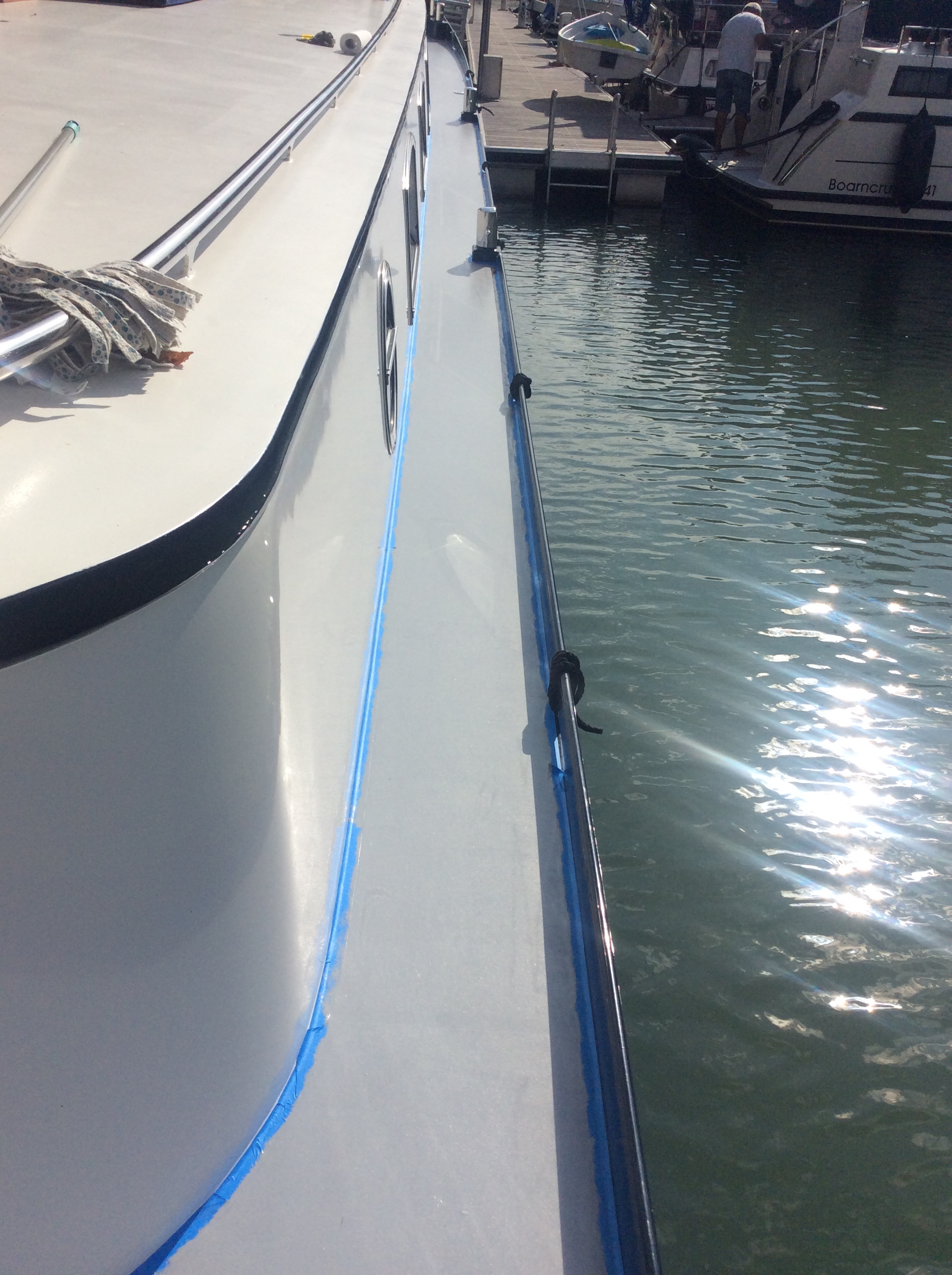
DB616C47-31D6-4546-BF58-D454BB3D1963The new week had us starting on painting – well preparing or painting initially. For me this meant clearing  and washing decks and roof, hunting out little rust spots for treatment, and eventually masking all round the deck ready for the master painter and his roller. Looks good now!

846EA99E-5211-4DB8-9F5B-BD65A27852FF

Despite all the work we managed to fit in a gentle stroll most days, trying to explore different parts and arts of the city.  I took the skipper to see some of the Nau and the Mau – two small rivers that cross Châlons, mentioned earlier. At one point the angle of the light on the twin steeples of Notre=Dame-en Vaux made it worth an extra photo.

A pigeon flew by obligingly at the right moment!


The next day was just a great laundry day – sunny, warm and breezy. So I used the excellent marina facilities and soon had my washing drying all round the back deck.

D18BB952-5043-4BD5-9B2B-703809A1DB27We stayed on board carrying on more jobs inside and out, and as evening faded in we had a surprise visit from Damien, the Port Capitaine, with a bottle of champagne left over from lunch with his colleagues at their end of summer season pic-nic.  He poured us a glass each and continued to the other occupied boats in his port. What service!

(You can tell the Skip’s done this before with two flutes inclined at just the right angle to get most liquid and least bubbles…)

It’s worth mentioning here the other great things that Damien does to earn the port’s Blue Flag. There are the basics like a working pump out, to discourage boaters form discharging their waste tanks into the port waters; a book swap; very clean showers and laundry room; selling environmentally friendly cleaning products; an array of recycling bins and a composting box; collect from us batteries, old light bulbs, plastic caps etc, and even taking things we no longer need and finding new homes for them.


So another evening drew to a close. We had a final /visit from the swan family, who adopted a stray goose when it was a gosling and brought it up worthy their three cygnets. They are now inseparable!

6F2F9C97-DC4B-4A96-A71E-9A8994B7D198Friday was a left bank, bonkers conkers and soup day. It was a bit colder ands greyer so what better than a nice bowl of home made soup for lunch – especially when blended to a creamy consistency. It helps not to turn the base of the blender the wrong way so that the soup pours out the bottom. It also helps not to have the blender spray the soup across the wall and curtains. Finally it helps not to drop the curtain in the canal when you are hanging it out to dry.  Sadly, this is all true ….


The bonkers conkers began Friday in earnest. and continued madly dropping until Sunday – more and more and more! We are moored under long rows of horse chestnuts and they fall on our steel roof with wonderful clunks, sometimes bouncing off into the water. They are a noisy but decorative distraction!


After lunch we went for our rive gauche (left bank) walk, crossing the canal, the Marne and the railway line to get there.


Quite unexpectedly we came across St Pudentienne, a church part deco and part something else (I think the word you’re looking for is the afore mentioned Bonkers) – strikingly different, and a delight.


On our way back we walked up into the town centre, looking for somewhere to eat out that night. The sun caught the gold and blue atop the town hall, below which a production team was in full swing preparing for a concert that night – a band called Natchez ….. (Yes, that’s the Captain peering into a shop window on the left).

We eventually went out for a Chinese meal – a bit odd to do in France, but we decided that the French restaurants were best visited at lunch time, both for the prices and to give more time to digest the good rich food before going to bed!


Saturday was an exciting one for me. Châlons-en-Champagne had laid on lots of free fun that was right up my street (less so for Stewart). The day time had a succession of world percussion events held at different locations back on the left bank. And the evening had a ‘colour run’ followed by a big outdoor concert.


Out came the bike and I cycled over the canal, the Marne and the railway line, and on to find the first venue and a Brazilian street drumming band. I honestly had tears of pure joy listening and moving to them; just loved it! Then onto to venue two and three to hear two different types of African drumming, one with great dancing, and the other with some fabulous singing. I had three hours of mesmerising musical entertainment.

Then the evening; well suffice it to say that I was not one of the official 2000 people registered to run 5 kms through the parks and streets, past Calliope, going through mad colour spraying stations, and accompanied by music at various stages. But I did manage to join in ……


Thank goodness the rain held off for that!

7E1B7550-D980-4F41-9594-D240EF351CD1Sunday was a different story, with storm force winds, pouring rain, and a temperature drop that had us lighting the stove. But then it is autumn, and it is northern France, pretty much – and still three weeks until the canal re-opens.

So most of the rest of this chapter is an outlook to and insight of Châlons-en-Champagne, in no particular order.


We had plenty of time to wander the streets, taking in the architecture from medieval to gothic. Almost every turn of a corner brings something interesting into view – a gateway, a roofline, a statue or a church.


Some are big, grand, and somehow survived the revolution. Others are small, functional, part of the real life of the Chalonnaise.


We walked down to La Marne, by now quite a big river and a long way from her source up near Langres where we were a few weeks ago.


The autumn colours glowed in the sunshine, and the earlier sunsets went from pink to yellow to purple as we watched.


There have been so many glorious days enjoying the sun on the back deck in comfortable warmth, rather than hiding from the blazing high temperatures of summer in the South.


Then there’s been swans …..


….. there’s been meals out – that good Chinese supper, an interesting French lunch in an old Parfumerie …….


…… there are local characters including many a fisherman (they are almost all men), and students affirm the crisis school practising tightrope between there trees (Châlons is a major cents for circus skills) …..


…… and the ever changing light on the structures of the Jards. (Jard is local colloquial for public garden or panted promenade, so almost the same as jardin, but not quite).


There was yet another event in the Grand Jard – an afternoon for crazy skate-boarders, cyclists, scooterists and skaters, with a DJ sending out good music, burger van, and a nice big air bag to catch the more acrobatic. We spent a while spectating, with quite a lot of amazement!

C5512502-D5D7-4682-99B3-17973C457524The Grand Jard includes a chalk board where you can add your bucket list wishes – ‘Avant de mourn je veux ….’ I love some of the wishes – fromage (cheese), miel (honey) and cheval (horse) – whether to eat or ride is not clear!
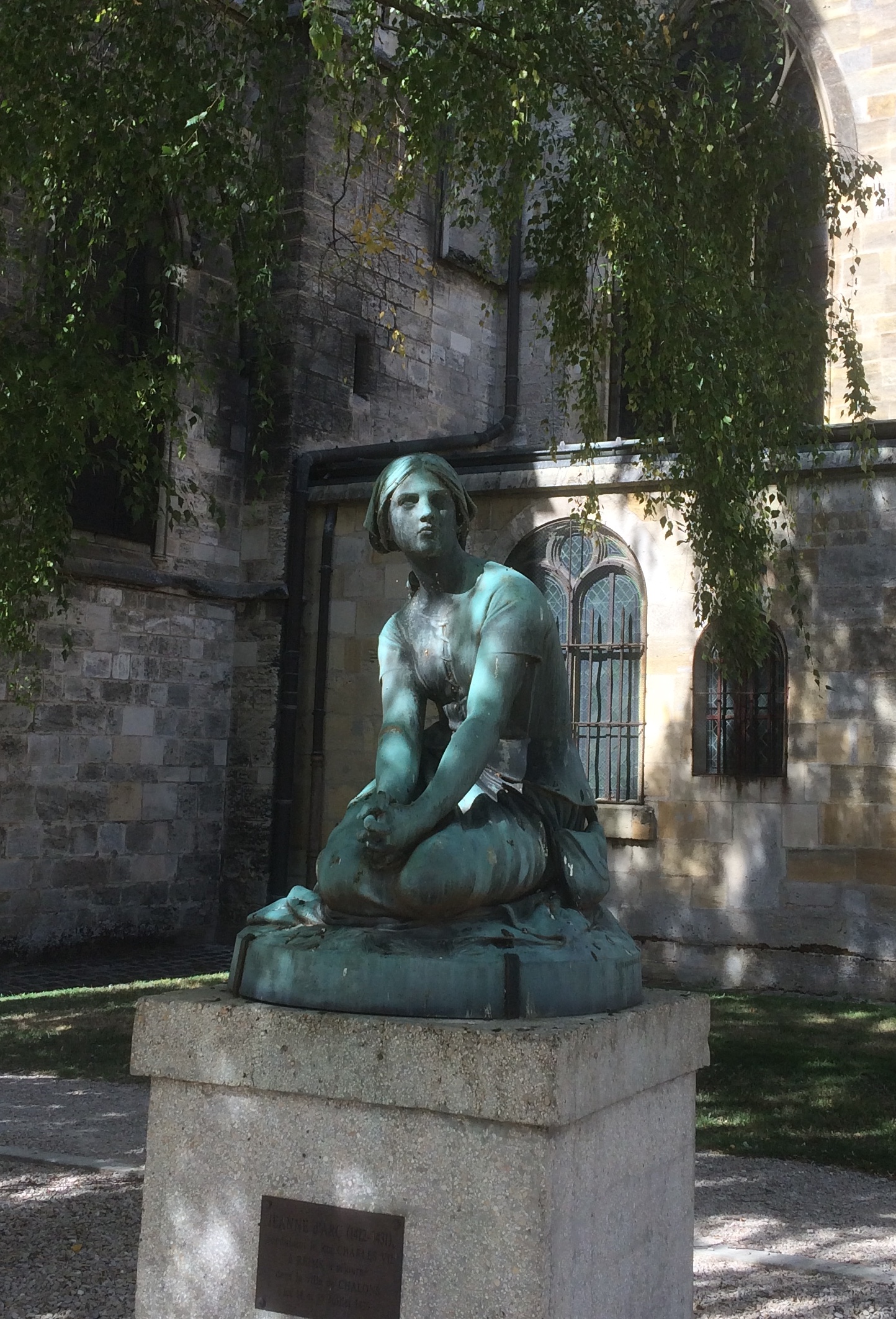
And as the weeks wore on we ensured we had seen the more cultural aspects of the city too – the Museum of Beaux Arts, the inside of the Cathedral and Notre-Dame-en Vaux, and a walking tour of the architectural wonders (Gates not the city – or where they used to be, houses of all ages, bridges over the many canals, rivers and tributaries of the Marne, statues etc).

1CB48EEB-E78D-423C-A36F-F247754B73B7
Joan of Arc, as a peasant girl

This includes my favourite statue of Joan of Arc ever – and we have seen quite a few on our journey – still as a young peasant girl, rather than as leader of a revolution.


We cycled south to Domaine de Coolus, a wooded nature park, which took us along next to La Marne and gave wonderful views of the weir and the old, now closed, municipal swimming area, with diving boards into the river.


The evenings gradually drew in, the leaves and conkers fell, and the time spent on the back deck decreased. But there were still some lovely early evenings there. My favourite Autumn drink made an appearance – white Aligote wine with a touch of Chataigne, chestnut liqueur.

2818C5B3-3598-41D5-8623-E9C10FDA32BEOut for an evening stroll on October 1st I discovered that Calliope was the only remaining boat on the port with people aboard – everything else, the hotel boats, other barges and cruisers, had either left or been ‘winterised’.


With only a couple of days before I was leaving Stewart alone to await the canal opening we went for a proper French lunch – a three course menu for €17 which for me included delicious herring and potato salad, a wonderful tripe dish (!!!!) with some of the best frites I have ever had, and a tangy fromage blanc. Stewart’s meal was also excellent, his steak haché arriving unexpectedly topped by two eggs!

My last full day arrived wet and windy, requiring a good sweep and mop of the decks to clear leaves, twigs, conkers and dust!

After lunch the weather changed – “Here comes the Sun doo be doo be” – (for those of a certain age) so we went for my final walk round. I didn’t take many photos, just of things I had not seen before, plus Stu and I in front of the one city gate still standing.

5A75CB0A-BC09-4237-82C5-3F2880EB86C4I’m not very good at good-byes, so started with my garden – at least the floral part of it. The herbal part is up on the foredeck.
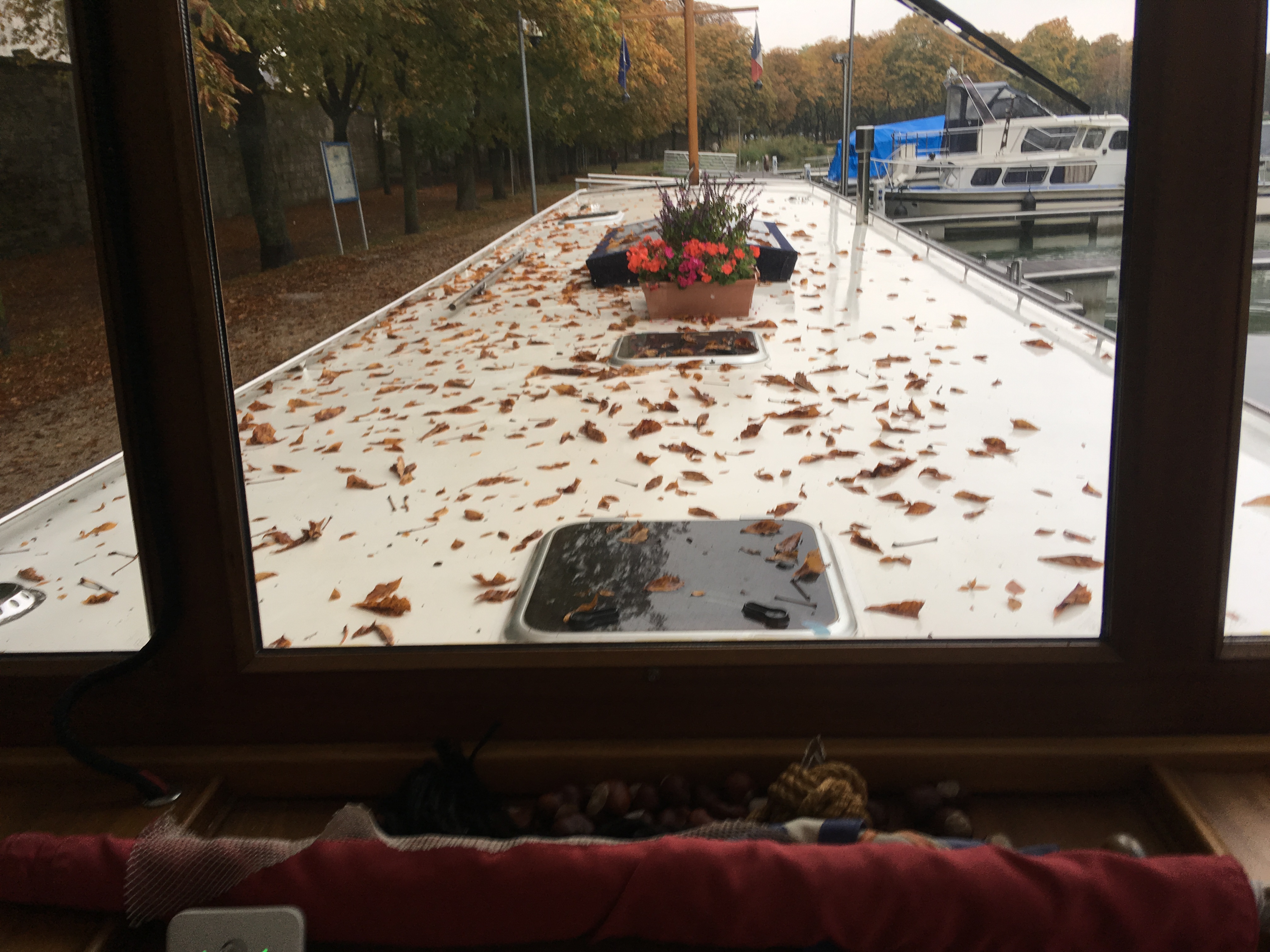
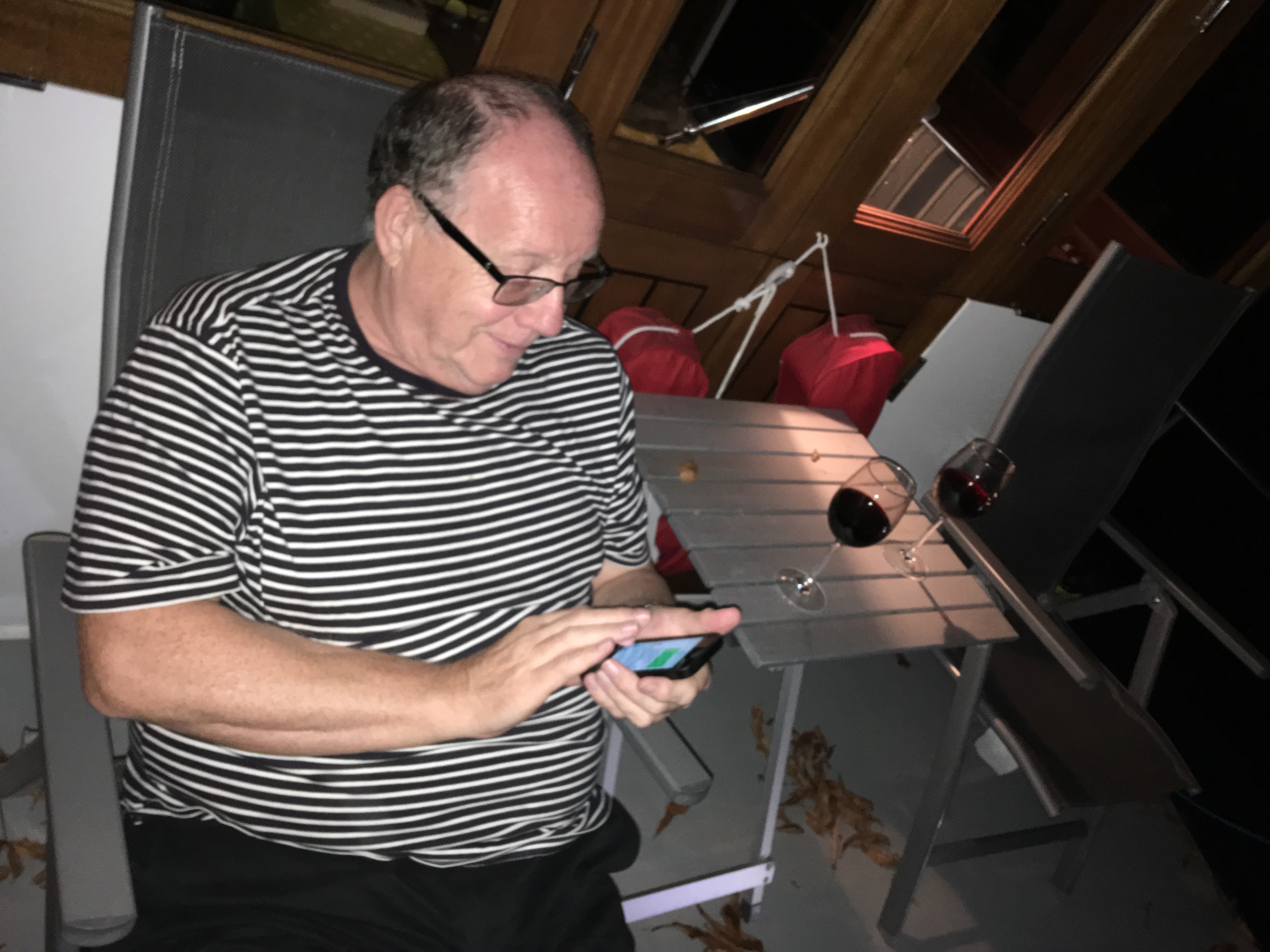
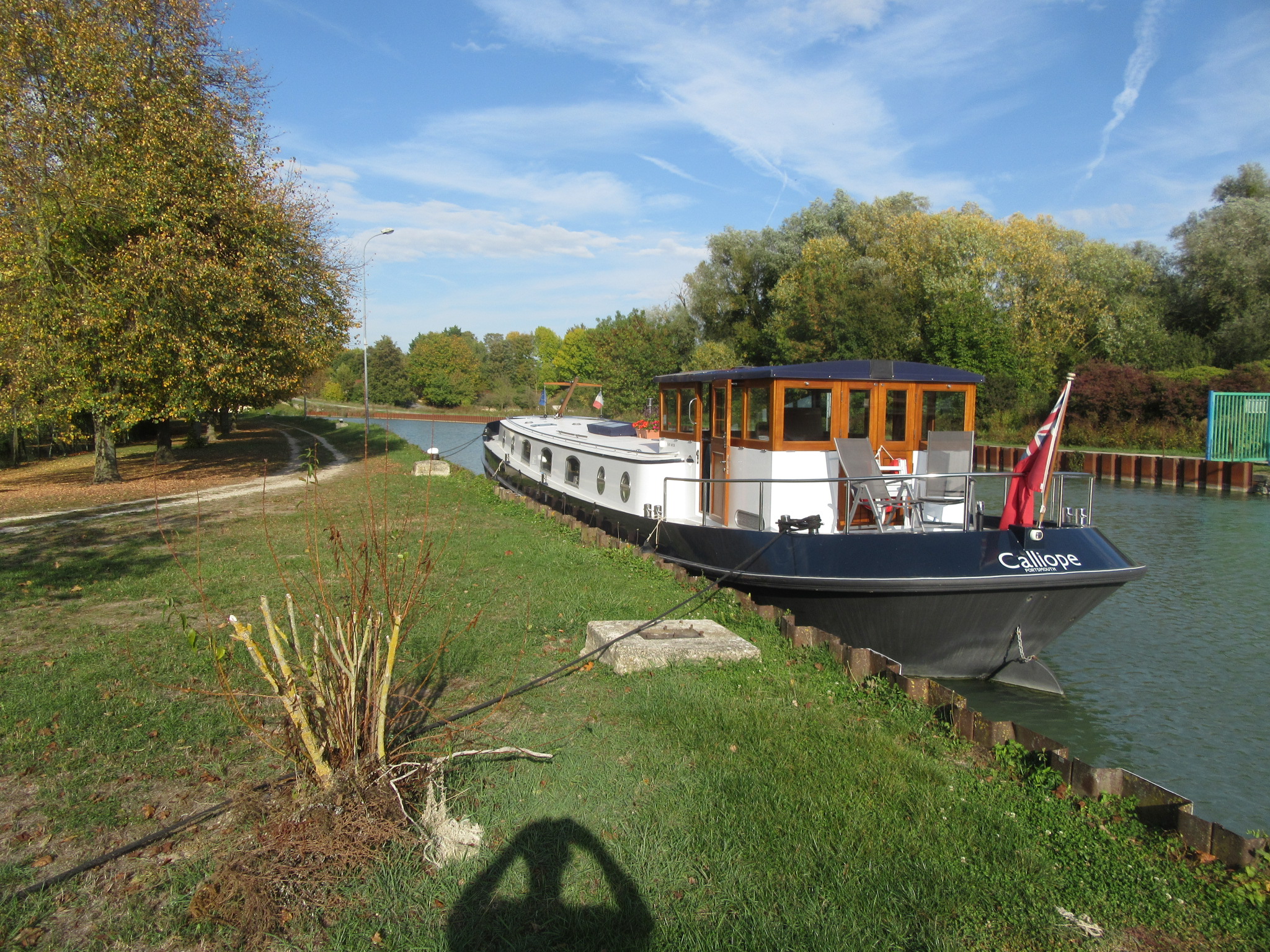
So that’s it from Calliope crew for 2018, but the Captain is on board for another two weeks and will, hopefully, continue the tale………

………………

……. So – it’s gone very quiet on board all of a sudden I’ve noticed, but we have a plan. There is still have another week to sit out in Chalons until the canal to Reims re-opens – though as you may have noticed from the above, this is not much of a hardship. 

At that point my old schoolmate Billy will arrive who, after a further couple of days R&R in Chalons to help him get over TGV-lag will help crew us through the last couple of days to our winter mooring at Sillery.

IMG_0154.JPG

The autumn winds are definitely blowing the new season in, though the nights are still balmy enough for Billy to check his racing results on the back deck . . . . 

IMG_0159 18.31.46.JPG

And then – right – we’re off! First day is planned as a very leisurely 8k and three (descending) locks to a quiet stop-over in the small town of Condé, which boasts a church, a boulangerie and three champagne houses. 

46296256_Unknown.JPG

The journey was sedate – and slowed down even more with a 3 hour delay in a wonky lock with an absent lockie – but we made landfall late afternoon at an empty quay. New crew did well and got the hang of the ropes quickly, despite being more of an obstruction to look round than I’ve been used to …..

46296160_Unknown.JPG

(Sorry Bill)  So – the last day’s cruise of the season starts bright and early and we’re off up the Canal Aisne a la Marne with eight 3m locks ascending to the wonderfully apposite tunnel of Billy-Le-Grand followed by three more descending to this year’s home port. There was however a bit of an Ooops ….

46296304_Unknown.JPG

Having negotiated all locks with aplomb up until the last before the summit, the boat in that lock rose way above the bollard on the quay and somehow Billy got hung-up while going up – which is quite an accomplishment.

(To be fair, the skipper also snagged a zig-zag on the very next lock gate and lost a lanyard, though I don’t seem to have any photos of that.)

So, during the year Lesley and myself would always acknowledge the ‘Last Lock of the Day’. It’s down to me and Bill this year to salute the ‘Last Lock of the Season’.

46296336_Unknown.JPG

And so here we are, the winter mooring at Sillery. Another wonderful 6 months, and another winter to work out next seasons adventure. I still would love to go to Berlin . . . . 

IMG_4309.JPG

Over the top to Champagne

Canal Entre Champagne et Bourgogne

25th August to 11th September 2018

This is a seriously exciting and enjoyable canal. It is 224 km along with 43 locks on the way up and 71 locks on the way down plus a 5 km tunnel through the summit – the Balesmes tunnel.

E832CFE6-BA43-47C8-9C9C-9B71CE5B18A9It passes through glorious agricultural countryside, forests, villages and somewhat industrial areas with the kilometres marked off by small white stone markers all along the way. Nearly all of it is tranquil, very rural, and somehow real whilst totally charming.

It is also very different to the rivers we had just left, Le Rhône and La Sâone.


After waking to a very misty morning in Maxilly Stewart and I jumped on our bikes and cycled off for a restock of the fridge and cupboard; There are very few shops on the way up to the summit!


Then with provisions aboard and the Sun shining we set off for our first day on the canal. We covered 23 km on day one going through 10 locks and rising 30 m. We found a lovely lunch spot-very pleasant thing to be able to stop for lunch after all the full days on the rivers.


We passed under the beautiful viaduc d’Oisilly, through plenty of locks ….


…. and eventually found a very tranquil mooring spot for the night.


Next day was a shorter cruising day-only 17 km, nine locks, and 28 m up. We began to pass more livestock – mostly cattle, but occasionally a horse. And dragonflies appeared to join the journey.


We arrive at Cusey in time for lunch and siesta, and then walk round the Village. This has obviously been a busy agricultural centre in the past, full of old barns and houses, and even 14th century Chateau.

9E7D2506-7F38-4FC3-995C-A2E404EBCD53


There were no people there to greet us but we did make one new friend.


03EF09EB-4E7A-45F5-B6D5-34E493ACED14


It was a peaceful mooring, even though a couple of other boats did arrive later to keep us company.


5DF753A9-3EE8-49EE-9383-624A87265563


The following day, Tuesday, began with a bit of boat cleaning. The heavy overnight dew provided just the right amount of water to clean the roof!


We only covered 14 km but we went up 14 locks taking us  41m higher.


The locks on this canal are mainly operated by a mix of a remote control, to prepare the lock and open the gates, and pulling blue levers (often rather slimy!) to fill or empty the lock.


For some reason the light was just right for photographs so I took quite a few; here are a couple with nice shadows, to my way of thinking.

6E6E359D-5BED-4A4B-A2B7-594A96000038At one point I jumped off the boat and ran, well sort of jogged, to get a photo of the Pont Canal de Badin from below.


I had by then begun a series of photos ‘through the galley window’, a couple reproduced here to show the varied buildings we passed by.

2A36F989-B09A-4202-9EC4-960946C09062We had not planned to go quite so far but it took a while to find a mooring. Eventually we stopped outside Villegusin-Le-lac under the trees; gentle light for the Captain and his crossword. (Oh, he and I together had cut off his curls a few days before, so here is the convict look!)

8EB90A44-8CC1-47E5-86B2-DBF68A92C385Once more there was time to eat, sleep and go for a walk. This time our new friend was a young Whip snake at the side of the road, behaving very bravely and threateningly given his size compared to mine!


There are plenty of fruit trees bulging with ripe fruit, many just growing at the side of the canal or the road, so some scrumping was in order! This continued for the length of the canal, with me collecting and tasting lots of varieties of plums and apples, some eaten raw, and some cooked with added alcohol!


Thunderstorms forecast for Wednesday so we decided to have a day moored up under the trees. Before the rain arrived I cycled back down the canal to Dommarien because I knew there was a Lavoir there – and as it turns out there is also a pretty bridge.


That afternoon the storm arrived and the rain absolutely poured down! We stayed in snug and warm with cups of tea.


Then when it had abated we walked into Villegusin-le-Lac and found the one bar, attached to the one restaurant, and had a pleasant evening along with the locals.

9D57D254-F76C-4E0C-8C0E-986DCA568CB7Throughout the bad weather the big commercial barges must keep working. Many of them are quite new, but one beautiful old barge came past ……


A good night’s sleep prepared us for what was to come – the final assault on the Saône side of the canal in order to reach the top. This meant 8 x 5m locks, each about half a kilometre apart, followed by the 5km tunnel. This required hours of concentration from Stewart, getting in and out of each lock without mishap, and then avoiding being sucked into the sides of the tunnel for an hour and a half!

2072489B-A6A0-4313-A2B5-186B44E3B721We stopped for a well earned lunch by the side of the canal and a field of 5 mares and 5 foals. Delightful. Then pressed on for two locks – downwards! – to reach Langres. We moored up with two other Piper boats, an unusual event since leaving the south where we were in the company of quite a few Piper owners.
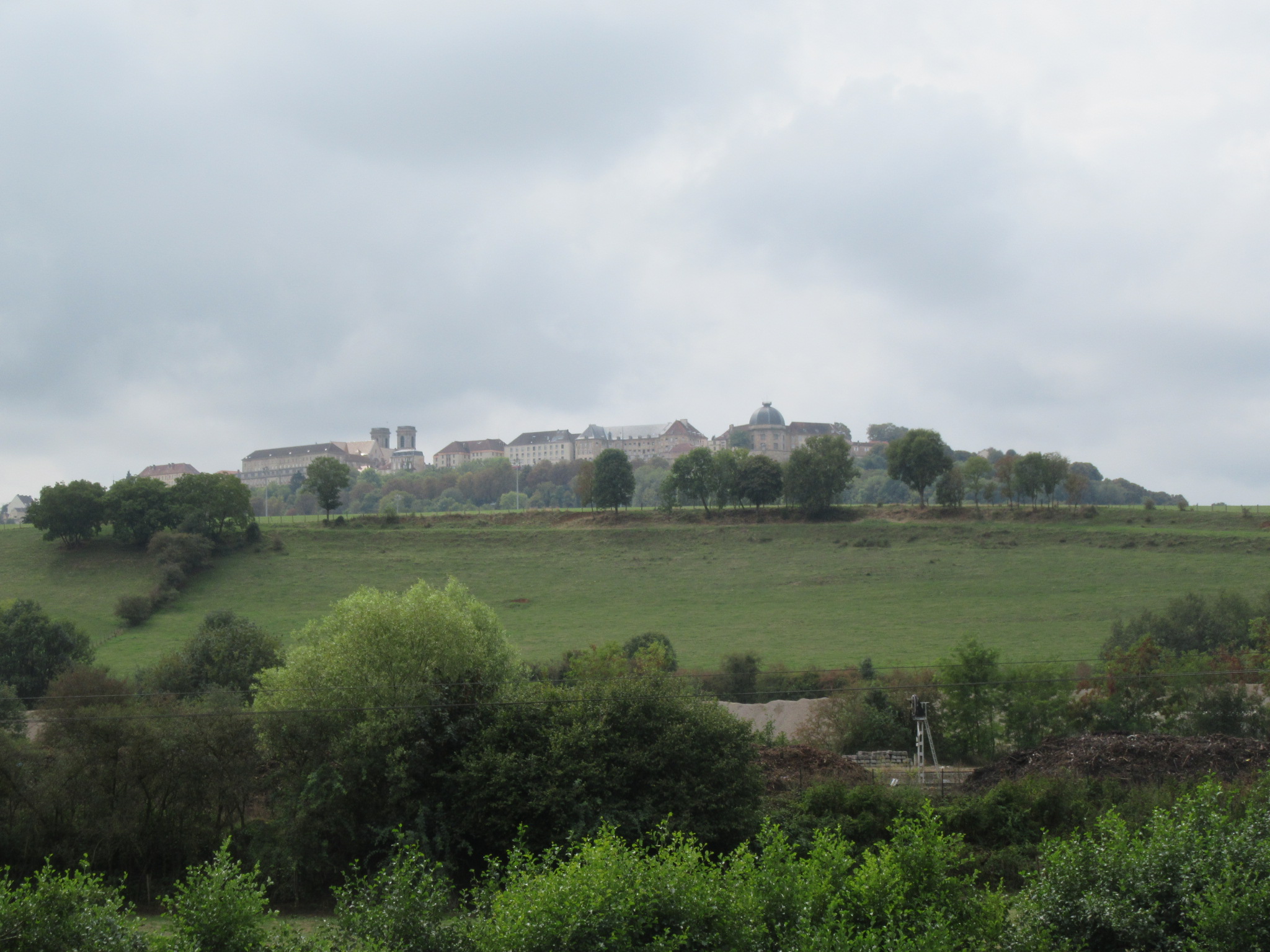
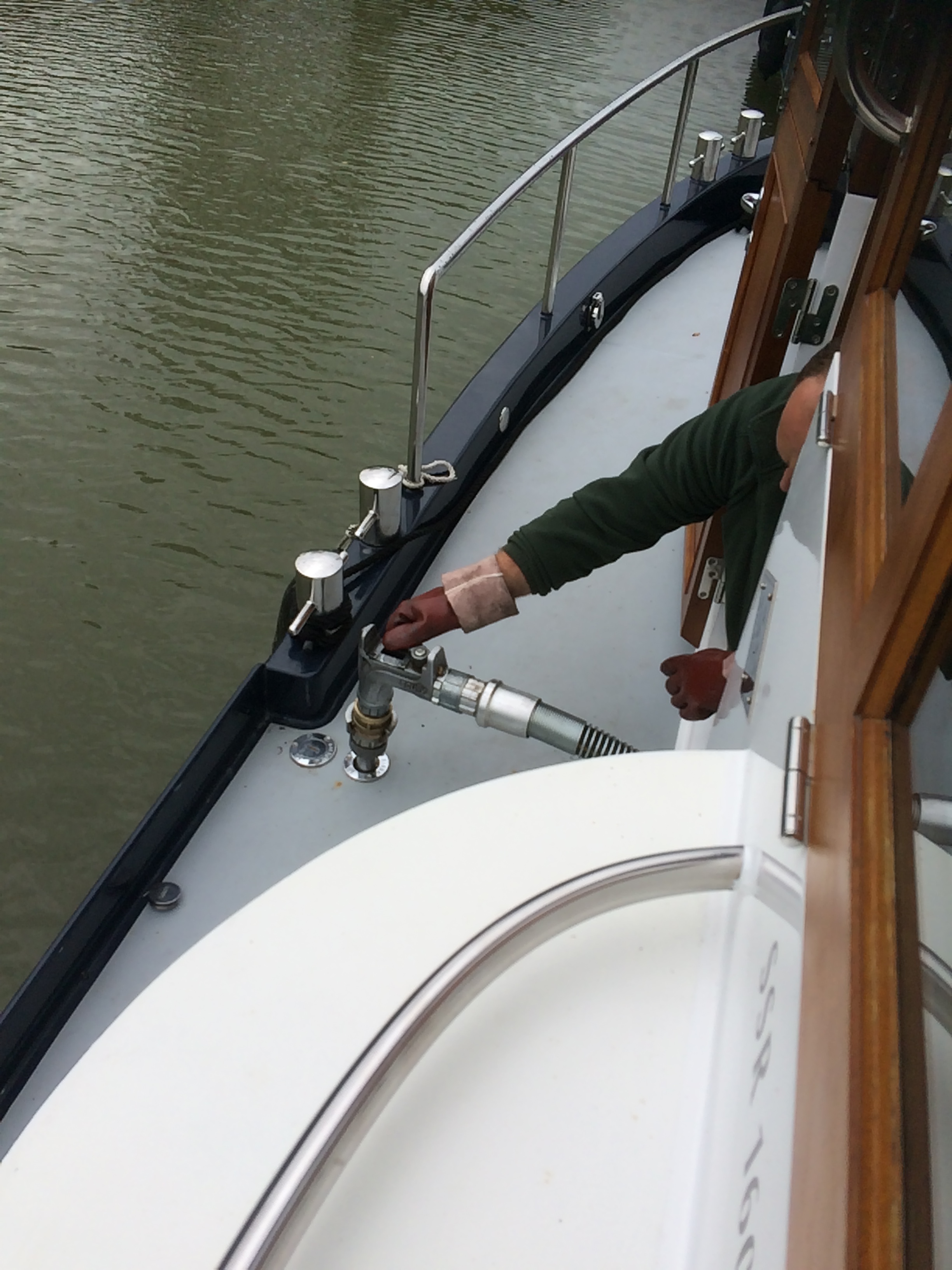
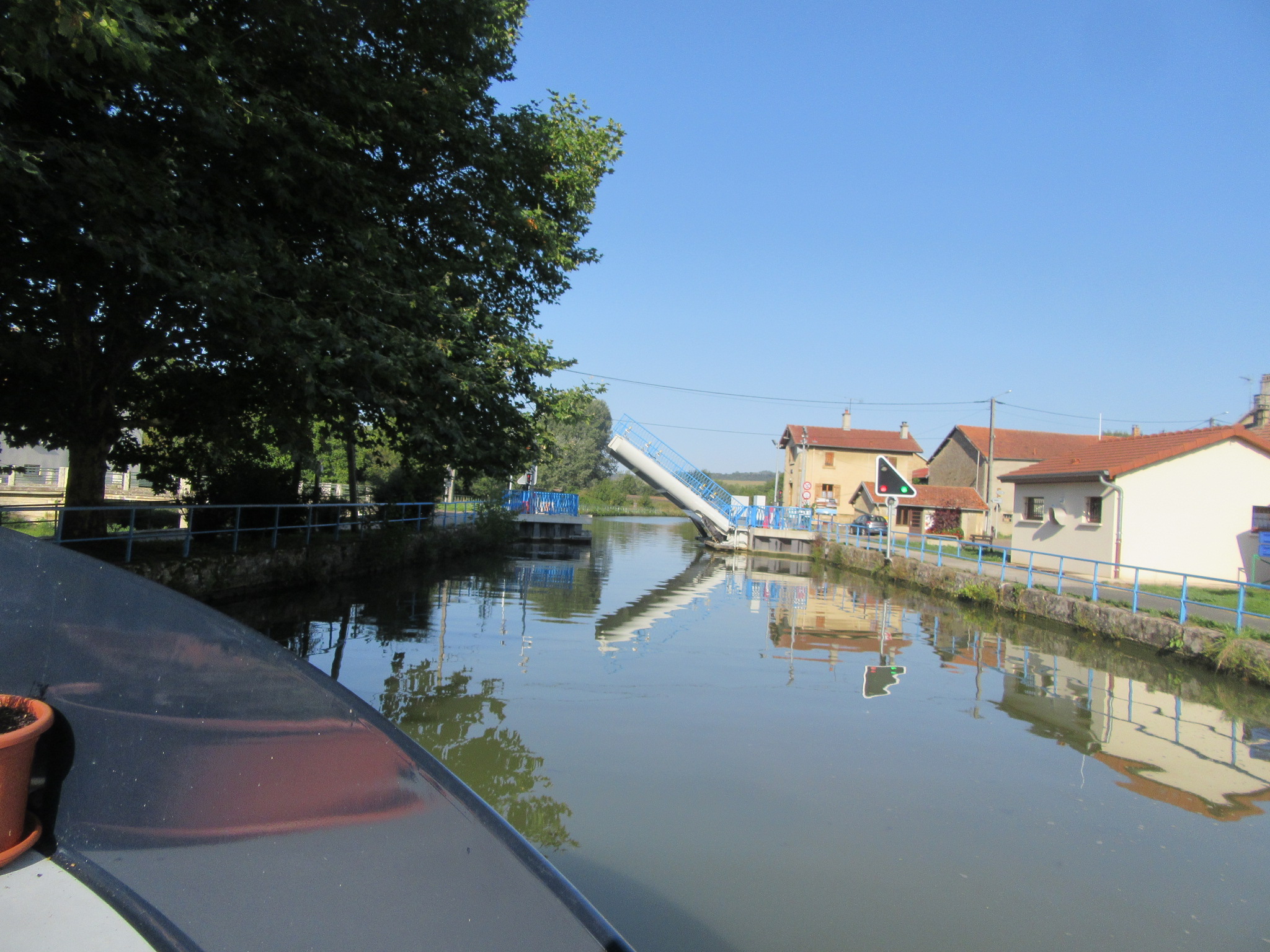
E1FD825E-CF6C-4326-B1D2-AD8BDCE354CD
Distant view of Langres

Our objective in Langres was fuel. If you read the Sâone  chapter of our trip you may recall our need for diesel and ‘shock horror’ finding the expected pump on the Sâone closed. So it has been an ongoing concern.

So we made it to Langres and I thought it would be easy. But when I  phoned 4 companies who apparently deliver to boats all I got was ….. “non, non, non, non”.

Next day I asked the girl in the VNF office; she found a number, made a call for me, and before I could walk the 150 yards back to Calliope a tanker was drawing into the quay!

3753B935-58E5-4E96-9835-BC4DCA8E6109


Such a nice guy too, helpful as you like – and patient as well when we asked him for his slowest fill so we didn’t overflow. The only bit of an Oops was when we gave him our card to pay for it, and he apologised that he didn’t take cards . . . . No problem he said though, we would pass by his garage in a village down the canal tomorrow and could drop in and pay for it then! Marvellous!


So having spent the rest of the day very pleasantly with a trip to Intermarché (yum yum, head and tongue charcuterie) and an excellent evening with the Rangali crew (fizz and salmon blinis) we set off first thing next morning for Rolampont to pay our bill.

9BF3EBAD-68C4-404C-A76F-0779301A40CCA short day of 9.9kms and 7 locks brought us to our destination. Along the way we were saluted by a lift-bridge, ascending magestically into the blue.
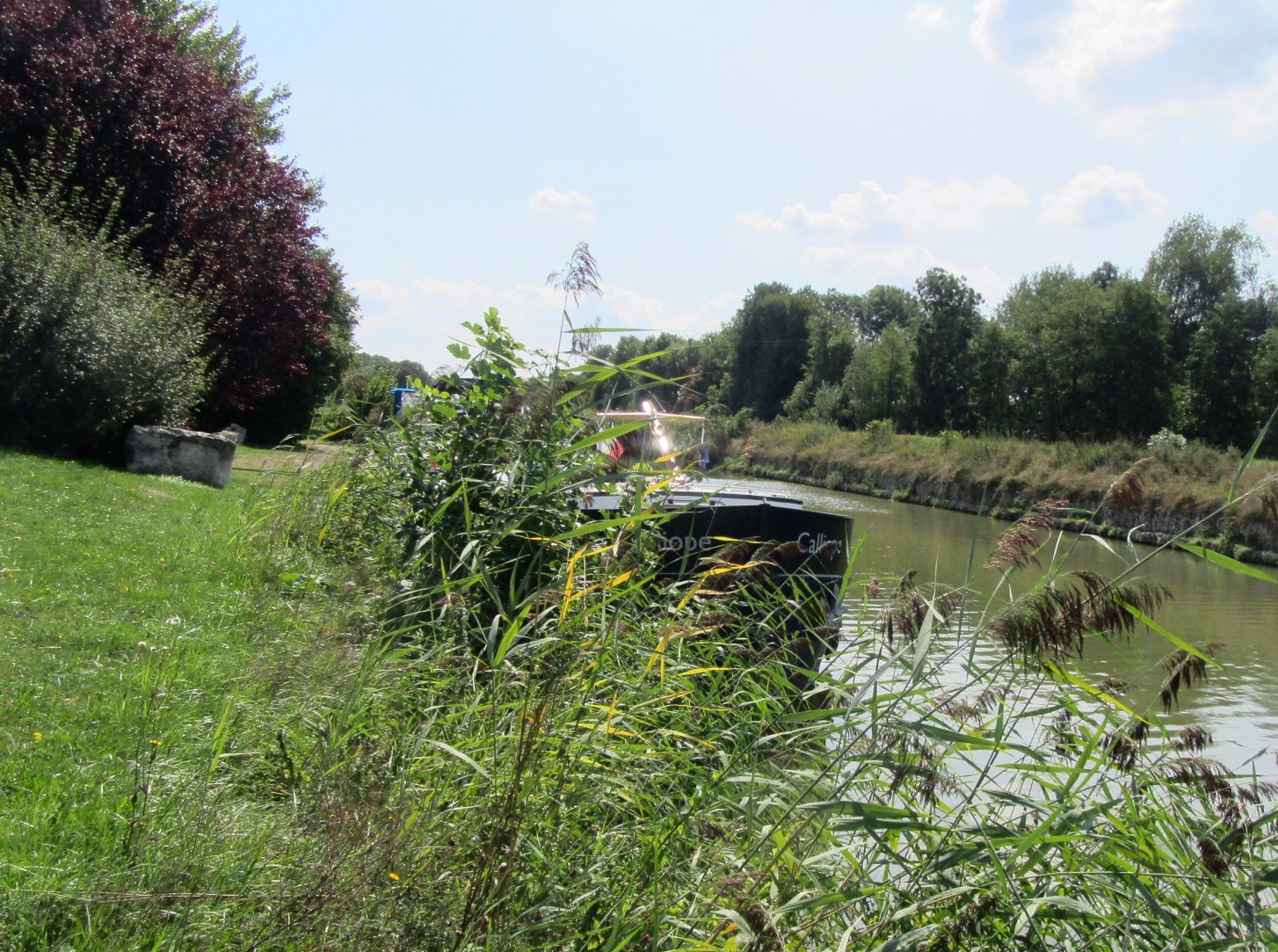
81043F77-C517-4159-B2F6-344F6F0EF0B5There was just room for us to join a cruiser on the 30m quay …. and then another, and another, and another boat arrived. We all squeezed up, moored with stakes, round rocks, and anything else that held fast. We ended up with our nose tucked into the reeds!
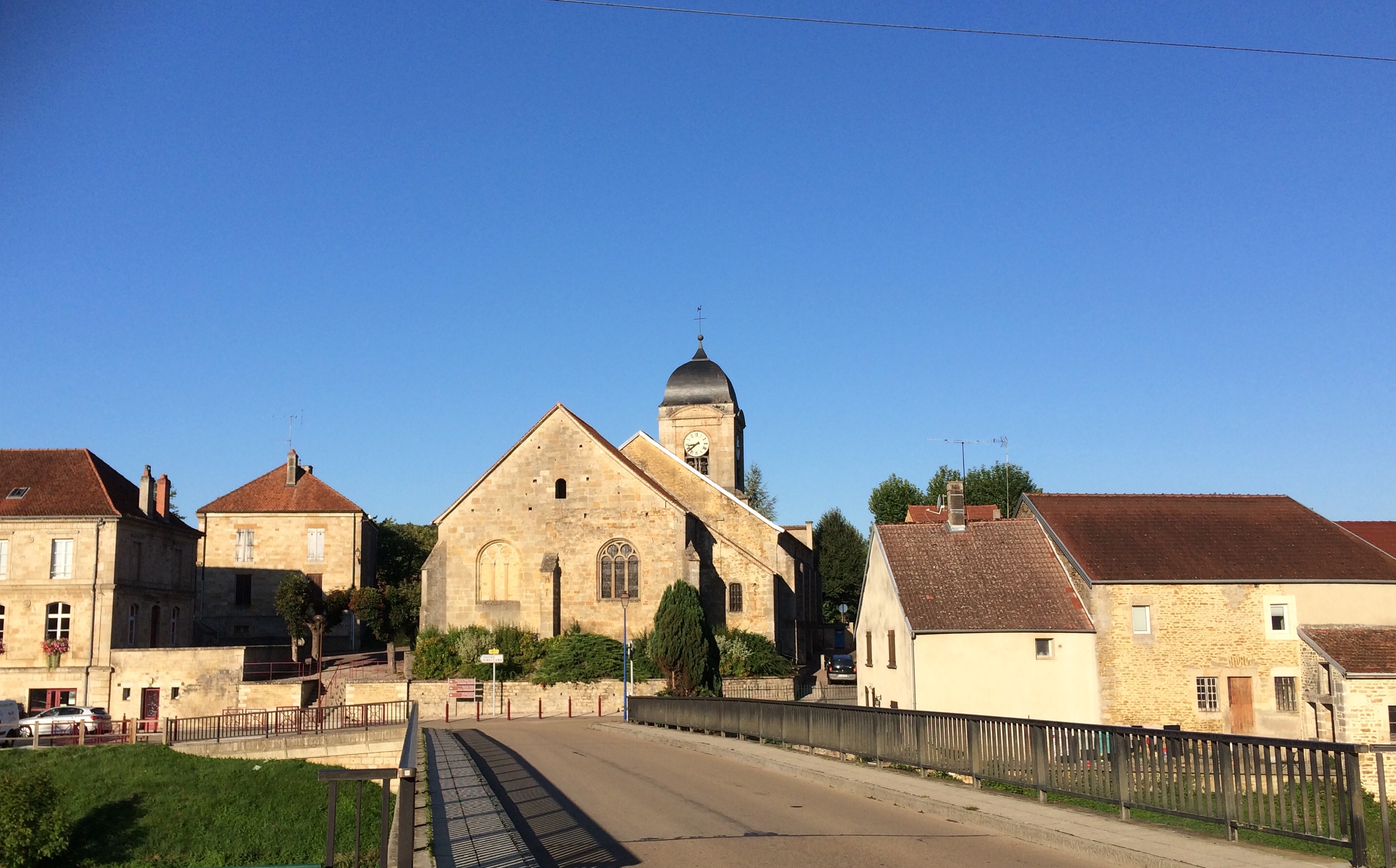
B1F9E843-69B0-4D9C-A11F-B736C31A5A00
Rolampont bridge and church

It’s a lovely mooring and attractive village, with that great essential – a good boulangerie.


And guess what we found – a lavoir! Watch out for more!

724BA6AC-66EA-4588-9F24-D59570B30055Sunday morning dawned bright and sunny. A quick visit to the boulangerie also discovered the start of a fishing competition, each ‘pecheur’ having several long long rods that reach right across the canal.

7D67162C-D4DA-4A55-A150-FD56EB29CEA8We were off at 9 when the locks officially open for ‘pleasure boats’ (yes we are known as bateaux de plaisance’ here in France). The locks along this section are all newly automated, with nice shiny clean blue levers to lift.

Calliope passed through green/blue scenery, reminiscent of England in some ways, although the Charolais cows are white rather than our brown Jerseys and piebald Friesans. (Do friesans come from Friesland, where I want to go cruising?)


6623FFC7-7B94-49ED-9000-5A342C87342BWhere kingfishers had accompanied us on the other side of the tunnel, this was heron country, though most of them take off just as you plan to take their picture!

There were twists and turns in the 15 Kms and 7 locks we covered, running alongside the Marne river and the railways line much of the way.


This led to interesting combinations of bridges and locks at some points, such as Pommeraye.

C238348F-3B3C-43BB-804B-20B2685843CFWe came to Foulain at about 1215, fingers crossed for somewhere to moor, and hey presto we have the place to ourselves. It is a joy to be in such a lovely place again, and in sunshine after our visit in the rain two years ago.


We took a walk into the village, and here’s another lavoir. There was added interest for this lavoir lover as it has a little trough all round the edge with drain holes in it, to carry away the splashes form the washing.

3E16C781-228F-42BD-9AD0-5A200A236AEAThe pontoons here are surrounded by meadowlike grassfull of flowers, and my little autumn display on board hopefully complemented the array; a suitable setting for a sunny evening.

We were only allowing ourselves one night on most places, so off we went next morning for a 24kms, 13 lock day – the run down to Riacourt. The first part of this section is not yet automated – the gear is all in place, but it has not been commissioned.


This meant that we were accompanied by a young temporary éclusier whose job it was to manually open and shut two pairs of heavy lock gates, and manually operate the ‘vantelles’, or paddles, that manage the water flow through the lock. Stewart helped close one side behind us and I got off open up at the other end of each lock, but it was still mostly his muscle power that saw us through locks 17 to 22.


The approach to Chaumont is different, passing the very pretty Chamrandes, then passing along a stone walled stretch. We waited for the Chamrandes lock while a big commercial barge came up, giving me an amusing addition to the ‘through the galley window’ series! We stopped briefly at Chaumont to eat lunch, then onwards to our destination.


The section through Condes is interesting – we remembered it from two years ago when the lift bridge did not lift and we floated about mid-aqueduct waiting for a VNF service van and man to appear.

9C427E62-810B-4195-B4D0-963DE2D7E7F4Seven hours after we stated we came to the final lock, and looked down, with relief, to see the hoped for mooring place empty and waiting.

9C56D1A3-B8E7-44B5-A28C-DDB1DC858232The mooring at Riacourt is next to a rather ornate ‘colombier’, or dovecote. We have seen many of these across France, of varying age and materials and in varying stages of repair. This one is newer than most, but still at least 150 years old.


I took myself for an introductory stroll round the village, and guess what … another lavoir! I had not heard of these structures when we came through the canal in 2016, so was very much catching up on what I had missed. This one was a gem, with lovely stone shelves round for the laundry baskets. But I bet it didn’t have a boat full of flowers outside when the villagers came to kneel on the cobbles and do their washing.

AC4D246F-C0B7-4EBB-A475-6A96294FC7D6Tuesday morning we were off again, starting on one of those misty autumnal days that you know will get better and better as the sun comes up, passing through such lush and beautiful scenery that words escape me. Even pictures cannot communicate the freshness of the air, the stillness and tranquility, or the real darkness of starlit nights. But maybe you will get a sense of the majesty of the wooded hills, and the abundance of the fields.
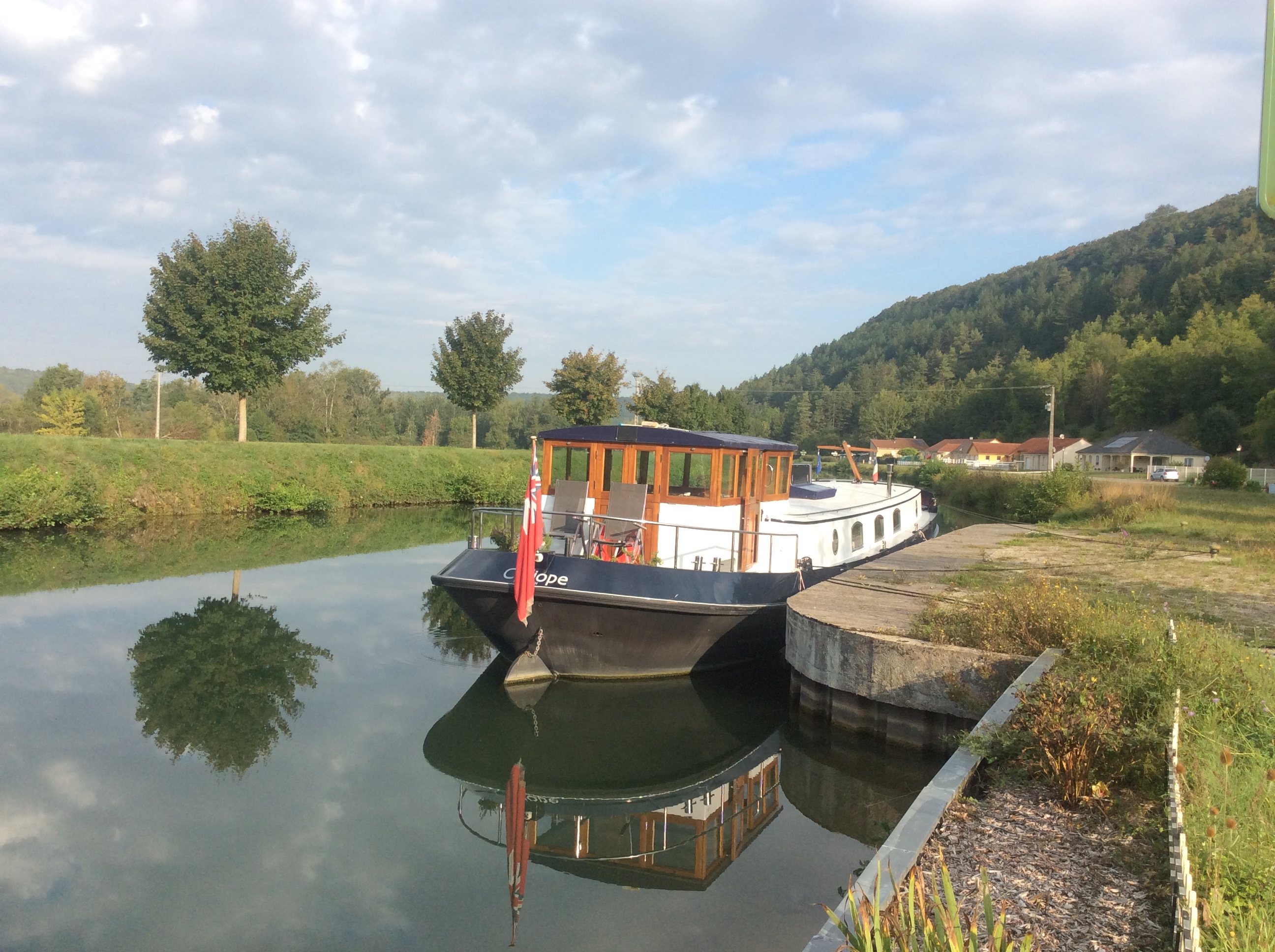
8CE04AE0-3E40-47CD-BD65-C509BD3E986AI had put in a special request to stop at Vouécourt as (apologies all round) I had heard of a rather special lavoir there, but I think you will be suitable amazed! We had a very short day of 10 kms and 5 locks, all quite easy, although a lot of loose weed in many of them. We hope it has not got wrapped around the propellor.

So this special lavoir – well it turns out that the village has had two previous lavoirs; one of them closed because of the amount of iron ore in the water, turning all the laundry pink! This has been a major metallurgy area in the past. The other, built in 1904, was a floating wash place that went up and down with the level of the Marne river; this no longer exists.


So in the 1860s the council built this new almost posh lavoir with water from the source of the Grandvau, 2400 meters south of the village and a little higher. The gravity fed pipework still functions and in addition to the lavoir, water was made available for drinking. The big arched windows, grand doorways, and separate rinsing basin all point to something a bit special here in Vouécourt.

18295657-64C0-408C-8116-A642B6B6AA72Wednesday morning was beautiful; I am quite envious of the people who wake up with this kind of view very day – although it does get very cold here on the winter, just above freezing and with a little snow.


Our cruise took us initially to Froncles, in the company of a young brave heron at one lock. Sorry about the look on my face; I did not expect to be on the photo! We stopped for a short time at Froncles to visit the supermarket, and we were surprised by the lack of boats at this nice little Halte Nautique. It was almost full when we came thorough two years ago.


Journeying on we met two boats that only just fitted onto the locks – a wide catamaran and another commercial barge. And we think we have it hard!

E9BE4AC0-4FF1-4DB9-B658-D562651B79EEAfter Froncles we finished the 13 kms and 4 locks of the day and arrived at a tiny mooring at Villiers-sur-Marne. This is a super quiet place. The tiny stone village has its Mairie in the front room of a cottage, and the only commerce is the far that sells milk, butter, cheese etc for two hours twice a week! We missed the slot.


Next day was not so blue – in fact a bit grey and drizzly. The days scenery included a shepherd inspecting his flock and a quarry with a juxtaposition of an old stone quay and a row of bright red railway trucks; the ancient and the modern ways of moving the quarry’s produce.

DF3540E1-738E-4CF0-ACD9-B64CDCD639CBThe travelling day was very short, just 6.4kms and 2 locks to Donjeux. As we got closer to the village the Donjeux church appeared through the mist above us. It is not the prettiest of places to stay the night, but is perfectly adequate (can those two words be put together?).
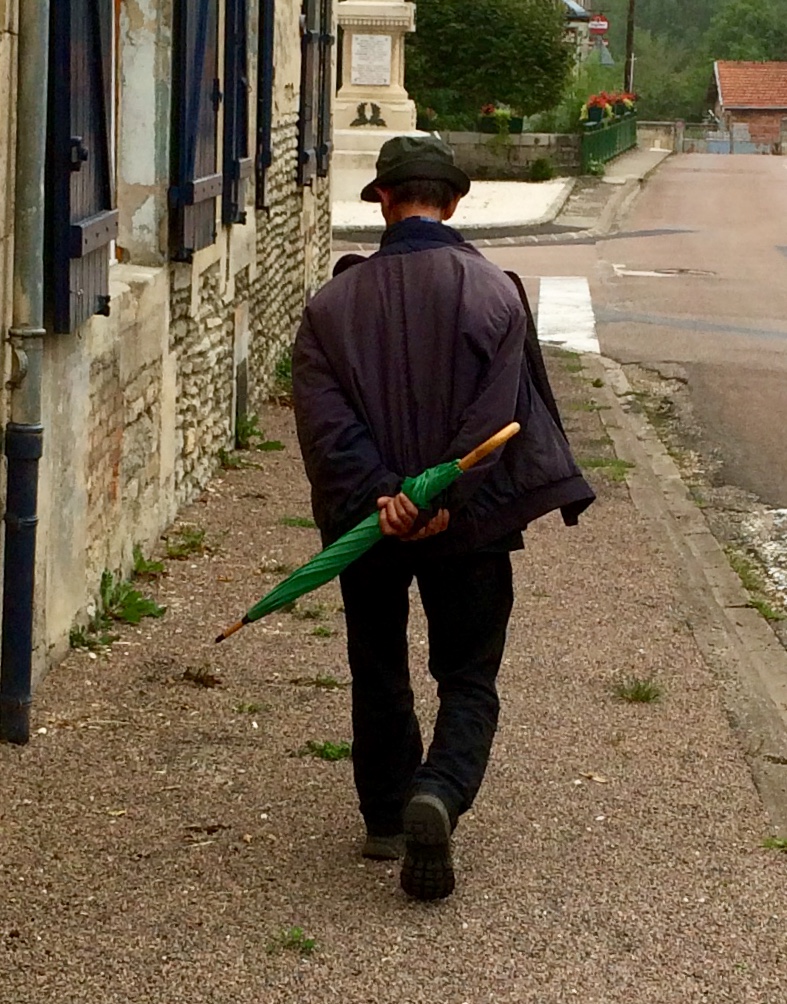
214A3F7A-0709-44BC-8176-AA7F4F2C597B


We walked round town, mainly to post a birthday card to our daughter, and found the La Poste in the school, with no collection until next day when the postman called! As we walked back to the boat we found ourselves following one of France’s characters.

He came and sat down by the canal later, deploying his green umbrella as the rain came down.


A few glimpses of the sun in the evening and as we left in the morning showed the mooring at its best.

E97F8589-C4E2-4D67-B1C6-2F53BFBFA621


The final day of the working week took us on down to Joinville, past the majestically rusting point levée at Massey – now permanently ‘levéed’!


44BD883B-7F71-4CB5-BBAD-C7F5AA46008EThis bridge leads onto yet another ‘point-canal’, or mini aqueduct, over the Marne, still twisting and turning alongside us. I include this photo more because I enjoyed the inadvertent shadows than for the river!

87470206-8E86-4FD6-8832-0AF99E932FAE

Along the way to Joinville there was plenty of countryside, less remarkable than that we had seen recently, but one article of fascination was this lonely and strangely placed book exchange. France has many of these free community operated mini-libraries, where people can browse, leave and take books – but normally in town and village centres. This one was way out in the country, but with a helpful reading bench alongside.

673322F0-38FD-4DA0-8DF8-112EB03EBDF8We are now only 60kms from the end of this canal, but with over 40 locks still to navigate, moored up by the trees and reeds at Joinville.

F51C2E9D-8466-44A9-9EE2-FFA0B57EEAD2In the morning the town, up a hill above the canal, looked almost ethereal.


A quick visit to Lidl for bread and wine (that sounds a tad religious) preceded our 9am get away from Joinville ….. and after less than a kilometre we were halted by an ‘en pan’ lock with two red lights to prove it! Having phoned for help we settled down to enjoy the morning sun in the countryside, and within half an hour all was sorted and we were on our way again.


Signs of preparation for winter were all around with much stock piling of wood at houses and cottages all along the way.


And random views of inquisitive young herons, cuts along tree lined valleys, sunlight on wet lock walls, and rusty bridge reflections all add to the delights.


We were heading for a little rural mooring at a village called Bayard with just room for one boat – us! Around us were ripe apples one side and a railway line the other!  Luckily the trains were few.


I walked into the village, strung out along a hilly section of the Mane, and found another lavoir, more utilitarian than many, and fed from a watering hole just above.


This felt a bit like the end of our rural moorings as we were heading into the town of St Dizier. I kept remembering May two years ago when we cruised this canal in the opposite direction, in the rain!  These photos compare me at the same lock, 28 months apart.


We had our last bit of help from an éclusier who opened the lift bridge at Marnaval for us. Next to this is the old railway turning bridge that used to allow the trains across the canal, long our of use.

BB98077A-D701-4D43-BEAD-867BA8ABF42FThe long quay at St Dizier was almost empty; we tied up and sat down in the sun for lunch.


Later we had a stroll round the town which is famous for its ironwork, Miko ice cream and its castle.

C5FF2432-4F8D-4F6A-B31E-E2BAF86D4624Back on board for the evening we discovered that even St Dizier can feel like countryside  in the autumnal sunshine!

0A812585-73E5-4B89-A8CC-6A8AE4A153F4With two days to go to the end of our odyssey on this canal Calliope set a north easterly course and 15kms, 7 locks later she was secured to bollards at Orcante, our last night on the Canal Entre Champagne et Borgogne. And somehow, yet again, we found ourselves in a quiet country spot, with chickens and donkeys almost the only sounds, and as the light fades, beautiful skies. (The two mysterious ET eyes are from our wifi router)


The last day dawned brightly and we left a sparkling wake behind us as we began the final stretch to Vitry-Le-François and the junction of three canals.


It took about three hours, during which I pondered on the past; lock keepers cottages derelict, idyllic (back breaking poorly paid) jobs replaced by a remote control.


Finally we reached lock number 71, the last in line going down the Marne side. The surroundings began to become industrial. Then we had to wait for the lock while a narrow boat came up to start their voyage through all the scenery we have enjoyed over the past two weeks.

34074D5B-9152-46AC-8147-1D21693CF5C6And ironically, this, the last lock, was a bit tricky! The water level came up above the top of the lock walls and a small surround wall has been built to contain the spillover. So the bollards along the side are partly under water; that, with the wall, makes it difficult to throw ropes and the skipper had to step ashore to get the ropes on and fend Calliope off the submerged ledge as the lock emptied !
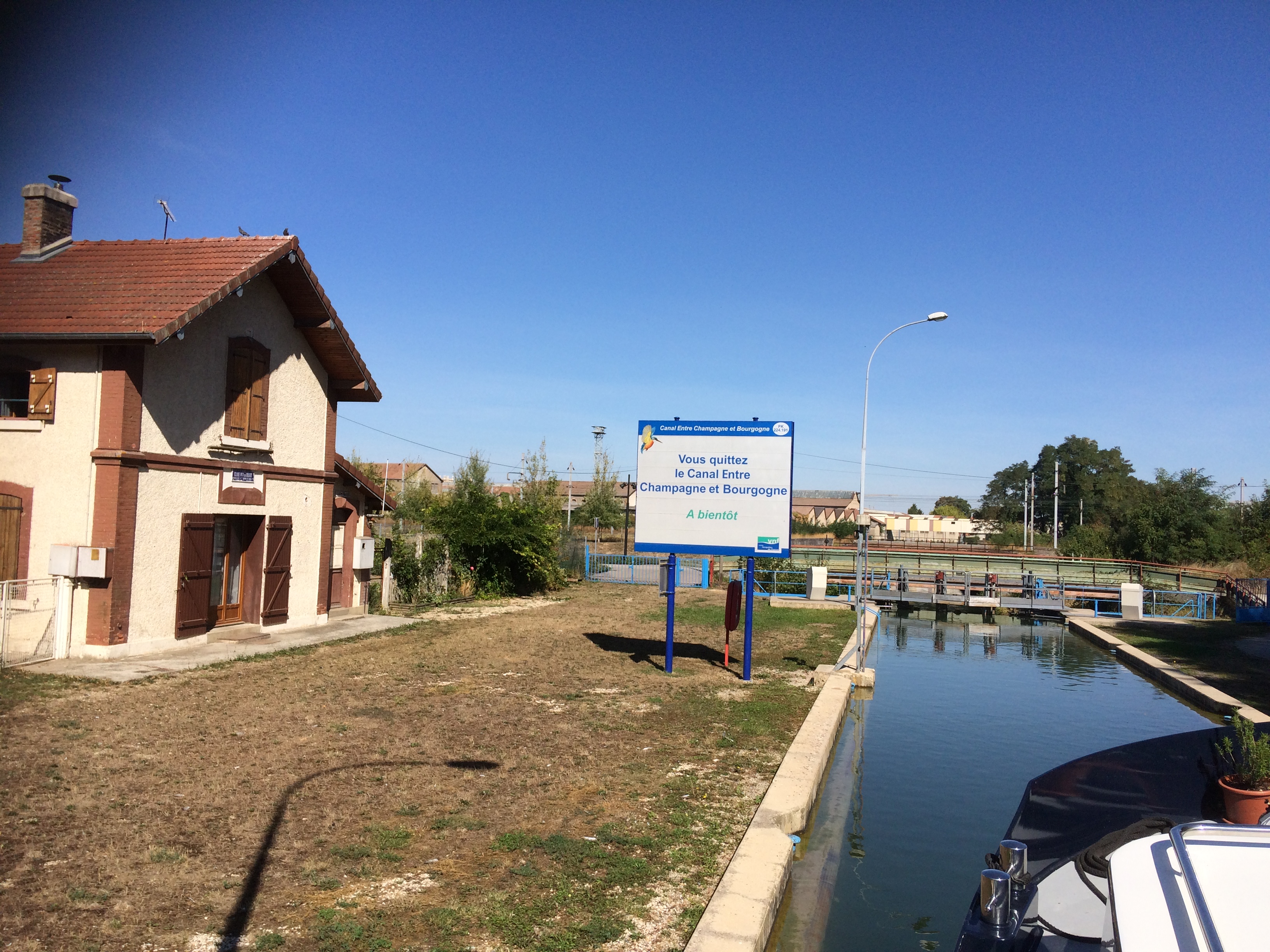
2440605A-D26C-4488-8553-2A52FB092803But all was well, and we said goodbye to the Canal Entre Champagne et Borgogne – bring it on Canal Lateral de la Marne ……
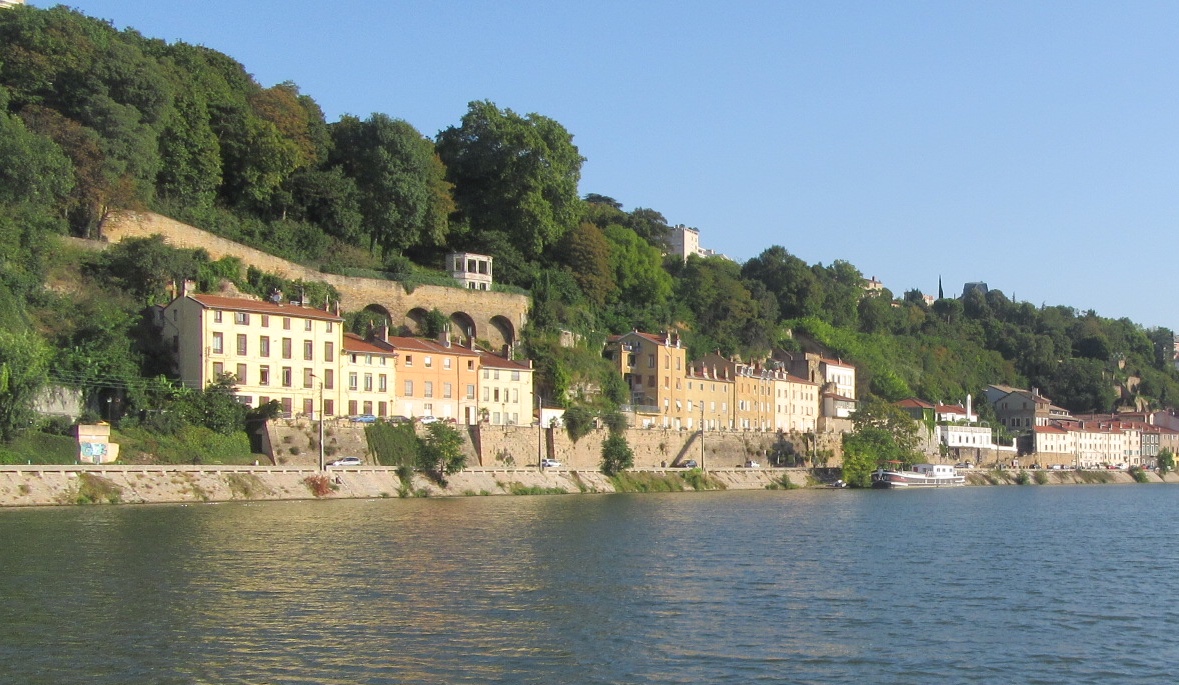
B9C1111A-AA26-4564-AA60-9EF3E453AED2…. where we moored up after 3kms, but that’s another chapter!


5 days and 4 nights on la Saône

August 21st to 25th

We liked the Saône. It is generally a pretty river and in the southern part there are plenty of places to moor – not so many after Tournus for a biggish barge like Calliope. It would have been easy to spend far longer on the river, exploring towns and villages, but we were on a mission, catching up on the two weeks we lost trying to get new batteries down at Frontignan.


So this chapter is short, and actually quite sweet. We left the port at Lyon in the morning, getting a good view of the city and its fine buildings as we drove through.

594BE8D7-D839-4C01-89F0-71713AC70CC2All the way along, after Lyon, there were gentle rural views interspersed by old villages, small towns and churches; always something to see. By side afternoon we were ready to find a stopping place, and saw a pontoon at Anse just the right size.

6202478D-D31C-46B6-A5FE-71F52A727000During the evening I went for the short walk to the Anse swimming lake – an exceedingly popular spot on the hot day. And in the morning before we left a kingfisher joined us long enough for me to make a photo through the window!
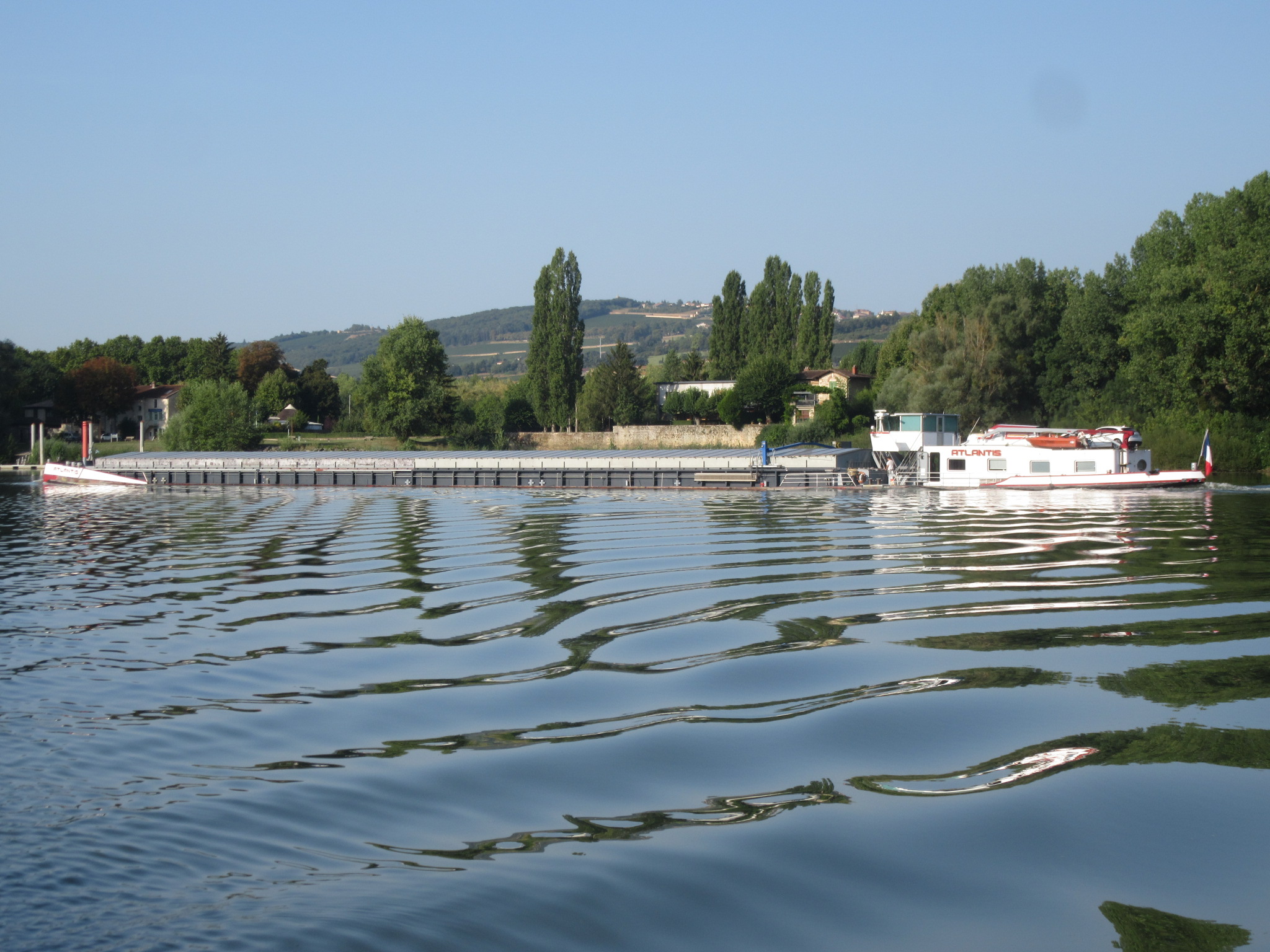
Despite rather liking the mooring we had only allowed ourselves one night in each place, so next day we were off to Mâcon where we hoped to meet a passing ship (a Westerly actually) from the same Haslar Happy Hour Yacht Club, the antidote to yacht clubs,  that we belong to back in the UK.

2B026251-806E-4608-A405-15C9D957BCB8Just before we cast off, yet another seemingly overloaded commercial barge went by – literally looking as if it was under water amidships!

370DE7E5-A4EB-4E5C-829B-F344910A8FDDWe had heard of a new long pontoon in Mâcon just before the multi-arched old bridge. and heading for it, we found it completely vacant – wow!
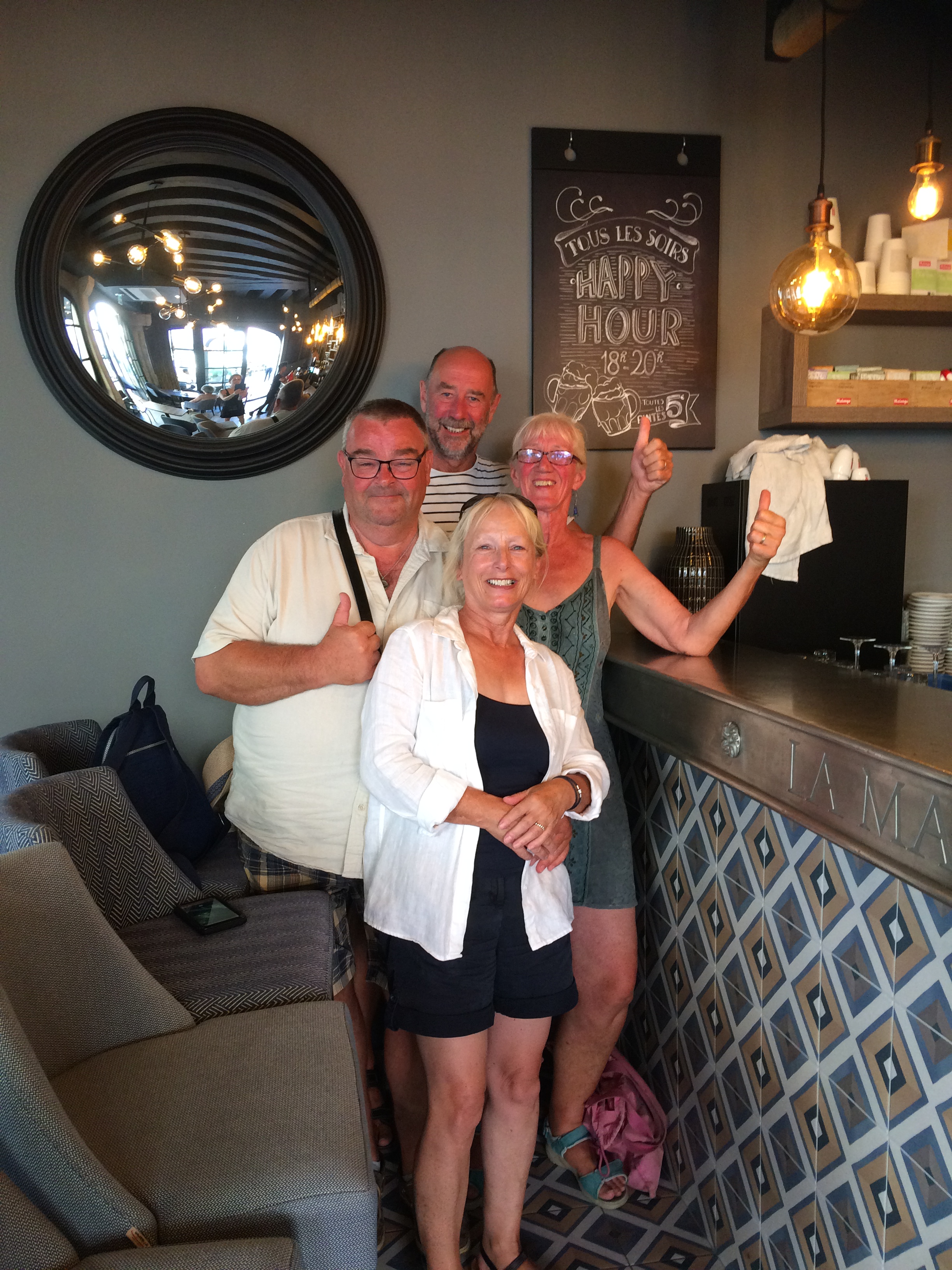
7A675266-13FD-42D1-B04A-3075EA1DB3C2


Once moored, rested and showered we went into town to meet the crew of Kraken, and there, in mid France and almost 500 miles from the official club house, we had a happy hour or two together.


A3FA649B-1DBF-4B34-AE76-940E0B9FD878Our mooring was also popular with local teen-agers, again, who decided that their favourite place on the long long quayside to eat burgers and fries at 1am was the part of the quay adjacent to us!  Ah well, we were also able to enjoy the modern instalation nearby.


Once more only one night allowed, so on another blue sunny day we carried on north, passing Mâcon’s waterfront houses, and also passing Kraken and crew heading in the opposite direction.

D983CF00-D385-4DEC-A343-F903FF862706With such a wide space to drive in, and such broad bridges, the cabin girl was able to not only take a turn at the wheel, but go under bridges too! I could even drink tea at the same time.
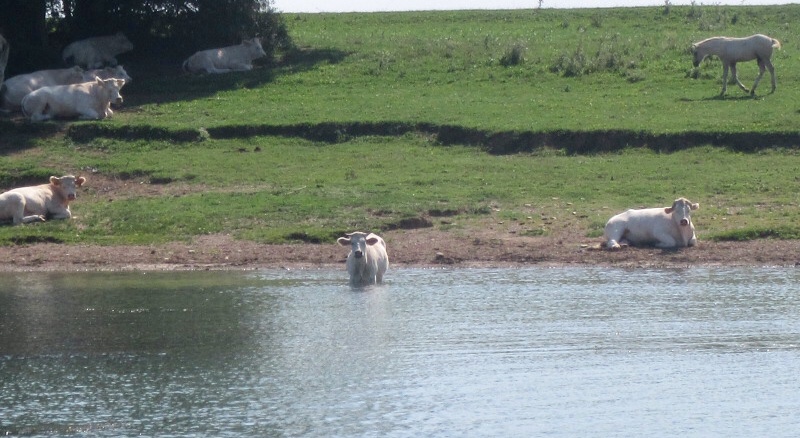
BFF41E2D-006D-4804-B86A-7F00253D3BE7Our trip was becoming increasingly rural, and a different kind of farming appeared. Dairy and beef herds were all along the banks, with cattle frequently standing in the water to cool down as we went by. Some evidently found us as interesting as we found them!


Unusually for us, who spend most of our time as a twosome, we were again heading to meet up with friends. This time it was to see Tam and Di, our ICC barge tutors from 2012 who now have a home not far from Tournus. Once more the mooring fairies smiled on us and there was space on the wharf.

51C2E98E-8450-4591-A36A-14131B58FD0FIt was wonderful to see them again and we had a lovely evening with a to-die-for prawn rice dish from Di’s famous cuisine and very nice white (or two) from Tam’s cellar. The evening was made complete for Stewart when Tam got his new banjo out and put it through its paces. Happy days!


Before we left Tournus the next day I went in search of bread and milk, allowing me a quick walk round in a rather grey light, but enough to show off a little more of the local stonework.

65228F81-D50B-44EA-97F5-AEC526F88CF4Then on upstream, occasionally left in the wake of hotel barges – bouncy bouncy!A6EF558C-0E48-402E-BC27-03E54B24F983We passed through Chalon-sur-Saône, remembering it form two years before when we had stayed nearby on the barge for a week and had quite a good look round. This time, a whoosh under the bridge and we were gone!
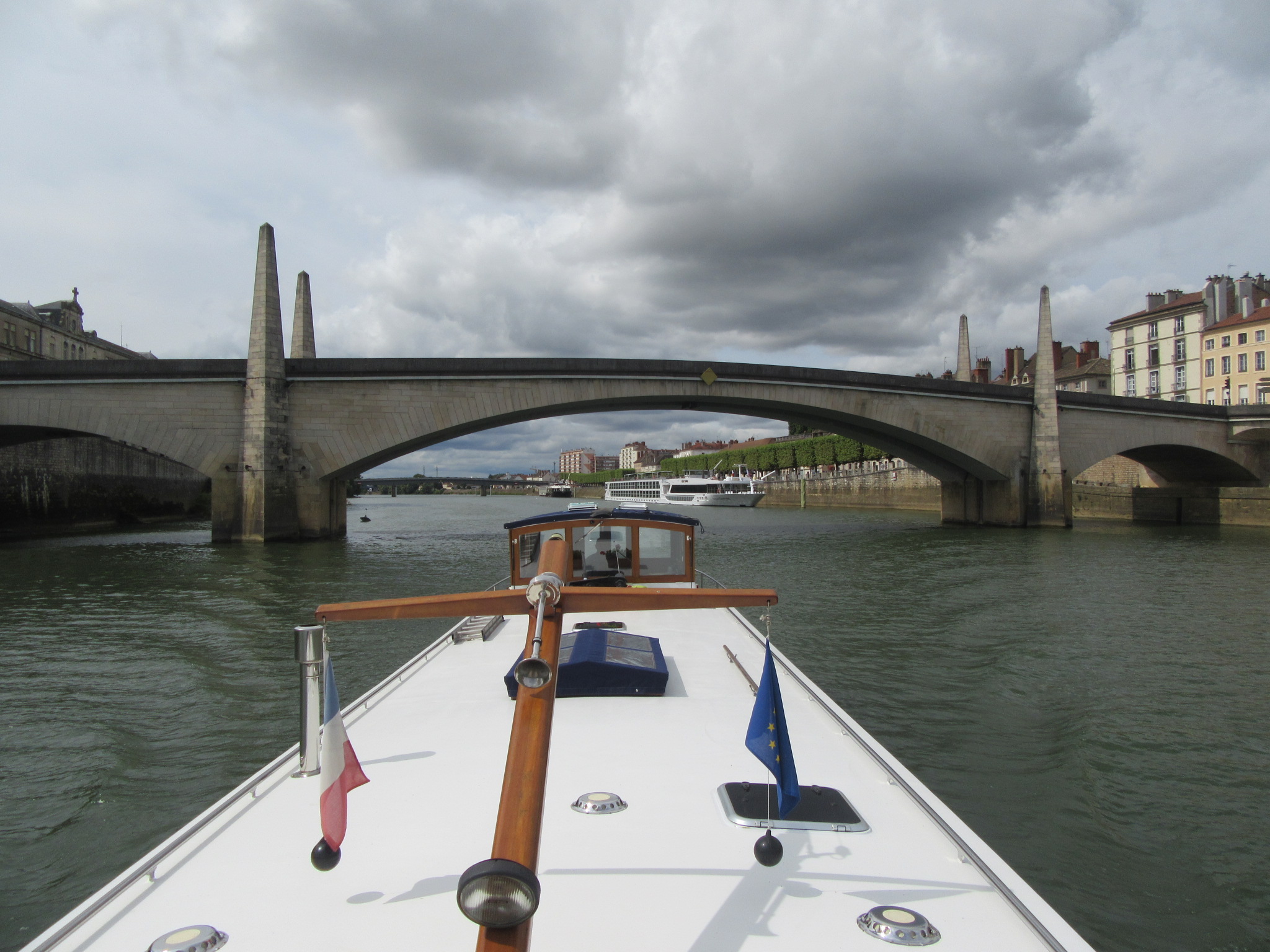
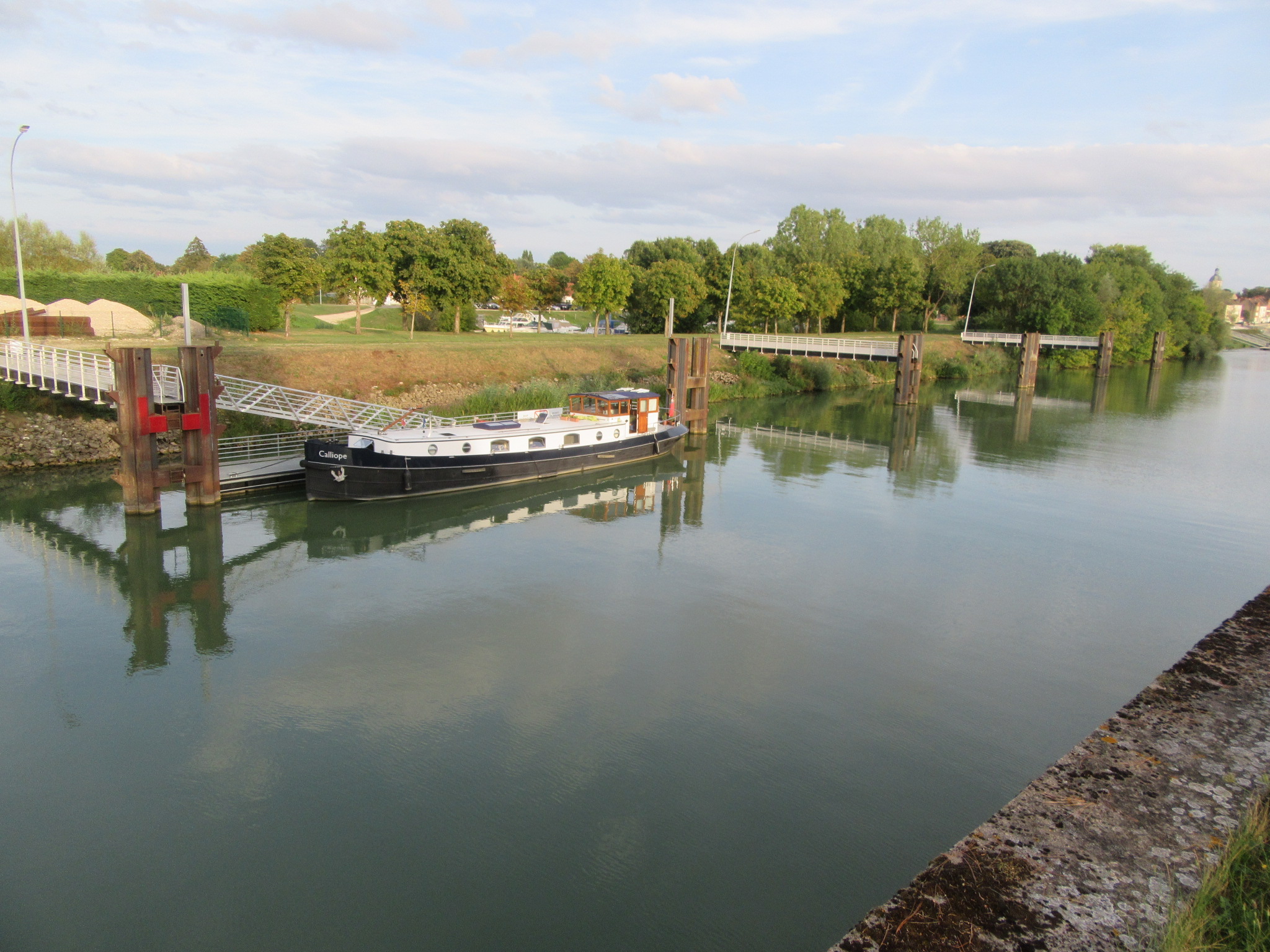
This is when mooring began to be difficult. We had planned a 4 hour day, but after 6 hours and passing by Gerry, Verduns and Écuelles without finding anywhere to moor I phoned ahead to Seurre marina. When they too responded with a “Non, je suis desolée” we decided to try mooring at the lock.

D585C8AF-3A53-489C-BD45-D1D2619D56CCWe have heard of many boaters mooring at the big river locks, but have never needed to do it ourselves until now and radioed the éclusier on he VHF. Asking in my very best (Portsmouth High School) French if it were possible he immediately replied ‘Yeah, no prob’ (or something similar) so hence this wonderful, very very tranquil Seurre lock mooring.

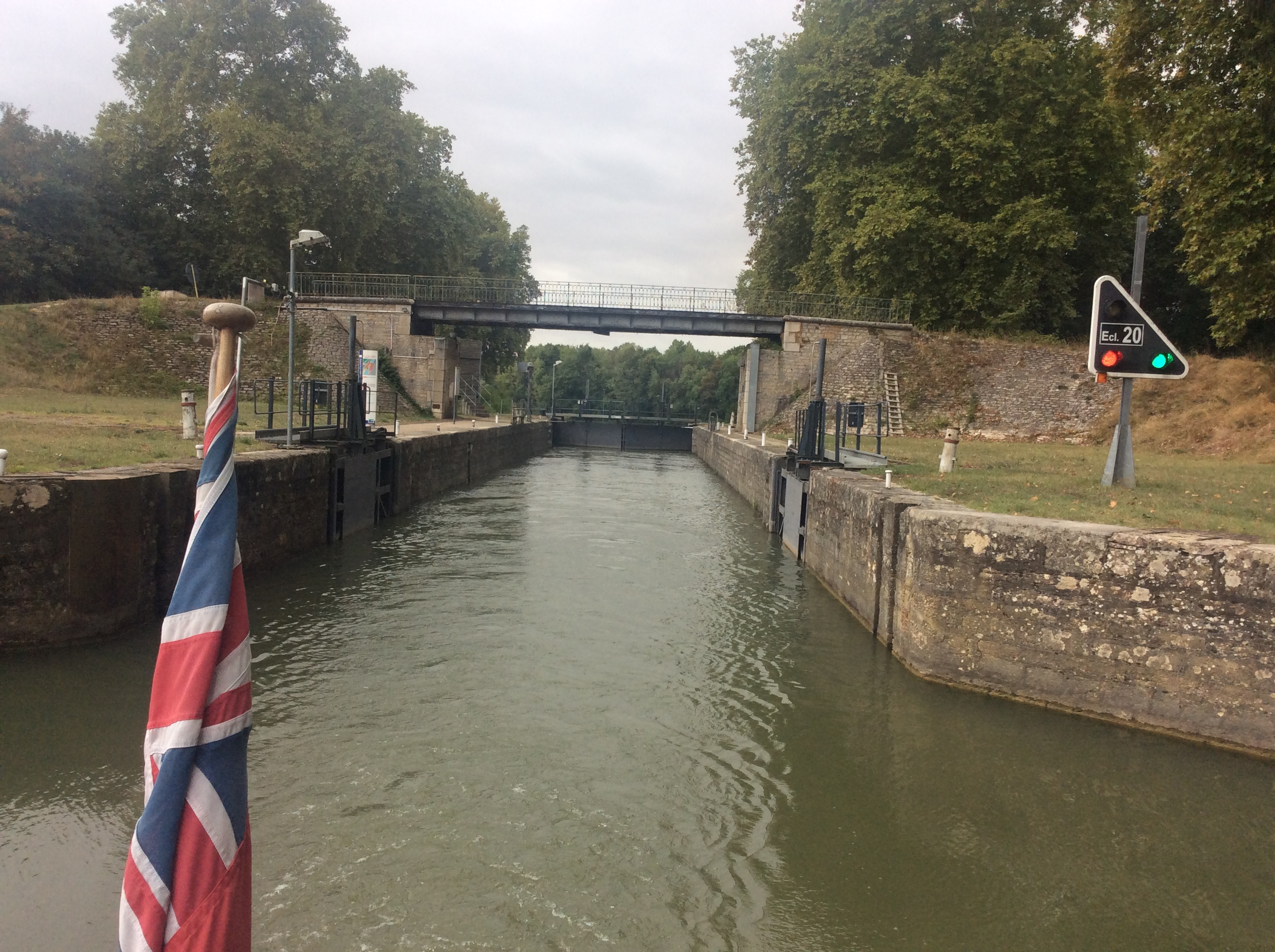
 

There are several ‘lasts’ around this. It turned out to be our last night on the rivers, last night on the Saône, and next morning it was our last ‘écluse à grand gabarit’, or big gauge lock of 185m length and 12m width. From now on it would be more like 39m x 5.2m!

We were set on a course to buy gazoil (diesel) at St-Jean-de-Losgne so that we could confidently carry on up north and we drew into the fuel pontoon expectantly. But we were disappointed. Despite it being a Saturday in August the fuel office was closed until Wednesday! And the supposed self-service option was out of order! So on we went.

3A697964-2428-4B7F-B35F-98C2604DBE91Once more we had plan A, B and C overnight mooring choices. This meant that we went up past Auxonne through the first of the little locks, number 20 at Dérivation d’Auxonne – oh so narrow – and hoped to moor at A ………. no luck.
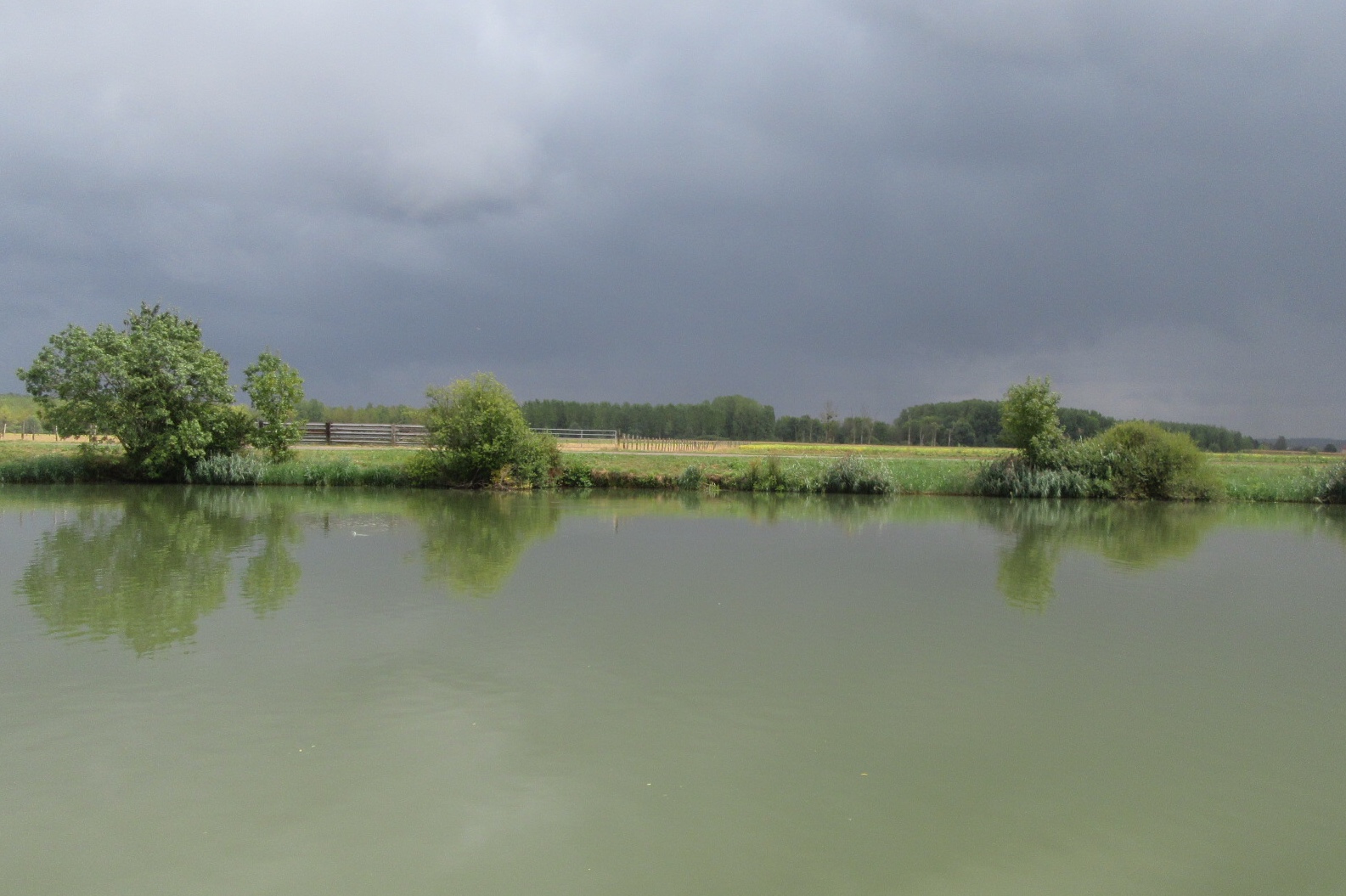
C09EF10D-3ED5-4777-B18E-4383A783B093The skies began to darken in an alluringly velvet manner and we carried on to pass B (Lamarche) and C (Pontailler).

A6A7C71E-2DDE-49E6-A2BA-4B2841D37420


Hmm – nothing for it but to carry on to the entrance to the Canal Entre Champagne et Borgogne, and leave the Saône behind, and we finally reached the turning into canal.


0CA36A40-D371-4BD6-8802-602DC607F9E9The canal looked so tiny, after the river, but small is very very beautiful.

378150A6-BEC1-439F-84A2-AAFB2C49FE70Within minutes we came into Maxilly to find a commercial barge just leaving, thus providing us with a space to tie up. We are off the river and back on the canal system again!