Three days and nights in Toulouse only allowed us to touch the surface of this interesting city. We fitted in some of the sights, some of the gardens, some of the culture, and lots of wandering through narrow streets with fascinating architecture. The weather and light was not kind to the photographer most of the time; here is a small sample of what we saw.
Toulouse
I love the huge old gates and doors hinting at the faded opulence within, courtyards, stairs and shutters.
Pont Neuf is wonderful, though cold and windy whenever we went across! I particularly enjoy the little cameo pictures through the holes in the pillars.
At one end of the Pont Neuf, at St Cyprien, is a water tower. It’s brick built architecture was beautiful, and housed a photographic exhibition.
Toulouse les Abbatoirs
Toulouse les Abbatoirs
Les Abbatoirs art gallery had some of the whackiest modern art I have seen – Heath-Robinsonesque in part. In fact it was Daniel Spoerri, Niki de Sainte Valle, Yves Klein and others. Great stuff!
A nearby park provided suitable grazing for a cow and the siting of a ‘Fabulous Creatures’ carousel and a couple of large modern sculptures for Stu to ponder over.
Toulouse black madonna
With all the stunning churches in the city it is odd that I did not get any photos of the outsides. But I did take one of the famous Black Madonna in the Eglise de la Daurade down near the river.
We’re off! It’s been nice having a slow start to the season – we feel that the boat is prepared, the kitchen stocked, and the wine cellar full, but the crew are now restless and wanting to feel the movement of the boat beneath their feet.
We left Castelnaudary and immediately the views South across the plain to the distant hills was beautiful. The plane trees here are still standing, and presumably healthy, providing a traditional Midi atmosphere.
Midi, La Planque ecluse 22
Before long we were at La Planque, our first lock, and waiting for a boat coming up; just as well! We had not realised that on this direction many of the locks are automatic – at least they are automatic once the mariner triggers the mechanism! A quick lesson for Lesley in button pressing and we were off – me dropped off before the lock, a gentle sprint to the buttons, then a pleasant wait while the lock prepared itself and Calliope entered.
Midi, La Planque ecluse 22
Stu remembered from last year the helmman’s tricks for a Midi lock, steering in with aplomb. We were soon tied up, more buttons pressed, and Calliope rose on the waters of the canal.
We counted up and realised that there were only another 4 locks ‘among’ until we reached the summit – including a double and a treble. The stepped locks were both ‘manned’, making things easier for us.
We moored up for lunch at a wild mooing before la Ségala, and realised we rather liked it; so we stayed the night.
There was entrainment from the pet goose of a local live aboard. He adopted us for a few hours, guarding the barge, following Stewart around, and treating his cooking as a spectator sport, watching attentively through the window.
le Segala lavoir
Leaving le Segala astern
Next morning, with Labastide-d’Anjou a ten minute cycle away, exercise and bread were provided in equal measure before we set off along the summit stretch, past le Ségala port, bridge and … my first lavoir of 2017. Not a particularly interesting lavoir, but worth recording just the same.
The five and a half kilometre summit bief is a rural ideally, accompanied by the A61 motorway at almost very turn! One of the most interesting and attractive points is just before the Ocean ‘going down’ lock.
PK 52, the parting of the waters
The feeder canal
one side of the octagon
old mechanism
Here at the Narouze pass is the watershed between the Atlantic and the Mediterranean. The fascinating octagonal outline of the original reservoir to hold water for the canal is still clearly visible.
Midi Lock 17 Ocean, first one down
So our downward journey towards the great Atlantic ocean began. Hurrah, a full lock! The first one since the Rhone in August last year; no more rope-hoying for a while . . . . The so called Ocean lock was very pretty, and although automatic we happened to arrive at the same time as a VNF man and he happily took control.
Midi, by Port Lauragais
We had decided to stop for lunch somewhere around Port Lauragais so that we could take a look at the Midi museum there ….. which turned out to be closed until May! Nonetheless we had a pleasant meal seated at a picnic table under the trees between a lake and the canal. We walked all around the modern port and although we prefer wilder moorings we could see that the facilities were good.
Filling Renneville lock
Calliope appropaches
Into Rennville lock, No. 14
Going down.
Lock antiquitie!
We carried on, enjoying the drop and relative ease of descending locks, through to lock 43, Renneville. This time I remembered the camera and caught some shots of Calliope waiting, then entering the lock.
RRanneville lock mooring
There was just space for us on the mooring below the lock so we tied up and began to enjoy another sunny afternoon and evening.
Villefranche-de-Lauragais
Renneville
Villefranche-de-Lauragais
Gardouche
First I went for a walk up (and I do mean UP) to the village where I found a lovely church with a brick built wall bell tower. I have since found out that the brickwork is the vernacular style in this region – hence these three church photos – Renneville, Villefranche-de-Lauragais and Gardouch.
Renneville bridge
On Renneville hill
The canal at Renneville
View from Renneville
The first evening was so pleasant at Renneville that we stayed on for a second night. A quick cycle trip to Villefranche established a good set of boulangeries, restaurants and supermarkets so our immediate needs were well catered for.
Along with the usual daily bread we also needed a suitable venue for a relaxed anniversary celebration. We walked into town on a lovely sunny Spring evening and found a PMU style bar and a Cambodian restaurant that suited us just fine.
Villeanche-de-Lauragais
Whilst in Villefranche we discovered a little more vernacular architectural ironmongery – little hinged metal figures designed to hold open window shutters. Looking at these in Villefranche, Gardouche, and later in Montgiscard I think there are two or three main characters – often with a male and a female figure on either side of a window. I’ve had a quick look on line but cannot find any information … anyone know?
We managed to contact the port at Toulouse whilst at Renneville and had a change of plan after discovering that we could not be accommodated yet. So Stewart sent me ahead by bike to see what other moorings were in store for us.
Only 4km along the canal I found the delightful wharf at Gardouche. A quick phone call to Stu and he and Calliope meandered on downstream to rendezvous with me and the bike.
Stu and I had a blue sky 3 day weekend at Gardouche, with very few boats passing and only one mooring up one lunchtime for a couple of hours to allow a group of hungry Hungarians time for a pizza.
Varnishing for Stu
Metal cleaning for me
We used the opportunity for a bit more maintenance – Calliope feels like the Forth Bridge sometimes!
There was time to steam delicious local asparagus for one lunch, and make asparagus soup for another.
Gardouche chateau wall
The church from behind
Lizard friend
The church from below
There was time to wander round the (small) village a few times, seeing the dominant hilltop church from many angles, and even visiting a jumble sale!
Gardouche
Gardouche
The mooring was most enjoyable, generally quiet, though the quay acted as a car park for the many people who understandable wanted to walk and cycle the canalside on such a sunny weekend. Sitting on the back deck with breakfast, ice cream, beer, or just surveying the start of our garden, was tranquil and warm.
Gardouche lock beginning to fill
almost full
Finally it was time to leave and to descend the Gardouche écluse. I went ahead to prepare it – well press a button that would automatically prepare it – no physical exertion required!
Negra ecluse
We continued on through the double écluse at Laval, managed by a happy young female éclusier, and on to Négra. We noticed that the drop here was 4m – not much compared to the Rhone, but more than we had experienced in most automatic locks.
Chapel at Lock 11, Negra
While the lock filled I took the opportunity to look around at the little chapel, stable block and other buildings – once all linked to a passenger boat staging post, but now mostly used by Locaboat boat hire company.
At the next manned (double) lock at Sanglier we learnt that several of what had been double locks have been changed to be just one deep lock, with the original second lock chamber remaining full at al times. They now act as kind of waiting rooms, or ante chambers to the lock when you are on your way down.
The top
The wall
The bottom
Our first experience of these deep single locks was only 1.5 kms away at Ayguesvives. You can just see in the photo above left that there is an oval lock shaped ‘pond’ behind us. As Calliope floated down and the wall of the lock emerged we discovered bollards within the wall and poles to allow mooring lines to slide down with a boat – both probably remnants of past times and big commercial barges. Captain’s note to self – must change the jumper next time the crew gets a camera out . . . .
Pont de Montesquieu
Aqueduc d’Aygiesvives
Bridge at Lock 12 Laval
Of course locks are not the only features along the way. Bridges and aqueducts slide past, many absolutely beautiful.
Montgiscard mooring
Stone steps to the boat
By 1230, after three and a half hours of cruising and descending we arrived at our hoped for destination of Montgiscard – and yes, our luck was holding. The lovely high wall, only long enough for one big boat, was empty and we tethered Calliope to the shore before having lunch. Lovely mooring, complete with a free water fill-up and our own front steps.
Montgiscard church
Gateway to somewhere
The bell wall
Joan
An afternoon wander round the town, another perched on a hilltop, displayed another great brick church in a rural community and some ancient narrow streets. We found Joan of Arc hiding amongst some trees, a long way from home.
From inside
From above
From across the water
Also, much to my delight, the town lavoir still exists – right next to our mooring. I think I have worked out my love of these structures; I think they speak of ‘community’, a place where the women of towns and villages met, talked, worked, and supported one another too I am sure.
Montgiscard lock pump
I suspect they also met around the pump, although that is located at the lock maybe it was more for the thirsty men, horses and dogs from the working barges.
Montgiscard lock
We stayed just one night, being booked on at Toulouse the next day. Montgiscard écluse is one of the double-cum-single locks, now a single drop of almost 5m. Stewart fancied a go at setting the fill-up in motion for a change. Hard work all this button pushing; thank goodness I’ve got good crew . . . .
Empty
Starting to fill
Almost there
Full and ready
It took a while for such a deep lock to fill; a treat if you like moving water. I love it! I never tire of watching locks fill and empty – the eddies, foam, spurts and ripples.
This was our first real slog of 2017 – and still only 20 kms and 3 locks! Nothing compared to last year. We set off at 9am confident of reaching Toulouse in time for lunch. Little did we know.
Pont de Donneville
We passed under the striking brick bridges of Donneville and Deyme, commissioned by Riquet when the canal was first started in 1667, and of brick due to the lack of stone quarries in the Toulouse area. These bridges were restored in 1821 after having been blown up a few years before to protect retreating troops at the Battle for Toulouse.
Damaged Pont de Deyme
Nesting amongst the bricks
Unfortunately one of them seems to be under attack again! But birds are making homes amongst the holes in the brickwork.
We were passed by very few boats, but often surprised by the lack of care other boaters had for the banks for the canal, causing quite a wake. We were proud of the smooth waters astern.
What caused us a little hassle and quite a delay was finding the next two locks both ‘en panne’, or broken. The VNF are great at coming to mend them, but one does have to wait for them to come.
However, on the plus side, we had picked up three lovely Americans, on a long distance walk, and offered them a chance to experience a bit of barging. So we had longer to chat to them.
At last we were coming through the suburbs of Toulouse, past fascinating old barges now used as houseboats. We also had the new experience of an aqueduct over a busy road – usually they are over rivers and streams.
At last the port of Saint Saveur came into view, and our hammerhead position was clear. We tied up without too much fuss, and relaxed for a while.
Yes, seems like an ok mooring – lets change the two nights to three if they will have us!
Toulouse Jardin Grand Rond
To round off rather a grey day – the first clouds we have seen for ages, we took a short walk round our immediate part of Toulouse, including the Grand Rond garden. Rain began to fall, so back to the boat for a cold beer, bit of supper and a planning session for our explorations tomorrow.
March 30th, 7am, UK. Time to leave our house in Hampshire and head back to Calliope. It felt so good to arrive at the Newhaven ferry port, not just in time, but early – and with the house all packed up, cleaned up, everything done. Phew!
By 4pm the next day we were in Castelnaudary, having spent a very pleasant night in Chartres on the way down.
It’s Spring. We are aboard. And we will set off from here soon for our 2017 trip. Calliope was looking good, though appropriately needing a bit of a spring clean after her cold winter of -7°C, gale force winds and an iced-over canal!
So plenty to do, and plenty of people to catch up with. Life was a social whirl for a week, meeting up with other ‘mariners’, local friends and Odile, the Capitainaire. There was also the delight of the local markets, including a trip to Revel and a great cheese counter with ‘spooned’ Gorgonzola – yum yum yum.
We decided to pay for an extra week in the port to allow time for settling in again – good value!
Our events included lunch and dinner with our friends who live in an old farmhouse nearby – piglets, hens, horses and dog included!
Bbq behind the Capitainerie
Homage de la Fromage in Alain’s cave
There was also a port barbecue and a ‘Homage de la Fromage’, both well attended with food and drink fun.
Stu and Martin fix the PV
Wet jeans = clean roof
Biting spider, rescued from canal
I should include photos of all the work we did – scrubbing decks, servicing engine, cleaning windows, airing bedding, sorting out the PV panels (thanks Martin), removing spiders – even the one that bit me, etc etc – but other things are more fun.
The canal below the quadruple St Roch locks
I decided to get back into my daily 30 minute fast walk regime, which is great for getting to see the area. First walk was to retrace some of or autumnal steps ,going back East, down stream, from Castel – as the locals call it!
Looking East
Looking West
There were several walks around the port and the Grand Basin plus some lovely sunsets before we slipped our ropes seven days later and went on a mini cruise, under the Pont Neuf at the west end of the port, and into a grassy mooring two hundred yards further.
There had been a plan to stay there just a few days, but with Easter weekend looming, and the possibility of a crowded canal, we decided to have another ten days enjoying the town, the port, the sunshine.
And then, after 18 days, Castel became our springboard for exploring new territory towards Toulouse, the Garonne the Lot and the Tarn! Off we go again.
‘Built on the orders of the sun king, Louis XIV, the Canal du Midi is listed by the UN as one of the “most remarkable feats of civil engineering” but also a natural work of art.’ Wikipedia
The rest of the comments in italics are those of Captain Stu
From Etang de Thau, into Canal du Midi
We had crossed the Étang de Thau on a clear blue breezy day, heading for the entrance to the Canal du Midi marked by a conical lighthouse. Hooray – we had reached our waterway destination, 5 months and two days after leaving Eastbourne to cross the channel. We could now relax, enjoy the Mediterranean sea and sunshine, and dawdle our way to our winter mooring site at Castelnaudary.
The first stretch seemed so narrow after the Étang, lined by boats on both sides, and warm worn old buildings on one bank.
Every canal has its own set of scenery, or indeed several sets of scenery. The Canal du Midi began fairly Camargue like – flat with étangs to one side or another, with reeds and grasses moving in the gentle winds.
We made our way along to the first of the distinctive Midi oval locks (also known as blooming bonkers – we grate up and down either end and miss in the middle by two foot). A rather grumpy éclusier refused to respond to my cheerful chatter (who could blame her in that heat?) but she did get to work and lock us and another boat up 1.5m to the next level.
Stu’s next obstacle was persuading Calliope through the first tight fitting bridge, Pont de Trois Yeux. She behaved perfectly and we glided through the central arch, and out the other side with no mishap. (Breathe in, close your eyes . . . .)
Calliope continued along the canal towards one of the most interesting locks in France – the round lock at Adge, a three way connection between the canal and the south bound arm of the river Herault. We arrived at lock keepers lunch time, ready to moor up on the waiting pontoon and eat our own while we waited.
Hurumph! The pontoon was full of boats that should not be there. One was a boat that had come through the lock and was heading towards the Étang; the other two had simply moored up, maybe for ever! There was no sign of any help or apology from any of them, and one was British. I have to say I was somewhat disgruntled.
Meantime we, and the other upstream boat, had to somehow get close enough to a steep bank for me to jump ashore with rope, whilst not running aground in the shallows. It was not easy, but we made it, and were able to sit back and enjoy lunch in the shade.
At 13.30 a smiling lock keeper helped and advised us into the lock-circle and through the 60cm rise. On we went, past another lovely old canalised building.
We aimed to spend the night at Vias, where we were picking up a replacement PV panel. Our initial thoughts on arrival were that there was nowhere for us to moor, so hot, tired, and therefore a bit fractious, I phoned the guy with the panel.
Life changed at that point! Mick (aka The Pirate) told us that a narrow boat opposite him was just leaving and we took her place near the old bridge – there we are on the left, second boat along.. The people and place were so pleasant that instead of the planned two night we doubled it up to four.
The mooring is on a busy section of canal with holiday boats passing quite frequently, but pleasantly. The light along the canal in the mornings just catches the bridge and warms it up to honey tones.
Vias market house
Old door in Vias
Vias church
Vias towards market square
The small town of Vias, about 1.5KM away, has a genuine old centre with good shops for food and wine selling on an industrial scale! Take in an empty 1 litre plastic bottle and they will fill it for €1.10. Take in something larger to be filled, out comes the hose, and your container will be full of wine in no time.
Vias Plage is a popular Med-side holiday destination, so no surprise to see all kinds of vacation entertainment, including a neon lit fair that, although quite close, was not too noisy and only open at the weekend.
We walked down to ‘la Plage’ one day for a dip in the sea – the weather was in the thirties every day, even in September; glorious. The beach was so hot that Stu went to buy a cheapo end-of-season parasol; its shade made all the difference to our picnic. Beach, grumpy, moi?
Stu paddled, I swam and lolled about in the water a bit, like a basking seal but not as elegant!
Far more elegant, in an arty kind of a way, was the almost silhouette of a young girl on the rocks with her bucket and spade. Had to include these photos.
We made several friends whilst moored up at Vias, not least amongst them a four legged friend. This young female feral cat took a fancy to us and the boat next door. She took to guarding us all, seeing off dogs much larger than herself with no fear. Martin and Carol think they will adopt her, seducing her with tinned salmon! She has been named Viz, sort of after Vias. Great to meet up with Martin and Carol for the fourth time: (i) Limehouse (ii) Bisham Abbey (iii) North Foreland 2 miles off (iv) the Midi – and big thanks for the electro-help Martin.
As the season is ending, so are my flowers. The sunflowers that have been our figurehead down through the canal and river system are now giving up their seeds; I will keep some to plant next year for the 2017 voyage.
So goodbye Vias, goodbye little cat and the human friends we have made over the past few days. With bread, ham, paté and tomatoes on board we are ready to head off. Not long after passing under the bridges at Vias we came to quite a structural masterpiece, Passages du Libron.
Overhead
Passage du Libron
Floodgate
The Passage through
Mechanism
The current structure, built in 1857, replaces a more modest attempt to keep the floodwaters of le Libron river from destroying the canal. The river is divided into two branches each side of the canal and in the event of a flood big gates at each end are closed, cutting off the two river branches form the canal. It would be interesting to see it in practise!
We continued on through low lying almost brackish countryside to the lock at Portiragnes and its pretty bridge.
Safe through the lock we started to see the kind of scenery that we had remembered from a previous trip along the Canal du Midi – a mainly straight calm waterway, shaded by the celebrated plane trees, now over 180 years old.
Many of these beautiful trees are now sick, or have died, due to the fungus Ceratocystis platani, which is believed to have been brought to France in contaminated ammunition boxes used by US troops during the second world war. We passed yet another sad section necessarily being cut down. But new trees, mainly poplar, oak and pine, all resistant to the fungus, are being planted for future boating generations to enjoy.
Pont de Caylus
We came on through Pont de Caylus, up the canal and to Villeneuve-lès-Béziers to look for a mooring – not an easy task! Eventually we found a spot with dodgy mooring poles, and with a strong breeze blowing us off the bank we had an interesting struggle to get ropes ashore and secure. Luckily another kind boater helped us.
If you are ever coming here aim to moor on the stone quay just below the lock where there are bollards and water!
Villeneuve lock
gargoyle on the church
Fantastic trompe d’oeil
Cool court
skyline
A stroll round the small town uncovered a much older and more interesting place than we had imagined from the name Villeneuve (new town). The troupe d’ceil is superb – painted on a completely flat front, but seemingly a grand house with sweeping steps and balcony.
Next morning it was our turn through the lock – actually second in turn as the éclusier didn’t see us pull out from our mooring to join another boat going into the lock.
(This photo is my camera’s attempt at being arty I think!)
While we were in the lock Stewart noticed that we had a little green stowaway on board – a small frog, able to walk down vertical surfaces with sticky feet! He hid in a dimple at the top of a fender.
stowaway going back into hiding
Stowaway meets his reflection
So on up the canal we went, passing an unexpected lift bridge with a little operators cabin in the centre. The bridge remains up for canal traffic, but can be lowered a few feet when road access is needed; fascinating mechanisms again.
Pont levee after Villeneuve les Beziers
,the mechanism for the bridge to lift
Here’s the next bit of excitement – heading for what we knew was a narrow bridge on a bend, we were suddenly confronted by an even bigger barge than us coming the other way!
Pleased to say that the Captain approaches these blind corners with caution, and it was a comfortable manoeuvre to stop, reverse and negotiate the passage port to port as prescribed.
Heading our way!
Narrow bridge at Cale
Not long after we came into Bezier basin through the lower lock, and were met by a smiling Capaitine of the port who guided us to our mooring – straight opposite this beautiful Art Nouveau villa.
It has so many nice features, the roof, the gable end tiles, the wrought iron, the stone carvings, etc, that I had to do show several photos to do it justice.
We did not take the trip up into old Beziers, at the top of the hill, as we only had one night in port. I managed a skyline photo as we left the next morning, and one across several of the bridges over l’Orb river towards the Pyrenees.
Nearing Pont canal de Bezier
Over the l’Orb
Our Friday voyage began through the tall, but very gentle, Orb écluse. Around the bend following the lock we went over the viaduct called ‘Pont-canal de Béziers’. This straddles the l’Orb as it makes its peaceful way down to the sea.
All of this, plus a quiet kilometre’s cruising and half hours ‘waiting’ mooring lulled us into a false sense of relaxed anticipation for the maelstrom ahead – the Fonserannes Staircase of seven locks taking us up 22m.
We waited across the channel from the ill fated ‘incline’, designed and built in the sixties to raise and lower boats using hydraulics, instead of the staircase of locks. It only operated two or three times before the brakes failed …….
It is a different process to our previous mega-lock experiences. Each lock is a slight oval, with mooring bollards that are not always easy to reach, this making the securing of a 20m barge a small challenge.
To accomplish the mooring I walked up the steps between locks, leading Calliope like a young horse, and tied the front rope. I could then go back and catch (eventually) the stern rope thrown up 3/4m by Stu and pop it round a bollard for him.
As you go into one lock the doors to the one above are also open, a massive cill, or shelf, above the waterline, and water already pouring in. Almost before you can tie up the gates behind close and the water starts to thunder in from the lock above, threatening to move 38 tons of steel around in the chamber if you don’t hang on tight!
Actually I make it sound more difficult than it is, so if you’re contemplating them please don’t be put off – just be prepared. We got to the top quite quickly and were able to look back down the incline we had just climbed. (Double bonkers!)
The rest of the mornings journey was as peaceful as the beginning, through the countryside along a narrow winding canal.
We reached Colombiers in plenty of time to moor up next to a willow tree and the bridge, and enjoy lunch in the sunshine……..
.
Colombiere mooring
…. although we had to deploy a somewhat Heath Robinson arrangement of ropes and stakes to be secure as other boats washed past!
The chateau
The bridge
The lavoir
Colombiers has a chateau, a low narrow bridge, and, hooray, a lavoir! (If this is the first of these blogs you have read you will not be aware of my passionate interest in lavoirs, or old waterside places for villagers to wash their clothes.)
We were impressed by the passenger barge squeezing back and forth through the bridge, each time looking to me as if it could not possibly fit.(Slow, effortless and seriously cool.)
Colombiere
Le grand rue
un autre rue
Roof edge detail
I rather liked Colombiere’s Grand Rue. Oh for the days when a narrow pretty street could be the grand rue of a village! The local method of edging a roof is somewhat different too – curved terracotta tiles in two rows creating a small overhang.
An unexpected thunderstorm in the early hours of the next day cooled the air and washed the boat before we left Colombiere for Capastang, 11 kms away.
By the time we left the skies were becoming blue again, although the last of the grey made a good background for the last of our tomatoes.
Malpas tunnel eastern approach
The blasted interior
Malpas tunnel western exit
Steps hewn from the rock
We went through the world’s first canal tunnel at Malpas tunnel, built in 1679-80, partly in secret after prime minister Colbert told Riquet, the canal engineer, that he was to take the canal over L’Aude river instead.(The first canal in the UK, the narrow Bridgewater was opened in 1761). The hill itself is fascinating, having the Roman road Via Domitia on top, a 19th century railway tunnel below the canal, and deep down the longest and oldest tunnel (1364m) built in 1250-70 by monks to drain the Étang de Monday.
Poilhes bridge on the bend
Poilhes lavoir, round the bend!
The canal wound round the side of a hill, looking out over a huge scene below, and with many a tight narrow turn, especially as we passed through Poilhès and its bridge. Then an unexpected treat – a lavoirr on the port side just after the bridge.
Capastang first view
Soon after Poilhès we caught our first sight of Capestang across the plateau.
Capastang square
We arrived in Capastang in time for lunch and to finish preparations for our mates Dave and Colleen to stay. Once they were installed aboard we all went for a beer-in-the-square and to explore part of this historic village and its old multi-century church and then another beer-on-the-boat if I remember correctly.
The church
Evening sunlight
Wondrous glass
Next morning we allowed time to visit the Sunday market, getting in essential supplies – wine, leeks, bread, tarte tatin, peaches and onions. With those stored aboard Calliope slipped away upstream towards the most famous bridge on the canal – due to its sloping shoulders.
Here we come
Under
and out
Everyone is warned about Capestang bridge, and their was paint of various hues left on the masonry as proof of the potential difficulties, but Captain Stu steered us through perfectly.
New trees for the Midi
We continued on along a beautiful, windy stretch of canal with big scenic views to the South – sadly created by the lack of plane trees. But we saw plenty of evidence of new trees being planted too, so in 20 years it will be back to its former shaded glory.
Pont de Pigasse
built 1684
I was sharing photo opportunities with Dave and Colleen now – this one of Pont de Pigasse.
Ventenac-en-Minervois
We came into Ventenac-en-Minervois and noticed a pleasant mooring just before the bridge.
Ventenac-en-Minervois chateau de vin
The boys take a beer before the Minervois grape
Evening light mooring
Trees above the mooring
The other side of he bridge we discovered the local wine producer. He had a superb canalised building, reminiscent of a chateau, with his cellars at the back and an old barge moored up at the front, complete with giant ancient barrels for transporting the wine in times gone by.
Ventenac en Minervois
Dave and Stu in the moonlight
We had a lovely evening there, with supper on board, and watched the fading sun go down behind the bridge as we sampled some of the local wine.
We were on a mission to get Dave and Colleen to Carcassonne before they had to go home so next morning we were up and away at a reasonable time, tootling on ever Westward.
We passed over several aqueducts over a series of rivers, the second being over la Repudre, on an almost hairpin bend of the canal. It has to be said that the stonework was more magnificent than the river below.
This bridge, built in 1676, is the first canal bridge ever build in France, and reputedly the second oldest in the world!
Argens-Minervois
Prickly pear, near Paraza
Paraza
Paraza came into view at this point, shortly followed by Roubia and then Argens-Minervois where we stopped to buy bread and have lunch. D and C went in search of a boulangeries and returned with quiches too!
We had a double lock at Pechlaurier to navigate after lunch, and wished we had cut short our break to set forth earlier. This was the first time we really had to queue for a lock!
At least we could all enjoy the sun and scenery as we waited for boats to go up, boats to come down, and then our turn.
It was a day of double locks, the next pair being at Ognon.
Again we had to wait, this time watching a big hotel boat descend in stately fashion from top to bottom.
One of the bigger elevations here, for the Canal du Midi, being 5.81m over the two chambers.
Quite a chamber!
Ognon lock, waiting
We found that we had not progressed as quickly as hoped towards our planned ‘harbour’ at Homps – where we wanted to go out for dinner and celebrate Dave’s birthday.
But we did make it, and cheekily went into a mooring that was primarily for passenger boats. None turned up. We were tucked in by a bridge, under a big hill, and next to the so called best restaurant in town – which was closed!
D and C found an alternative restaurant, and after a beer at a bar on the wharf we went for an excellent meal in typically French surroundings at Le Foudre; highly recommended!
Happy Birthday Dave!
We pushed on almost 20 kilometres next day to Marseillette. We knew the weather was turing somewhat grey and wet the following day so deiced to get some locks under our belt in the dry – 2 single, 3 double, and a treble.
Aqueduct d’Argentdouble
The first interesting canal structures of the day were the aqueduct and Épanchoir, or spillway, above the river Argentdouble.
Epanchoir d’Argentdouble
Spillway arches
Spillway sluice
The spillway has been there over 300 years, taking excess water from the canal to the river below, to avoid flooding. A sluice is still there in silent tribute. The towpath rises above the spillway over the arches – now used by cyclists more than horses!
Just beyond le Argentdouble is the village of La Redourt where the VNF have offices in the old ‘Lodgement du Gare de Canal’ building – where some of the supervisors of the canal, for water management and maintenance were based.
La Redourte, near
Not far away I spotted a concrete barge – something seemingly so ludicrous that I took a photo. One day someone will explain how concrete can float in a way I understand!
The second of our double locks for the day was Aiguille where the lock-keeper is also an artist, making quirky cultures out of scrap metal etc. Some of them are connected yup to the water flow and move as the lock is in operation. Fantastic.
My favourite
Aiguille double lock
Aiguille sculpture park!
It certainly gave us something different to look at as we came up through the two lock chambers.
After a further 3 kilometres we arrived at the triple lock (sounds like a government promise!) at Fonfile. And here we had another waiting game to play! We were fourth in line when we arrived, meaning that we would probably be in the second set to be locked up – only an hour to wait, but the clock was ticking on into the late afternoon.
The queue behind us
Fonfile lock, boats coming down
As we waited a long queue formed behind us. We did manage to go up with what was the last group of the day; the rest of the boats had to moor up for the night and wait until morning. Ah well, there are worse places to spend the night.
Once up through Fonfile we had just one single lock at Marseillette between us and where we hoped to stop for the night …. the lock keeper was there, up we went, and a few minutes later we were tying up to a nice wooden jetty.
We were expecting a change in the weather, and it arrived. Through the night and on into the morning heavy rain fell, but we were optimistic that it would clear so we cast off and headed for Trèbes – not too far away.
Entering Trebes lower lock
Middle lock, empty
Middle lock, filling
We made it in a few hours, including the triple lock just before Trèbes town, and easily found some posts to wind our ropes around. The sun came out and we could see a pizzeria winking at us just a couple of hundred yards away.
We were set up for, and enjoyed, a very pleasant evening, with Stu having his first taste of frogs legs.
Other more sensible people had lovely filo encrusted goats cheese salad and cassoulet!
Colleen and David left us next morning, to go to Carcassonne by bus, then on to Avignon by train as stage one of theft homeward journey. We walked up to wave them good bye, and Colleen caught Stu, Dave and I loafing on the bridge. Once in a band, always in a band . . . . Cheers Matelots.
Stu and I were ready for a rest after several days steaming along, with the added general anxiety of relatively difficult double and treble oval locks (in our size barge) so we stayed an extra day and night at Trèbes.
I kept hearing the braying of donkeys, and with these being a favourite animal of mine I went to find them. I could not get very close, but located three pretty donkeys, sharing space with a characterful pig that gambolled around the enclosure.
The sunshine of the morning was not to last through to the night, though this did give rise to splendid, threatening, skies.
But the night remained dry; dawn was cloudy, with no hint of rain, so by 8.30 we had bought fresh baguette and were off.
The bridge out of Trèbes, on quite a bend, had looked as if it might be a bit tight, but in fact Calliope took her course through with ease and we headed into the countryside.
It was to be a day of bridges and locks, all the way to Carcassonne. Here’s the one that Stu, Dave and I loafed on the day before.
The locks were mainly of reasonable size and although requiring some concentration, rope throwing, ladder climbing and line hauling we got by with a bit of extra huff and puff, though did crew we had enjoyed for the last 4 days.
One double lock, Fresquel, was rather deep. When the vantelles were opened the water spurted in high, long and strong, soaking the front deck crew – much to the amusement of the dozen or so on-lookers. Luckily I love getting wet and probably laughed more than everyone else; sadly no photo to show the dripping result as the assistant photographer was busy in the wheelhouse wrestling with the elements – and keeping dry.
Bridge before Fresquel lock
Sunlit steps, St Jean lock
Bridge before St Jean lock
As for bridges, in addition to that at Trèbes, the one before the single + double locks at Fresquel was interesting and the one before St Jean lock outside Carcasonne, downright eye-catching with its stone steps and sloping sides.
Carcasonne, waiting for the lock
We moored up to wait for Carcasonne lock in the centre of town, but out of sight of the famous old city, so no snaps of that I’m afraid. Soon after the lock we found a pleasant mooring in the cutting through the town and stopped off long enough to eat lunch.
Epanchoir de Foucault mooring
The final stage of our day brought us to a delightful mooring by an old canal building for the spillway Épanchoir Faucault – now a Gite, but empty of guests the day we arrived. I would think that it was a wonderful Gite to rent, just outside Carcassonne, but rural, peaceful, part from the occasional train.
The spillway is bound up with the original ‘ancient’, overgrown, and mostly disappeared canal that left the Midi at this point and wound north of Carcassonne.
The structure in the photo was on the far side of the old canal and took surplus water down to a stream. The same happens now, but from the current canal.
Hope that makes sense! I have a booklet, in French, about it all if you want to see.
The owner of the gite/cafe business offered to bring us bread in the morning, so in return I said that I would take breakfast in his cafe; it was the biggest breakfast I have eaten in a while!
I ate it all!
We enjoyed the relative quiet of the mooring, and made the most of a balmy evening, well out of the wind that was blowing quite hard in the trees at the top of the cutting.
We had a ‘two by two’ plan – two nights, move on, two nights someplace else not too far away, and slowly creep up to Castelnaudary for our winter’s berth.The first stage was to be 4 kilometres and 4 locks, but the mooring on the map was a figment so we continued, and continued.
We ended up at Villesèqueland, and both so glad that we did. Our mooring was opposite an exquisite view across the sunflower fields to the old tower in the village, with rising purple hills beyond.
30’s style lavoir
Lavoir soapdish
The mooring was also opposite a 1930’s lavoir – completely different to all the previous lavoirs of the trip. This one was designed to allow local women (I assume to was mostly the women) to stand up as they washed their clothes, rather than be on their knees at water level – each in a separate ‘sink’ space, complete with a metal soap dish.
Modernity came to Villesèquelande.
Sadly the lavoir is now also complete with graffiti.
We liked the mooring and village, with its well stocked little shop, so much that we stayed a week, moored up in the countryside with the grape harvest going on around us, and in front of a very pretty little 49 footer . . . . .
Tractors and trailers regularly chugged up and over the little stone bridge between the wine cooperative buildings and the vineyards on the other side of the canal and every evening the air was thick with the fret of crushed grape and yeast.
It gave us time to get going on end-of-season maintenance. Stewart was in charge of treating small rust spots and chips in the paintwork.
I was in charge of polishing out the smaller inevitable scratches, delighting in the final reflective sheen! I also cleaned out the grey water tank, a job that I bizarrely enjoy.
I had time on my hands, and was in a static photographic position instead of constantly moving along the canal. The days were turning autumnal, giving me so may opportunity for interesting colour and light. So there were berries.
There were random flowers on various stages of their life cycle.
And sunset after beautiful sunset.
The butterflies were quietening down and the few I saw escaped my camera. But two grasshoppers, one of them a visitor on the boat, sat still long enough to be photographed.
The village of Villesèquelande has history. As far as I can make out the 12th century church and presbyterie were both originally part of a chateau, and were converted into religious use at some point in the past.
As mentioned above the view from our mooring, over the sunflower field and edge of the village, includes the tower of the church – fairly obviously built for war-like rather than religious purposes. The bell is on a nearby building.
Villesèquelande is famous for its 400 year old elm tree – one of the oldest in France, and one of the few to escape Dutch Elm Disease. It is right outside the church, shading the small ‘square’.
Wow, great photo . . .
A Roman road touches the northern edge of the village and maybe helps to explain why there are quite a few hints at antiquity. although my photos are a lot more modern that 50BC!
We learned that the plane trees along our mooring stretch had been cut down just a few moths ago, leaving a few misshapen oak trees to now spread and thrive.
Whereas on the opposite side of the canal most plane trees are still in place, lighting up with a golden gleam in the evening sun.
During our week’s sojourn here we noticed autumn creeping in. The days were much shorter and if we had got up on time it would almost have been in the dark! Leaves and acorns were falling, the latter with a clatter on the roof above our cabin.
And while on a nature theme I wasn’t to include this beautiful black cat with ’emerald blue’ eyes that lived nearby with at least half a dozen other cats of every hue.
We went out for a day to see our friend Chris at his farmstead near l’Abecede. It was a relaxing day for Captain Stu with no ropes or crew to concern him and he settled in to a day of wine and country talk of chickens, horses and vegetable growing.
L’Abecede
On our way back to the boat we stopped at the l’Abecede lavoir ; I enclose a photo here just to illustrate how different the lavoirs on the Canal du Midi are to all others we have seen.
In our last days at Villesesquelande we had a couple of ‘moments’. The first was to suddenly, and against all the modern odds, to see a woman doing her laundry at the lavoir! She was beating her clothes with a big wooden paddle on the stones, just as in the past; fantastic.
The second was a head to head between wine and grapes – or to be more precise between a tanker full of wine and two tractors hauling trailers full of grapes. Then tanker had tried to cross the narrow bridge, but been unable to turn the tight bend. This meant that it had a hundred yards of reversing along the canal bank, then backwards and down behind the bank, round a right angle bend back towards the village. This took some time. Whilst this was going on the two tractors appeared back from the vineyards, over the bridge, with their new loads. They simply had to wait, slowly moving along on the opposite Calliope, until the jam was untangled. The photo is of the blue lorry disappearing round the bend with the red and yellow tractors in close pursuit.
After 11 glorious days with the view of the village, church tower, and old elm in our view through yellow dawns, golden blue days, and pink sunsets it was time to move to our winter resting place at Castelnaudary, a deliberately slow three day trip away.
We said good bye to our longest time in one mooring since April, with a last view through the bridge. Hopefully next Summer we will be back for a day or two.
Our next few days were to be of locks and lavoirs (Sorry!).
As we went under the next bridge at St-Eulalie Stewart spotted the smallest lavoir we have seen anywhere, although I am sure others exist that we have missed.
There was space for just three local washer women to be side by side chatting and scrubbing their way through the heaps of laundry.
Aqueduc de l”Espitalet
We only travelled 6 kilometres that day, with one gentle lock to ascend. We passed over two aqueducts – l’Espitalet and Rebenty – both with beautiful old stonework dating back to the 17th century and still solidly in use.
Aqueduc de Rebenty
By midday we were at Bram where we moored up for the rest of the day and night. It was a pleasant mooring in a small port.
By now it was Friday and our mooring place in Castel (as the locals call it) was not ready for us until midday on Saturday. We came on through gradually clearing skies to get within striking distance of Castel for next day.
Bram lavoir, looking back through the bridge to the ‘port’
Literally as we left Bram we came upon our first lavoir of the day. These on the Midi are a distinctly different style to those on the Borgogne.
Sauzens lock keepers house
Foam ‘iceberg’
Sauzen lock autumn crocuses
After Bram écluse the next was Sauzens. The éclusier’s house was fairly typical of those on the Canal du Midi – much bigger than those on the canals in the North, and interesting because this was the first canal to be built. They obviously held their lock keepers in higher regard back then. I was amused by the iceberg of foam in the lock, and intrigued by yellow crocuses growing in September.
The next landmark was the lavoir at Villepinte. It is a good kilometre from the village – I would not have fancied carrying my load of sodden washing back home to dry!
We meandered on through the autumnal leaf dropping landscape looking for a place to moor up for lunch, and fund a set of sturdy mooring poles not much beyond Villepinte.
By the time we finished lunch the sun had arrived and shone hotly down for the rest of the day.
The next stretch starkly showed the problem with the plane tree disease, with those on our port side dead, and those on the starboard side seemingly healthy.
We altered our usual way of lock management at Tréboule to make it easier to get the ropes on bollards perched on quite a high lock wall. I was dropped off before the lock and walked ahead to catch ropes, meaning that I could also catch Calliope sliding under the bridge and into the typical Midi oval lock.
Tréboule offered more than a lock! There is also an aqueduct and a lavoir to absorb.
Over Acqueduc de Treboul
Treboule lavoir
Acqueduc de Treboul
The countryside opened out with recently harvested yellow sloping hills on our right, villages visible in the distance, and more of the clinically blue skies we have almost come to take for granted.
After Treboule lock
The next lock goes by the wonderful name of Criminelle. I did ask the éclusier where the name originates form but she did not know.
I had one of my greatest wildlife surprises at Criminelle. Whilst waiting on the edge of the lock for Calliope to arrive I suddenly noticed a mink hurrying towards me carrying a fish!
I was caught so unawares that by the time I had the camera ready he was passing by my feet – inches away – and I had no time to properly focus.
Calliope made her stately way into the lock for what was quite a turbulent ascent. I enjoyed the spray from the water surge, cooling me down on a very warm day.
Not far after Criminelle the map showed that there was an ‘Ancien lavoir’, just after the écluse at Guerre. This is one of the more picturesque lavoir locations; I think I would have enjoyed walking into the shade of this willow with my washing basket on a hot day, arms up to the elbows in the cool water and gossiping with my friends as I worked.
St-Sernin lock
This was to be our last night this year on a ‘wild’ mooring – out in the country. As we approached St-Sernin lock Stewart suggested that I ask the éclusier if we could stay the night above the lock. The answer was ‘oui’ so we stopped.
The mooring was lovely………
…….with a calm view back towards the lock.
We made the most of this last rural night, sitting out on the back deck with wine, listening to the wind and the water.
Later we discovered we had been playing host to a beautiful moth, sleeping half way down the steps. By morning it had gone.
And so into the final days travelling this season – exactly 6 months after crossing the channel into St-Valery-sur-Somme we we would be ascending the final 10 locks into Castelnaudary port for the winter.
First lock of the day, Guillermine, was a single chamber, with an attractive ‘waterfall feature’ at the far end.
Although now close to Castelnaudary there was sill a rural feel to the area.
Then we came to the triple lock at Viziers, with an old mill to one side that is still in use.
The feeling was more industrial, with roads and buildings creeping in on all sides.
The double lock at Gay was quite easily ascended, so just the last set of four to go.
The St Roch staircase of four écluses is approached along a pretty tree lined length of canal, creating a sense of country within the town. The as Calliope turned the final been the full set appeared before us – along with a gathering audience of locals and tourists. As we ascended each lock the audience grew. Luckily all was going smoothly. All thrown ropes locked onto bollards; Stu controlled the boat against the weight of the water flow, and steered us from chamber to chamber without mishap.
The top lock was another matter! The placings of the bollards and the direction of the currents within the chamber made initial mooring more than a challenge, but we got there, and received a ‘Bravo’ from our fans.
We emerged into the Grand Bassin of Castelnaudary! Whoopee!
At the far end was the small bridge leading to the port and our haven. We had made it. We were there.
Our very old mate Chris has lived 10 minutes north of Castel for a long while, and four years ago we told him to put the kettle on because we were going to retire, buy a boat and come visit.
And here we, are moored up at our six month winter berth. Lovely. Really lovely. Relaxing.
Castelnaudary canal side building
What’s next? Well initially maintenance and the ‘winterising’ of the boat, then a flight home to see what its like being in a house again after a wonderful 18 months afloat. There’s decorating to do, grand children, family and friends to see, Christmas to plan.
And then there is deciding where we would like to go with Calliope next Spring. The adventure continues!
Calliope joined the canal from le Petit Rhone at St-Gilles lock – a lock already mentioned in the last chapter, with the minuscule drop of 15cms – with ropes fore and aft and lifejackets as required . . . .
Now we were truly away from the delights of rivers and back on a canal, albeit quite a wide one.
On the stretch we were cruising the PK (Kilometre Points) have been replaced by PR – Rhone Points. I’m not sure why, but they still measure kilometres and were useful markers of our progress.
We quickly discovered that we were out on the Camargue – a beautiful wild area that we had visited before by car and on foot, but the boat trip was another experience.
The wide flat panoramic views were to both sides of the canal, broken by a few carefully planted trees, and a scattering of nature’s bushes, reeds, grasses and other Mediterranean plants. You are not encouraged to stop through the Camargue, any moorings being for much smaller boats than us or full of liveaboards – so I did not get any plant or insect close ups!
Sluice points along the canal indicated a water management system to keep enough water in the canal for boats, and point the étangs and marshes for the wildlife.
We spotted our first purple heron (which isn’t spotted) (or purple), and plenty of cattle egrets, usually with some of the famous wild white Camargue horses.
TheseI hadn’t realised, but the lesser egrets (see photo) that we have in the UK have bright luminous green feet, just visible on the stone in my rather blurry ‘please-slow-down’ photo.
Actually we were going slowly already as the speed limit in this canal is only 8kph, dropping to 4kph at crucial places.
Needing bread for lunch we looked for a mooring at Gallician; the only free space was reserved for a hotel barge, but with no hotel barge in sight along the kilometres of straight canal in either direction we decided to take a risk and tie up. I walked briskly into a small town that was preparing itself for the bull running festival at the weekend, managed to buy bread, and a delicious leek quiche and some local wine (that has to be drunk ‘immediately’ apparently), and walked briskly back.
I found Stewart waiting to go, having been harangued by the local Capitaine, worried that a hotel barge was imminent. We got underway immediately and indeed met said hotel barge about 15 minutes later heading our way.
We cruised through mile after mile of blue sky, blue water, and occasional flocks of birds and herds of horses. At the second Aigues-Mortes* junction the canal widened; as we approached we thought it was covered in white foam, but as we got closer we realised it was a huge flock of gulls who took off in relays around our bow. * Great name for a holiday destination, translates as Sickly-Death.
The Next landmark was les Portes du Vidourie – two massive gates that are lowered when the intersecting Vidourie river is in flood – another part of the intricate water system to manage the natural state of the Camargue.
Fishermen (and they do all seem to be men) still live on narrow strips of land and put out their nets each day – sometimes across the canal! Here at Cabanes du Roc is one of their settlements. I am pleased to say that I can play the theme from Deliverance, but do not currently own a banjo . . .
The canal passes between nine differently named Étangs between Aigues-Mortes and Sète. Each is a huge salt water lake, at sea level, and only separated from the Mediterranean by narrow strips of land. They have inlet/outlet channels here and there – above is one for Étang de Mauguio.
Quite a surprise on the skyline is la Grande-Motte, a ‘leaser’ town created in the 1980’s, with architecture to prove the point.
We began to see flamingoes, appearing and disappearing between the scrubby bushes which, with us moving as well, made it nigh on impossible to get a photo – but here are a couple.
We continued past Carnon, with its crossing of our larger canal and a small canal that goes inland to a marina and seaboard to a small port.
Further along was another crossing, this time with the river Lez. Smaller boats can go under the bridge and continue down to Palavas-les-Flots marina /port and the sea; Calliope knows her limitations.
We moored up on the canal just after les Quatre Canaux crossing for the night with pleasant sea breezes to cool us a little before bed.
Next morning another blue sky and blue waters. We moved on westwards between étangs.
It is very much a fishing area; fisherman whizz by in small boats to tend their nets; fishermen on bridges and at the canal edge; evidence of their nets in the étangs, and old, possible still used, pontoons.
We had the beautiful Étang de l’Arnel on our right, its waters mixing with those of the canal through all the breaks in the barrier. We felt suspended in the blue, between sky and sea.
The map showed an interesting area to our left – a flat island with a cathedral marked on it. Maguelone was founded here in Roman times, but the 5th century cathedral is all that now remains. The current town, now named Villeneuve-les-Maguelone, is several kilometres inland, whether to escape the marauding arabs of the 7th century, or the invading sea, I do not know.
There is a footbridge over the canal to allow tourists to visit the island, cathedral and beach. Opening the bridge to allow the passage of boats involves tooting ones horn and waiting for a man in an orange T-shirt. He opens this hinged, floating bridge by means of motorised propulsion on a centre section. I have never seen anything like it! But it works well.
More flamingos drifted in and out of view and I focused and refocused in attempts to get just one decent photo, but sadly not.
Next on the starboard bow was Étang des Moures, opening out into Étang de Vic – another smooth expanse of shimmering blue water, sparsely spotted with the white dots of gulls and only broken by an old fishing pontoon or set of nets.
Etang de Vic
There are a number of commercial quays along the canal, but apart from hotel barges we had not see anything of the commercial aspect to the canal – perhaps because it was August, the customary holiday month in France. Then, just outside Frontignan, we met a fully loaded coal barge heading east. Good to see the canal still working as intended.
We noted two bridges in the centre of Frontignan. The first, from our direction, is a high, very busy, rail bridge. The second is a low road bridge – too low for all but the smallest of craft to go under. Twice a day the bridge is raised – just long enough for all boats waiting to go through; no longer.
Downstream chaos
Upstream chaos
Too late! Bridge dropping
We moored up to wait for 4pm, and then having walked to look at the full moorings the other side we decided to stay put. At 4pm chaos descended as about 15 boats tried to come upstream at the same time as about 8 boats tried to go down. Wonderful to watch, including one boat who arrived to late. The red light was on; the bridge was descending. Reminded me off the line from Oranges and Lemons – “Chip chop, chip chop, the last man’s head”. Luckily the boat stopped, moored up and waited until 8.30 next morning, and kept its head.
Twilight at first mooring, above lift bridge
Our first night at Frontignan was not exactly beautiful or peaceful, being on the industrial side of the bridge and very close to the rail bridge, but never mind. The photo, taken at dusk, includes one of the two boats used at the Frontignans’ ‘joutes’ We were not here to see one, so a photo from the web is shown here to explain……. It happens right by our mooring; we would have got wet!
Frontignan Joute
Next morning, under anther blue sky, we made ready for our advance under the 8.30am bridge opening. Naughty upstream boats started to stream through first, but began to move aside as the mighty Calliope set forth.
‘There’s a space for us’
Frontignan mooring 2
Fortunately there was a good size mooring available for us within an hour and by 10am we were secure, and off to the view the town and the amazing Thursday market.
Olives
Onions
Melons
Cheeses
Paella
Fruit
Goats cheese and eggs
We made some purchases, including lunch for each of us from the paella stall, but not paella.
For Stu it was a warm salad of potato, chorizo, mushrooms, red peppers and a tasty dressing.
For me – well it was my turn for cephalopod, but not pie. I had cephalopod pockets, or encornet farcis to be precise. Not sure what I had eaten I looked up a recipe. It includes cutting the head and tentacles off a squid, turning the body inside out and back again, and stuffing it with chopped tentacles, fins, rice, shallots, peas and saffron. That’s ok then. Good Med food. Ugh – really really is as bad as it looks . . .
We had a wander round the town in the cool of the evening, with the inevitable stop at a bar under a plane tree.
The old town is a real maze of narrow streets running almost in concentric circles. The church was built into the original ramparts of the town.
Old wine warehouse
Beauty
Frontignan skyline
Frontignan church
The area is famous for wine, especially Muscat, so there are a number of wine caves and old wine warehouses too. Overall a town with real character.
First glimpse of the beach
In she goes!
On our last day there we walked the two and a half kilometres down to ‘la plage’; we set off to catch the bus, but the timetable had changed the day before and we missed it! So a super warm hour later we stepped onto the sand and while Stewart made himself comfortable on some rocks in the breeze I did the inevitable and went for a swim in the azure Med – mmmmmmm.
This was followed by a shady drink at the marina, before we did manage to catch the bus back. After a six minute journey we were back in town, ready for supper in the square, all extremely pleasant and with that pervasive sense of southern France.
After three nights in Frontignan it was time to carry on towards our final waterway this year, the Canal du Midi. To reach it we must cross the Étang de Thau, which is like being at sea, but with a thin isthmus separating you from the Mediterranean proper.
We had a final half hour of cruising down the canal de Rhone à Sète to bring us to the brink of Étang de Thau near Sète. Then, with wind speeds thoroughly checked to ensure safe passage we set out for the 14KM crossing.
Etang de Thau, Sete
We could see Sète across the water on our port side as Stu aimed out between two very widely spaced yellow marker poles, and on towards the red and green marked channel.
The Captain investigated the charts and seeing that we could take a short cut across the étang without running aground or filing any fishing nets or oyster beds he set course towards the far end.
It was a beautiful day; sunny and with enough breeze to keep us cool and send up a few splashes over the deck. We did feel as if we were back at sea! Well, maybe a little bit of a sea that’s 20 feet deep in the middle . . . .
The oyster beds are marked with rows and rows of poles over to the North of the lake near Mèze, Bouzigues and Marseilles. We looked at them from a good distance, their neat regular shapes standing out and upright from the blue waters.
We made good progress , leaving Sète way behind as a small mound on the horizon.
After an hour across the étang we could pick out the red topped light house marking the entrance to the Canal de Midi; other half hour took us there and we were off the inland sea, and back onto another new inland waterway – the last one this year . . . .
From Chalon-sur-Saone, through Lyon, to Saint-Gilles
Thursday 18 August 2016
Leaving Fragnes (we like Fragnes) after a full moon night and just after breakfast we had a final short trip on Canal du Centre from countryside towards La Sâone.
First we had to pass the the industrial end of Chalon-sur- Sâone, with the usual warehouses, old quays and occasional beautiful rusting barge before reaching the tall, narrow 10.76m ‘bis’ lock to drop us down to river level.
Approaching Lock 34
Looking through at the drop
Inside Lock 34, bis, Chalon
The mighty door lifts
Calliope peeps out
The mighty lock 34 of Canal du Centre – ‘bis’ – ready to lower us to Sâone level.
And it started to rain! Ah well – boating is a water sport I guess.
Chalon, bridge to island
Juxtaposition; old and new
Cjalon; the island
On the island
Nicéphore Niépce
We joined the big wide Sâone uneventfully and started chugging downstream at a good pace, enjoying the grey-hued view of Chalon from the water.
The statue is important to me, and all those who wield a camera. It is of the unlikely named Nicéphore Niépce, born in Chalon in 1765 and widely credited as the inventor of photography.
The countryside below Chalon is rather flat – less interesting than some, but the wide, open, view and the wildlife made it very enjoyable on a day when clouds lifted and the sun came through..
The wide mouth of Ormes Lock
All to ourselves!
From the tall and narrow to the wide and shallow – we went through our one Sâone lock of the day – all alone in a huge space! Life jackets on! It’s the rules!
Chalon, after, Ormes lock
And look who we saw the other side of the lock! Our friends on Lapin Vert, the theatre barge, last seen on Canal de Bourgogne weeks ago.
Tournus quay
Calliope at rest
Not far on from the lock we came to Tournus and moored up at the quay – what a pretty place, full of history!
Tournus
I loved some of the balconies, and all the flowers! It is a must for another visit, to explore the abbey sector and the many little narrow streets.
We saw all weather from sun, clouds, pouring rain, mist and back to sun again by 11am the next day, when we were finally able to move on down the river.
Friday
Le Villars
The Captain feels he is relaxing into river ways quite quickly. Huge hotel barges ply up and down but there is plenty of space for us all on La tranquil Sâone. Cattle and horses graze; towns and villages look down at the water.
We cruised a massive 57 Kms on Friday, past the graceful riverside house of Macon and ending up moored near Belleville. Macon, which looks a pleasant city. It’s a shame to miss such an important wine growing region, but if we are to meet our mates Chris and Tasmin in 3 days time we need to keep going.
Below Macon we began to see a new set of watersports make use of the river – water skiing, power boats, jet skis and ribs were more prevalent than skiffs and kayaks!
Drace lock with Mogneneins beyond
Solid cast iron bollards
Ancient lock of Thioissey
It is so much quicker with about one lock a day, and at a steady 12 Kms an hour with the current. Friday’s lock was called Dracé – as wide and empty as Ormes the day before, out in the country, with the hill town of Mogneneins in the distance. In contrast the abandonded old lock of Thoissey, just after Dracé, seemed gentle and contained.
Soon after Dracé we spotted a ‘perfect’ rural mooring for us – except that the pontoon was 8m long and we are 20m. In a canal it’s ok to moor in such a short space, but on the river, with big barges, jet skis and power boats sending wonderful wakes our way, we thought it might not be wise.
No mooring here – tomorrow!
Belleville mooring
We carried on to Belleville, and at first were alarmed to see a ‘No Mooring’ sign on the pontoon. We came up close, peering through binoculars, and saw below something that indicated it was the next day that mooring was forbidden, so tied up and crossed our fingers. All was well.
No time to explore Belleville this time, but an absolute definite for next time we pass through.
Belleville dawn
Belleville day!
Saturday
After a nice calm night and pink purple dawn we had pouring rain – I don’t think it stopped until about 3.45 that afternoon! Nonetheless the intrepid crew slipped mooring ropes and set off to Lyon.
On the way we saw some lovely countryside – hills, woods, islands, lakes – and attractive villages; but all through windscreen wiper!
And there is always the industrial side of the river, lending purpose to the maintenance of the locks, banks, and navigation buoys.
We caught sight of the National Patanque Competition at Trévoux – an Italianate town somehow transposed to La Sâone.
Trevoux
Trevoux
I don’t give much info about the towns, but Trévoux is worth a quick mention. It was capital of Dombes, an independent principality with its own parliament until 1762. It has a 10th -13th century castle amongst other old buildings and is famous for diamonds and dictionaries – and Petanque!
As we passed through le point de Trévoux we remarked on some languishing ladies in blue atop the ornate piers, unconcerned by the rain.
Route de Soleil!
Also unconcerned by the rain, or perhaps to escape it, were the cars whizzing South on the Route de Soleil, passing overhead for about the third time!
Wet Neuville
Neuville quay
And then we stopped at Neuville-sur-Sâone for lunch. I ran through the rain to find a boulangerie, discovering on the way set of lovely lanes flanked by small shops of all types – how France used to be, but maybe tarted up for the Lyonnaise who were not far distant.
Neuville-sur Saone has a claim to fame, linked to the Lumière Brothers. A congress of French Societies of photography took place in Lyon in June 1895. They had a boat trip on the Saône, to Neuville-sur-Saône where Louis Lumière filmed their landing on the Pastor dock. The following day the film was screened at the closing session of the congress. This film is considered to be the first “news” movie, the ‘ancestor’ of all news.
Coming into Lyon in the rain
Belle isle, Lyon
Lyon’s Eifell tower?
Rhone swans a’sleeping
As we came on down into the Lyon conurbation we passed so many lovely houses and buildings, all set against a wet grey sky so not shown at their best.
But it did give us a typical parapluies sur le pont moment.
We were on the look out for gasoil and somewhere to moor, and found both. The diesel pump was at a very friendly boatyard / chandlery. We filled up to be sure of propulsion on the Rhone.
Then returning up stream half a kilometre or so we tied up on a tree-lined quay in the middle of the city. When the sun comes out this is going to be spectacular!
The skies cleared as it became dark, bringing ‘spectacular’ forward by a few hours.
Sunday
Lyon, from our mooring
Rive droite a Lyon
Rive gauche a Lyon
Sun shining; it was spectacular all over again.
Last 2 bridges on La Saone
Entering Le Rhone
There were no traumas joining the Rhone – just suddenly very wide, though no perceptible increase in flow. Seemed a quarter of a mile wide, so even had thee been loads of river traffic we would have been ok – and as it was we were the only ones there!
The confluence of Saone and Rhone
The Confluenece Museum
The confluence is marked by a slim isthmus of grass – and a huge modern museum building – both equally amazing in their way.
Approach
Enter
Descend
Leave
We had a bit of hanging around for the first lock, Pierre Bénite, as we had not qute grasped the ‘registration’ system, but once in the ‘sas’ (lock chamber), the floating bollards took us down the requisite 9m very gently.
Rules is rules, so life jackets on for the lock. We would be at our most vunerable waiting for a lock the Captain says, so we were lucky; with a low flow and a back breeze we were fine.
Calliope glided on down the river, with the scenery opening, closing, changing. We passed towns and villages more reminiscent of Italy than France, so definitely now in the South and with a Roman influence.
On the canals our expectations were to achieve 20 Kms per day; on the river, with few locks and a following current we have been doing 14Kms per hour on Le Rhone! White Water Barging!
We ate lunch on the go, with co-pilot taking the wheel while Captain ate, weaving my way in and out of bridges and boats coming the other way – with yards and yards to spare I must admit!
Just after lunch, before digestion set in, we were at the second lock, Vaugris. We only gave the éclusier a kilometer’s notice of our arrival, so we bobbed about a bit waiting for the lock to be set for us, and another bateau de plaisance also travelling downstream.
These big locks are so gentle that once tied up one can loll on deck during the descent.
By now the wind was starting to pick up …. Is it the Mistral???? We have been warned about the dangers of the Mistral, but ‘hell, came from a winter in Gosport!’
And its not the Mistral. It is northerly, but it is only 15kph, and its warm – though a 3 to 5hph flow coming up your aft at the same time makes it interesting . . . .
Le chateau de la Batie, Viennes
Mount Salomom, Viennes
Viennes
We passed Viennes; it looks fascinating from the water, and through the greyish light; a town-in-waiting for exploration.
Downstream of Viennes
We were by then deep into Côte du Rhone country, slipping by lots of named vineyards; we passed so many vineyards – it was mega frustrating not to be stopping and trying them all, but actually there are very few mooring places on the Rhone. Capital V, capital F.
Our planned mooring at Chavanay was spotted from about 1.5 Kms away – a 20’ pontoon for our 20’ boat, empty. Hooray!
About half an hour after our joyful mooring out in the country we were joined by a HUGE hotel barge who was disembarking passengers for a coach trip! The Captain of this barge was superb, mooring up to 5 ‘ducs’, or huge black poles sticking out of the river, to which are attached gangways to the land.
Half an hour later, it was gone.
Chavanay
We had moored by a tall, elegant, simple monument. The plaque was a sad reminder of WW2 – something we thought we had left behind further North. The village were obviously very proud of this young man.
Chavanay
Stu and I took a walk round the village, bumping into the remnants of a holy of festivities – the Vogue fete! The band played on, with musicians in a variety of locations (and libations), and people (in a variety of locations and libations were joyous.
Not sure whether any of them made it it the evening’s dance and the 1.30am ‘Grand Galop’!
And Chavanay has wine caves too – for next time.
It all led to a peaceful moonlit night on the river and a beautiful clear morning..
Monday
Leaving Chavanay
Centrale de St Alban et St Maurice
We liked the mooring at Chavanay, but had to continue next day, leaving the monumental nuclear power station on the opposite back behind us.
Setting off towards the South, we descended through Sablons lock, which had one huge door each end that opened sideways, and a hydroelectric power station alongside. To be honest, most of these big Rhone locks incorporate hydroelectric – good source of power.
Callliope cruised on, between Andance and Andancette, the former being clearly labelled! Three crosses on the hill above the church stood strong against the blue sky.
Many of the small towns and villages along the Rhone are just out of site, behind trees, or well above flood levels. One that we could see was St-Vallier, where La Galore river enters the Rhone under a low bridge. Nauticulars will notice the white horses just forming; time to re-check the wind forecast . . . .
Before we reached Gervans lock the Tour d’Arras came into view above the trees, though the town of Arras was out of sight.
We were on and through this 11.5m lock quite quickly – getting used to them now, radioing ahead to say we are nearby.
By now the wind was picking up, a daily feature, probably linked to the ground warming up in the high temperatures we have been enjoying!
It almost felt as if we were back at sea – in a good way – no, not so good some would say . . . . . .
We needed to reach our hoped for mooring at Glun to meet friends, so a quick bowl of cereal lunch for Stu and yesterday’s bread for me as we continued.
I took a turn at the helm, taking Calliope through the relative narrows by La Table de Roi – a small (6’across) flat rock in the channel where, apparently, Louis IX stopped to eat on his way to the Crusades.
We came into the Hermitage area, past Tain and Tournon and the many many vineyards terraced onto the slopes.
Tournon is overlooked by two watchtowers, and connected to Tain by the first suspension bridge over the Rhone in 1825.
The wind continued to pick up – blowing harder than forecast, but with a bright sky and sunshine – harder than forecast is correct.
We reached the wonderfully name Glun, and la Roche de Glun, and turned away from a canalised section onto the old Rhone and the hoped for mooring – which was totally full!
Stu managed a difficult astern manoeuvre in the wind, back onto the main route, refocussing to the South, with me contacting the friends and changing our meeting point.
A quick look at the map suggested that I should phone the port at Valence, and an extremely pleasant Capitaine told me he had a hammerhead on ‘J’ for our 20m boat – the second pontoon.
The 12km trip included another lock, Bourg-les-Valences. Here the ‘door’ rises up behind you out of the water, although this photo does not show the actin very well.
We entered the port a Valence with me on the bow looking for pontoon J; the one closest to the entrance for H. The sign for the next was hidden by masts and wheelhouses, but surely would be I, not J? ………. As it emerged I could see that it was G, and coincidentally realised that in the French pronunciation of the alphabet, G is J, if you get my meaning!
Good, all sorted, and we moored up with welcome help from another boater as the wind was blowing us straight off the pontoon. We quickly met up with our friends, and after a 800m walk to Casino (supermarket, not entertainment!), we settled down to a very pleasant evening.
Tuesday
Lovely day – horizon to horizon sunshine, low winds. Perfect half days cruise, with Captain Stu sharing the helm and binoculars with his old old Lake District boatman friend Chris – drinking orange juice look; mind, it was early.
la Voulte
downstream from la Voulte
Through Beauchastel lock, past la Voulte with its fascinating buildings and lovely rock formations and onwards to find a resting place with a restaurant, if poss!
The four of us came down to le Pouzin quay which looked like a difficult mooring; the wall was tall, the two bollards too far apart to both be used, and the railings potentially insecure! Despite there being little to hang onto it all worked out , with the exception of one rope snapping after a small boat with a ridiculously large wake went by. Ah well.
Lunch weas enjoyed by all, followed by a stroll round town for the men and relaxation for Tas and I.
Hotel boat
Looking iffy for bridge
Made it!
The ropes continued to be tested by some big commercial barges and hotel boats – will they even get under bridge?
Hey, got me a swimming partner, so while the old boat mates spun yarns and drank grog Tasmin and I took the healthy option of a cool down swim in the river. The current was strong enough to be testing, but not frightening, so good exercise for ten minutes or so.
Stu and Tas
Ho ho
Then off to a local pizzeria for a treat meal – all delicious, and with some delightful translations on the menu
Chris, Tasmin and Stu at le Pouzin bridge
The evening walk back through warm air, past the illuminated bridge, to our floating apartment was just perfect.
Wednesday
This was ‘extreme écluse’ day; le Logis-Neuf (11.7m), Chateauneuf (16.5m) and the enormous Bollène at 22.5m!!!! (That is an 8 x storey building, with its roof on . . . . heroic engineering, and the smoothest decent ever.)
Le Poizin breakfast
Prior to that we had a breakfast of croissants and hot chocolate before moving off in splendid sailing conditions; enough breeze to cool us down now and then, full on sun, and a gentle but persistent current in our direction.
Logis-neuf lock
Floating bollards
Our first lock, Logis-Neuf, was the baby of the day. We had quite a wait for the lock to be ready, and then quite a wait for another boat to arrive and join us in our journey 11.7m down. It gave me time to inspect the floating bollards more than usual!
Osprey posing
Osprey perching
Birdlife was a bit more prolific than usual, with plenty of cormorants and gulls – and on a floating branch, an osprey. The photo, though not good, is included as we see them so rarely. Can I say “Cormorants to the left of me, gulls to the right. Stuck in the middle with Stu’? (Doh!) Guess it depends how much of a music lover you are!
The garden leads the way towards Cruas
Cruas nuclear power station
In contrast to each other my Mediterranean garden was at the fore as we passed the nuclear power station at Cruas, where attempts have been made to make one of the cooling towers attractive.
Further down river we saw the delicious town of Montelimar in the distance rive gauche, and beyond the inky outline of a mountain range.
‘wine stain’ edging
a waterfall at the circular door
giant chains to move doors
huge middle doors
a rising door and ironwork gate to let us out
Soon after the 16.5m Chateauneuf écluse came into view. As usual we radioed ahead to announce our presence. I know I am a bit of a lock nut! Chateauneuf had interestig features – ‘wine-stain’ colours to the locked, massive curved doors either end to hold the weight of water, huge doors part way along to make a smaller lock (I guess), a bit of a waterfall leaking in at the top end as we descended, and a rising, curved door, with metal gate beyond, to let us out at the bottom of our 54 foot drop.
Below Chateauneuf lock is the Donzère Gorge. The river narrows appreciatively, although not to the scale of other famous gorges. There are many magnificent rock formations and cliffs that once formed the immediate banks of the river.
We had hoped to stop above the lock at Bollène, but the quay was full of commercial barges being loaded with very dusty stuff so we continued, down through the absolute biggest lock in Europe.
Donzere-Mondragon hydroelectric dam
Bollene lock, nearing the bottom
Bollene lock midway doors
Bollene lock way out
The curved downstream door
Does it look or feel different to the other big locks on the Rhône? Well probably not a lot, at least not on a benign August day, but just knowing that you are dropping the height of three houses is something to keep you awake on a dreamy afternoon. (Actually I had to be woken up to do it!)
It was a 10 minute smooth as silk descent from hot sun to welcome shade, and I even got a good shower from a spray leak in the wall at about 3m down, that continued to soak me with water all the way down to the bottom!
The associated dam and hydroelectric power station was designed by architect Théodore Sardnal, built in 1947 and officially opened in 1952. It is now a historic monument, as well as a working generator.
Saint-Etiennes-des-Sorts wall
Water level rings
Securely moored
Still with Tas and Chris aboard we arrived at Saint-Etiennes-des-Sorts to find the pontoon occupied. We turned round and examined found tall wall at the upstream end of the village and located enough rings, some at water level and some 4′ above. With ingenuity, acrobatics, boathooks, (competent helmsmanship) and leaning overboard we managed to tie up securely for the night – although it did require the deployment of our ladder to get on and off the boat, even for swimming!
Mornas fortress, distant
Mornas fortress, closer up
Mornas fortress, sunset
Across the river, solidly watching from the top of a cliff, was the Mornas Fortress, with colours changing as the day progressed into night.
St Etiennes
Downstream, as twilight faded in, we could see a cluster of village buildings, including the church overlooking the water.
Thursday
Next day the sun streamed in once more. Chris set off early, hitch hiking, to collect his car from Valence, returning for lunch before taking himself and Tasmin home.
Stu and I had a relaxing afternoon and evening, including for me a late evening stroll in the cooler air around the village.
Friday
We liked Saint-Etiennes, and seeing the boat on the pontoon leave at 8am we decided to make the 400m journey down to that mooring and enjoy one more day at the village.
Aiming for the pontoon
Looking upstream from the pontoon mooring
We had been told that there were no longer any shops or boulangeries in the village, so we were surprised to read a sign at the pontoon telling us that there was a an selling bread at the bus stop each morning from 8.30-9.30, and an épicerie van once a week on a Friday morning for an hour. We moored up on Friday morning!
I set off to find the bus stop, asking along the way, and discovered that the dépôt de pain had relocated to the Petit Restro. This was easy to find and a friendly welcome resulted in the lunch time baguette and a promise to return in the evening for a beer.
Then, just before 11.30, a van drove along the riverside road tooting; must be the épicerie! I followed the sound and found a shop-in-a-van continuing everything I could need. His card reads ‘Épicerie, Fruits et Legumes, Boucherie, charcuterie & fromage à la coupe, Depot dépôt de pain, Crèmerie, Produits régionaux, Droguerie, Parfumerie, Timbres post, Presse …..’
Tirelle
Cephlapod pie
Fishpaste tart
I only needed one word for it – superb. In addition to buying some chicken legs for supper I noticed a regional specialty, from Sète, called ‘tirelle’ – or in my words, cephlapod pie. But I don’t know my version until I had heated it up, quartered it and served a portion to Stu – who pronounced it fish paste tart! No, it wasn’t that nice . . . . .
Another relaxing afternoon, reading, gentle cleaning, and an exfoliation of my feet by the local little fish!
One more bit of retailing to do; wine, veg and eggs. I had noticed a big high wall with a big high wooden gate on my evenings perambulation the night before – and a sign saying that they sold ‘vin en bouteilles et ‘bag-in-a-box’, ouefs, legumes et fruits’ – and were open after 1700 each weekday. So off we went to explore, rang the bell in the wall, and went in to an authentic rural courtyard and barn, linked to the Le Jonquiers vineyard.
The cool dim barn
Our booty
A 5L Cotes du Rhone winebox €8; a bottle of white Vignognier was €6. I am not sure how much the 10 eggs, aubergines, onions and garlic were, but the total bill was €20. It’s how I had hoped rural France would be. (And the wine was more than palatable; apparently if you buy 4 x 5l boxes it’s only 7 Euros each – I’ve made a note for the trip back . . . )
la Maison Commune
at dusk, from the mooring.
On the way back we stopped for a beer at Petit Restro, and sat watching small village life swirling gently around us. I could describe so much; I am saying too much already.
But I had better tell you about our electricity cable. We were pleased to moor Calliope in such a way that the stern overshot the pontoon and allowed our 10m power cable to suspend over the water to the electricity point on the land. It worked perfectly – until a large boast with a particularly big wash rocked Calliope so much that the wires popped out of the plug on the boat and disappeared into the river. I hope not too many fish were electrocuted!
After a third wonderfully peaceful evening and night at Saint-Eiennes-des-Sorts we said au revere et bientot.
Saturday
Feeling much more relaxed we awoke to a perfect dawn. A gentle 21Km day was plotted, from Saint-Etiennes to Roquemaure, another free mooring at a small quay.
Our prayers were answered; the quay was empty. Along the way we had just one lock at Caderousse – a mere 8.6m. And I can remember only a few weeks ago being excited about he 7m lock on the Canal de Roanne à Digoin!
Chateau de l”Hers , evening
Chateau de l”Hers, dawn
Chateau de l”Hers, daytime
View from the wheelhouse
We moored up and stayed two nights, entranced by the ruined Chateau de l’Hers on the opposite bank (it used to be an island in a much wider river, and paired with another castle in Roquemaure village – photos below). Like the fortress at Saint-Etiennes, the stonewalls changed colour with the arc of the sun.
The weather continued to be hot and sunny. We learned that a flat calm morning would likely be superseded by a breeze midday, then calm period in the afternoon before evening breezes blew in.
Roquemaure, sea planes
Saturday was invigorated by wat we thought was a flypast of about 5 sea planes, that appeared to landed the river further downstream. In fact they were part of a firefighting team, scooping up thousands of litres of water to dump on wild fires somewhere – or practising. At one point they swooped down over a barge, landing and taking off not far in front of it; I hope the Captain was expecting it!
Further invigoration for me was through the use of the biggest private swimming pool I have ever encountered – the whole of this stretch of the Rhone just for me, with warm stone steps at the end of the quay for easy immersion. On Sunday I dived in from the boat – feeling quite brave at my age; stupid really.
Sunday
Stu and I went for a walk round the village in the cool of the morning air. Along the way I saw lots of little white flowers – except they weren’t. They were little white snails!
Roquemaure castle
Stu exploring
Morning glory
Tower on a rock
Another view
We found a small town full of surprises; it has rich history, part of which is, regrettably, being the place where that pest of grape vines, phylloxera, was introduced to France in 1860 from America. Not one to be proud of, but plenty of other points of interest, a lively retail and bar/restaurant area, and the ruins of the aforementioned castle, now part of someone’s home.
Two pleasant evenings at Roquelaure, during the second of which we planned a long day South and onto the Petit Rhône. Seems like a good idea through those millpond calm hours.
Monday
Our last day on the mighty Rhône – and it happened to be more than breezey, though certainly not a gale! (Hmmm, it had been picking up since 6am , and the wind forecast predicted 15kph plus later with up to 20kph tomorrow; time to go . . . ) We set off early before the midday winds came in and passed through Avignon lock on a bit of an adventure; our first lock on the Rhone shared with a big commercial vessel – called Poseidon! All went well.
Avignon peeping over at us
Villeneuve-les-Avignon
We by-passed Avignon (it is up a side shoot of the river) having a better view of Villeneuve-lès-Avignon. I would have loved to see the famous bridge that people danced under, rather than ‘sur’ as described in the song.
Taking note of the quite expensive, but not very attractive, marinas along the way we came to our last lock on Le Rhône, with the wind at its trickiest, blowing sideways across the river. We were helpfully blown onto the small waiting pontoon, but that made it difficult for the Captain to persuade Calliope back into the stream and through the lock mouth. He did it! Bravo!
Chateau de Roy Rene, Tarascon
Chateau de Roy Rene
Chateau de Roy Rene
Chateau de Beaucaire
Chateau de Roy Rene
Below the lock the river runs between Beaucaire and Tarascon – both of which have castles. In fact there was a castle on almost every tenth hill we passed, and I had to rein in my photography. Here’s a small selection, especially the Tarascon side, a very together castle, called Chateau de Roy-René, the 15th century King René, son of Louis II of Anjou.
Turn right for le petit Rhone
Head for St Gilles
It felt like quite a long day so we were pleased to spy, just before Arles, Le petit Rhône forking off to starboard, with a dredger working to improve the channel nearby. The morning’s high level clouds that had made it less bright than usual were lowering, and making photo clarity difficult for this amateur.
Good bye River Rhone
Goodbye Le Rhône. We’ve spent 9 glorious and exciting days in your company. À bientot, l’année prochaine peut être.
Just into Le Petit Rhone
Further down
And further
What a change! From a wide open vista back to a quiet, narrower, tree-enclosed waterway.
Shady and quiet
Three sturdy bollards
Petit Rhone mooring
We found the hoped for 6m jetty at PK296.5, as detailed by the DBA members, just a couple of kilometres before St Gilles; we tied up, and enjoyed the solitude.
The flora and fauna is so different down here – definitely Mediterranean. I went ashore with the camera, but apart from this red mini beast I didn’t capture anything good ‘on film’. We were a little bothered by biting mini beasts later, but a mélange of smouldering coils, sprayed skin, swatting and spraying kept us safe for the night.
Tuesday
The scent of sea salt was in the air! Casting off at about 9am Calliope glided through the last kilometres of the blue green Petit Rhône morning to reach Saint Gilles lock by 9.30.
St Gilles lock
A quick radio call resulted in the lock being prepared for us – the lock that would take us off the Petit Rhone, off the river system, and back into canals – the Canal de Rhône à Sète.
Would this be a big drop down – after all we have become used to locks from 7m to 20.5m over the past 10 days? Actually no; the drop was 15cms – fifteen centimetres! If you don’t believe me, just look at the waterline.
But it is obvious from the huge lock doors and vertical sets of bollards that in different river conditions it can be a lot more.
So that’s it for this section. The Canal de Rhône à Sète will be a somewhat different experience I think. Let’s see.
Whoops whoops whoops! Pressed ‘Publish’ by mistake! But now all sorted I think.
I’m taking a break from lots of words for this canal section, but still got lots of pictures to share.
Digoin viaduct
Reflections
Digoin sunset
We joined the canal at Digoin, mooring by the viaduct, and with Keeva and Abi still on board.
Over the viaduct
The Loire below
Breakfast first!
After breakfast amongst the sunflowers we set off across the viaduct towards Paray-Le-Monial, with the girls adding a touch of glamour to the proceedings!
K&A working hard as crew!
Over the viaduct we go
Passerelle at Digoin
Digoin snail festival preparations
We passed under lovely bridges and past the (sadly to be missed) Snail Festival preparations.
Ancienne écluse de Neuzy
We also passed the entrance to an old ‘narrow guage’ canal, complete with its own pont levée.
Paray basilica
Paray building
Paray young moorhen
Next stop, Paray-Le-Monial; an absolutely delightful little town, where I discovered for the first time that moorhens have green legs! (Cool for cats or what?)
Ready to go
The drinks menu
Faux Pina colada
Perfect pizza
Old ‘uns there too
Girls and basilica
Out for a drink and a meal. I had my portion of escargots and Charolais beef and ice cream drenched in local alcohol!
Pont de Digoine
Chateau de Digoine
Swarm (OK, shoal) of chat
The girls left next day and Stu and I continued on a strangely quiet barge towards the summit of the canal. We had a lovely lunch stop in sight of Chateau de Digoine, with a ‘swarm’ of baby cat fish swimming alongside.
I had a delicious lunch à la francàise with things we had bought in the charcuterie, boulangerie and boucherie in Paray – baguette, terrine de Lapin avec noix, oeuf et jambon en gelee, cows cheek salad in vinaigrette and big salad with radishes and dressing.
Tucking in now!
Old furnace near Palinges
We wiggled round Montet where it seems that the canal was forced to go round an important persons chateau – not always easy – and past a beautiful old pottery furnace.
Tied up at Genelard
Genelard basin
Mooring mates
That night we moored up at Génelard. Just what is that creature attached to the quay??
Génelard had several unexpected treasures. One was this 1950’s fake Art Deco facade to an old factory that used to make mechanical parts for locks etc.
Another was the Trancées of Génelard – a cutting sunk round the town.
Ceramics museum
Pottery kiln
Traffic lights again
We carried on upwards next day, passing a famous ceramic tile factory, now a museum and another abandoned kiln. We were getting used to having traffic lights again too!
For cow lovers like me, some different cows. On the left some spotty cows, a change after all the white Charolais. On the right, one white cow who likes to be different – lying on the sun while the rest of the herd crowd into the shade!
Picturesque picnic place
Chavannes lavoir
We found one of our (less) picturesque lunch stops by an old cooling tower, but with lovely flowers. As we moved on I was waiting with excitement for Chavannes lavoir, imagining another old stone washing place for villagers, only to find a monster facility to wash coal!
Motceau, bridge 2
Next set of obstacles were the six bridges of Montceau-Les-Mines – a mixture of types of lift brudge and passerelles – leading us into Montceau lock.
Blanzy evening
Blanzy night
Blanzy morning
Blanzy day
We had decided not to stop in Montceau and continued on to Blanzy – a former coal mining town, though nowt like them that I know.
Blanzy, after, Stu
Blanzy, after, lock traffic lights
Next day we made the short trip to the summit at Montchanin, noting a change of traffic light structure on the way (bit nerdy!).
The summit pound
Bridge into Étang de Parizinote
Lock 1, Ocean side
We came through the last lock Ocean side (see explanation later) into the top stretch.
The mooring by the VNF office at Montchanin was quieter than it initially looked, with roads and bridges nearby.
Montchanin tiles
Montchanin tiles
And the town of Montchanin was pleasant, tree lined, with some houses decorated with spare tiles from the ceramics factories (more of these to come!)
After after a night at Montchanin we began our descent. An interesting start with the Captain looking to see if we had missed tripping a sensor on our way into Lock 1 ……. And once in the lock we had a great view down over the first staircase of four.
‘Écluse 1 Med’ had lots of interesting points. Firstly it helped us understand why the locks on the way up were all named ‘Ocean’, being closer to the Atlantic, and on the way down named ‘Med’, being in the direction of the Mediterranean.
Second was the amusing painted lock operation building, with mermaids depicting the two linked rivers, Loire and Saone, flanking the architect of the canal.
And thirdly, a strange boat shaped sluice, or something……. (Since found out that it was a ‘lock boat’ – they would float it across a lock gate, open the scuppers and sink it to stem the flow of the canal while they worked on the gates.)
Lock 5 Med
Real floating bollard!
As we went into the deeper locks we began to see real floating bollards to descend with; what a treat. We LOVE floating bollards.
Les 7 Ecluses, tiles
Les 7 Ecluses, tiles
As we reached les 7 Écluses we found more houses and shops with the colourful Borgogne tiles.
Next to Lock 6 Med we went by another set of old canal and locks, the water cover in green algae. Next to it was an interesting decorated building …….
Moving on down we came to what is now one of our favourite stopovers – St Julien-sur- Dheume, a quiet, peaceful village. Lovely lovely.
After St Julien there is a section where the canal and several locks have been moved. We could still see one wall of one of the original locks.
Lock 1, Ocean side
Along the way on this canal were another set of atmospheric abandoned lock houses.
So with With another 46kms still to Chalon we decided to hit another 20 Kms from St Julien to Cheilly-les-Maranges. This turned out to be a good move as we were able to buy some good local wine at Chailly!
Chailly, after
The start of the next day’s journey gave good scenic views, plus a wacky garden.
We passed a lovely old steam boat (tug) which deserved a photo.
Into Chagny
Out of Chagny
Then into Chagny over a viaduct above a railway for a change. We found baguette for lunch, and chicken quiche, before leaving Chagny through a narrow channel!
Lock 18, Med
We went down through some lovely locks, both abandoned and occupied, on our way to Fragnes – and often the ‘garden’ within the lock was just as stunning.
Then at the last lock before Fragnes we thought ‘where is the green light…..?’
Aaah, there it is, amongst the Foliage!
And finally, moored up at Fragny, just outside Chalon!
The cruise down to Chalon-sur-Sâone was a short one and we knew we would be whizzing straight past on a downstream current so we visited Chalon by bus! The old town near the river is a fascinating place to walk around.
Three days getting there from Diou; three days RnR at Roanne; two days back to Digoin, although maybe the RnR was more Rock n Roll than Rest n Relaxation because we picked up 17-yearolds Keeva and Abi while in Roanne!
IF
So it started calmly enough – in fact very gentle and peaceful; we liked it! We came form Diou and did a smart turn to starboard into the Roanne to Digoin canal, 56kms.
The first lock, going up, was automatic; “are we know all about this”, we thought. Then the next included an éclusier who let us know they would be with us at the third – Chassenard – a 6m deep lock (gulp!).
Chassenard top gates
The old rising hooks
We’re up, 6m!
The lock has interesting old hooks on the wall that barges used to use for their ropes and gradually move up, or down, with the water. These days the éclusier lowers a rope with a hook on it to take your rope up, out of sights, and round a bollard on the quay; very civilised.
La Beaume mooring
After three locks, and a later than usual start from Diou, we decided to moor up at la Beaume. The official quay was full, but a well placed one of trees acted as an additional series of mooring posts and we soon tied up in the glancing evening sunlight.
IF
IF
A stroll after supper led to the surprise discovery of a stork in a field, hoovering up grain spilt during a recent harvesting. These were the prelude to seeing 14 storks stocking up in another field the next day. We are just not used to storks! Wow!
le Beaume evening sky
The light was magical, with mini rainbows flickering among the sunset clouds.
Next day was to be a 20km day to Artaix, rising up through (what we thought was) the deepest lock in the French waterway network. It turns our that there are even deeper ones in store on La Rhone – more of that in weeks to come.
Avrilly bridge
Clavegry chimney
14 gorging storks
Sluice works
Clavegry – pottery kiln?
Ruined house or mill
There was much to see along the way – such a variety of buildings, bridges, glimpses of La Loire and insect/butterfly life.
IF
IF
IF
IF
IF
All of this relaxed us for the expected excitement ahead – rising up in our first 7.2 metre lock, Bourg-Le-Compte. That’s 23 and a half feet – the height of a house.
The half doors open
A cascade appears
Jacob’s ladder?
As we got closer we noticed as the giant downstream doors opened that only the bottom half of each door moved. We could see at the end of the cavernous chamber water already pouring in through various leaks and, as we got closer, slimy ladders reaching skywards on each wall.
Taking the lines lock
Getting shut in
And off we go
The éclusier pulled our ropes up on his hook and we held on tight for the elevation. It was a very smooth ride; we emerged 20 foot up, and glided out to the next pound.
We passed a nice mooring in a basin just outside Artaix and continued to our anticipated mooring closer to the village …. oh no! The map had misled us, and the mooring place we were aiming for did not exist; it was behind us in the nice basin!
Les Poteaux mooring
The view
So we left that one for our return trip, and carried on to Les Poteaux, jumping ashore with stakes and a hammer to moor by a bridge. We had a noisy evening (neighbours!) but from 10pm a quiet night, waking to another blue sky summer morning.
Bridge to Iguerande
Mailly on the hill
Pont Dupian
Just the run up to Roanne to do now – easy n a day; 26 kms and 3 locks. Along the way we saw the big bridge over La Loire to Iguerande, with Mailly on the hill beyond, and the tight squeeze Pont Dupian just after; all definitely worth a visit next time! But this time we have to arrive, shop, hire car and collect grand-daughter plus friend.
By mid-morning we were going past Briennon – what an attractive little port! But with nowhere to easily moor we thought we would carry on through the next two locks before éclusier déjeuner time. We ate as we motored and pleasingly arrived at the lock into Roanne port just before 1pm.
Roanne port
Alongside, Roanne
After a short wait we were up and into the port, with directions towards a mooring space towards the far end.
Trompe d’oeil side
Trompe d’oeil back
Stu propping up medieval house
Summer evening market place
Curtain of water
That evening there was music in the market place so after a wander round town to admire some old buildings and amazing trompe d’oeil we sat by the fountain listening to the music and watching the crowds.
Flybe flight arrives form Southampton.
After a day of rest and pottering it was Saturday and we were off to rediscover other modes of transport! The hire car, a modest Nissan Micra, ‘cheapest-you’ve got’, went so fast after our pedestrian 6km per hour for the past 4 months. And seeing planes arrive and depart at the airport was a stark, noisy, reminder of the life outside the canal network.
If you have read Keeva and Abi’s blog about their days on the boat, this may seem a bit similar, but then we were on the same boat.
The girls plan was to get a tan; simple. Except as we drove back from the airport the storm clouds gathered ……..
….. and once back on the boat a massive electric storm hit Roanne – rain, thunder and lightning all around us. I could sense the disappointment emanating from the girls.
Sort of lardy cake studded with pink pralines
Next day was cloudy, but dry so they put on their shorts ready for the sun. We set out for the obligatory croissants and pain au chocolat for breakfast, plus the Roanne yummy speciality ‘La Pralaline” – a chintzy looking pink confection that is much nicer than it looks!
Then a walk round town to choose a restaurant for K&A to eat at that evening. It was Sunday. Roxanne has a very traditional attitude to Sunday! Just about everything – shops, cafés, bars, museums – was shut!
IF
IF
But Keeva has fun ion the fountains, and we did find one restaurant that was open Sunday evening; the girls photographed the menu so that they could translate it back on the boat.
A&K at Roanne Plage
We walked round the port, dropping in at Roanne Plage, a place whose name had offered spot much fun, but is actually a large sandpit with a café and a fountain.
Things looked up that afternoon. The sun came out and we went to the outdoor pool, with water slides, flumes, lots of water, and virtually no other people!
That evening they went out for their meal while Stu and I prepared for the next day’s cruise.
The return trip
Quite amusing to travel back on he same waterway, but this time in the company of two lively teenagers.
IF
It was still and quiet during the day as they took in the sun and began to achieve their tanning objective.
IF
IF
IF
Bit more hectic when we went for a countryside stroll in the evening, round the sleepy, scarecrow invaded, village of Artaix.
IF
IF
IF
Getting back to the actual journey …. having set off at 10 we stopped at Briennon for lunch. There is a wonderful dinosaur of a crane on the quayside, interesting buildings and a view out to distant hills.
North of Briennon
The canal passes through gentle countryside with enough straight stretches for the girls to take driving lessons from the Captain – even I had took the wheel for a change.
Keeva’s turn
Abi’s turn
My turn
We moored up at the Artaix basin that we had missed on the way up – and it was as lovely as it had looked, though quite busy with boats and camper vans.
Artaix basin mooring
After supper we went on the aforementioned scarecrow walk, and found other points of interest in Artaix.
Twilit Artaix
Weighbridge office
Above L’Arcon
Canal catastrophe
They have an old weigh bridge, complete with the weigh master’s little office, weights and scales. And in Fenruary 1933 the canal collapsed near Artaix – a major catastrophe. We walked back via a footpath and bridge over L’Arçon river, quite small at this point.
Next morning broke bright and sunny. We were off to complete the canal and get round the corner to Digoin.
1916 stamped bridge
19xx telegragh pole
Random old artefacts kept me amused as usual.
K&A at the top
Stu does his bit
nearly down
K&A moving out
The wondrous gate cog
Then we were back at our 7.2m lock, this time to go down, with the girls decorating the foredeck. Stu got the chance to step off and help with the gates; I got the chance to photograph the turning mechanism of the gates!
The canal from Bourg-Le-Compte to the end was peaceful and pleasant, passing by our night’s mooring form a few days ago near Le Baume, and gradually working our way up to join the Canal du Centre.
To be faithful to the title of this bloglet I should end here, but with just 36 hours left of the girl’s sojourn with us I am including a little of those last hours.
We had an evening’s mooring just outside Digoin, but close enough to walk in over the amazing viaduct and have a beer in the centre together.
And then our last day voyaging together, over the viaduct, up to Paray-Le-Monial. It was another blisteringly hot day with plenty of sunbathing opportunities, and another outdoor pool to enjoy in Paray once we arrived.
Stu is escorted off the boat
Translating the drinks menu
Granny and grand-daughter
That evening we went out together in the warm sunshine, taking a quick tour of Paray’s lovely buildings, stopping off at a bar or a drink (once the kids chose what they wanted!), and then a meal to suit us all overlooking the river and the Basilica.
It would not be complete without the famous Oreo photo, and the cat who looked on.
IF
IF
It was helpful, fun and lively having this two on board. Sorry to say goodbye.
We said good-bye to the Canal de Nivernais at Decize, but still had a few more days before we were to say good-bye to Jenny and Charlie so as a boatload of 4 we voyaged down a small section of La Loire to join the lateral canal.
Decize
Two seemingly big, adjacent, locks called Ter and Bis act as the barrier between river and canal and we approached with caution the blue rope ‘pull’ that would prepare and one the first lock for us.
Coming up to Ter lock
Looking through
Jenny on the ropes
The doors were a new fascination, having a ‘window feature’ at the top allowing us to see in and through each lock. I guess these are filled in when the river is in flood.
It’s great having guests aboard who are comfortable with the lines, allowing this totally amateur photographer time off for a few extra shots! Thanks Jenny.
IF
IF
Once the two locks were traversed, quite simply as it happens, our joint reward was time off on the front deck taking in the scenery.
Locks with 2 vantelles per porte
I noticed on the Canal latèral à la Loire that the locks were different again from other canals. For example each gate, or porte, has two vantelles, or paddles, allowing more control over the rate and direction of water flow into the lock. On the whole this resulted in a smoother climb for Calliope and crew.
Stu and Charlie moving on upstream
The day was fine and the journey relatively undemanding, with only 5 locks after Ter and Bis. Charlie and Stu took turns at the helm while Jenny and I took in the view.
Storks nesting on telegraph pole
Black kite
Strange lock wall slime creature
Spider at bay
Rescued moorhen chick
Nature had some surprises for us. Stu noticed two storks standing in their nest atop a telegraph pole some three hundred yards from the canal and despite distance and the movement of the boat I caught a ‘not-too-fuzzy’ photo.
Then there was the amazing living slime on a lock wall – what is that stuff??
And the baby poule d’eau (moorhen) found by the éclusier in the swirl of scum and weed by the lock gate, followed by a second found by me, its little head just trying to lift and breathe through the mess. The éclusier’s wife took them in to care for.
Les Vanneaux mooring
Great meal. Thank you
Sunset silhouettes
We had chosen our mooring for the night with care – Les Vanneaux – because it had a restaurant and our guests had offered to take us for a meal. Having moored up right beside the restaurant we approached with fingers crossed as it was Sunday and highly likely to be closed on the evening ……. but we were in luck. A simple barbecue menu was on offer each evening from Thursday to Sunday. Stewart and I enjoyed both our treat and the company!
Les Vanneaux morning mist
Next morning we awoke to an eerie mist across the river, lending quite a magical feel to the start of the day. It soon cleared and by the time we were on our way the sun had swept up the moisture; another blue blue day began.
Rosiere lock
Charlie as look out
There was a definite new confidence to the crew; Jenny was throwing ropes onto bollards with far more ease and Charlie was understanding how a cumbersome barge reacts, compared to his beautiful sleek sailing yacht. Look – no hands . . . . .
Besbre lock
Needing bread for lunch we stopped at Garnat-sur-Engiêvre and walked into the village – but all was shut on a Monday, so back to the boat and onward upstream to Beaulon where there was the promise of ‘lundi pain’. The captain took the opportunity to stretch his legs, which were stretched more than expected! He was gone for half an hour or more, returning with packaged pancakes, croissants and sliced brioche; all he could find left on a Monday shelf in the one small shop open. It was an interesting lunch (not . . )
Besbre ecluse
Pont canal de Besbre
Over the Besbre
Hunger sated for now we moved on towards Diou, are stop for the night. On the way we went through and over the lock and viaduct near Dompierre. The latter took us over little the river Besbre which joined La Loire about 4km down.
IF
IF
IF
The last night’s stop for Jenny and Charlie was at Diou. We had hoped to moor on the quay, but when we arrived it was full so we pulled out the stakes and hammer and moored up on the grass bank. Next day, as the photos declare, our friends on Piper boat Rangali left the quay to go downstream.
A rare photo of Stu and I on the back deck was taken by Charlie. Thanks mate!
The Loire at Diou with Charlie and Jenny
That evening and next morning we wandered round Diou, admiring its stretch of La Loire, the church, useful small shop, excellent boulangerie, and an ancient wine press (??) hidden in the corner of an ancient garage.coach house.
Diou donkey and friemd
Diou cattle mates
Diou antiquité
Diou still has a decidedly rural feel, so plenty of opportunities to see cows, donkeys and ponies!
At 11am it was time for Jenny and Charlie to swap barge travel for the faster alternatives of taxi, train, plane and ferry to return to the Isle of Wight. We waved good bye, then headed for the short stretch of canal towards Digoin.
Changing canals again
Just before Digoin we saw the right hand turn towards Roanne – 56kms – and left the Canal Lateral á La Loire for a week or so.
Our objective? To reach Roanne in time to tidyup boat, shop, and hire a car – then collect Keeva and Abi from Lyon airport; the next episode will describe it all.
If you are ever going on the Nivernais, allow a month or more. There are lots of lovely places to enjoy and explore. Our 14 days were magical, and tiring! We were on a mission to meet firstly two friends, and then a grand-daughter, hence the speedy trip.
Migennes lock
Talkin’ ’bout Migennes-eration – a good place to set off from. (Ho ho ho – Hope I get old before I die . . . )
On L’Yonne
To reach the Canal du Nivernais from the Canal de Bourgogne we had a short trip out on L’Yonne – a river – wide and flowing much gentler than it had been until quite recently.
First floating bollard lock, Bassou, Yonne
The Yonne has some HUGE locks, sometimes with sloping sides and floating pontoons. Not sure about them! (Billy totally unfazed, contemplating the end of the bit of string)
Bridge, Pont, Bill and lock de Raveuse
To navigate the locks we had Bill helping with ropes, Stu maintaining our position with the engine and Lesley out of sight with rope between teeth while taking this photo.
Neron, Whoops. lock blocked,
At Neron a holiday boat locked us in the lock, making a strange manoeuvre …… something most of us have done in the early days, and no doubt will inadvertently do again at some point in time.
heron in lock gate
From Neron to heron on the inside of a lock gate – novel way to fish.
Auxerre, Bill’s first view
Bill spies Auxerre and its heavyweight crouching churches. (Heavyweight crouching churches? . . . . )
Auxerre mooring number one
Auxerre – first mooring on wall, requiring ladder scramble ashore – fun in a long dress and with a bad back – not!
Auxerre town
Auxerre town
Auxerre town
There are so so many old houses and churches. Lovely lovely meal out with Bill at restaurant behind the red and green sun shades; restaurant is called St Nicholas after the square and after the patron saint of mariners. (Thanks Bill – good to have you on board)
Auxerre
Auxerre
Onto our second mooring – right by a couple of bars, but feeling safe under the godly surveillance of three churches! Mind you if we had know the cost of staying there each night, which was NOT displayed at our mooring point, we would have remained on the wall.
Allez les bleus
Euro 2016 final; the locals prepare, but I am drinking the wrong colour beer – Kriek. Either sad French or elated Portuguese fans kept us awake much of the night!
Auxerre – a modern aspectLeaving Auxerre
Time to leave after two nights with a top up of fuel and water, and a serious lightening of the bank account. Ah well . . . .
Auxerre, entering Nivernais
Auxerre lock
We were sort of off the river and into the Canal du Nivernais, although much of the ‘canal’ is delightfully the river. And despite the town’s historical links, Auxerre lock has the most modern surround I have seen.
Champs-sur-Yonne bridge and needle weir
Some points of interest along the way.
Upstream from Auxerre
Bailly mooring
Bailly sunset
Bailly swans and cygnets
Bailly; there’s a massive wine cave in them there hills! It’s full of creamant bubbly-luscious drinkable stuff. Visited, did tour, tasted, bought some; saving it to savour.
Upstream from Bailly
The countryside opened up to reveal hills and pastures, forests and cattle.
Lavoir de Barzarnes
On our way down from Bailly we found a pretty little mooring by a bridge near Bazarnes and I was despatched to the village to find bread. Before I found the boulangerie I saw the telltale roof of a lavoir down a little lane. It was one of the most beautiful I have seen, with a small river flowing in one end and out the other. Wish I had had some washing to do!
Tying up against the current
Mailly mooring
Belle ammarre
The river at Mailly-la-ville
Mailly-la-Ville was planned as a three night stop, to take us through Bastille Day when (we thought) the locks would all be closed. The three pontoon moorings were just right for us and several other boats, with free water and electricity. The village had character, boulangerie, épicerie and a bar. Really nice stop over place!
dragonflies and water lily in L’YonneMailly-la-Ville’s Bastille Eve Fireworks (both of them at once)
On 13th July the local children paraded with lanterns to their firework display on the bridge to Mailly-L’eglise.
IF
IF
IF
Discovering that the locks were open on 14th July we decided to move on south, past the Roches du Saussois ……..
IF
IF
IF
…. enjoying views of L’Yonne …….
IF
IF
…….. fascinated by the antiquity of the Chatel-Censoir lock house, and the modernity of the éclusier’s little office.
La Place ecluse
Tournesol field
Charolais field
The views and nature were unendingly fascinating; hopefully these picture will paint the thousand words my brain cannot bring together.
Alongside at Lucy-sur-Yonne, after thunderstorm
Our next night was at another tranquil village mooring – Lucy-sur-Yonne. We were just a few yards away from the river and a lavoir – but I have restrained myself and not included this one.
Chateau de Faulin
We walked out between the wheat fields in the late afternoon sun to take a look at Chateau de Faulin – a fortified farmhouse. I long to know who they were fortified against. Were there marauding peasants? Was Bourgogne at war with another region of France? Someone who knows history will let me know, I hope. (I suspect it was the Blooming British pet)
IF
IF
The opposite bank at Lucy-sur-Yonne provided a gentle parade of animal life, including an occasionally noisy family of geese and a cat who did not become a snack.
First view of Coulange across L’Yonne
Next day we continued west a bit towards Coulanges, then gradually south again.
IF
IF
Pousseaux
We had a ‘feeling foolish’ moment, approaching a closed point levée, looking around for an éclusier on bike or scooter to open it, with Stu gently braking mid channel. Ah, I see it now …. one of has to get off and operate it! There’s a mini mooring and a set of buttons to press! Push and press at Pousseaux.
Through Pousseaux bridge
Pousseaux lavoir
And what is that beyond the bridge??
Fortified farmhouse near Basseville
near Basseville
Garenne lock house, abandoned
Old lock and farm buildings seem a natural part of their surroundings as we float on by.
Foret – very narrow and awkward
IF
Then, getting close to Clamecy at La Forest, a wake up to the crew as we took a 45 degree swerve to the left to go through a very narrow and awkward barrage flood gate! I don’t know how Stu does it; all I have to do is click the shutter! Narrow’s OK, it’s the little side currents they throw at you that keep you on your toes. That said, I’m awful glad we’re not any wider. . . .
Clamecy port
Our outlook across to the lock
Clamecy street
Our mooring
One of many Clamecy houses
Clamecy lived up to its description as a ‘pretty town’ with many medieval buildings, streets and steps. It has a massive and interesting history linked to the timber industry, floating logs and rafts down to the Seine and Paris. We were lucky to get space in the port, and used it as a stepping off point for exploring the town and the market.
IF
IF
Two little details – the statue on Bethlehem bridge of a ‘floateur’ waiting for work with the logs and rafts, and a magnificent butterfly that spread its wings on the ground before me.
IF
Clamecy lavoir 2b
Clamecy also boasts two lavoirs – a renovated one, now used as an art gallery, and a very sad, tired one and full of weeds, where the roof has fallen in
Montceaux-le-Compte mooring
Monteaux sheep
M le C lavoir on L’Yonne
Our next stop at Monceaux Le Compte was a few hours longer than expected!
We woke up aground. Ooh La La to starboard
Several hours, conversations with éclusiers, and multi litres of water we were off. What had happened to us, and several other bats up and down the pound? It seems that three days of small mistakes in water management had resulted in too little left on the canal.
Dirol drawbridge
Think its Dirol lavoir
Chatillon lock
We continued through ‘drawbridges’ at Dirol and elsewhere, noticing lots of extra water flowing over the top of lock gates and into the locks!
IF
IF
Leaving Montceaux late we adjusted the plan and had a short day to Chitry Les Mines – scarily hitting some rocks whilst mooring, but seemingly no damage. The photos show peaceful views out of the port, across the canal – and omit the three large boats full of youngsters on an activity holiday! Despite the apparent threats of late night noise they were worn out by 1030 all became quiet.
We arrived hot and slightly bothered, so I went in search of foot cooling resources. I hardly dare mention that I discovered an ideal spot in a lavoir. The Yonne flowed by, depositing clean sand, and I lay down in the water to lower my core temp.
IF
IF
Oh yes, there is also a good cafe there – good prices and smiling service.
Abandoned lock house, 22?
IF
Grazing by lock 26
Wooden beam opening, lock 22
Narrow channel to lock 24
Next day was designed to be a short trip to Sardy where we would take a good rest before tackling the 16 locks to the top. We neared Sardy in temperatures of the high thirties, looking forward to stopping. Then, one of those serendipitous interventions, a lady éclusier mentioned that the 3 boat loads of kids were also going to Sardy and maybe we would prefer to moor above écluse 12? We took her advice, steeling ourselves to the additional 5 locks, and what a good decision.
IF
The magical mooring above écluse 12 is a barge’s wonder to behold! Truly.
Fully clothed, soaked and cooled – and happy
My first action once moored was to cool off in the water. Too hot to waste a moment I was in fully clothed again.
IF
IF
IF
IF
IF
IF
The area around the mooring abounded with creatures and plants – lots of butterflies and other nature to get close to.
Lock 6 – sculptor Mazieres
IF
So now we just had 11 locks and three tunnels to the top.
3 elusiers at ecluse 3
The final 11 locks in 2 kilometres were made easy by young, hard working, teams of éclusiers and stunning scenery.
IF
IF
Breuilles tunnel approach
The tranchée to the tunnels was very beautiful, if a little precarious – with rocks at the edges just below the waterline.
Entrance tunnel Mouas
IF
IF
Three tunnels and three approaches for Le Capitaine to steer through, light/dark/light/dark/light/dark/light. Gimme an F . . .
And out onto the lake at Baye – wow!!!! Another swimming opportunity.
Low bridge.
First challenge after Baye at PK 62 is a bridge, unnamed, and no wonder. It is apparently 2.7m high, which is interesting in a boat 2.85 high …… made it with inches to spare!
The triple lock of Chance
Eclusier/cook/entrepreneur
There’s a treble lock closely followed by a double lock on the way down to Chattillion. Our éclusier on the first three also had lovely little chocolate fondant cakes for sale – €2 each.
Pont canal d’Aron
Mingot lock
We passed over a small aqueduct that took the river Aron below, and through Mingot lock towards Châtillon-en-Bazois.
I am sure Captain Stu will have something to say about the hairpin bend and bridge into Châtillon! The map gives an indication of the necessary manoeuvre.
View from the wheelhouse
We moored up below the chateau, where we belong – and discovered that there was a ‘jazz festival’ at the port that very evening. This event was simply lovely small town France get together. We were made so welcome; tout la monde was served an aperitif of rosé wine with pamplemousse (grapefruit) and we could buy tickets for various sausages with chips.
Riverside Jazz band
It rained.
In full swing
All the town turned out
Not to every dog’s taste
French Health and safety
The DBA recommended our next mooring – thank you; another gem.
Anizy bridge
just fit
Anizey is a basin above a lock, just after another bridge we should not fit thorough! This bridge is also labelled as 2.7 and we are 2.85 ……. (Bit tight this one, with a footpath off to starboard)
Anizy bridge
Anizy basin
Anizy mooring
I liked the bridge, the mooring and the nature.
Anizy
Lizard at Anizy
Calliope roof visitor
Butterflies and lizards to enjoy as I wandered round the sunlit, then twilight, basin.
Villard abandoned lock house
Lock decoration
Lock mechanics
Next day was the final dash to Cercy-la-Tour where we were due to meet two friends Jenny and Charlie from Tulsa Oklahoma. We got as far as Villard lock, 19, only to be stopped for lunch. Never mind – it was a very pleasant place to eat and relax – and take photos!
Our lady of Cercy
Looking down at the mooring
L’eglise
Street from canal to town
Cercy-La-Tour is a great place to welcome friends to the French canal system. The village, up a steep hill, is ancient and picturesque.
Cercy-la-Tour lock
The lock is one of the most colourful!
(Thank you Jenny for this, and several other, photos!)
One of the eye-catching bridges
Stork nest building!
The colourful canal
Captain of Cercy
The scenery after Cercy, down to Decizes, was open and full of colour (and weed)
Jenny
and Jenny and I could relax on the front deck while Charlie was first Lieutenant to Stu.
Concentrating on the ropes
heron near Decize
Cercy-la-Tour garde
Lesley meets a sad sheep
She took some great photos along the way – here’s a few I love.
The mooring we chose in Decize was right next to supermarket, ideal for taking on food, drink, and gas!
Decide across the old Loire
When Lesley and Stu met Charlie and Jenny
We walked into town for a couple of drinks at a pleasant bar, getting a good view of the old Loire, bridge, and the city on the way.
Leaving Nivernais
Choosing a channel
The next day we left the Nivernais, spending a short time on the Loire before gong through two interesting locks, Ter and Bis, to join the canal latèral à la Loire – and the next chapter!


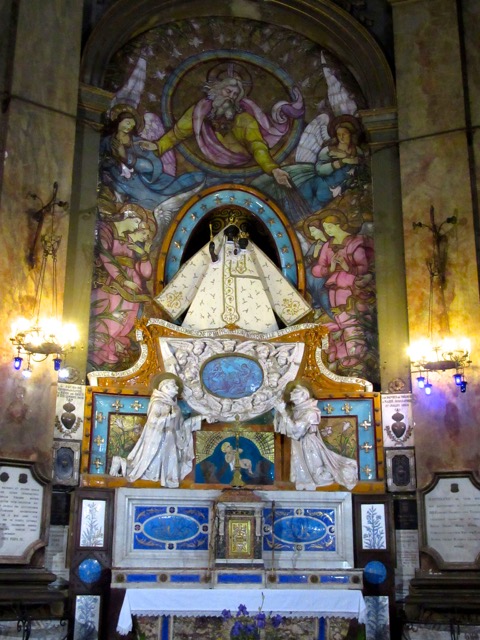


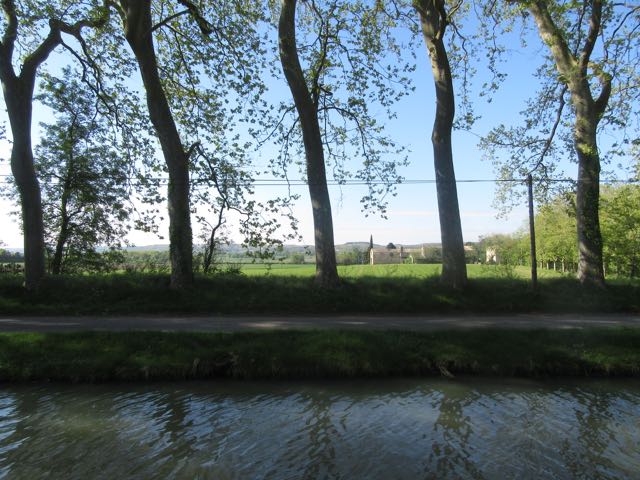


 Along with the usual daily bread we also needed a suitable venue for a relaxed anniversary celebration. We walked into town on a lovely sunny Spring evening and found a PMU style bar and a Cambodian restaurant that suited us just fine.


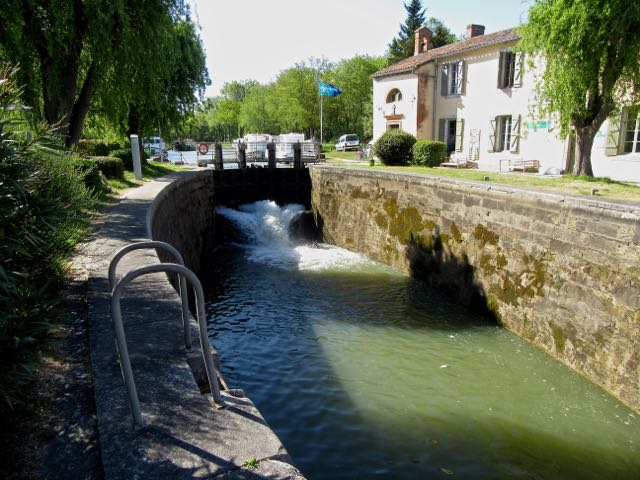
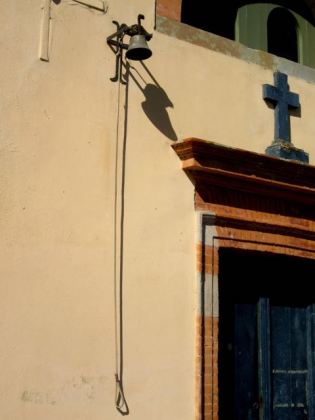


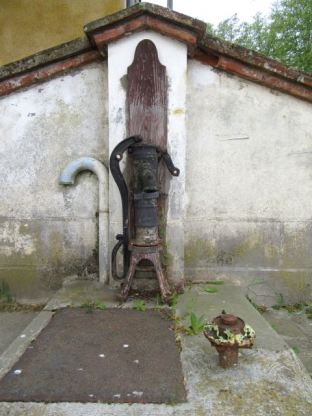


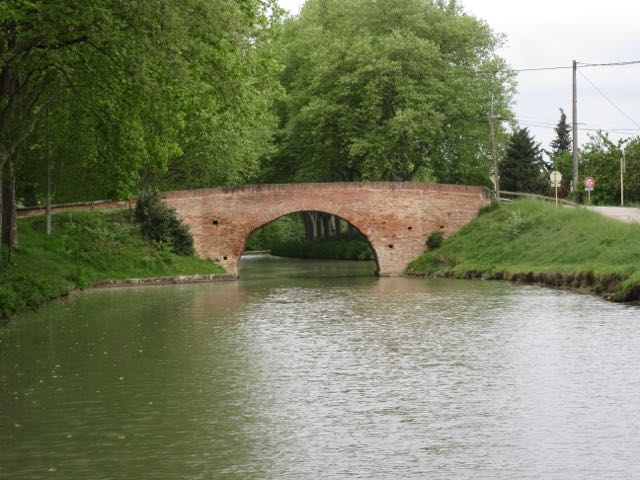


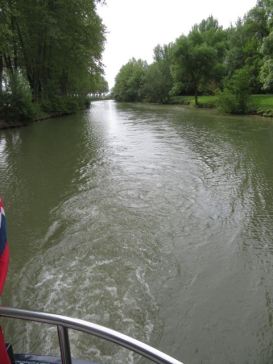 We were passed by very few boats, but often surprised by the lack of care other boaters had for the banks for the canal, causing quite a wake. We were proud of the smooth waters astern.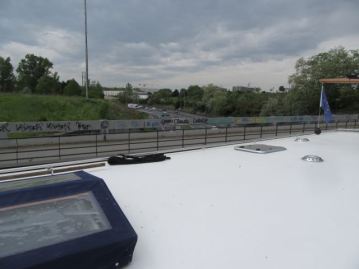
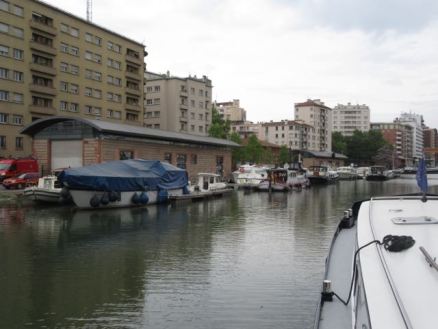

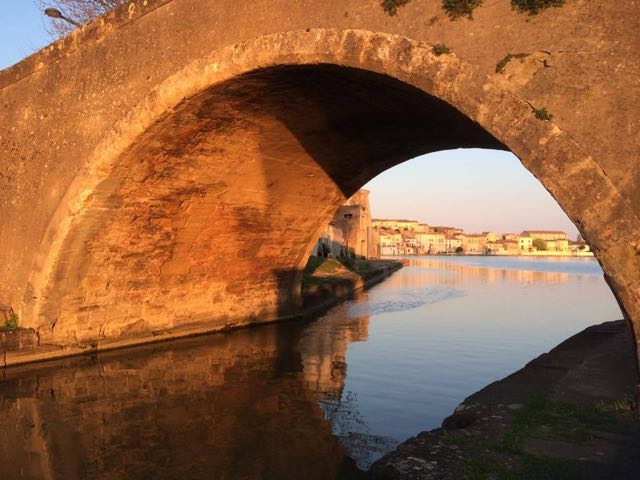
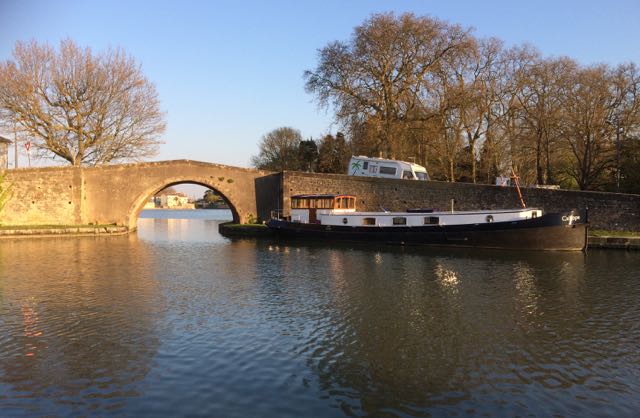


 There had been a plan to stay there just a few days, but with Easter weekend looming, and the possibility of a crowded canal, we decided to have another ten days enjoying the town, the port, the sunshine.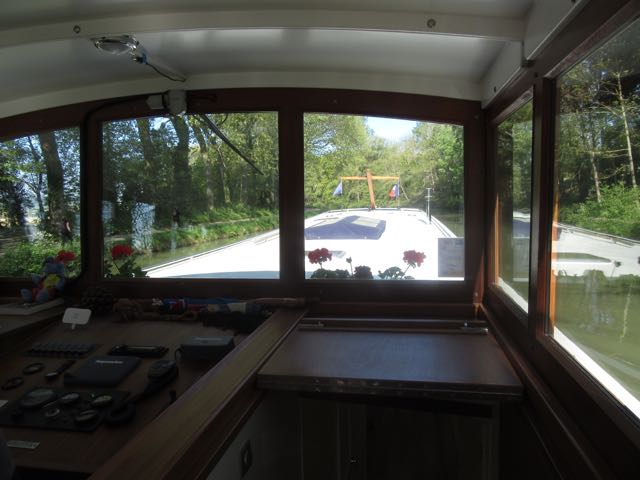
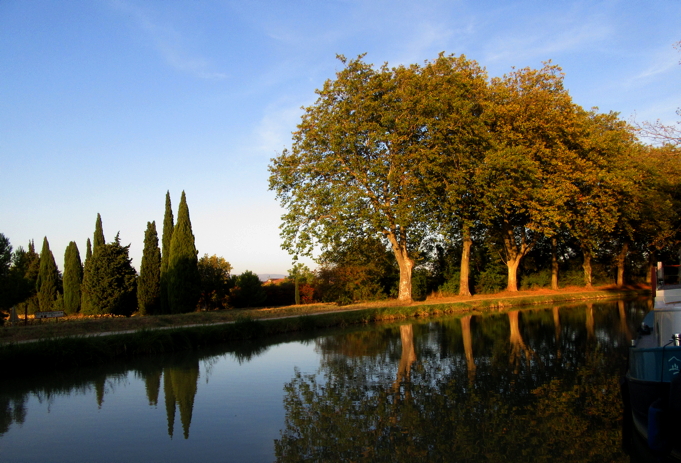


 We made our way along to the first of the distinctive Midi oval locks (also known as blooming bonkers – we grate up and down either end and miss in the middle by two foot). A rather grumpy éclusier refused to respond to my cheerful chatter (who could blame her in that heat?) but she did get to work and lock us and another boat up 1.5m to the next level.

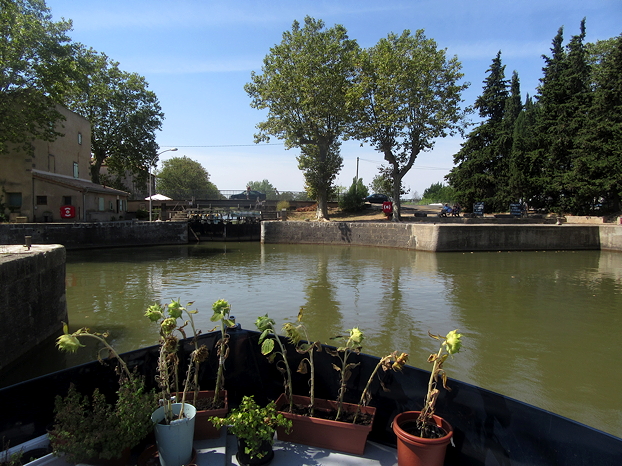 Calliope continued along the canal towards one of the most interesting locks in France – the round lock at Adge, a three way connection between the canal and the south bound arm of the river Herault. We arrived at lock keepers lunch time, ready to moor up on the waiting pontoon and eat our own while we waited.

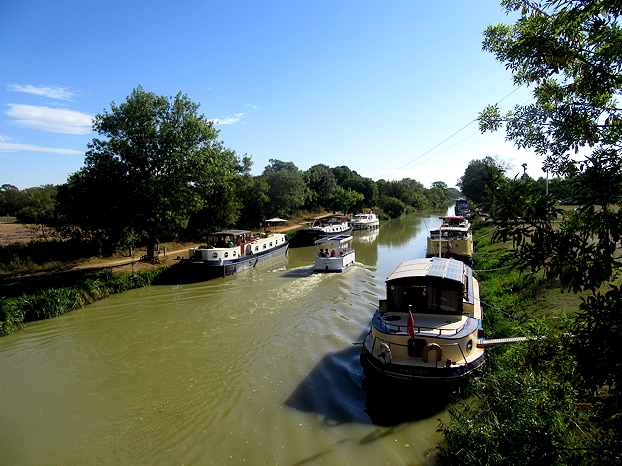


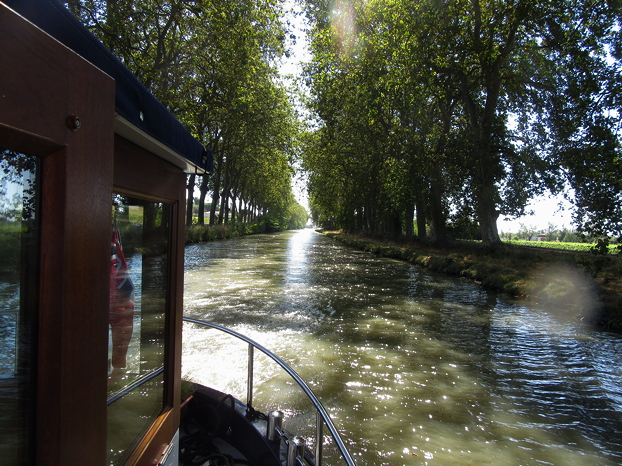
 Many of these beautiful trees are now sick, or have died, due to the fungus Ceratocystis platani, which is believed to have been brought to France in contaminated ammunition boxes used by US troops during the second world war. We passed yet another sad section necessarily being cut down. But new trees, mainly poplar, oak and pine, all resistant to the fungus, are being planted for future boating generations to enjoy.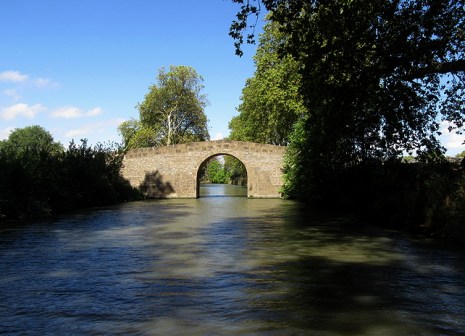


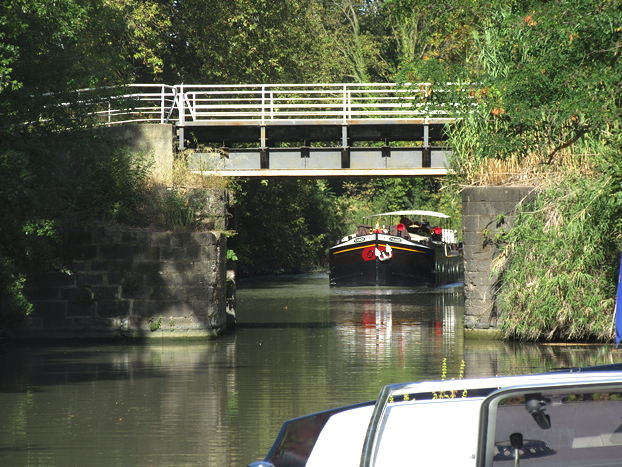


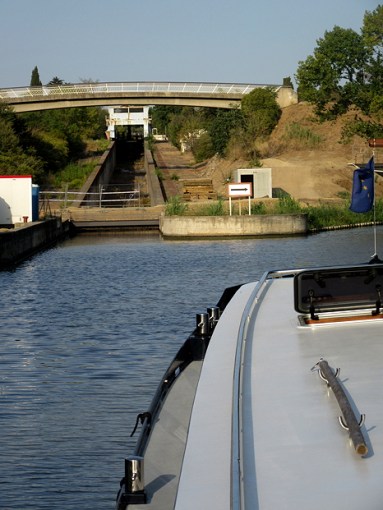


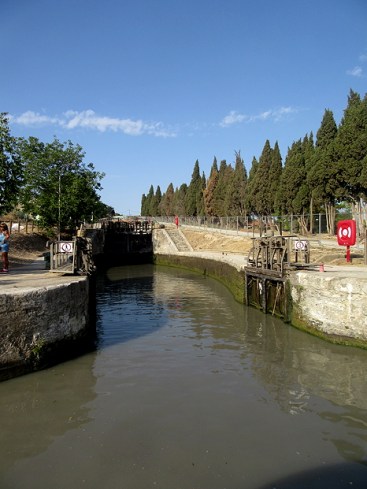
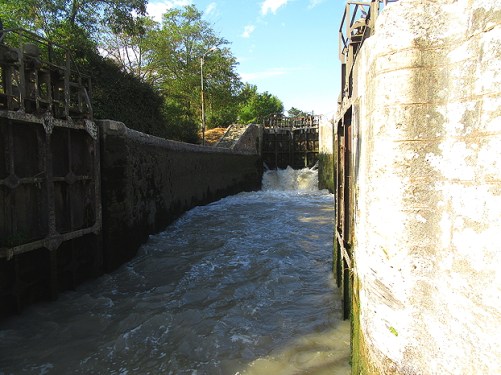 As you go into one lock the doors to the one above are also open, a massive cill, or shelf, above the waterline, and water already pouring in. Almost before you can tie up the gates behind close and the water starts to thunder in from the lock above, threatening to move 38 tons of steel around in the chamber if you don’t hang on tight!

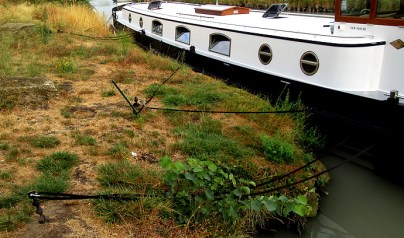


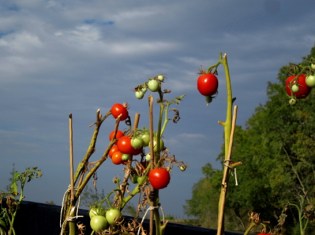


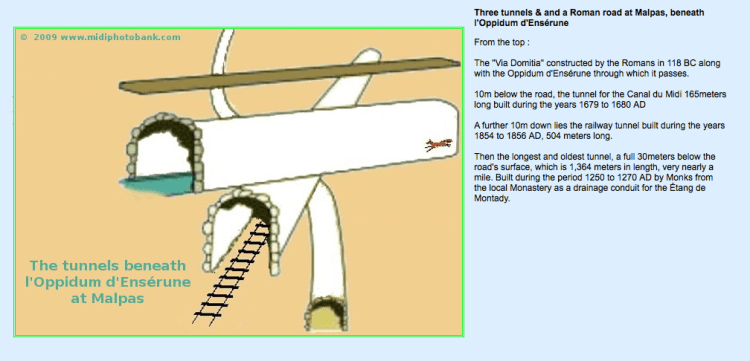


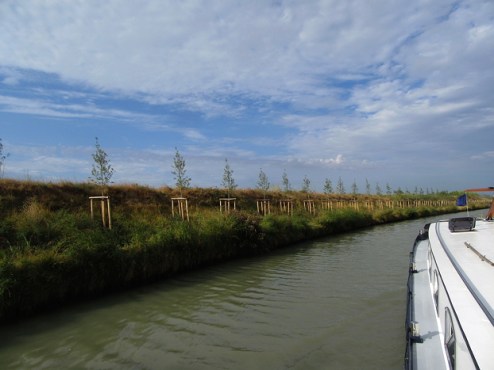


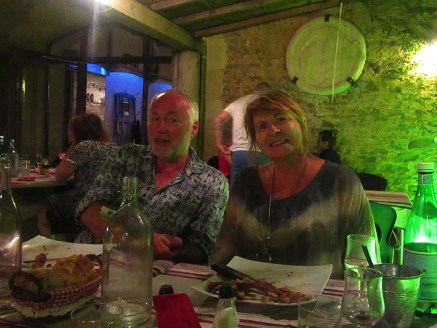


 Stu and I were ready for a rest after several days steaming along, with the added general anxiety of relatively difficult double and treble oval locks (in our size barge) so we stayed an extra day and night at Trèbes.


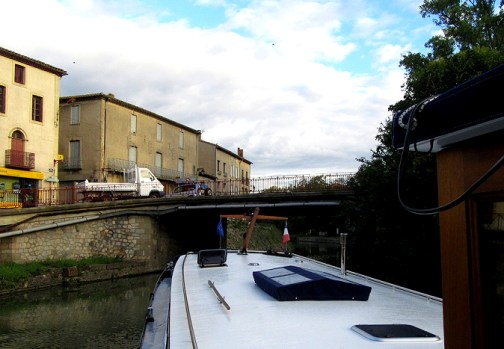


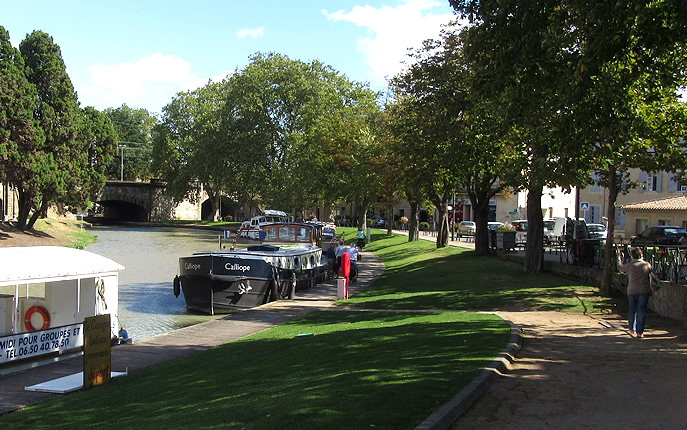


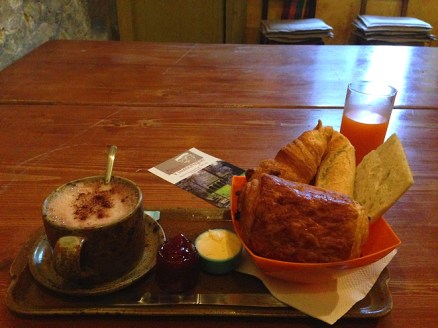


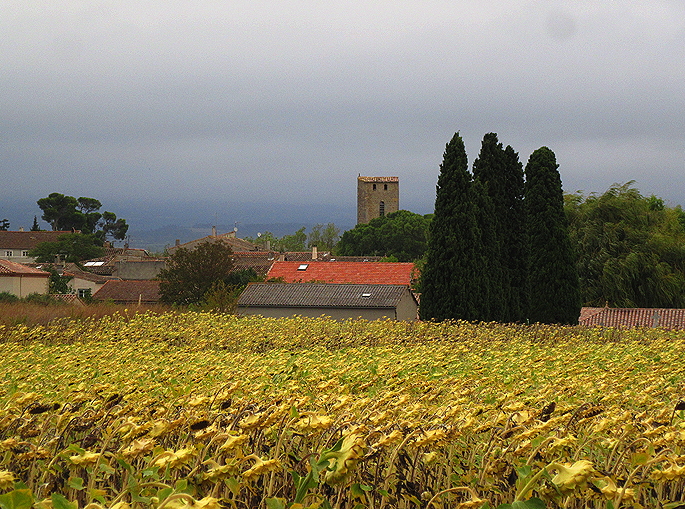 We ended up at Villesèqueland, and both so glad that we did. Our mooring was opposite an exquisite view across the sunflower fields to the old tower in the village, with rising purple hills beyond.

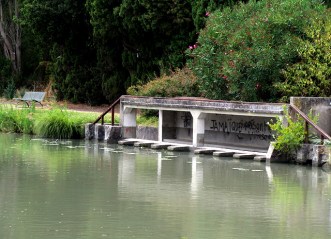


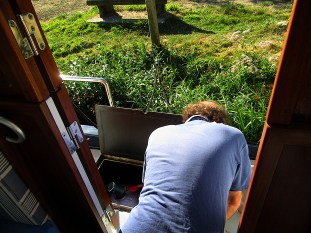


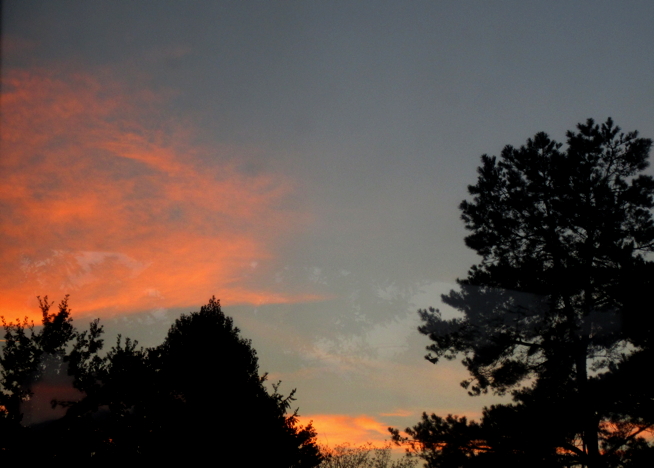


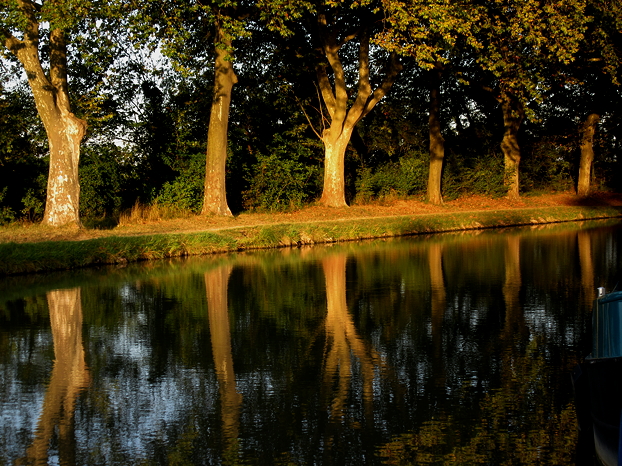 Whereas on the opposite side of the canal most plane trees are still in place, lighting up with a golden gleam in the evening sun.


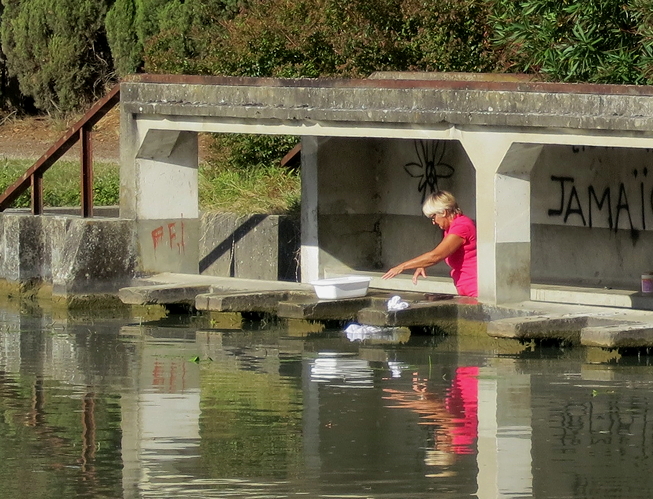
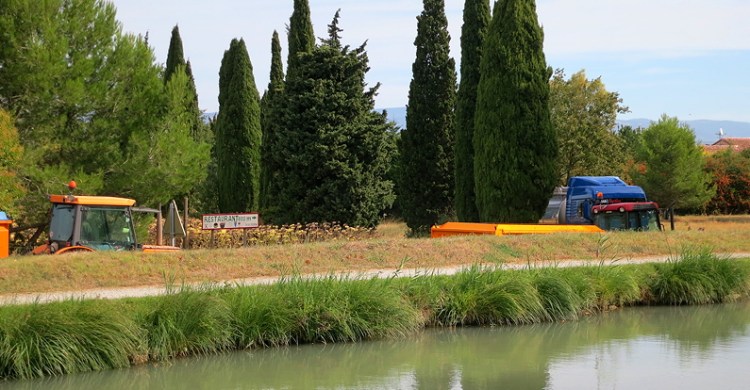 The second was a head to head between wine and grapes – or to be more precise between a tanker full of wine and two tractors hauling trailers full of grapes. Then tanker had tried to cross the narrow bridge, but been unable to turn the tight bend. This meant that it had a hundred yards of reversing along the canal bank, then backwards and down behind the bank, round a right angle bend back towards the village. This took some time. Whilst this was going on the two tractors appeared back from the vineyards, over the bridge, with their new loads. They simply had to wait, slowly moving along on the opposite Calliope, until the jam was untangled. The photo is of the blue lorry disappearing round the bend with the red and yellow tractors in close pursuit.
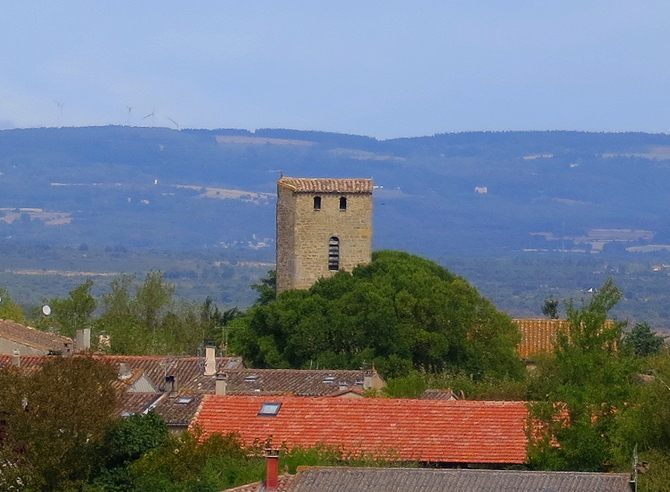 After 11 glorious days with the view of the village, church tower, and old elm in our view through yellow dawns, golden blue days, and pink sunsets it was time to move to our winter resting place at Castelnaudary, a deliberately slow three day trip away.

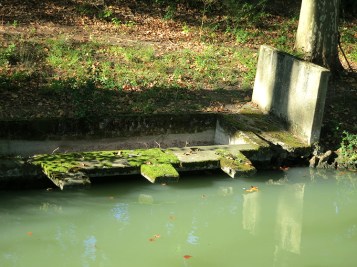

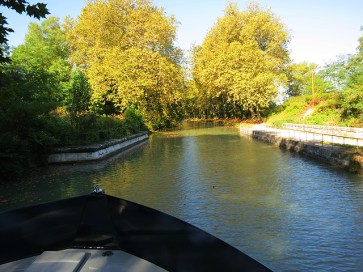


 Not far after Criminelle the map showed that there was an ‘Ancien lavoir’, just after the écluse at Guerre. This is one of the more picturesque lavoir locations; I think I would have enjoyed walking into the shade of this willow with my washing basket on a hot day, arms up to the elbows in the cool water and gossiping with my friends as I worked.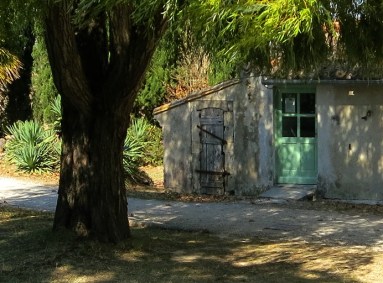

 …….with a calm view back towards the lock.
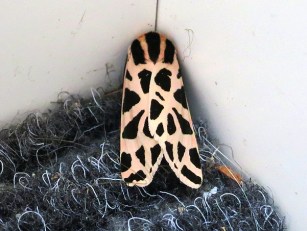
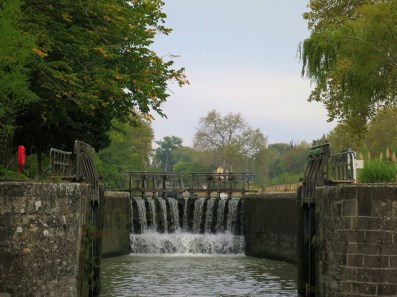
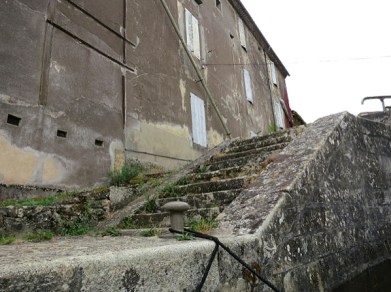

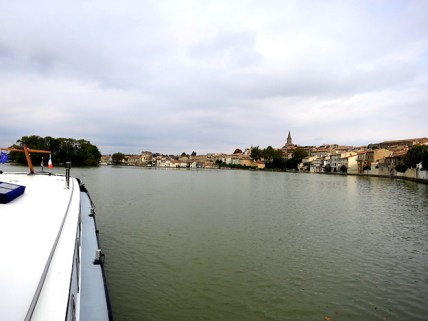


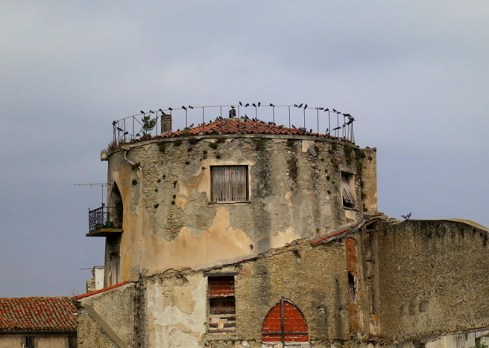

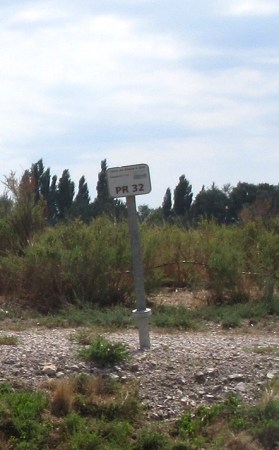
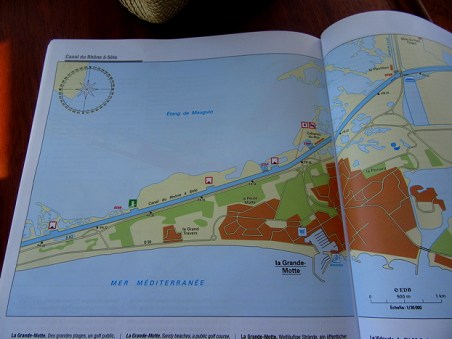


 We cruised through mile after mile of blue sky, blue water, and occasional flocks of birds and herds of horses. At the second Aigues-Mortes* junction the canal widened; as we approached we thought it was covered in white foam, but as we got closer we realised it was a huge flock of gulls who took off in relays around our bow. * Great name for a holiday destination, translates as Sickly-Death.
 The Next landmark was les Portes du Vidourie – two massive gates that are lowered when the intersecting Vidourie river is in flood – another part of the intricate water system to manage the natural state of the Camargue.
 Fishermen (and they do all seem to be men) still live on narrow strips of land and put out their nets each day – sometimes across the canal! Here at Cabanes du Roc is one of their settlements. I am pleased to say that I can play the theme from Deliverance, but do not currently own a banjo . . .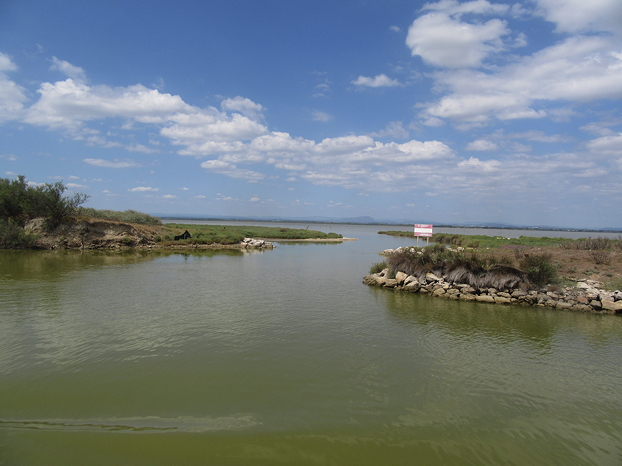
 Quite a surprise on the skyline is la Grande-Motte, a ‘leaser’ town created in the 1980’s, with architecture to prove the point.

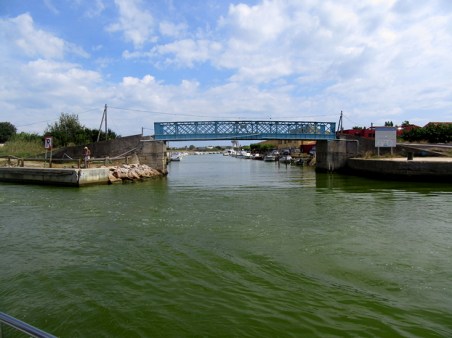 We continued past Carnon, with its crossing of our larger canal and a small canal that goes inland to a marina and seaboard to a small port.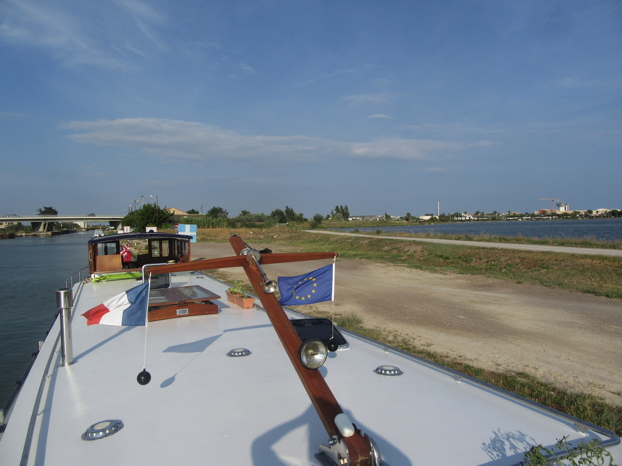
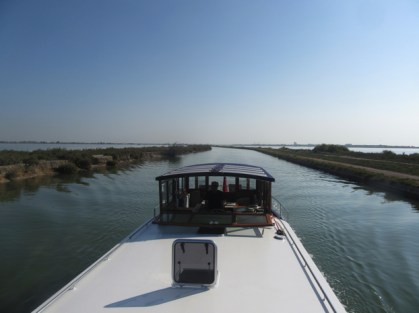

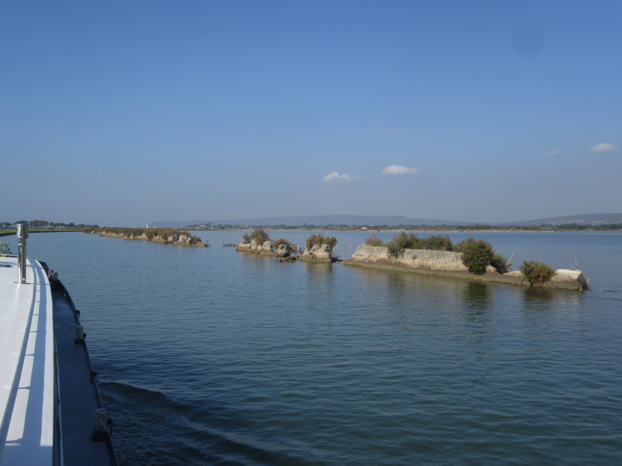


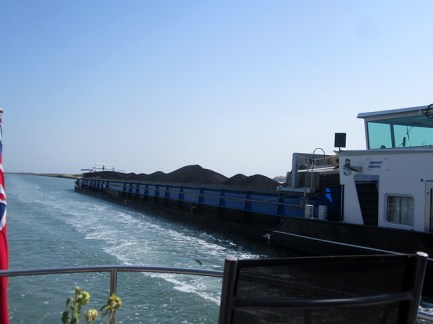 There are a number of commercial quays along the canal, but apart from hotel barges we had not see anything of the commercial aspect to the canal – perhaps because it was August, the customary holiday month in France. Then, just outside Frontignan, we met a fully loaded coal barge heading east. Good to see the canal still working as intended.


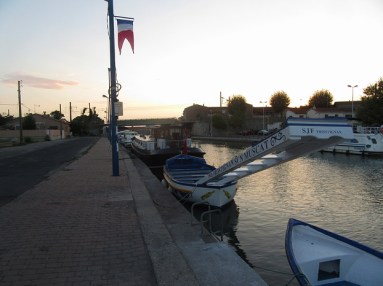
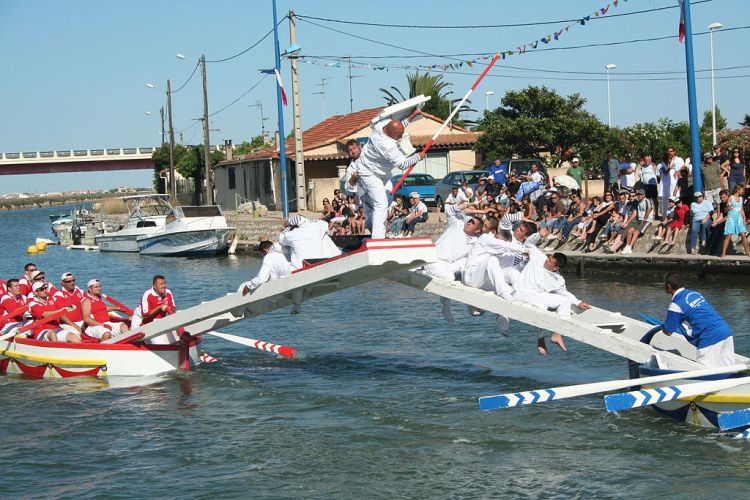


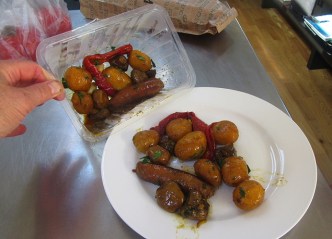 For Stu it was a warm salad of potato, chorizo, mushrooms, red peppers and a tasty dressing.
 That’s ok then. Good Med food. Ugh – really really is as bad as it looks . . .


 This was followed by a shady drink at the marina, before we did manage to catch the bus back. After a six minute journey we were back in town, ready for supper in the square, all extremely pleasant and with that pervasive sense of southern France.
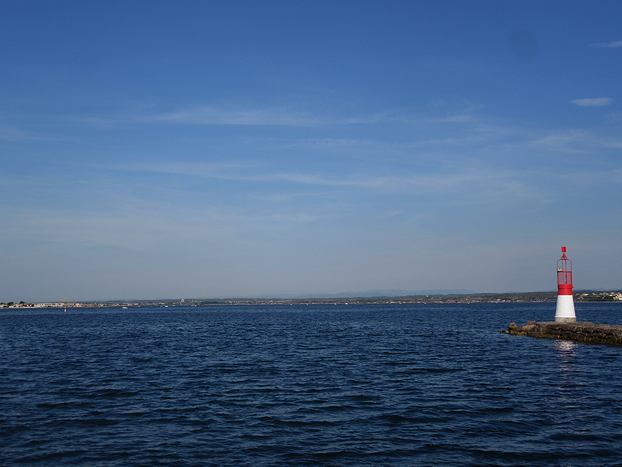 We had a final half hour of cruising down the canal de Rhone à Sète to bring us to the brink of Étang de Thau near Sète. Then, with wind speeds thoroughly checked to ensure safe passage we set out for the 14KM crossing.


 The oyster beds are marked with rows and rows of poles over to the North of the lake near Mèze, Bouzigues and Marseilles. We looked at them from a good distance, their neat regular shapes standing out and upright from the blue waters.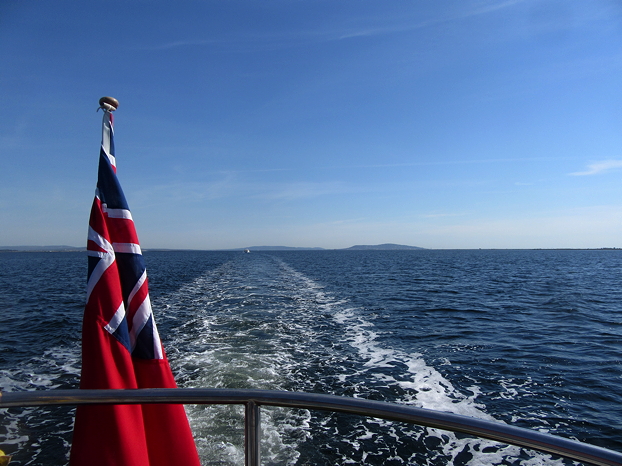
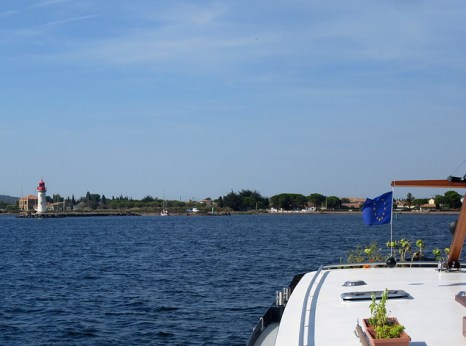

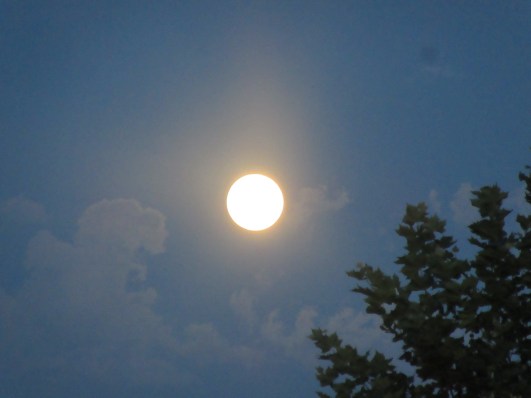 Leaving Fragnes (we like Fragnes) after a full moon night and just after breakfast we had a final short trip on Canal du Centre from countryside towards La Sâone.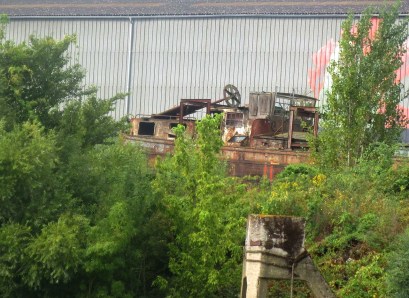


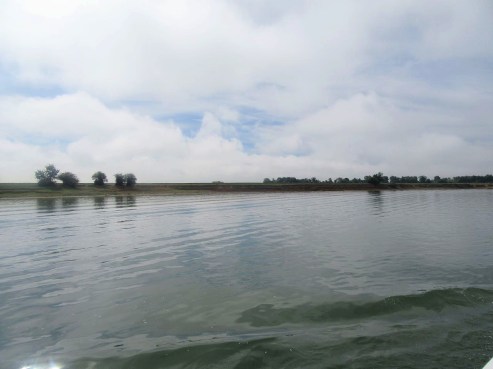 The countryside below Chalon is rather flat – less interesting than some, but the wide, open, view and the wildlife made it very enjoyable on a day when clouds lifted and the sun came through..

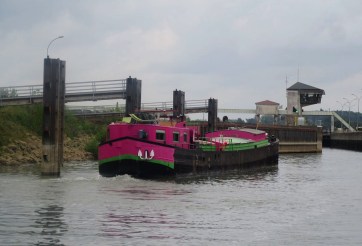


 We cruised a massive 57 Kms on Friday, past the graceful riverside house of Macon and ending up moored near Belleville. Macon, which looks a pleasant city. It’s a shame to miss such an important wine growing region, but if we are to meet our mates Chris and Tasmin in 3 days time we need to keep going.


 Soon after Dracé we spotted a ‘perfect’ rural mooring for us – except that the pontoon was 8m long and we are 20m. In a canal it’s ok to moor in such a short space, but on the river, with big barges, jet skis and power boats sending wonderful wakes our way, we thought it might not be wise.


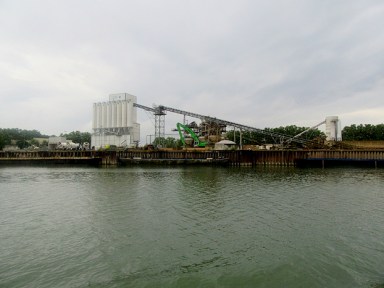


 Neuville-sur Saone has a claim to fame, linked to the Lumière Brothers. A congress of French Societies of photography took place in


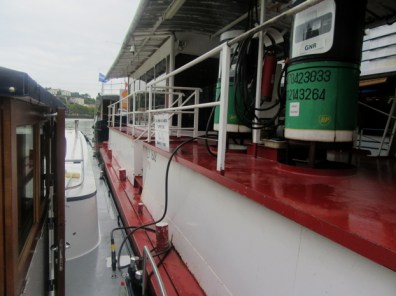
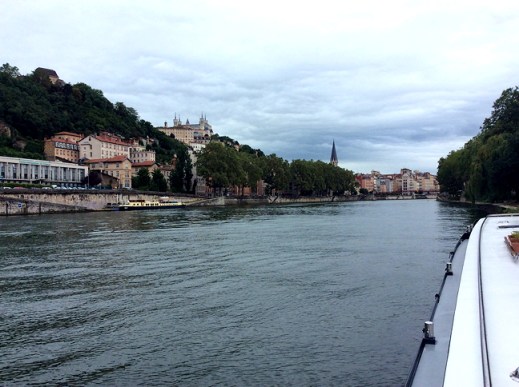 Then returning up stream half a kilometre or so we tied up on a tree-lined quay in the middle of the city. When the sun comes out this is going to be spectacular!
 The skies cleared as it became dark, bringing ‘spectacular’ forward by a few hours.


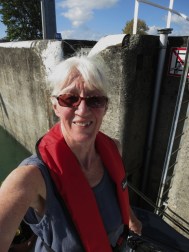
 Calliope glided on down the river, with the scenery opening, closing, changing. We passed towns and villages more reminiscent of Italy than France, so definitely now in the South and with a Roman influence.
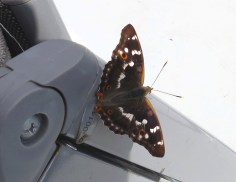 On the canals our expectations were to achieve 20 Kms per day; on the river, with few locks and a following current we have been doing 14Kms per hour on Le Rhone! White Water Barging!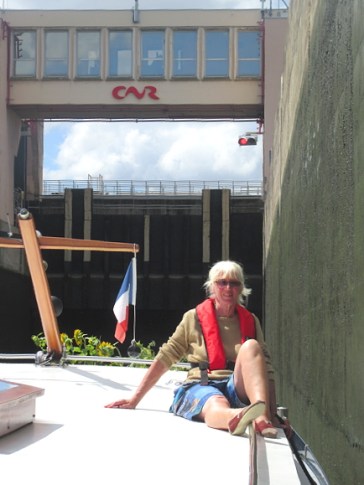


 About half an hour after our joyful mooring out in the country we were joined by a HUGE hotel barge who was disembarking passengers for a coach trip! The Captain of this barge was superb, mooring up to 5 ‘ducs’, or huge black poles sticking out of the river, to which are attached gangways to the land.


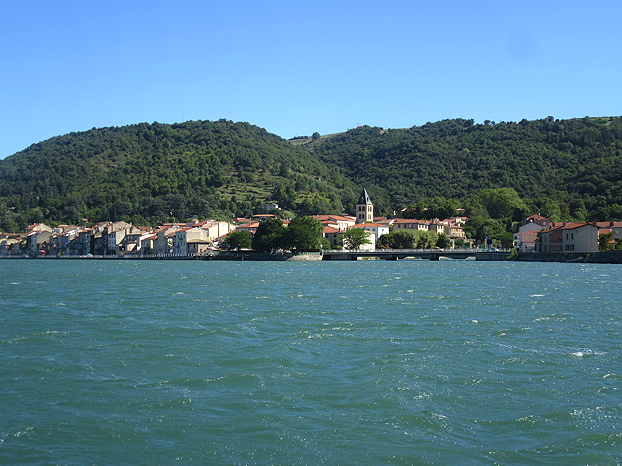

 By now the wind was picking up, a daily feature, probably linked to the ground warming up in the high temperatures we have been enjoying!


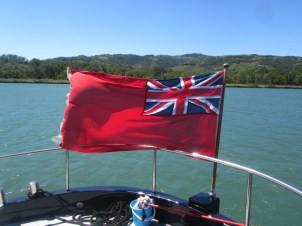 The wind continued to pick up – blowing harder than forecast, but with a bright sky and sunshine – harder than forecast is correct.
 The 12km trip included another lock, Bourg-les-Valences. Here the ‘door’ rises up behind you out of the water, although this photo does not show the actin very well.


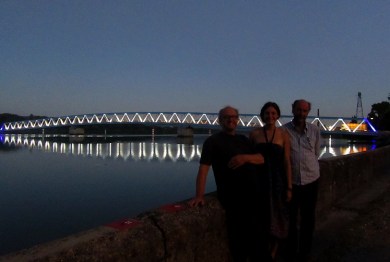


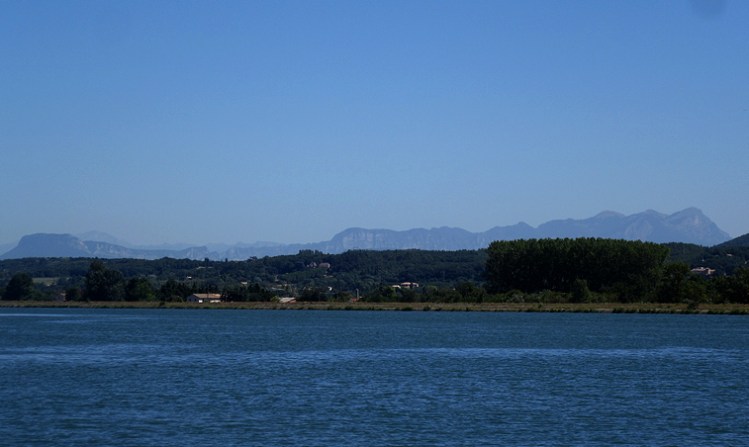 Further down river we saw the delicious town of Montelimar in the distance rive gauche, and beyond the inky outline of a mountain range.


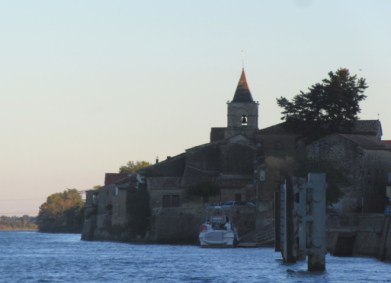
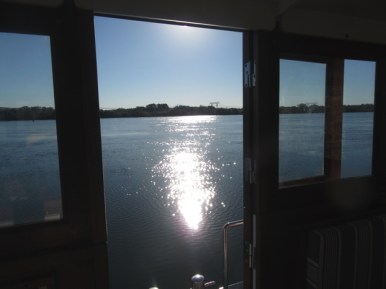


 But I had better tell you about our electricity cable. We were pleased to moor Calliope in such a way that the stern overshot the pontoon and allowed our 10m power cable to suspend over the water to the electricity point on the land. It worked perfectly – until a large boast with a particularly big wash rocked Calliope so much that the wires popped out of the plug on the boat and disappeared into the river. I hope not too many fish were electrocuted!
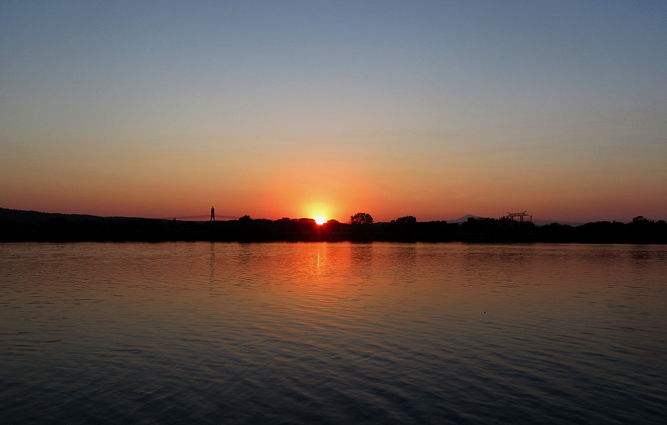 Feeling much more relaxed we awoke to a perfect dawn. A gentle 21Km day was plotted, from Saint-Etiennes to Roquemaure, another free mooring at a small quay.


 Further invigoration for me was through the use of the biggest private swimming pool I have ever encountered – the whole of this stretch of the Rhone just for me, with warm stone steps at the end of the quay for easy immersion. On Sunday I dived in from the boat – feeling quite brave at my age; stupid really.


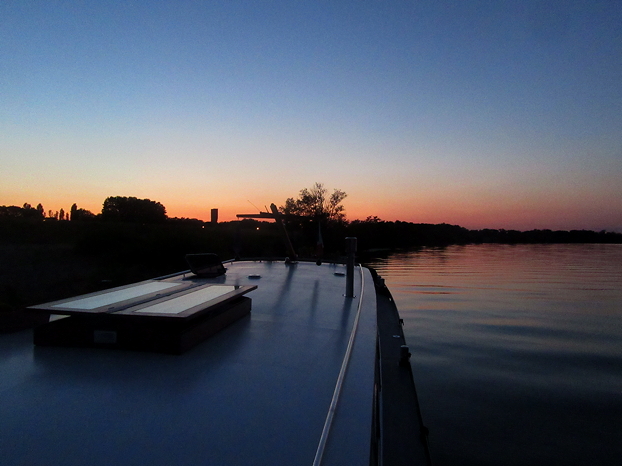 Two pleasant evenings at Roquelaure, during the second of which we planned a long day South and onto the Petit Rhône. Seems like a good idea through those millpond calm hours.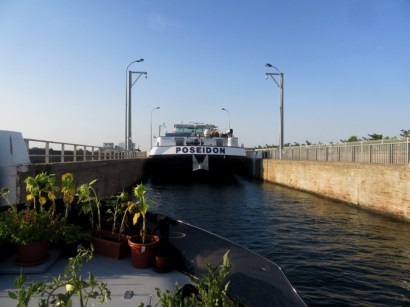


 Taking note of the quite expensive, but not very attractive, marinas along the way we came to our last lock on Le Rhône, with the wind at its trickiest, blowing sideways across the river. We were helpfully blown onto the small waiting pontoon, but that made it difficult for the Captain to persuade Calliope back into the stream and through the lock mouth. He did it! Bravo!


 The flora and fauna is so different down here – definitely Mediterranean. I went ashore with the camera, but apart from this red mini beast I didn’t capture anything good ‘on film’. We were a little bothered by biting mini beasts later, but a mélange of smouldering coils, sprayed skin, swatting and spraying kept us safe for the night.
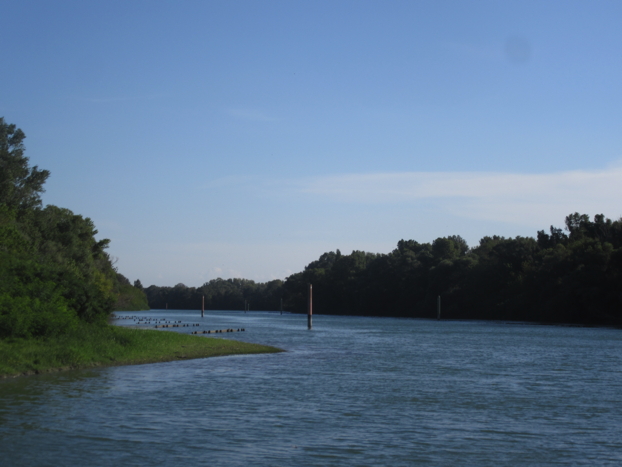


 So that’s it for this section. The Canal de Rhône à Sète will be a somewhat different experience I think. Let’s see.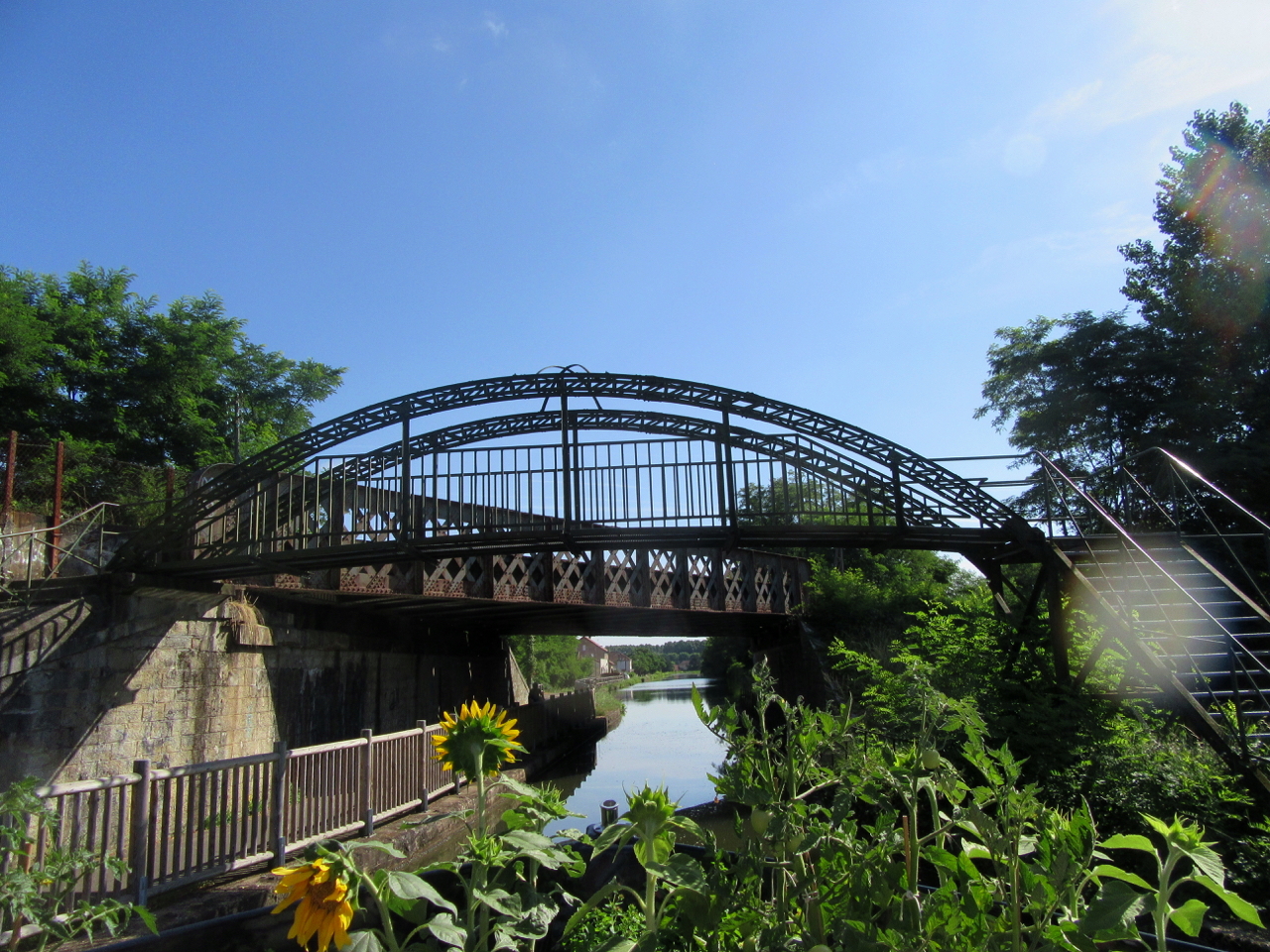


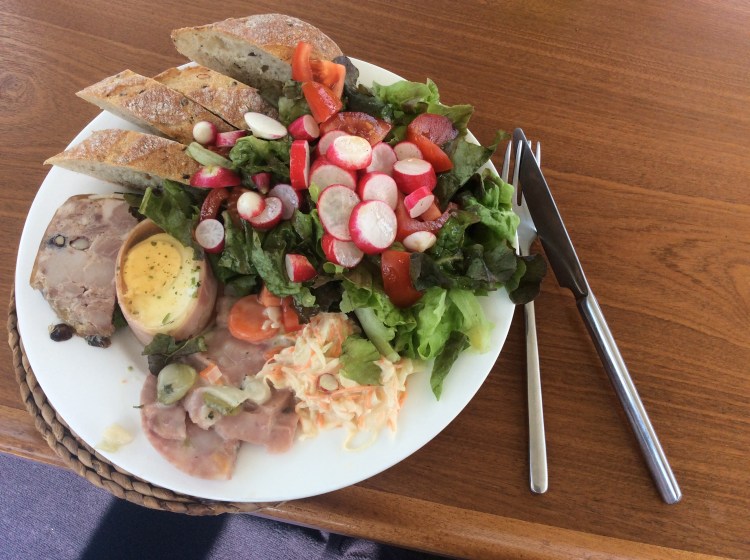 I had a delicious lunch à la francàise with things we had bought in the charcuterie, boulangerie and boucherie in Paray – baguette, terrine de Lapin avec noix, oeuf et jambon en gelee, cows cheek salad in vinaigrette and big salad with radishes and dressing.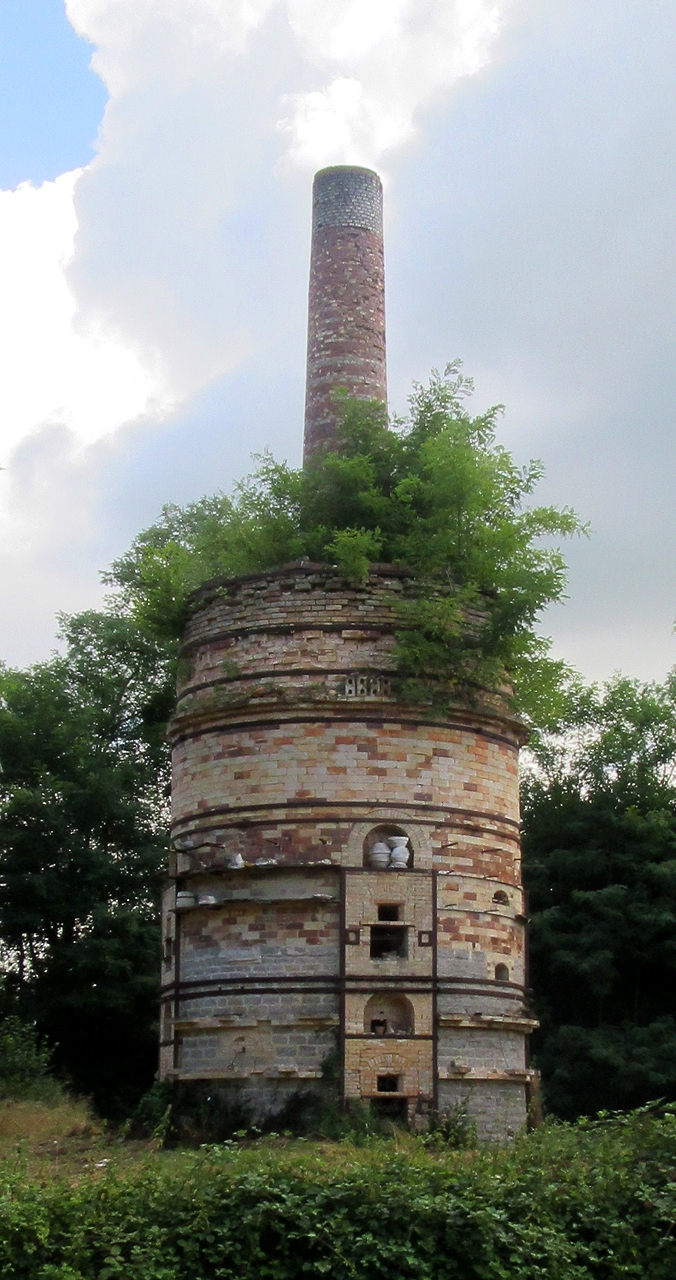


 So with With another 46kms still to Chalon we decided to hit another 20 Kms from St Julien to Cheilly-les-Maranges. This turned out to be a good move as we were able to buy some good local wine at Chailly!


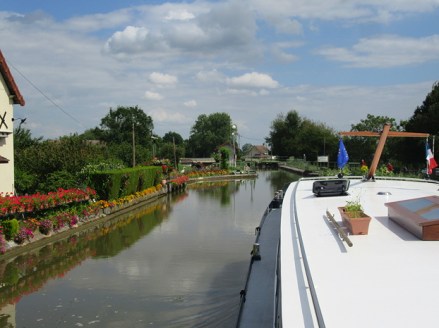

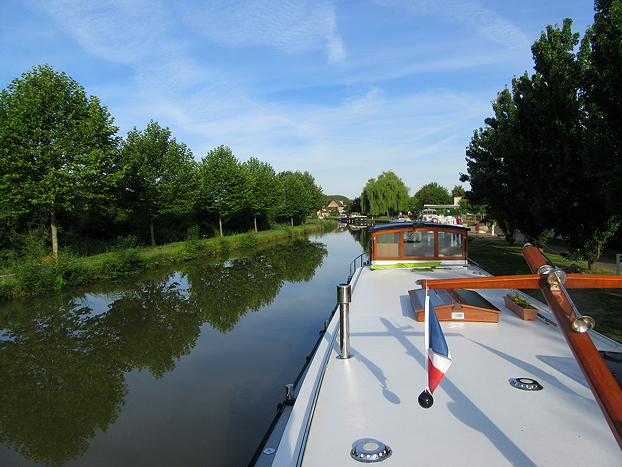


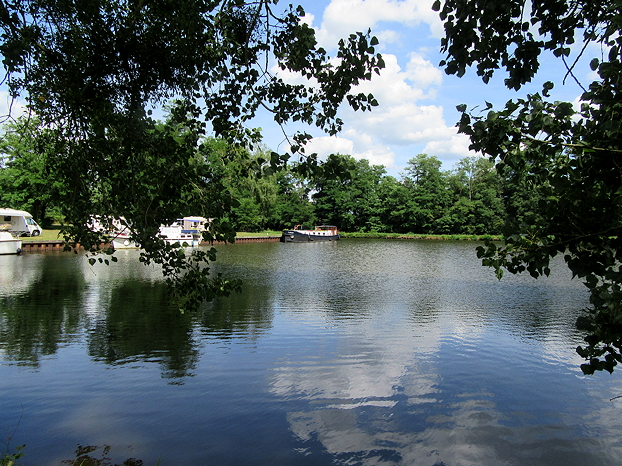


 And then our last day voyaging together, over the viaduct, up to Paray-Le-Monial. It was another blisteringly hot day with plenty of sunbathing opportunities, and another outdoor pool to enjoy in Paray once we arrived.


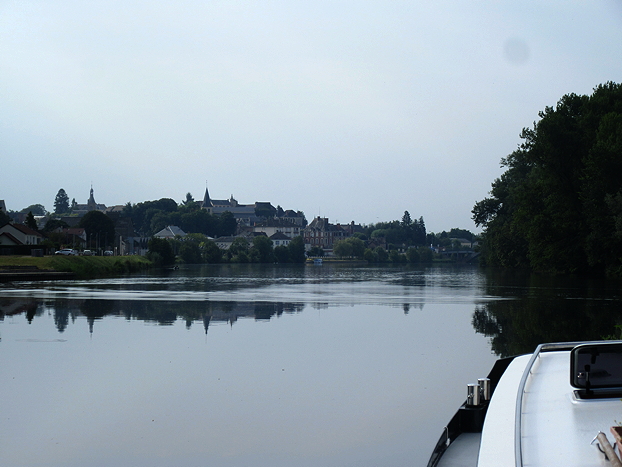


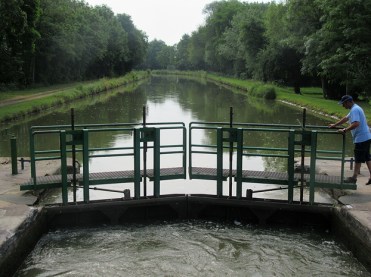


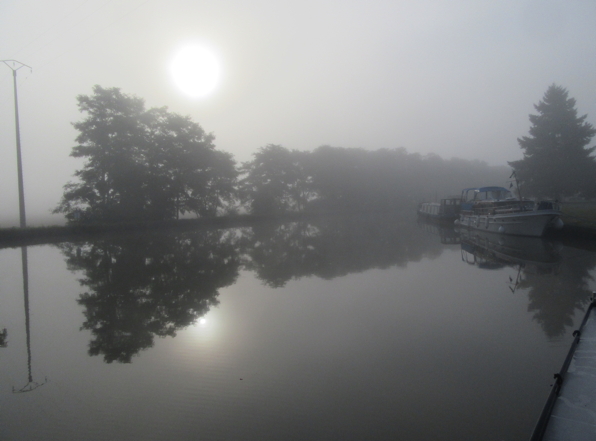


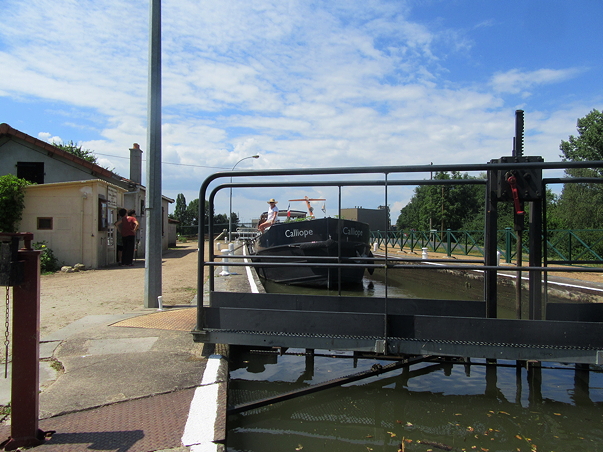


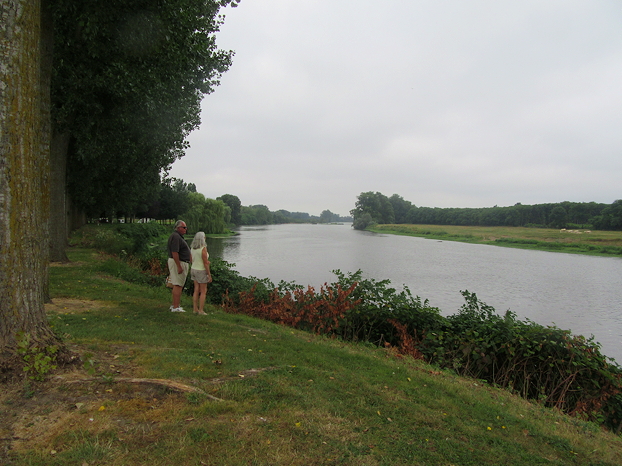


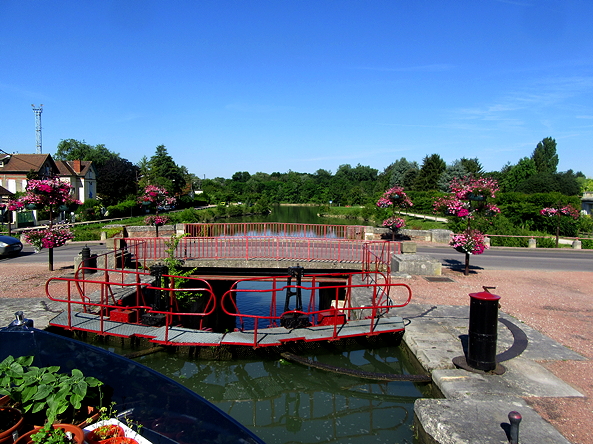

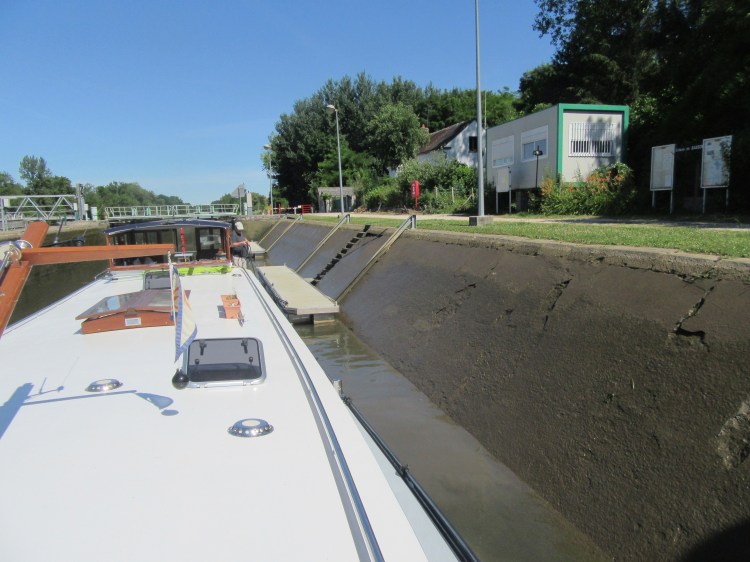


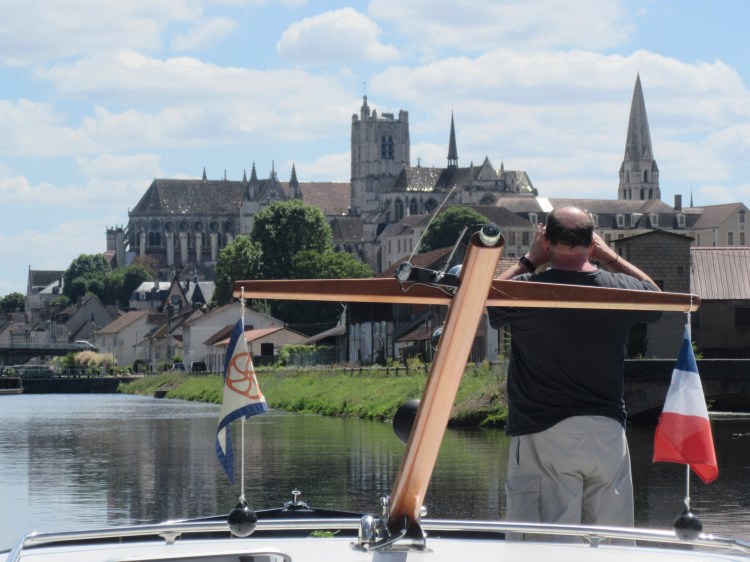


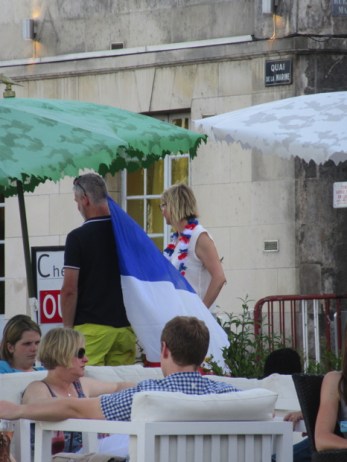


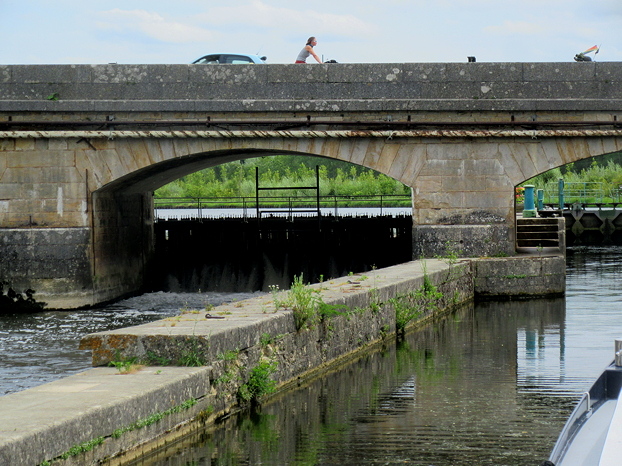
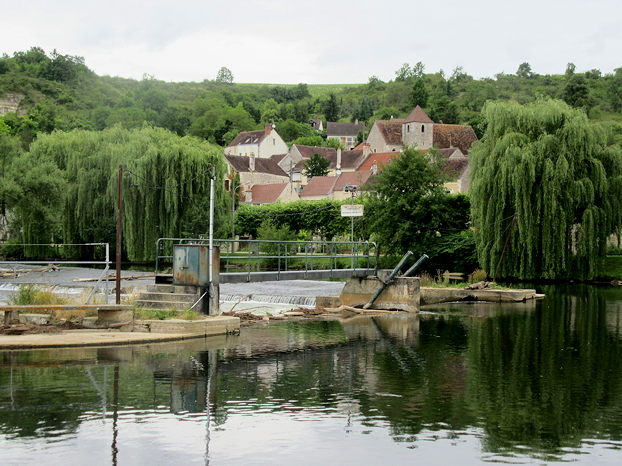


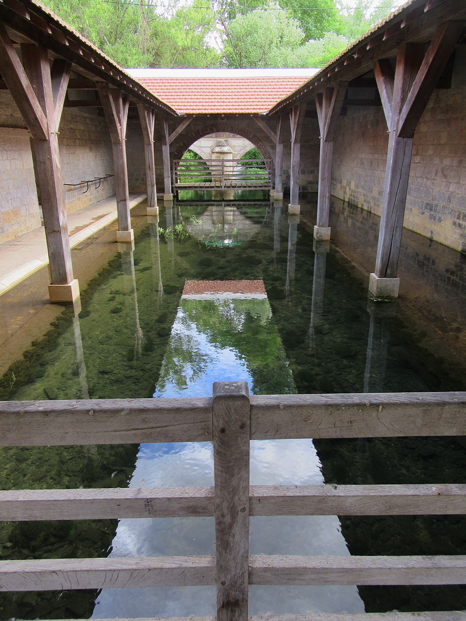


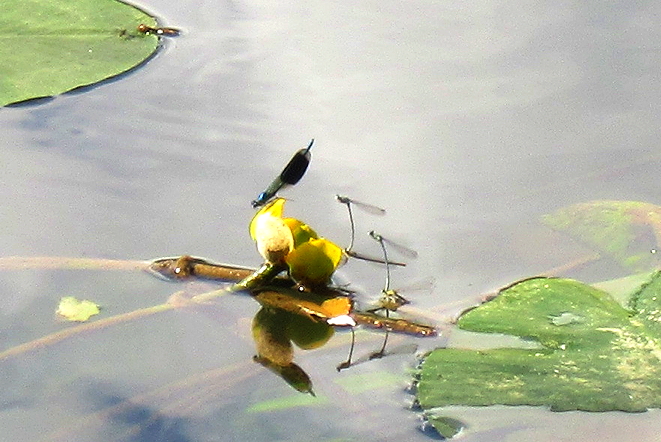


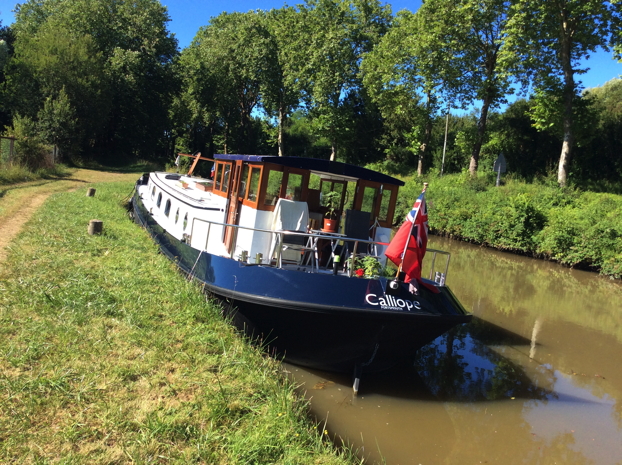


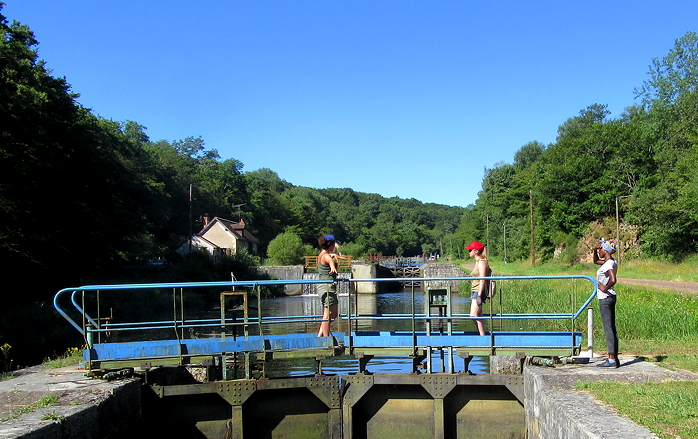


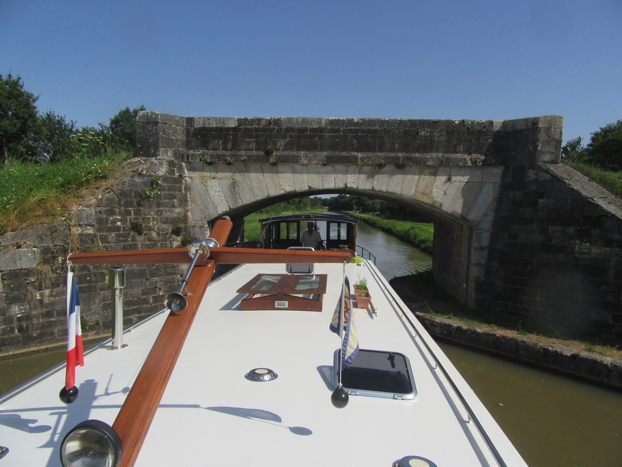


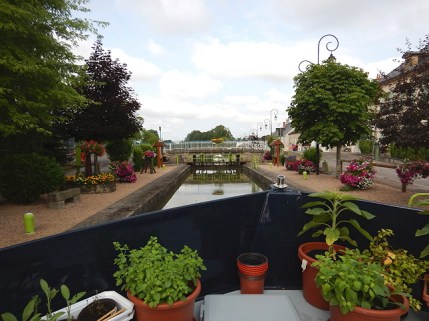




 goodshipcalliope