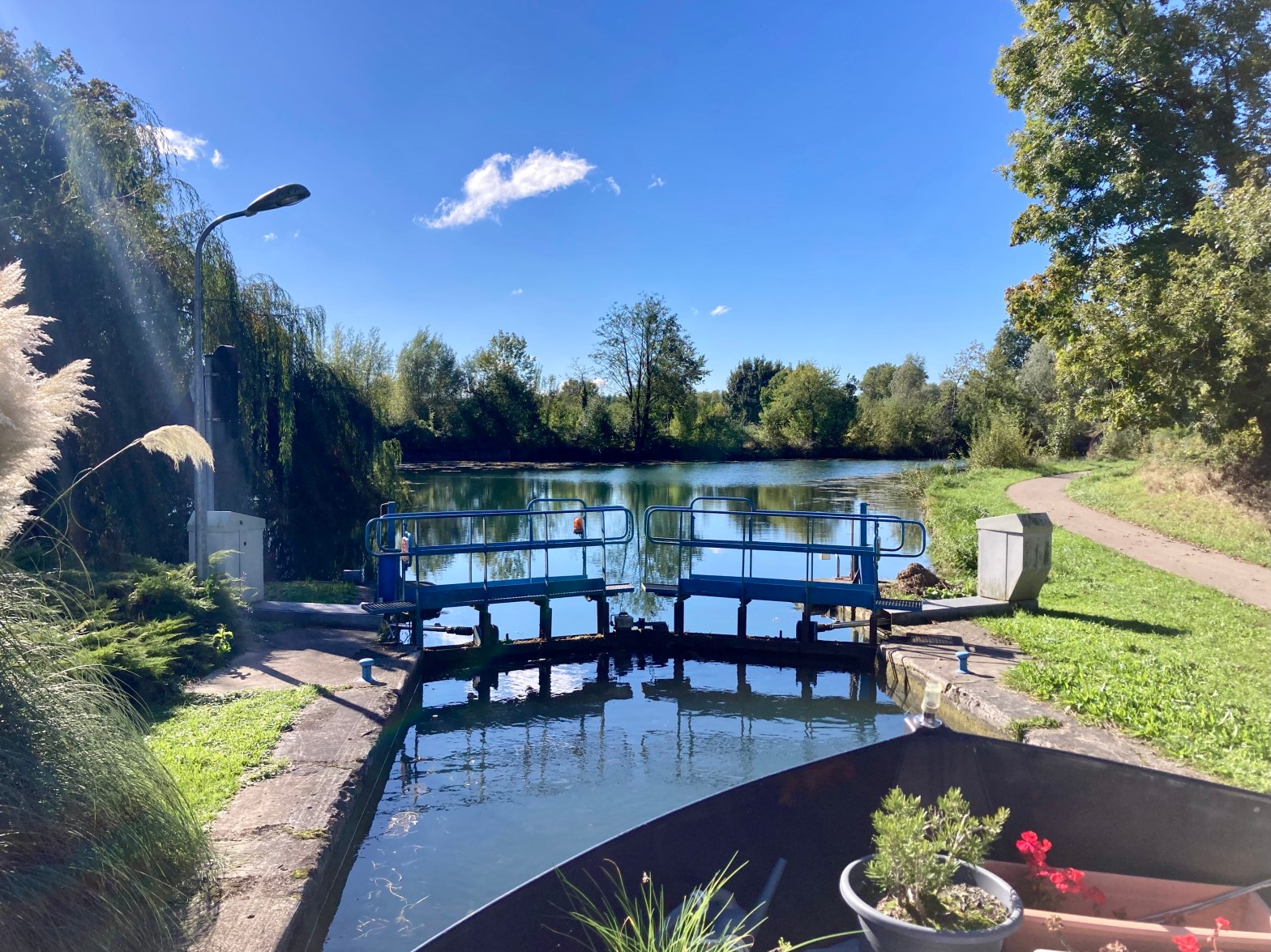
Canal Entre Champagne et Bourgogne (and La Saône)
3rd to 23rd October 2024
This is one of our favourite canals, despite the 71 ascending locks and 43 descending locks over its 224km length. The first section out of Vitry-le-François is rather straight and although mostly through countryside it is not as scenic as the kilometres after Saint Dizier – but I am getting ahead of myself.

We arrived at the northern end of the canal from the Canal Lateral à La Marne with additional crew on board. Our son had come to help us put in some long days south after a 5 week hold up on the Canal L’Aisne à La Marne; a lock was undergoing modernisation.
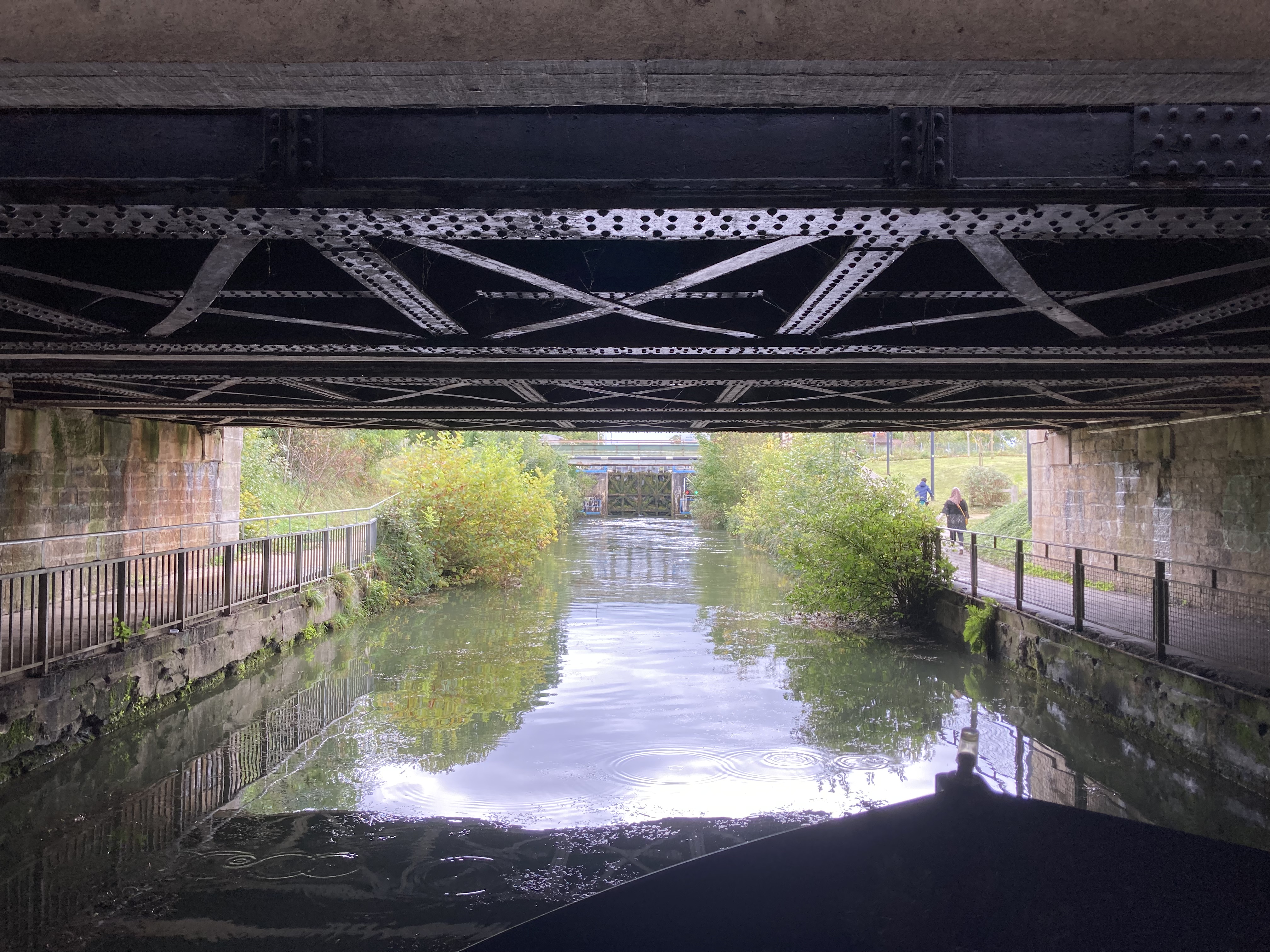
Turning into the Champagne et Bourgogne at Vitry we passed under several close-together foot, road and rail bridges and into Écluse (Lock) 71. Only another 70 to go to the top!
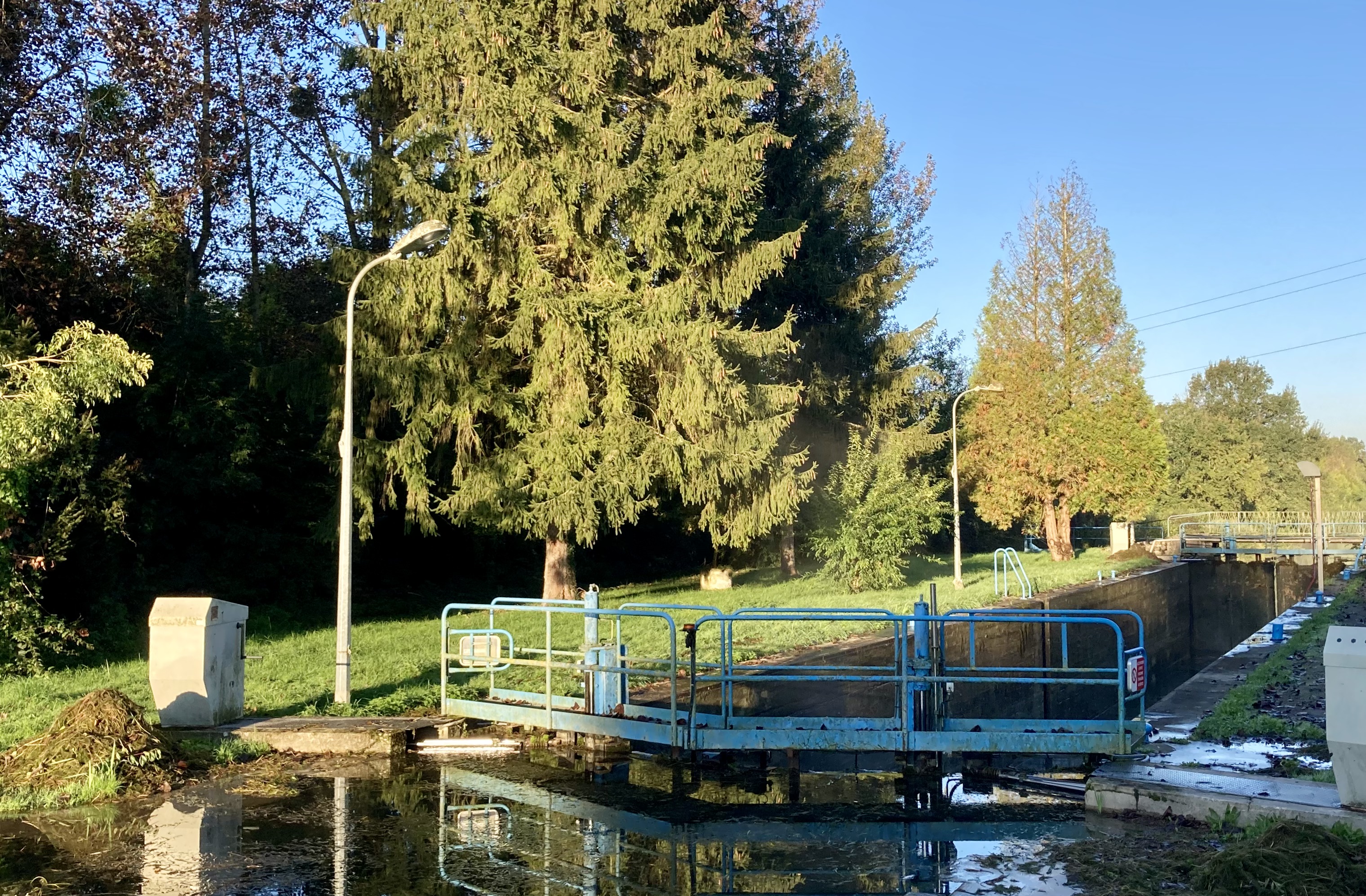
Lock 71 Desert, has some interesting features. We came in at the bottom of an empty c3m lock and needed to throw our ropes up over the bright blue bollards. These are set into angled indents just below the top of the lock wall; once the lock fills up the water level is above the base of the bollards.

So crew must be alert for both ‘roping’ the bollards at the start, and then keeping the boat off the side at the top; we did it!
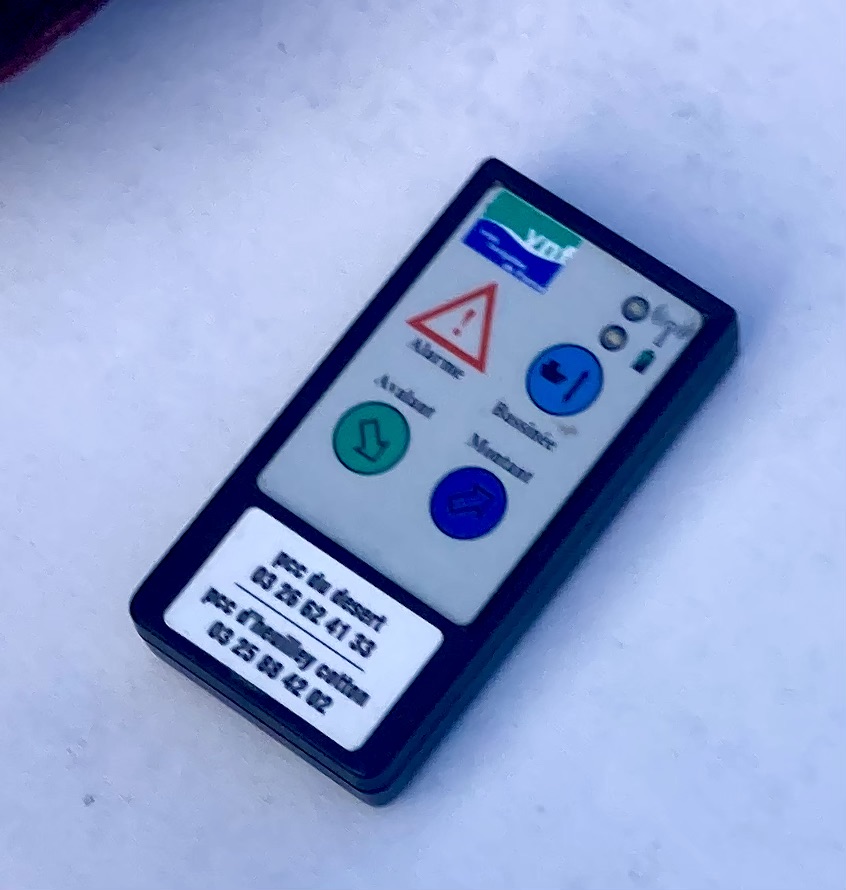
When the lock is full of water there is only one way to get the gates to open. We had to collect the ‘telecommand’ that will operate the remaining locks.
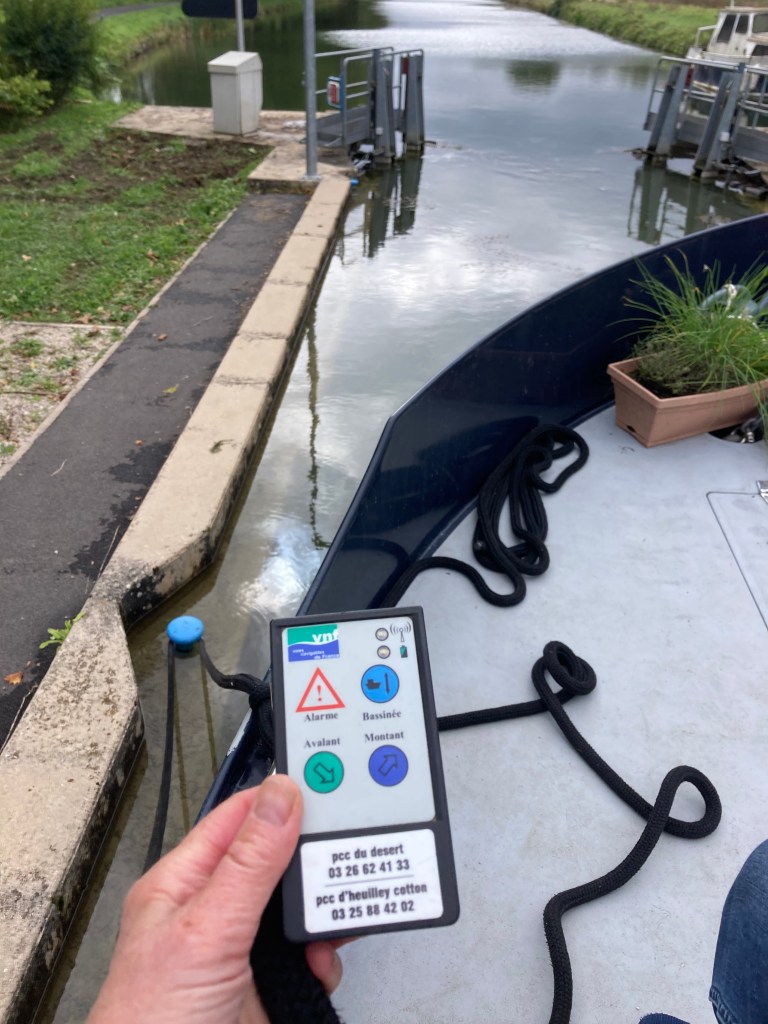
Once we had called up the local control centre and given information about Calliope and crew the telecommand was released from a dispenser next to the lock.The control centre like to know our size, depth. destination etc. The two centres, one nearby at Desert, and one at the summit at d’Heuilley Cotton, then kept an eye on our progress through a mix of cameras and peripatetic éclusiers (lock keepers).
I suppose éclusiers have a new job title now that they are driving around in vans labelled Service, and rarely actually operating a lock …….. I must ask.
Matignicourt, near Orconte
We had considered going through another 14 locks that day, while we still had son Ashley on board to help, but as we reached Matignicourt we all decided that this was a nice place to stop – expecially as there was one of our favourite Just Queen pizza kiosks nearby!
That made supper nice and easy!
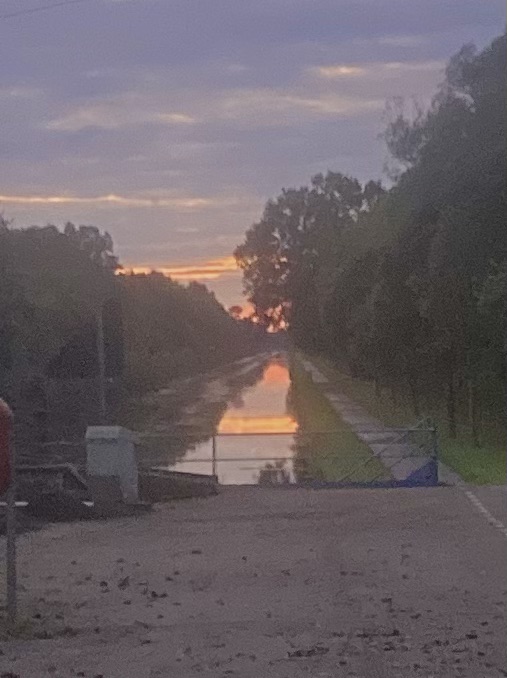
Pizzas were soon bought and brought back strapped onto my bike. Now to enjoy a last evening with Ashley with another lovely sunset in the background.

The next morning showed the canal at its Autumnal best. We took our time with breakfast and an early lunch, and by 1230 we were on our way.
Saint Dizier
On we went towards Saint Dizier, along a section of almost entirely straight canal. The first three ècluses (locks) were as expected and uneventful, and we knew to expect something different at the fourth, Perthes.
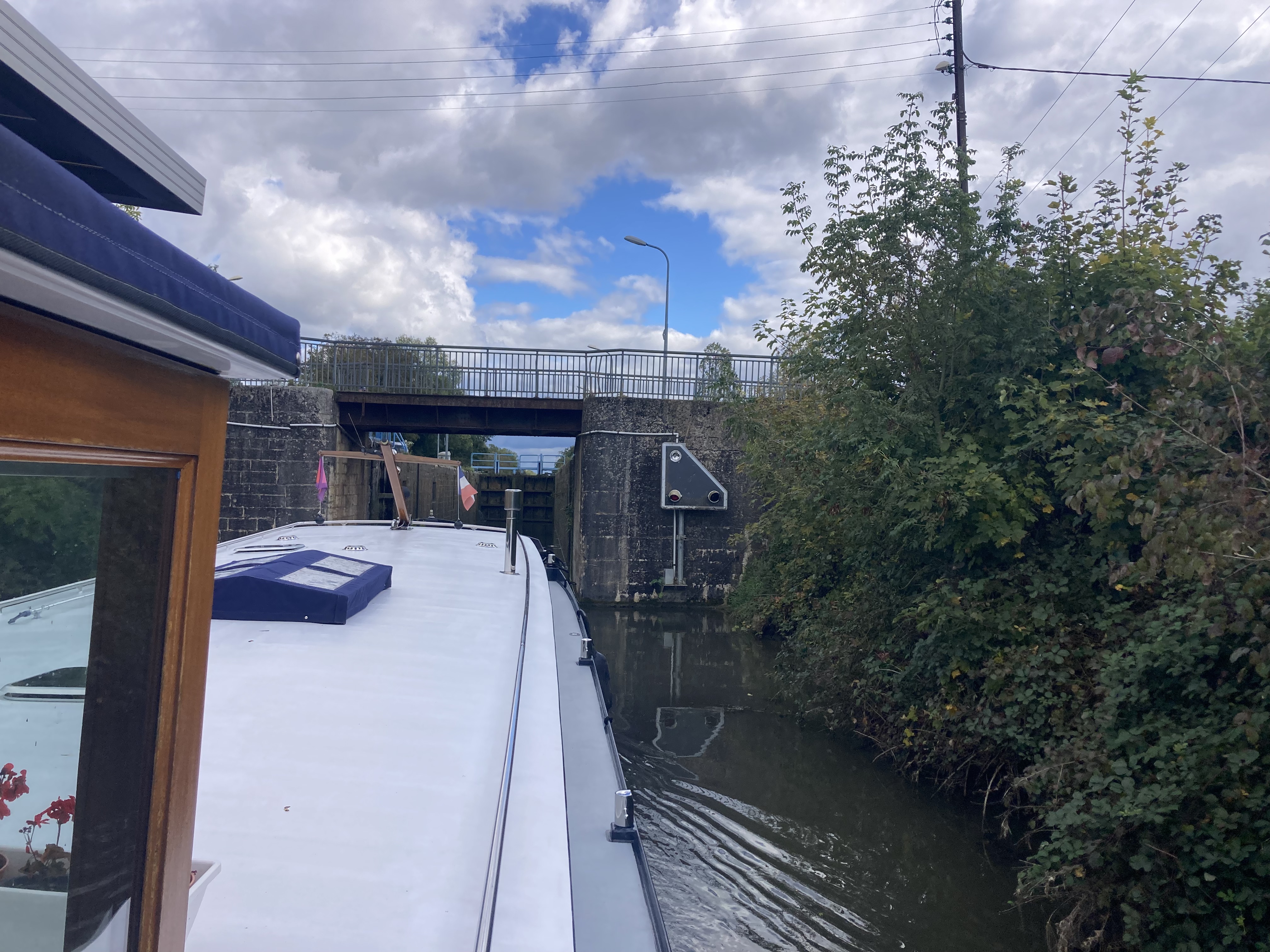

This lock has been a bit of a problem to the VNF (Voies Navigable de France – or French Waterways) for several years after some local ‘bad boys’ decided to take out the ‘traffic’ lights next to the lock. These let boaters know when they can enter the lock. We had been told to call the VNF as we got close to Perthes, and on cue a VNF service man turned up to operate the lock for us. A smooth passage was effected.
As we left the lock we were asked when we would leave Saint Dizier as we would also need to meet a VNF person at a lift bridge just beyond the town; we gave him the time we would be there the next day.
The next three locks took us up past a big airfield, home to the French Air Force fighter jets. As usual they were out practising their noisy take offs and landings – an awesome sight.

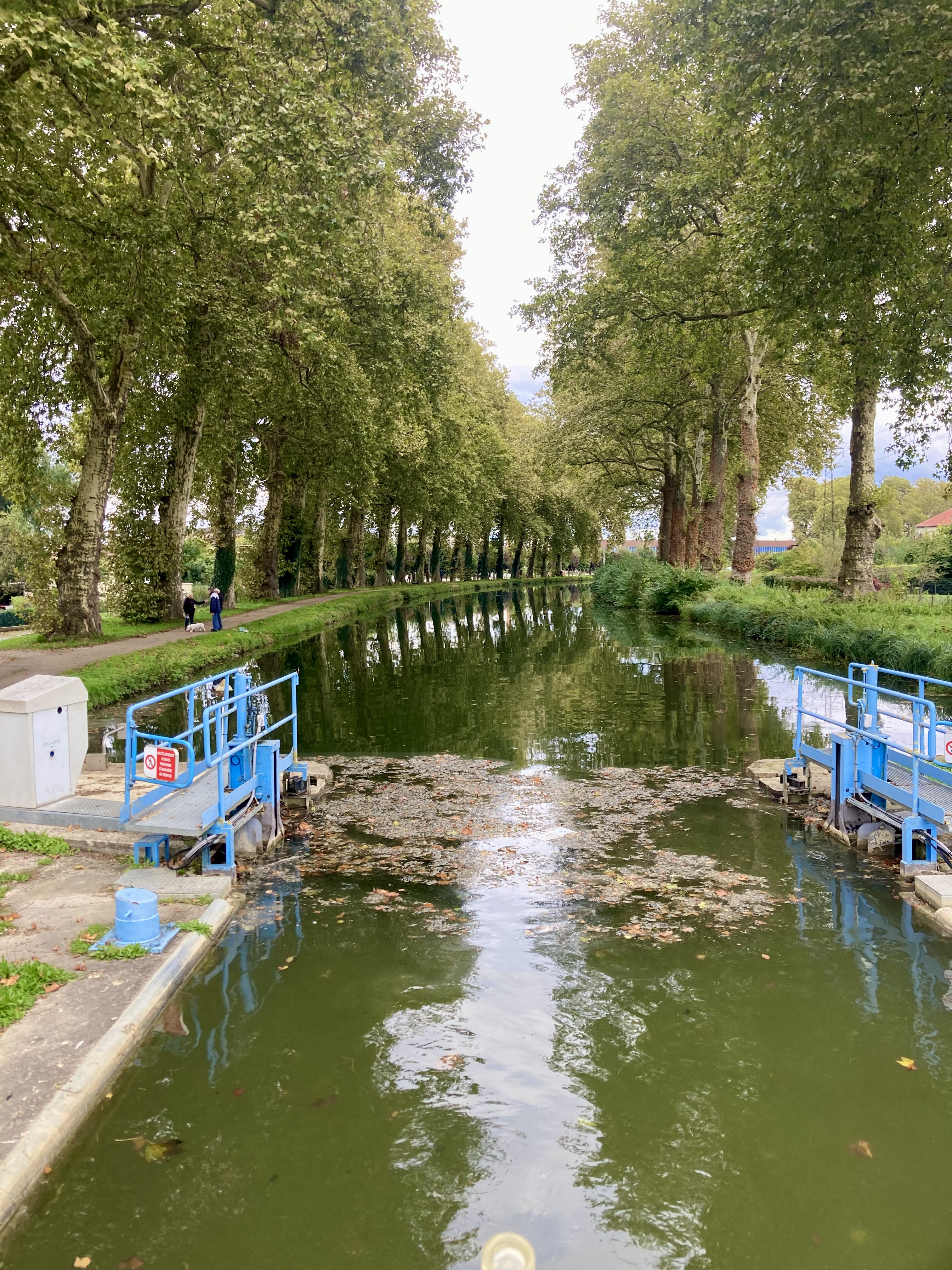
Then as we drew close to Saint Dizier the canal takes a sharp turn to port, under a bridge into lock 59, Noue. After the rather plain and industrial stretch leading up to here it was nice to see a tree lined avenue of a waterway ahead, still green despite the time of year.
The last 2 kms of the day took us between an interesting array of buildings on one side and the station, where Ashley would be heading, on the other. Then we went through the final lock and onto the St Dizier quay for mooring.
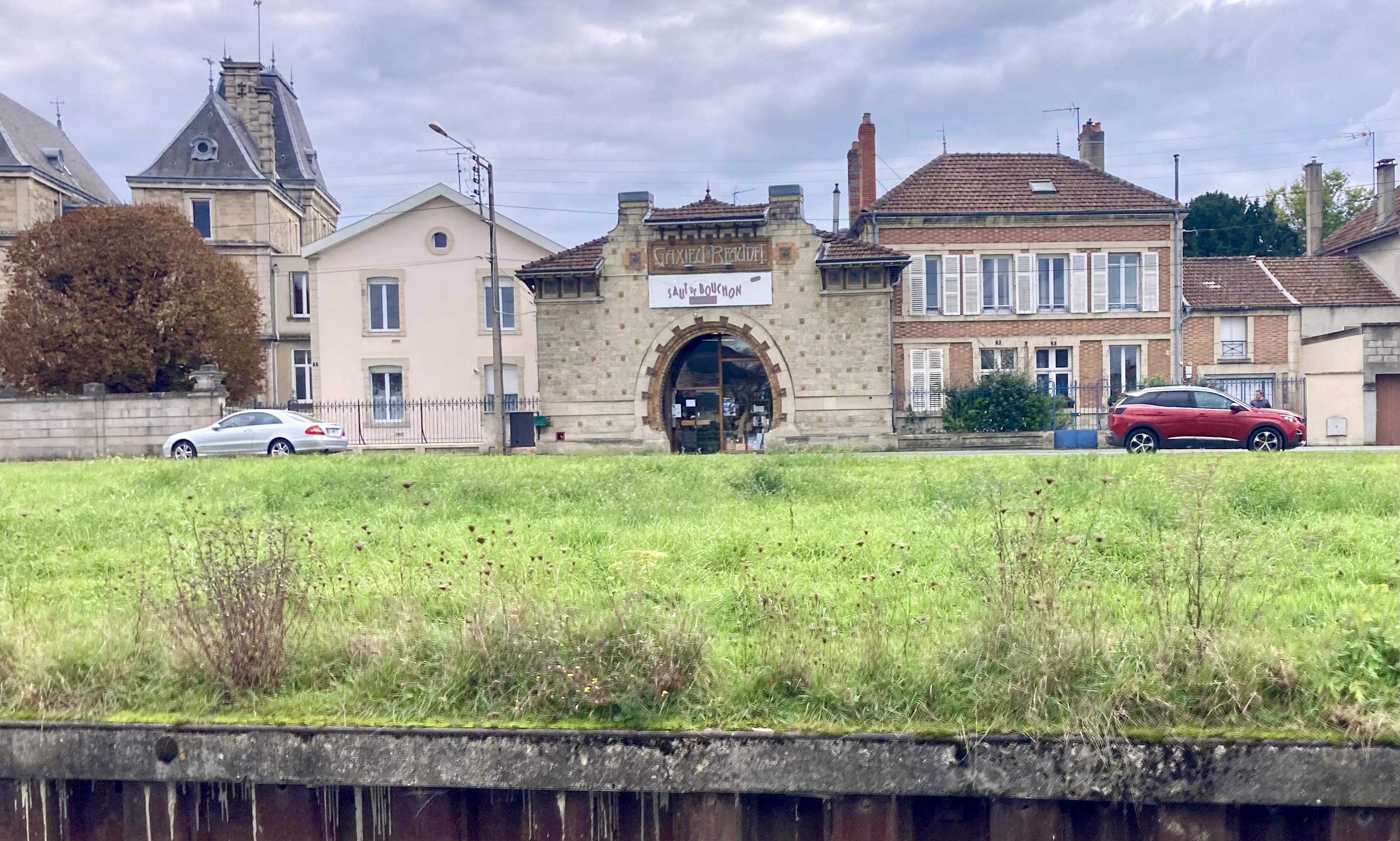
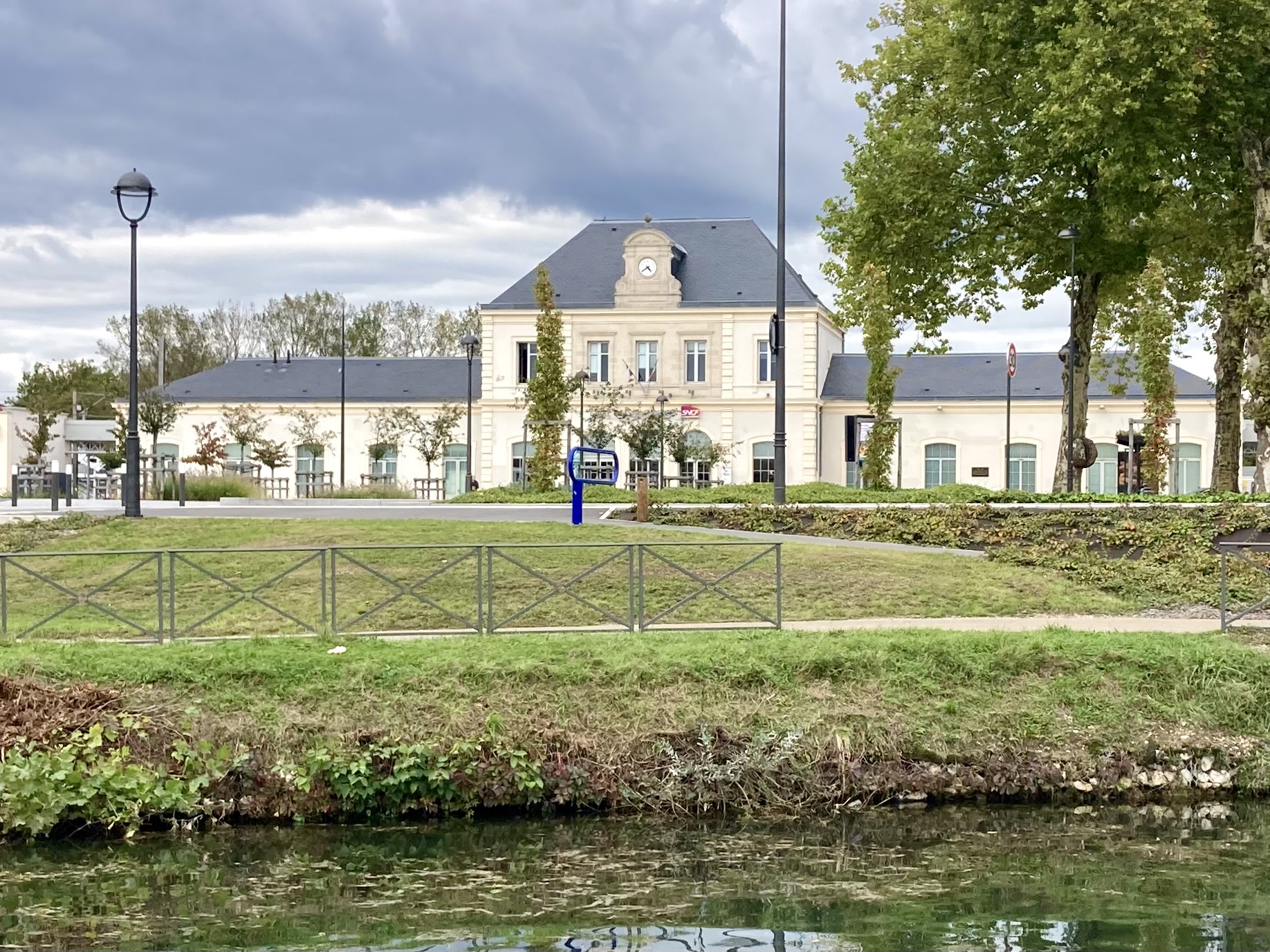

We have moored here a number of times, opposite the swimming pool and close to all the amenities of the town. There is electricity and water, should it be needed, available by asking for jetons at the swimming pool.

We said goodbye to Ashley and settled into passed a contented night there.
Nearby the famous Miko tower shone out, actually more blue than the mauve showing in the photo.
Miko is a famous ice cream brand in France. It started here in Saint Dizier supplying ice cream to the cinema.
Bayard
Just one night at Saint Divider this time as we still needed to make up for lost time over the last few weeks, so in the morning on we went up the canal.
We thought we had agreed with the VNF the time that we would arrive at the next ‘obstacle’ along our way the lift bridge at Marnaval ……. but when we arrived there was no sign of anyone to operate it.
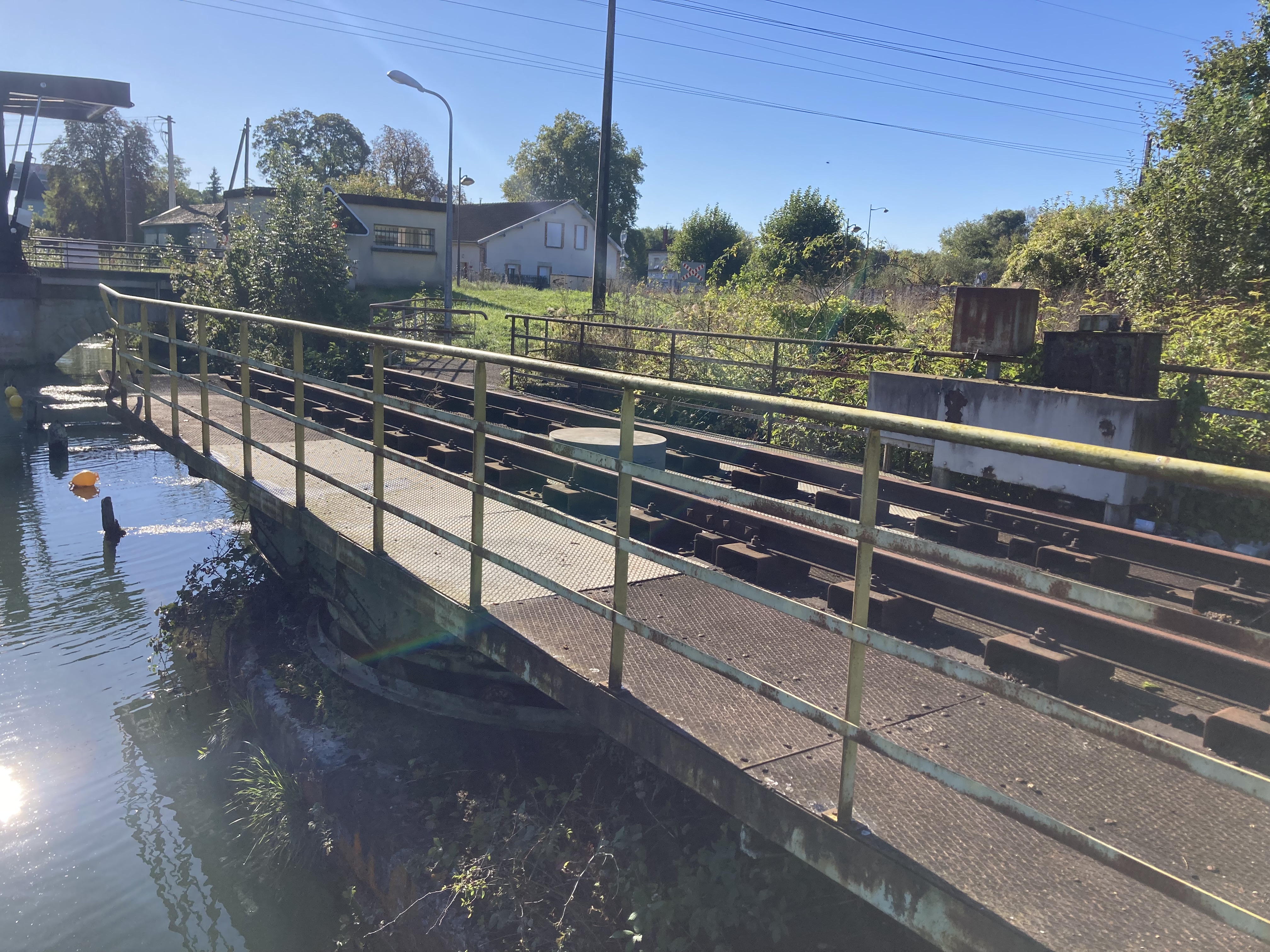
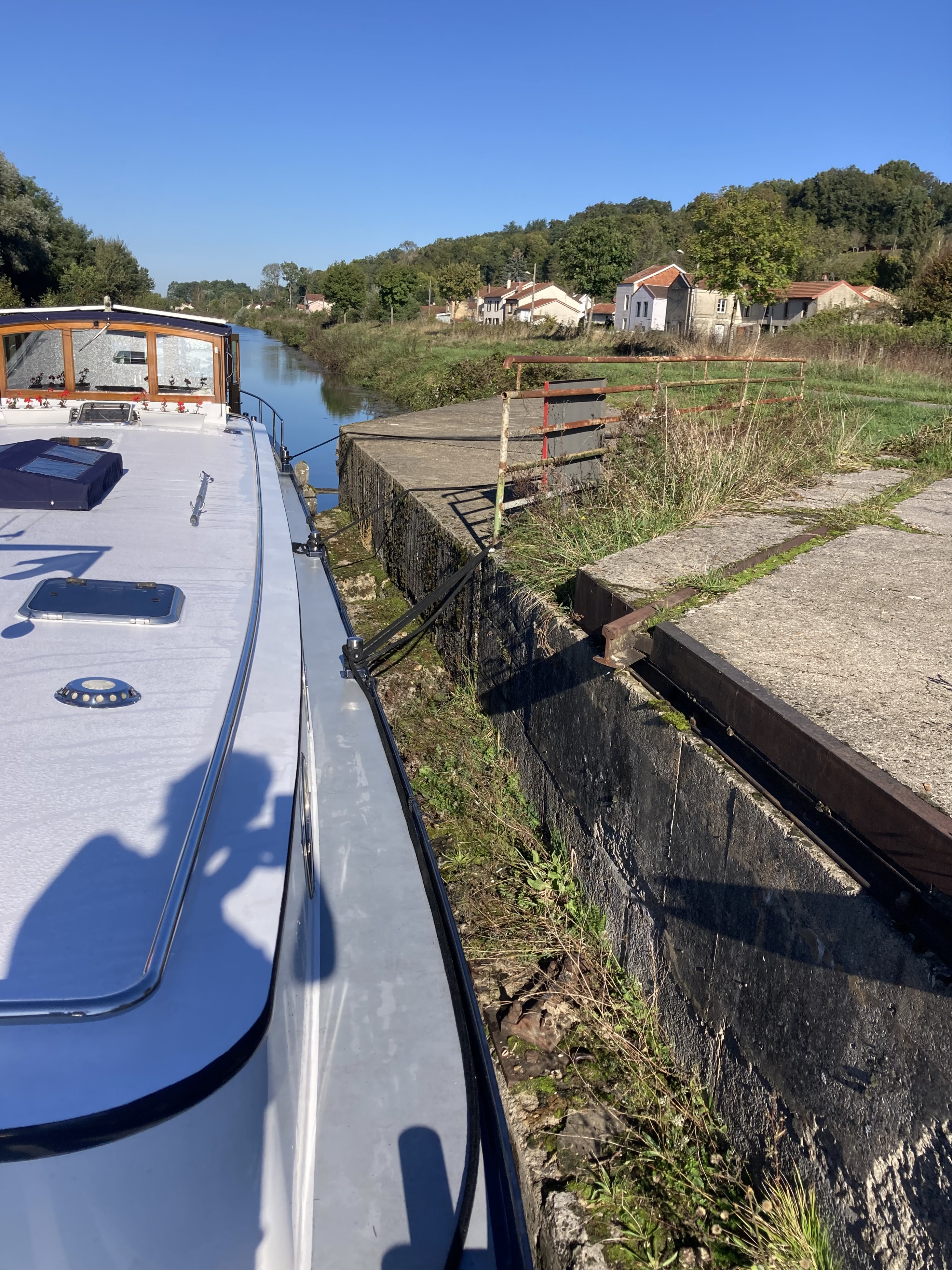
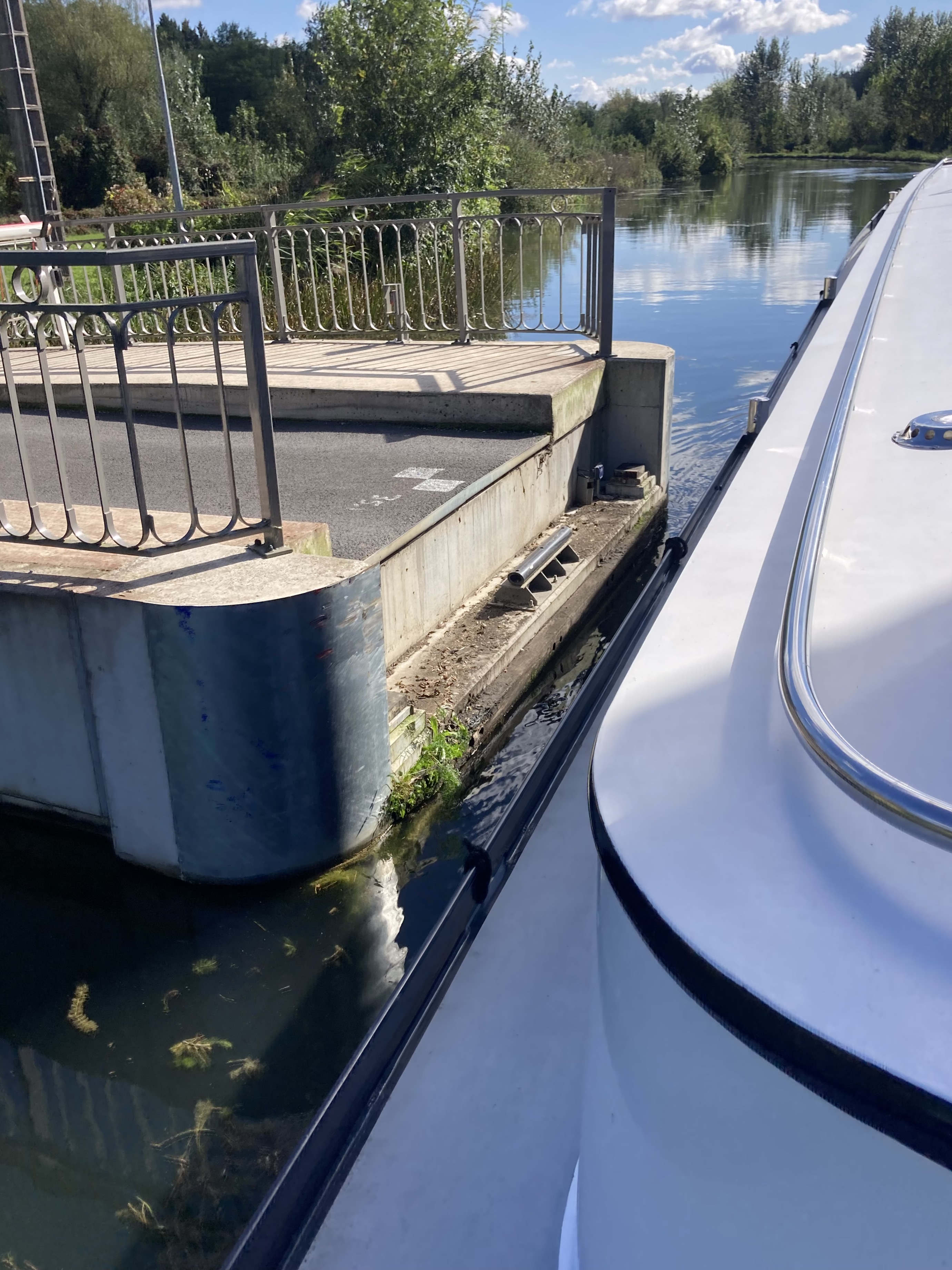
It is not easy to wait on the Saint Dizier side of this bridge because there are the remains of an old railway swing bridge immediately before (left photo). Using a mix of carefully placed fenders and ropes we did tie up, call the VNF and prepare to wait for a while. It was a Sunday morning and it was likely that the duty person would have a little way to travel.
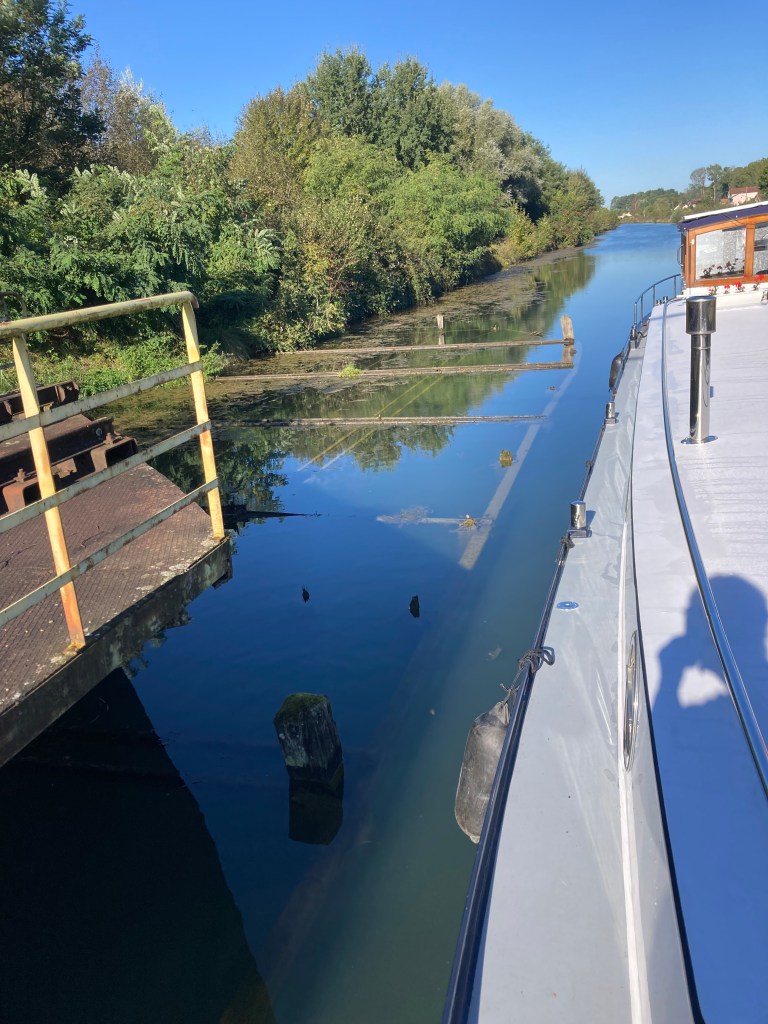
We waited less than half an hour in the sun shine, and then saw the welcome man and van arrive. He went into the bridge hut, stopped the traffic and lifted the bridge.
Then Calliope crept forwards gently. We are aware of the need to watch out below the water line at this point. Some of the railway bridge structure is under the surface; other less fortunate boats have received a bit of a scratch to the hull here.
But we were safely through and enjoying a lovely cruise onwards towards an interesting ‘wiggly bit’, controlled by traffic lights. The canal turns sharp left under s bridge and then fairly quickly sharp right into Gue lock. Below is a very-much speeded up video of the wiggle, steered through beautifully by Captain Stu. It’s about the fourth time through this section for Calliope, and far easier when you know what to expect, including an understanding that the green traffic signal means that you will not meet another boat heading towards you.
It was such a beautiful day’s cruise and so many scenic moments; I feel that I must share some of the images that took us along from Gué to Bayard, where we stopped for the night.1


By mid afternoon we had moored up at Bayard, one of our favourite little moorings, gently sandwiched in a 500m stretch between a lock and a lift bridge, and nearby is a small supermarket should we need it.
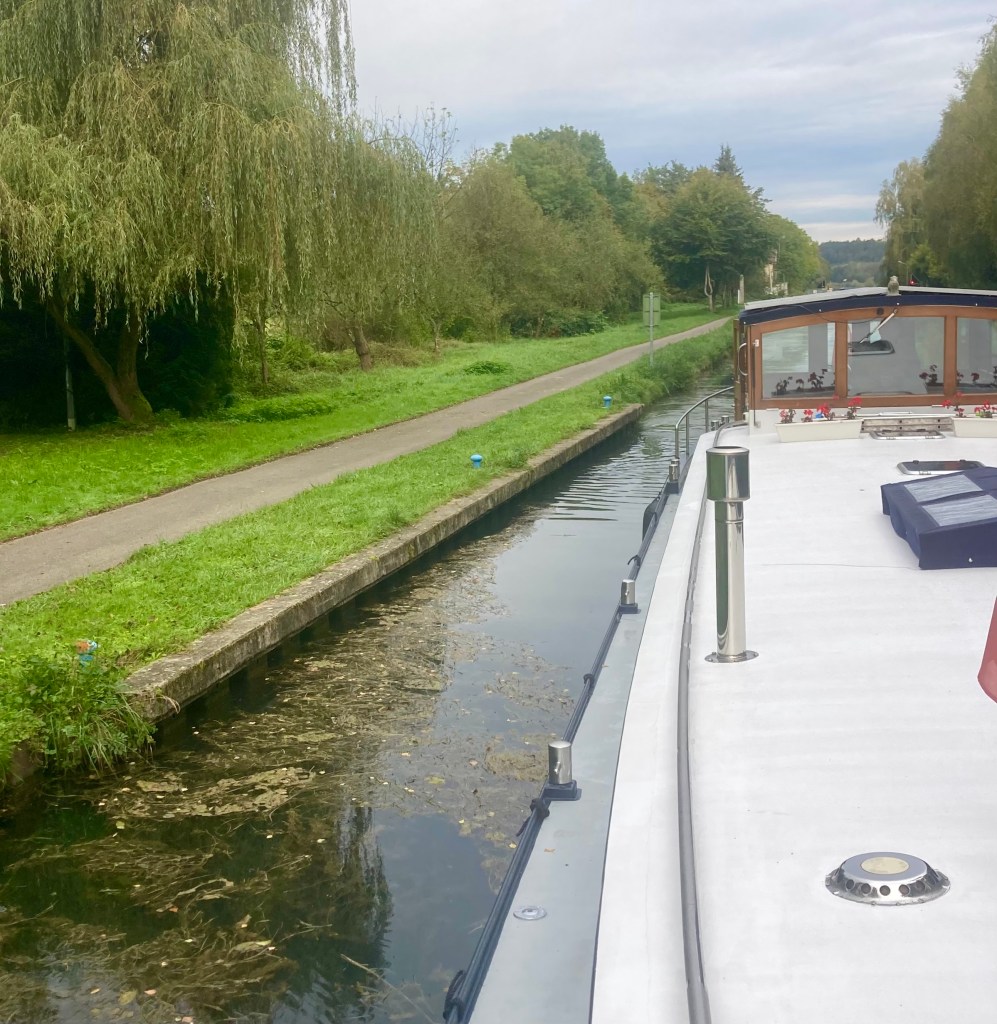
I didn’t take a photo of our peaceful evening there, but quickly captured the mooring as we left it next day.
Not as bright day a day as the day before. It was warm enough and not raining, so all in all no complaints.
Dolphin above Lock 50, Chevillon
We had good plans to reach Joinville that day, only 16 kms and 7 locks ahead, but as we all know the best laid of plans can easily be derailed. In many ways it is part of the enjoyment of the waterway, rising to the little challenges, and through that discovering new places and skills.

We made a good start, waiting initially for Bayard lift bridge to ‘prepare’, so that road traffic could stop and we could pass through.

Half an hour later we were passing Fontaines-sur-Marne, where the canal passes close to the river. At this point there is a lovely wide weir down to a branch of the river that runs past Bayard. The river map here is quite complex!
The sluice gear and the railings will let you know that Calliope was passing over a ‘pont canal’. This is a bridge takes the canal over the main part of the Marne.
Two kilometres further we received notice that a lock ahead was closed and that we must stop after lock 50, Chevillon …. where there was almost nothing to tie up to.


The map showed two ‘dolphins*’ about 25m apart. We are about 20m long, so it would take some kind of juggling act to secure bow and stern ropes. Stu drove close to the front dolphin and I got a rope on, plus myself ashore. Then Stu went astern gently until the bow rope was taut, threw me a stern rope and I looped it on the back dolphin before throwing back the loose end.
[* A dolphin, in this context, is a strange ‘Anglicisation’ of Duc D’Albe. There is a myth that they date back to the 16th century Duke D’Albe who apparently ‘invented’ wooden moorings in the water, rather than on the land. Other sources suggest they are from the Netherlands where groups of wooden stakes in the water were known as Dukdalf. They are a lot more sophisticated now.]
We were moored! Only one problem – I was ashore; Calliope was 2m off shore, and strung between the dolphins! The Captain soon managed this, paying rope out at the stern and driving up to the front dolphin where I hopped aboard.
It is lucky that we made ourselves secure as we ended up there all night, but feeling safe as no other boat would be able to come by and create a wash.
Joinville

In the morning I was glued to the radio waiting for news that we could continue.
Instead a VNF man arrived alongside in his van to let us know that all ahead was now ahead and we set off.
It was rainy as we left our dolphin mooring, but the clouds gradually cleared as we cruised on through the next lock, no longer a problem.
The map showed another 12kms to Joinville – too short a day really, given our desire to reach our winter mooring, but we like the Joinville mooring and the local Brico (DIY store) and supermarket. So Joinville remained our plan.
The next lock, Curel, has an attractive garden around the lock house. We are always pleased to see the lock houses, no longer occupied by éclusiers (lock keepers), being used by someone else.
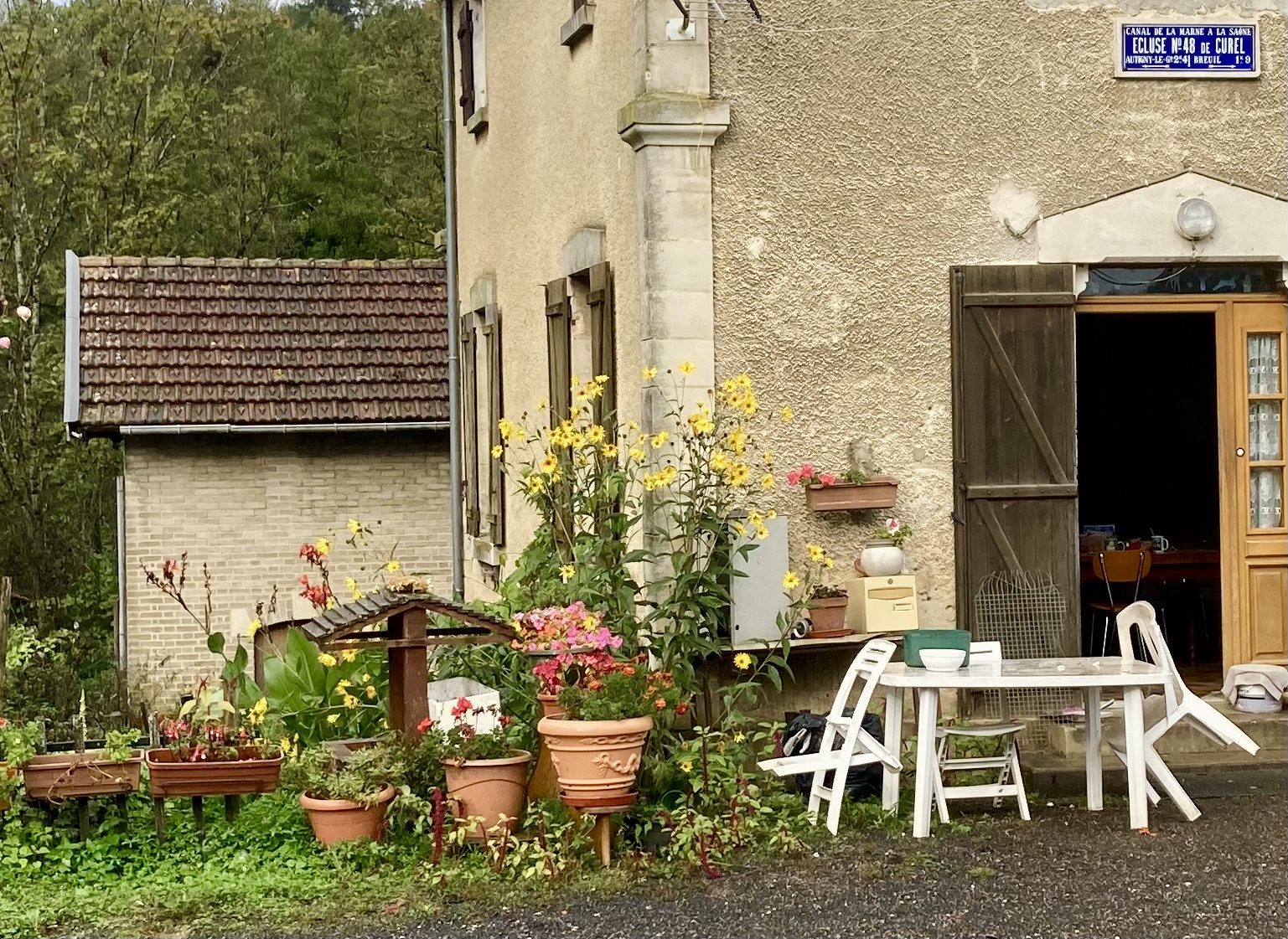

Who ever lives here is making the most of the space around them.
Straight after the lock is a lift bridge, lifting automatically as the lock gates opened. A third of the day’s short cruise behind us already.
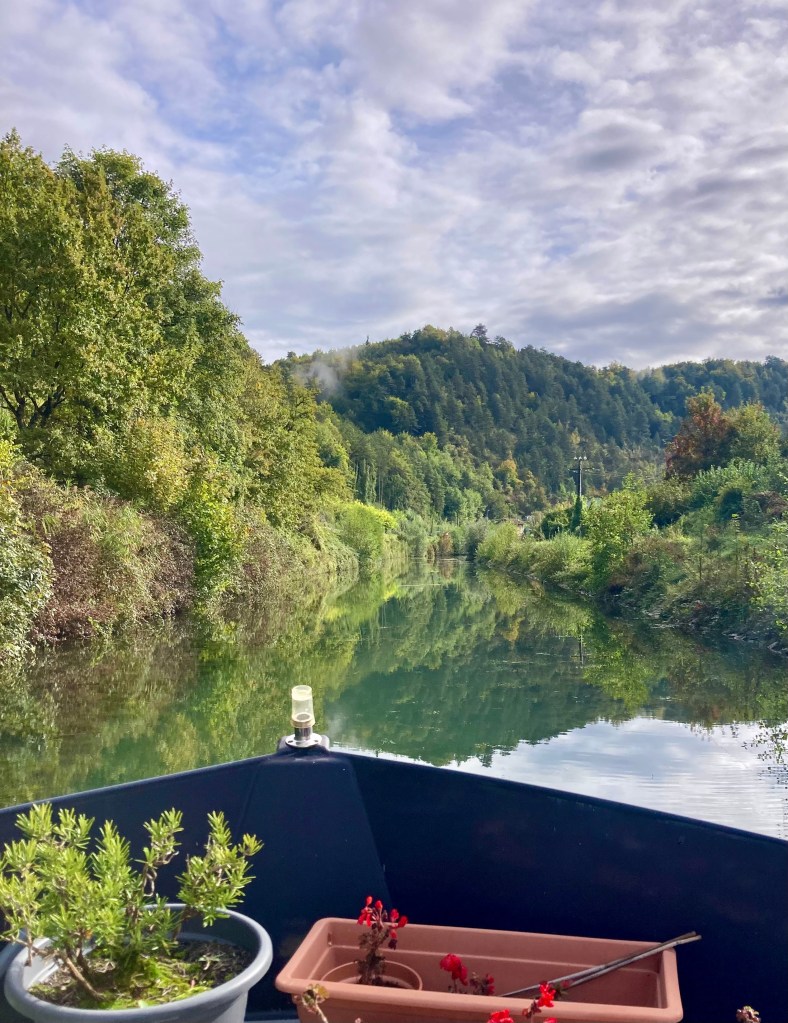
The topography approaching Joinville changed, with the river and canal winding round a tall wooded hill.
It is a beautiful scene at any time of year, but maybe Autumn is best as the trees start to change their colours and the still waters reflect back the October palette.
It was less calm 10 minutes later around the bend!
Just ahead was Bussy lock and things were busier there than other times we have passed by this quiet little hamlet. But it was all good stuff.
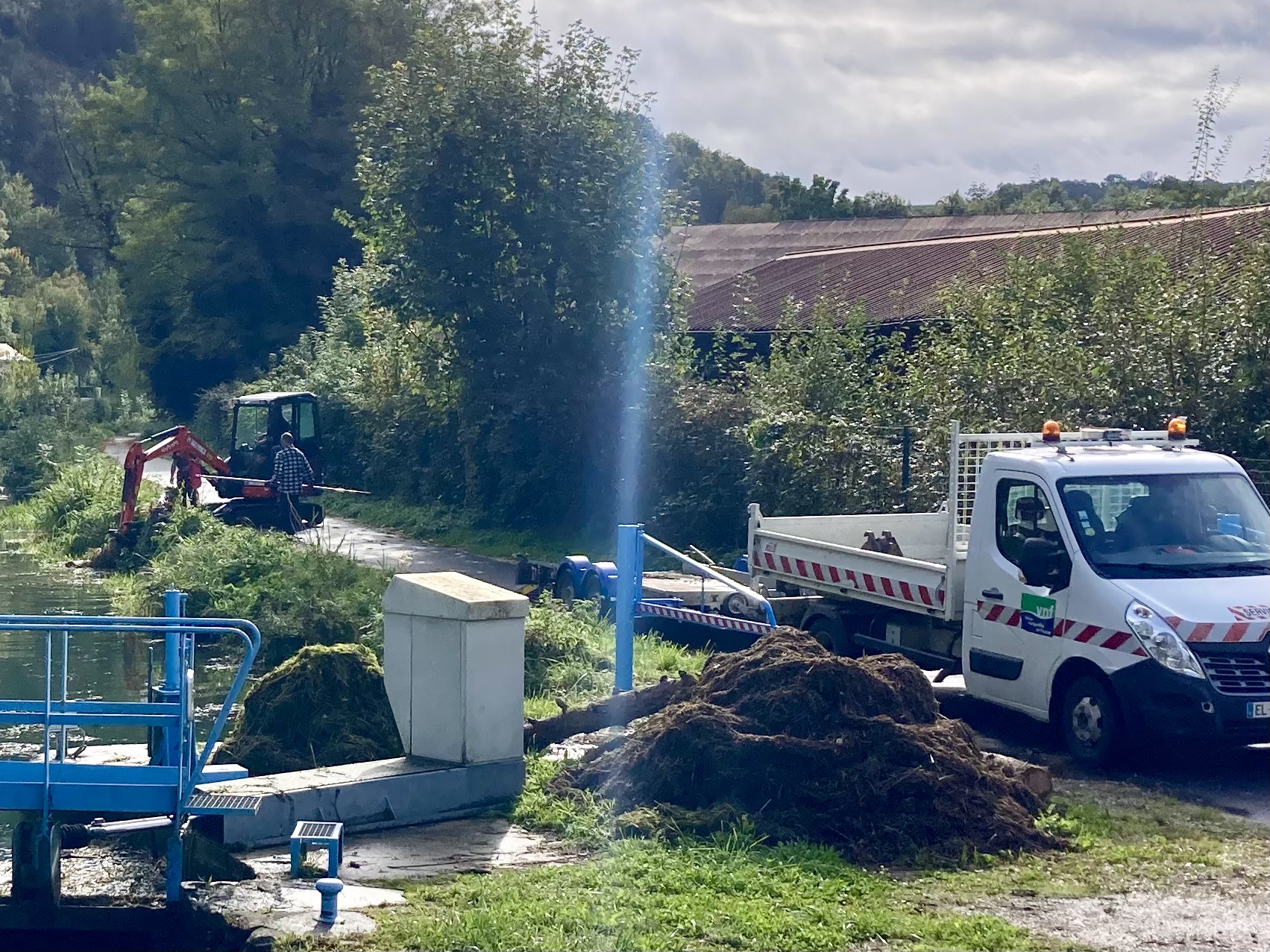
Forgive the quality of the photo. It is attempting to show a VNF team hard at work clearing the canal of weed and logs. There had been high winds a couple of days before resulting in quite a few trees falling into the water.
This team, with saws, rakes, diggers and pure muscle power, had been clearing the stretch up to Joinville. We were held up for a few minutes, but these are minutes we are always pleased to wait as they lead to clear waterways, making it easier and safer to cruise.
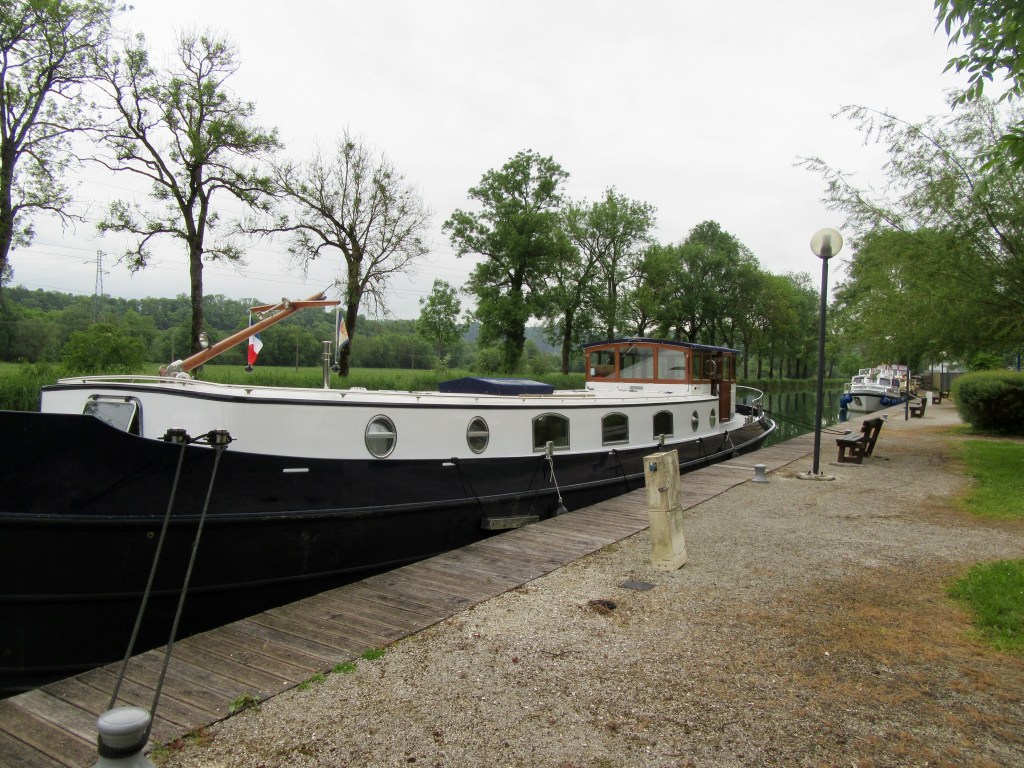
And then it was plain sailing into Joinville where we had the choice of the full quay.
Somehow I didn’t take any photos of the mooring on this occasion so I have borrowed one from a previous visit in 2016.
We did just stay the one night, using the afternoon to go shopping for essentials. Unfortunately the aforementioned brico was closed due to a flood a few weeks before, but luckily there was nothing on the list that couldn’t be waited for.
We did stock up on some fresh food, knowing that after Froncles there were few opportunities close to the canal to buy food.
Froncles
I love the name Froncles, and we love the mooring there, so although it meant another short 12km day we had decided to definitely stop there. It was going to be 9 upward locks on a windy day so we knew it would take a few hours anyway.
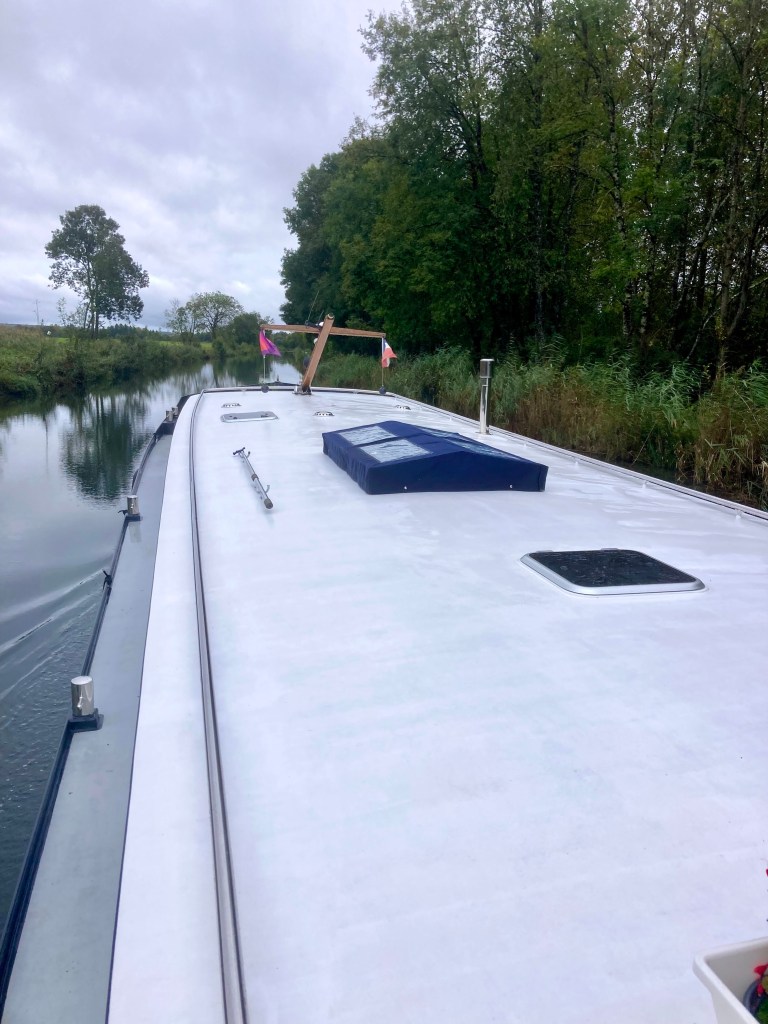
Overnight the wind had shifted a lot of those Autumn leaves from their branches to Calliope’s roof and decks.
I decided to use the time between locks to clear them all and expose Stewart’s lovely clean newly painted roof once more ……. knowing that it would not be long until the next load fell and I was clearing again!.
An hour later we were warned by some friends on a boat a couple of locks ahead that there was another little hold-up; a repair required on the canal.
This timed nicely with lunch time and with one of our favourite lunch stops, dating back to 2016 – our first trip on this canal.

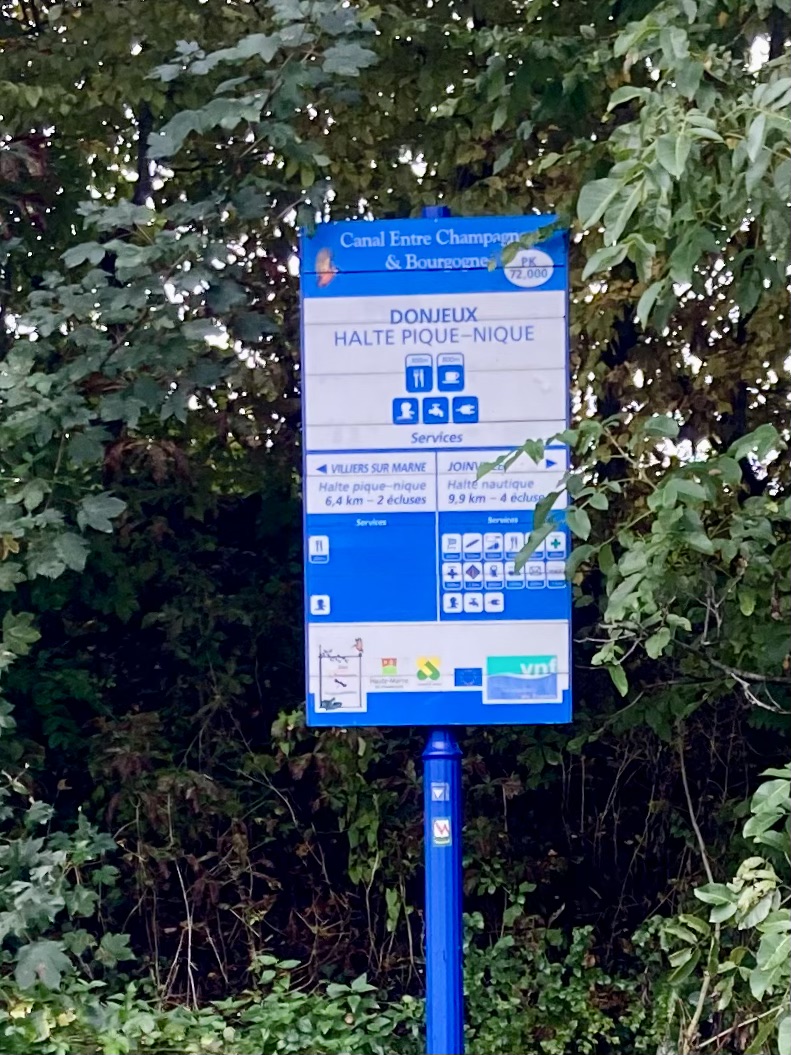
Here is the Halte Pique-Nique of Donjeux. We have sat at that picnic table at least twice before, and even stayed overnight at this little halte. But this time it was just for a couple of hours until the canal was open again.
We soon came across the evidence of our delay – a pile of logs neatly sawn up on the bank at a point where river and canal coincided again.
Obviously another tree had fallen into the waterway, and had now been removed by the VNF.
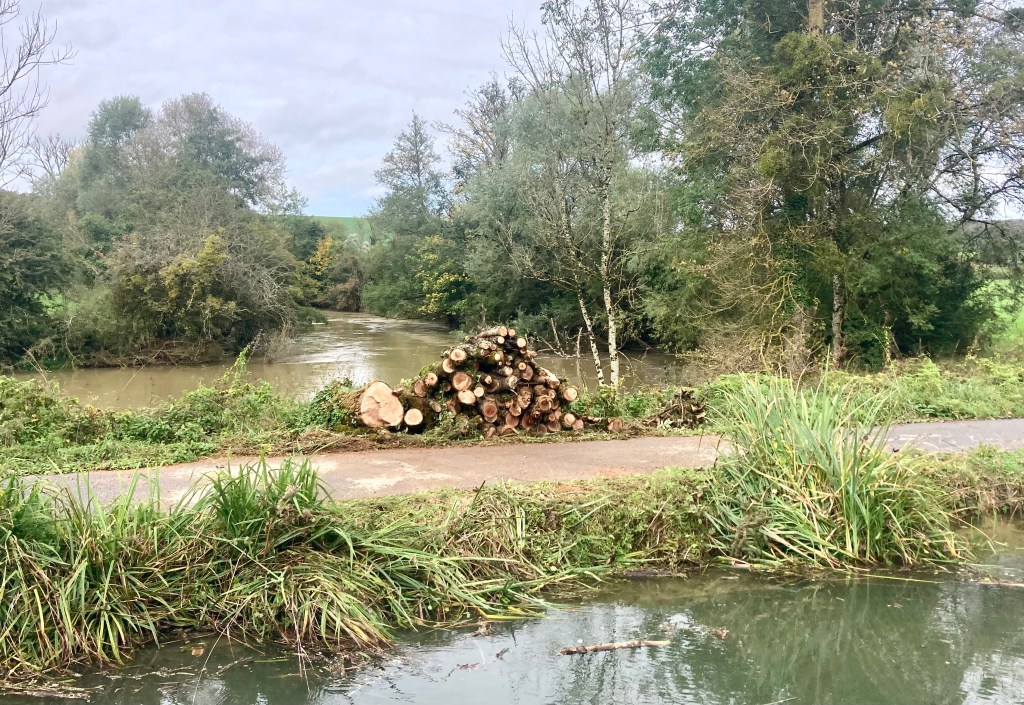


It felt good to reach Froncles – partly because we like it, and partly because it is half way up. It was also good to have a rest from the concentration needed to manage the sidewinds and currents across the front of each lock entrance.
We moored up on an almost empty quay – just a couple of deserted boats to share the scenery with us. I guess you can see why we like it here.

As soon as we settled into the calm of Froncles we found ourselves adding on more days to stay there!


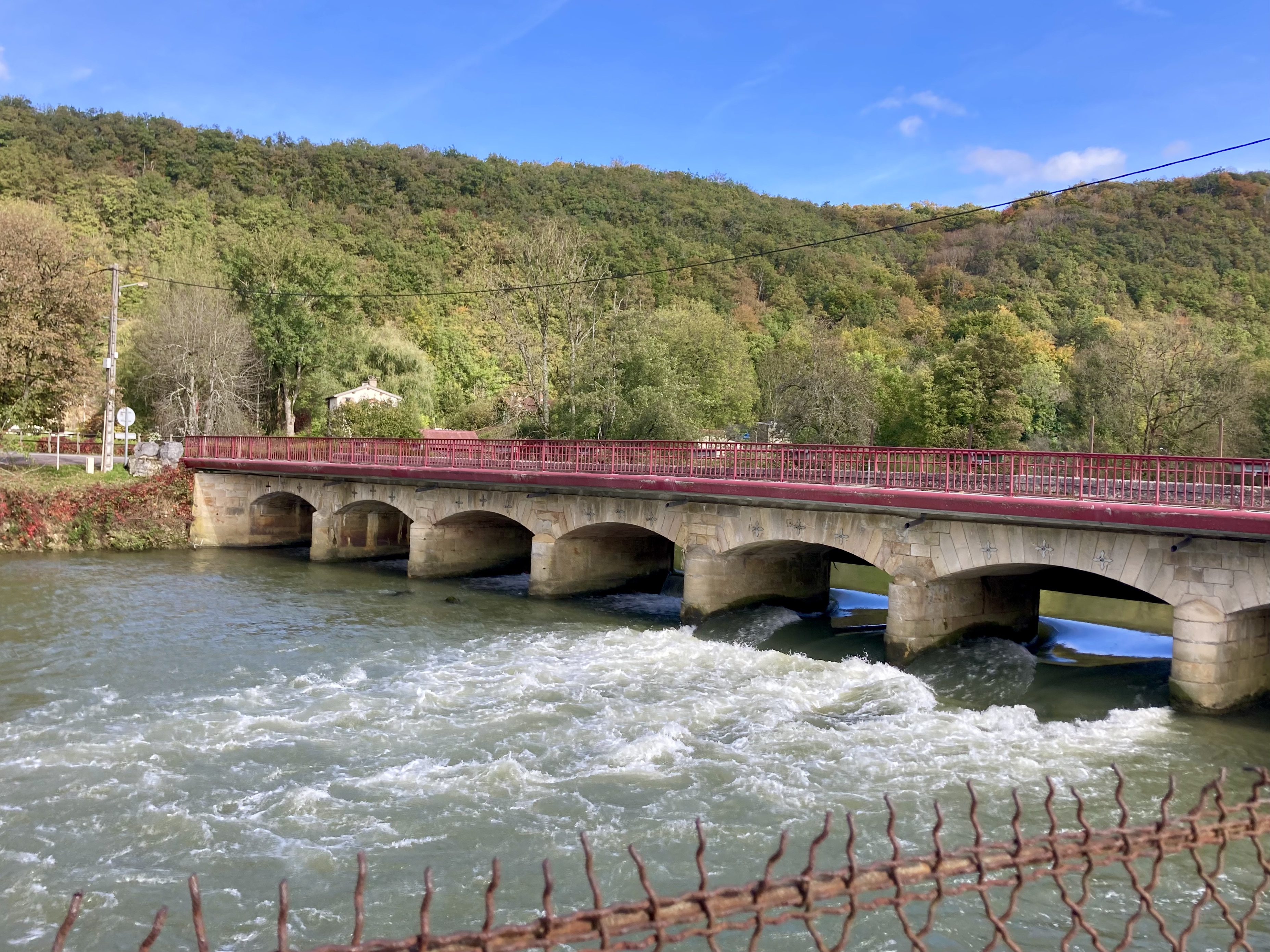
In fact we ended up spending a whole week in Froncles, getting to know its streets, lavoir and the river quite well. We also enjoyed daily walks to the excellent boulangerie, the useful little supermarket, and the station.
The latter gave us a means to travel to the nearby city of Chaumont. This is just 8 hours (26kms) away by canal, but 40 minutes by train. Suddenly we had all the shops we needed, including the bronco that was missing in Joinville, and a selection of restaurants for lunch – we chose galettes!
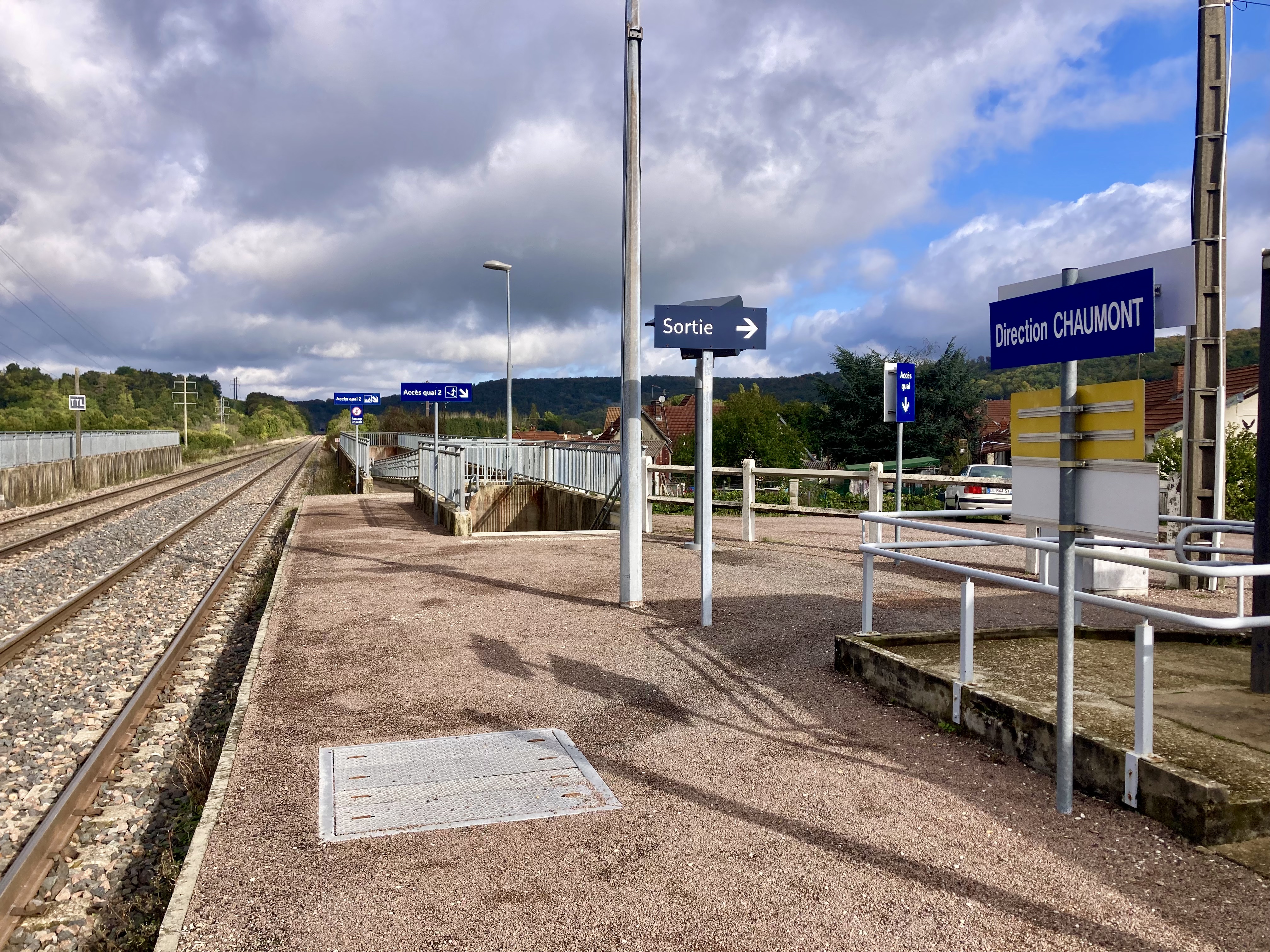

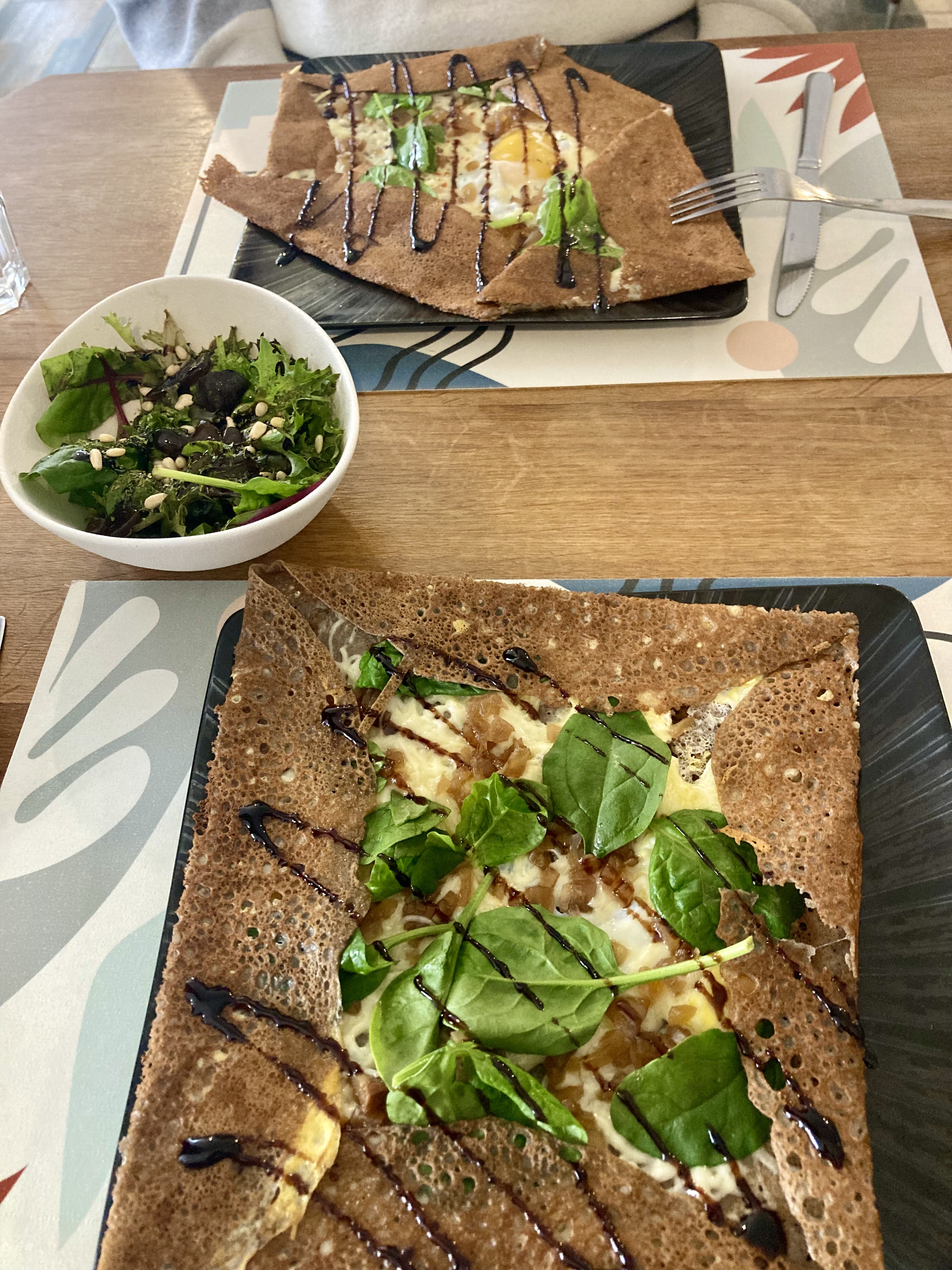

Chaumont, as its name suggests, is on a ‘mont’, or hill. This means you can look down on the rooftops as you go down the hill to the Brico and supermarket. I cheated on the way back and caught the bus up!

Despite enjoying our little break in Froncles in the Autumn sunshine we really did need to get going.
So one Wednesday morning we decided to cast off and put 12 kilometres behind us that day. We could start to feel in traveling mode again.
It was hard to leave this lovely view but we knew we had other good views in store.
[As an aside I read that ice breaker boats were required in Froncles 3 months later, so just as well we left!]
Bologne
Bologne is one of those moorings that most people pass by. It is a very simple quay in a quiet location, yet only 10-15 minutes away by bike from a good supermarket. This becomes important on this canal as many moorings are pleasantly rural, with no shops!

With Froncles in our wake we were off through Voécourt and on towards Viéville, where we had another short hiatus in our journey, though only about 15 minutes this time.
The lift bridge at Viéville did not respond to our remote control, nor to the sensor on the canal-side that we had passed.
A phone call to the VNF soon had someone there and the bridge was lifted for us.

In another hour we were moored at Bologne enjoying lunch. Calliope had behaved perfectly through the day’s 6 locks; Captain and crew were feeling relaxed and refreshed.
We had decided not to stop at Chaumont again and so we probably had 5 days of moorings ahead without a chance to re-provision. My bike was taken out of the ‘bike shed’, or front deck locker, and I cycled off to buy what was needed.

Cycling back I stopped on the bridge over the canal to capture the lovely loneliness of the mooring.
I hope you can spot Calliope moored on a quay on the left of the canal.
Foulain
Next day we pushed on for 26kms – back to the longer days we had initially planned for our trip to winter mooring.
[I realise that for many boaters 26km sounds like an average or even a short day. It is totally possible to put in longer days. It is just that Stu and I, retired and normally with all the time in the world, choose to potter along enjoying the views, then moor up early with time to explore our surroundings.]
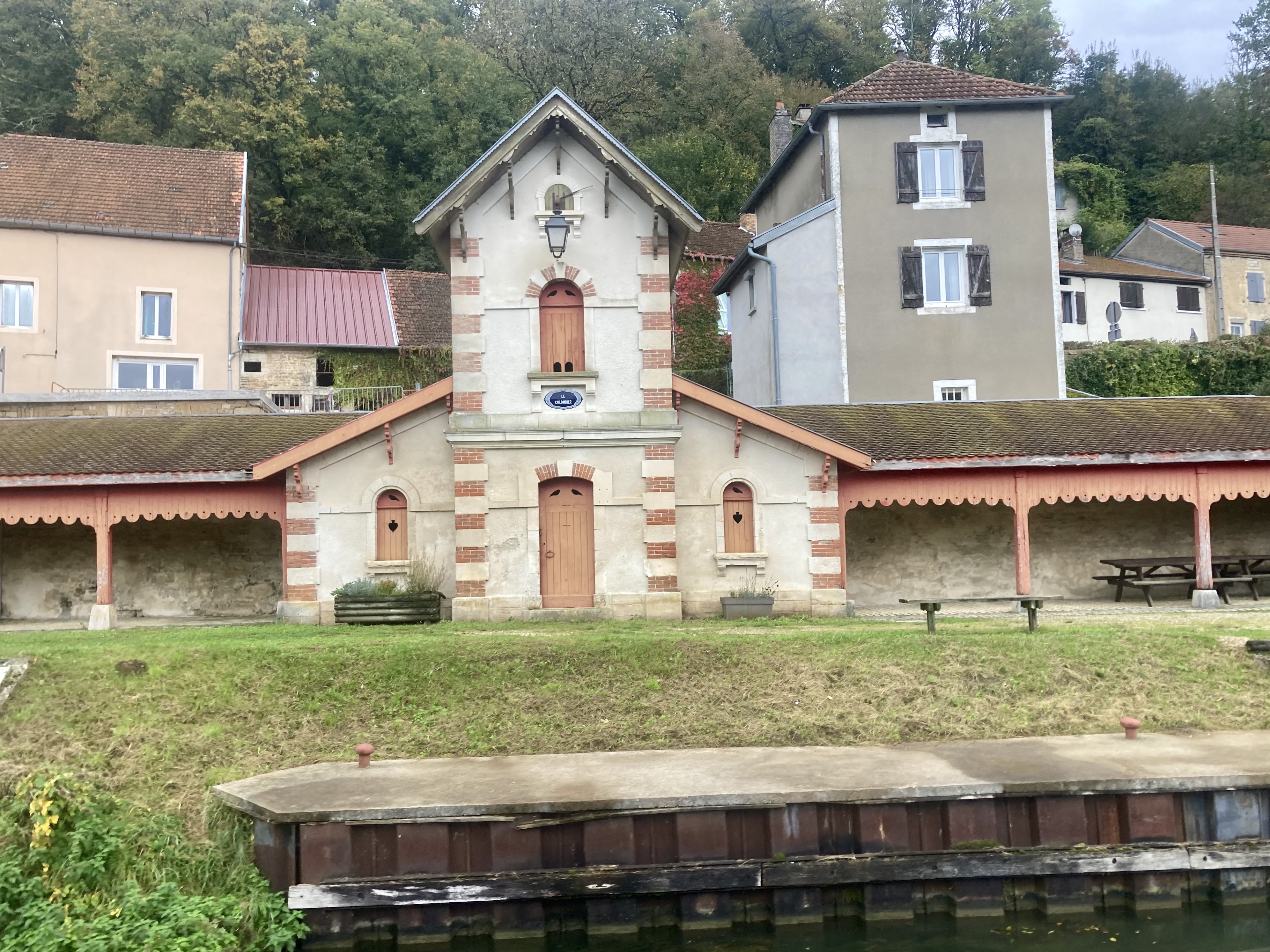
There is plenty to look at enjoy along this canal; this stretch is no exception. Just a short distance from our Bologna mooring is Riacourt écluse (lock) and village. We were not stopping today, but admired once more the unusual building by the quay.

After going up through the lock there was time for a cup of cruising tea and a quick scan of the map to see what was coming next.
The wheelhouse ‘work surface’ is a telling view of everything we are ready for! I can see sun hats, warm hat, map, remote control for lock operation, fly swat, binoculars, bird identification book, log book – and tea!
I guess we are not the tidiest of crews!
Four kilometres on is the little hamlet, lock, mill and farm of Brethenay.
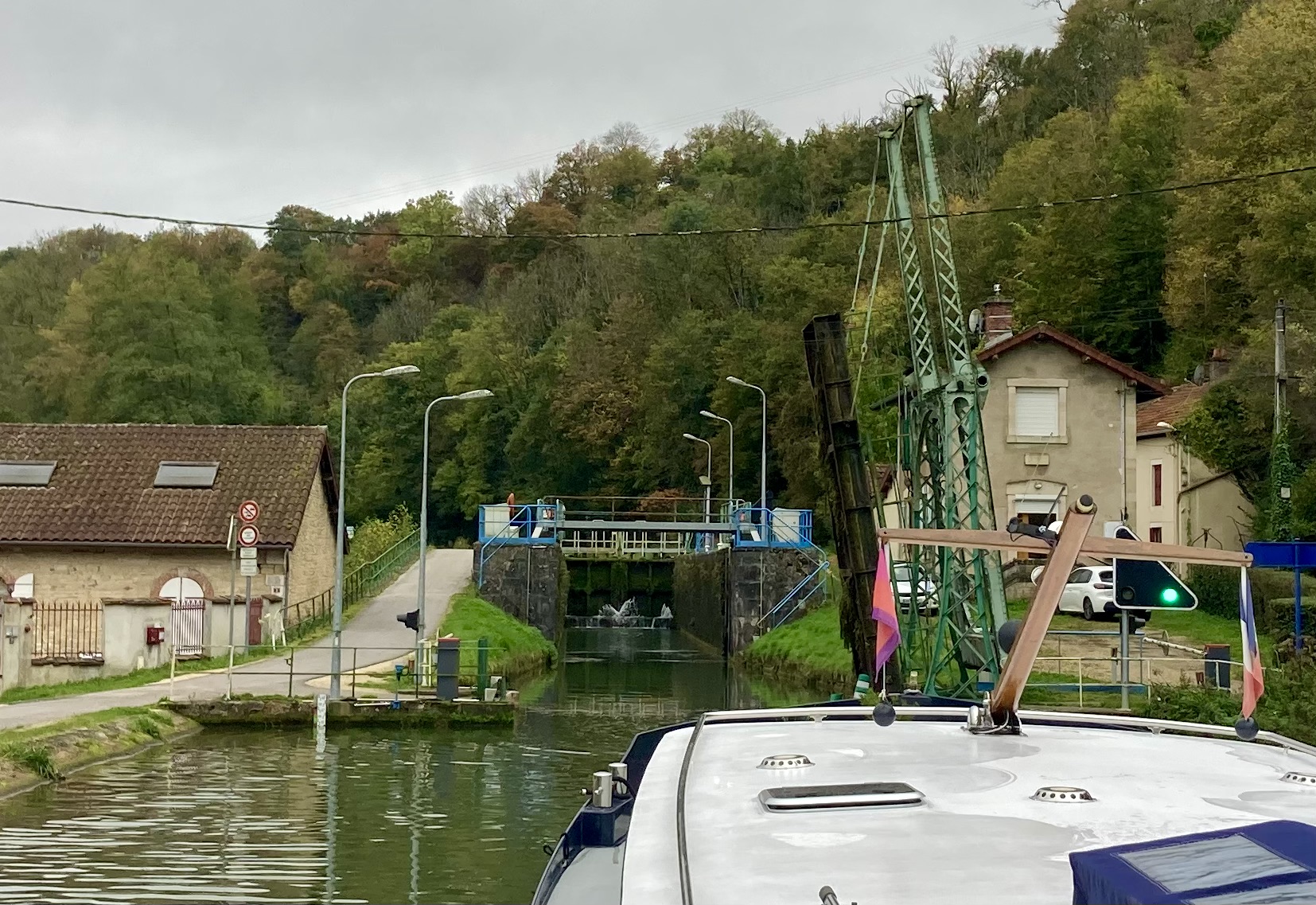

On a clear sunny day the whole scene here is beautiful – the green lift bridge, blue lock bridge, the old stone buildings and the curve of the Marne through the mill farm, all combine as a reminder of tranquil rural days from the past.
But today it was grey and drizzly.
Just around the bend is one of my favourite canal combinations, at Condes, whatever the weather.
We arrived to find a green light at the lock – a good sign,

Once at the top of the lock, as the gates open, you see ahead the entrance to the little Condes tunnel. This takes you through a small hill while the river slowly circles round the edge.


The tunnel is well lit, a decent width, and only about 200m long.
Then we emerged into the Autumn colourscape to find a pont canal once more taking us over the river, which has reappeared from its circular journey. And at the end of the pont canal is a lift bridge, permanently open these days. On our first trip through here in 2016 the bridge was still operational, but would not respond to the remote control. We had to float gently on the pont canal, looking down at La Marne, until help arrived.

Twenty minutes later we passed by the old silos that signalled our approach to Chaumont, this time by water.
We had decided not to overnight in the little Chaumont marina, and to carry on to Foulain.
That meant 14 kms still to go, but it was only 11am so plenty of time. It started with the narrow section taking the canal round the base of the Chaumont hill.


To port are wooded slopes, trees just turning to their most glowing colours. To starboard, as the canal widens again, are the fields lining the flood meadows of the Marne, and a tree lined canal path running alongside.
Across the meadows, way up high on the hill, Chaumont can be seen. The photo top left shows two of the big modern buildings; other aspects are better for views of the old buildings and fortifications.

In the narrowest section ladders are placed into the water every 100 yards or so to allow unfortunate wet sailors to climb out.
This has not been my mis-fortune yet …..
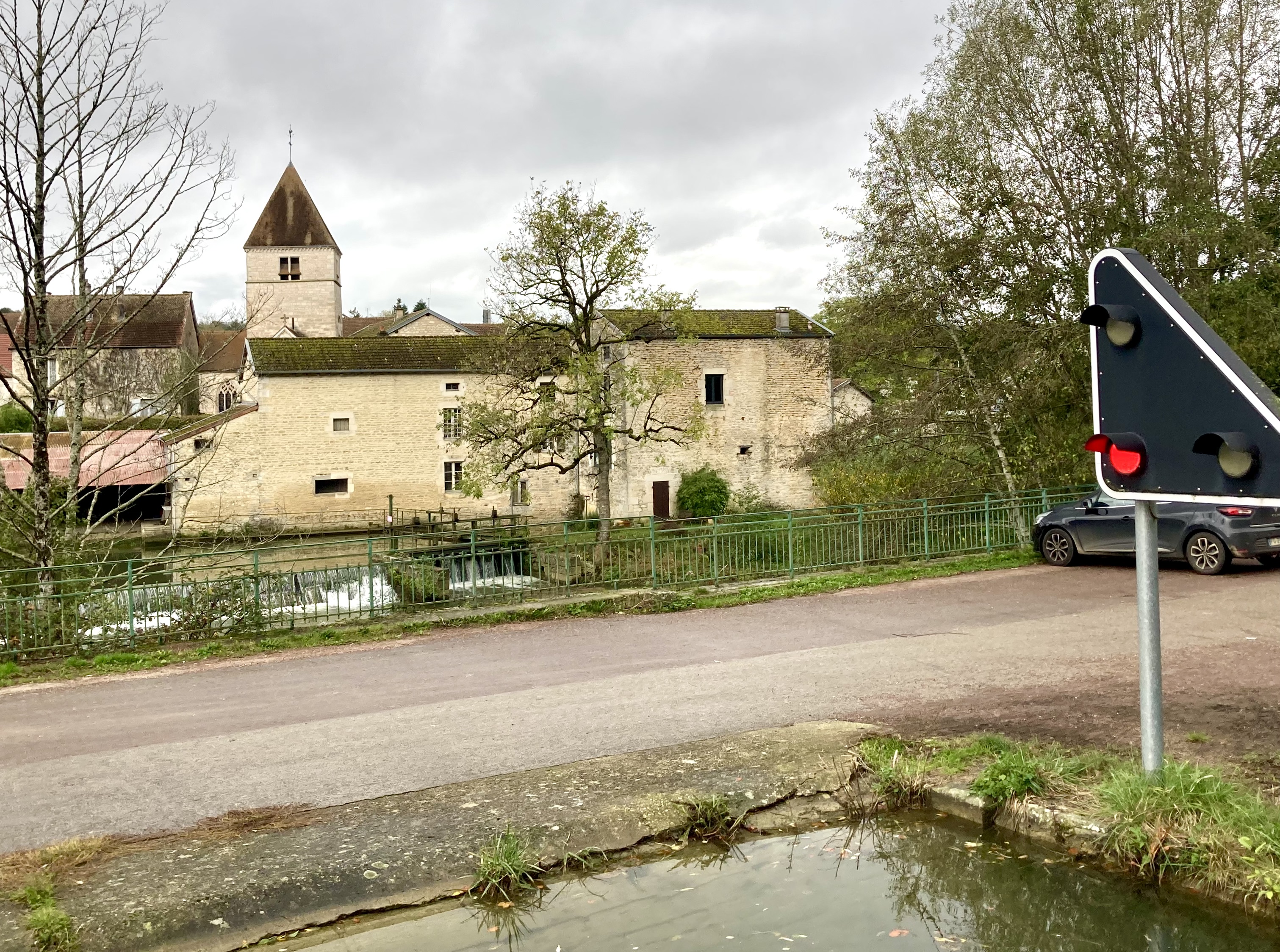
Leaving the narrow channel through the lock at Chamarande-Choignes there is a great view down to the right. An old mill sits astride part of the river, with a long weir next to it. Water is the great feature here, to see and to hear. It is well used by water-sporters, especially in kayaks.
I have often looked for the history of this mill but so far found nothing online.
A few more kilometre and a few more locks; we were nearing Foulain, but first La Marne, now on our port side, must come back to starboard.
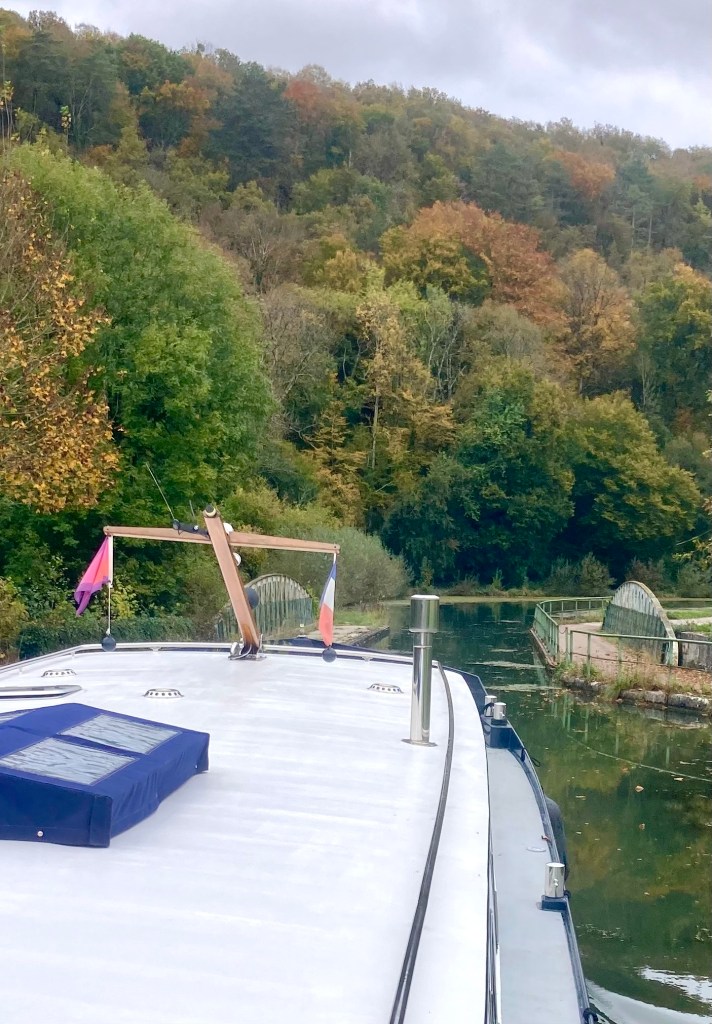
We arrived at the little ‘pont canal’, or aqueduct, taking the canal over the river, under gradually greying skies, but still bright trees.
It looks so narrow, but is the same width as all the locks so fine for Calliope.
I always enjoy looking down on a river from the canal above. There is something special about a water crossroad.

Finally we followed the long curve of the canal, between the hill and the river, for a kikometre, arriving to find the two little Foulain quays empty.

Mooring here is always interesting, requiring a little agility on the part of Captain and crew. Each quay is about 12m long; Calliope is almost 20m. The two shoreside bollards are small and set back in the grass. But a bit of jumping ashore with ropes and coordination between us makes it is a relatively easy moor.
Good; we can settle down for the evening in this quiet little park and watch the birds.

We knew a supermoon was due around this time and had been glancing sideways through the wheelhouse door waiting for the moment it would rise. The clouds parted and – wow!

What a wonderful way to end the day.
Langres
This was our last full day going up. We were off to Langres, 24kms away. It would leave us with just 6 kms and a final two ascending locks the next day before we went through the tunnel that crosses the summit; more of that later.
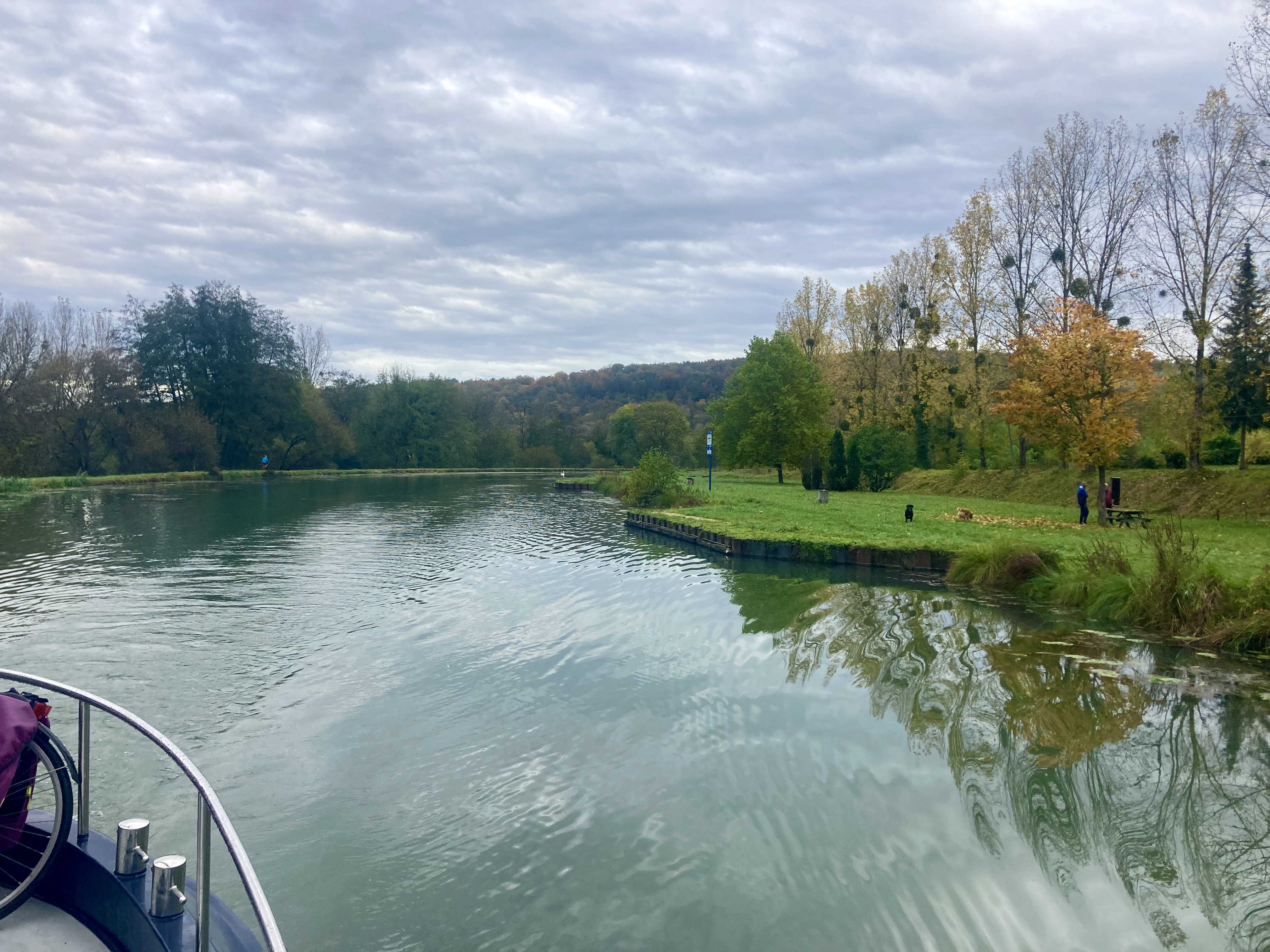
The weather was still rather overcast as we left our overnight stopping place behind and headed for the first of the 14 locks of the day. It is always a bit more of an effort going up a canal than down. This was the ‘final push’ of the season; all down hill from here!
It’s obvious really, but the point about going up the locks is that Calliope comes into an empty lock and depending on the depth it can be easy or a bit of an effort to secure her to bollards on the lock quay. Every boater works out a method that works best for their boat and their crew. 😁
The really deep locks have built in structures to help; floating bollards that more with you, poles your ropes can slide up on, or bollards at different heights that you can move to gradually as the lock fills. There is an example of the latter later on today’s journey.

Entering the second lock at Pré-Roche was interesting, going under a railway bridge first, and through a narrow channel into the lock, beautifully accomplished by Captain Stu. And the next lock, at Pommeraye, was also going even more interesting.
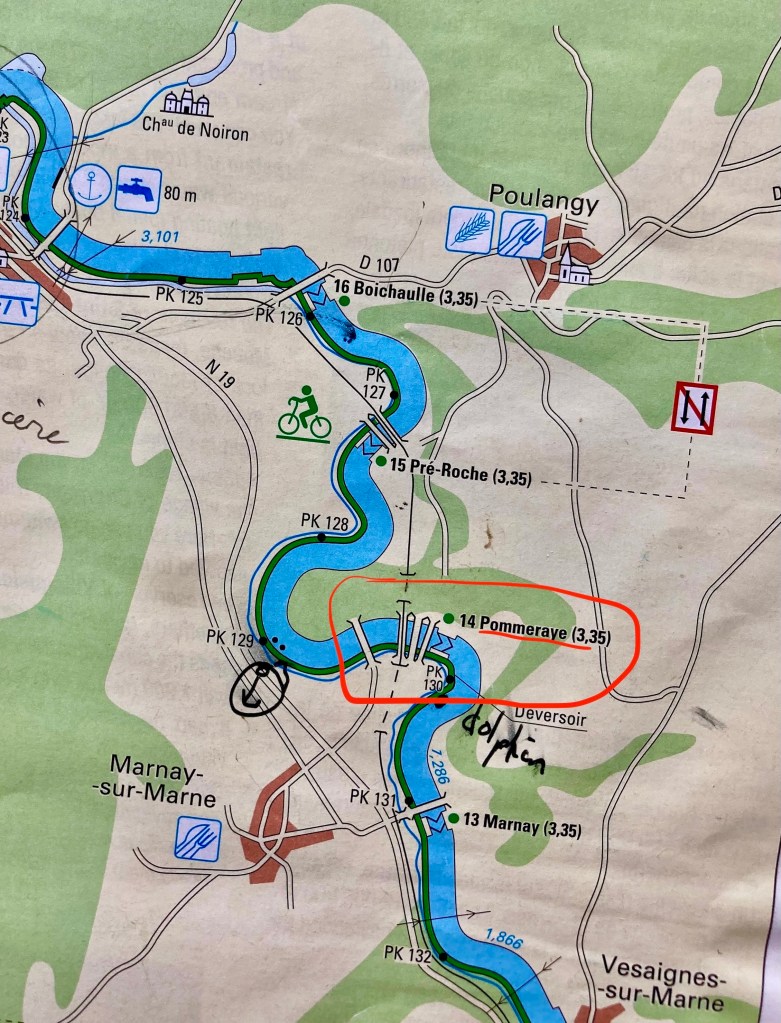
The map shows the meandering nature of the canal, following the contours of the land, with 4 adjacent bridges leading round a bend into Pomeraye lock (circled).

It is these twists and turns that keep the journeys constantly fascinating, but not always easy for the Captain!
Looking closely you will see that all the locks here are the same depth – 3.35m. The precision of those engineers way back in the late 19th century is something to be admired.


On we went – Marney lock, Vesaignes lock, Thivet lock – the latter with an old deserted lock house and a partly new concrete quay.

Thivet is a good example of the renovation work happening on this canal. Sections of the lock wall and top needed renewal, whilst next to Stewart the original stone built lock still stands firm.
Some locks remain totally original, and others are transformed with modern materials.
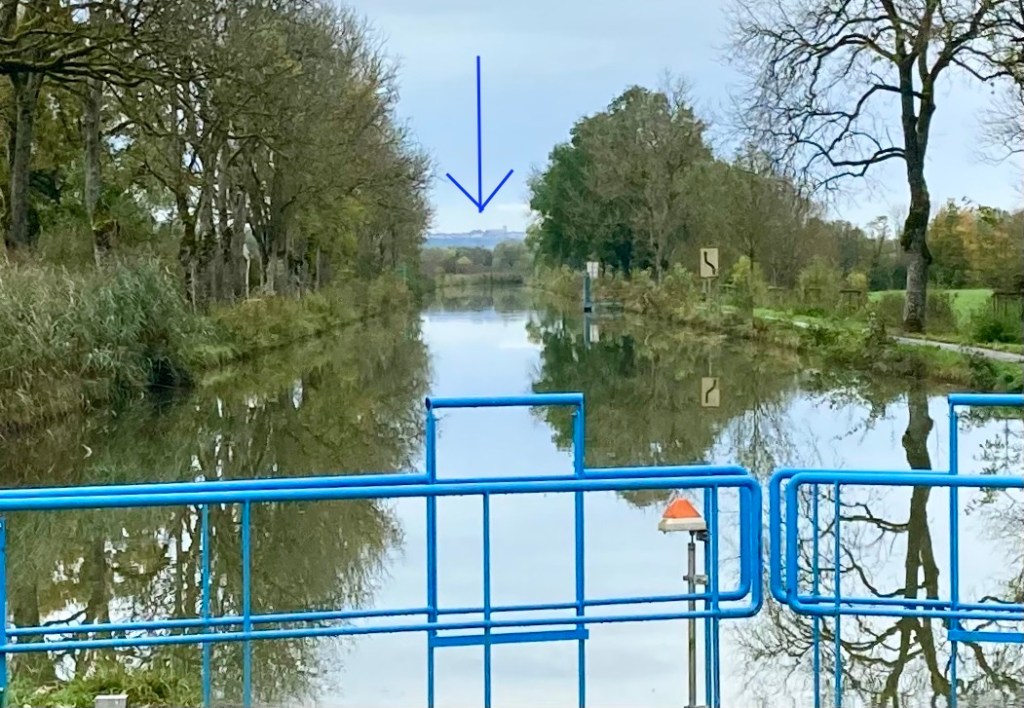
By 1130, at Prées lock, we had our first glimpse of today’s journey end – the city of Langres, up on its hill.
It would take us another 3 hours gentle cruising to get there, ever onwards and upwards through the French countryside.
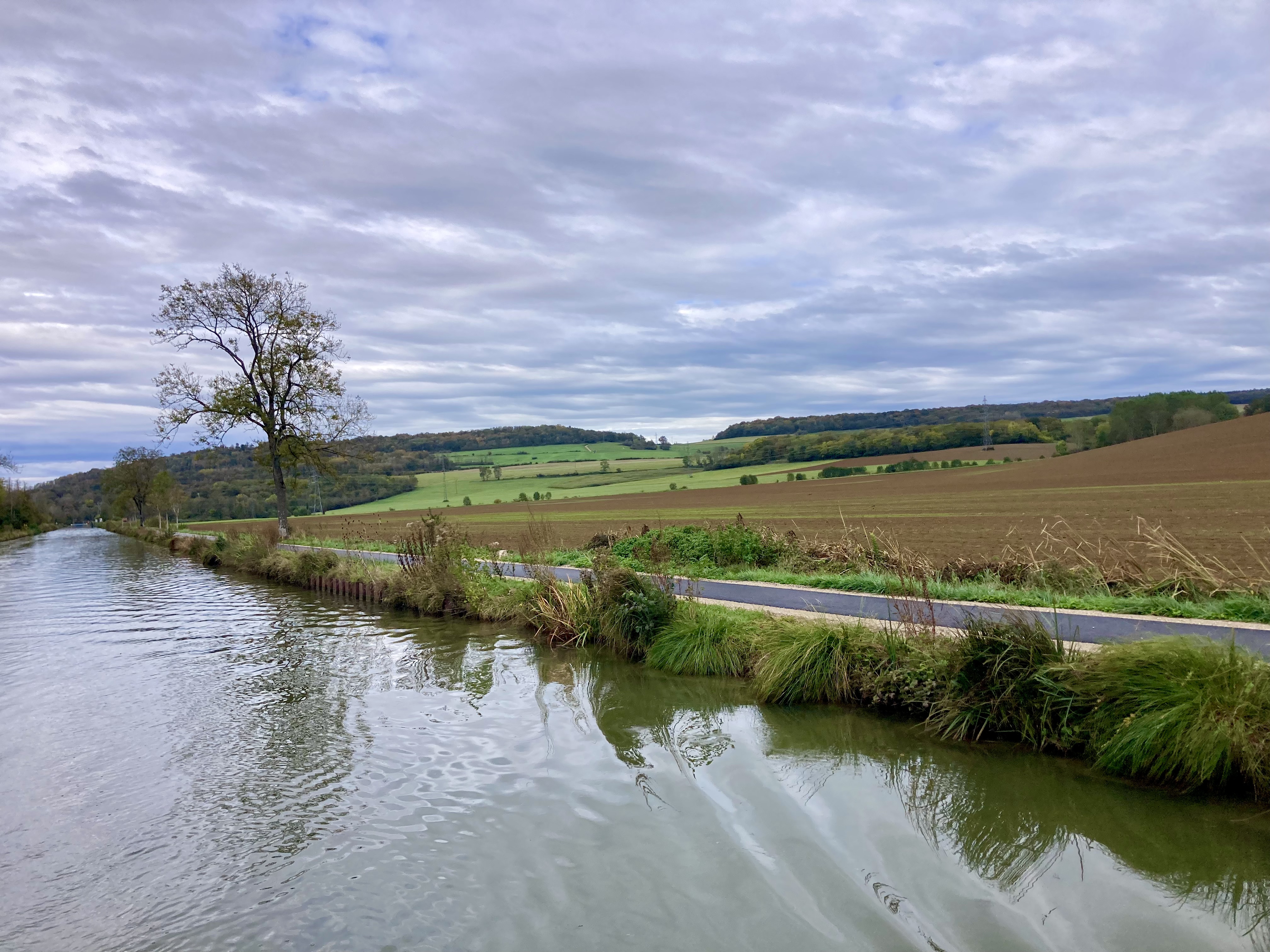

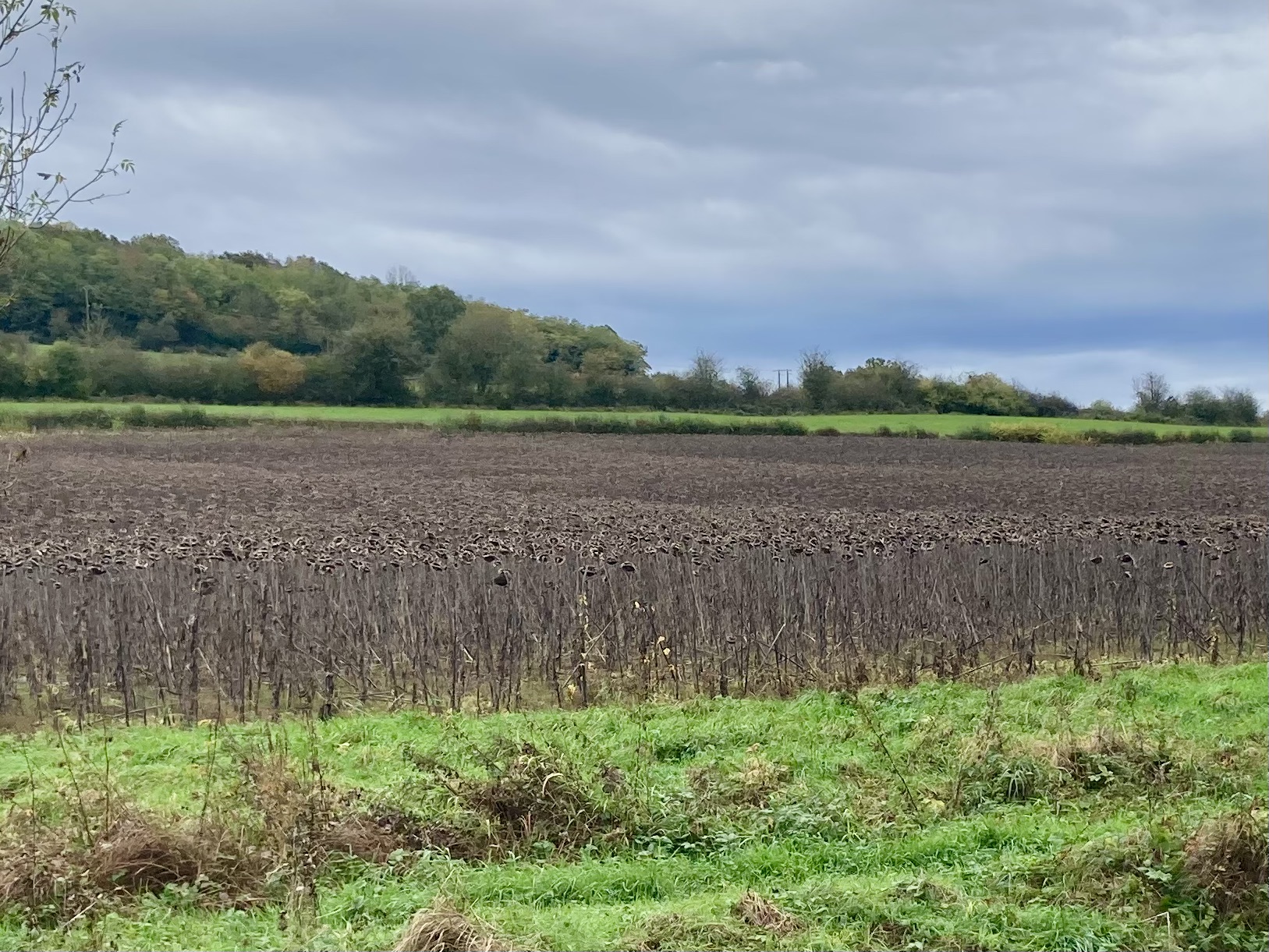
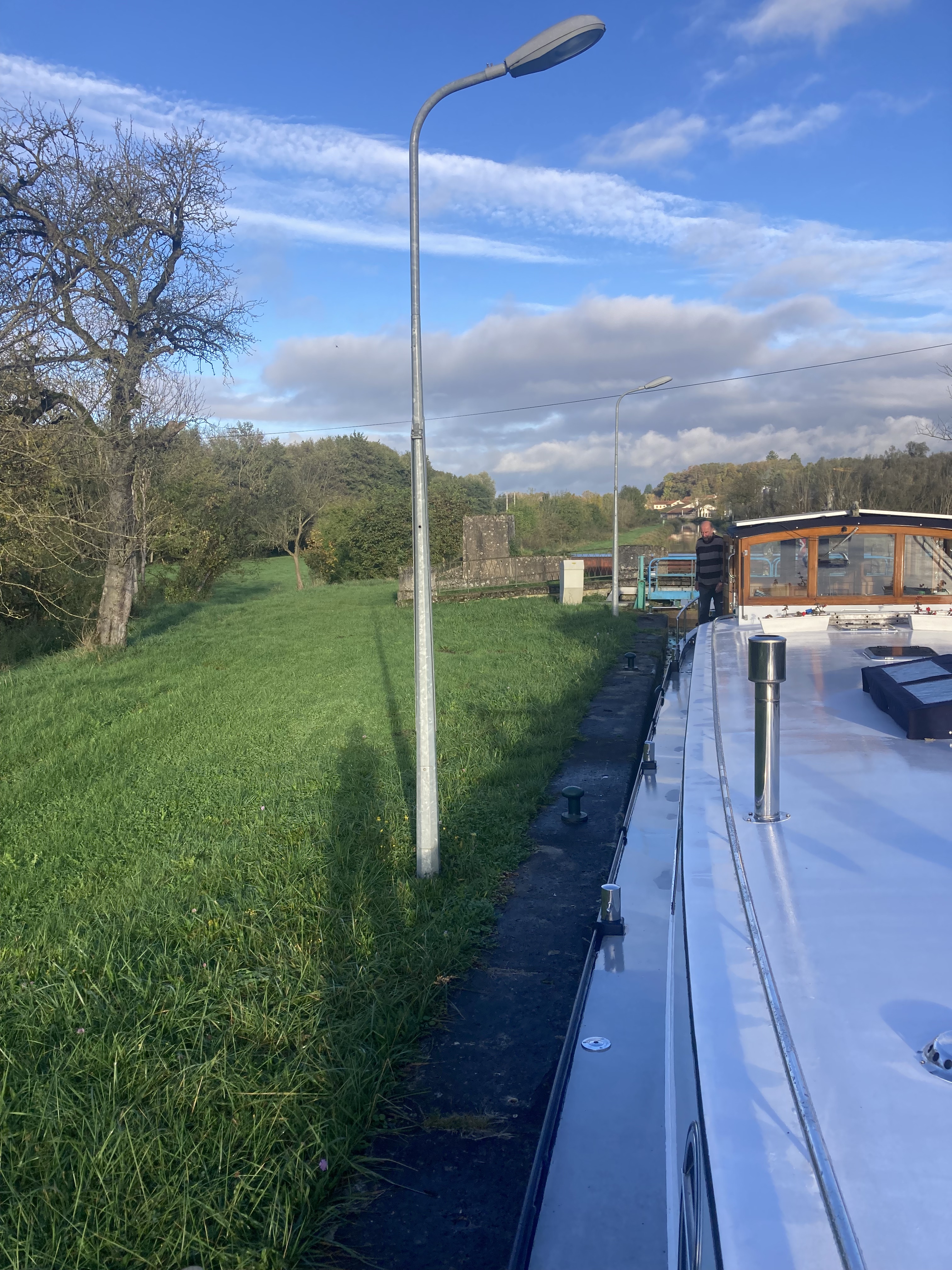
A few locks further on is Channoy where these is an example of the bollards placed in lock walls to help boaters gradually move their ropes with the rise or fall of the water in the lock.

This lock has obviously been renewed with concrete sides and has quite large ‘alcoves’ where the wall bollards are situated. This makes it simpler to throw or place ropes on them. Above this bollard is another on the top of the wall; a similarly placed bollard is just visible further along the lock. I think that demonstrates the principle. It is at its best when the wall bollards are just the right distance apart for your boat, not always the case. But there is always a way to make it work.

Just one more photo to demonstrate the loveliness of our journey up to Langres.
Even with dull skies the scenery, reflections, peace and nature cannot dull our enjoyment!
Enough of my reverie!
We arrived at the long Langres quay by about 1400 to find it almost empty, and, as always, plenty of space for Calliope.

She’s looking good after her climb up the Marne side of the canal, through 69 locks (2 to go next day) and almost 150 kms. She has risen about 232m and is ready for the final 7m tomorrow.
Piépape
I did think of splitting the blog into the ‘up’ side and the ‘down’ side, but we only stopped twice on the way down, so here goes …..
We left at 9 in the silvery light of a mid-October morning.
The sun was making a big promise to appear soon, although as were soon to be in a tunnel for an hour it didn’t matter too much.
As mentioned before we only had two more locks up to the tunnel.
By the time we reached the first, Moulin-Chapeau, (what a lovely name) the sun was out.

We continued on the 2.5kms to the last lock, checking along the way what we needed to know for the tunnel ahead. It seemed that there was a job coming up for the ‘communications officer’ .
A big sign at the side of the lock told us that we must call up the Heuilley-Cotton control post for permission to go through the tunnel – it is not wide enough for boats to pass so a one way system operates.
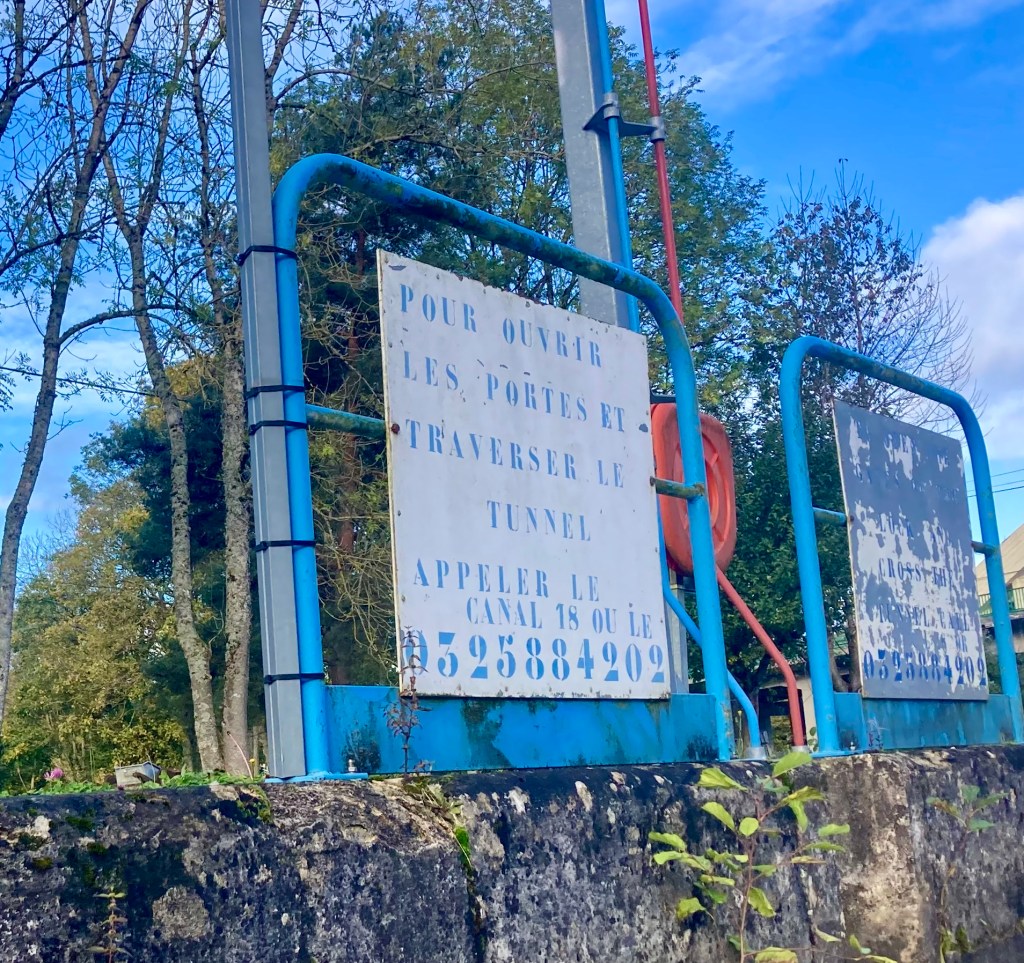
I called them, gained permission, and was asked for the number on the back of our remote control – 176.
It always surprises me that there is another 3kms to go between this lock and the entrance to the tunnel. Half way there we arrived at the narrowing of the waterway and the cutting for the tunnel approach; there we saw a nice illuminated sign with our 176 number at the top.

It was clearer through the binoculars than it is here! But it was telling us that 176 could pass the tunnel, and the green light verified this. As you can see once you are in the cutting there is no space for a boat to come by, hence the one way system starts here.

We have always found these cuttings to be very quiet places, full of greenery and wildness.
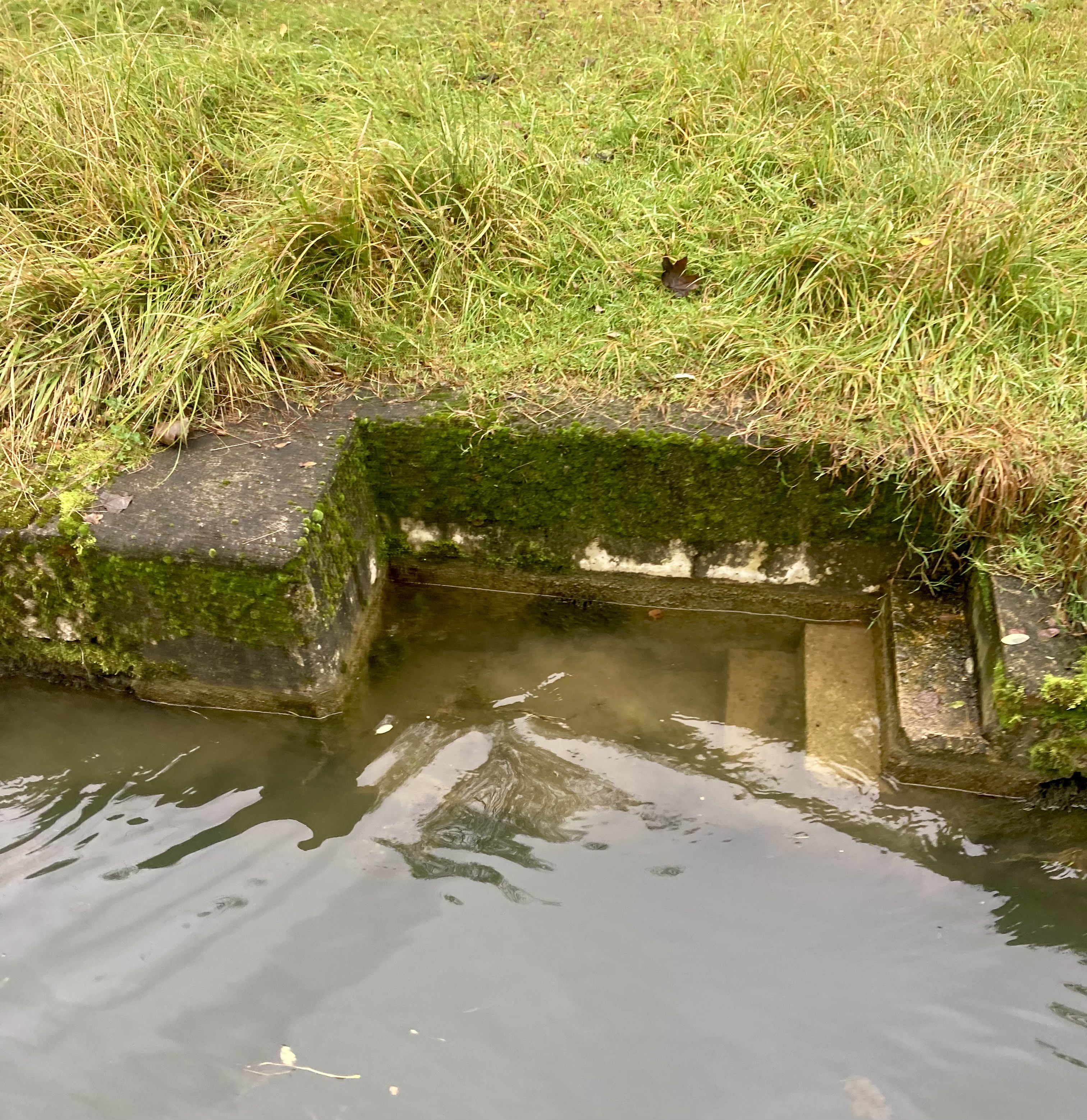
It seems that animals, especially deer, get in the water here and steps like these help them to find a way out.
And then we were in the 5kms Balesmere tunnel. Tunnels require good concentration on the part of the Captain, so crew tries to keep quiet, maybe making tea but otherwise out of the way.
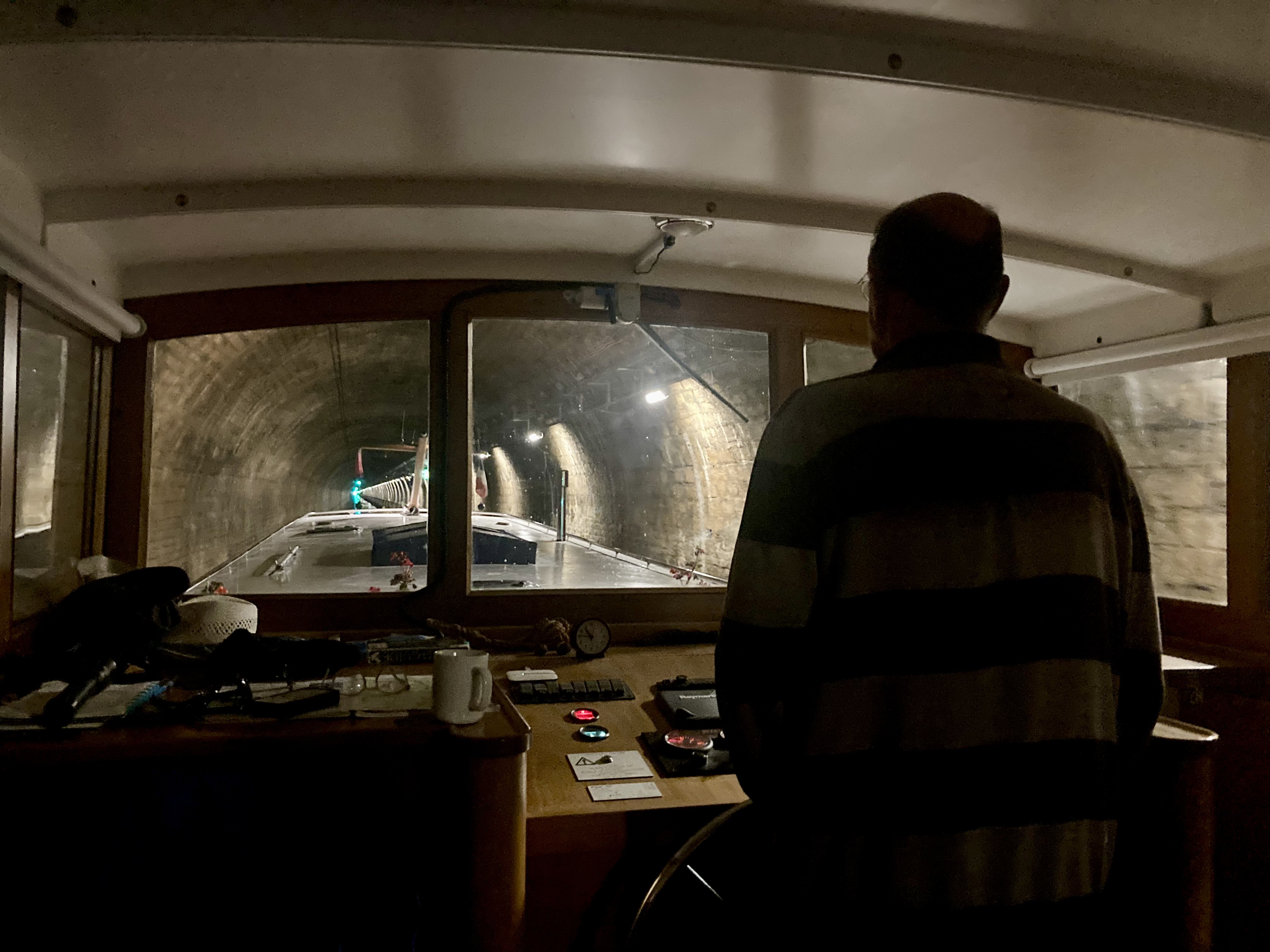
The tunnel is tall enough and wide enough for Calliope, but concentration is needed to drive a straight path along the full length.
And this is what Stu did, for the next hour, until we emerged on the Saône side of the canal, once known as the Canal de la Marne à la Saône.

It felt good to be in the cutting leading away from the tunnel, and towards the 43 écluses (locks) going down to the river. We had in mind to get the first 11 of these behind us today.
Locks 1 to 8 Saône side are in a flight across 3.5kms. This means that as you leave one lock the next one is preparing and opening for you, making the trip through them quicker than you might imagine, especially as they are all about 5m deep.


The 8 locks are broadly similar, particularly in length, breadth and depth. But vary in the amount of greenery that is growing on the sides!
All have the bollards in the wall that allow crew to gradually lower the ropes down to the bottom.
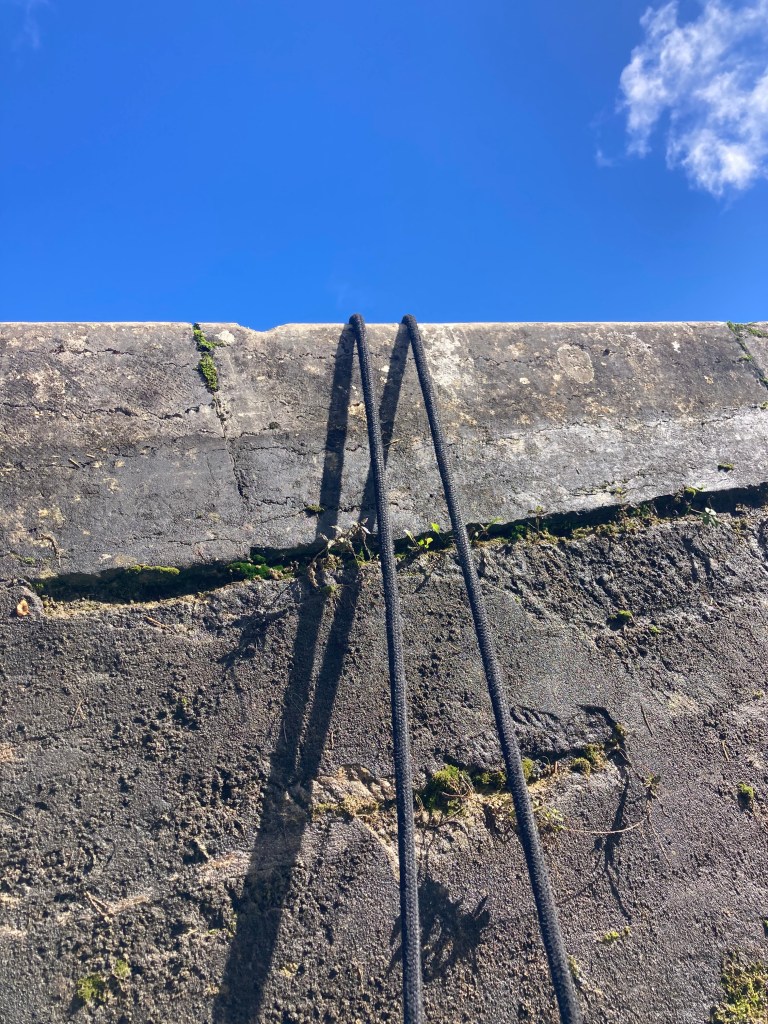
Actually this time we found that we had longer ropes and could leave them round the bollards at the top for the descent.
One by one we went down – here is No. 7.

The countryside on the Saône side is different – more open, and now we were descending we had south facing slopes rather than north facing ones.
We could see for miles!


The sun began to break through; it was feeling more southerly already.
Two hours after leaving the tunnel we were down through the Versant Saône flight of 8 big locks and heading on to the last 3 of the day taking us past Villegusien-le-lac.
The landscape closed in again, trees lining the canal as we approached our mooring for the night at Piépape …….

… four sturdy bollards on a quiet sunny bank under the trees.

Pouilley-sur-Vingeanne
After that pleasant sunny October evening it was a bit of a shock to wake up to this.
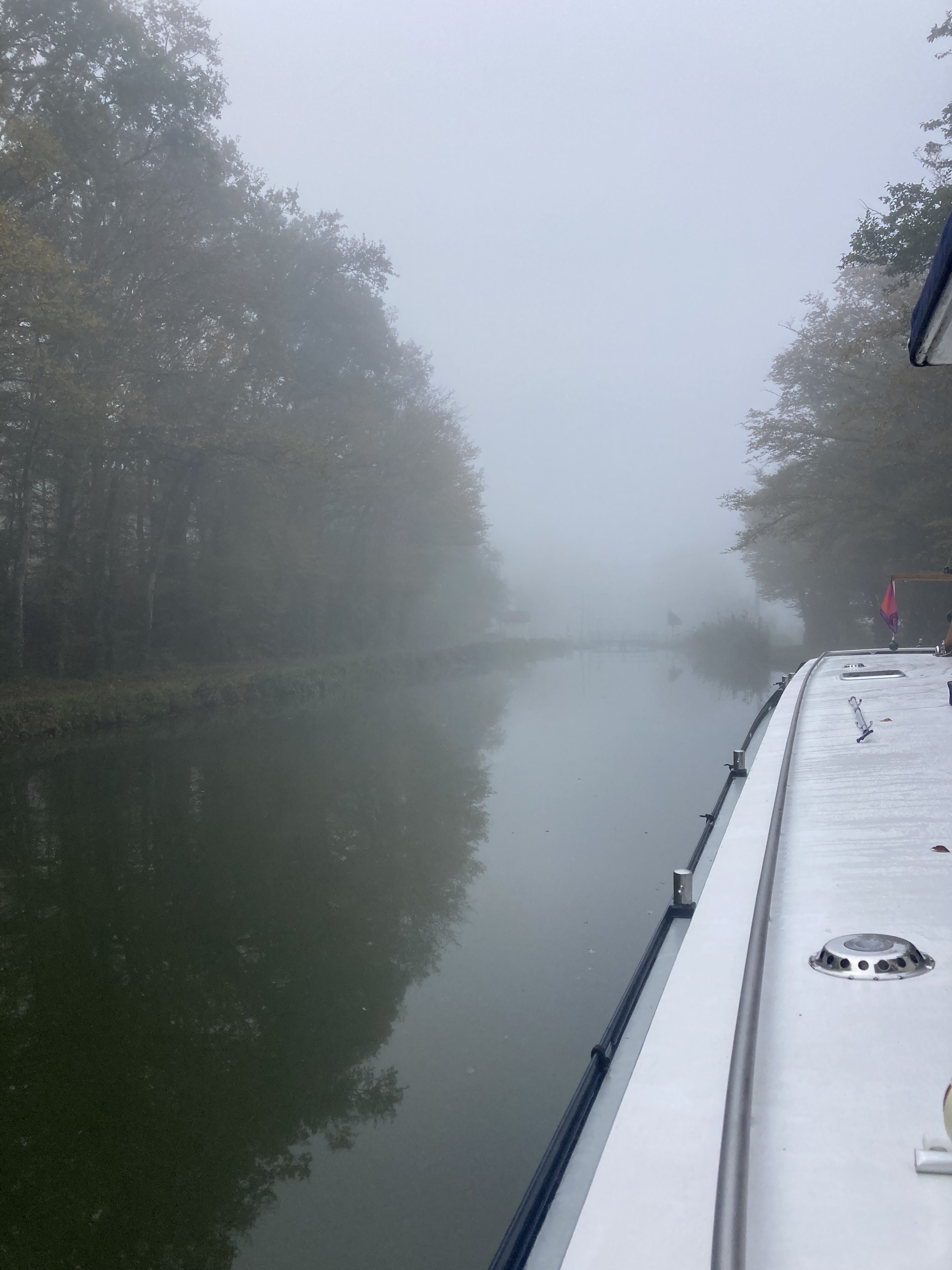
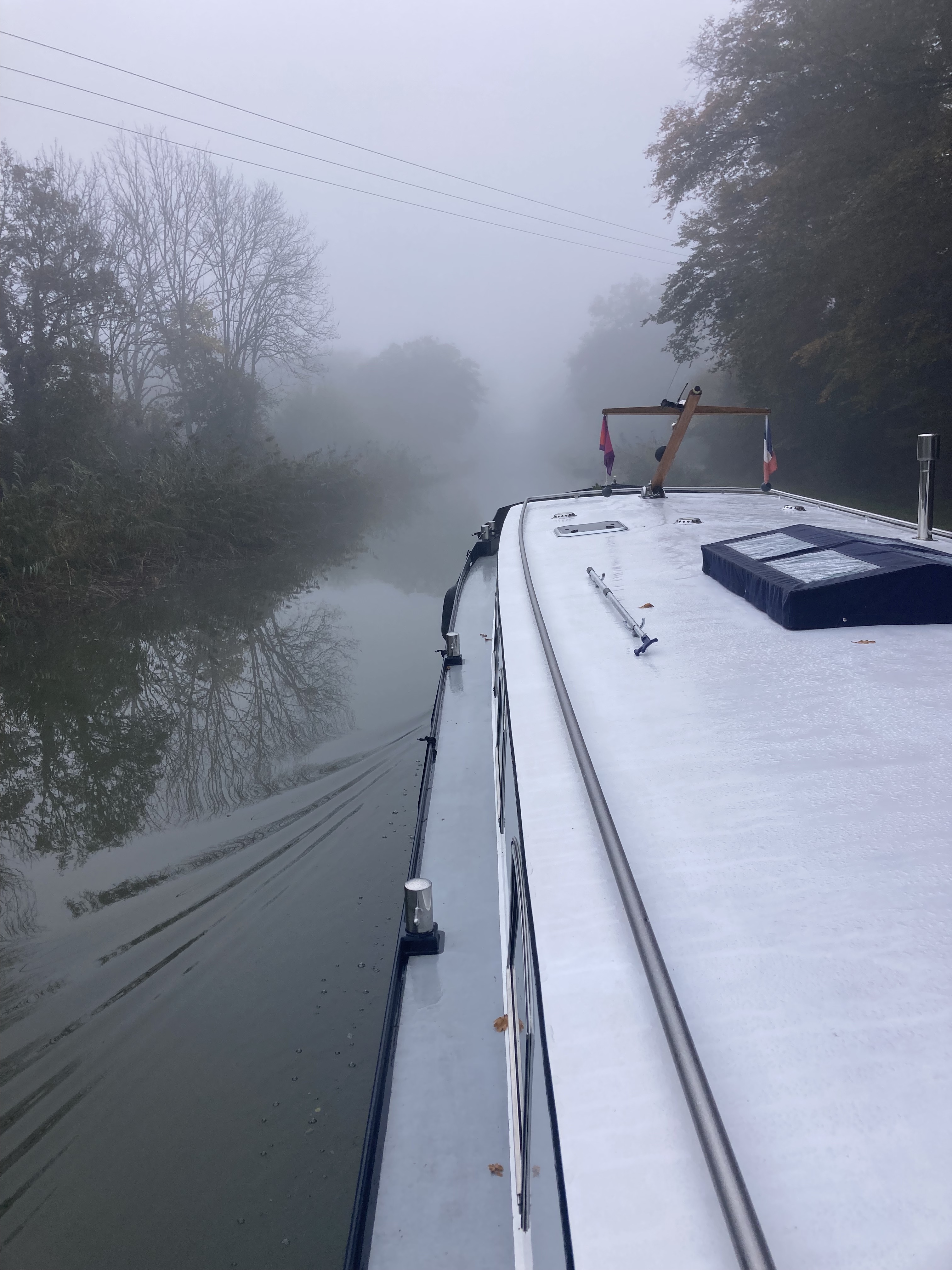
We waited an hour and the mist cleared slightly so we decided to set off. We could definitely see far enough ahead to see any boat approaching, and to see locks and bridges in plenty of time.
It was to be another fairly long (for us) day; 26kms with 17 locks – all down and all just over 3m deep, so not difficult to negotiate. We wanted to get started.
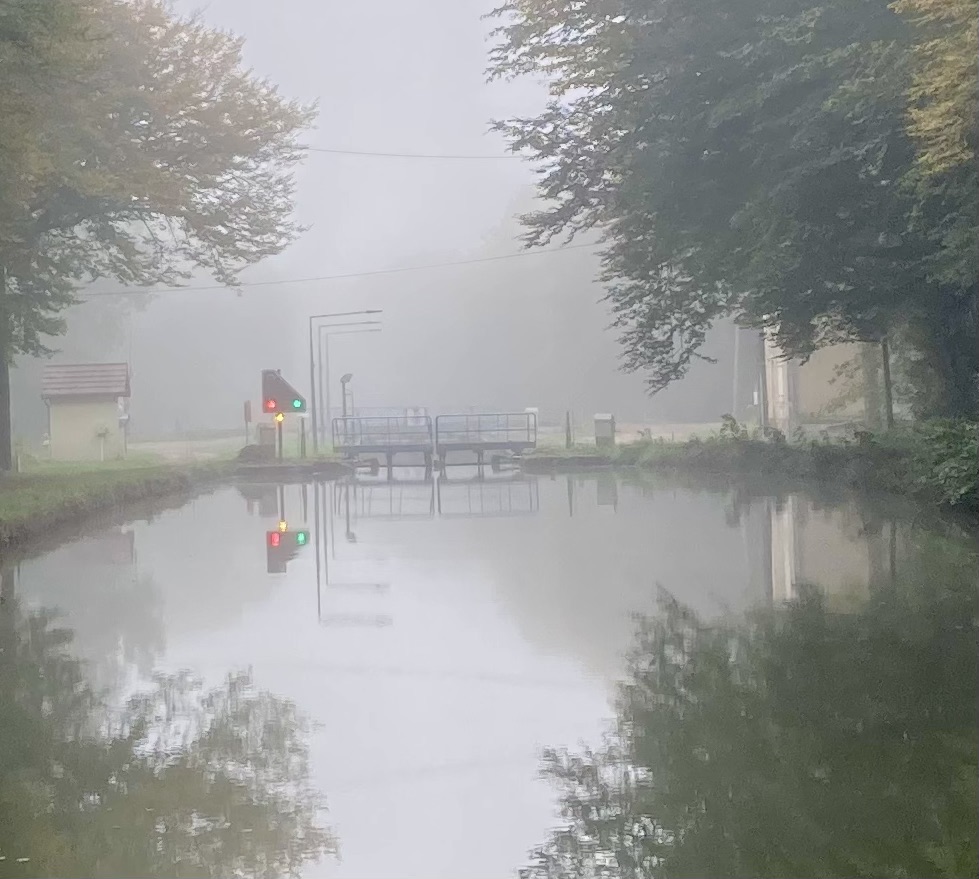
Half an hour later, as we approached Croix-Rouge lock, the mist seemed to have thickened a bit but we could still clearly see the red and green lights at the lock gate; all was well.
A bit further we saw the signs indicating a narrow passage under a bridge – keep between the white triangles!


Calliope cruised on comfortably, with crew diving back into the warmth of the wheelhouse after each rather misty damp lock.
By 1215 the sun was working hard to break through what was left of the fog, and we could tell we were heading South towards it.
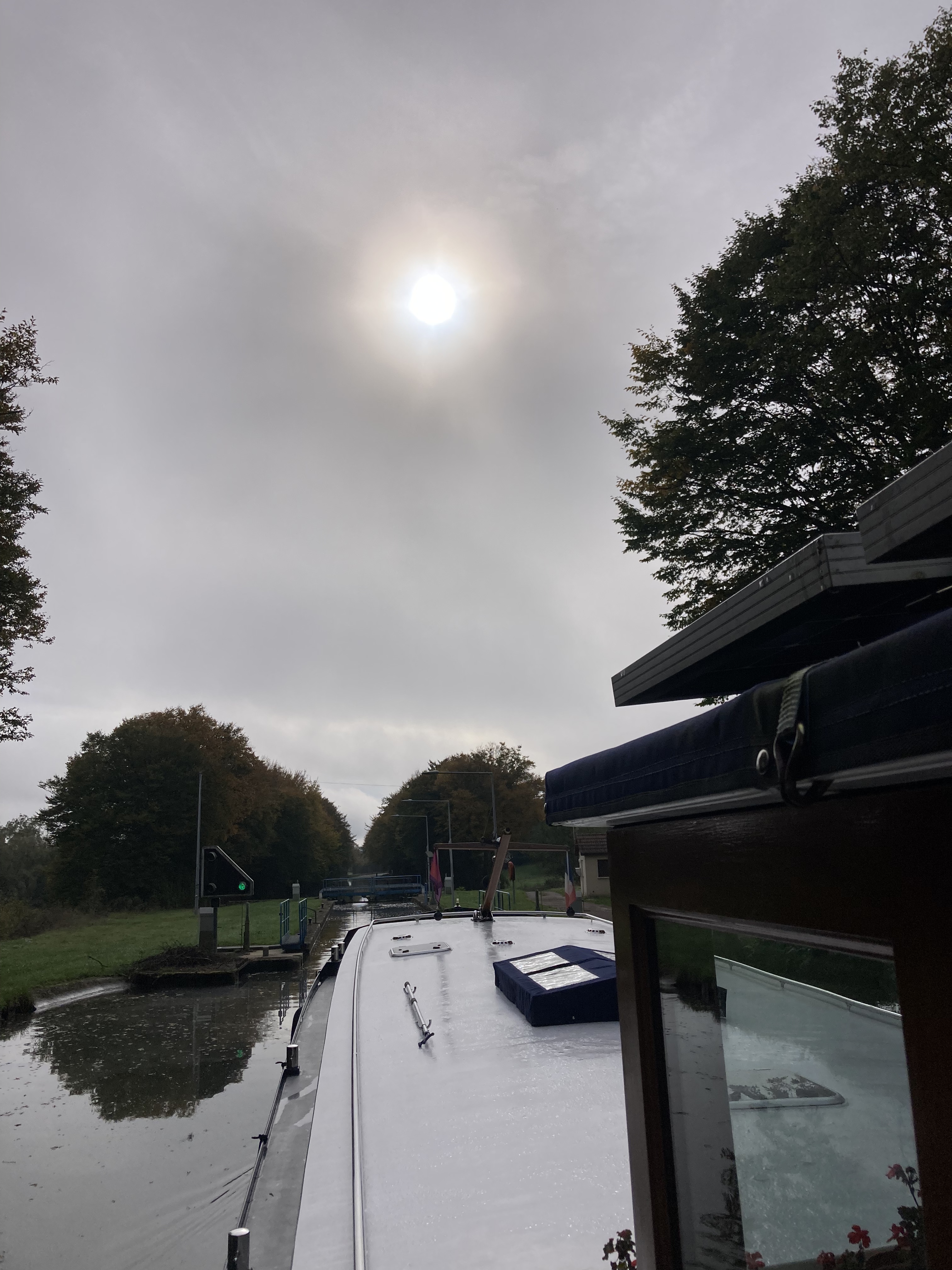
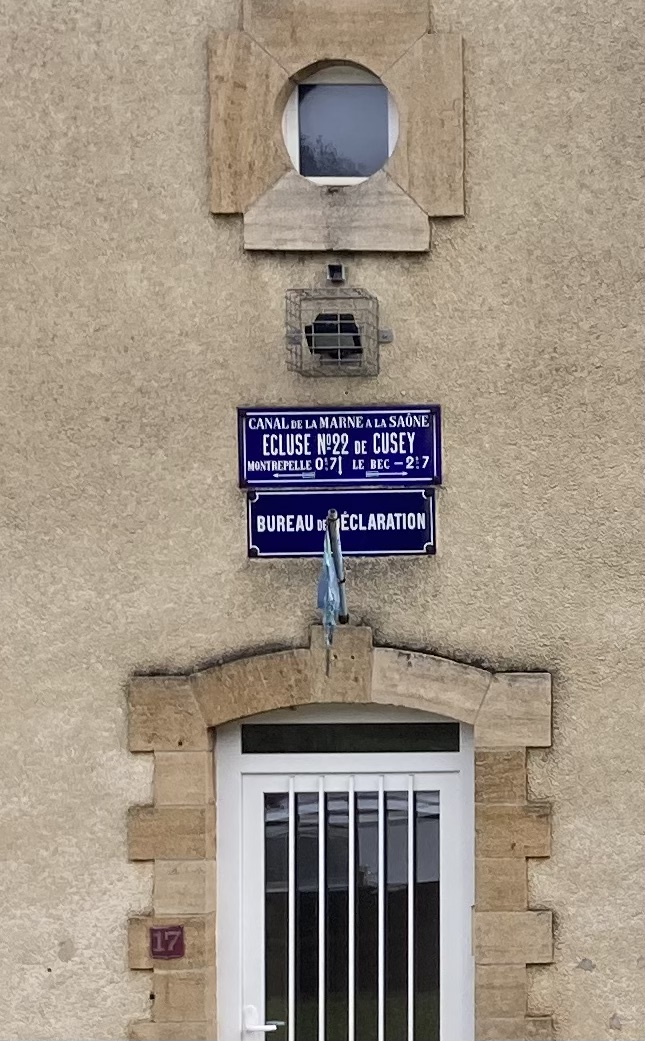
Not long after we reached our eleventh lock of the day. Écluse No 22 de Casey was a Bureau de Déclaration in the past – a place where bargees must stop and declare their cargo, which might be taxable; payment must be made before they could continue.
The sign above the door also told us we had come 0.7kms since the last lock, and had 2.7kms before the next – enough time to make a sandwich to munch along the way.

A landmark was reached at Corchamp lock – we entered the départment of Côte d’Or – the French department that also contains our winter mooring place at Saint Usage!
We really were getting close to home.
There were much wider views again now, this time across to a village called Percy-le-Grand.

If I am right in the positioning of my photos we had another 4 locks until mooring for the night. We had considered stopping a bit sooner, but then I discovered a small funky pizza place at Pouilley, so we kept going.
An hour later we had a bit of an unexpected delay!
As we approached Lock 26 Saint Maurice we saw the disappointing sight of two red lights. The lock was ‘en pan’, out of order.

I called the VNF; it was a Sunday so we might have to wait a while.
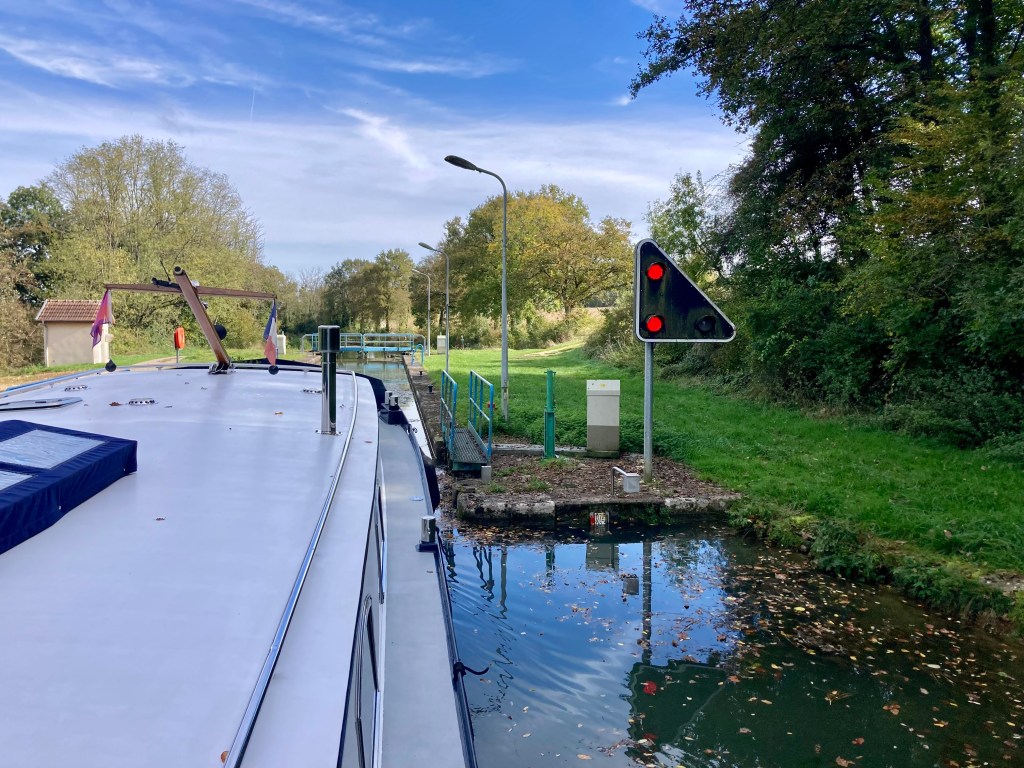
But out luck was in; within 20 minutes our service man had arrived and before too long we were on our way through the last 3 locks of the day and moored up on a single dolphin at Pouilley-sur-Vingeanne.

Single dolphins require us to get a rope midships onto the dolphin, then crew can jump ashore and Captain can throw me fore and aft ropes to attach to the bollards that will be hiding in the grass somewhere.
With boat secure I went to find the pizza place, ready to visit it later that evening.

It is a pretty little village, built up around a bridge over the Vingeanne river which runs along close to the canal in this area.
However it no longer has a pizza place, funky or otherwise! I found where it had been, and even tatty posters advertising it, but no pizzas to be had.
So back to Calliope for something from the freezer!
And then a nice evening and night with our dolphin.
Maxilly-sur-Saône
There was one more long day on the canal down to Maxilly. This is the last mooring before the canal runs into La Saône a kilometre and a half further south. We had about 27 kilometres to cover and just 13 locks to descend.
This was a day to savour; we both really like this canal and would have preferred to take it at a steadier pace, stopping longer in our favourite places. But because of an earlier 5 week canal closure we now needed to scuttle back to our winter mooring before we used up both our French visa and additional Schengen days!
Here are some scenic highlights of that beautiful day – no fog or mist, just blue skies and sunshine.


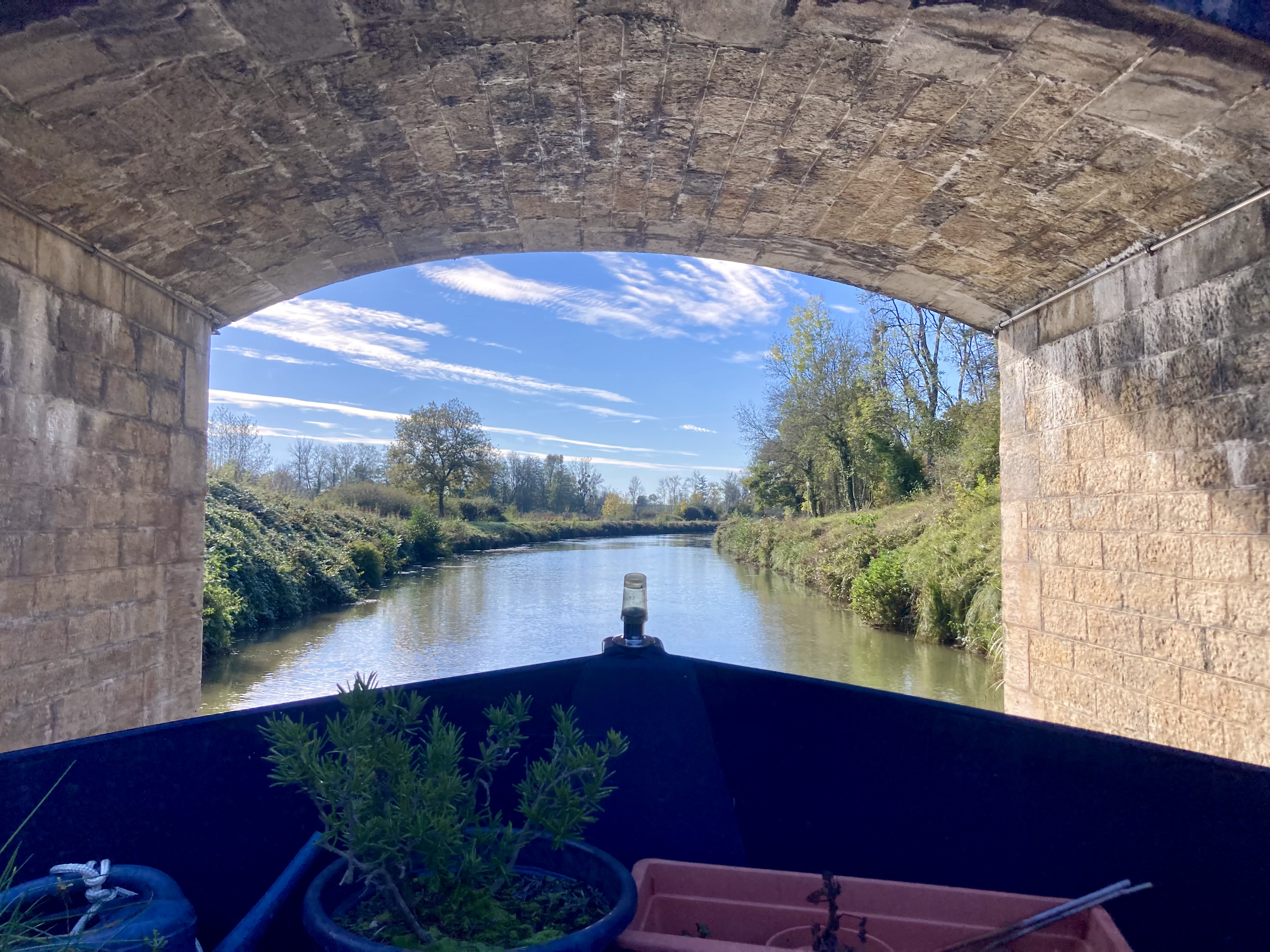


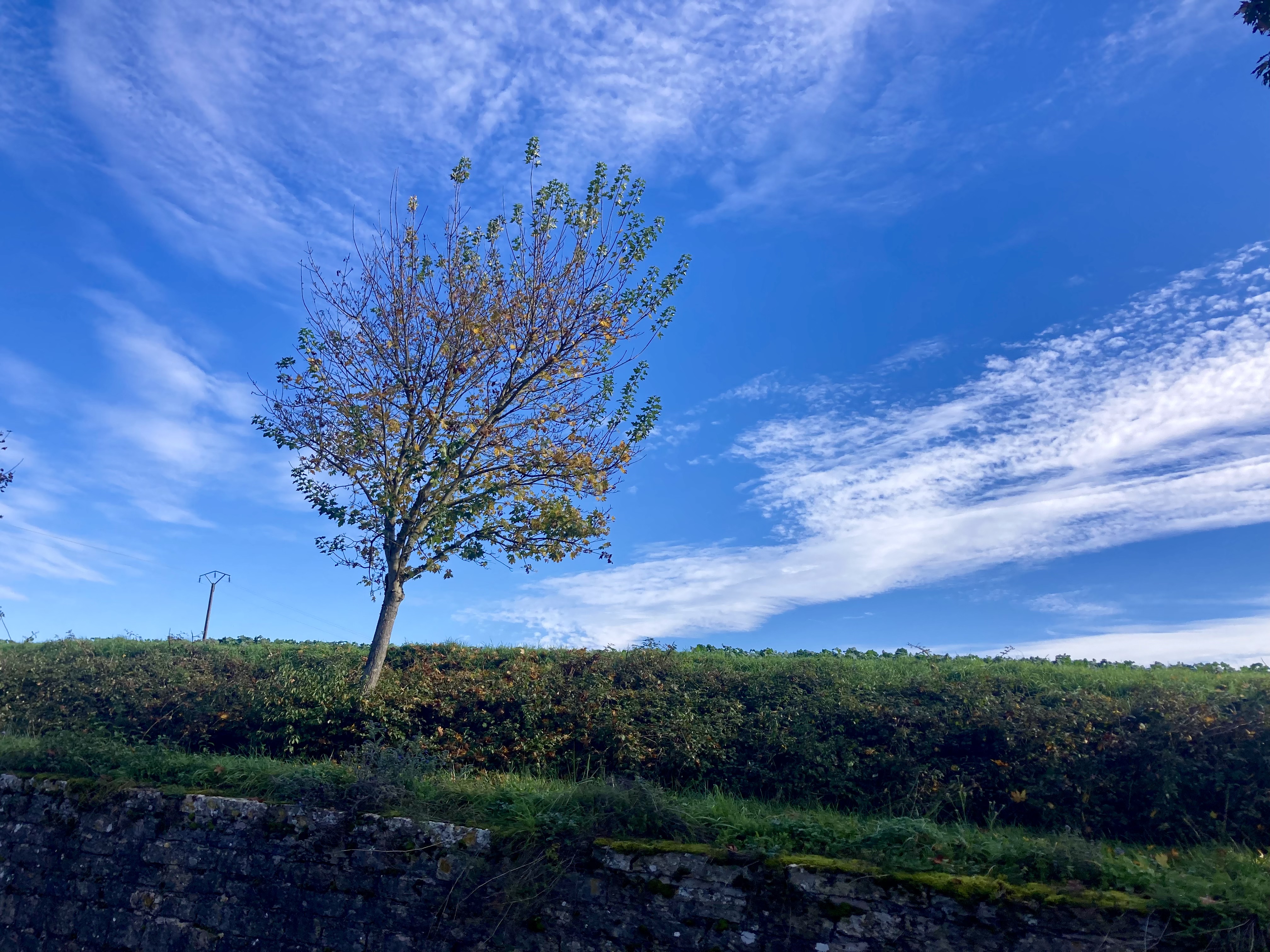
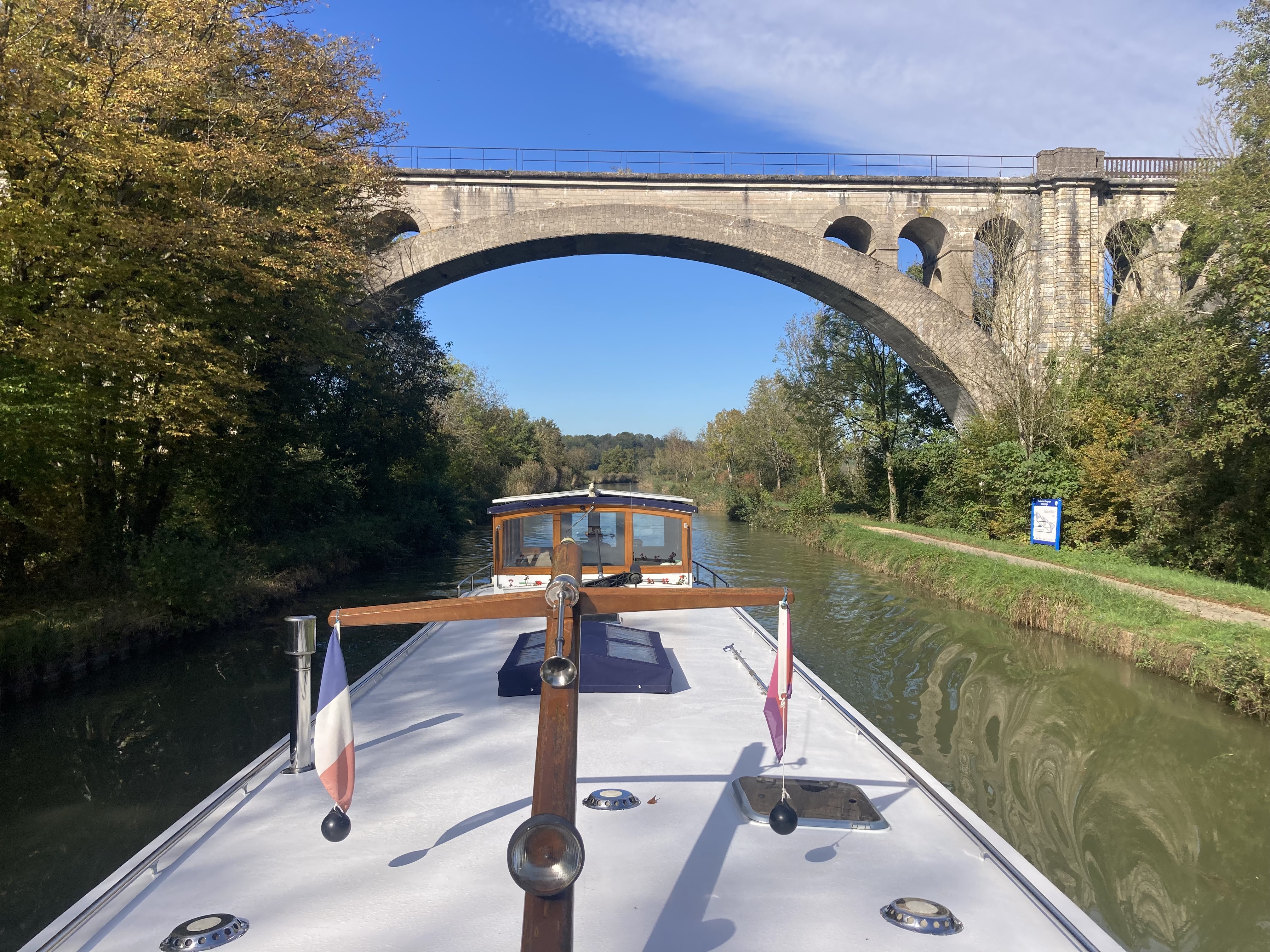
There are so many other lovely photos of this stretch; I must restrain myself. The best thing to do is advise others to take a boat or barge along this canal.
I was loving it. (Apologies for the crazy angle – we weren’t really tipped on one side!)

And this pack of hounds, out for exercise, were having fun too.


The canal still had one more double red light for us – this time at a new lift bridge at Cheuge.
This small bridge connects an old mill on the Vingeanne with the hamlet the other side of the canal.
(Sorry about the photo, taken into the sun)
This meant another 20 minute wait while our long suffering VNF service man caught up with us again. He was very surprised that we had a problem at this bridge, fairly recently renewed and normally without any problems.
He soon fixed it for us and we were on our way again – with a better photo taken the other side of the bridge.
By now it was 1520. Normally we are moored up by this time; today we still had 6kms plus 2 locks to go – about another hour. That’s OK.

Calliope came on down towards her last lock of the day at Saint-Sauveur. It was still a beautiful day – such a treat for our last full day on the Canal Entre Champagne et Bourgogne.
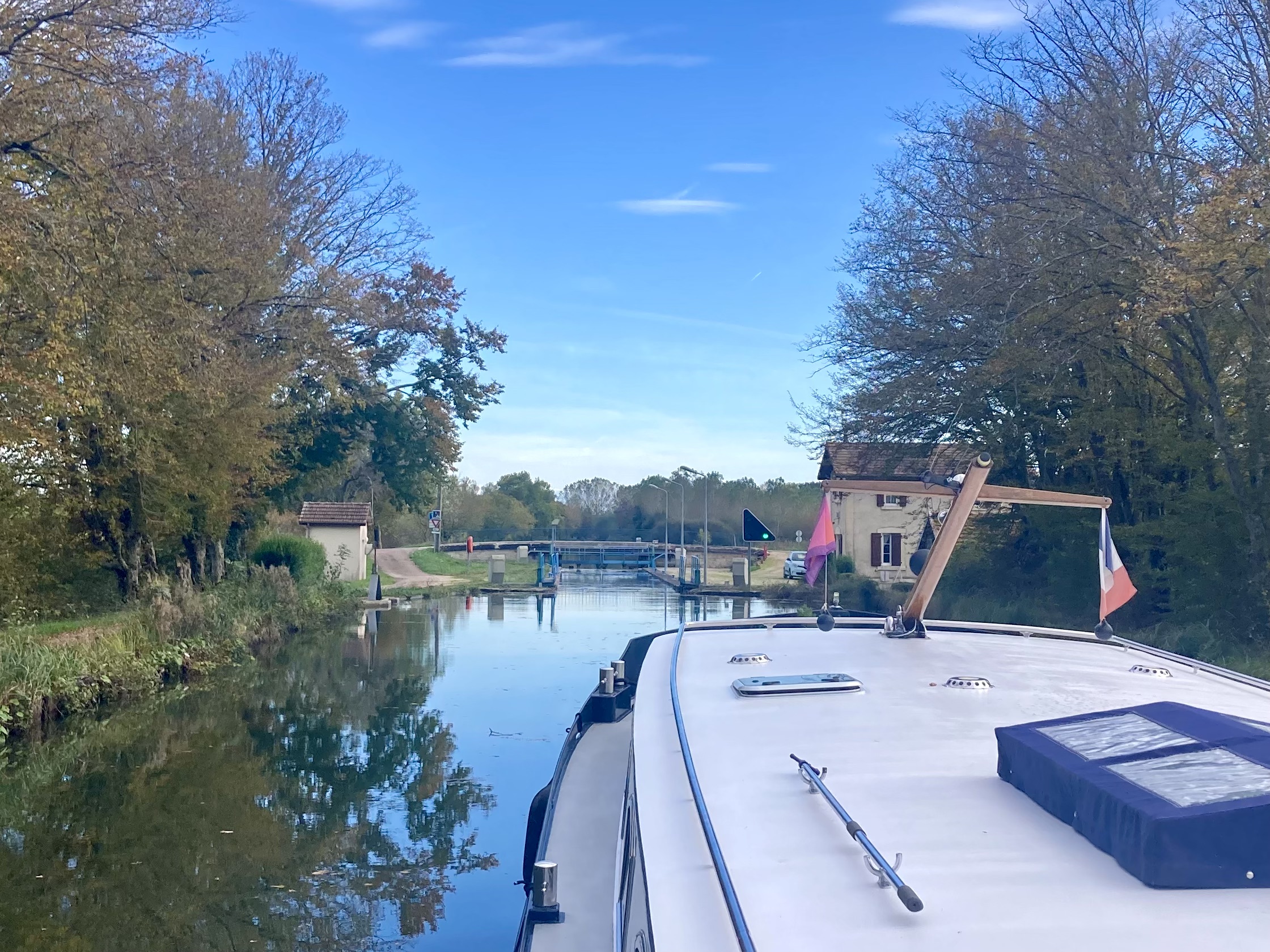
There is a long straight stretch of canal leading down to Maxilly. You can see the quay in the distance and see if there are other boats already there – but the perspective does not allow you to work out if there is room for Calliope until you are almost upon it.

Yes, there was plenty of space for us, as expected at this time of year. Not only that, but the only other boat there was La Fée Verte, a boat we had met several times on our way through the canal. Now we had time to get to know each other a bit better and an amiable early evening hour was spent aboard chatting to our new Swiss friends.
Next morning, looking at our energy levels, the date, and the weather we decided that after our long but enjoyable haul over the past 223 kms and 18 days we could afford to take a day off.

So we stayed at Maxilly an extra night and relaxed, although I was less relaxed watching my football team play! (they lost 😢)
We had made the right decision about the weather. We awoke to bright skies – and a heavy dew!

The last 1.5 kilometres of the canal down to the river includes two locks., one immediately by the quay where we were moored.

By five past nine we were through the one lock and heading towards what was our last lock of the 114 between Vitry-le-Francois and the Saône.
It was the final use of our trusty ‘telecommand’, pressing Avalant to prepare the lock for our descent.
And then there we were at lock No.43, Chemin de Fer, so named because of the railway bridge adjacent.
A bit sentimental I know, but here is a mini pictorial record of that last lock.
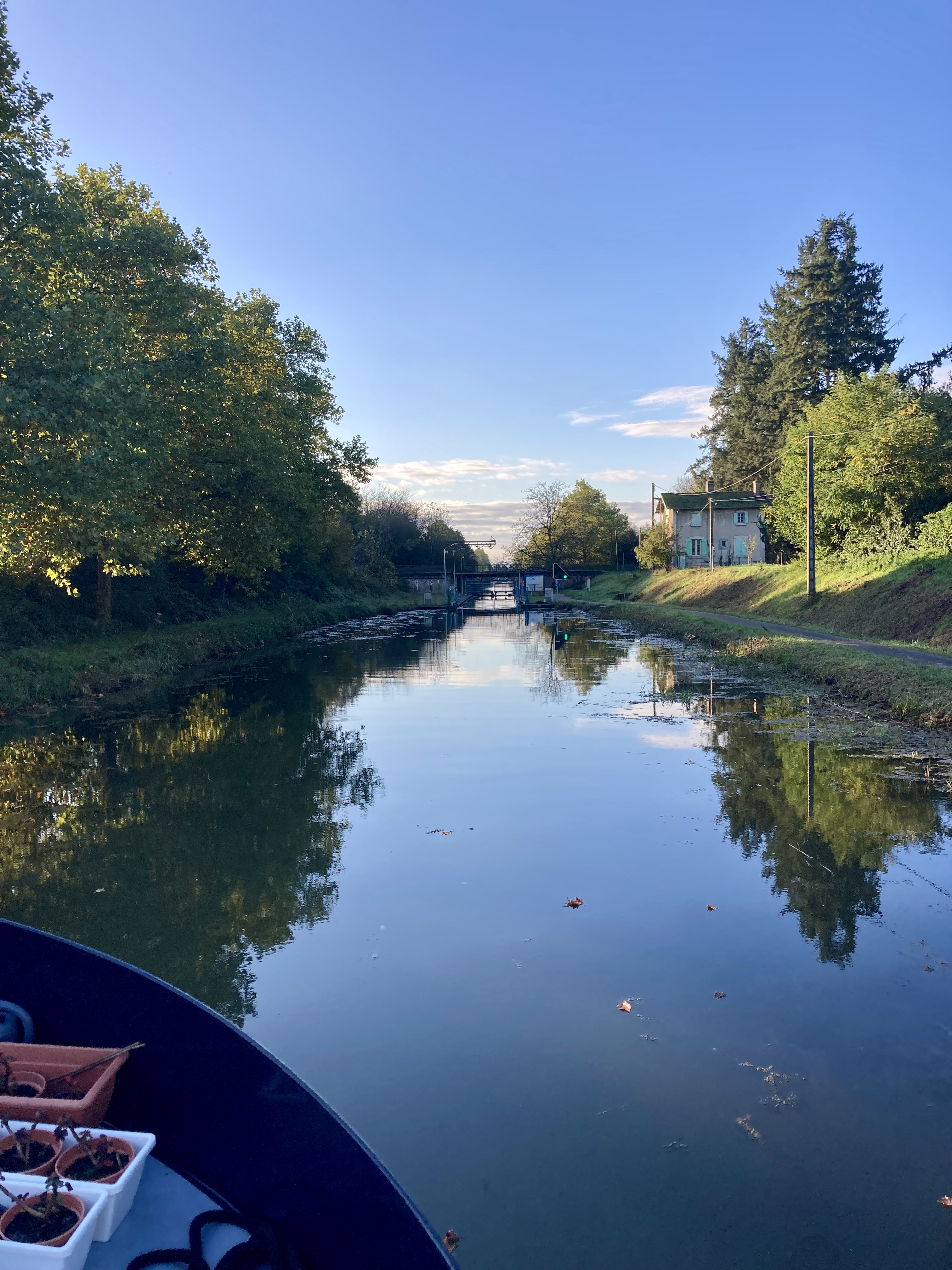

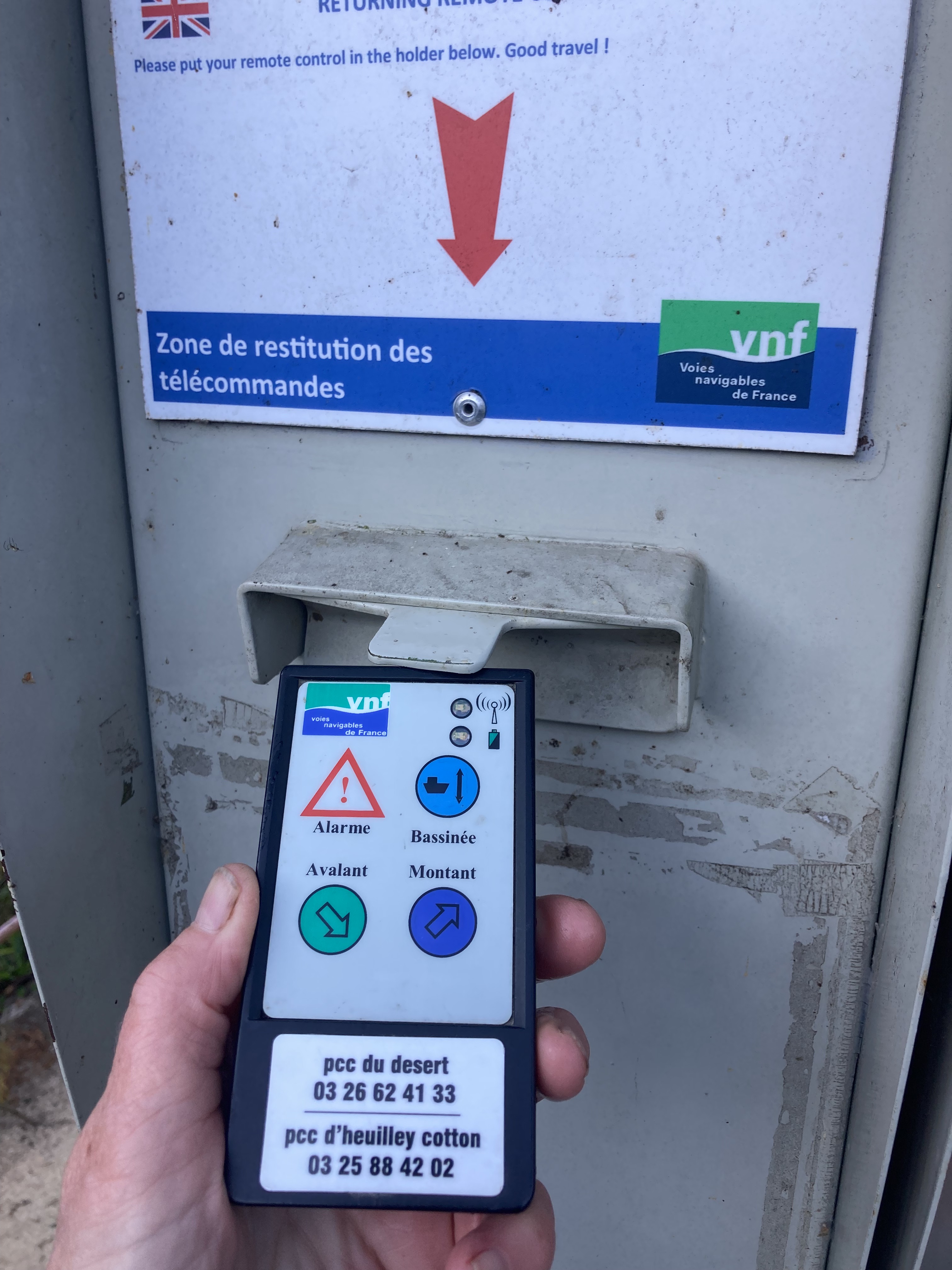

You may recall way back at the start of the canal we had to pick up the telecommand. Whereas at Lock 43 we had to return it, and follow specific instructions to do so – all carefully shown on a big noticeboard, in several languages.
- 1 – Moor your boat
- 2 – Call the central control station
- 3 – Mail the remote
- 4 – Lift the blue lever
And that was it – the lock began to empty and we began to go down to river level.
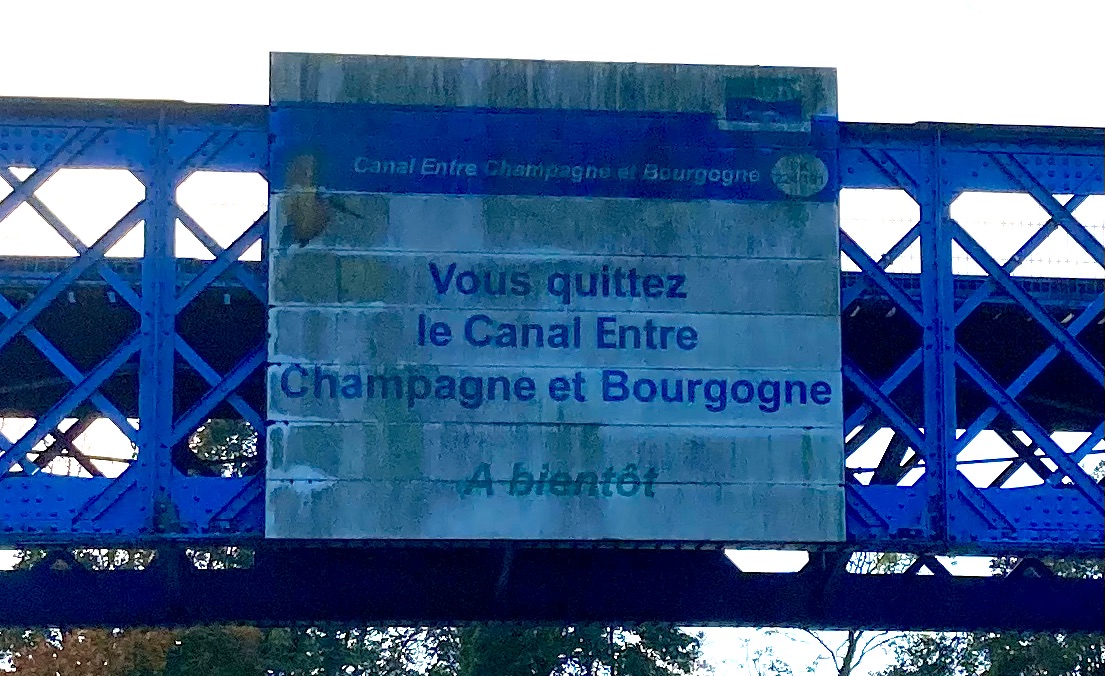
Another kilometre to the bridge over the entrance to the canal, with its tired sign saying we were quitting the Canal Entre Champagne et Bourgogne and we entered the Heuilley lock-cut out onto the river.
La Saône
The lock cut is a deviation of the river along to Heuilley-sur-Saône, but today we were heading the short distance to the right and onto the Saône.
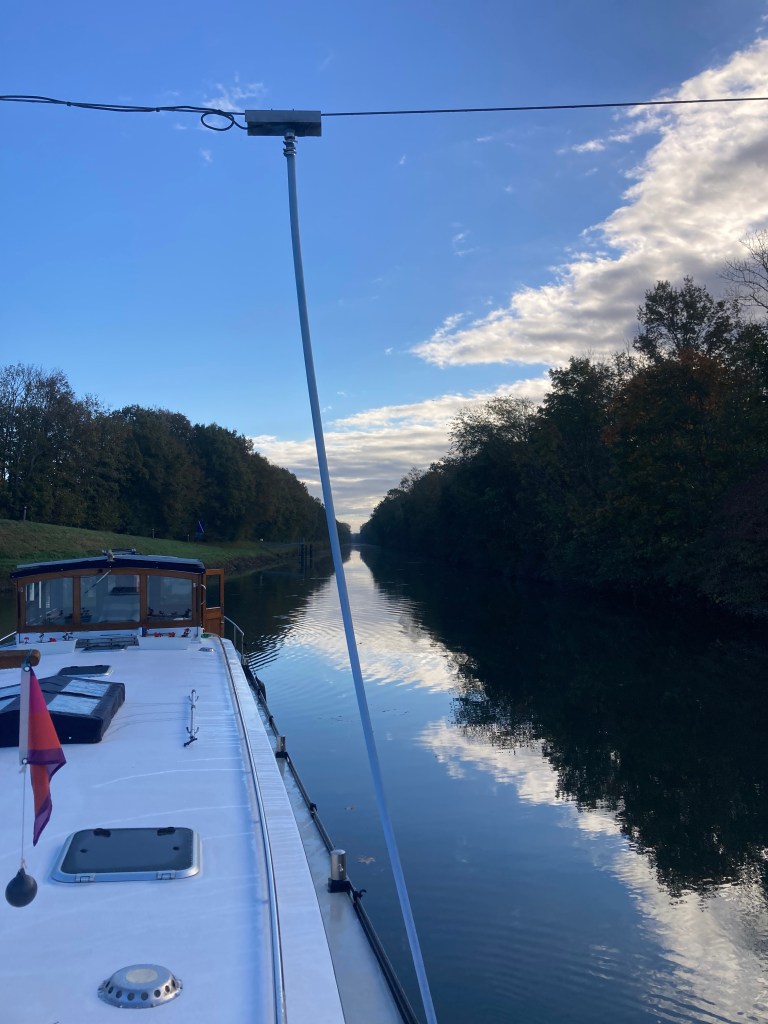
Now we were away from remote control operation of locks, and back to ‘pole-turning’.
These flexible poles, more like thick hoses, hang over the river before each lock.
To get the lock to prepare and to open its gates one must give the pole a quarter turn – an easy thing to do, especially with a good helmsman to direct the boat towards it.
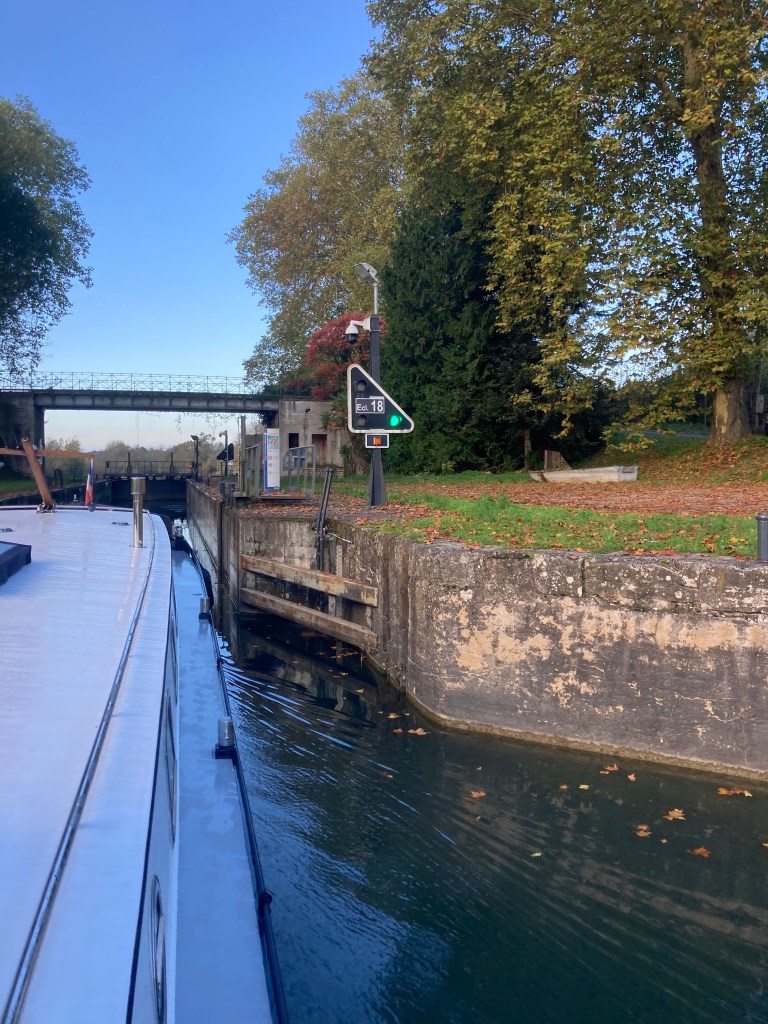
The lock out of the deviation and onto the river proper is in a pretty location and, at this time of year, not very deep.
There had been a fair amount of rain so the river was running fairly high, meaning not too much difference in depth from the deviation to the river.

And then we were out!
Set free from the narrow, though lovely, confines of the canal, and out onto the width and spread of the river.

It brings a smile to my face even now to recall how it felt sweeping downstream on such a beautiful day. 😁
Despite the sun glowing down on us we were still covered in dew. It was a good excuse to be out in the fresh air with a mop, using the dew to give the roof a quick clean up. We would be in our home port within a few hours so good to smarten her up.
Calliope was soon passing the bridged entrance to the small marina at Pontailler-sur-Saone.
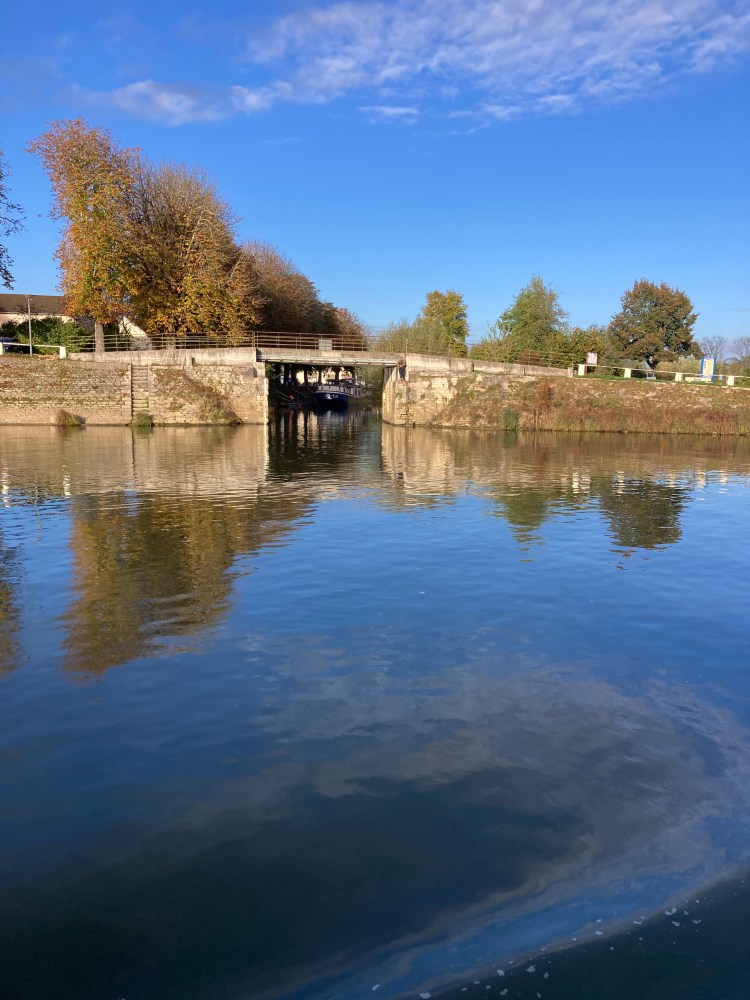
Although mainly best suited to smaller vessels we could see a barge alongside the quay in the marina. Normally barges moor on the low quay and steps just downstream.
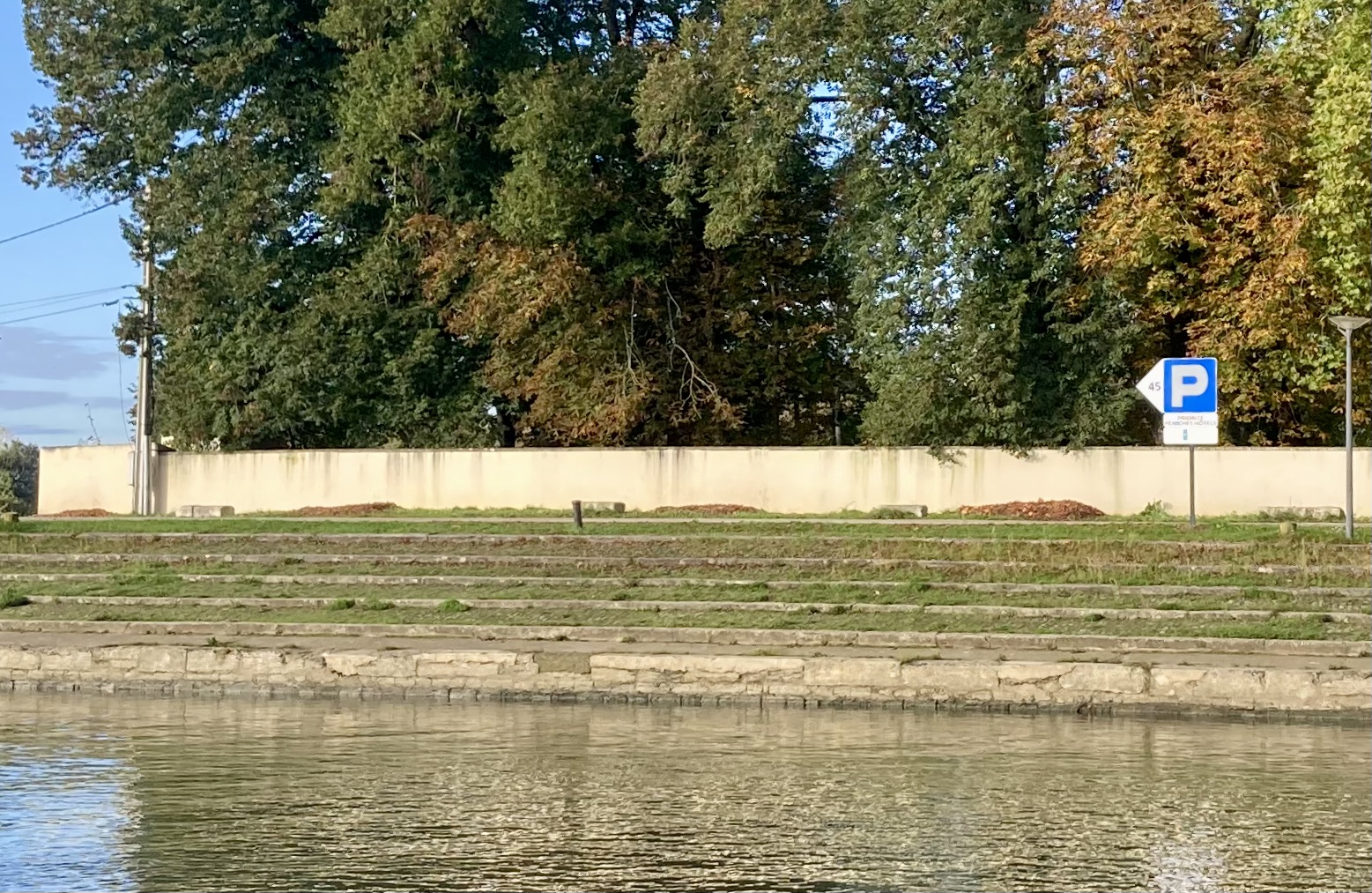
With the current helping us along we found we were travelling at 10-11 kms per hour. It may sound slow, but it is a good but faster than the 8kph on the canal, realistically reduced by half when you factor in all the locks.
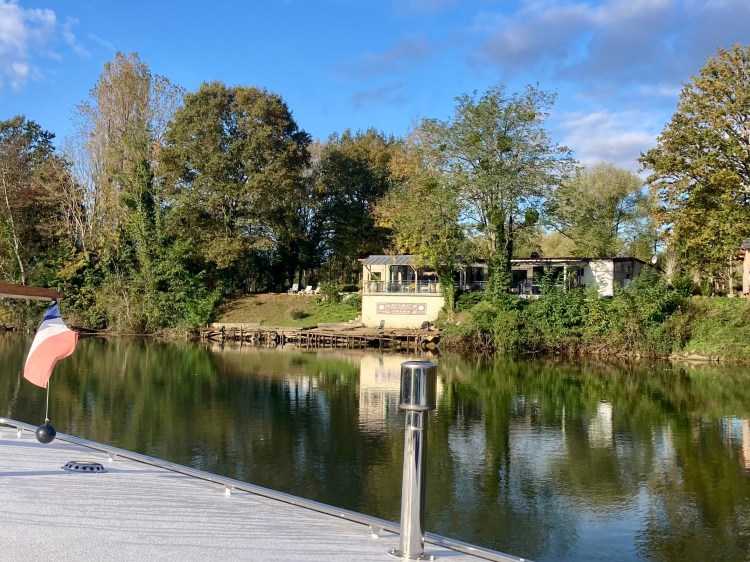
So it was not long before we were passing La Nymphéa restaurant at Lamarche-sur-Saône.
Despite its somewhat tumbledown look this is an excellent place to eat; slightly precarious moorings are available too.
The next landmark for us was the 1 kilometre deviation of the river called the Poncey lock cut. We were watching out for it on the left; looking into the sun it was not initially easy to spot, but then suddenly not was obvious.
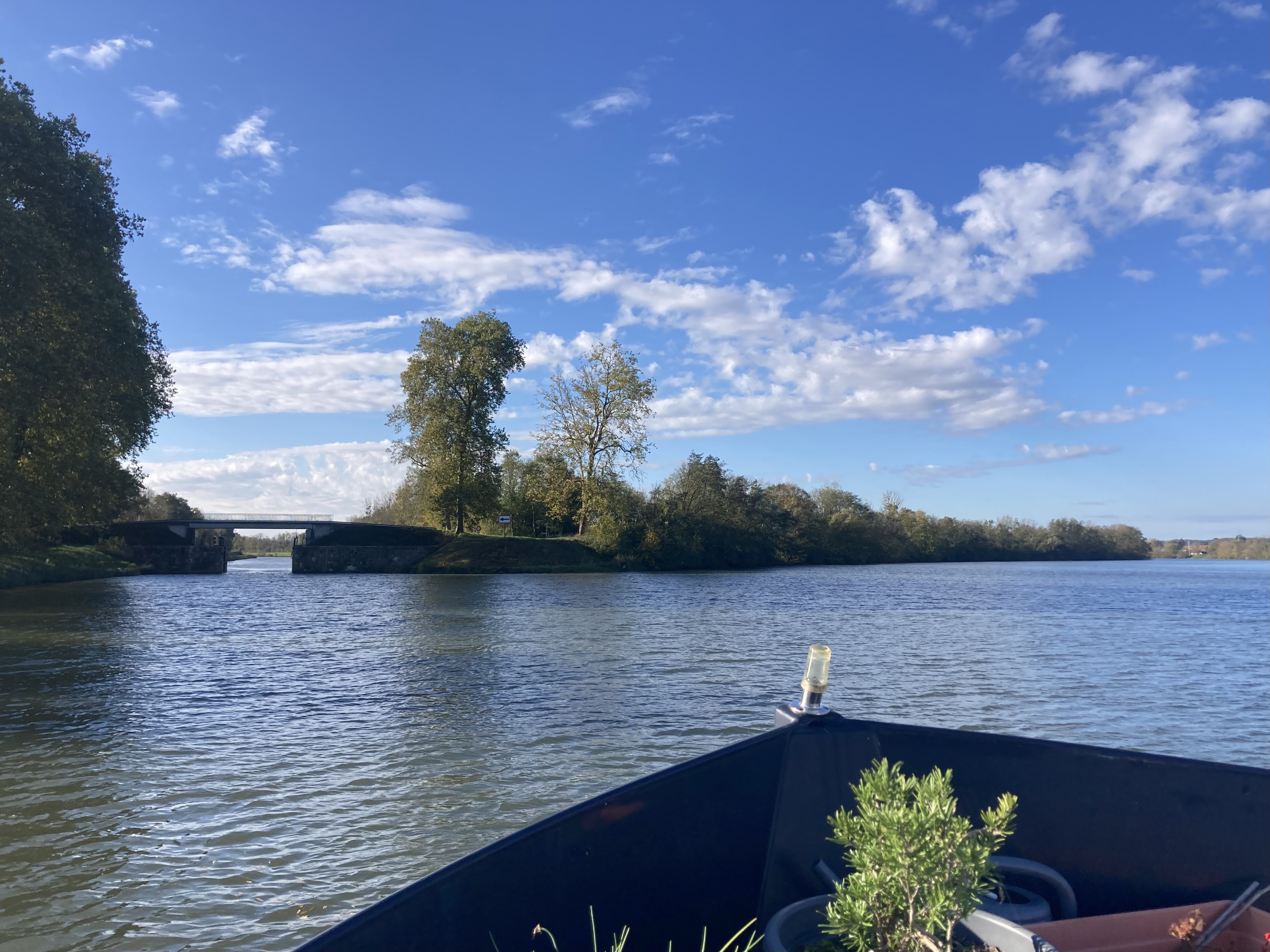
It’s a bit hard to see here in the photo, but just to the right of the big tree is an arrow informing all craft that they should go through the lock cut, and not down the river.


The upstream end of the cut has a flood gate, closed when the river is in spate, but open today for Calliope.
And at the downstream end was our first full Saône lock, 40m x 8m on this stretch and feeling wonderfully wide after the 5.2m width of the canal.
The view was becoming increasingly familiar. We have cruised up and down this section of the river a few times, always loving it.

After 8 kms we were passing the famous city of Auxonne, where Napoleon went to army school and where many boaters stop for a few days or all year.
This very poor photo shows us passing the H2O marina, waving virtually to all our friends moored within.
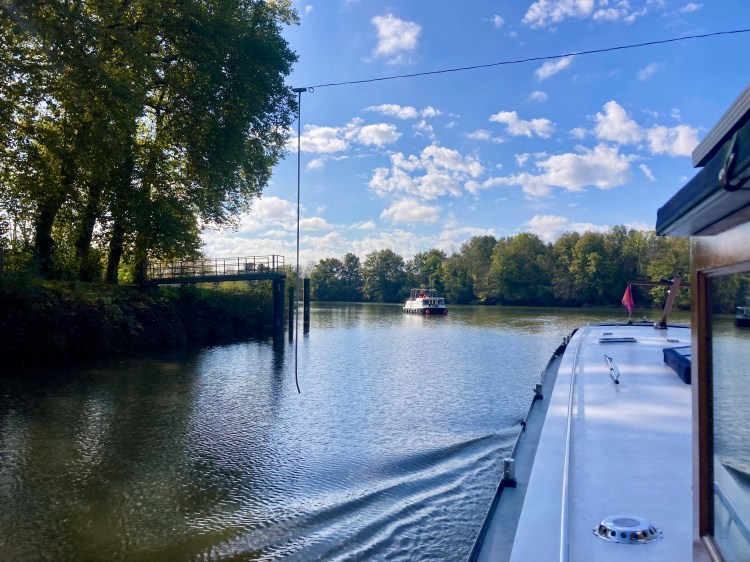
Just beyond Auxonne there is another deviation, with a lock the far end. We found ourselves waiting here for a while as a boat in front of us slowly organised themselves into and through the lock.
Then it was our turn. As we left we had a good view of the pole to be turned for boats heading up stream.
With just an hour and a half of the seasons cruising left we went on down the river past the junction with the Canal de Rhone au Rhin towards Saint-Jean-de-Losne (SJdL).

I was enjoying it so much I tried to make some videos of my joy at being on the water, but I am not yet any good at vlogging so you are spared that!

SJdL and its bridge appeared on the starboard bow and we noticed that the church, with its amazing Burgundian roof was now clear of scaffolding.
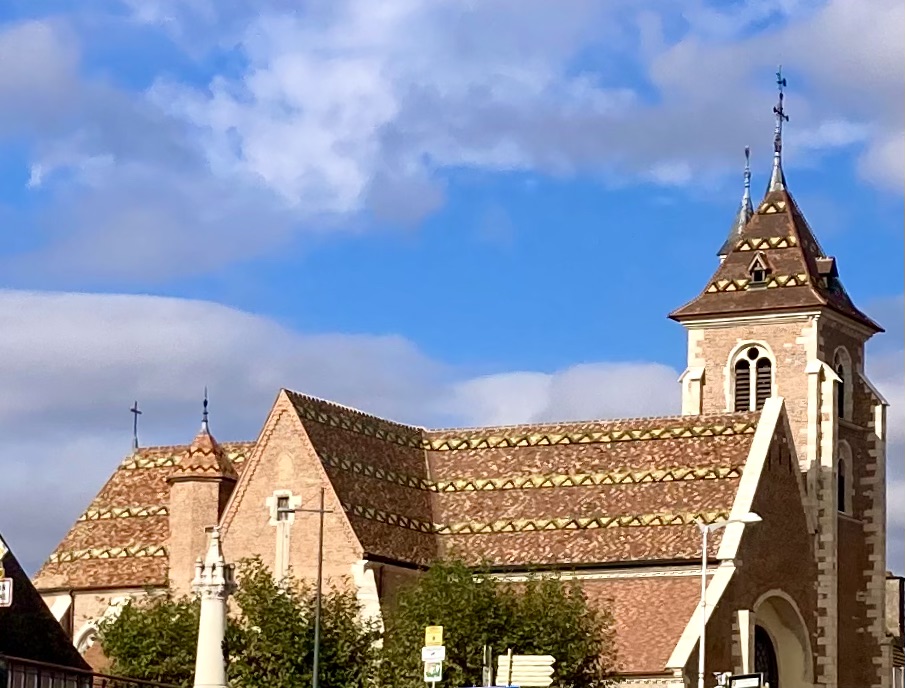
Saint Usage
Just after the SJdL bridge a turn to the right brought us into the entrance to the Canal du Bourgogne and the Port de Saint Usage – our winter mooring place for the past three years.

It only remained for us to go up through the lock and along to the far end of the basin.

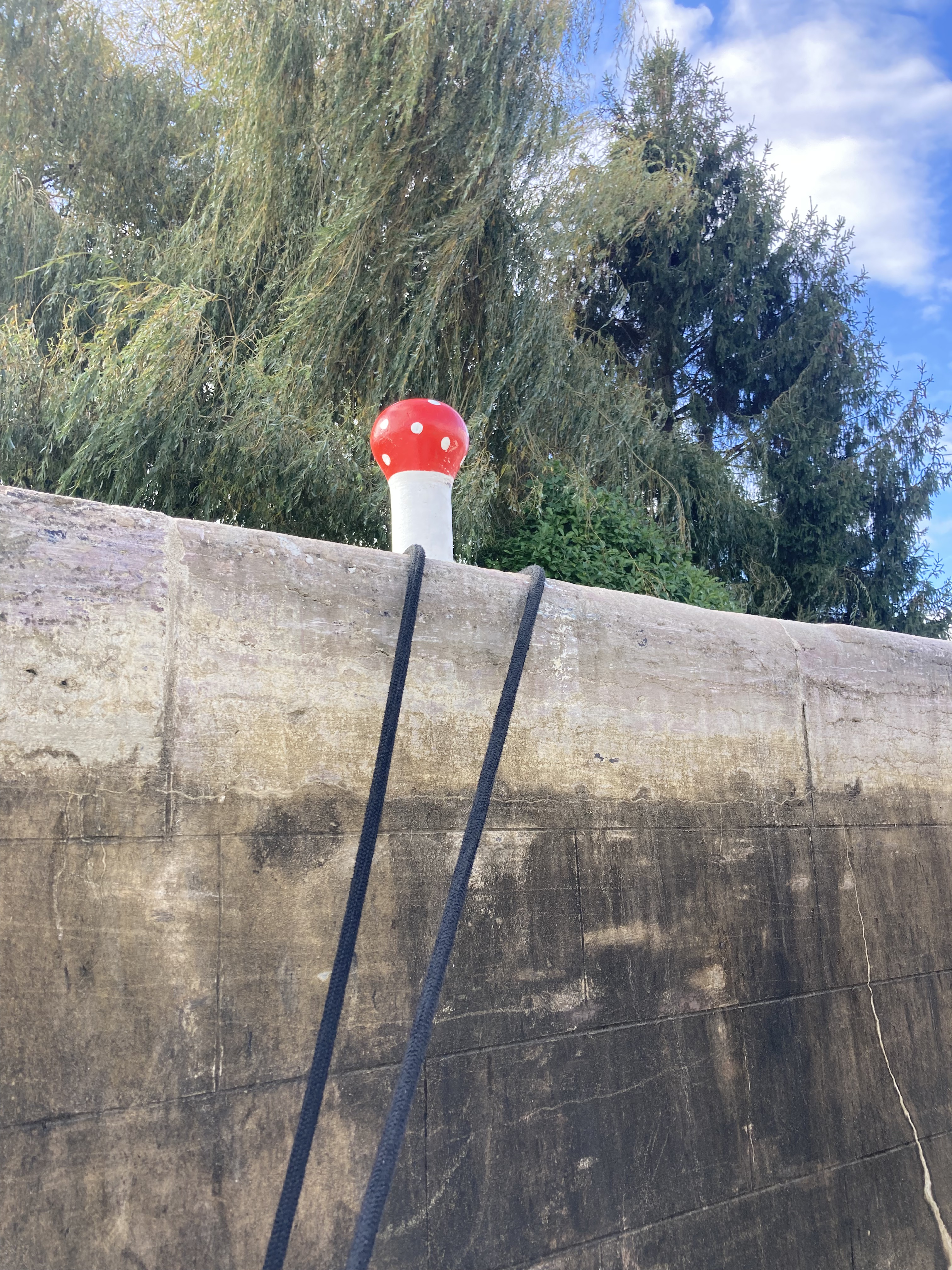
We reached the top of the lock and could see along to the far end of the port where we were due to join a group of other Piper boats in what has become known as Piper Port.

It feels good to be home among friends for the winter.
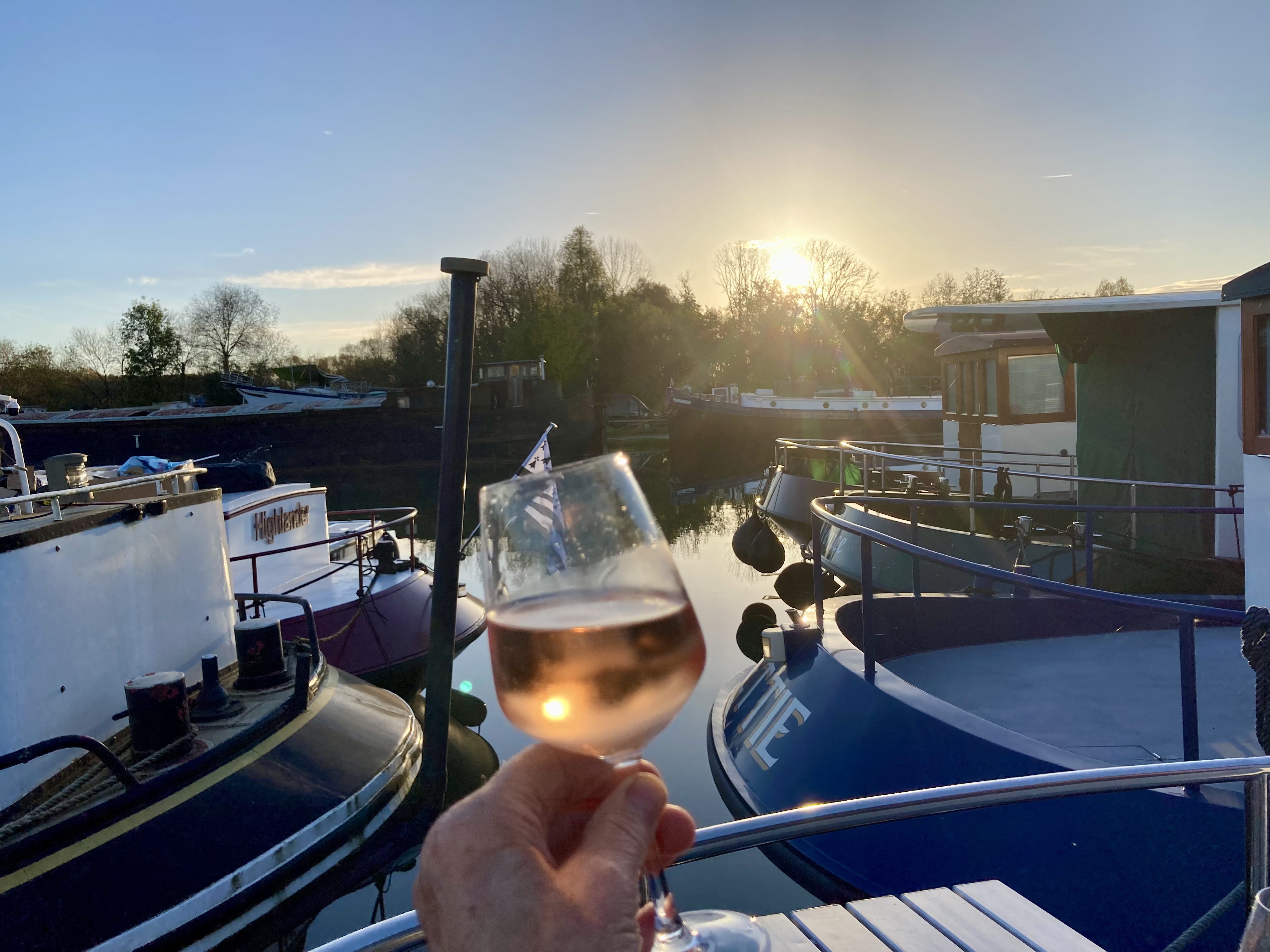
Cheers Calliope!
Cruising through until October has its own particular attraction; the Autumn colours and peace and quietness of the waterways more than make up for the cooler days for us.
But now it’s time to tuck the Old Girl up for the winter again, a gentle ritual we both enjoy with our own responsibilities to accomplish in our own time (the skipper especially).
This time though perhaps has an extra poignancy; after the most wonderful 10 year adventure with our beautiful ship we feel that it is now time to pass her on to younger owners.
When we return in April we will be asking Simon Piper to broker her sale.
Thank you all for reading the blog over the years,
Lesley xxx
(And Stu…)
 goodshipcalliope
Dear Crew Calliope, I am so sad you will be leaving your boating life! You have been such an inspiration- each year going twice as far as we do, and writing about each leg as if it was your first time. I have enjoyed reading each adventure, and have followed and moored at many of your favorite spots because you described them so well. We will miss you and your beautiful writings! Best of luck in your boat sale and your new life regards Steve and Maria Dulcinea >
LikeLike
Hi Steve and Maria. Thank you for the positive comments about the blog – very kind. I started it simply as an outlet for the (far too many) photos that I was taking, and then began to include things that I thought might be helpful to those following behind Calliope! She is not sold yet and I hope we will get another cruise or too aboard! But if you now anyone looking for a beautiful barge like this let them know! All the best for your future voyages. Lesley
LikeLike