
of the Canal Entre Champagne et Bourgogne
12th to 29th May 2024
[It took more than 3 times as long to go down the Marne side of this canal as going up the Saône side. Consequently this blog post is rather long and you might want to read it in chunks rather than all at one; your choice.]
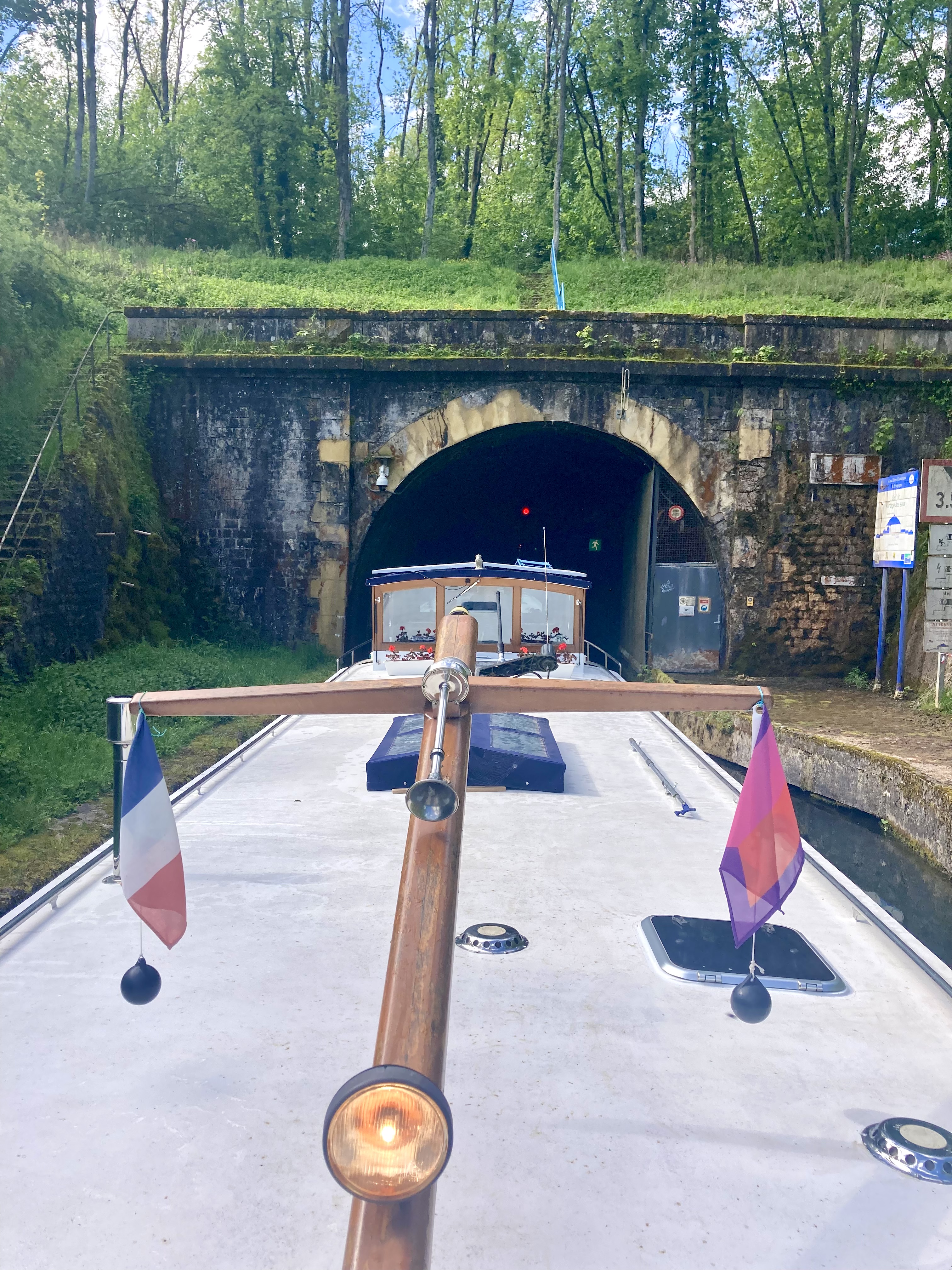
Over the previous 5 days Calliope and crew had ‘climbed’ the 43 locks from the river Saône to Heuilley-Cotton; if you are interested in that part of our journey it is in the previous blog post. Then it was tunnel time at the top.
We went into the Tunnel de Balesmere on the Saône side of the canal and came out on the Marne side. The source of the Marne is in the hills above the tunnel. At this stage it is quite a small river, but it will grow and grow over its 513 kms to its junction with the Seine just upstream from Paris.

Calliope was soon entering the first of the 71 locks that would take her down to Vitry-en-Francois and the canal that then runs lateral to the Marne.
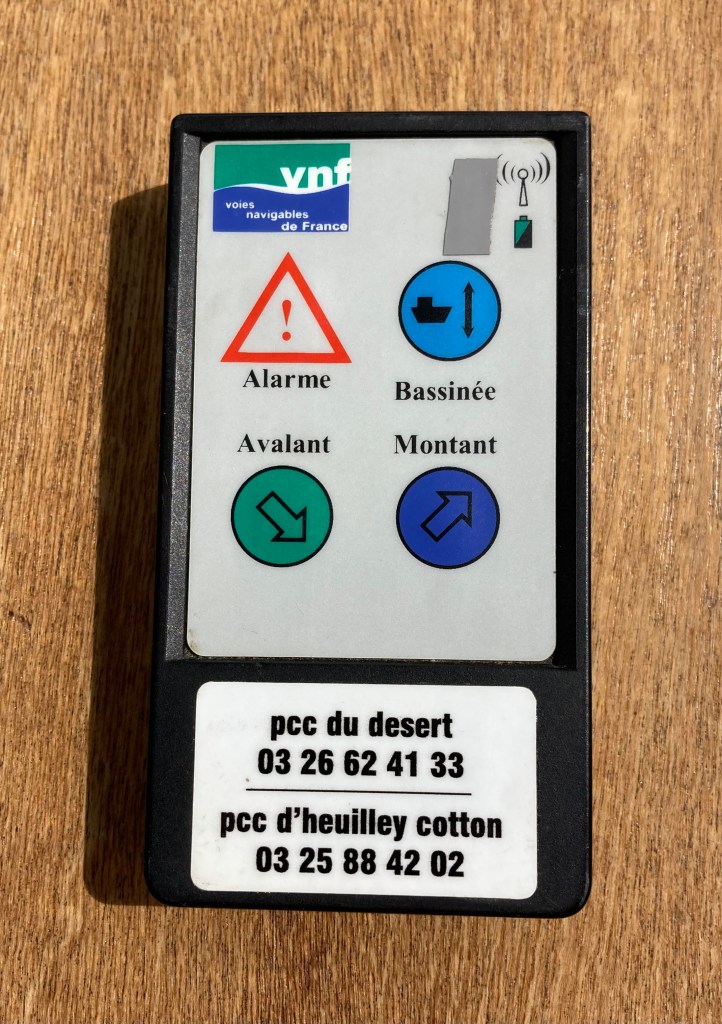
Now to remember we are going downhill and I needs to repose the Avalant button on the telecommand (remote control) that operated the locks.
I had got used to pressing Montant for 43 locks over the last 4 days!
I am not sure how long this version of the remote has been in use, but it is different to the one we had in 2018 – it is very useful to have the phone numbers of the two canal control centres on it.
Everything was going smoothly and we began our descent to Langres, where we would moor up for a couple of nights – and hopefully arrive in time to get some fresh bread for lunch – the first in six days! Its was just a 4km run, and as it was Sunday we needed to be there before the shops shut at 1230.

The landscape was a little different to the ‘other side’, but still gentle hillsides and cattle grazing.
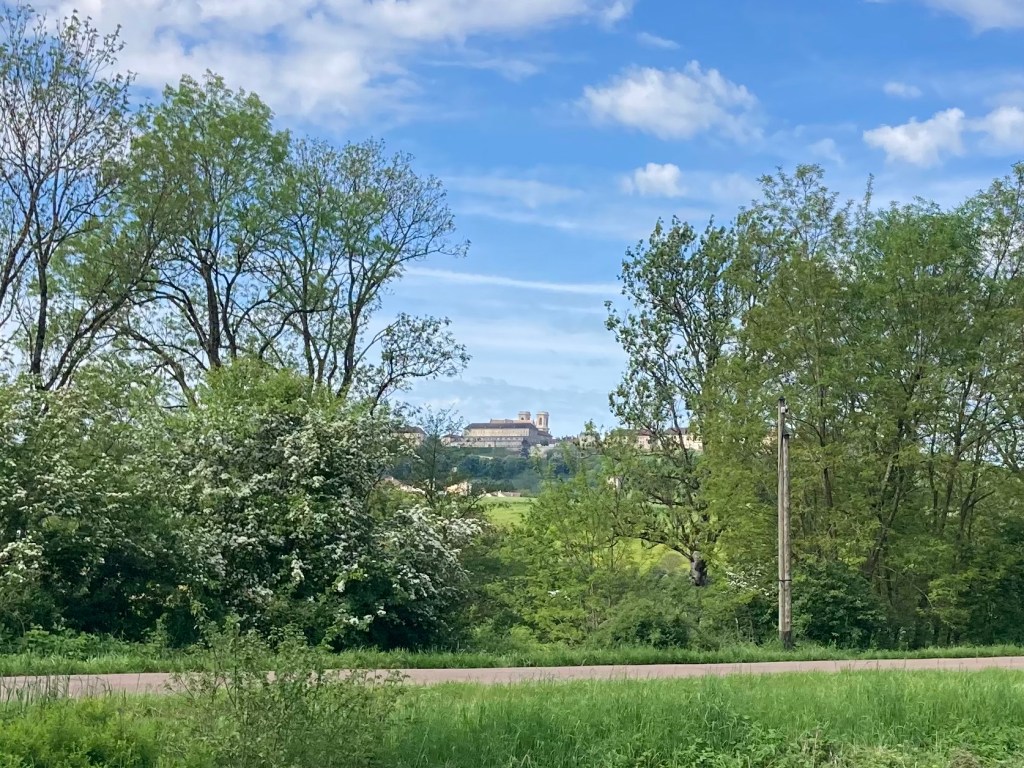
We caught our first sight of Langres through the trees, way up on its rocky cliff 130m above the Mane and the canal.
And then came to lock 2.
Where we stopped for a while!
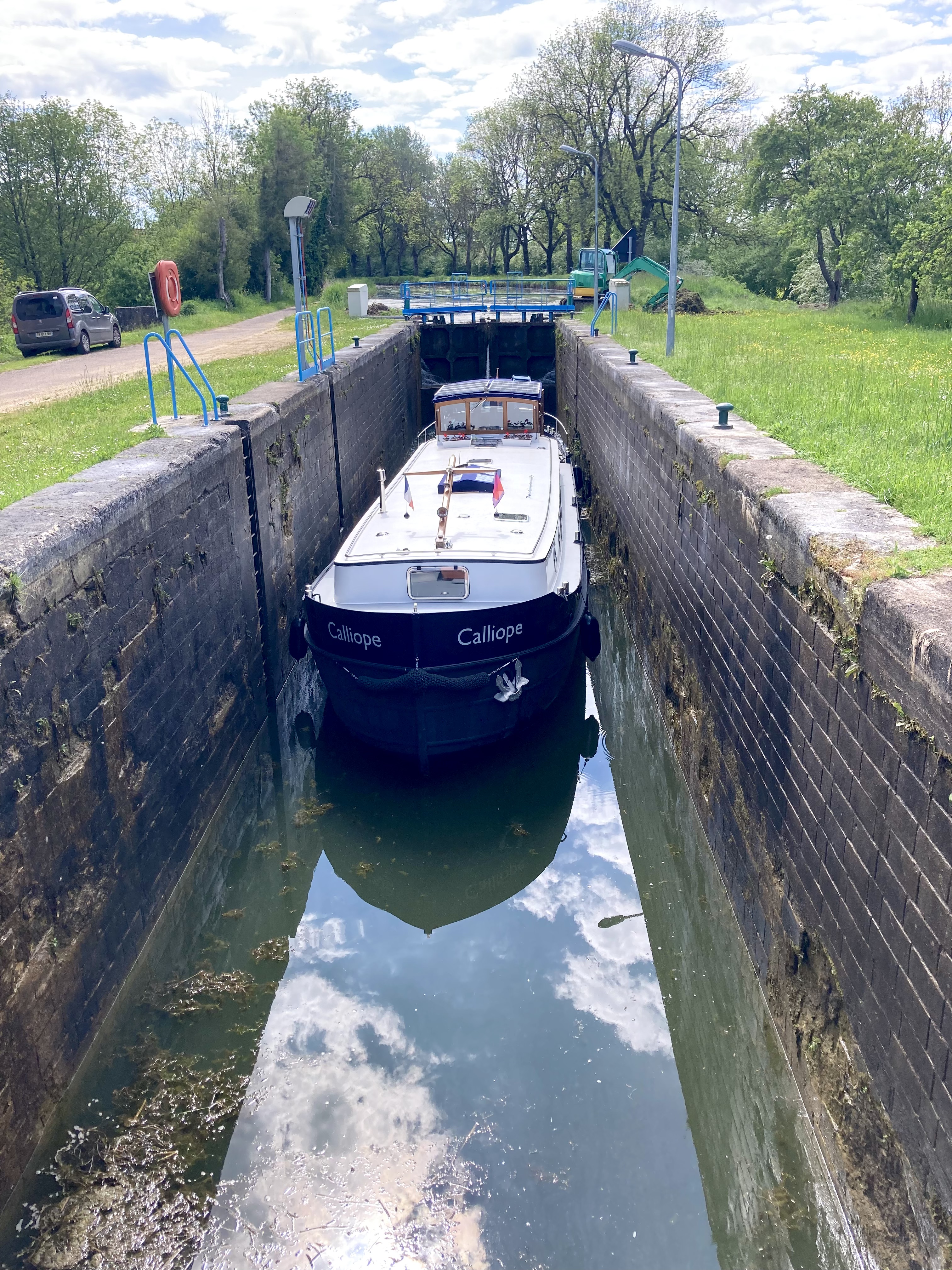
The lock dropped us down smoothly enough, but then the doors did not open to let us continue.

So its time to drop my rope, and up the ladder for the crew, and off to the little orange communication box that you can see on the hut.
(This is the alternative to using a mobile phone to call the number on the telecommand – we don’t always have a good signal out in the sticks.)
This put me through to the command centre at Heuilley-Cotton at the far end of the tunnel and a VNF service man (yes, it was a man) was despatched to sort it out.
We only had to wait about half an. hour, and during that time I wandered around taking photos.


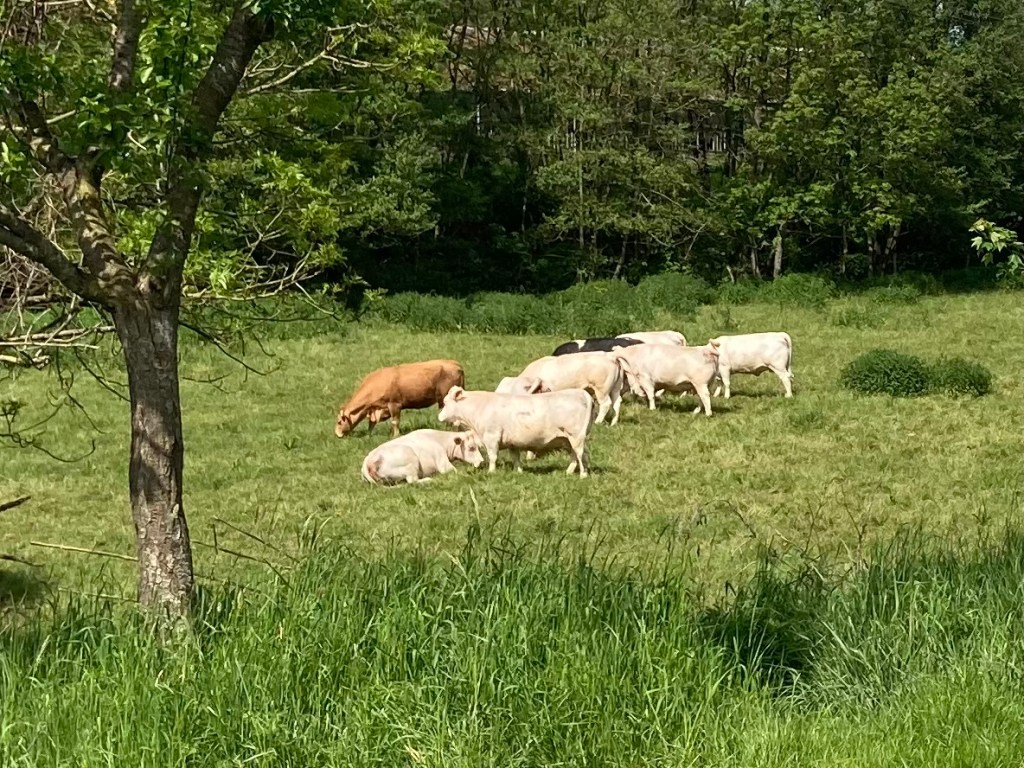
The wild irises are stating to show their yellow faces; the underside of some of the old bridges are interesting brickwork; a cappuccino finish to some swirling water, and a mix of cattle breeds taking it easy.
Langres
It took seconds for the lock to be back in action and the doors swung open to allow us on to Langres.
We were too late to get our fresh bread, but there was a good long space for us to join other boats on the quay. Most of them were empty and looking as if they were still packed up from the winter before. In fact the whole port had a slightly deserted look.

Although the bournes were supplying water all the time they only supplied electricity for 3 x 2 hour time slots per day. The Capitainerie was closed up, so maybe we were just too early in the season. Previous visits have felt livelier.
Anyway we were able to tuck into a good lunch on board, using wraps for the store cupboard; we did not go hungry.
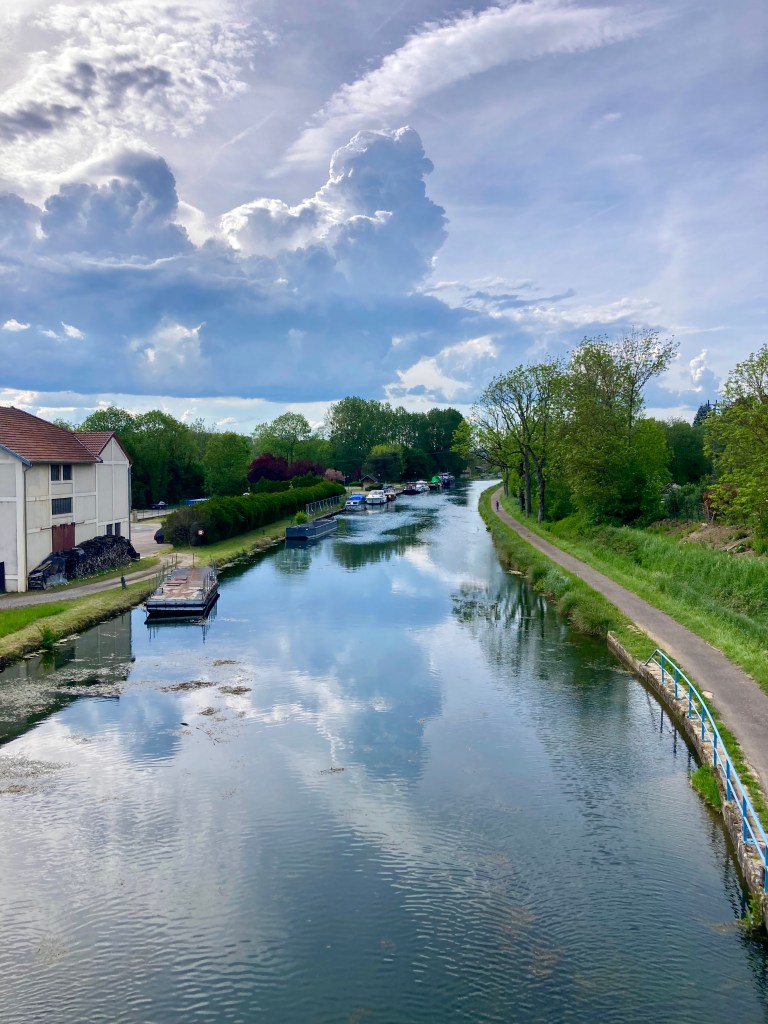
We decided to take it easy for the rest off the day. I took a short rectangular walk along the canal, using the road bridge and the next lock to cross from side to side.
The view from the bridge shows the long line of boats in the port further back on the left.
I got back as storm clouds were gathering ….

And sure enough we were treated to a lightning and thunder show, followed by heavy rain. We always enjoy the feeling of snugness and dryness sitting in Calliope’s wheelhouse hearing the rain drops on the roof.
The following day had been earmarked as a re-provisioning day. We knew it involved walking up a steep hill to the nearest supermarket – indeed the nearest shop of any kind!
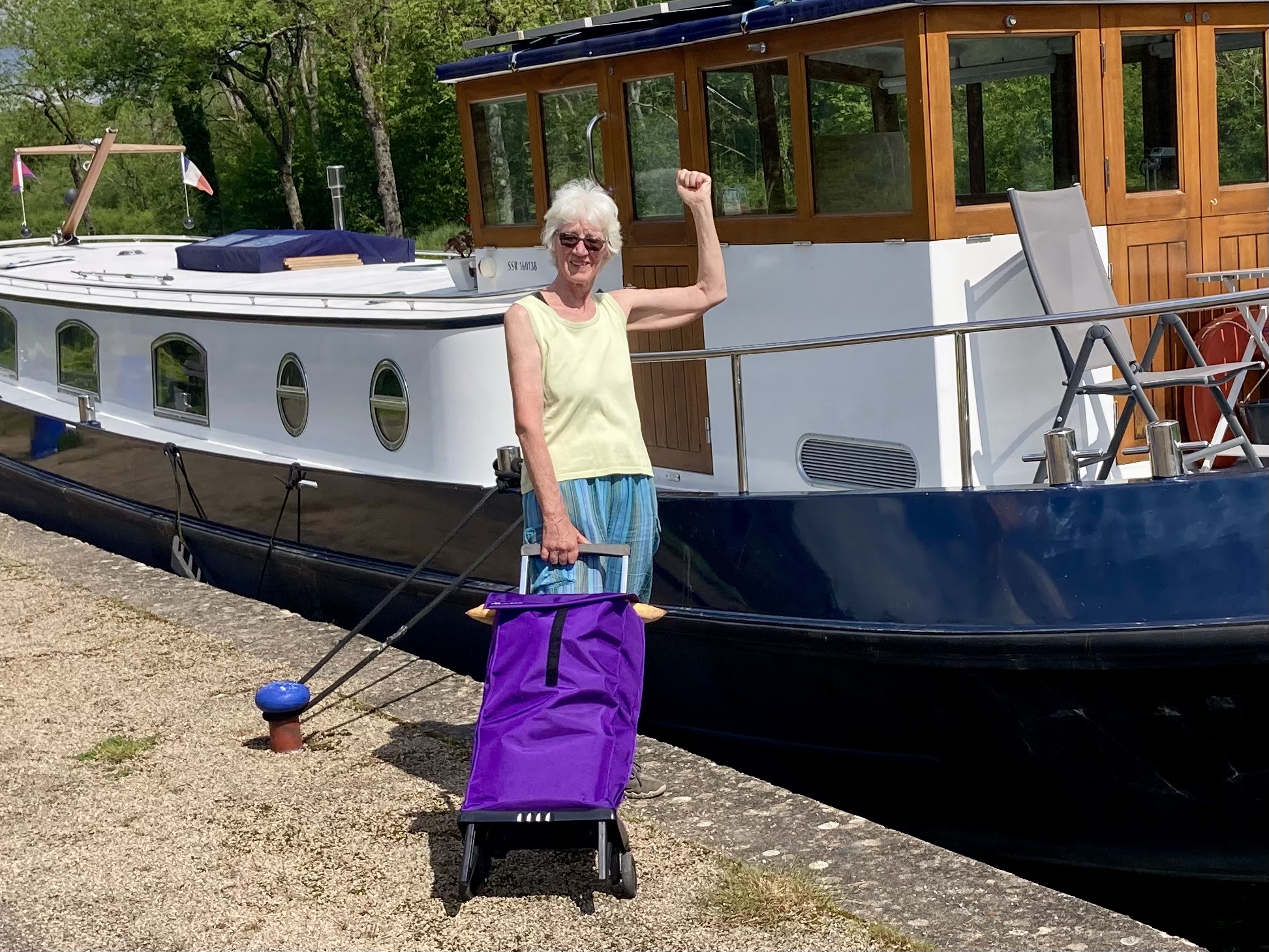
It was time to try out my birthday present in earnest – a shopping trolley! But not a tartan trolley like my grandmother might have used – a modern bright purple folding trolley that anyone would be proud to roll with.
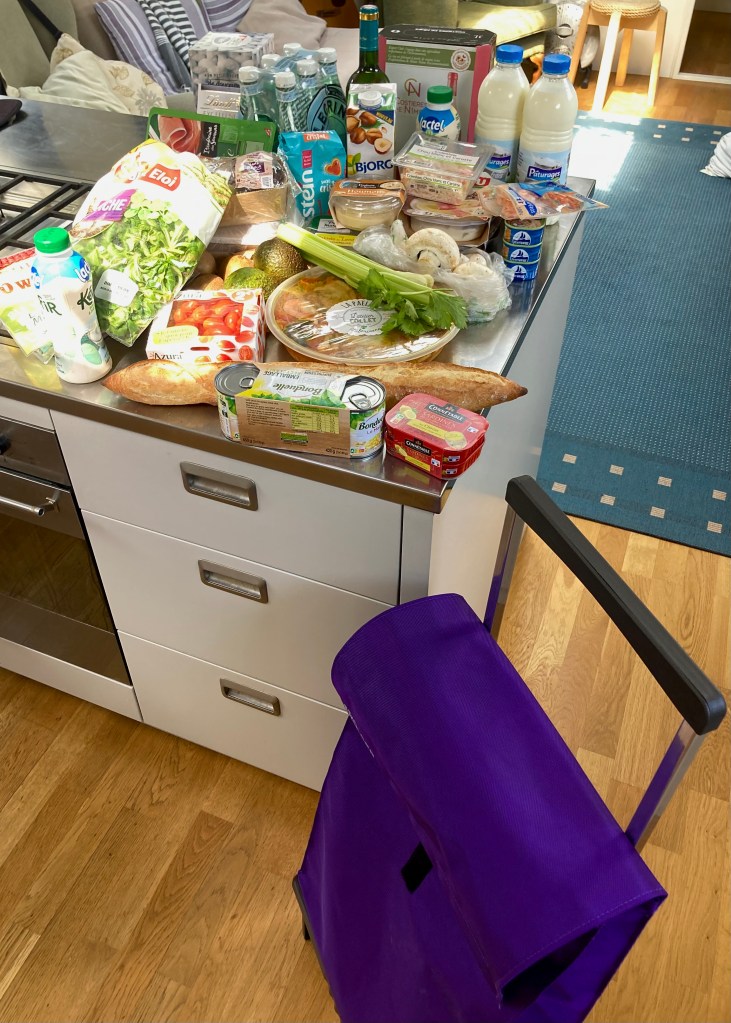
Stu and I went up and back to Intermarché, returning with a full and heavy trolley. It was pronounced a great success.
And enough yummy stuff to keep us going through quite a few days of (shop) barren lands ahead.
(Yes, several ready meals! After working our way through locks for several hours we find neither of us are keen to start cooking!)
After a much enjoyed lunch with our first fresh baguette for 7 days we set about two watery tasks – topping up the fresh water tank and trying out the new high pressure pump to wash grime from the locks off Calliope.
Using the fresh water taps at ports for washing your boat is frowned on – in fact it is forbidden at many ports. Our pump is able to take water from the canal instead, so we knew we were within the rules.

A pleasant day ended with a very different sky to the night before and a quiet calm evening in the port.
Rolampont

It was pleasant to see a mainly blue sky next morning as we set off for our locks down.
At the second lock, Jorquenay, I was still carefully remembering to press the Avalant button, and soon saw a green light at the lock telling us the gates were open and we could enter.
This lock overlooks the little village of Jorquenay and is swiftly followed by a pont levée, or lift bridge, which also was operated by our remote control.
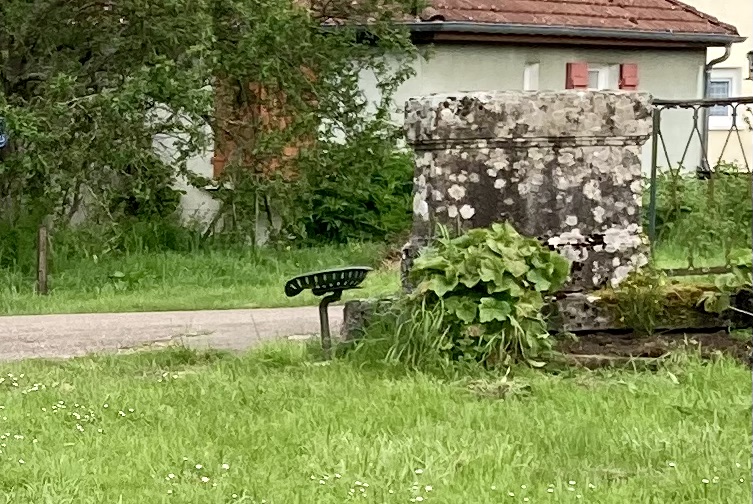

As we went through Jorquenay I noticed that someone with a sense of humour had placed an old tractor seat at the end of the bridge, presumably to give people a chance of a rest as they moved around the village – the top left photo.
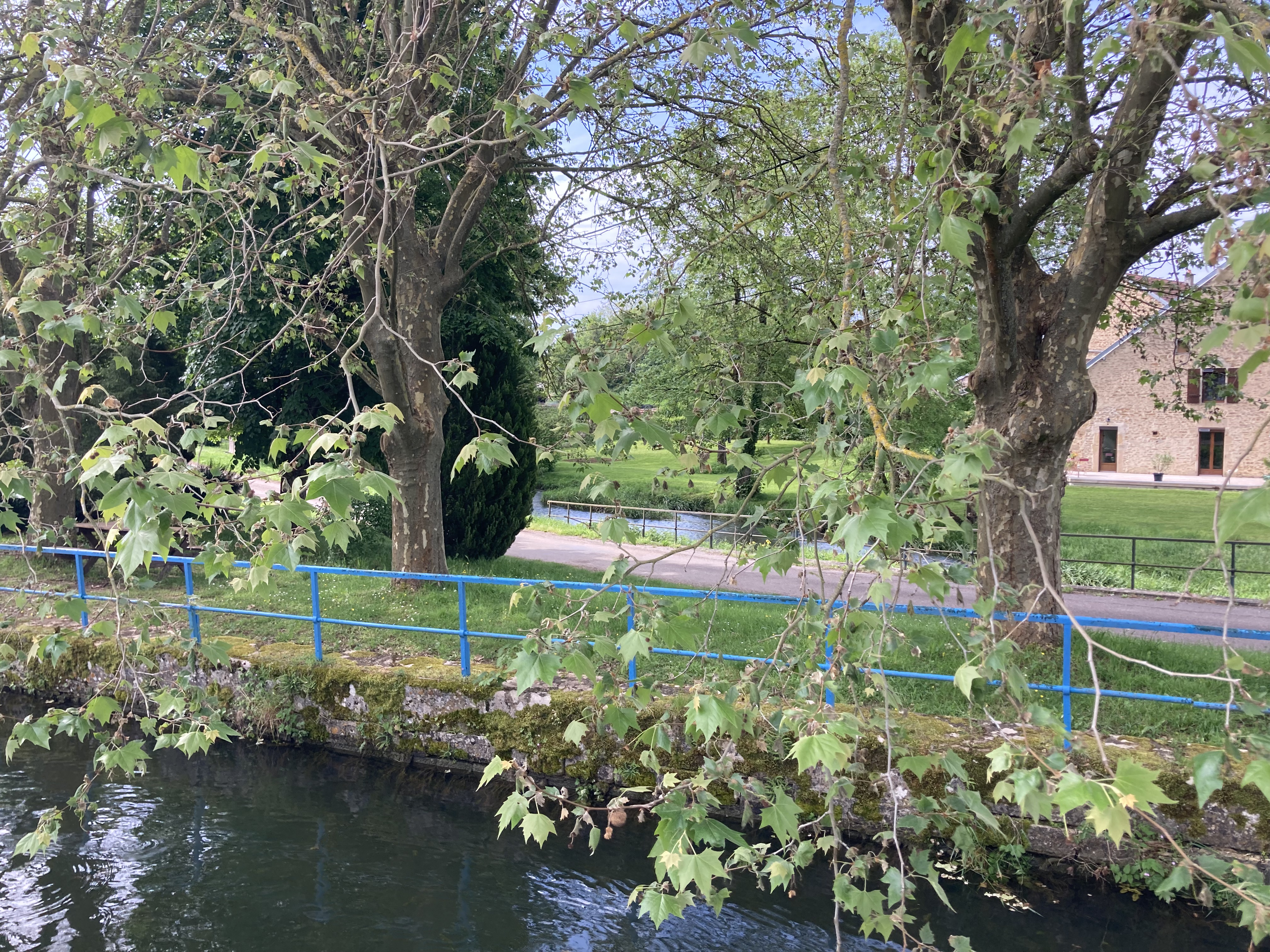
The other photo attempts to show how the Marne is running alongside the canal – the water bottom left is the canal, and the gleam of water more in the centre is the river.
The river was our constant companion for miles – often within sight and never further than a field away.

The stretch after the bridge along to Hûmes was somehow narrower and more confined, but we did not meet anything coming the other way.
It followed the contours of the landscape for about a kilometre and then broadened out as we came to the next écluse (lock).
This lock confused us at first. As you approach a lock there is almost always a red light. Then, when you press the telecommand button, a green light apprears as well; this shows that the lock is in preparation mode.
Once the lock is fully prepared the gates open, the red light goes out, and just green for GO is left illuminated.
But on this lock we never got a green preparation light, and as the lock gates opened we had no light any all.
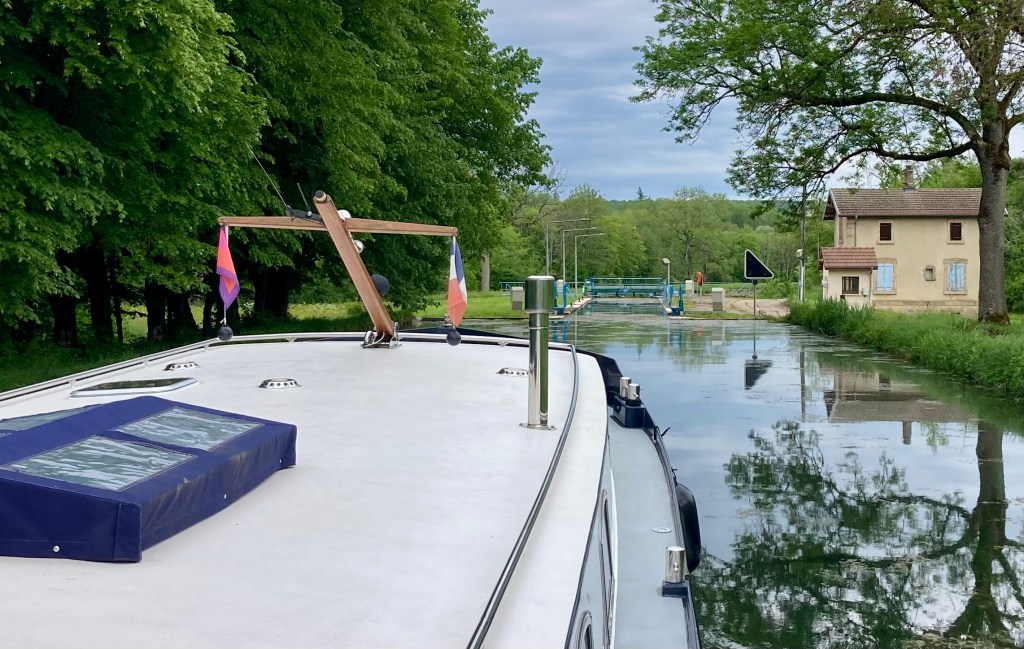
We decided to go into the lock and if it didn’t respond to the next telecommand command we would call for help. In fact it operated perfectly and we concluded that it was simply a case ofd the green light bulb needing to be replaced.

But the next lock truly was inoperable! We could see no lights were showing and a VNF van – plus smoke rising from a welder at work. One of the VNF guys walked along the bank to explain that we would have to wait 5 minutes. Fine by us.
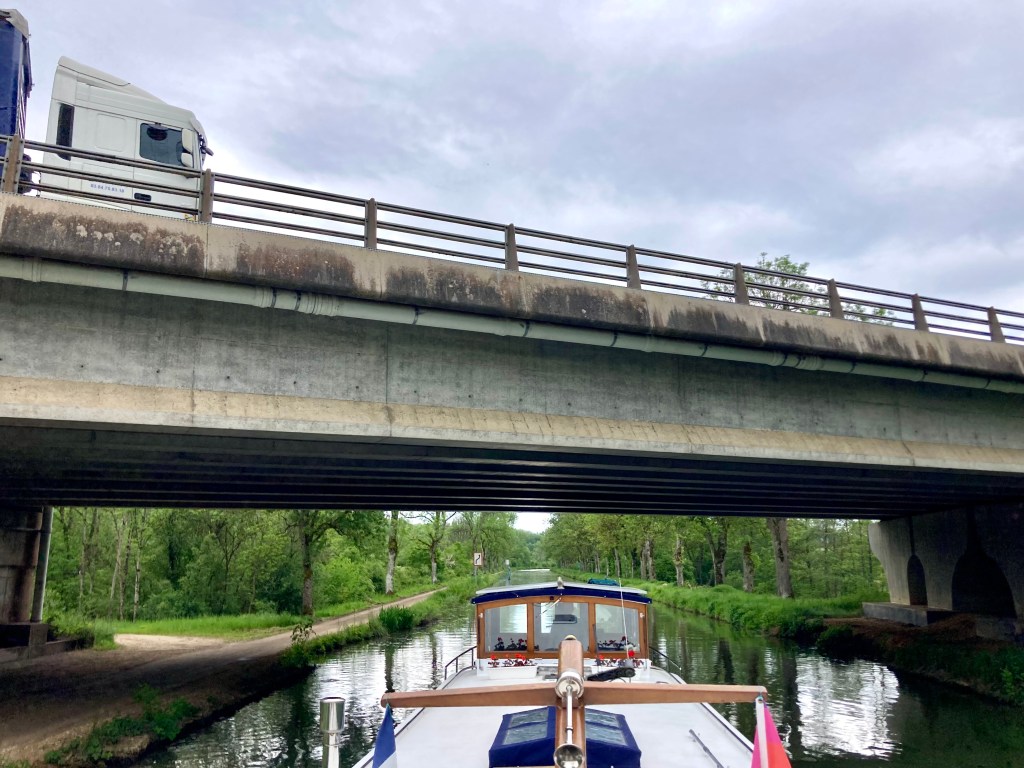
Stewart let Calliope drift back a 100m or so, ending up under a motorway bridge!
We knew the 5 minutes would be more like 10, and in fact was closer to 20, but its good to see work being done to maintain and improve the canal.
Soon we were through and waving goodbye to the working team. We did not have much further to go to reach the overnight stopping place.

We knew the mooring from a few years before. It is just on the edge of Rolamapont next to a small park – a pleasant location, but just a 30m quay. So we were pleased to see it empty when we arrived and tied up comfortably, leaving 10m spare for any other boat that arrived.
It felt extra good to be moored up as we had a date for later that afternoon – watching the live streaming of one of our granddaughter’s MA graduation ceremony. As there was plenty of time before we settled down for that we took a short walk around the village.
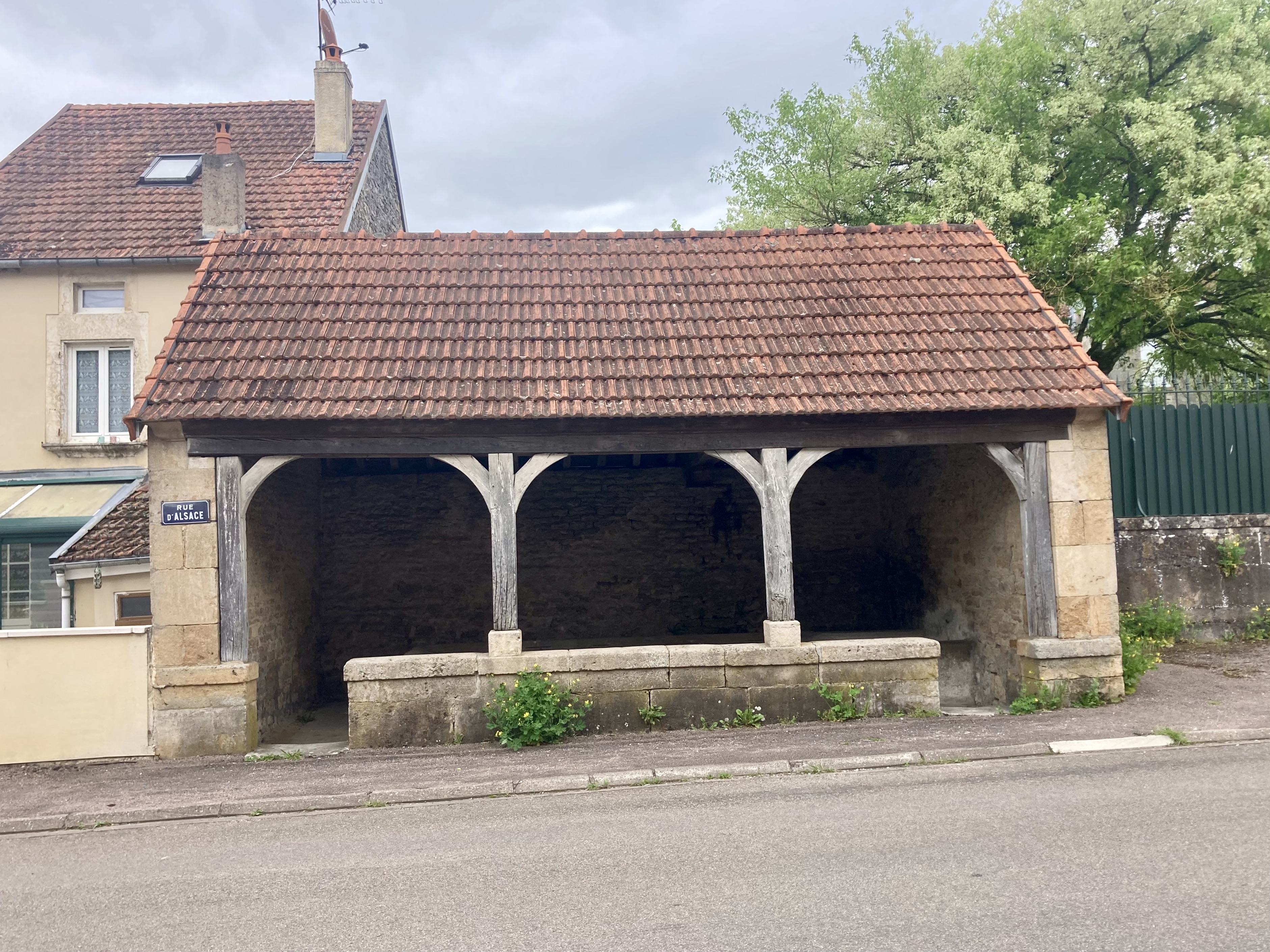


It has a lavoir that was for the chateau on one side of the Marne, and a church, an old school, that is now a town hall and a few shops on the other. It is a pleasant place to stop; the local bar restaurant looked well worth visiting but we were already sorted for food that evening.
And after toasting our grand daughter’s success we settled down to a quiet evening; very pleasant.
Foulain
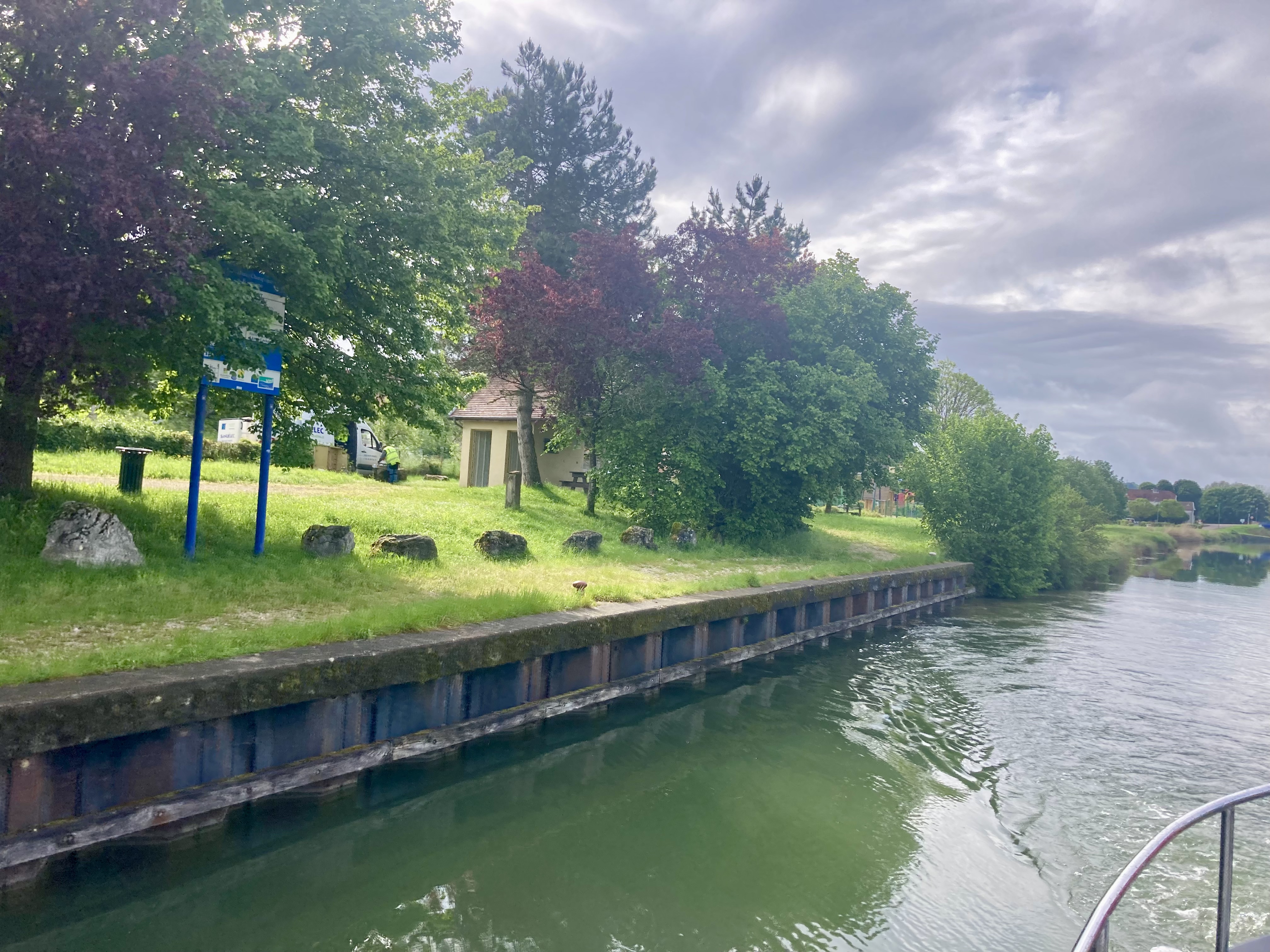
Leaving Rolampont at 0900 we looked back at the mooring, remembering how last time we were there we had moored one (overlapping) end of the boat to one go the granite boulders! Well it had worked, no problem.

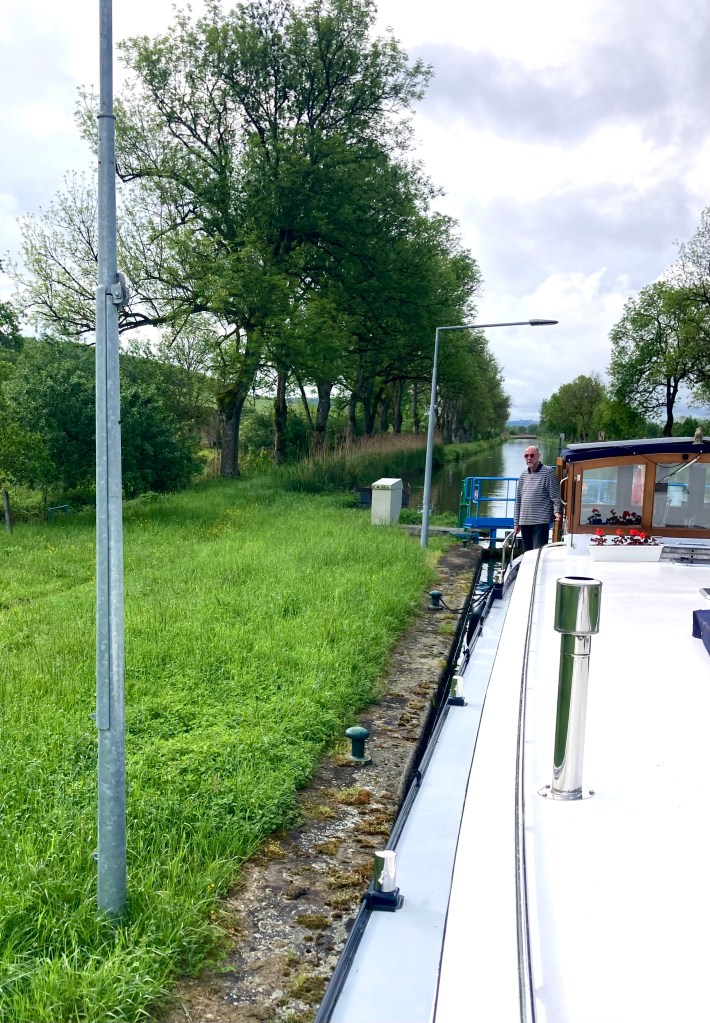
Within twenty minutes we were at our first (of 7) lock of the day. Captain and crew looked happy to be out and about in the fresh morning air.
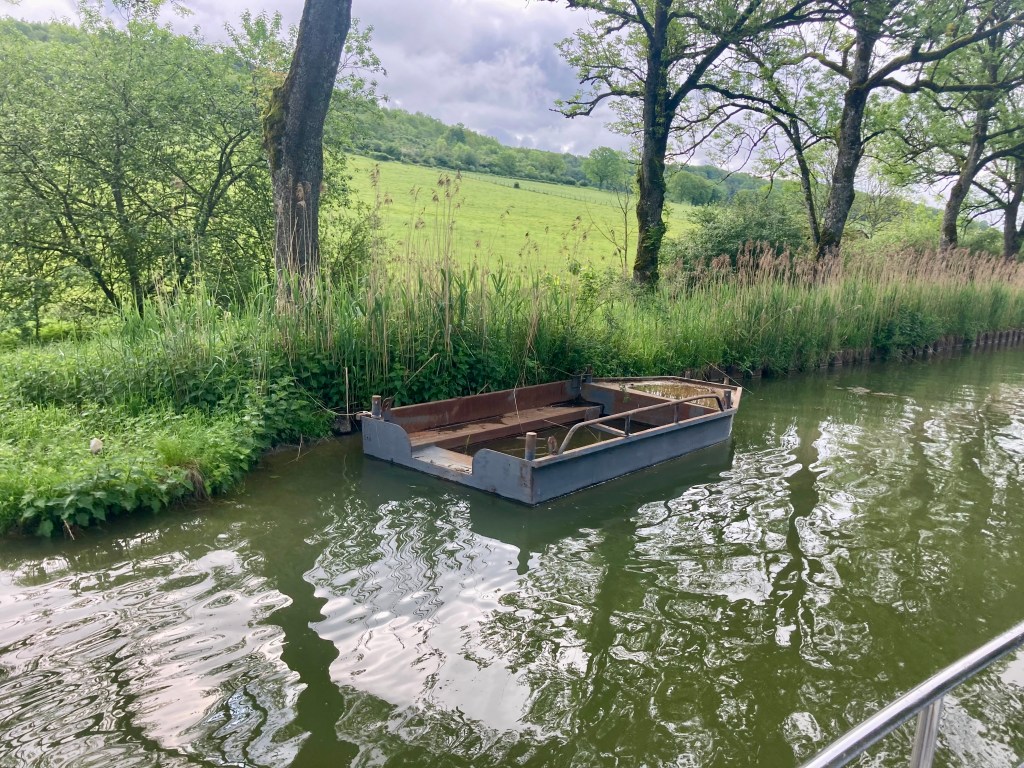
There were two little ‘features’ that I photographed at the lock. One was a small metal work boat, used for moving around the lock area to remove debris etc. Why don’t metal boats sink???? It’s lucky they don’t as Calliope is made of steel!
(I know it’s all about displacement, but still seems magical to me.)
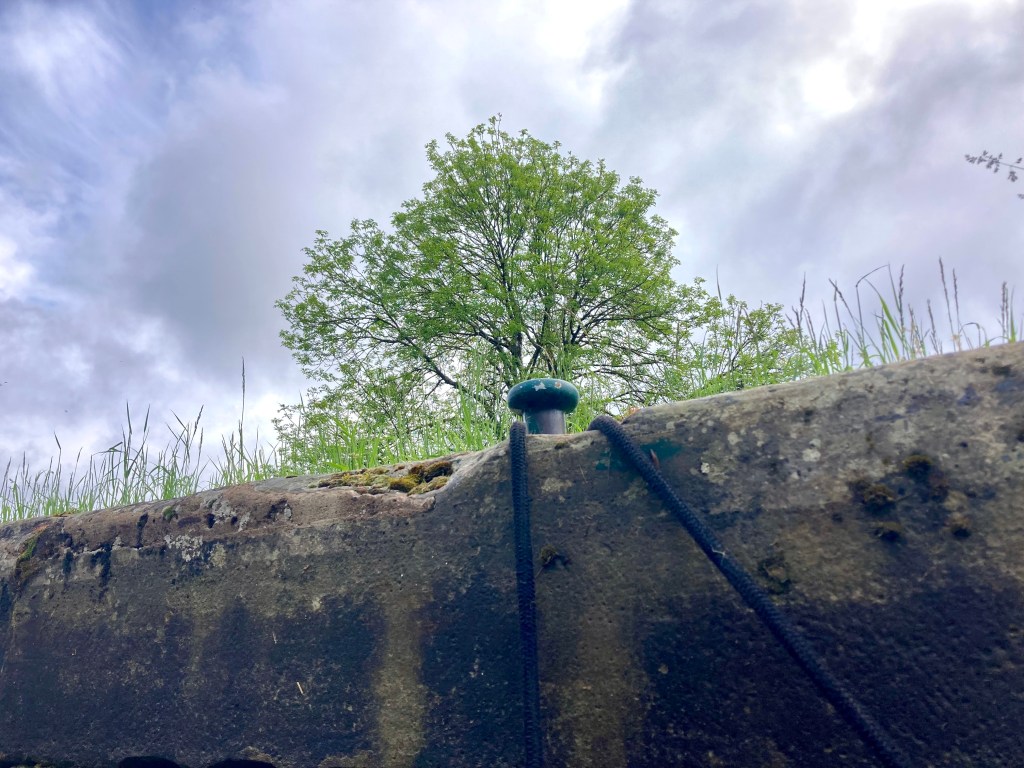
And the other photo, up to the right of my smiling face, is another example of how ropes over the decades have rubbed grooves into the stone caps of the lock walls.
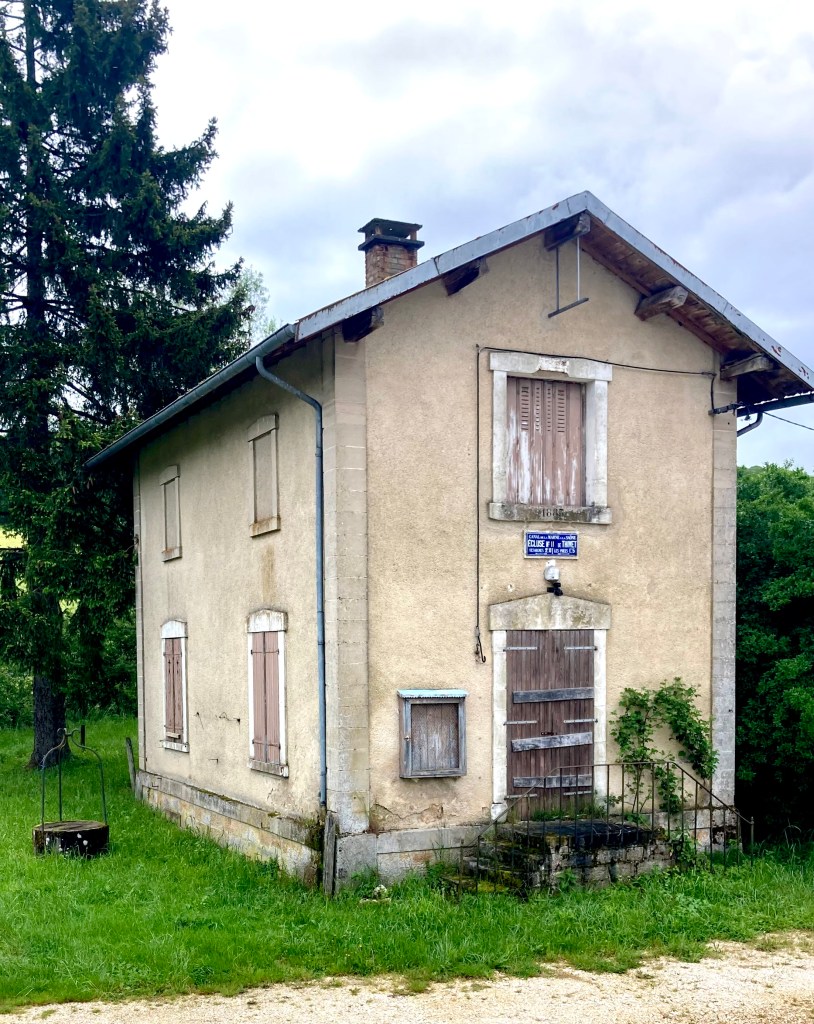
The next lock, Thivet, had one of the abandoned lock houses, far to common along the canal.
With automation comes redundancy for many éclusiers (lock keepers) and as well as losing their job they lose their home.
This one, with its well in the garden and steps up to the front door, is typical of many we passed.

Calliope continued under heavy skies and a change of cattle! We were starting to see more dairy cows and less beef herds.
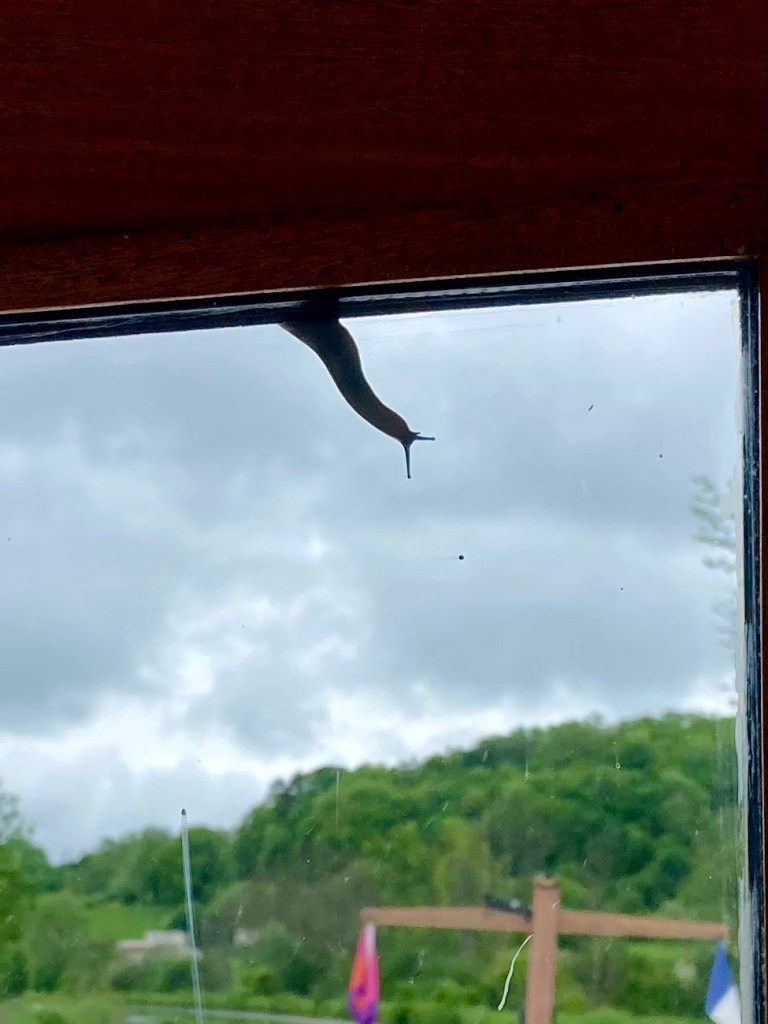
And while on an animal theme, this little charmer made us smile with his cheeky hello.
At Marnay lock I noticed a sign on the lock house advertising fresh eggs for sale. A man emerged form the house and as Calliope began to descend in the lock I quickly asked if we could buy some eggs.
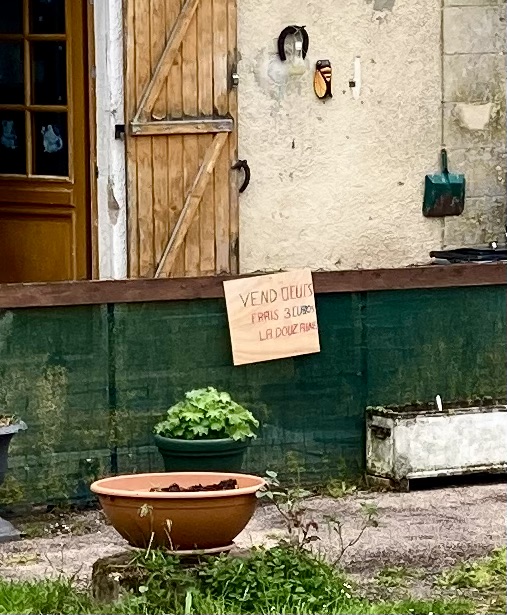


He disappeared into his back garden and returned with a dozen. Stewart handed over €3 and the deal was done. When we came to eat them they were genuinely tasty.


With the canal following the Marne valley it meant that we had quite a meandering course at times! The map gives a better indication of this than my photos of Calliope going round bends – think I need a drone!

When the canal gets too full of water these overflows allow excess water to run down into the Marne, or whatever river is nearby.
Five minutes later and we were in a lock with an interesting array of bridges before us.
The two blue lock bridges, the rusty old railway bridge, and between the two, further away, the beige line of the newer railway bridge.
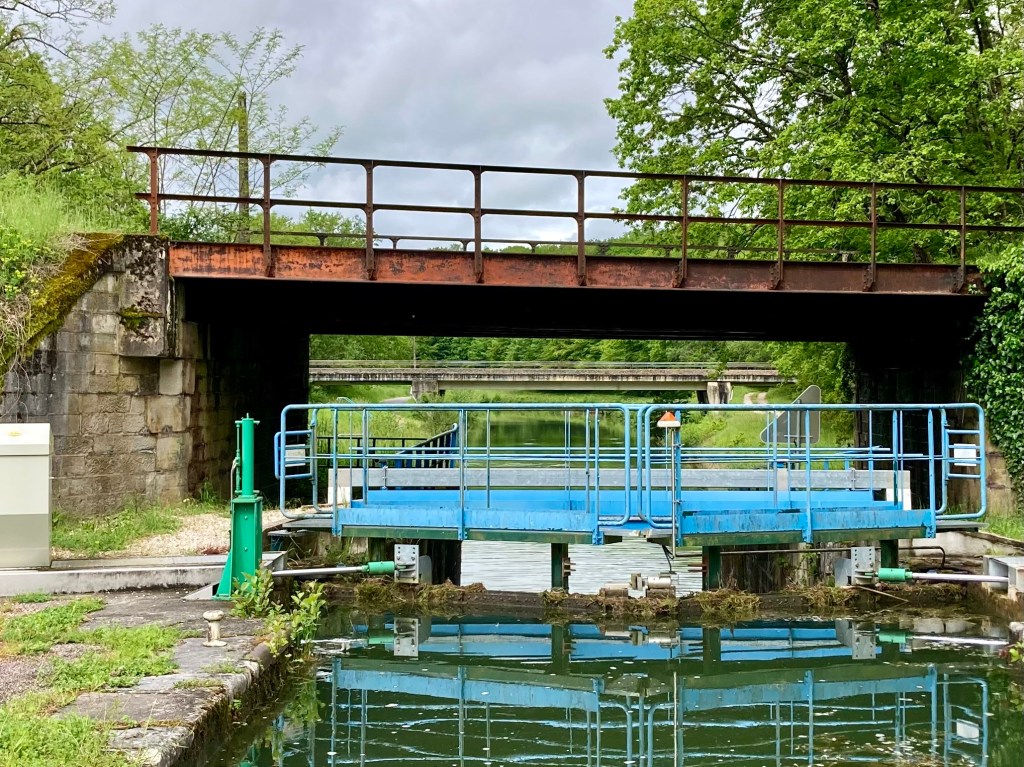
Then the gates opened and the bridges came fully into view.
(I’ve also just now noticed the up-turned shot glass protecting our jackstaff socket in the photo, which has been there for eight years now after a bit of an interesting manoeuvre on the river Somme in our first week in France lost the original flag pole to foliage ……)

Its was definitely a day off bridges!
At the next lock, Pre-Roche, we left under two bridges, the second of which was quite low!
But enough room for Calliope’s 3m air-draught to pass through without concern.
There was just one more lock before the end off the day’s cruising.
And as luck would have it this one broke down when we got to the bottom! The bottom doors did not open to let us out; it happens at about 1 lock in 8 on this canal so we are used to it and happy enough waiting.


It was up the ladder for me – something I enjoy – a call to the VNF, and then wait in the wheelhouse for help to arrive. To be honest it is often possible to call the VNF from the bottom of the lock, but I so like the scramble le up the ladder that I pretend I need for mobile signal! Looks like the skipper’s catching up on the news – or doing a crossword…
The wait can be as little as two minutes, and as much as 40.
On this occasion it was about half an hour, and when the lock gates opened and we left (beneath another bridge!) we saw that a boat had been waiting below for the lock to be mended, so that they could go up!
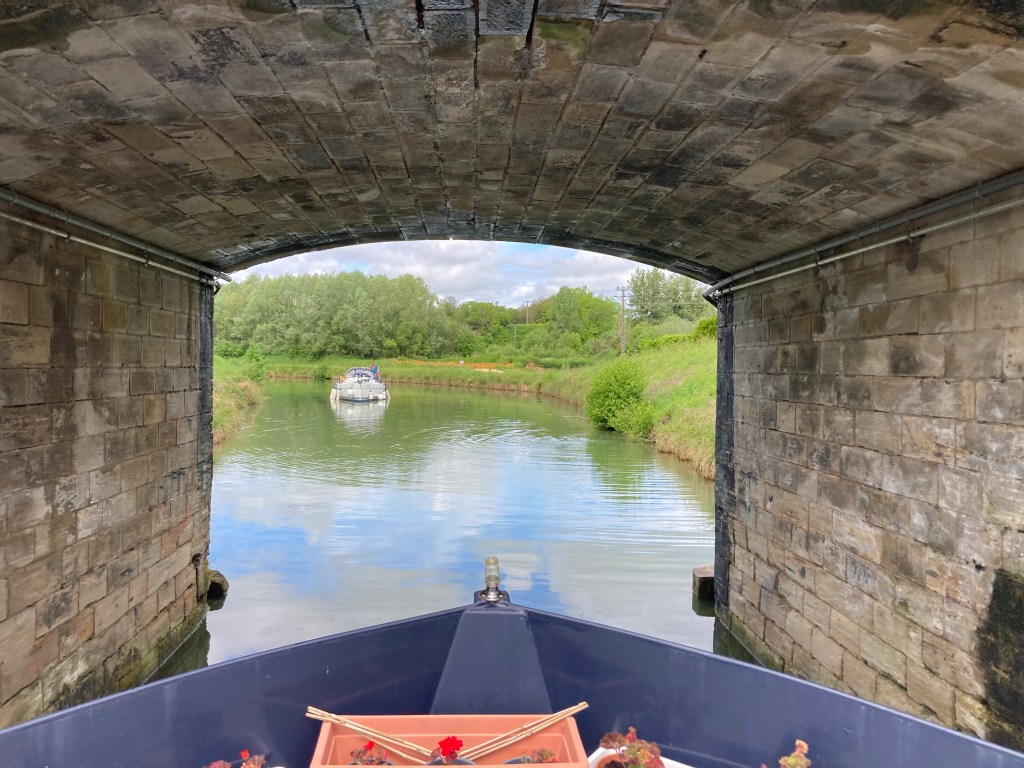
A quarter of an hour later and we arrived in Foulain. Not only that, we could see that the two quays were empty and we had our choice of mooring place.

Foulain is another mooring we have stayed at before, and really love. It is so quiet and the scenery around is beautiful.

It did not take long to get tied up.
Then we could relax for the day, initially with lunch, a rest and some crosswords (or in my case, Wordle!)
We did go for our customary walk in the afternoon. There is not a lot to see in the village nowadays, but there is a new small epicure, an old church set well up above the Marne flood levels, and evidence of past industry.
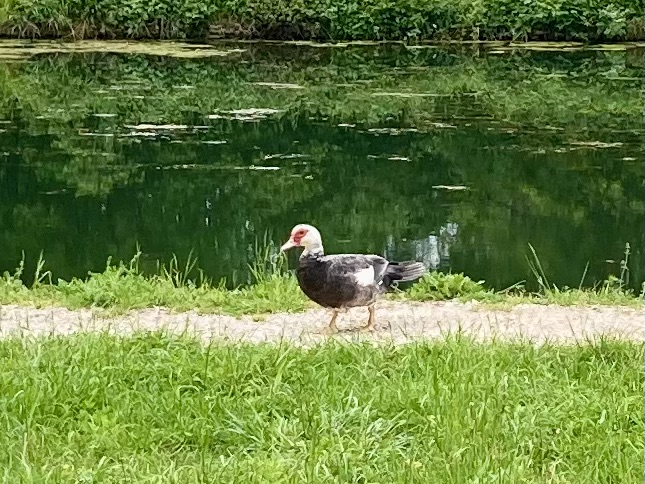

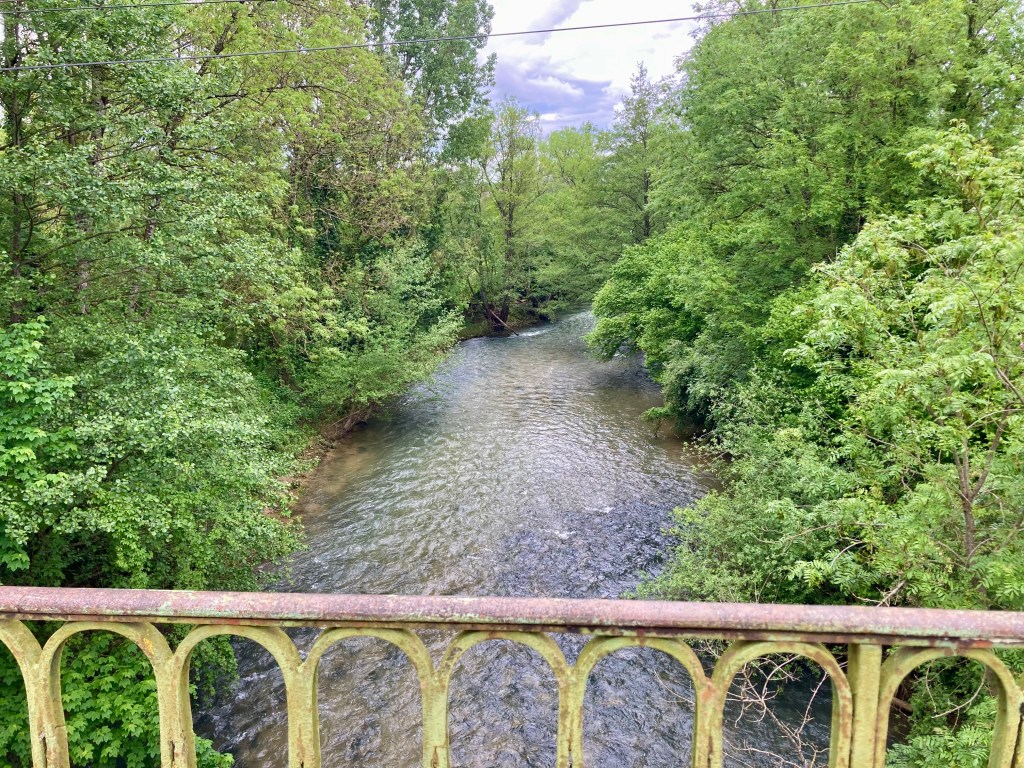
A Muscovy duck was plodding about, the wild irises were beginning to flower, and the Marne flowed on between the canal and the village; plenty to enjoy in a calm way.
Another barge arrived to take the second mooring place and Stewart went out, in the rain, to help them tie up as the bollards are set well back from the pontoon and surrounded by longish grass. This bit of help gained us some new friends – British this time – and we found we had many tales of places, people and boats in common.

We had been watching the weather forecast and had had repeated warnings about imminent thunderstorms.
Finally all the black and grey clouds coalesced at Foulain and we had a good downpour.
That was us for the night, tucked up dry in Calliope.
Chaumont
We set off at 0900 with baguette and croissants on board brought to us by Christine on the other barge; she had been to the shop on the village on her bike and kindly brought us the goodies.
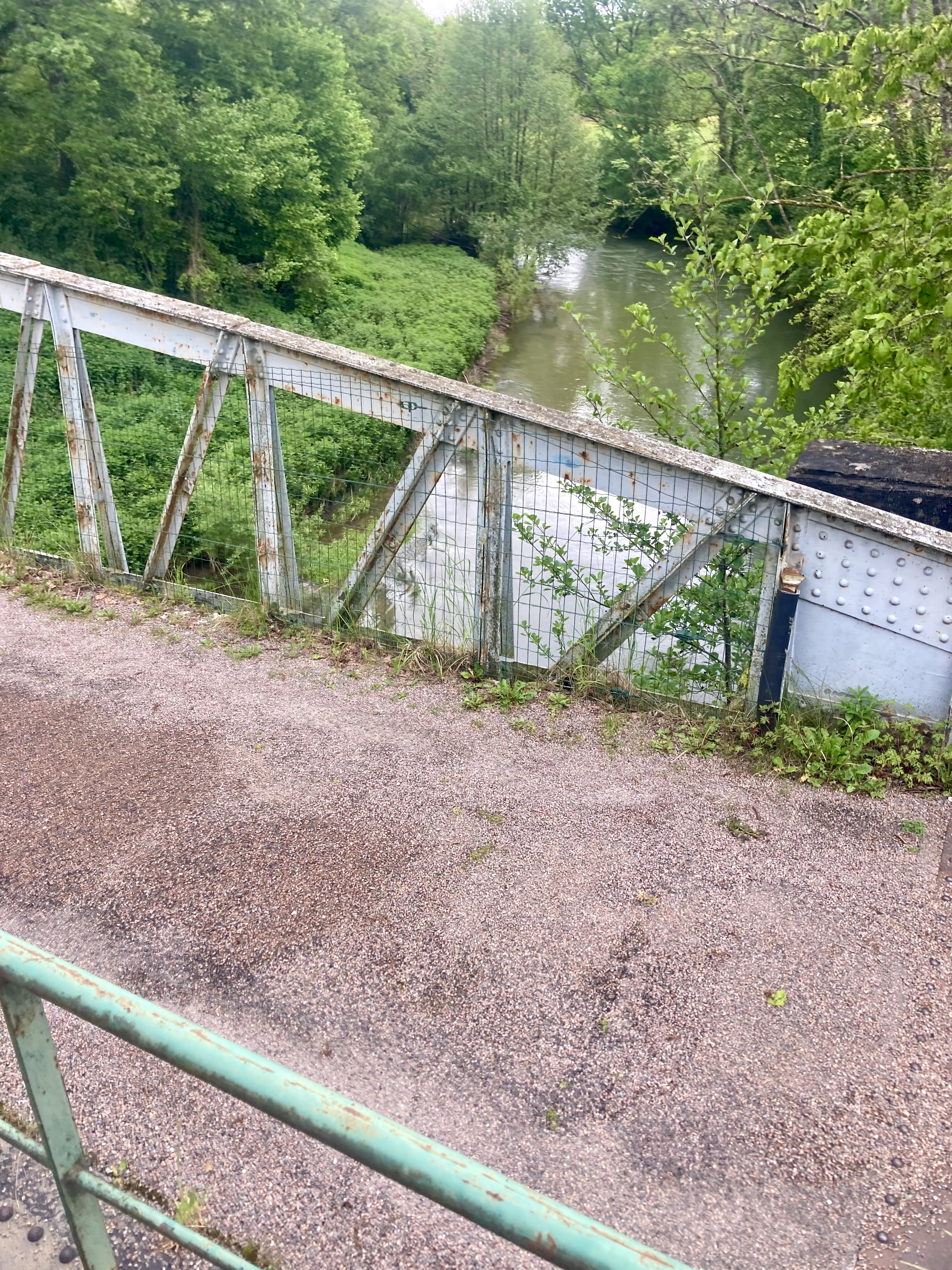
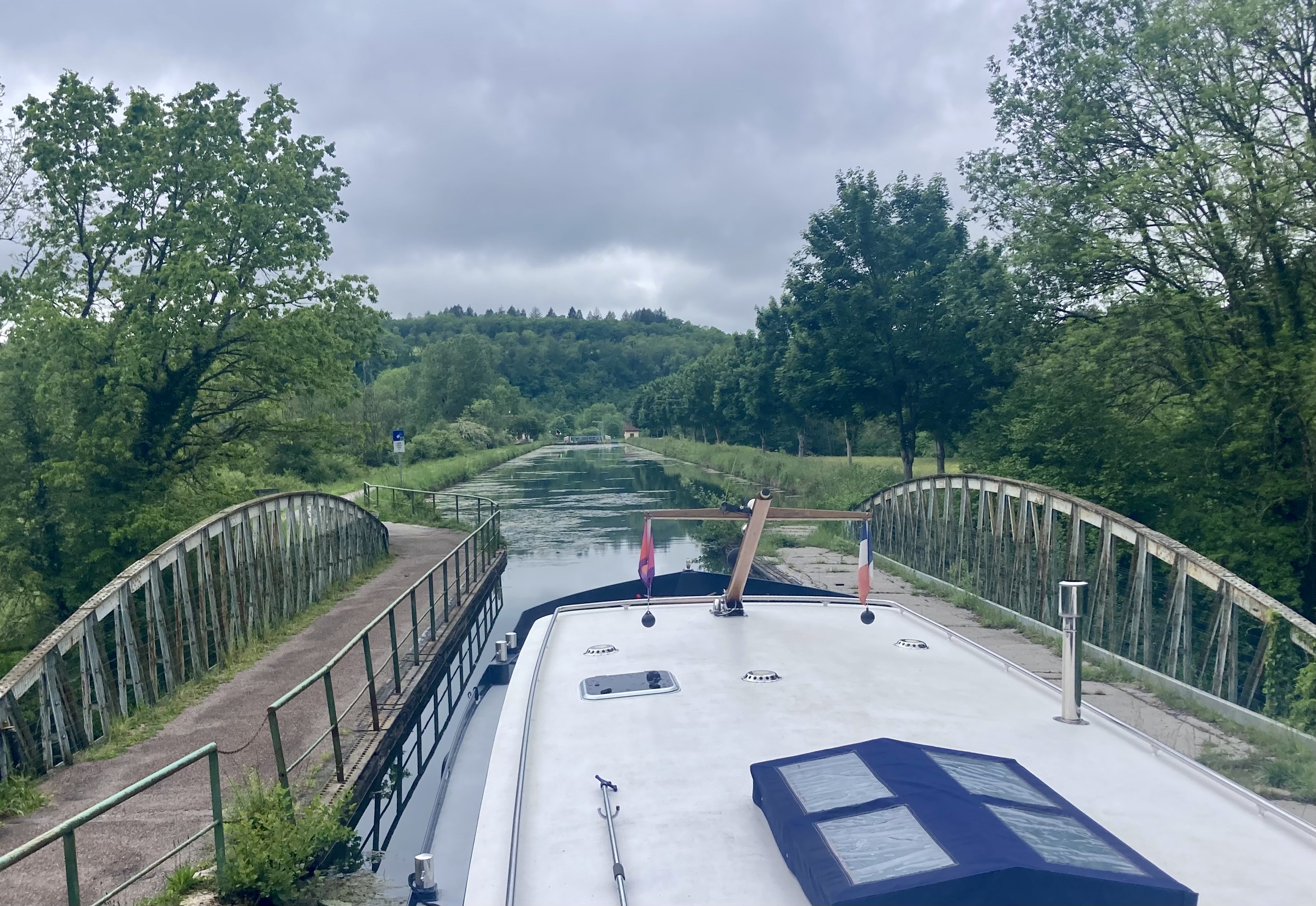
Just round the corner, under heavy grey skies, the Marne slipped under the canal as we glided above.
And a few hundred metres further we came to our first lock of the day. As usual I pressed Avalant and the lock doors opened.

As we got closer and were about to enter the lock the lights on the triangular ‘traffic signal’ suddenly turned to two reds! Oh no – this means the lock is en panne, or broken down.

We decided to drive into the lock anyway. We preferred to tie up rather than ‘wallow’ mid stream and in the lock there was somewhere to tie up to there, unlike the canal bank.
(In case you are wondering, this photo is taken later as we are going down)

How ones luck can turn in just seconds. Before I could even pull my phone from my pocket to call Heuilley-Cotton centre we saw a VNF can driving up the towpath! As luck would have it on this occasion the VNF service man was coming along checking each lock and arrived to us at precisely the right moment.
Within a few minutes we were on our way.
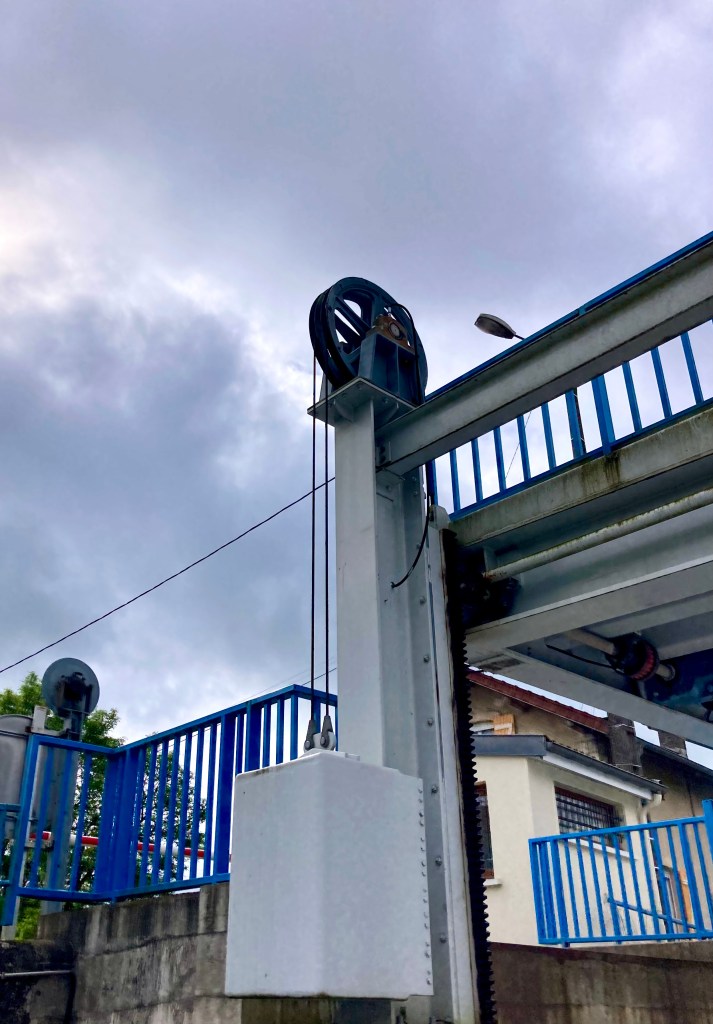
An hour later we had reached the beautiful Pont Levis de Luzy.
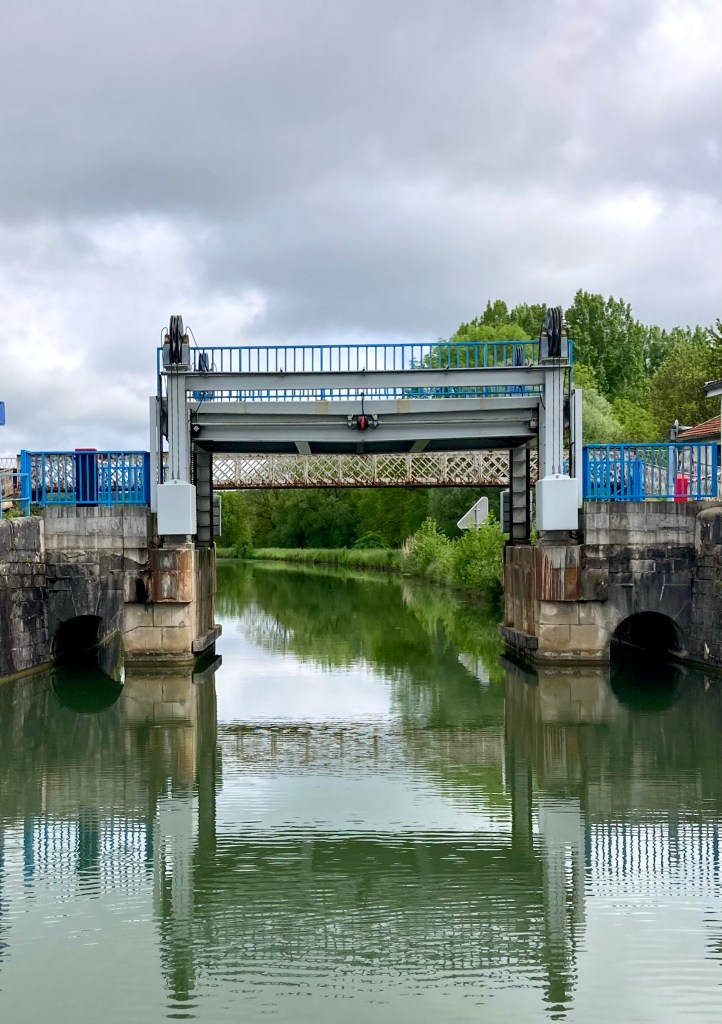
This is a true raising bridge, going up vertically on both sides.
I cannot find out when it was built but historic photos suggest it is c100 years old.
The journey down to Chaumont follows the Marne valley, often right alongside the river. Later in the blog I have included a series of photos of the Marne as she grows in width and flow.
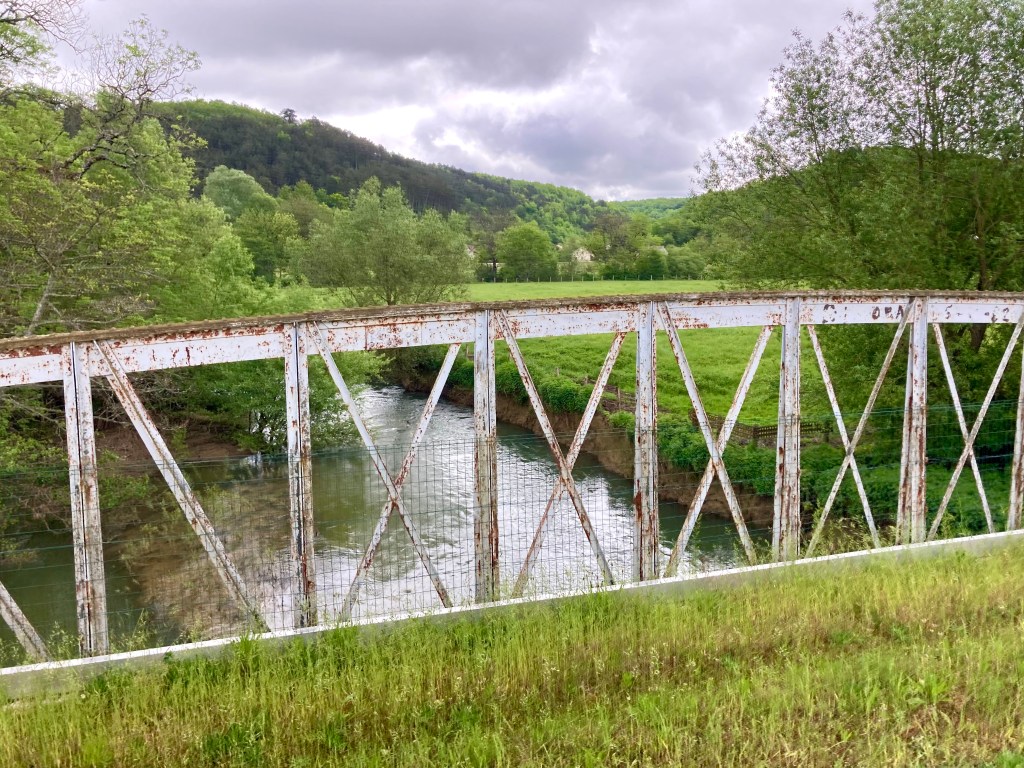
For now, here we are passing over her yet again!
The last few locks were slightly deeper than before – only by half a metre, but that seemed to be enough for bollards to be included in the wall of the lock.
This allows boats going up or down to use both the bollard on the lock quay and the one in the wall at different stages of their rise or fall.
We did not find we needed to use them, but in deeper locks they have been a god-send.

We were getting close to Chaumont by now, and began to follow the canal round the base of the hill that has Chaumont at the top.
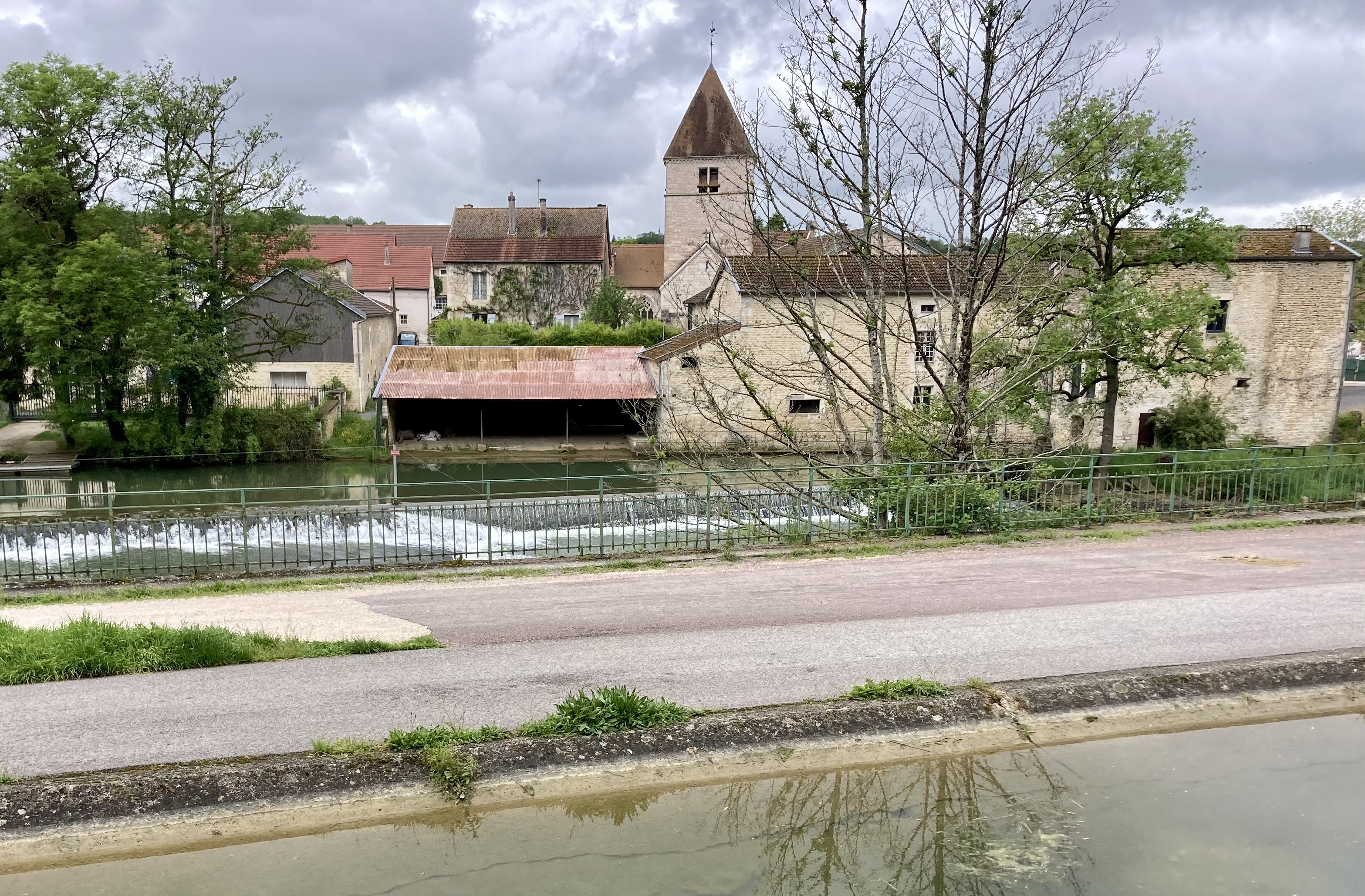
The Marne spread and divided between a mill race for the Chamarandes Moulin and a long spectacular weir.
As we have got older and wiser we have chosen to cruise at a slower pace and generally aim to reach our next mooring by about midday, tie up and have lunch.
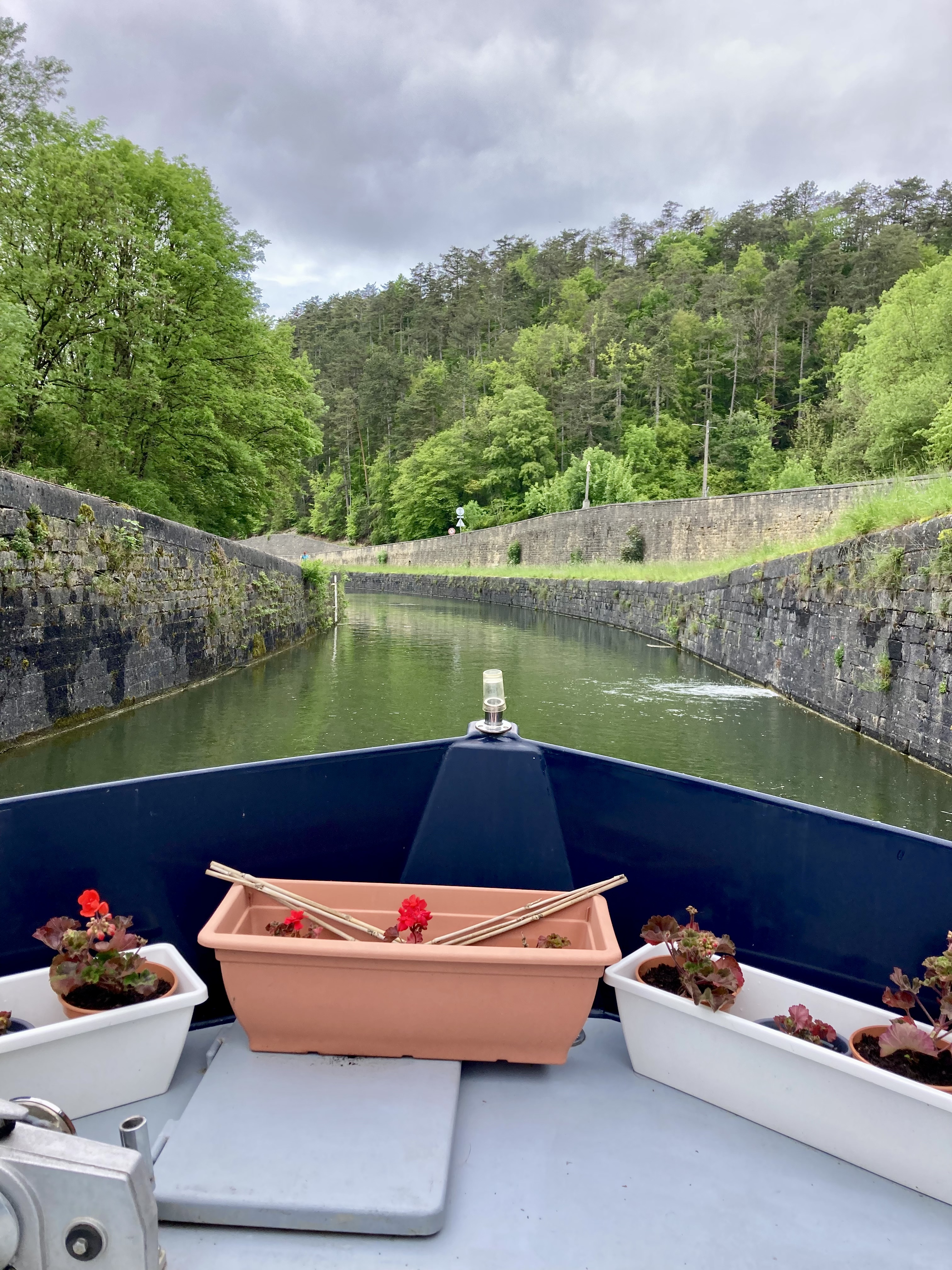
We came down the last two locks and along the narrow channel into Chaumont just after 12, so were happily tied up and eating our lunch close to 1230.

Then we girded our loins and walked up, up, up from the port on the canal to the old city of Chaumont which stands on a hill above the river Marne.
This was Route A, on a steep road to the top.
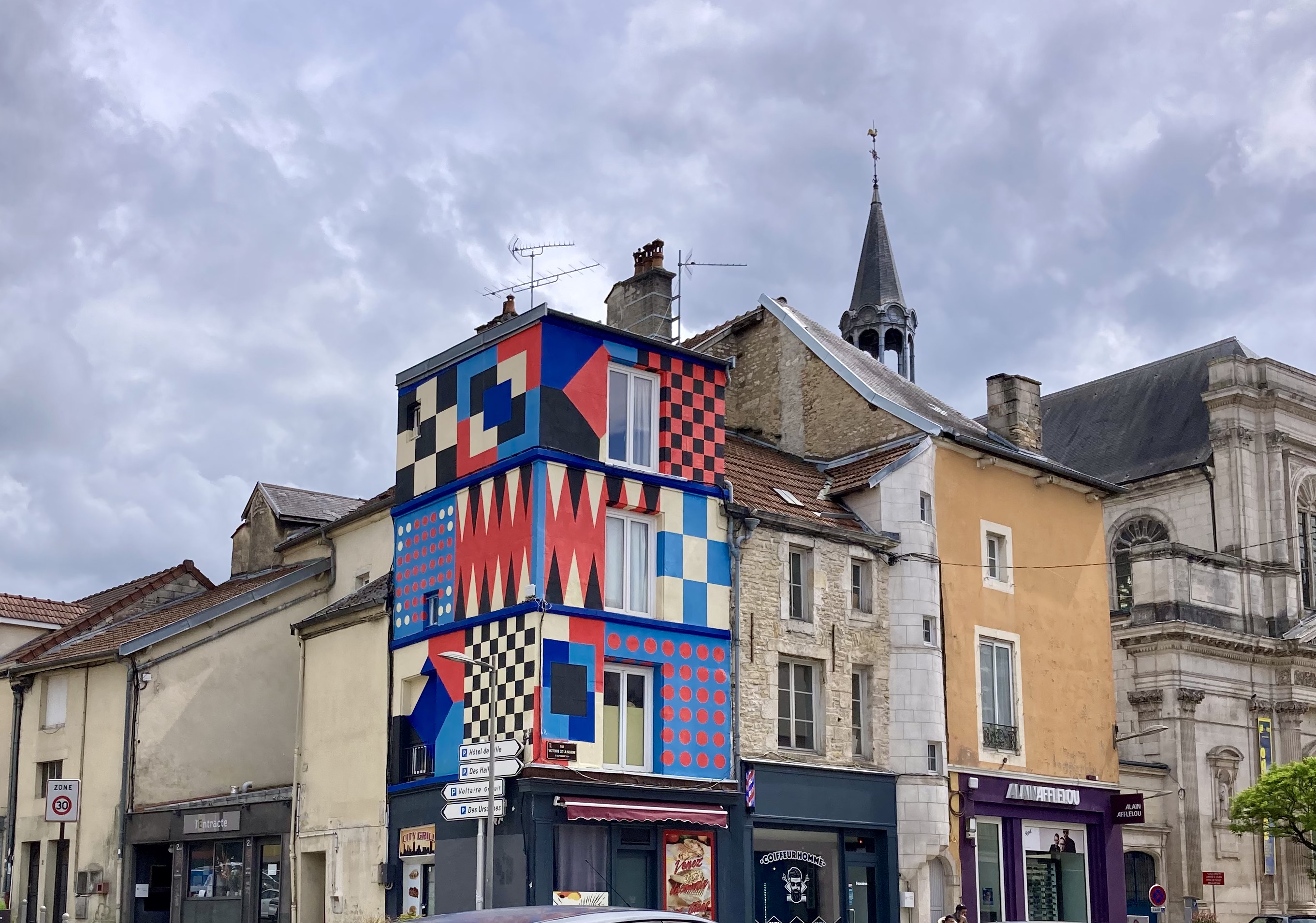
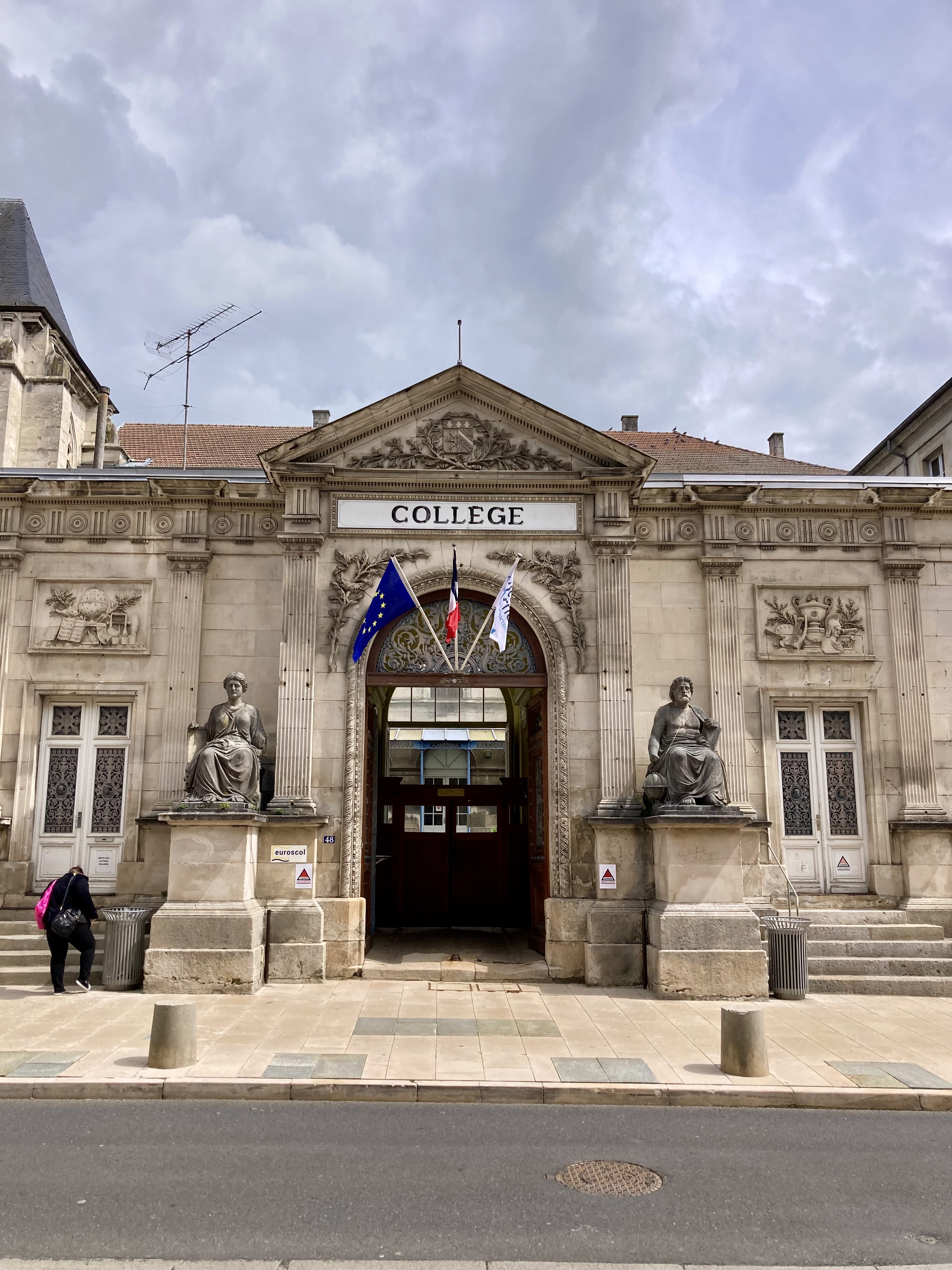
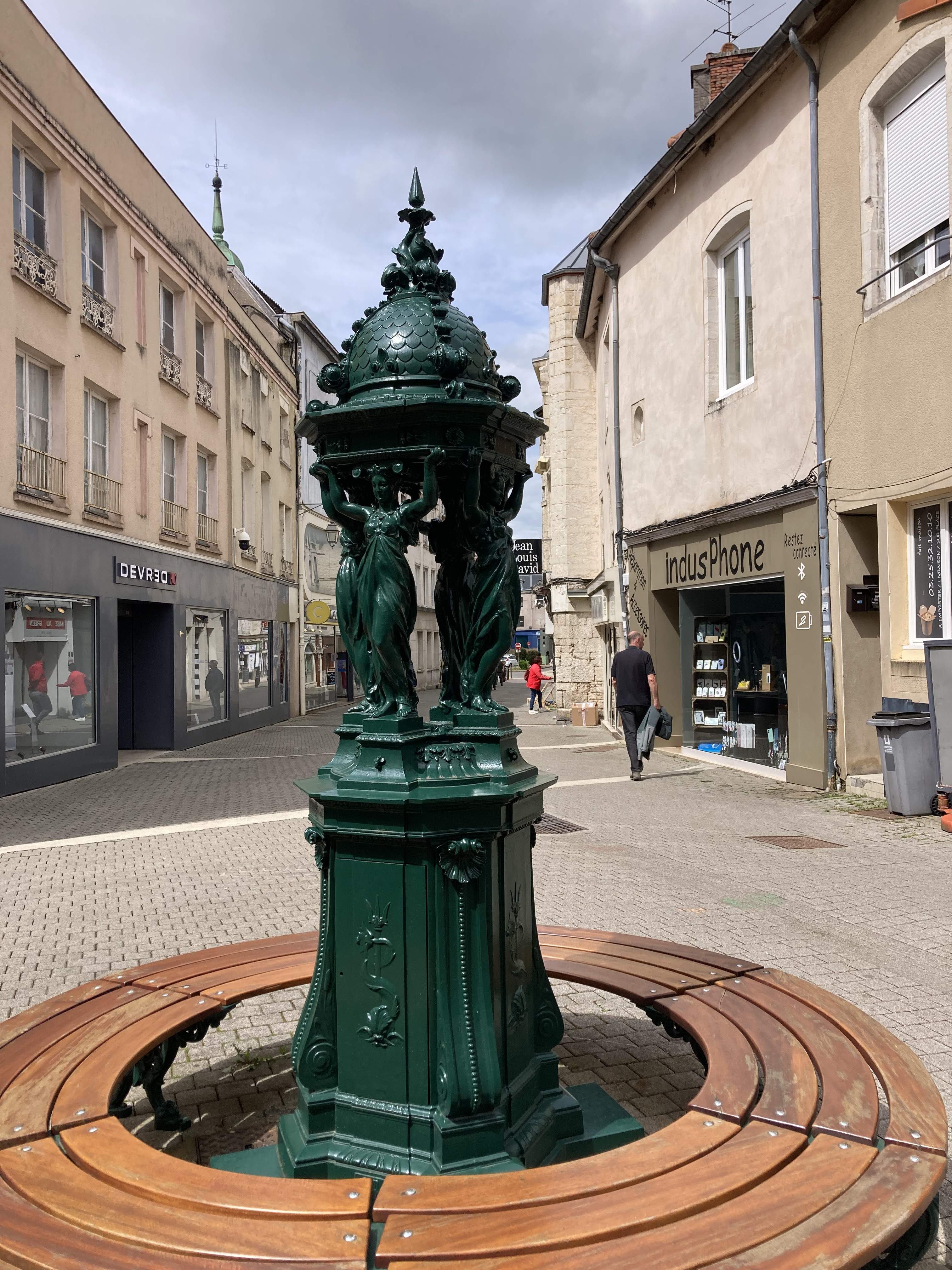
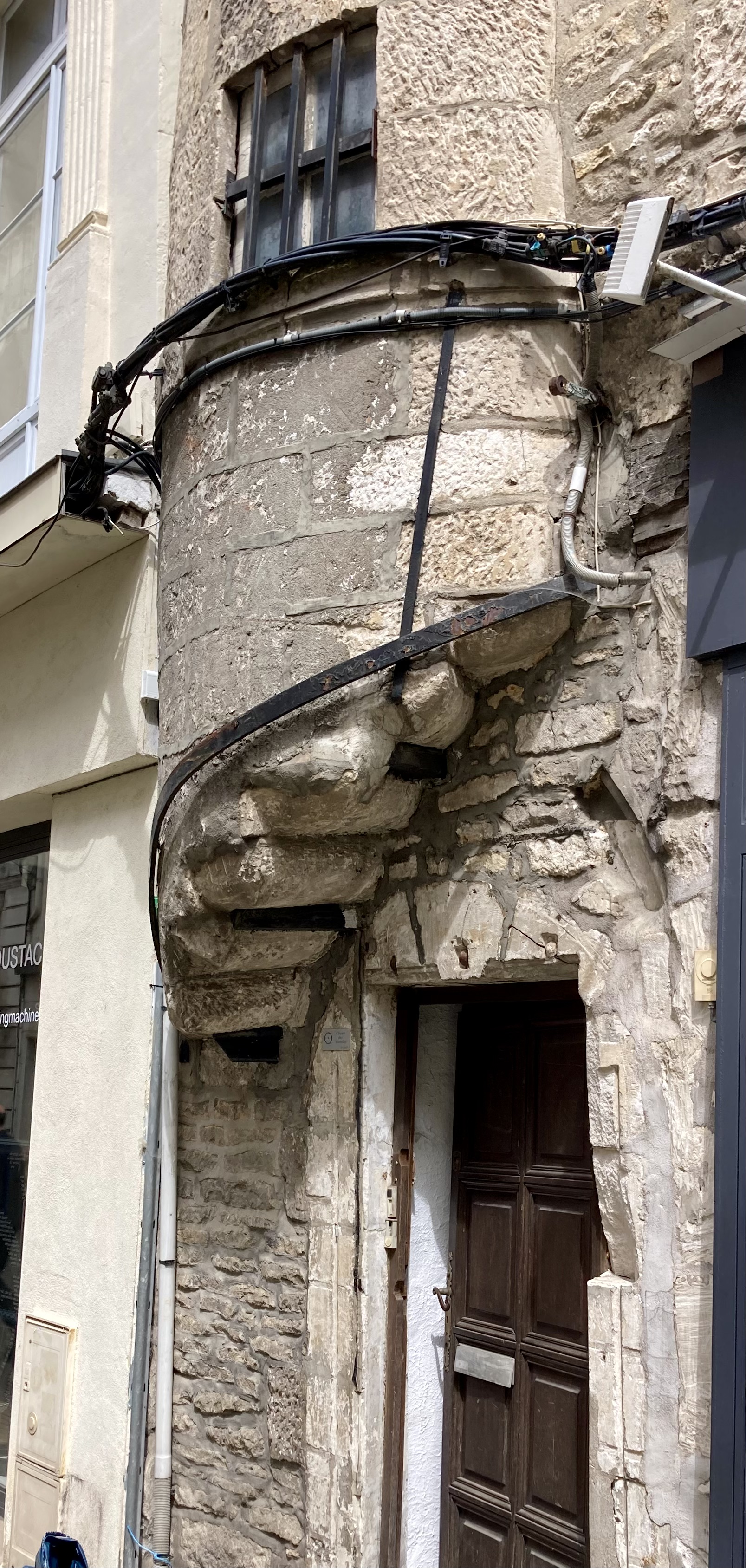


After a stroll around the town, taking in some of the old buildings and varied shops, but not finding one that sold the ship’s clock that the Captain was after, we decided to return to the port.

So we came back down, by a different route, B. This became a path through some woods – very pretty, and also steep! Don’t let me out you off – it is worth the walk.
We both made it.
Still smiling!

Here we are, moored up in Port de la Maladiere, the port of Chaumont.

and as so often on our travels we settled down to a gentle evening on Calliope which ended with rather a splendid sunset sky.

Bologne
There were a couple off minor nature moments as we left Chaumont.
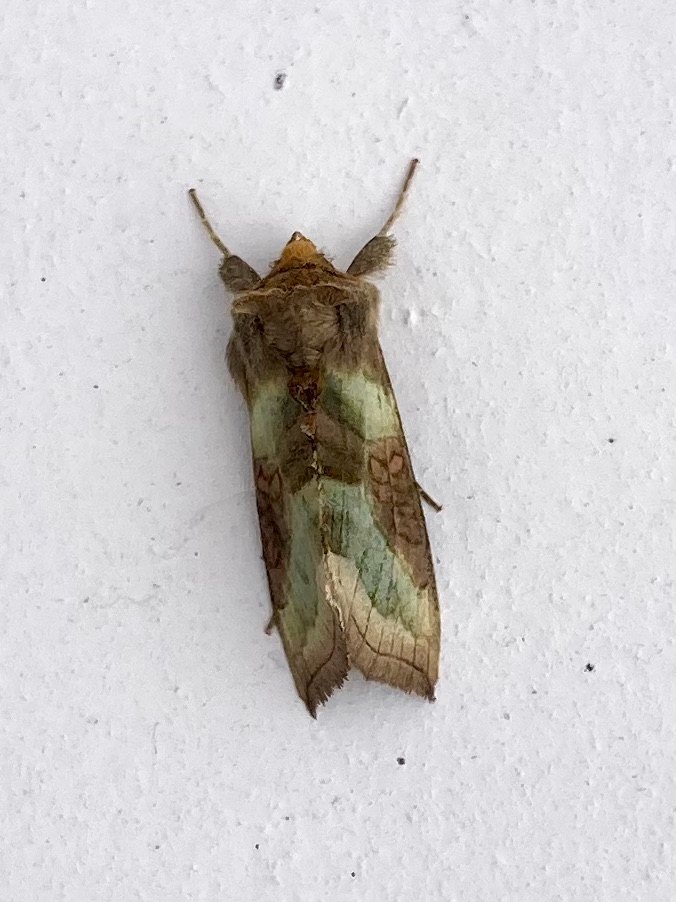
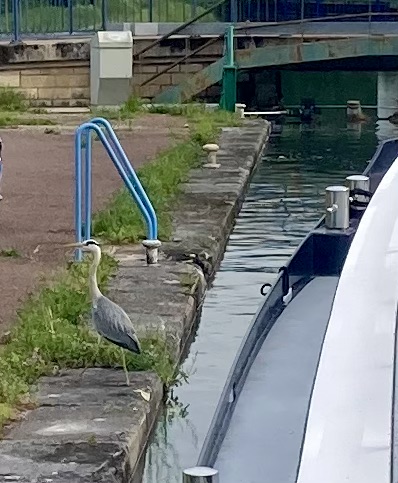
A rather beautiful and, to me, unusual moth joined us on the cabin roof and a heron almost forgot to fly away as we arrived at the first lock.
I have ben trying to find the name of the moth – its species, not its ‘name’ 🤣 – but so far no luck. It may be a ‘map-winged’ or a ‘green arches’.Please let me know if you find it.
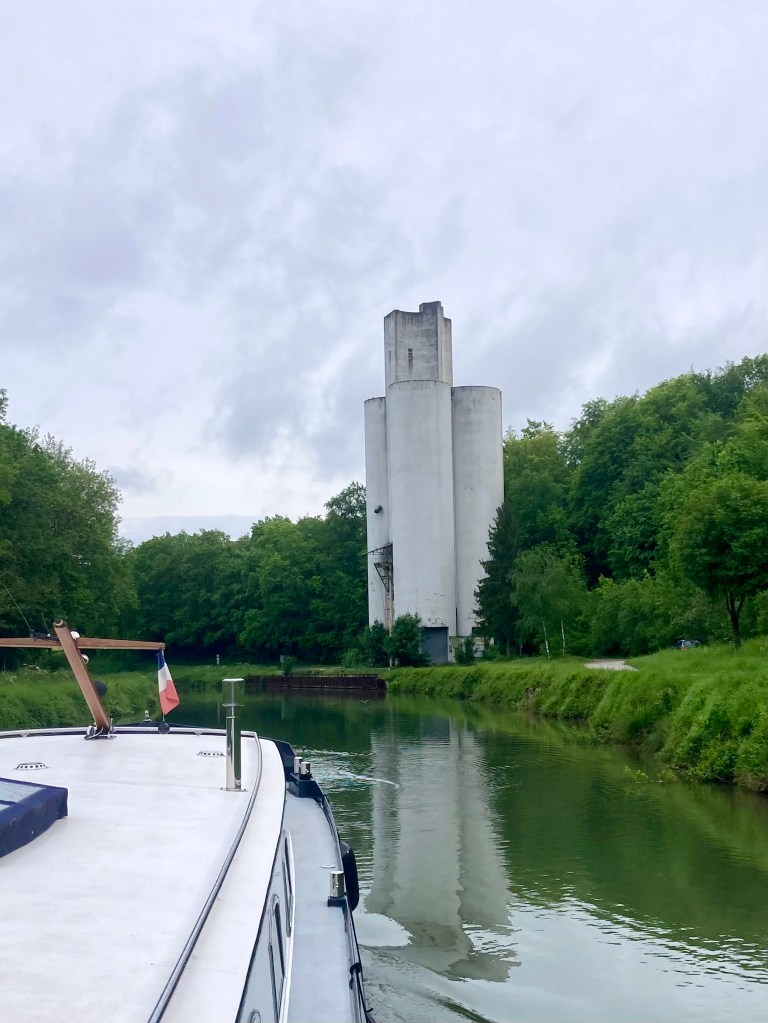
As we continued our northwards journey out of Chaumont we passed more evidence of the canal’s past importance to the economy and transport.
These silos were almost castlelike in their shape, commanding a great position on a bend of the canal. But now they are served by neither canal nor road.
I’m guessing they were grain silos because of all the arable fields behind the trees.
In less than an hour we had reached the Condes Complex – my name for the combination of lift bridge, post canal over the Marne (again), tunnel and lock – all within just over half a kilometre.
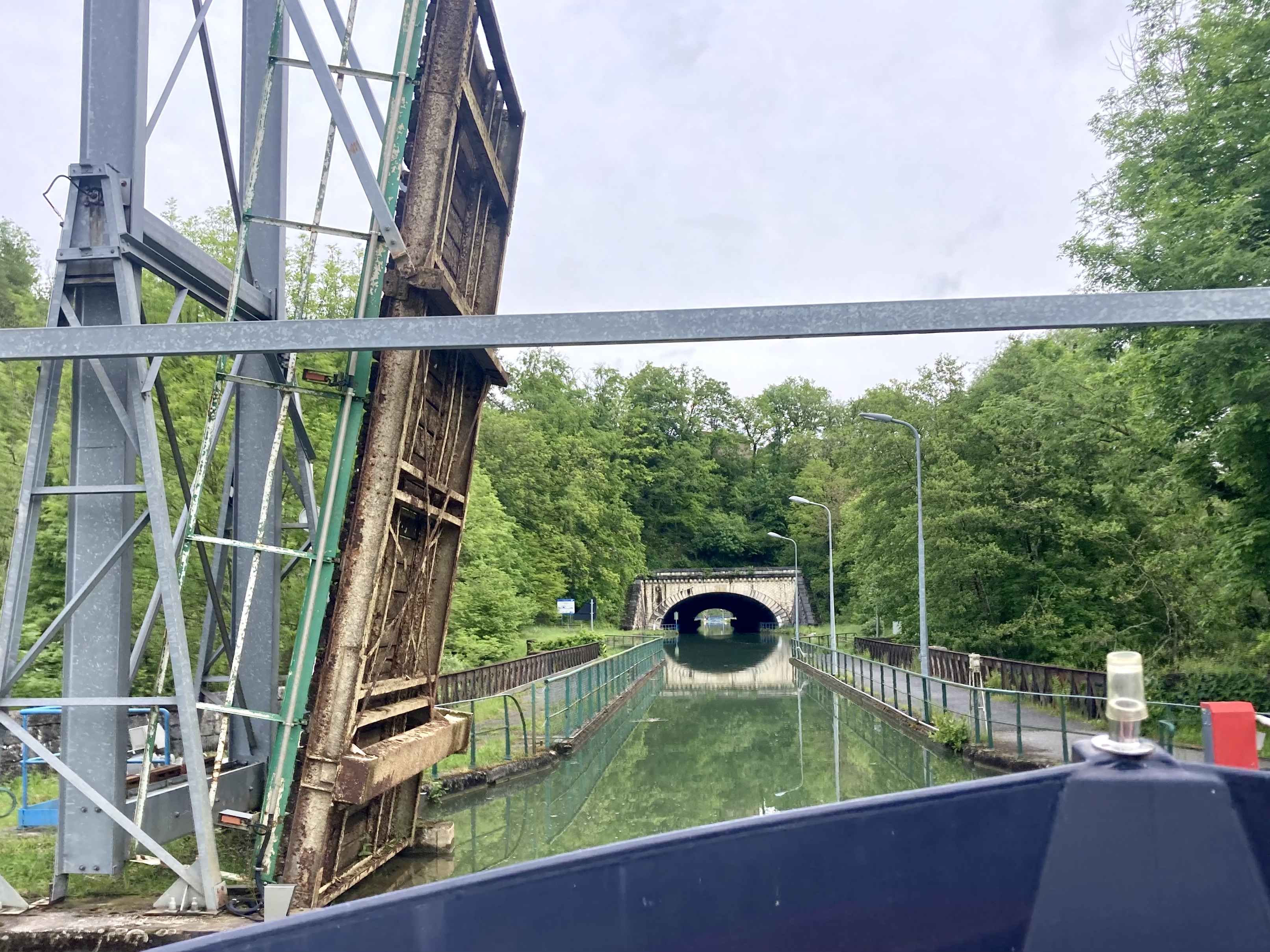
In 2016 when we were going the other way we emerged from the tunnel, and the bridge remained steadfastly down! We gently drifted on the pond canal with good views of the river below waiting until an éclusier arrived to get the bridge lifting.
This time we got stuck at the lock instead! But before that we came through the tunnel and just for fun I did a time lapse video which speeds up out kph by about 10 times I would think!

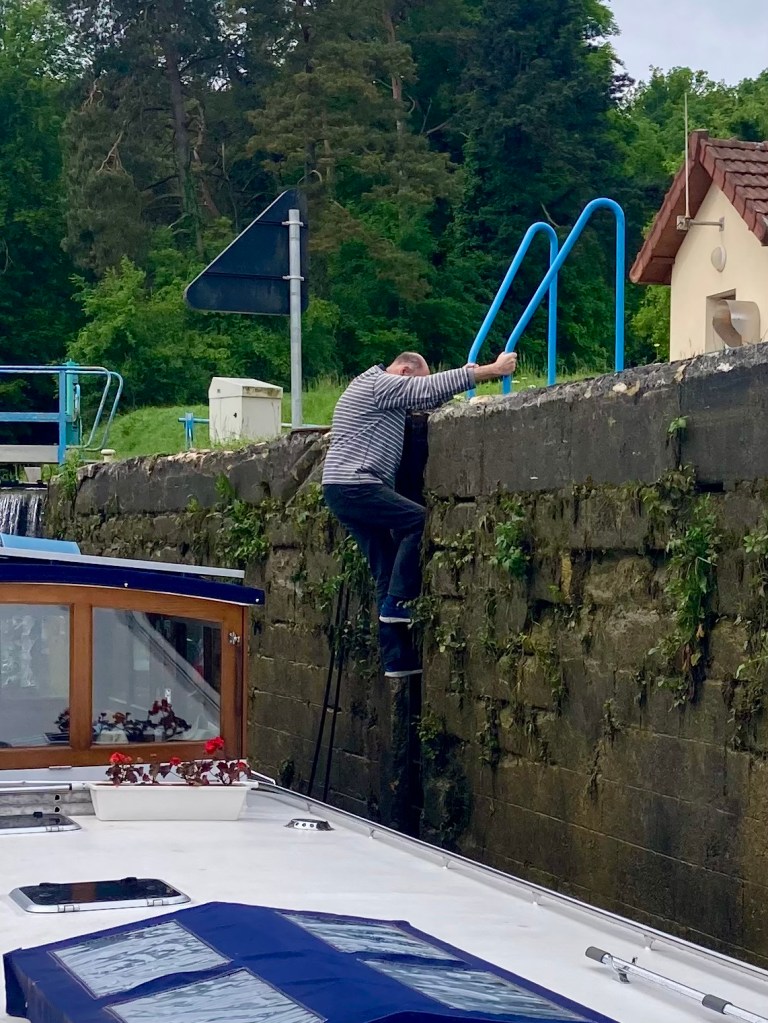

We came happily out of the short Condes tunnel, into the lock, and descended to the bottom uneventfully. Then the gates did not open again. Stu climbed up and tried jiggling the gates -that has sometimes worked in the past. Not this time, so I called up for help and they were soon there.
It is all the weed in the canal that tends to cause the problem and although we constantly see the VNF teams raking and dredging to keep things clear it is not enough. The canal needs more boats, especially large ones, to use the canal and keep the channels free of algae.
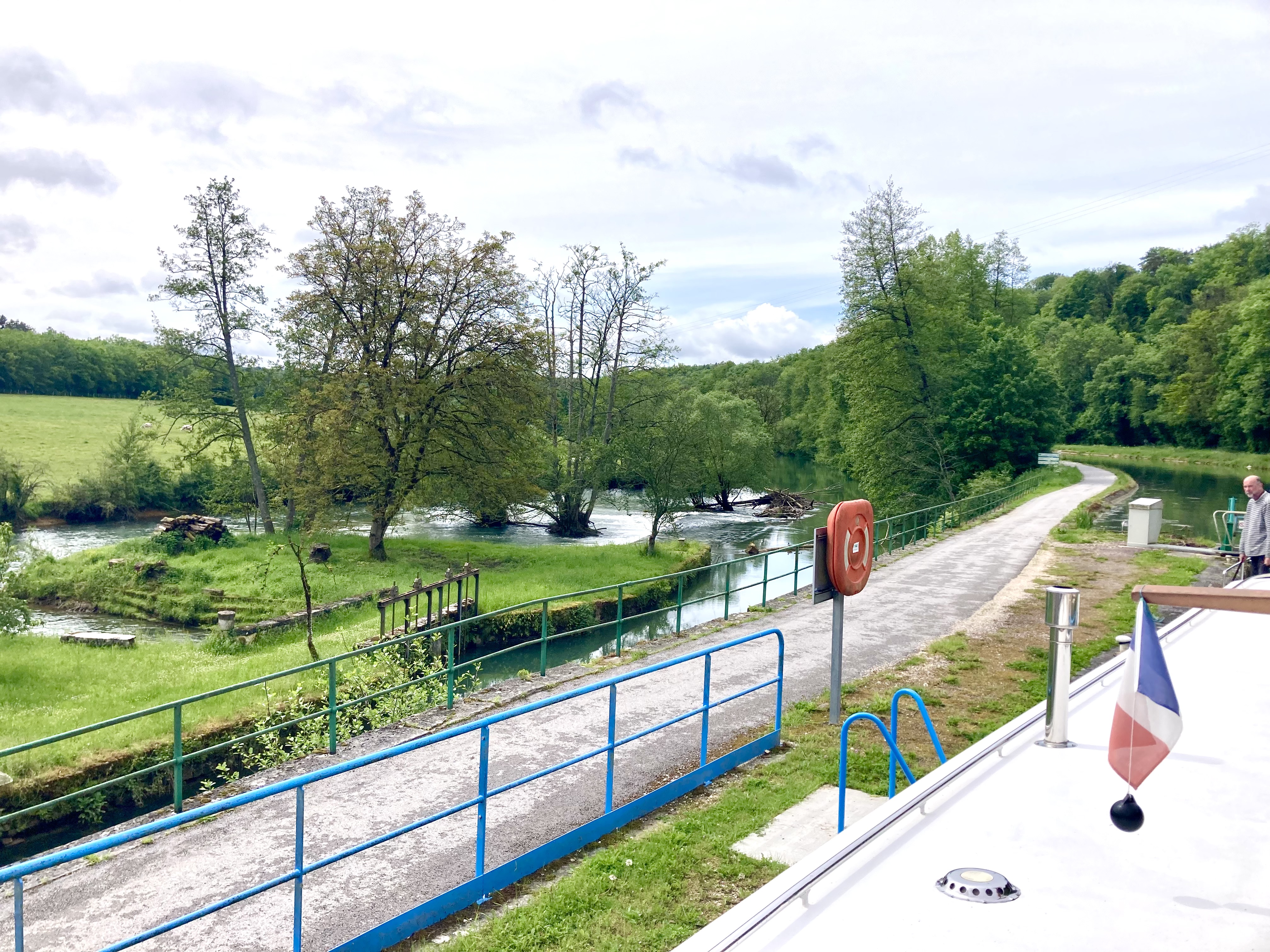
Just a couple more locks before we stopped for the day and at one of them the Marne came right up close to us, breaking up into pretty ‘riverlets’ in order to provide a mill stream for Brethenay mill.
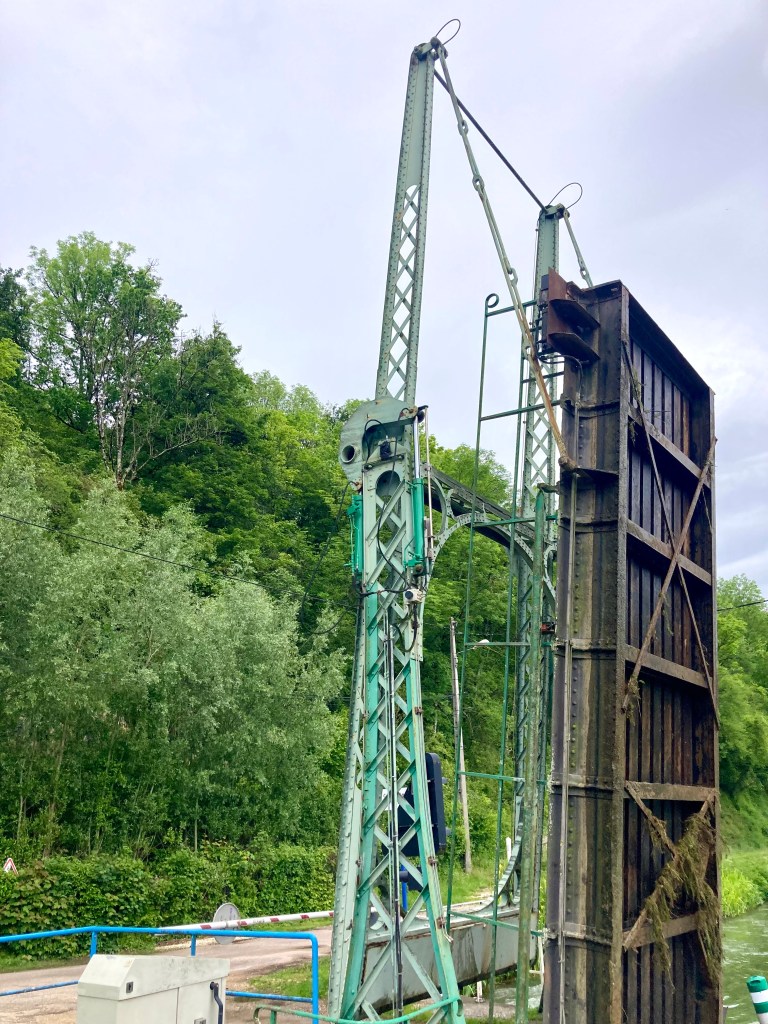
Next to the mill itself, connecting it to the road, was another nice green pont levant (lift bridge) that responded to our telecommand without a problem.
On we went for another hour and a quarter to our mooring outside Bologne.

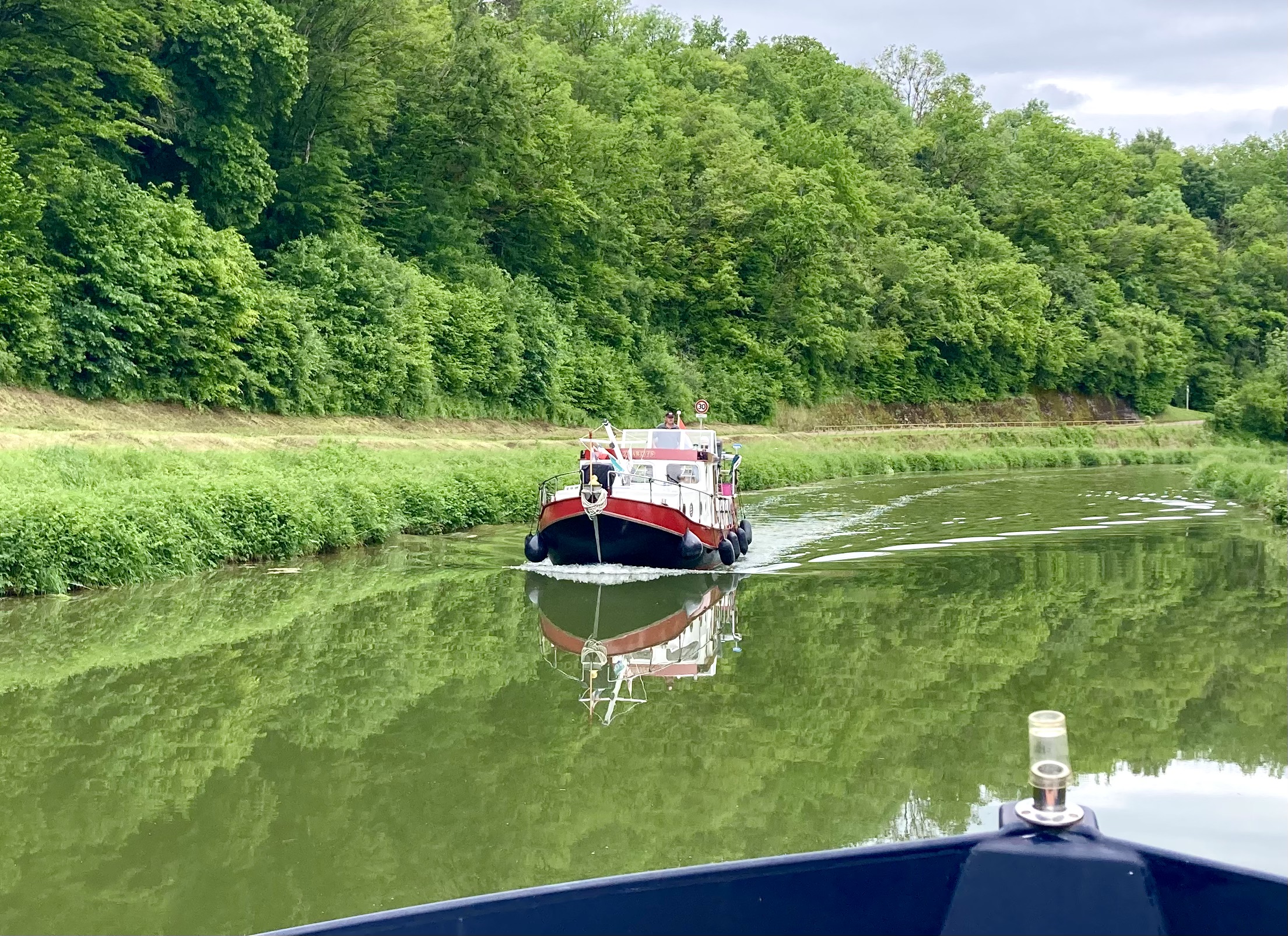
We were surprised to pass another boat and also a cliff – maybe a quarry in the past. They are very different things to report, but both were unusual on this trip.
The boat had on board a WOB (Women on Barges) with whom I had been communicating. It was a shame that we were passing midstream and not able to have a cup of tea together, but at least we exchanged quick greetings and photos!

Here is her photo of us cruising past, with her dog helping at the side! We love getting photos that others have taken of Calliope – it allows us to see her with us on board.

Then it was just banks of lovely yellow flag irises until we stopped.
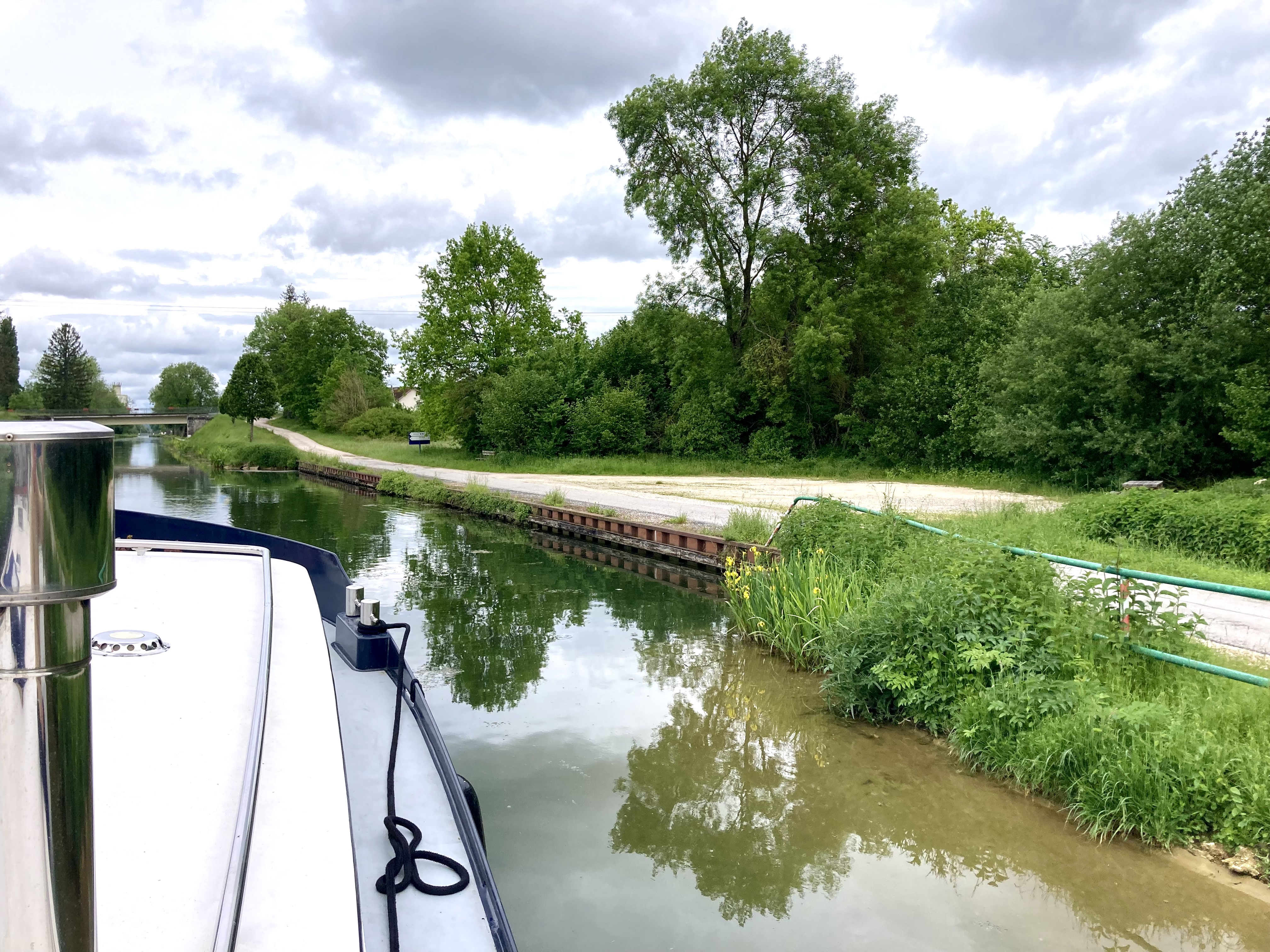

The mooring is a low metal edged quay, with a timber edge at water level to protect the boats. It is always good to see your planned mooring with plenty of space as you approach.
I was looking through the binoculars for bollards and seeing none, but a quick check on the DBA (Dutch Barge Association) mooring guide told me to look for rings instead! And there they were, half hidden in grass and weeds, but totally usable and secure.
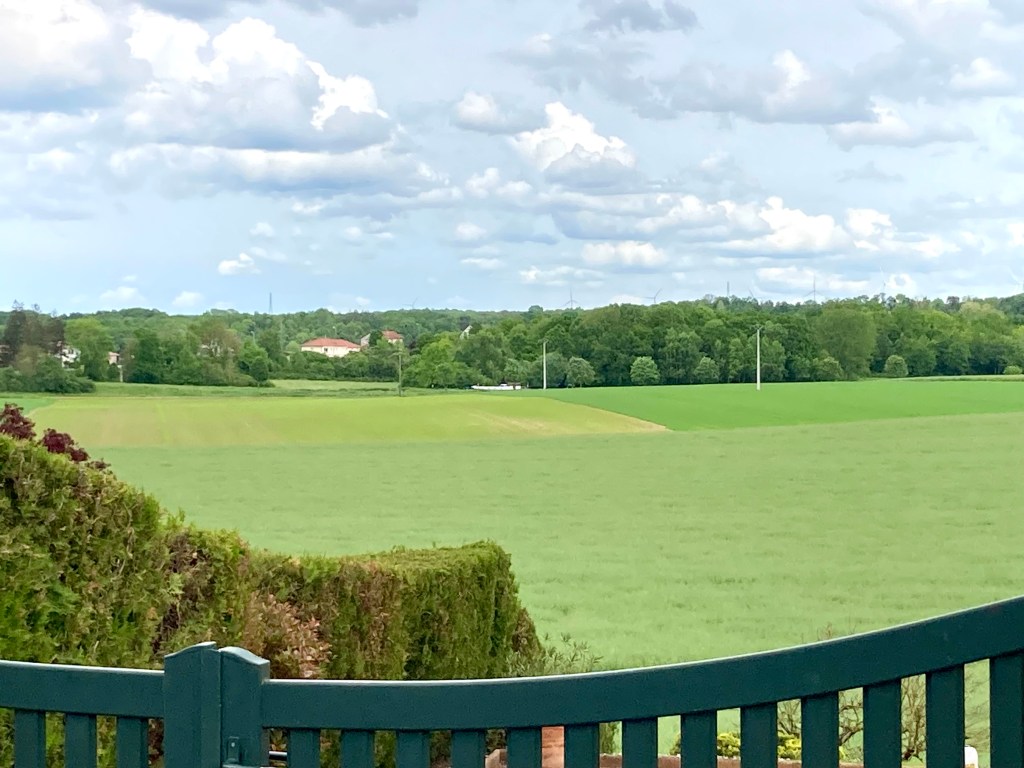
The Captain took on shopping duties and got this great photo of Calliope moored in the distance across the fields.
Whereas I, for my daily exercise, went for a walk in the opposite direction, hoping to end up on the banks of the Marne.
Instead of which I found myself at the gates of a big aero industry site, hidden away down a dead end lane! So I turned back and took photos of local wild flora.

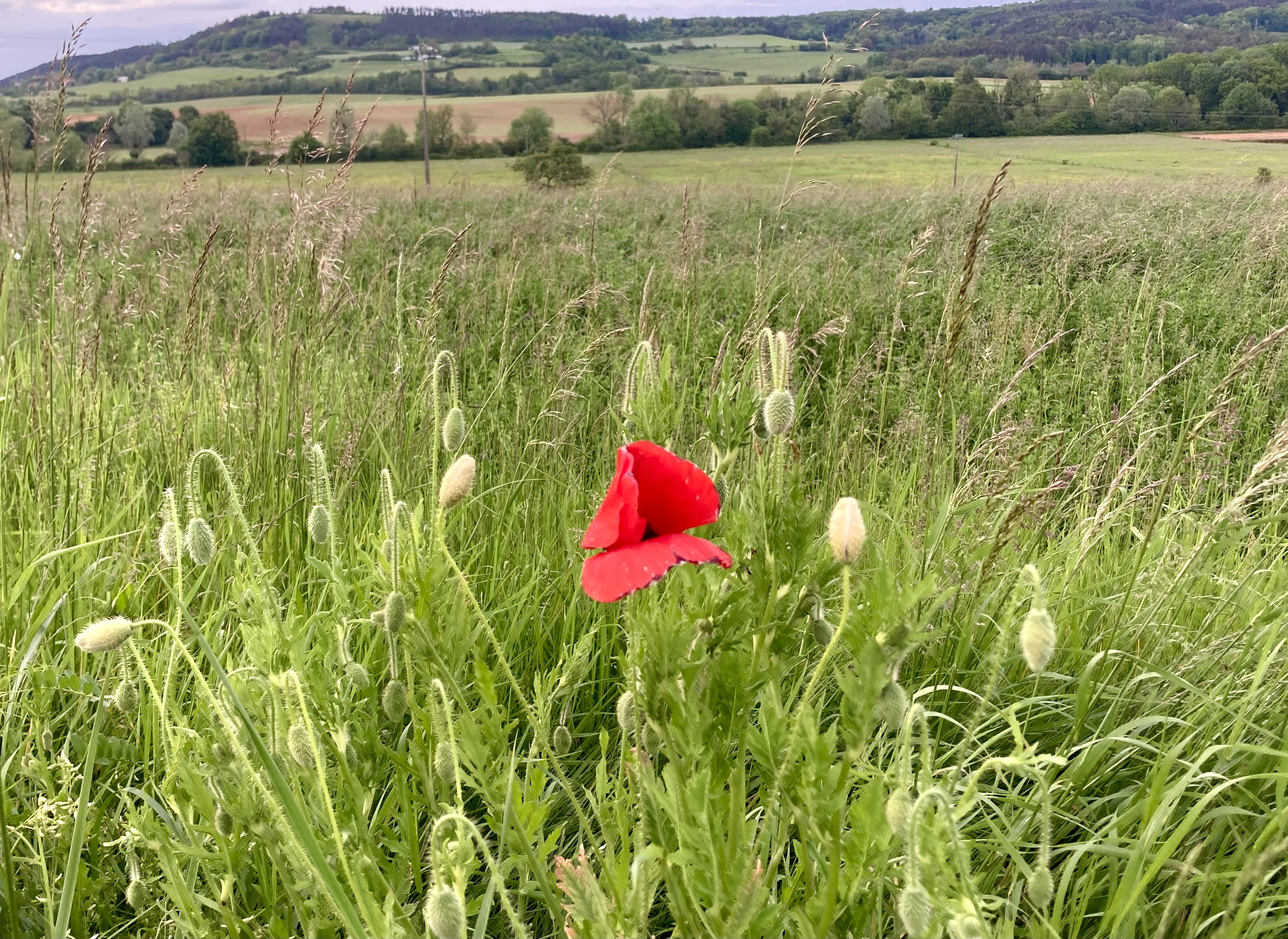

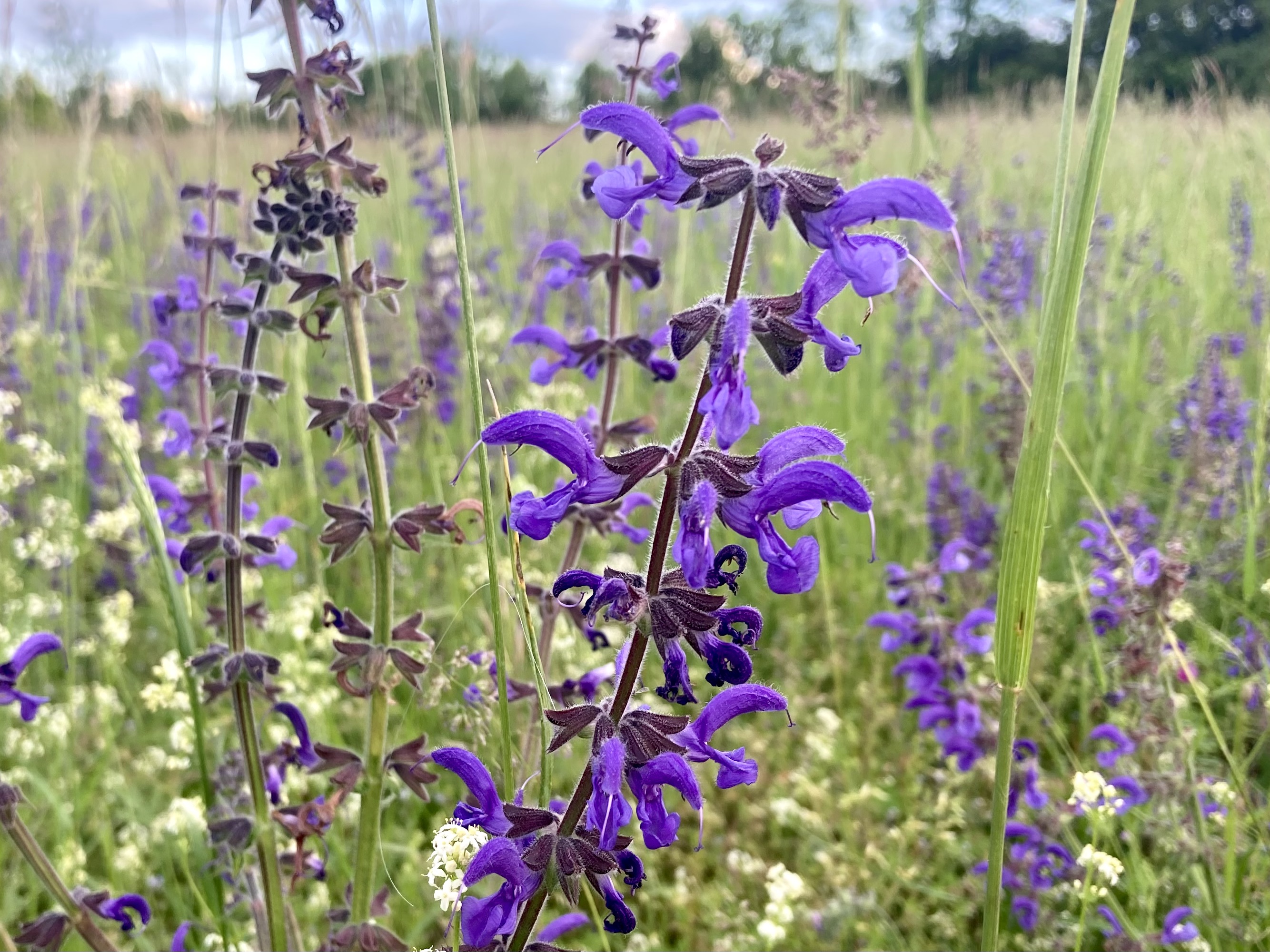
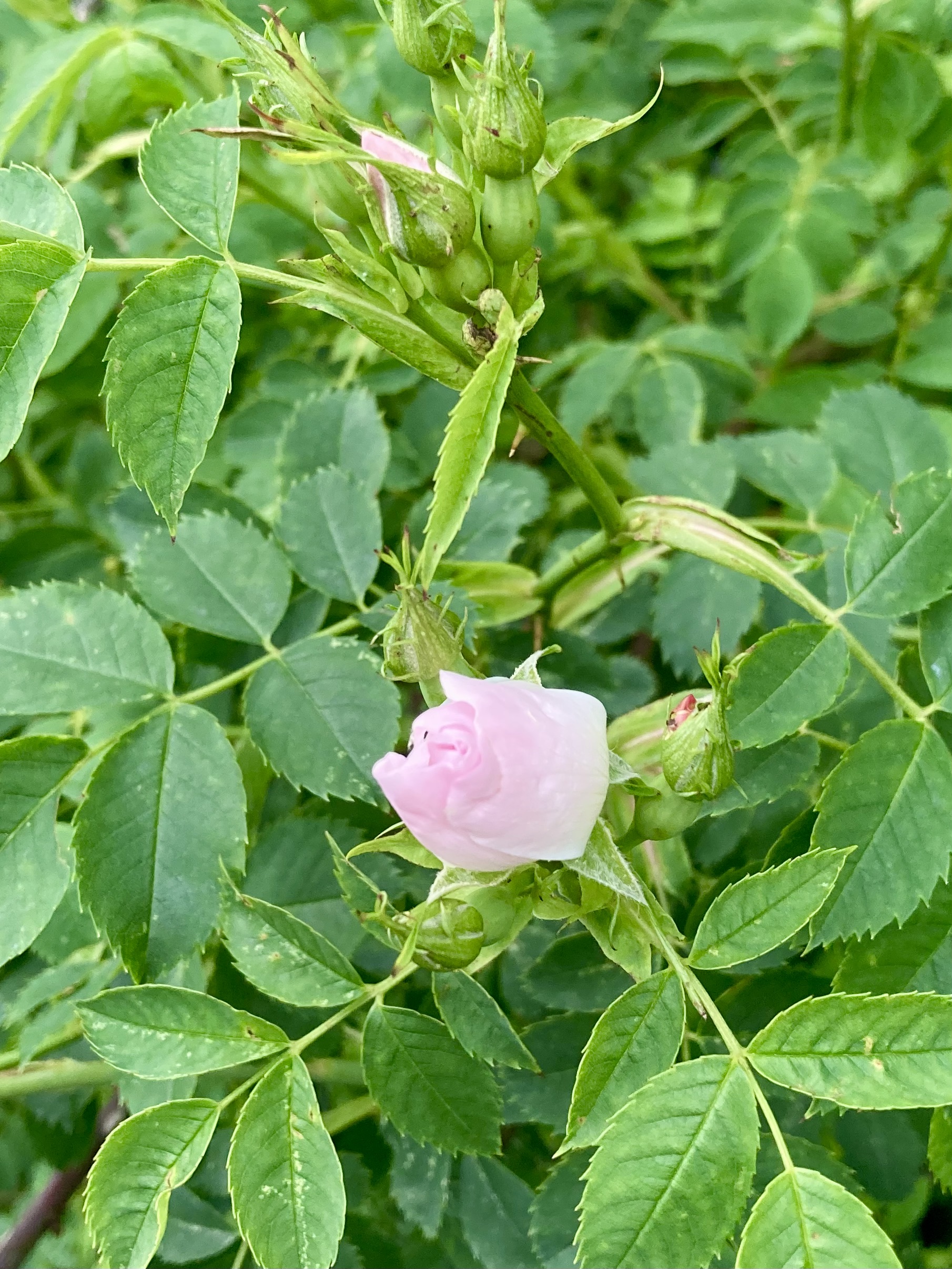
Thus ended our short pleasant stop at Bologne!
Froncles
The good May weather was still with us next day and we were underway soon after 9am. One of the first things the canal gave us was yet another bridge over the meandering Marne.


The views over the river and the canal were particularly good on this day; everything was calm and smooth, reflecting the blue of the sky.
Then we were into a lock, and it was one with a few things going on – and not going on.


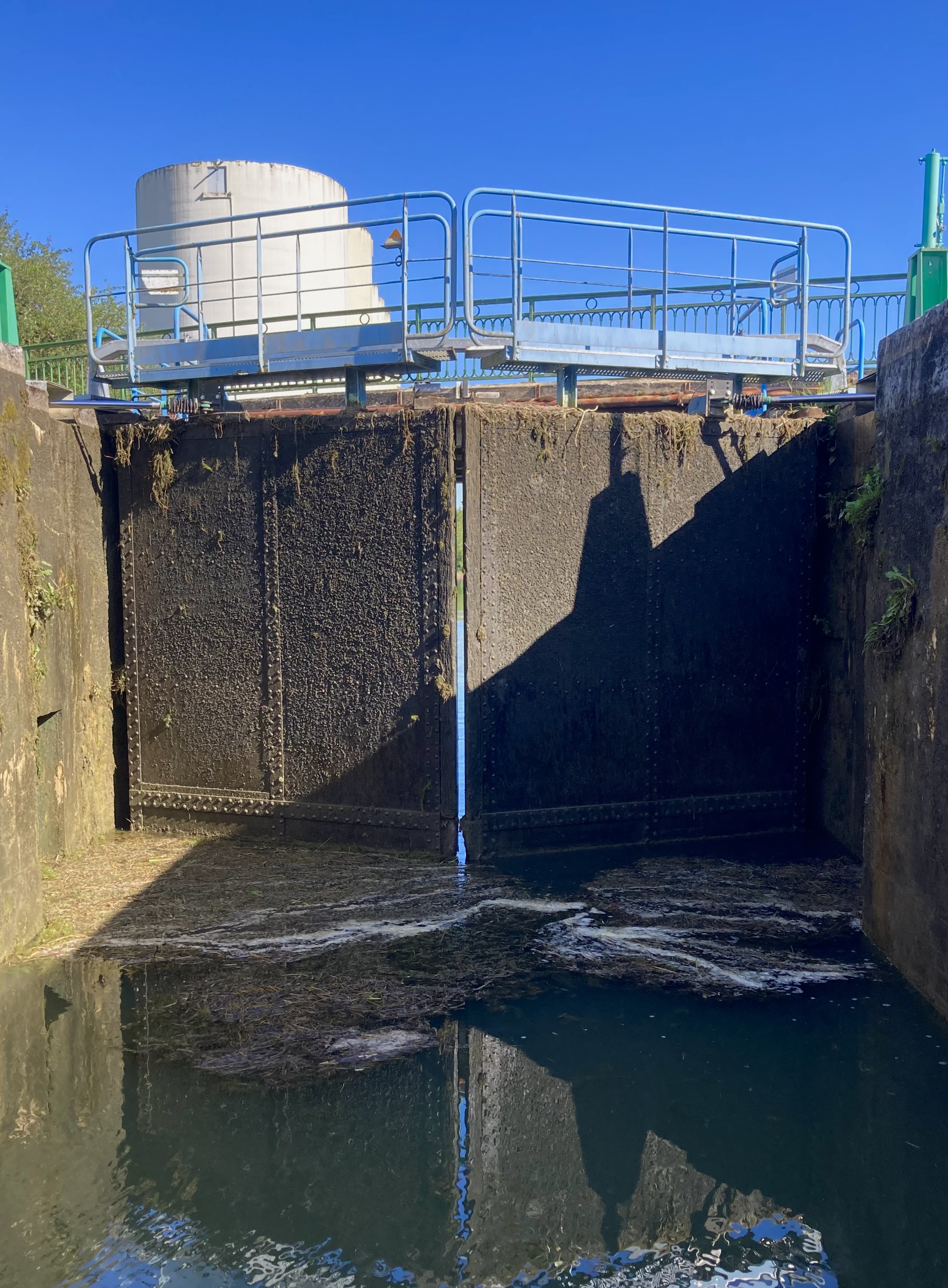

The inhabitant of the lock house was selling truffles – of the fungi variety I presume, not chocolate. The surface of the lock looked a similar truffley colour, but was of course water weed.
This managed to clog up the door opening again, so we were paused again waiting for the VNF; this seems a great opportunity to mop down the roof using the dew still collected there.
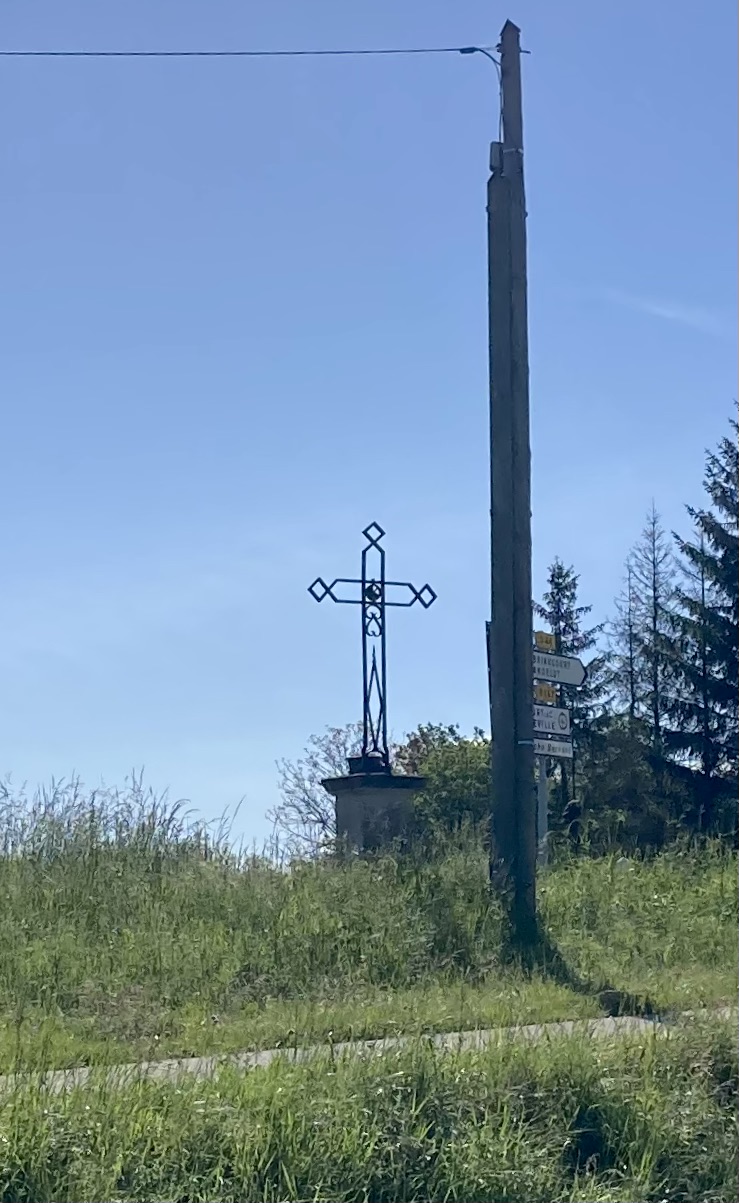


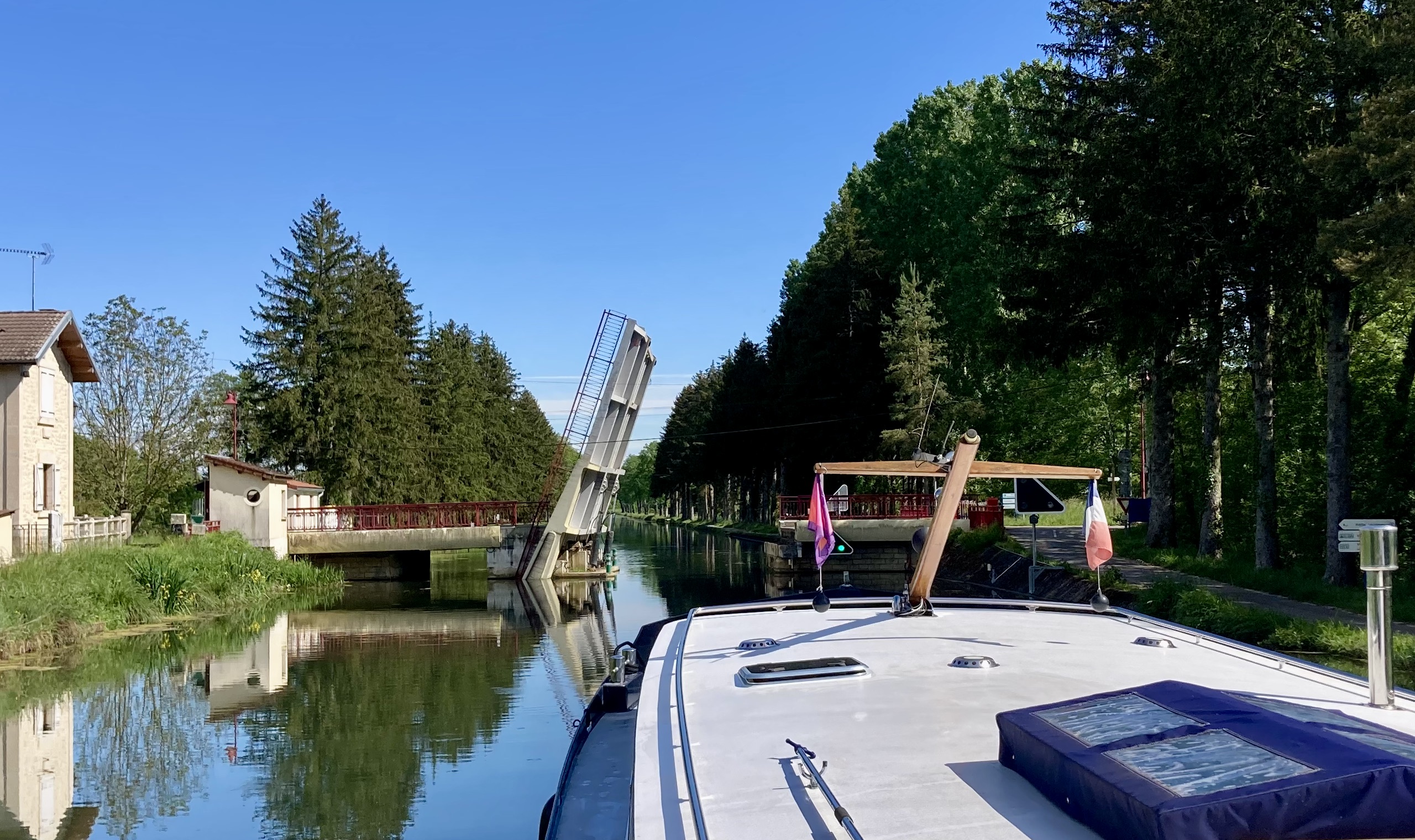
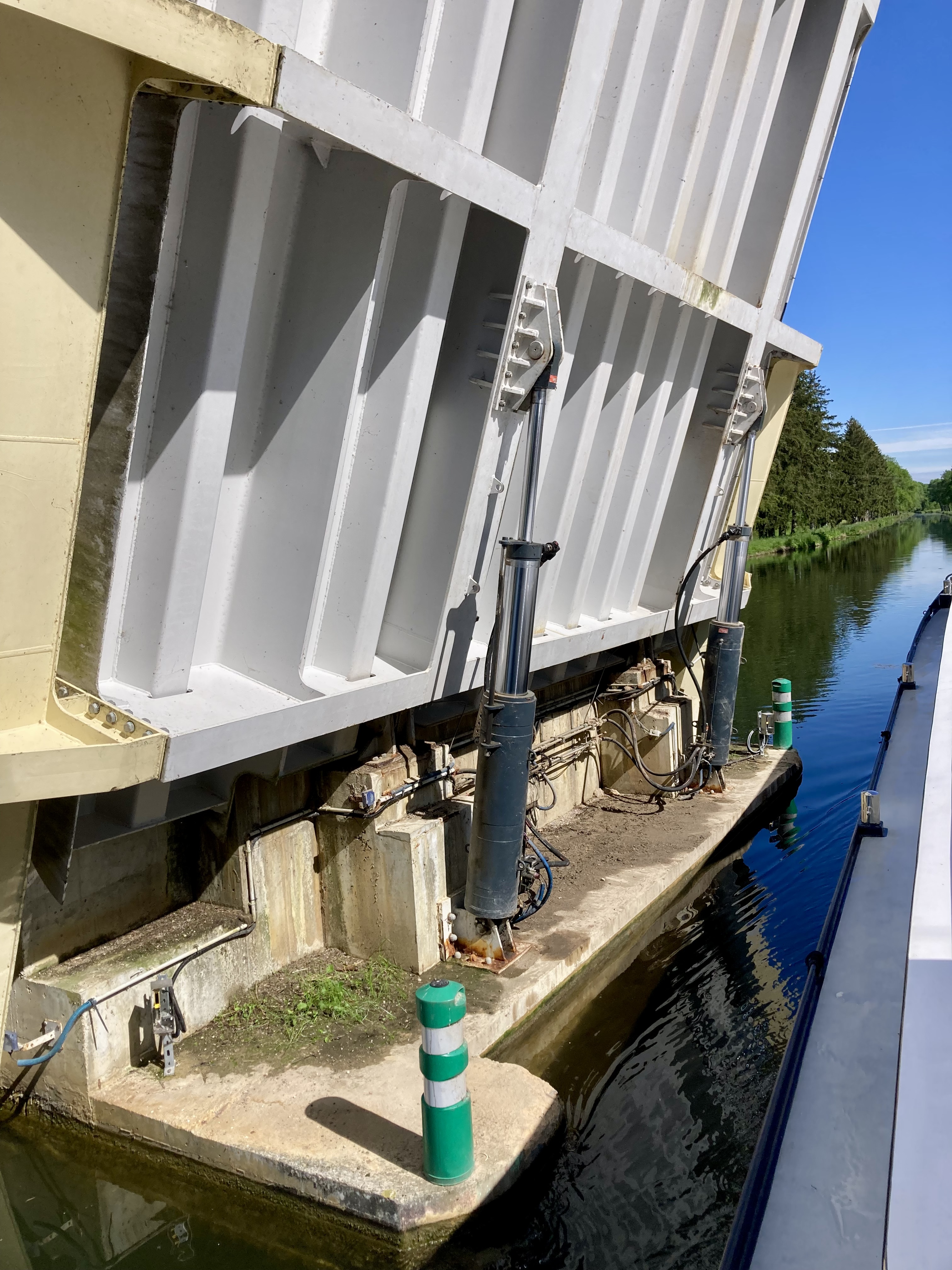
Then we were off, past silos magnificently reflected, past a wayside iron cross, a fisherman, and a new lift bridge with shiny new hydraulic mechanism.

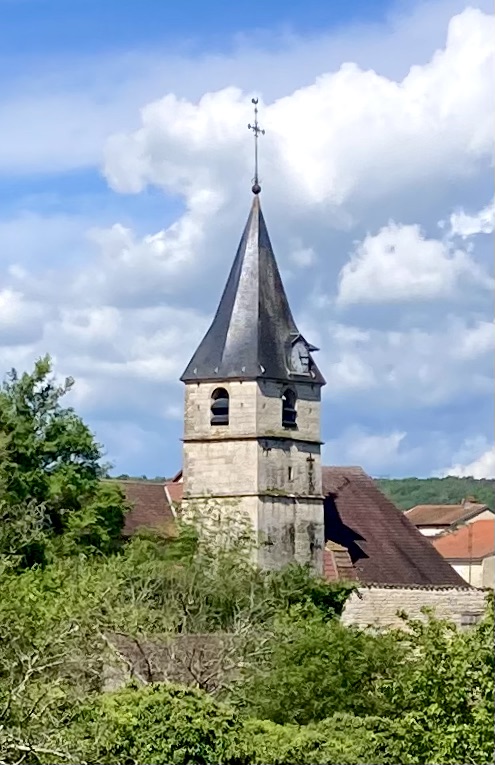
Each village had its own variety of a tall slate steeple poking above houses, and always above the flood levels of the adjacent river.

Every lock had its own little bit of fascination, whether natural or man made.
This bollard is a shape I have not seen anywhere else.

As we got closer to Froncle the topography began to change.
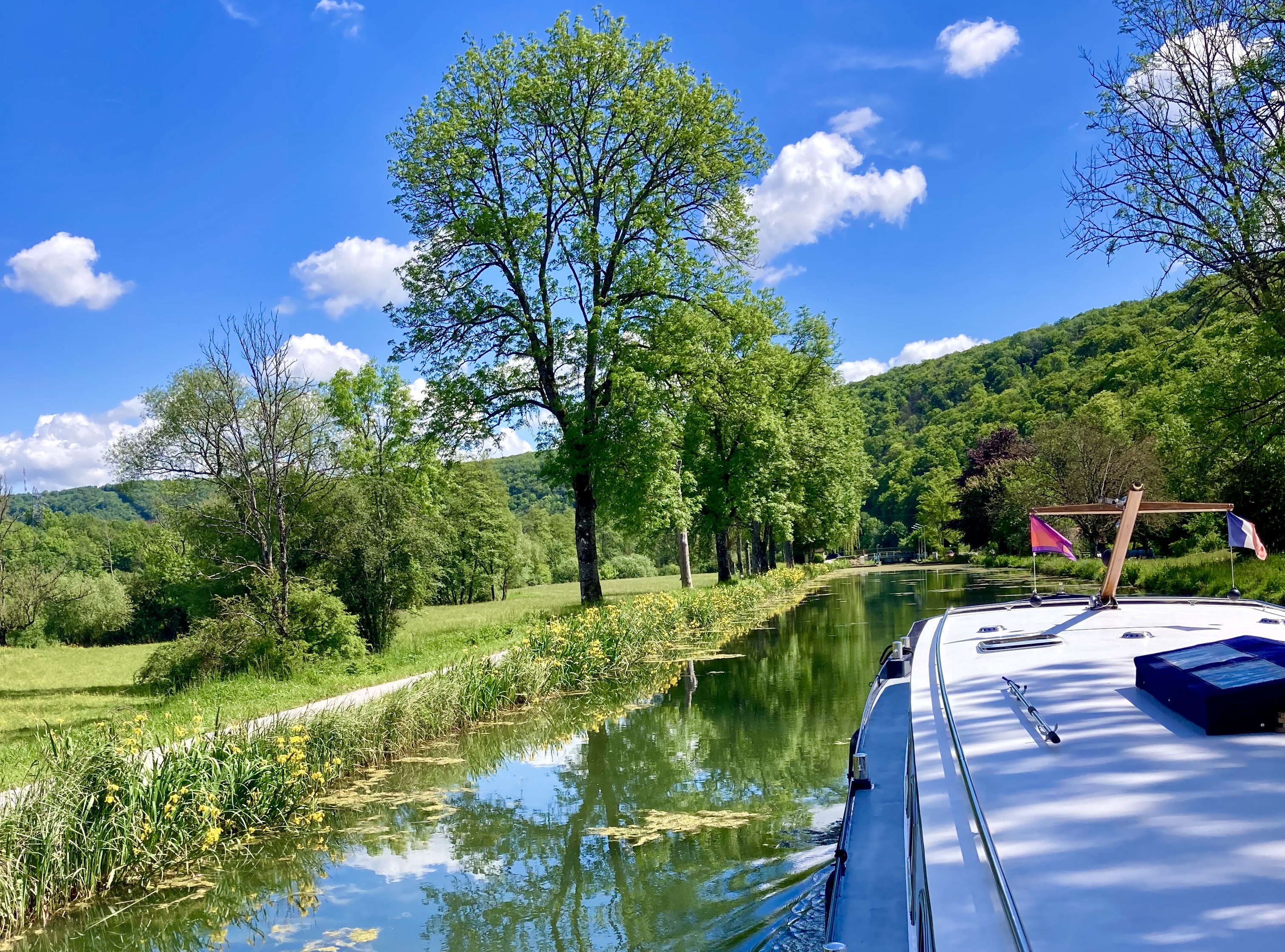
We remembered from our previous stays that the canal and river swept round the bottom of a tall wooded curving hill here, and that hill was more and more apparent on our starboard bow.
Stu and I felt very hopeful about the mooring at Froncles, knowing it to be a long quay, and that there are few boats on this canal so far this season, although plenty of weed!

We arrived to see a space just the right size at the end off the quay, and although there were potential spaces further along we prefer the end of a quay. That was we can sit on our back deck looking out along the canal ……

….. which we might have done later but it began to pour with rain!
Ah well.
We like Froncles – not just the name, but also the place. It has been a busy working town with industry down between the canal and river during the last two centuries. It still has a thriving ‘forge’ business.

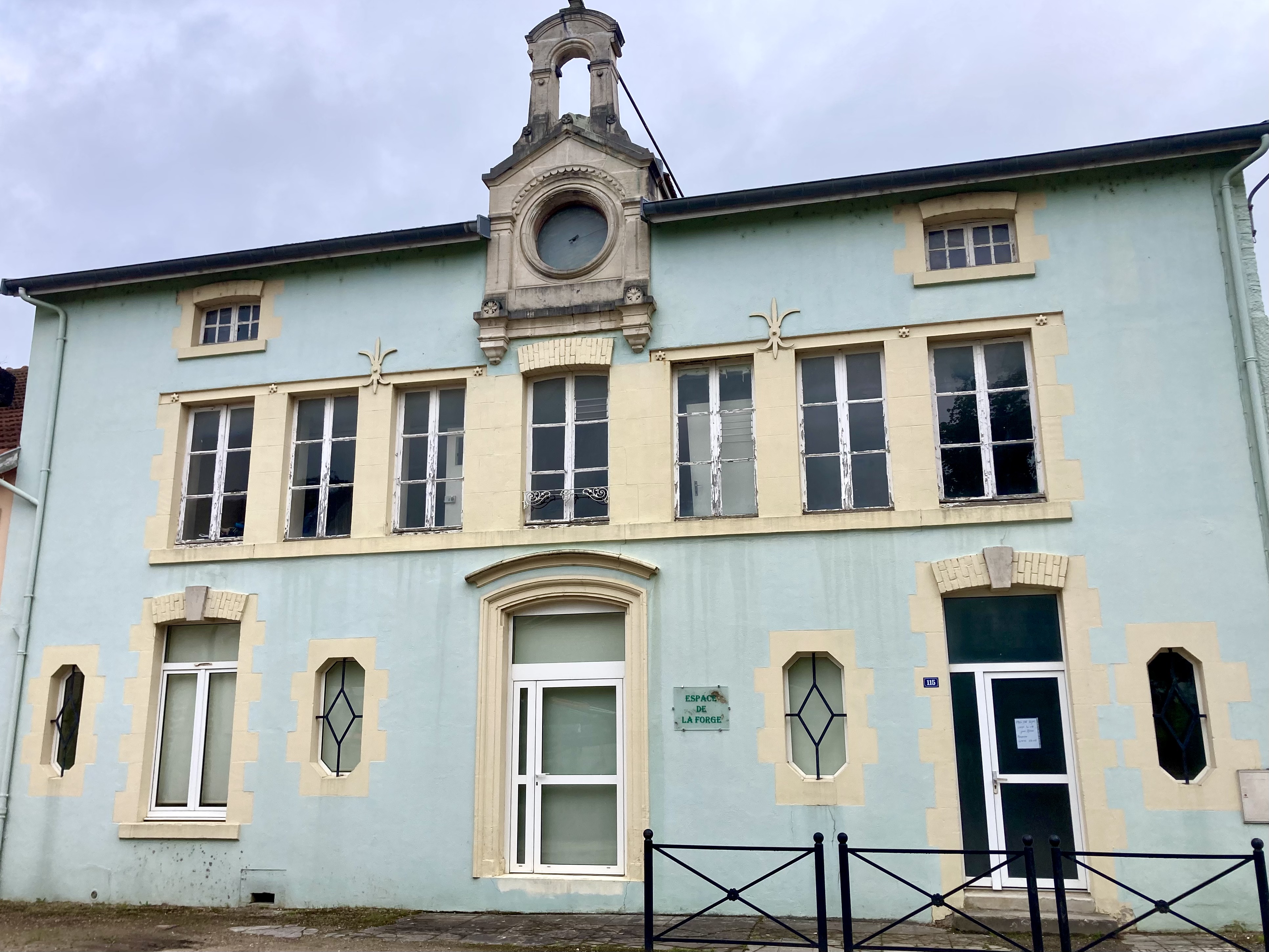
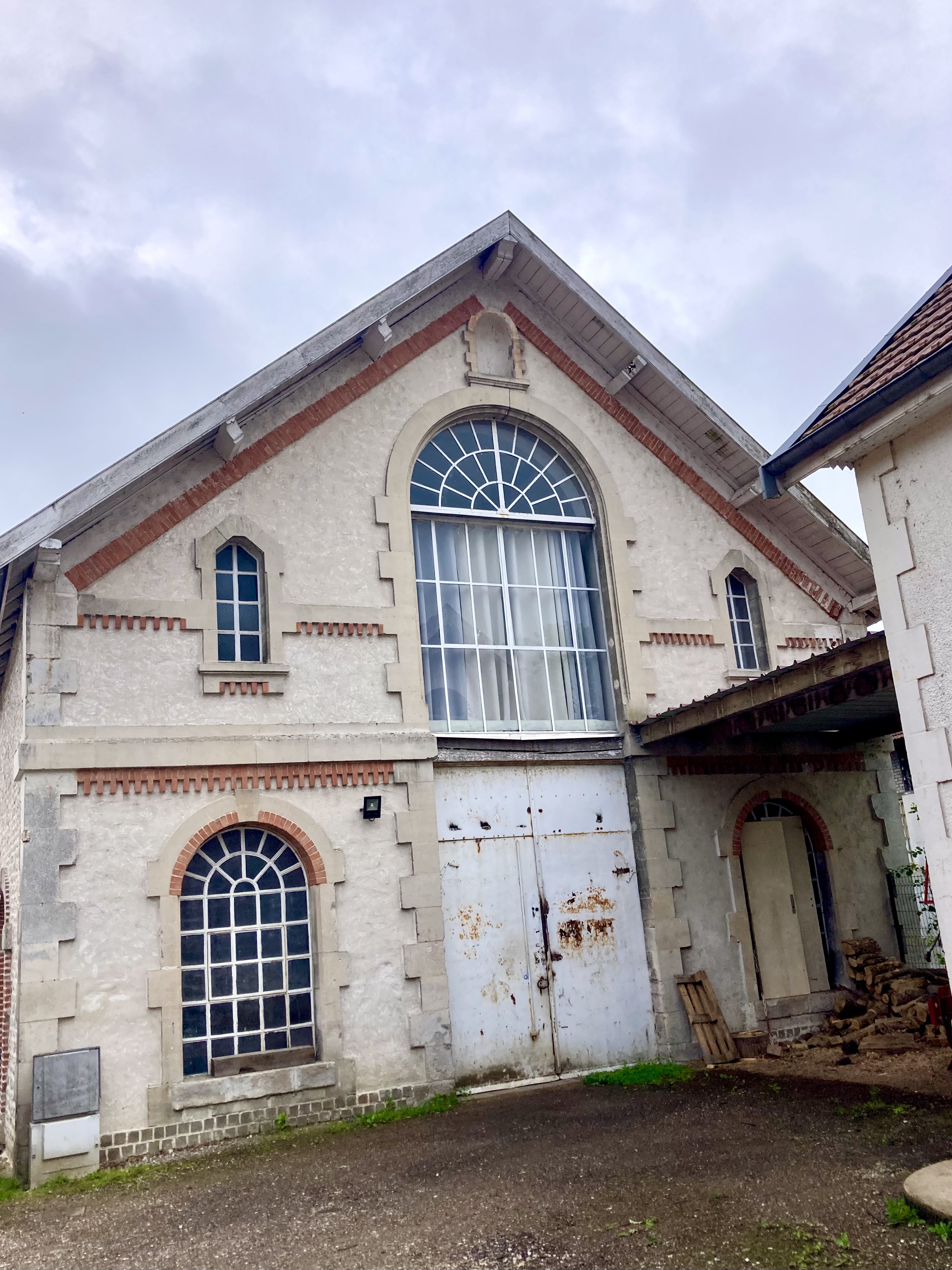
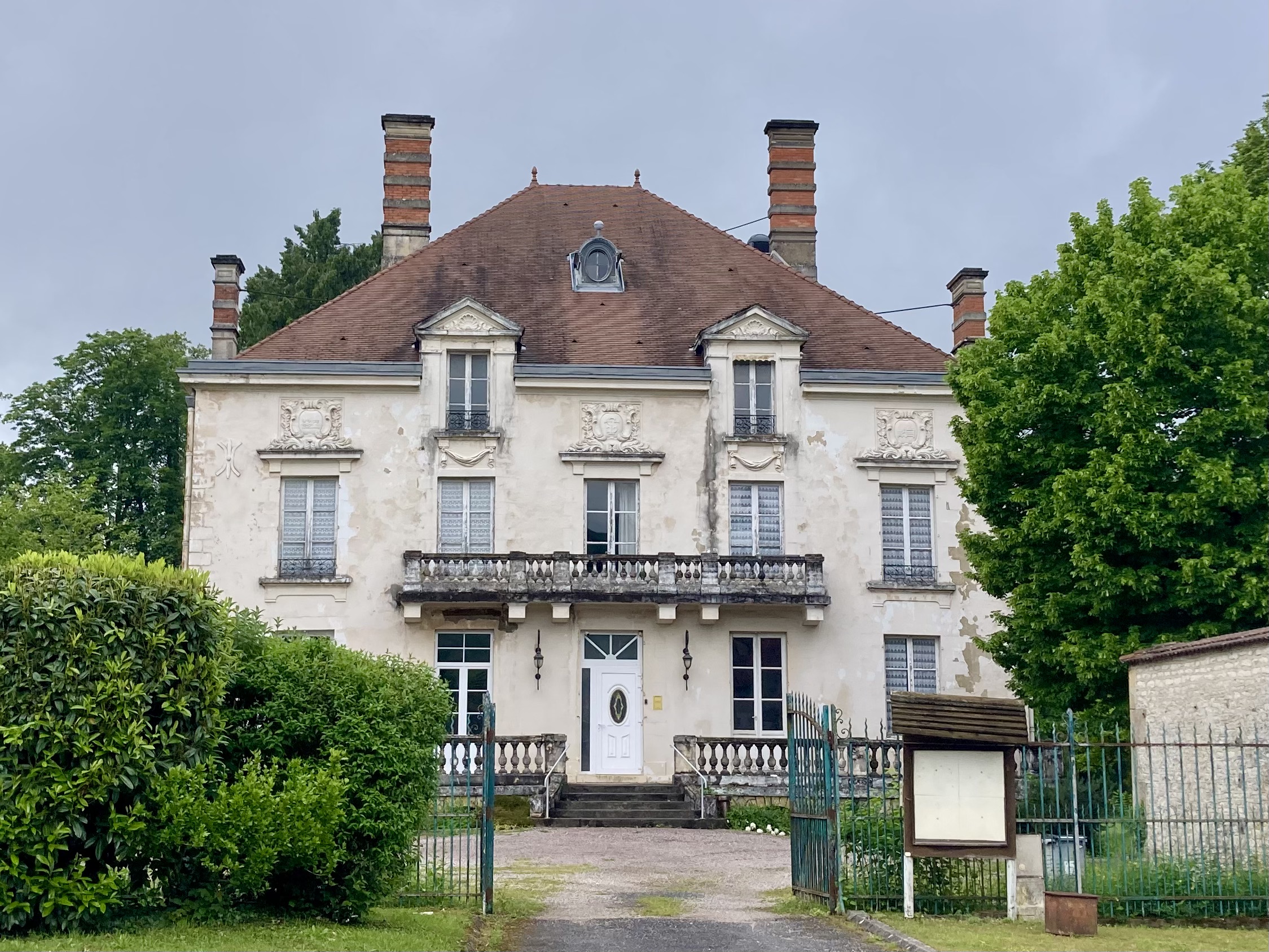

These photos include an electrivcity generating plant, fuelled, I think, by burning wood, one of the metal working mills, a big administrative building (blue) and probably the owner’s grand house (white – well ok, more like cream).
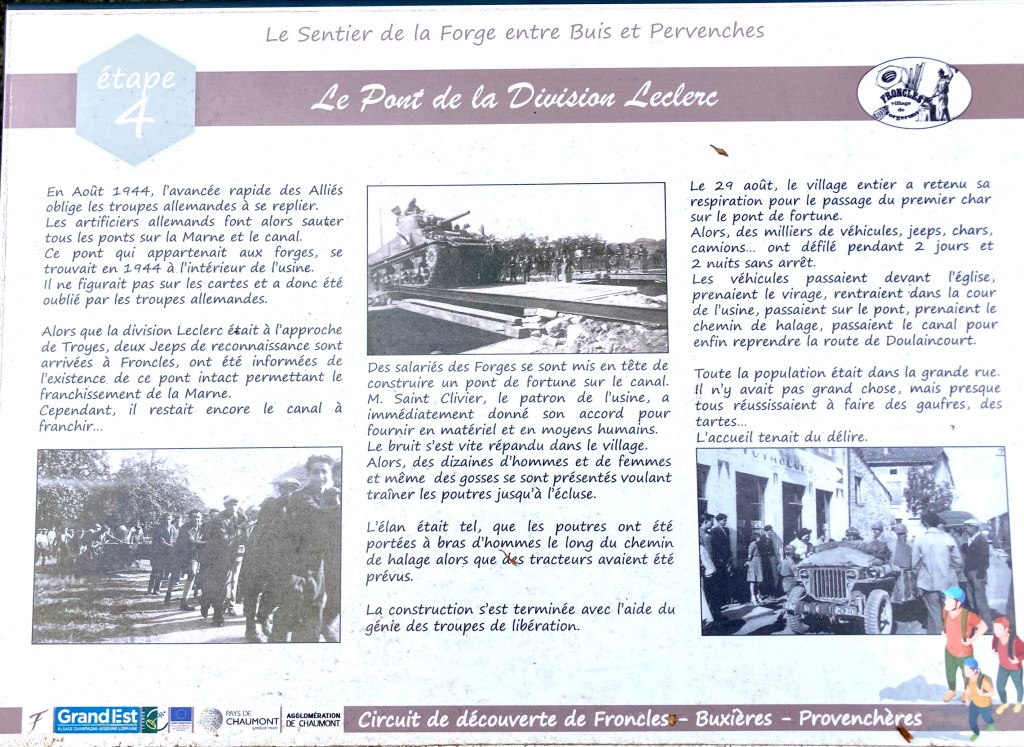
There is also a bridge of which the town is very proud. It was built during WW2, and the men of the town helped buy hauling huge timber beams to the site.
If your French is better than mine you can find out about it here.
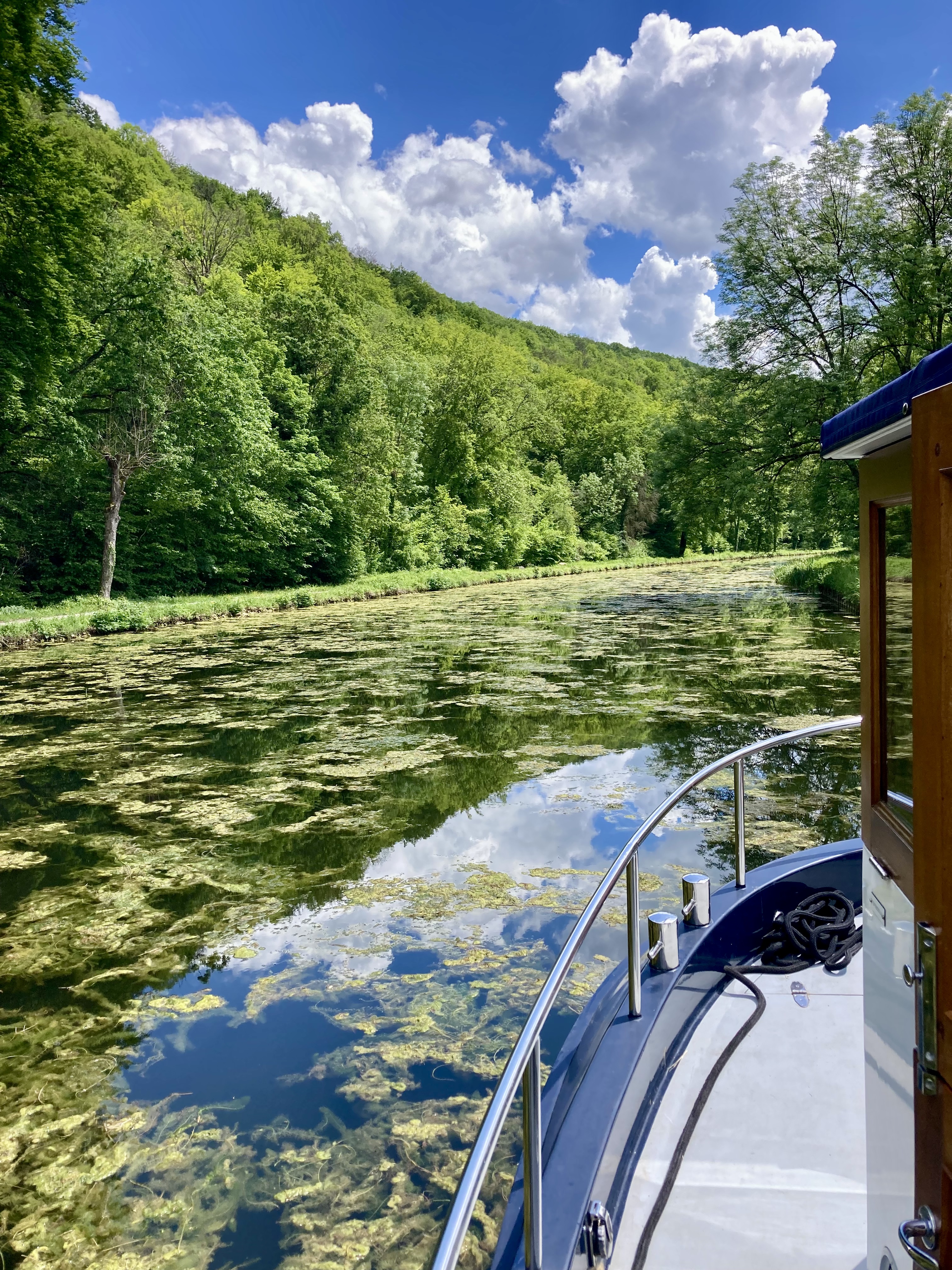
We were having rather mixed weather; sometimes it was warm and sunny, and an housr later is could be raining with thunder in the background. When the sun was out the colours were amazing. Although we do not like to see quite such a bright lime green surface to the water. That means lots of loose weed to clog up locks and propellors.
Strangely it was particularly this ‘beef’ or stretch of water that had this much weed.
My first walk into town indicated a Sunday morning market, so we planned a visit. It was somewhat disappointing having just two stalls, one of which was clothes. However the other was a rotisserie chicken van! And that sorted our Sunday lunch for us.

We ate the still warm chicken along with a very good baguette bought at the local boulangerie.
It was obviously a good boulangerie as shown by the queue outside! It was even longer by the time I left.
I had a lie down after my good lunch and was awoken from my gentle but deep siesta by a Captain wanting to more to a quieter mooring. The Capitainerie at Froinlces also has a couple of small apartments for hire and the latest occupants of one arrived just after us and got straight down to enjoying some rather noisy beery fishy fun, right next to our barge. They turned out to be six Italian lads in their 30’s out for a weekend jolly, and though very friendly, but we gracefully declined their offer to join them for the party and slipped our ropes at about 4pm for quieter mooring.
.

Villiers-sur-Marne
We were definitely heading out into the country. I took the photo below and realised afterwards that in one picture it holds many of the messages of this canal.

– trees, weeds and hills …..
While I had been asleep Stewart had looked at the map and found a mooring near by that was out in the country. My note in the map book said “September 2018 nice’. And checking out the photos from 2018 it certainly was very peaceful.
Here it is.

It looked a nice area for a bit of a stroll. I set off in the direction of the village about a kilometre away, anticipating that I would get to see a bit more of the river that was so oftyenm the other side of a hedge or field.
At the first bend in the road, beside a bend in the river and down a grassy bank, I saw a familiar shape building.

Yes, somehow I had found yet another lavoir! I don’t know if they seek me out or I seek them out, but I keep finding them.
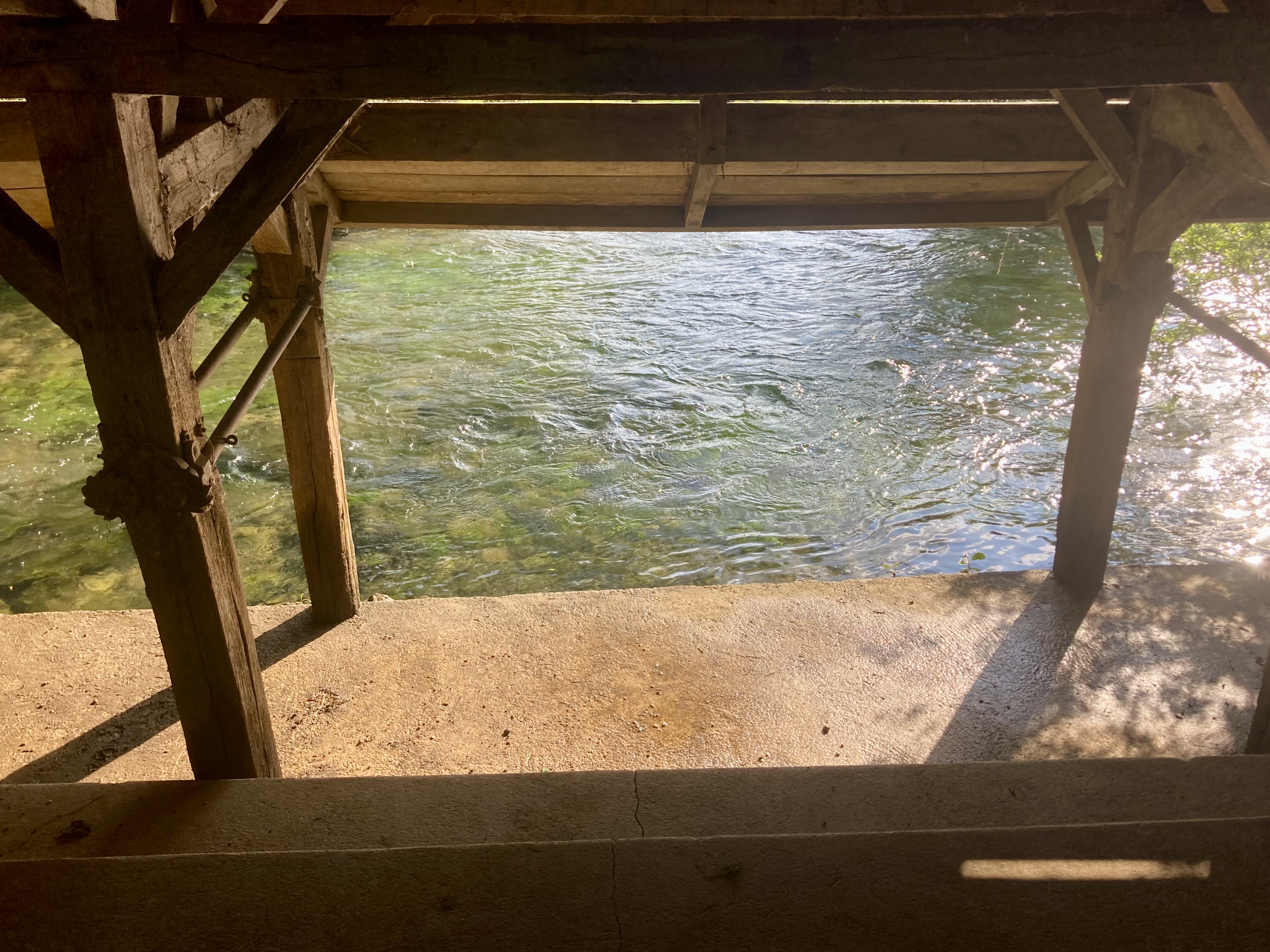

Then back to find Calliope and supper.
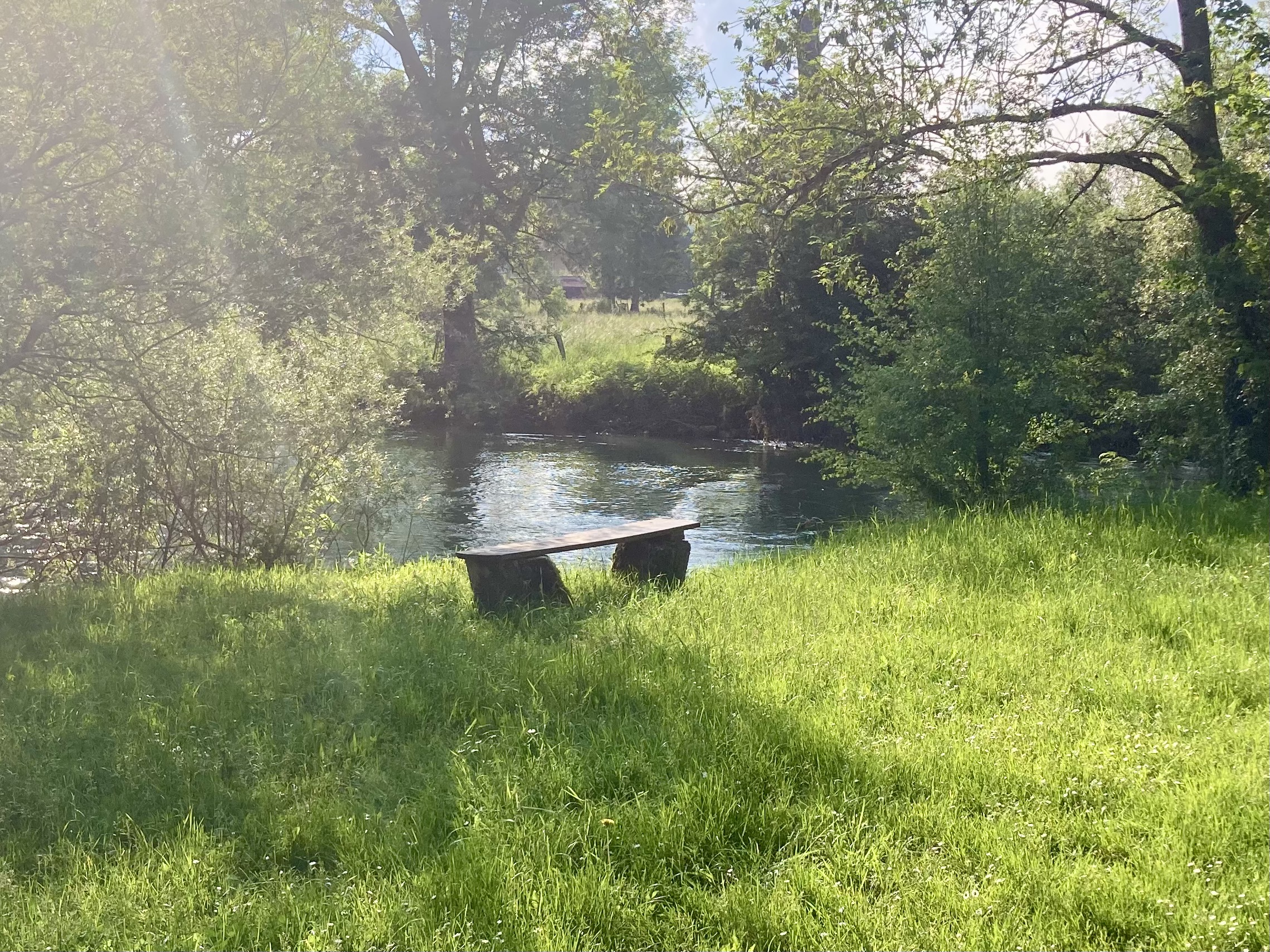


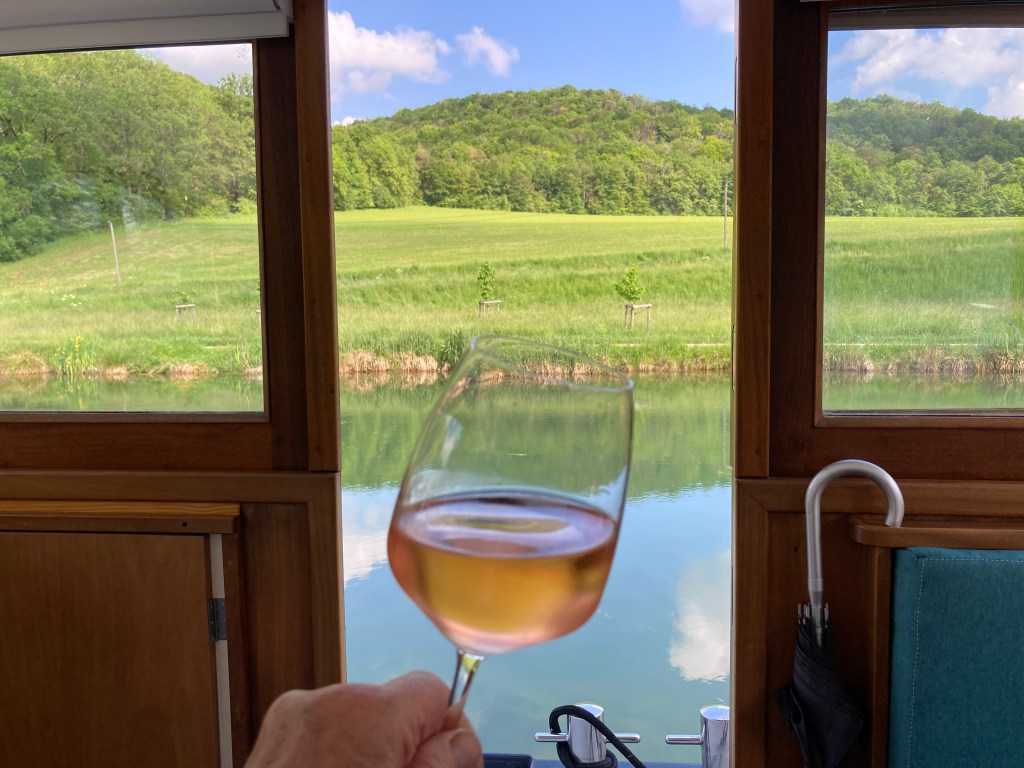
Salut to the French countryside!

We woke up to an unusually misty morning for this time of year.
We are accustomed to this kind of view in Autumn, but not in mid May, so it was a bit special to see it. The sun burnt it off by 10am.
This mooring is at PK 78.4. The mid point of the 155 kms this side off the canal is obviously 77.5, so only just round the corner. But I didn’t take a photo to record the fact – the next one is at about 76.3! Next time I’ll be sure to get it.
Donjeux

Here is the 76.3 kms photo, showing our approach to Gudmont Écluse and the bridge in front of it being raised for us. By then, 1030, all the mist had cleared and we had another glorious day in front of us.
One bank of the canal along here has been completely renewed recently, giving a smooth concrete to starboard and unruly grass to port.

As luck would have it Gudmont lock was one of those where the doors do not want to open for us!
Having phoned for help I sat on the sun at the front of the upbeat watching a redstart fly back and first across the empty lock, finding things to eat on the wet walls.
The photo shows him flying away from me towards the wall, his red tail fanned out.
We did not wait too long and by 1200 we saw the church of Donjeux on the horizon as we crossed over the Marne once more and into our last lock of the day.
The mooring is just within the Donjeux boundary, but on the Rouvray-sur-Marne side of the canal. These two villages lie almost opposite one another with the canal and river in-between.


We remembered being on this mooring before, in 2016, and on almost the same date! The photo on the left is the 2015 version, when we stopped for lunch and made use of the quite new picnic table. Stu sat back at a somewhat older table this time, in 2024, with Calliope facing the opposite direction.

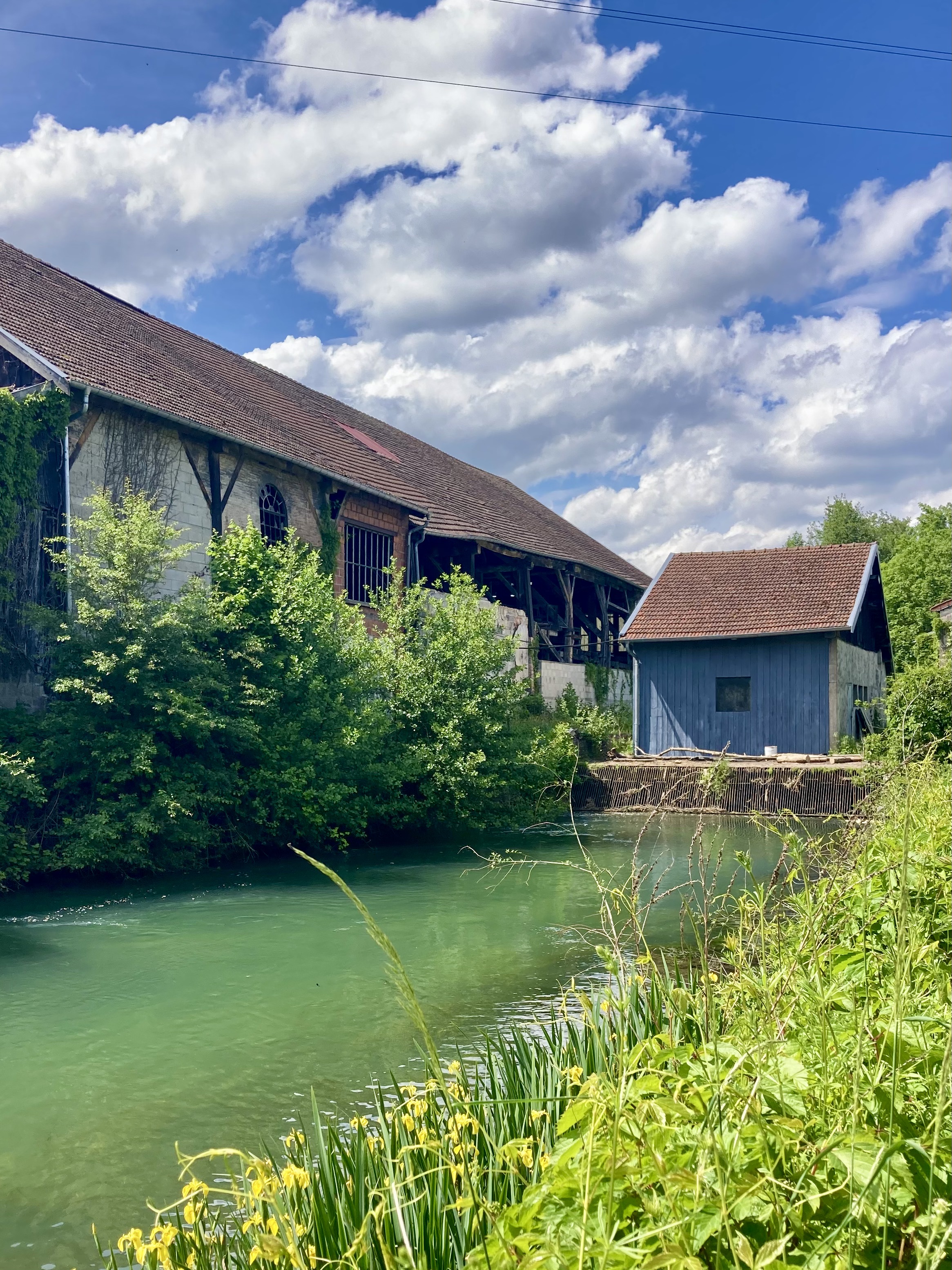
We started out towards Rouvray for a walk, but decided it did not look too interesting (sorry Rouvray) so walked back past the boat and over the bridge to Donjeux.
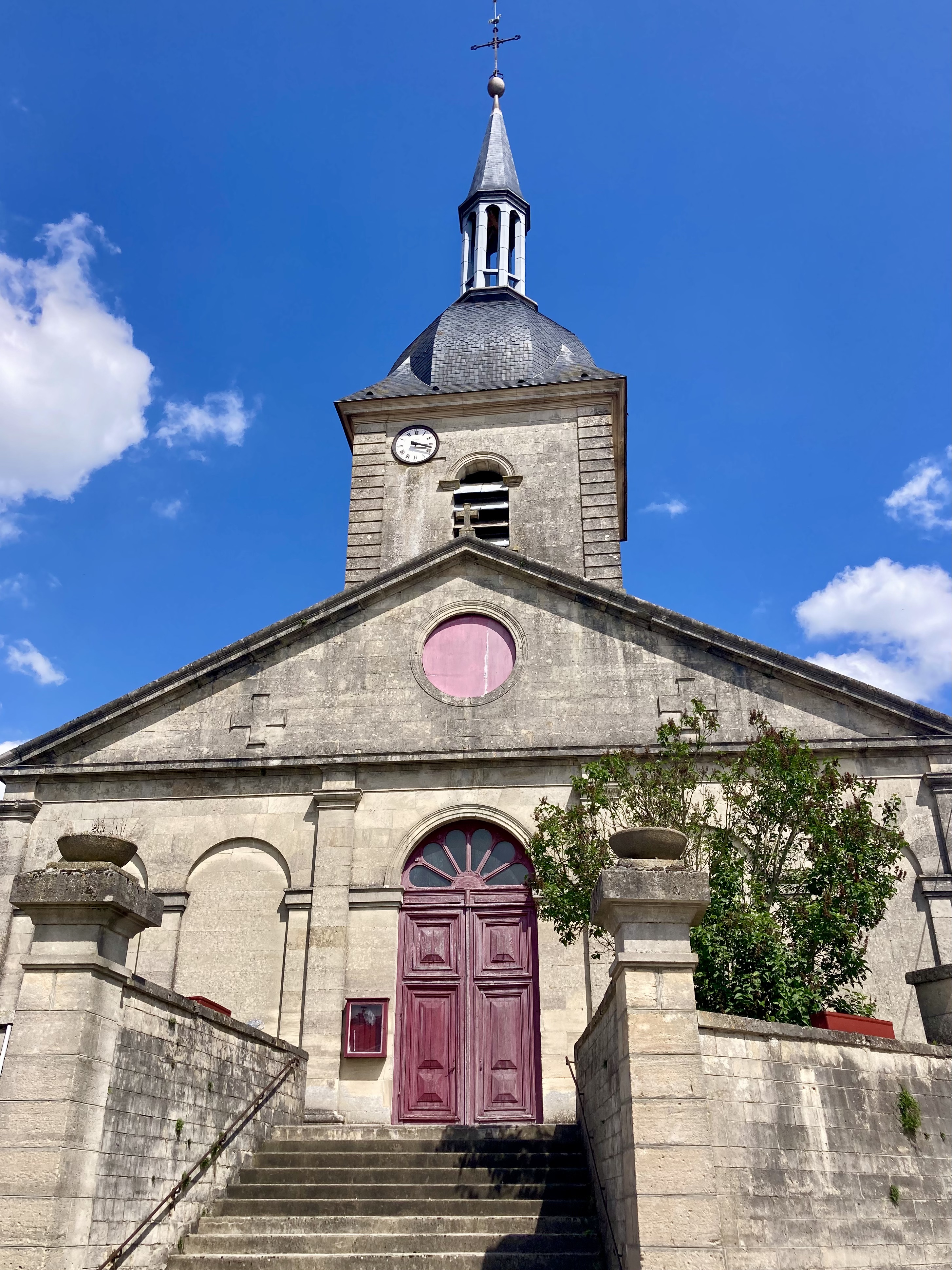
Then I got a close up of the church we had seen earlier, and the old mill that had kept Donjeux busy in days long gone, making nails.
An otherwise calm evening was broken by a short thunderstorm, and a strong gust of wind that covered Calliope with leaves and blossom; very pretty, bit more work for the cleaning section of the crew!
Joinville
The journey to Joinville was pleasant and generally uneventful. Half an hour before we planned to start there was a knock at the door and a VNF man asked when we were going. He had come to take out the ‘weed dredging’ work boat that had been moored along side us since we arrived.
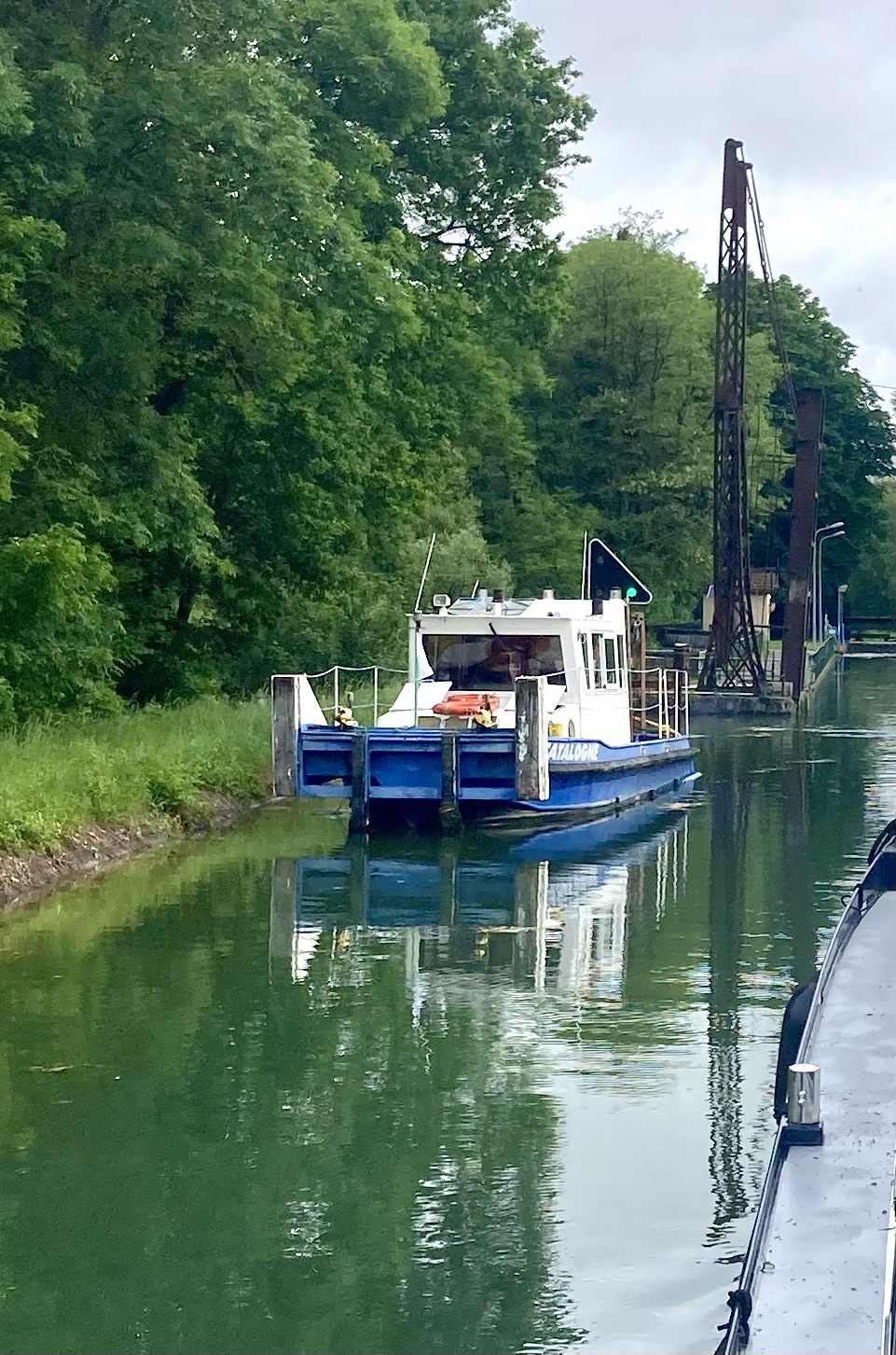
We agreed that he should go immediately and we would catch him up at the first lock. Which we did. Before the lock was a redundant lift bridge, now permanently and rustily pointing skywards, constantly open for boats to pass.
Also before the lock there is another pont canal over the Marne – the sixth time so far that the river had flowed under the canal.

We made sure we enjoyed the landscape, knowing that within a few days we would be down into more heavily populated, industrial, flat land!
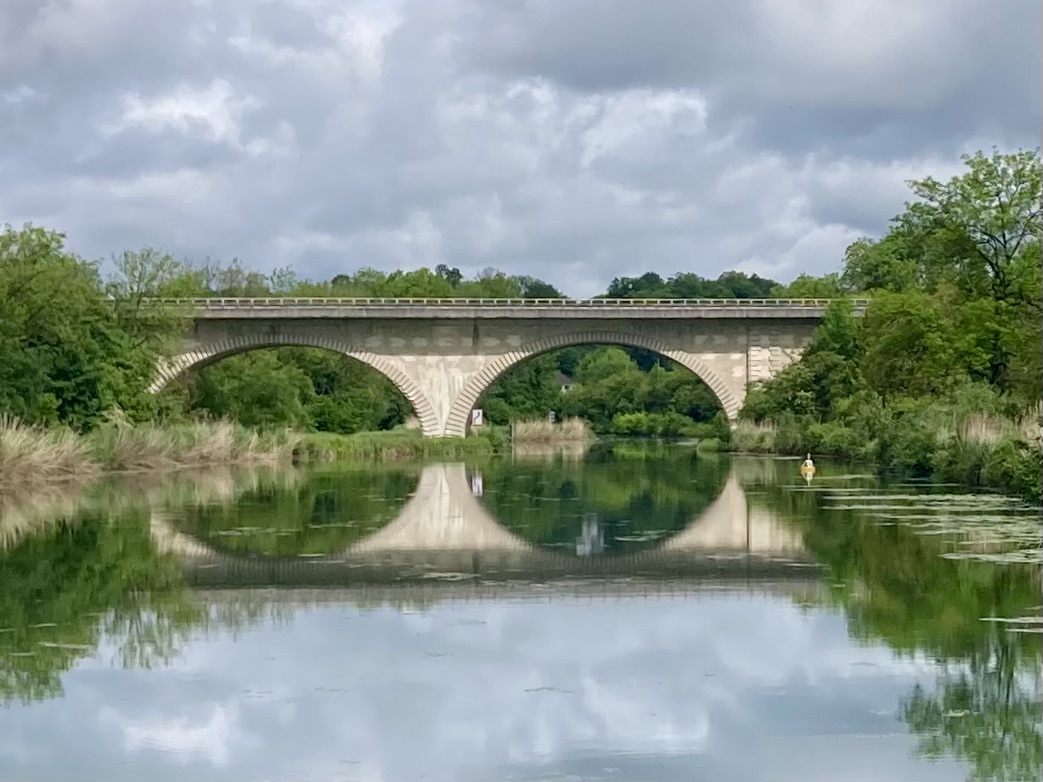

Just outside Joinville we came to, and under, a beautifully arched bridge that spanned both the canal and the adjacent river. It carried the main Joinville bypass, N67, across the waterways and water meadows.


As we dropped down the final 3.41m into the town at lock 44 we took another look back at the hill country we were leaving. The lock house here, built in 1878, pre-dates by 3 years the one at Lock number 1, the first after the tunnel at the top.
We reached Joinville around midday, to find a completely empty 50m quay waiting for us. Split for choice we chose to moor at the end furthest from the town, and out off the way of the 4 happy anglers!
A quick 10 minute walk to a boulangerie provided a sandwich lunch – our favourite tuna and egg salad bagnet (not quite the famous Nice version, but filling and delicious.
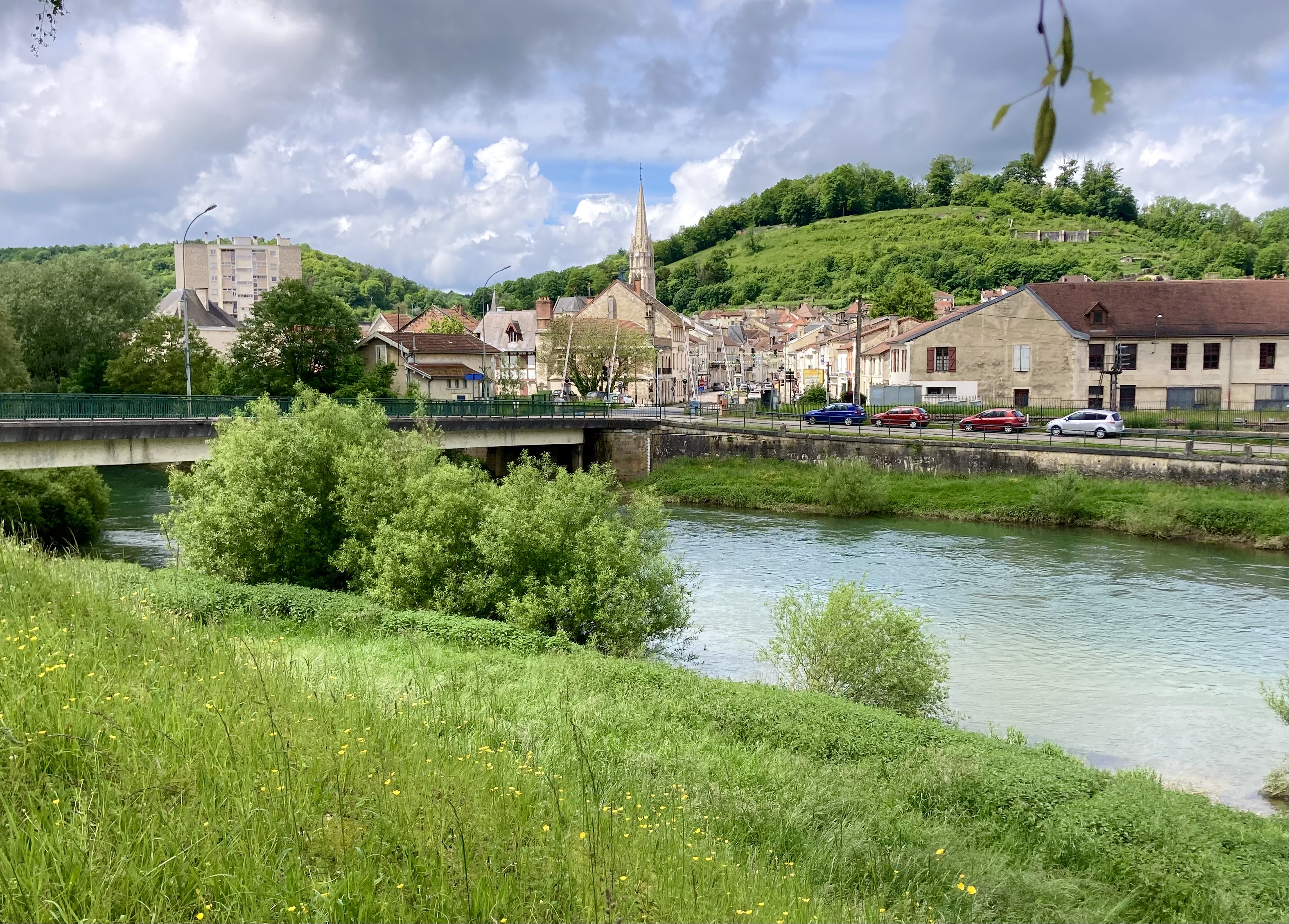
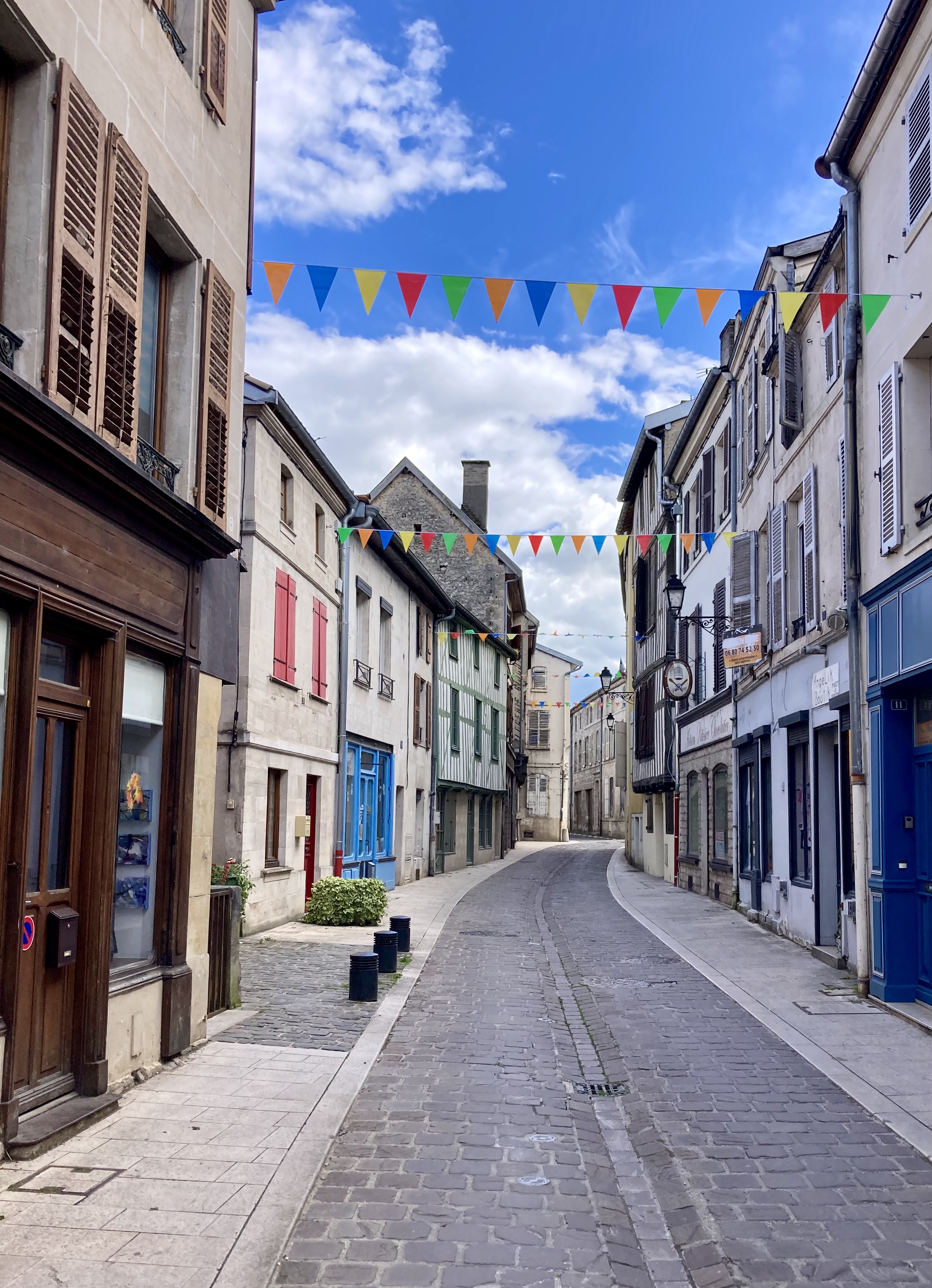


Later that day we went for a walk round Joinville with the intention of having an early beer and a pizza. The town, though rather tired in places, is very interesting. The river Marne splits at Joinville with the main part running round the outside of the town (first photo) and a smaller arm running through the town (last photo).
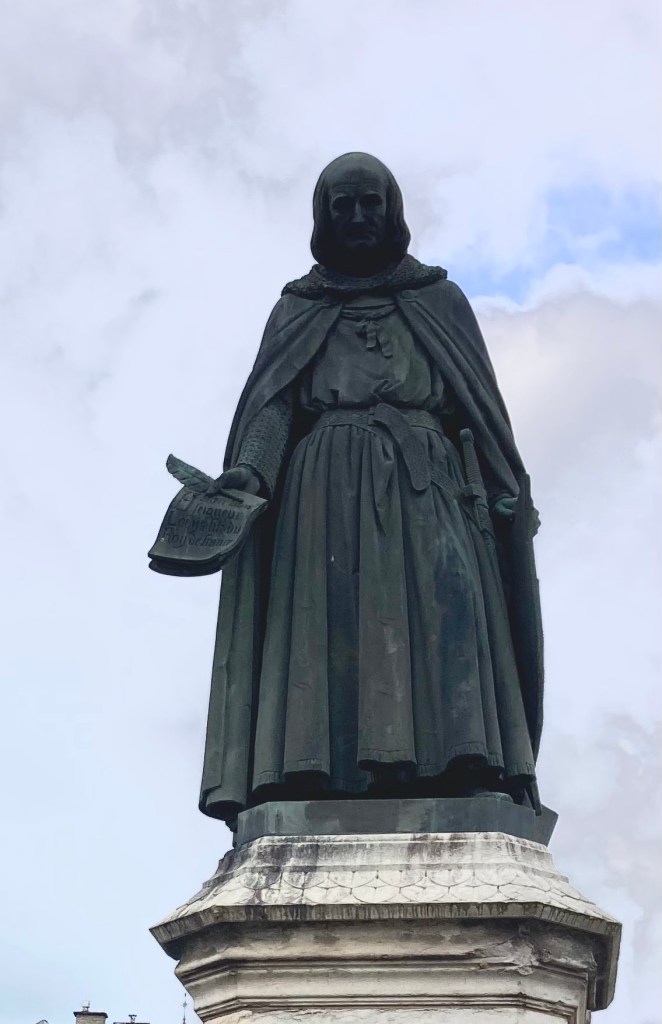
The town has a famous son – Jehan Sire of Joinville and his statue stands on high in the middle of the road at the bottom of the main street.
This medieval gentleman became friend and adviser to mKing Louis IX. accompanying him on one of his Crusades.
He wrote a book about the life of Saint Louis (the King was later canonised) and lived to an amazing 93 years – quite something in the 14th century!
However the only bar open was a PMU (betting shop with bar) that had no outside tables so we wandered back to our lovely boat and enjoyed an evening on board instead.

Joinville was one of our two night stops; we enjoy a rest day or two, and time to do things on board when we are not underway.
This time we filled up with water and Stewart manfully took apart the sink trap for its annual Spring clean. No problems there, and it went back together without leaking; result!
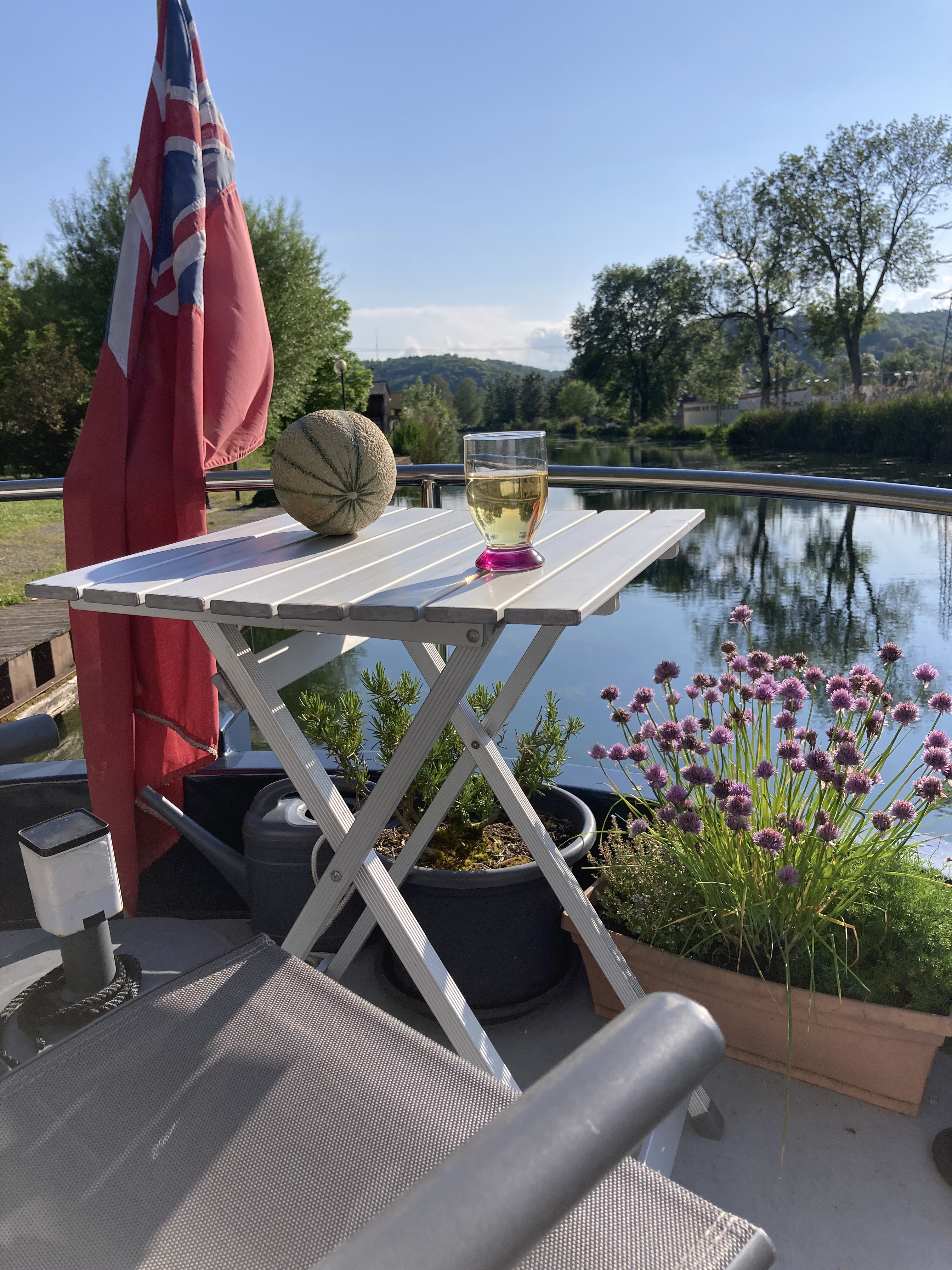
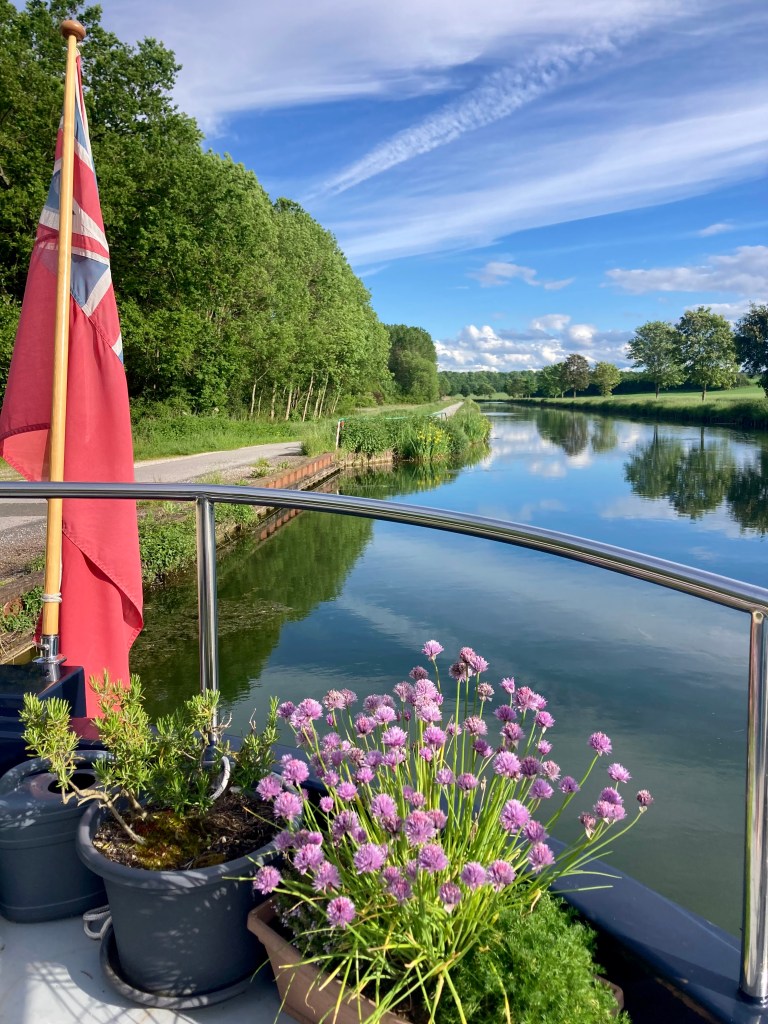
Our second evening in Joinville was one of two halves weather-wise. It began with blue skies sunshine, and white wine with chataigne (chestnut liqueur) on the back deck. It was so peaceful sitting there my herbs (the chives beginning to pass over), whilst Stewart cooked supper.
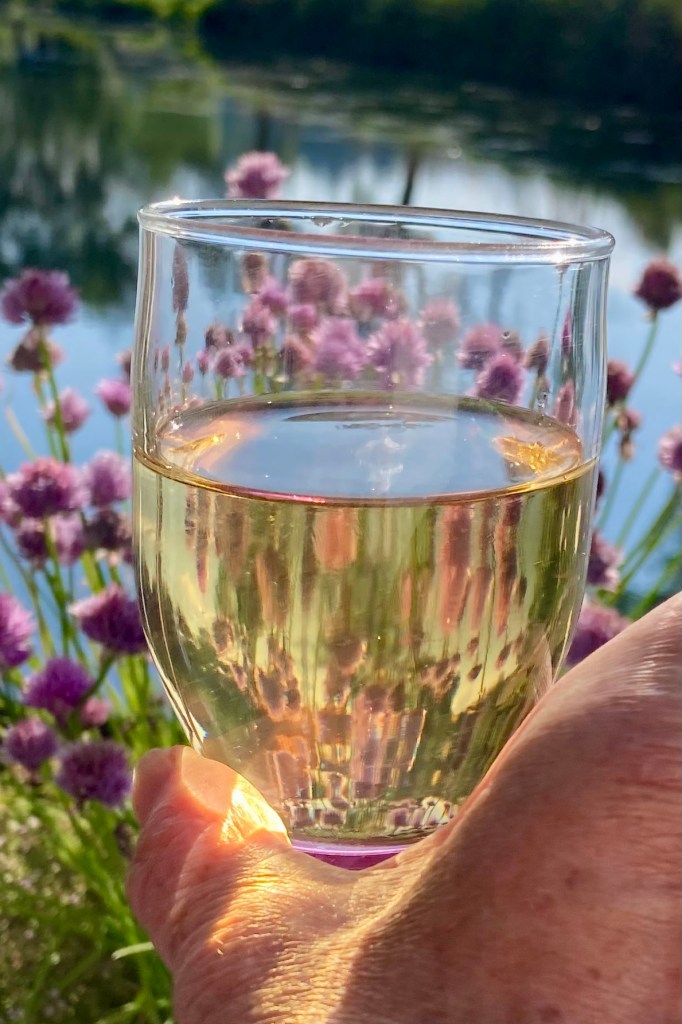
May I share my attempt at an arty photograph, combining the chives, the Chataigne kir?
Thanks
Sorry that my old hand father spoils the effect!
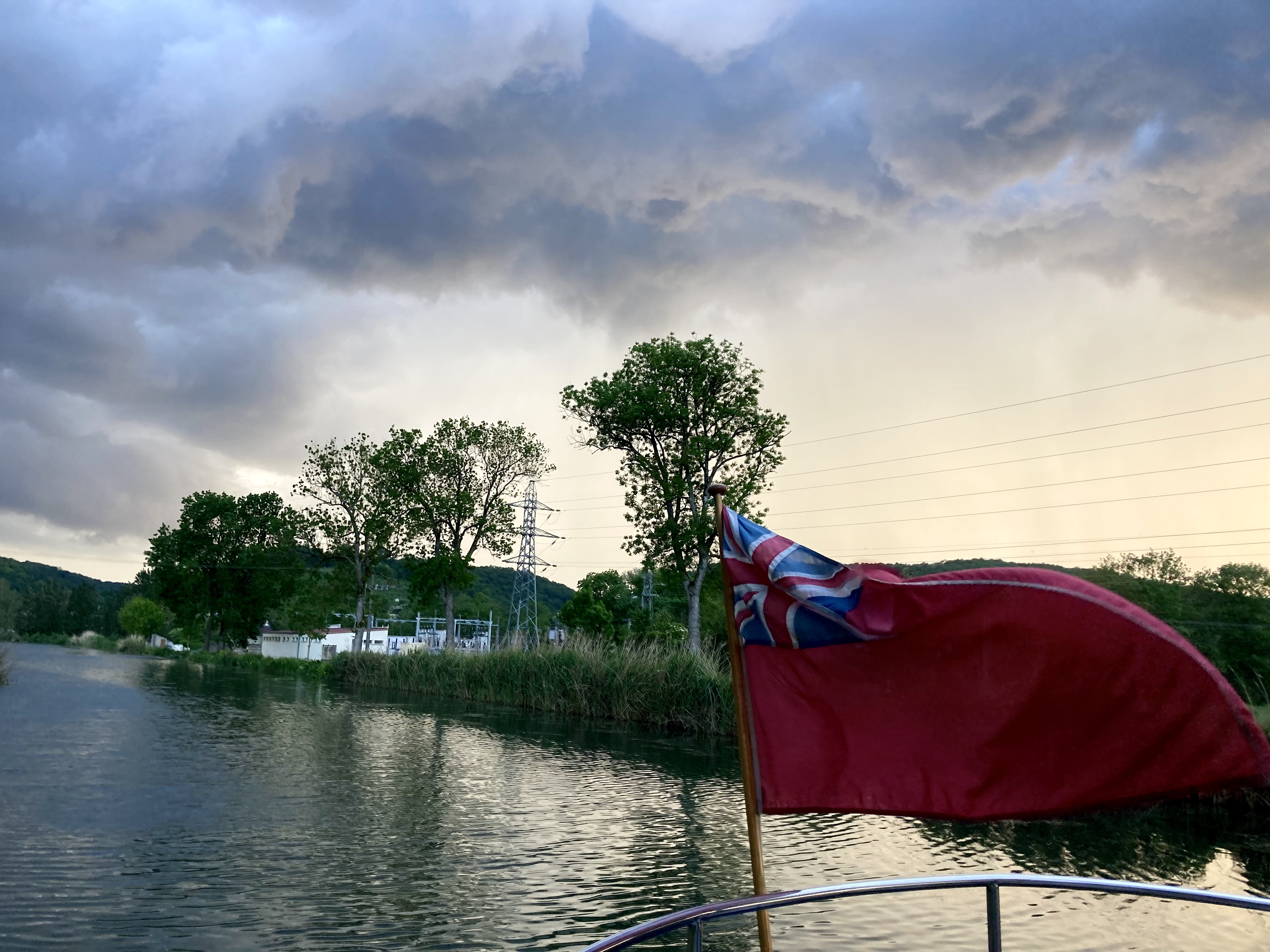
After supper things began to change! The wind suddenly roared along the canal and purple grey clouds were gathering.
When the clouds turned yellow, the rain began to fall, and it fell in sheets.
Then, as soon as it had come it was gone.
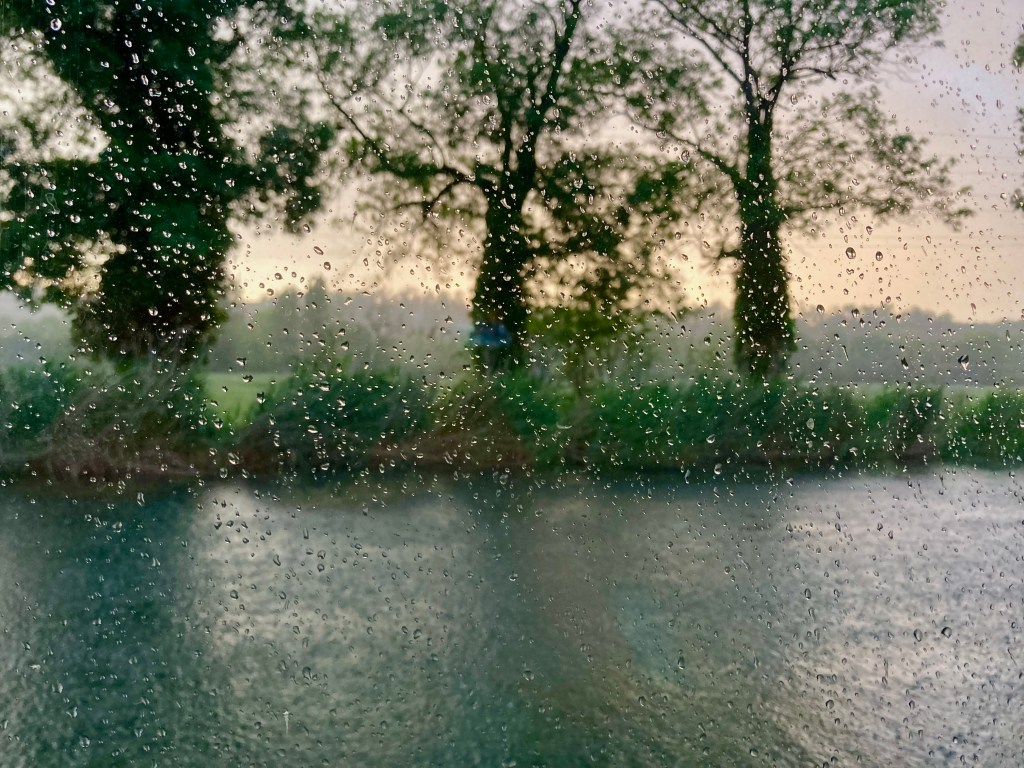
And we had a calm last night sleeping in the little port
Bayard
We had arranged set off in the morning at 9 am. Two French people in a camper-van had come along the evening before and show an interest in the boat. Stewart invited them on board next morning just for a half hour trip through the first two locks and then they could walk back along the canal path.
They were so pleased that they brought us a bottle of champagne!
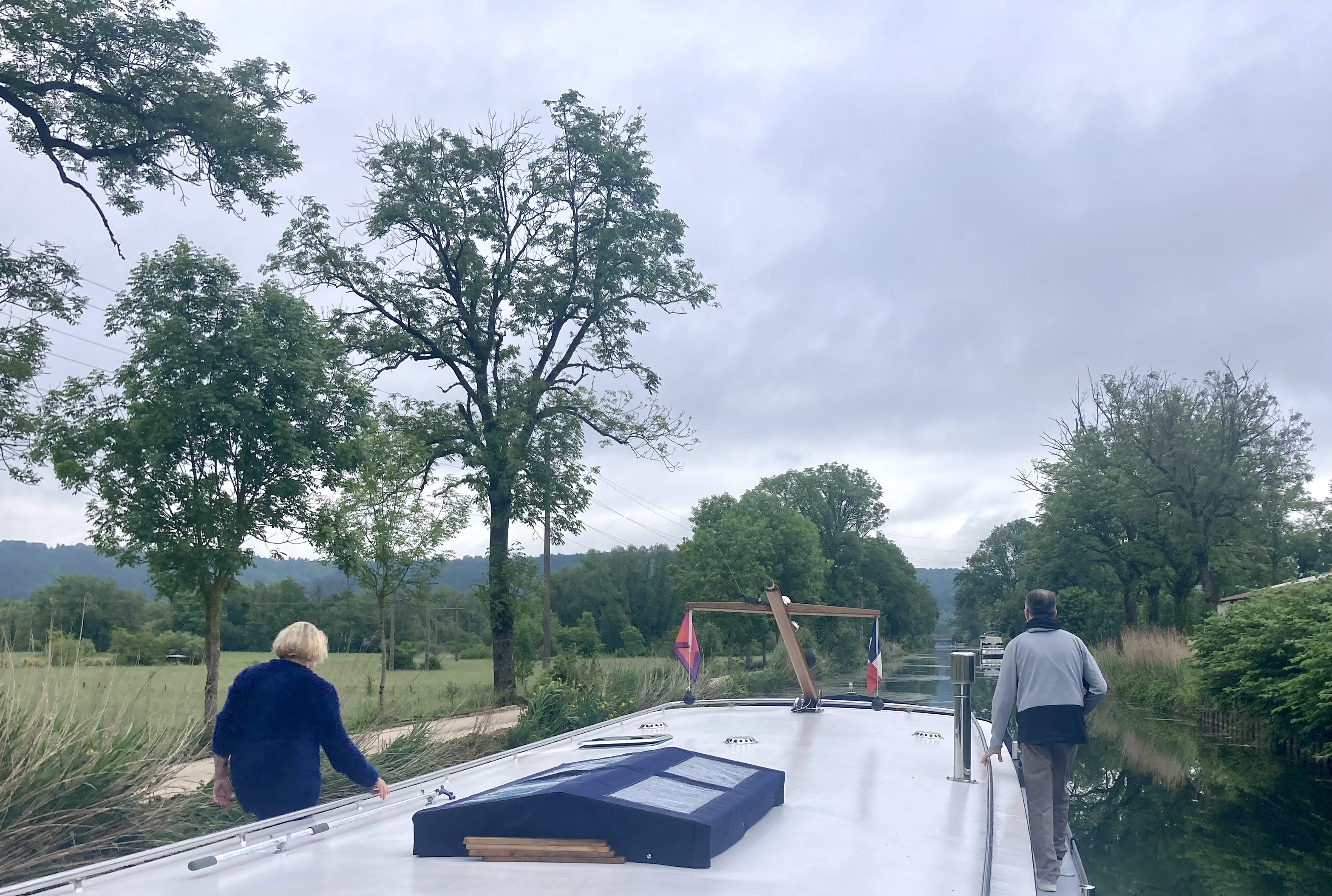

They were soon happily moving to the front of the boat and sitting on the fore-deck to watch the countryside go by.
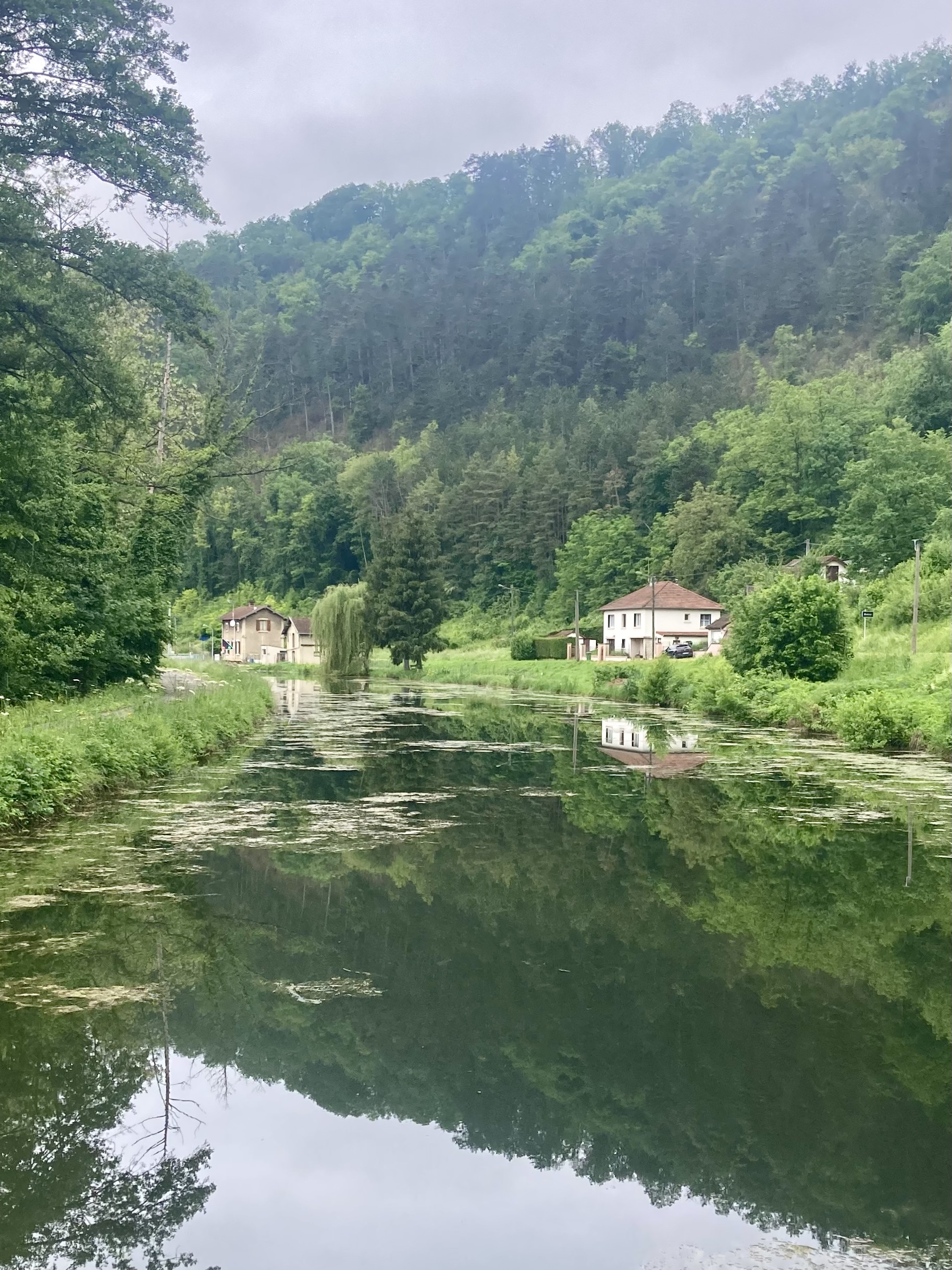
I though that we had left the big hills behind but suddenly found we were cruising through another deep sided wooded valley.
It was rather beautiful.
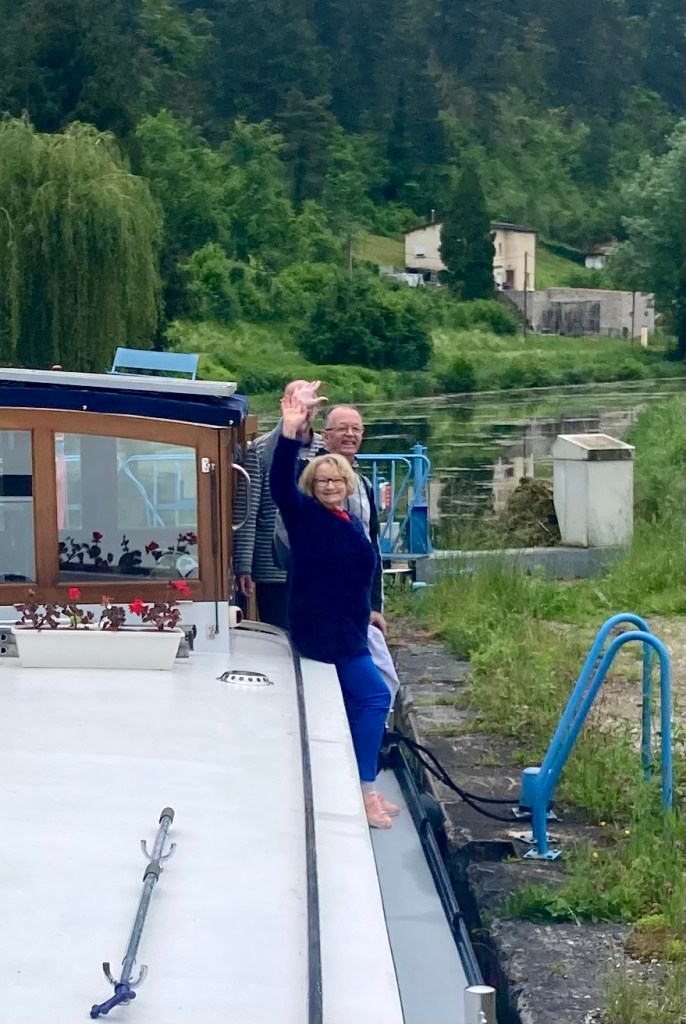
We reached the second look and our new friends Richard and Sylvie said goodbye.
We seem to have persuaded them that a boating holiday is a must for them next year!

Our next lock had a real waterfall pouring in at the back and splashing on the step. I always find this rather splendid site.
It turned out to be another of ther multi-bridge days.

We went through several lift bridges; some of them that we had to operate with the telecommand.
And some, like this one, are now permanently open.
And later this beauty! We were so lucky that the sky had cleared a bit and the reflections were at their best.

It is near Rachecourt-sur-Marne and appears to be another disused railway bridge. Somehow, for me, it holds so much rusty rustic presence.
A couple of other lock photos – just bringing to life what happens as you move along these canals.
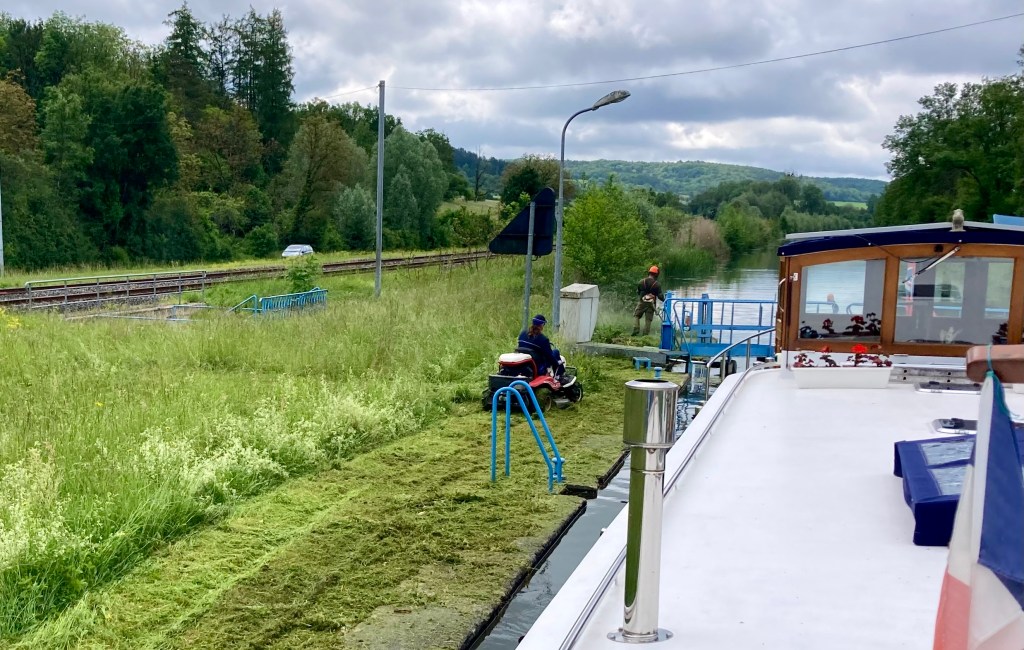
At one we were accompanied by a team of 3 VNF guys who were tidying up the lock area.
There was something of a meadow to be mown …. 3 men went to mow …..
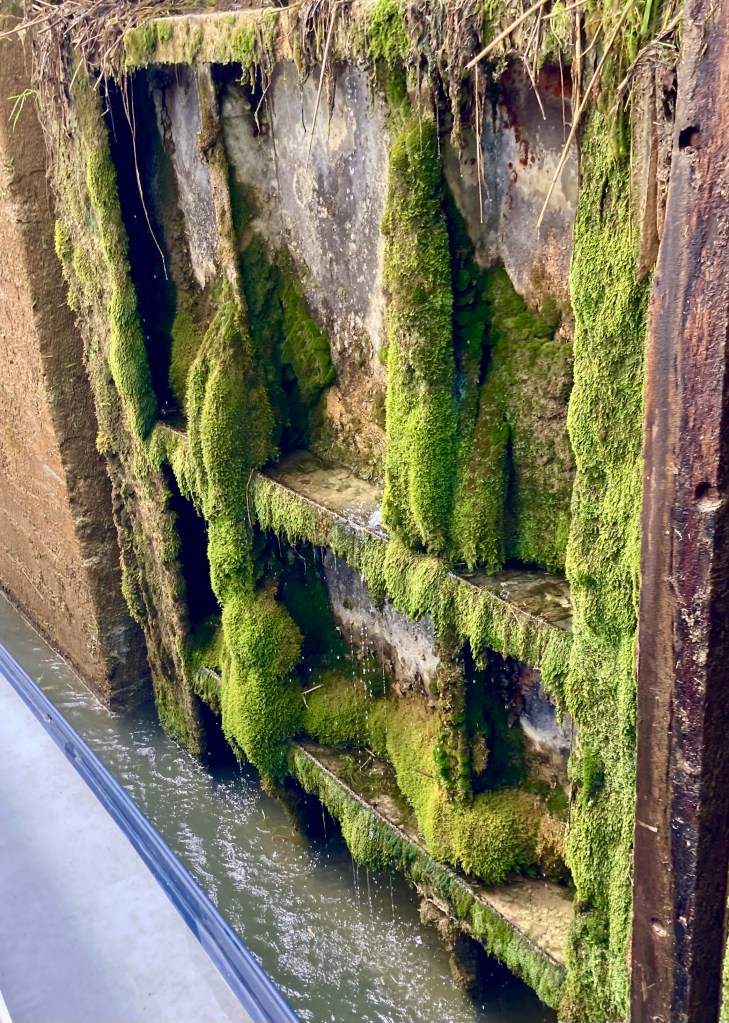
And at another – in fact at many others on this section of the canal – hanging moss gardens had formed on the lock doors.
As wife to someone who in the past tried to develop a moss and fern garden, I was quite envious of this natural greenness.
We were now nearing Bayard, our overnight stop.
Immediately before the final lock we crossed an arm of the Marne once more.
There was a confluence of waters, a separation of flow through weirs and tributaries that we could not quite get the hang of. It looked like this from above, with water flowing underneath us as well.
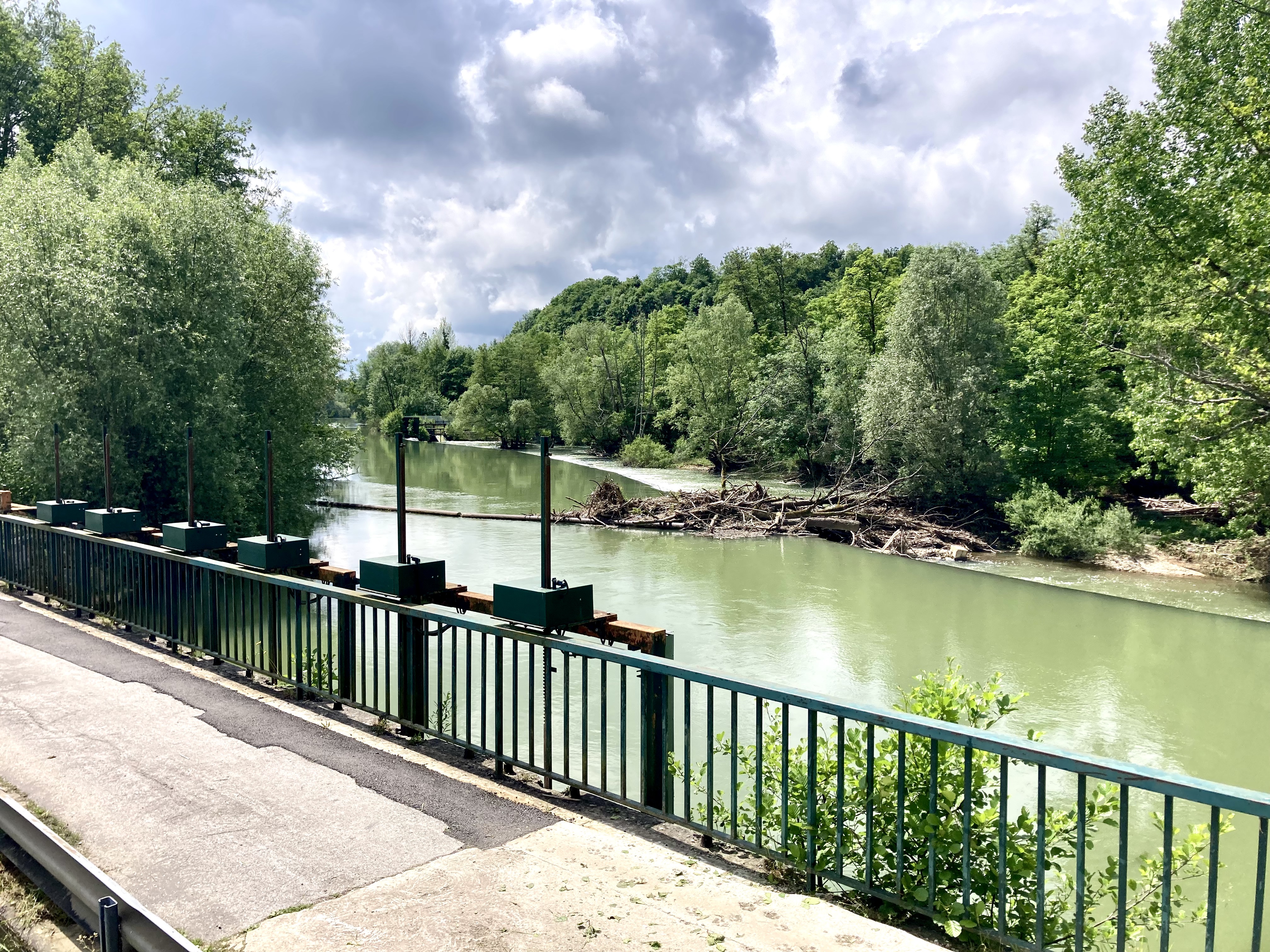
There were a whole series of sluice gates to allow changes in the flow from the main Marne into this arm that would carry on through Saint Dizier and meet up the the river again further down.
It looks like this on Google Maps.
We were just going into Écluse 51, and although it looks as if the canal and the river simply merge together we were actually going above on a pont canal.
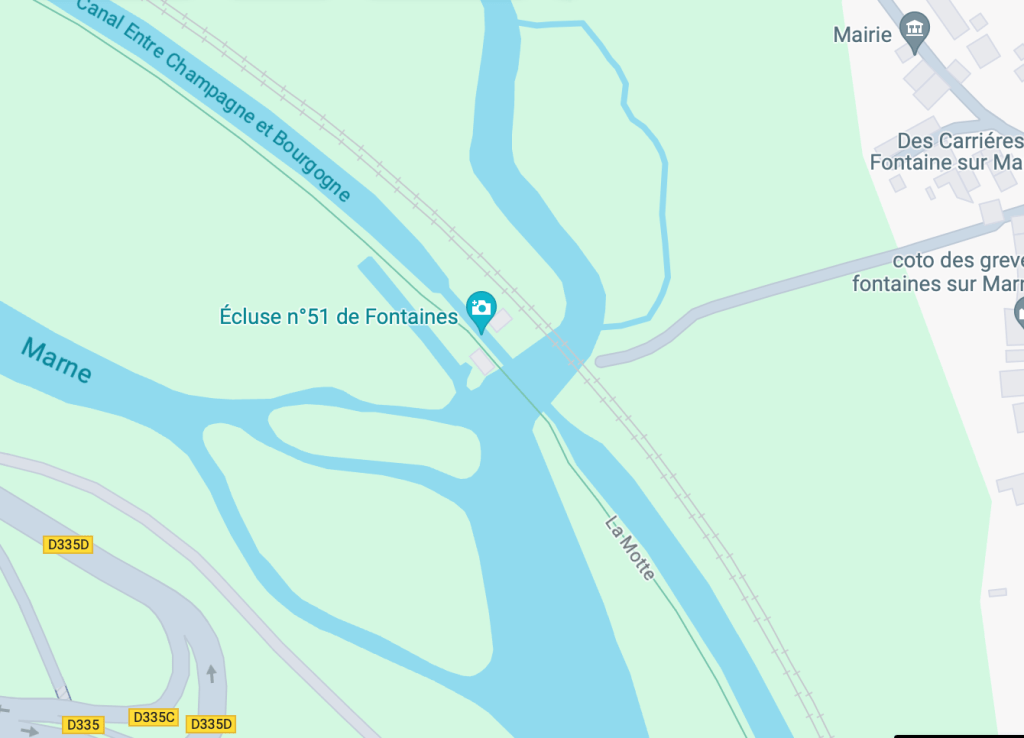
Lock 51 turned out to be ‘en panne’, or out of order, so we had a short stop by all the rushing water while we waited for help to arrive. It is strange how often it is the first or last lock of the day that breaks down!

Once through the lock we had two kms to go to the final obstacle of the day.
This ‘obstacle’ was in full working order and as the bridge raised we could see our mooring on the left, empty and waiting.
If you zoom in you can just see it by the first grey box.
We have stopped here before – twice!
And co-incidentally it was exactly the same day – May 23 – in 2016.
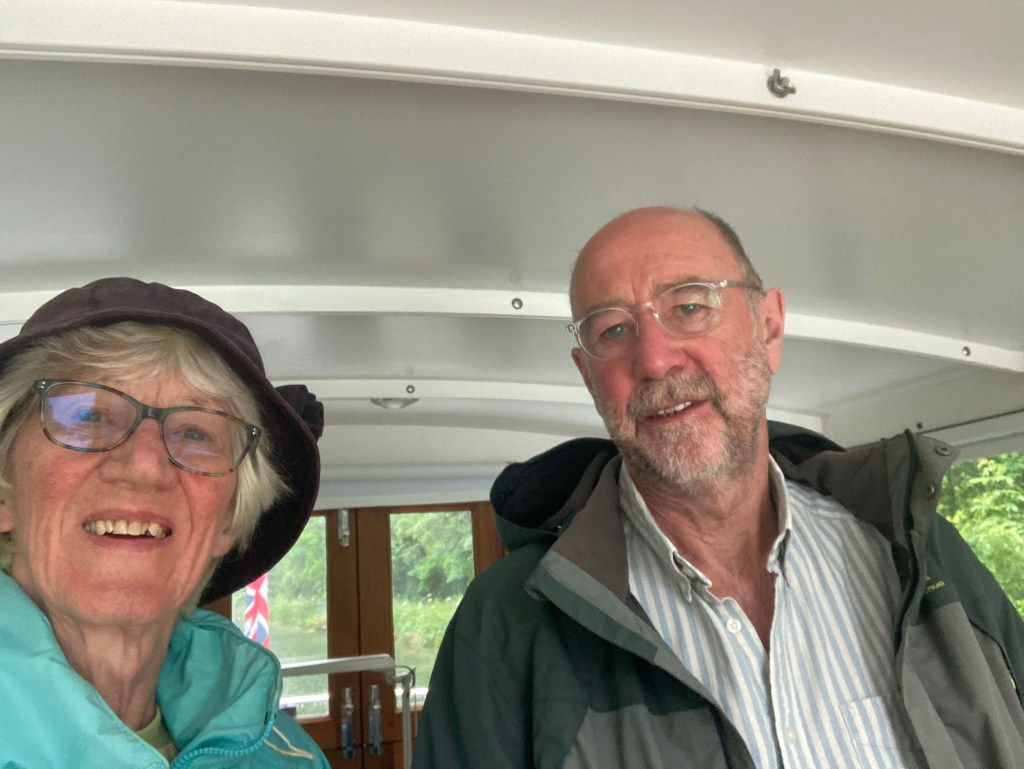
So we took a commemorative selfie!
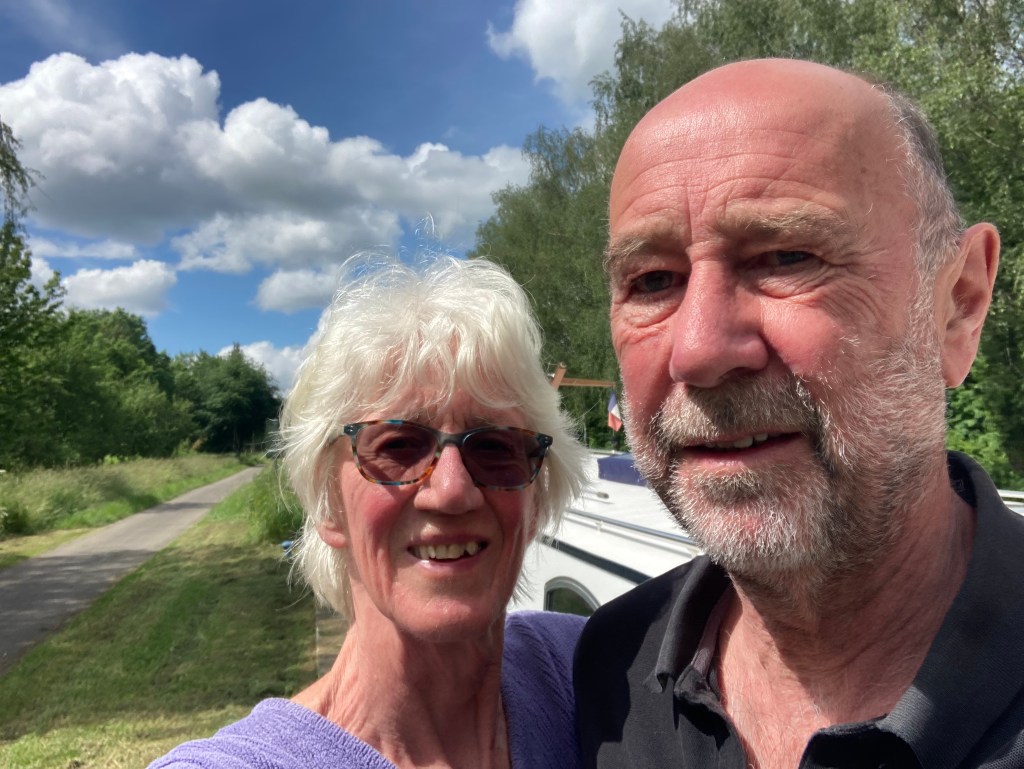
It is a very peaceful mooring …..
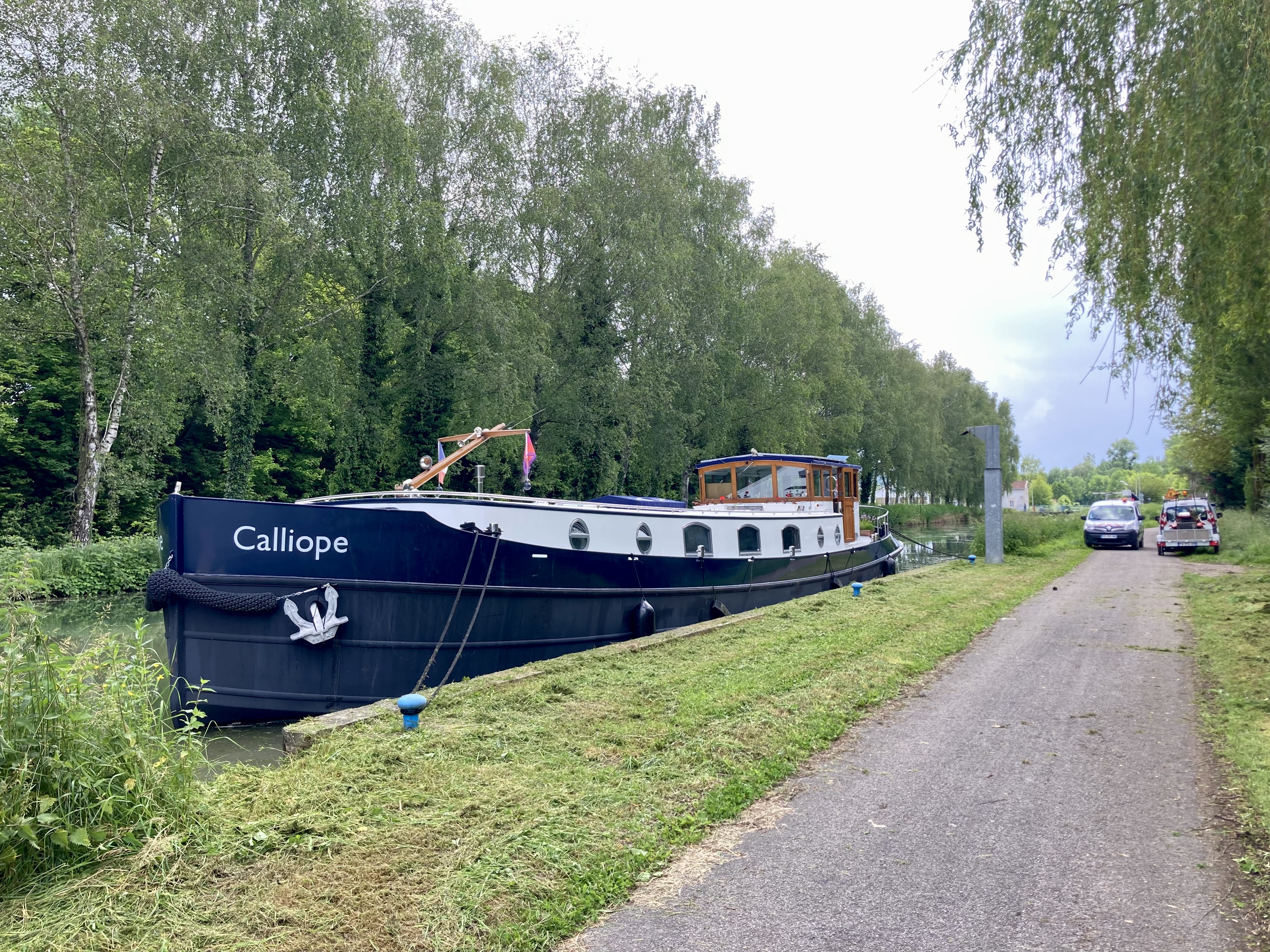
Although when we arrived we were accompanied led by the VNF grass cutting team. It is good news to see the canal moorings kept clear like this; it does lead to quite a lot of grass cuttings on the deck too. But they wash off with a bucket or two of water sluiced down the sides.

And the few morning and evening commuter trains made brief noisy appearances!
Overall it genuinely is a quiet, dark and peaceful place to stop.
There is a good small Intermarche supermarket within a 10 minute walk, and just beyond the old village of Laneuville-a-Bayard.


Before shopping we walked over the bridge, looked underneath, took a photo of the old church which is undergoing restoration, and walked back! Behind the church, within the graveyard, are 6 graves that form a Commonwealth War Grave site.
Supper on board, listening to nightingales and watching the dusk settle on the canal put an end to another good day.

Saint Dizier
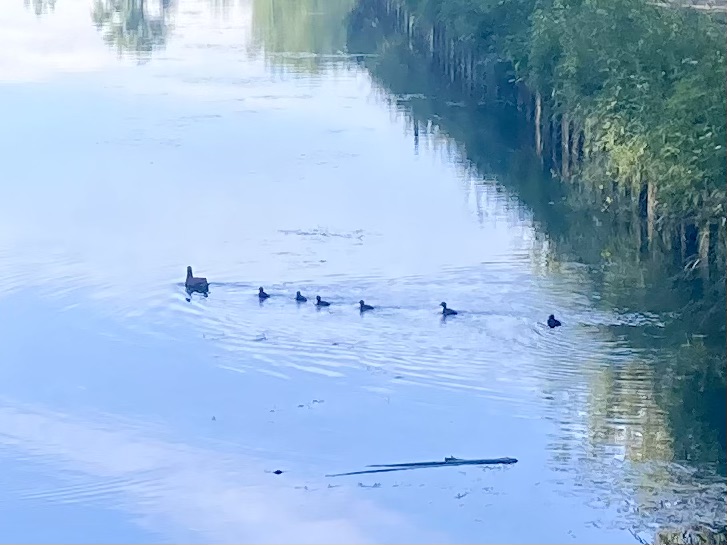
As it drew towards time to go on the morning we found ourselves looking fore and aft. Behind us Mother Duck was taking her 6 babes out for a swimming lesson. In front of its was a lock, just 250m away, with. no lights on it to indicate whether it was ready for its or not.
As we wondered what to do a VNF van came by, with waving and smiling occupants, and our two nice female éclusiers from the day before arrived at the lock to start not up for the day.
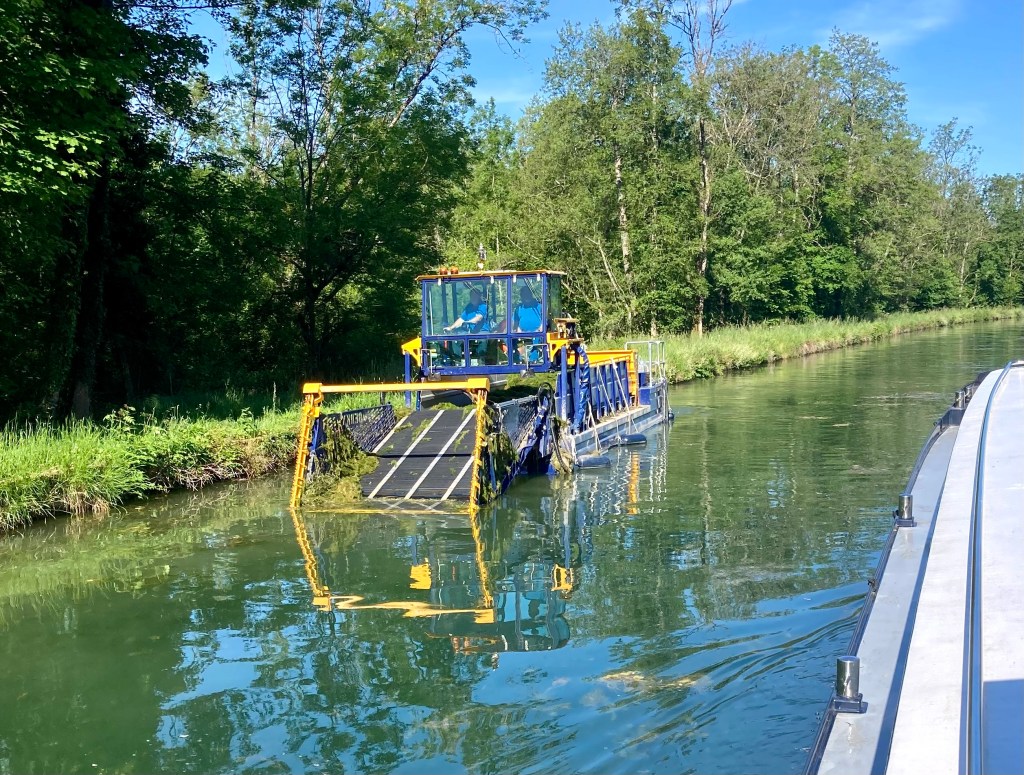
Soon after the lock we came upon the mighty weed muncher!
It seems to be a brand new machine, and this appeared to be a driving lesson.
More about this machine later.
Overall it was an easy day down to Saint Dizier. We did need to call on éclusier help once, but I will come to that.

There seems to be a lot to say about bridges in this post! There must be a bit of my grandfather’s engineering blood in me that I find all these different designs so interesting.
Here is much more modern lift bridge.


A few minutes later and we were going over a bridge, rather than under one. It was another off the pont canals – the little viaducts that take the canal over the river. And at this lock we already had a VNF man waiting for us.
He had been busy clearing weed from around the gates, thus helping the locks to operate correctly.
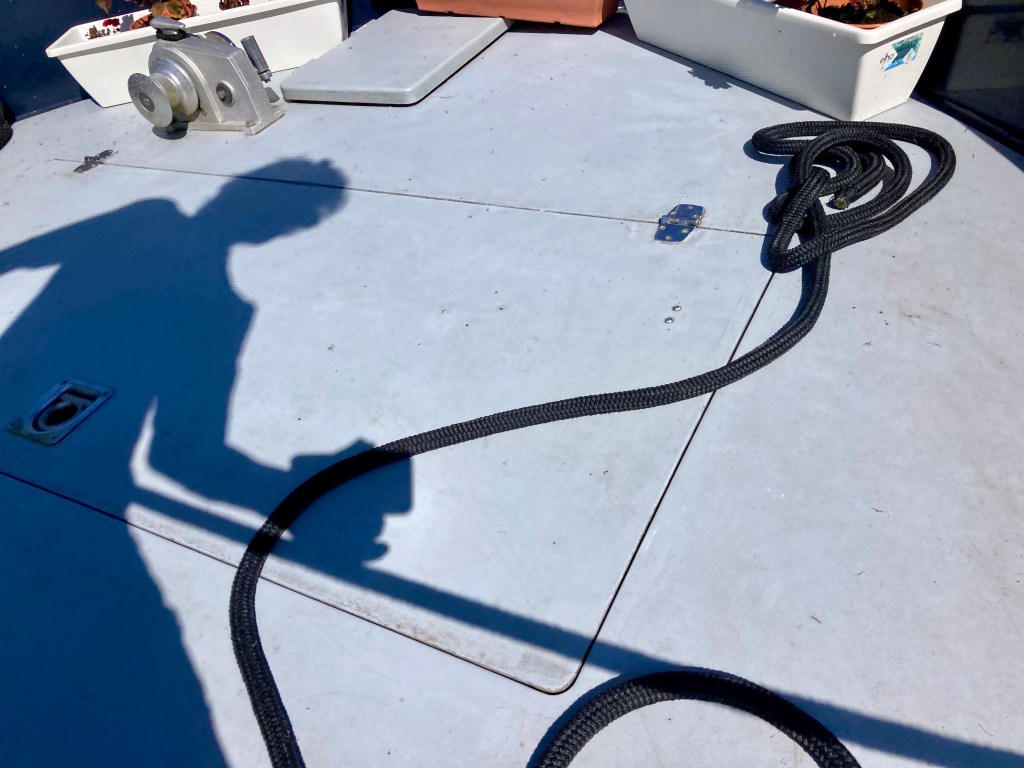
I add this photo just for a laugh – one taken in error but the combination of my shadow and the rope on the deck give the appearance of some kind of rope trick in progress!



Cruising on into gradually less rural and more urban areas we passed a small square basin with huge silos at one end, no doubt a busy place in its day.
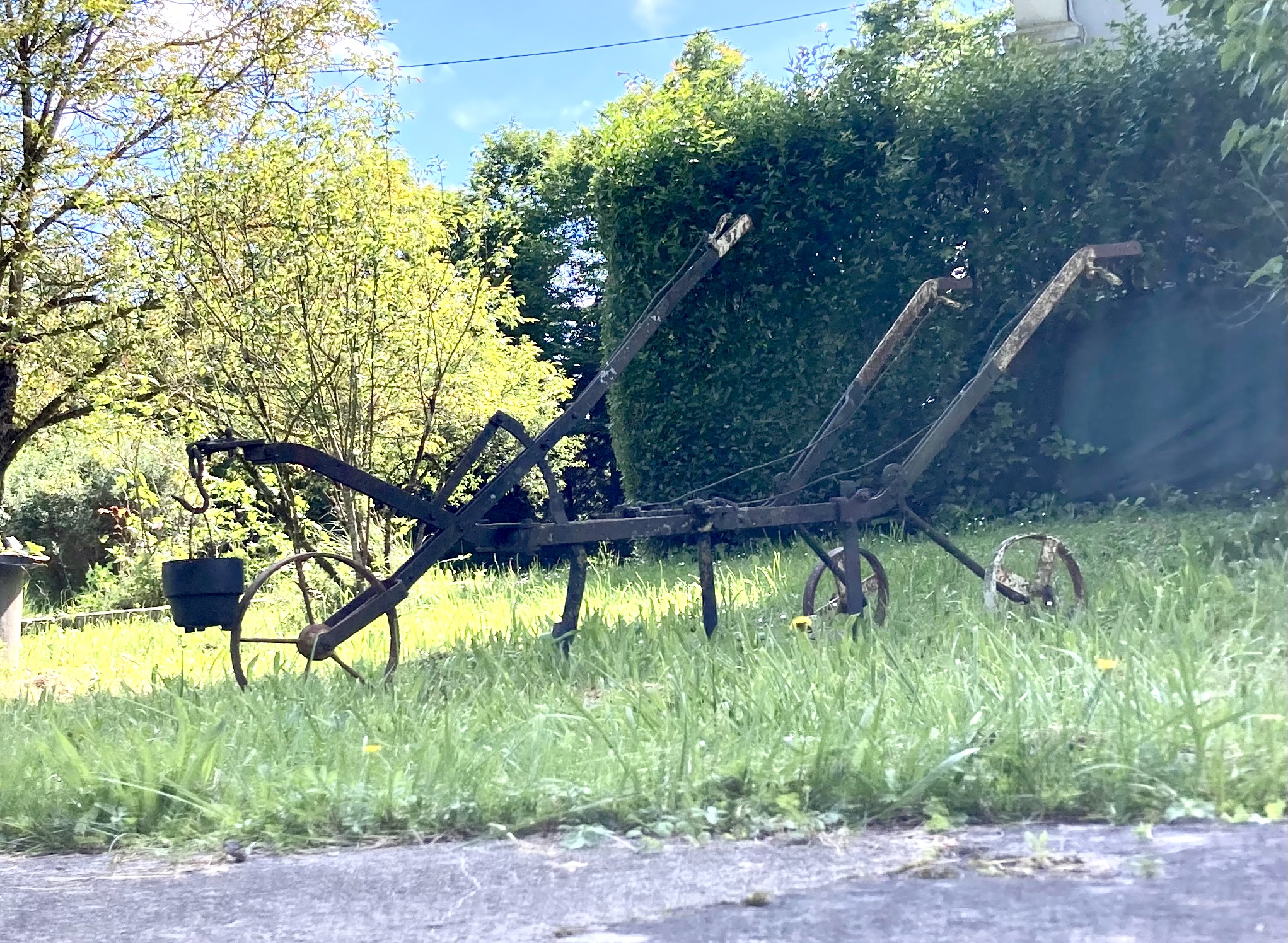
There were lock houses with old artefacts in the garden, and some being lived in, painted nice bright colours; a pleasant change from the sad deserted ones we had seen over the past two weeks.
There was also an interesting wiggly bit of canal, dropping down in a lock to a right angled left hand turn, through a narrow bridge, and out into a sharp right hand turn. At both turns the canal widened to aid navigation; the big photo above shows the narrow bridge in the background, and Calliope now turned round to continue her journey.
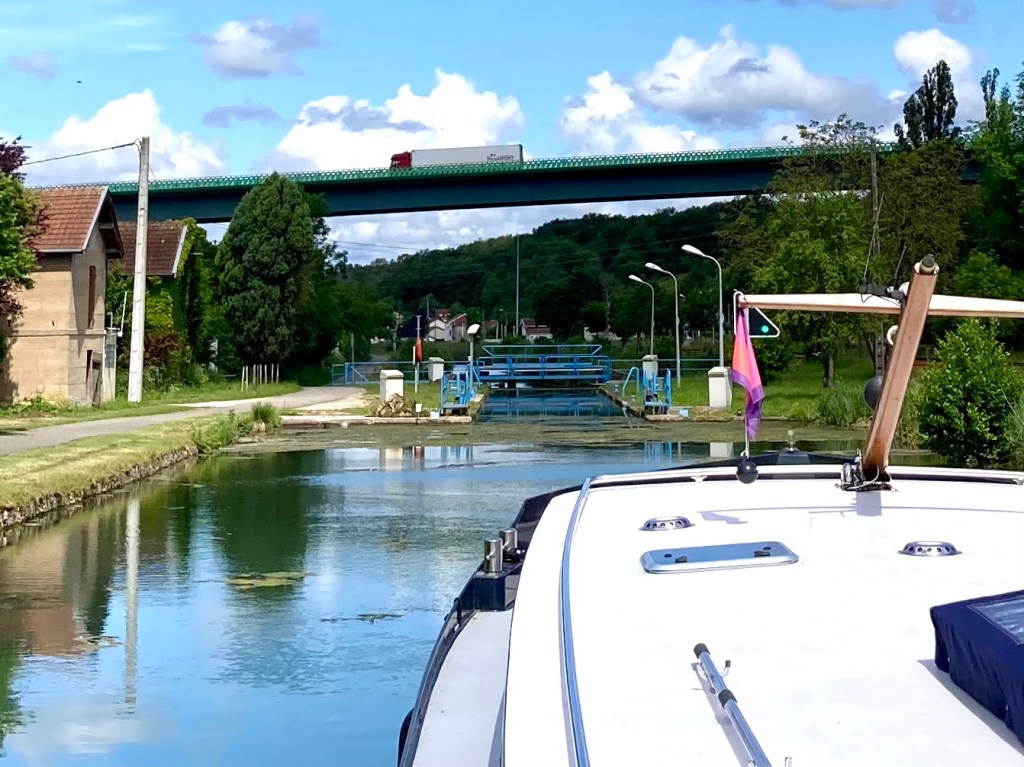
Now here is a bridge and a half! A bridge in the sky.
It is a relatively new bridge taking the N4 over various minor roads, the canal and the river.
This is the outskirts of Saint Dizier and we were at our final mini-combo of hurdles – a lock, a lift bridge, and the passing of a redundant pint-rail swing bridge that is described as a hazard. This is due to some of its infrastructure at water level not being too visible from boat wheelhouses; we were prepared!
The lock was uneventful, but the lift bridge remained stubbornly down despite repeated presses on the remote control.
A call to the canal command and control centre soon had one of the great VNF team arriving and setting the bridge in motion.


And the Captain steered carefully past the infamous abandoned rail bridge without mishap.
Within half an hour we were moored on the long quay at Saint Dizier, next to our friends on another Piper Boat, and opposite the swimming pool.
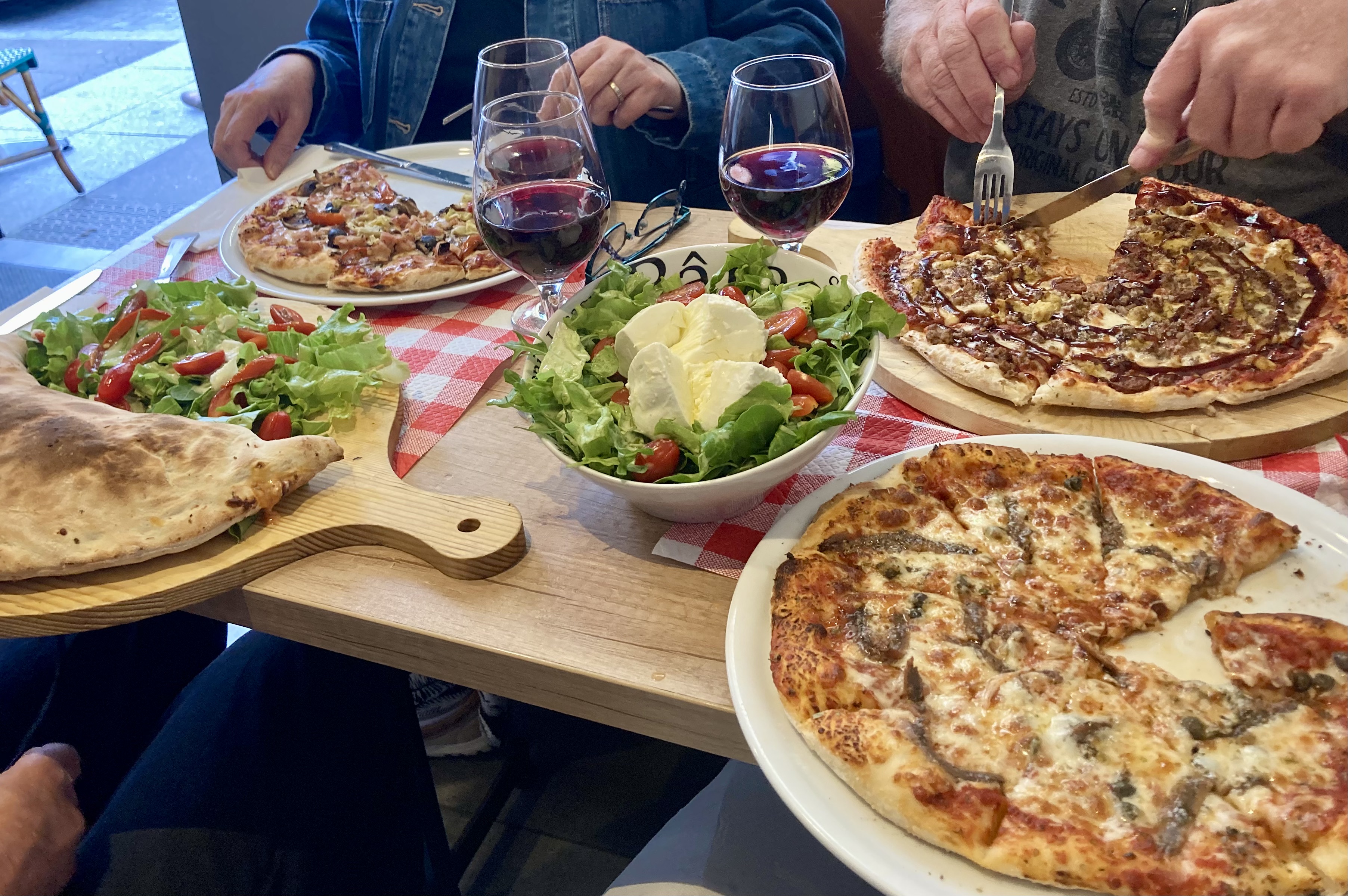
We met up with them later for an excellent pizza supper in town. It’s about time I had a photo of some food!
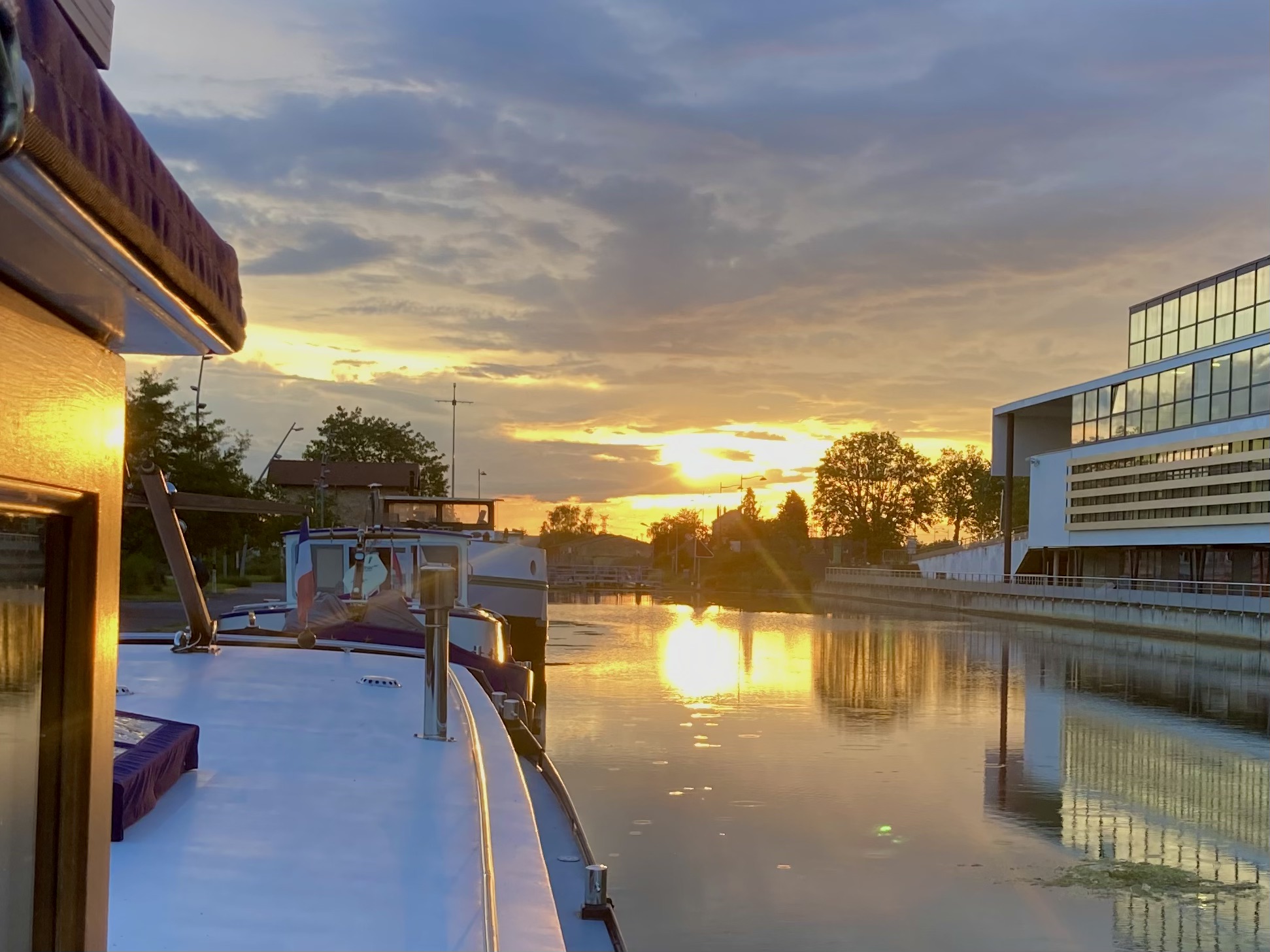
Later, back on Calliope, we watched the sun go down in a true blaze of glory.


Our friends were off first thing next morning, going upstream towards all the places we had been through on this blog.
We didn’t walk round Saint Dizier much this visit; I did go to Les Halles on market day, but regret no photos of that gastronomic excursion! I did come back with food for several days – good fresh free, veg, meat, fish, cheese and paté.
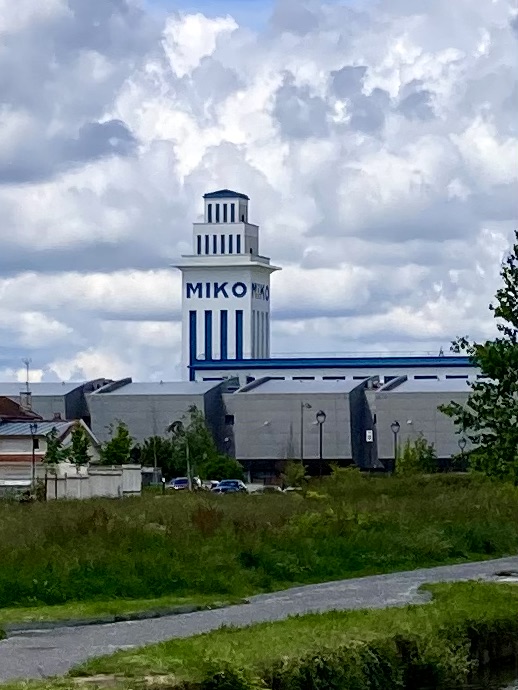

You don’t have to walk anywhere to see the MIKO tower – the landmark that says you have arrived at Saint Dizier. For those who do not know Miko, it is a brand of ice cream that initially started up in 1945 to supply the local cinema, and has grown to be a brand known throughout France and beyond, though now owned by Nestlé.
On the day before we left Stewart noticed a boat coming up in the lock at the end of the basin. Not only was it a boat, it was a Piper boat, the same brand as Calliope. And not only was it a Piper boat, but it was friends who we first met back on the Thames in 2015, and had not seen for about 5 years.

Affinity moored astern of us and came aboard for a cup of tea and a catch up. We discovered they were having to sell their lovely boat, and were on their way to the Piper Port in Saint Usage for her to be looked over before going on the market. It is a sad time for them, but necessary due to their circumstances.

Also sadly they could not stay more than an hour, needing to crash on towards Saint Usage, so soon we were waving them goodbye.
Écriennes Lock
Overall we have aimed to take this trip relatively slowly and gently, aiming for around 15 kms a day maximum where possible, and sometimes far less. But a 2 day hold up for a pump out meant that we had two days to make up; we were booked into Chalons-en-Champagne port in a few days time.
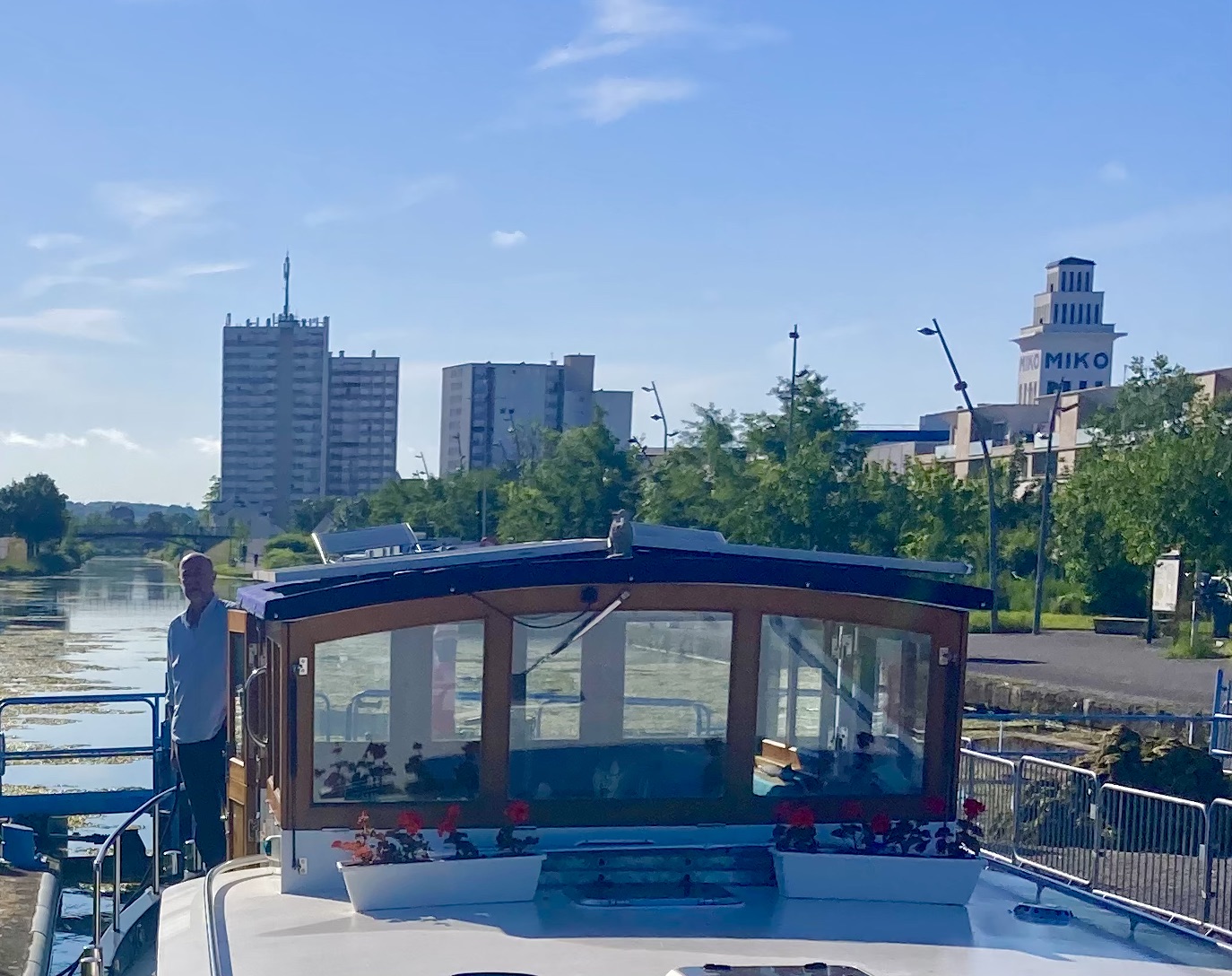
We were into our first lock before 0900, leaving the Miko tower behind.
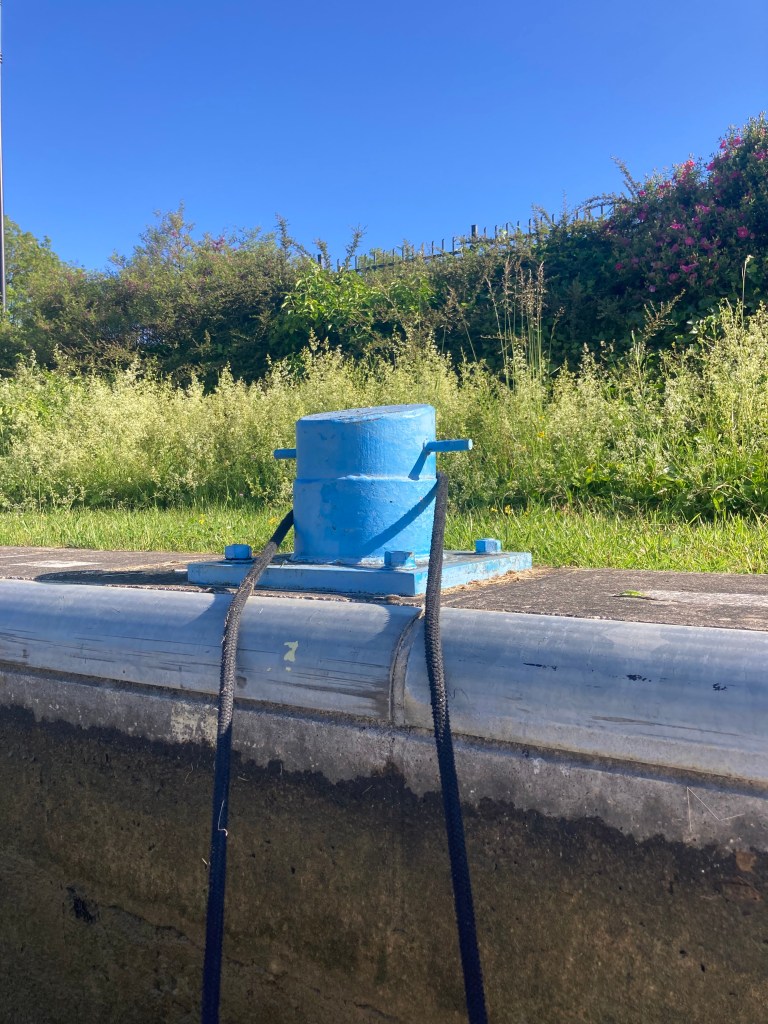
The locks from Vitry to Saint Dizier have been designed with commercial traffic in mind.
Big stout blue bollards stood on at least one side of each lock ready to hold those Freycinet barges tight.
But blue was not the only colour on show today!

We had reached our third lock by around 0945, and were in for our own private Air Show, courtesy of the French Air Force. The Aérodrome de St Dizier-Robinson is home to squadrons flying the Rafele fighter aircraft and Écluse 60 Hoericourt is adjacent to the perimeter fence.
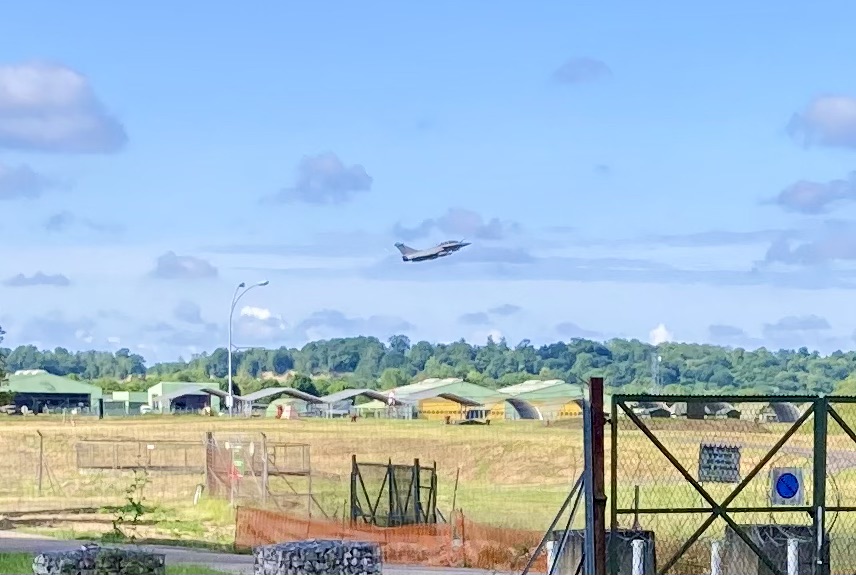


And 0945 was the signal for 8 of them to emerge from hangars and take to the sky. They were very fast and not very close, so all my photos are a bit blurry.
But my video might give an idea (hope I am not arrested for espionage! Wait for the plane – it is coming. And turn your sound up to discover why the Captain had his fingers in his ears most of the time through this lock!
Despite being a very straight canal through fairly unremarkable countryside there were still things that caught my attention.

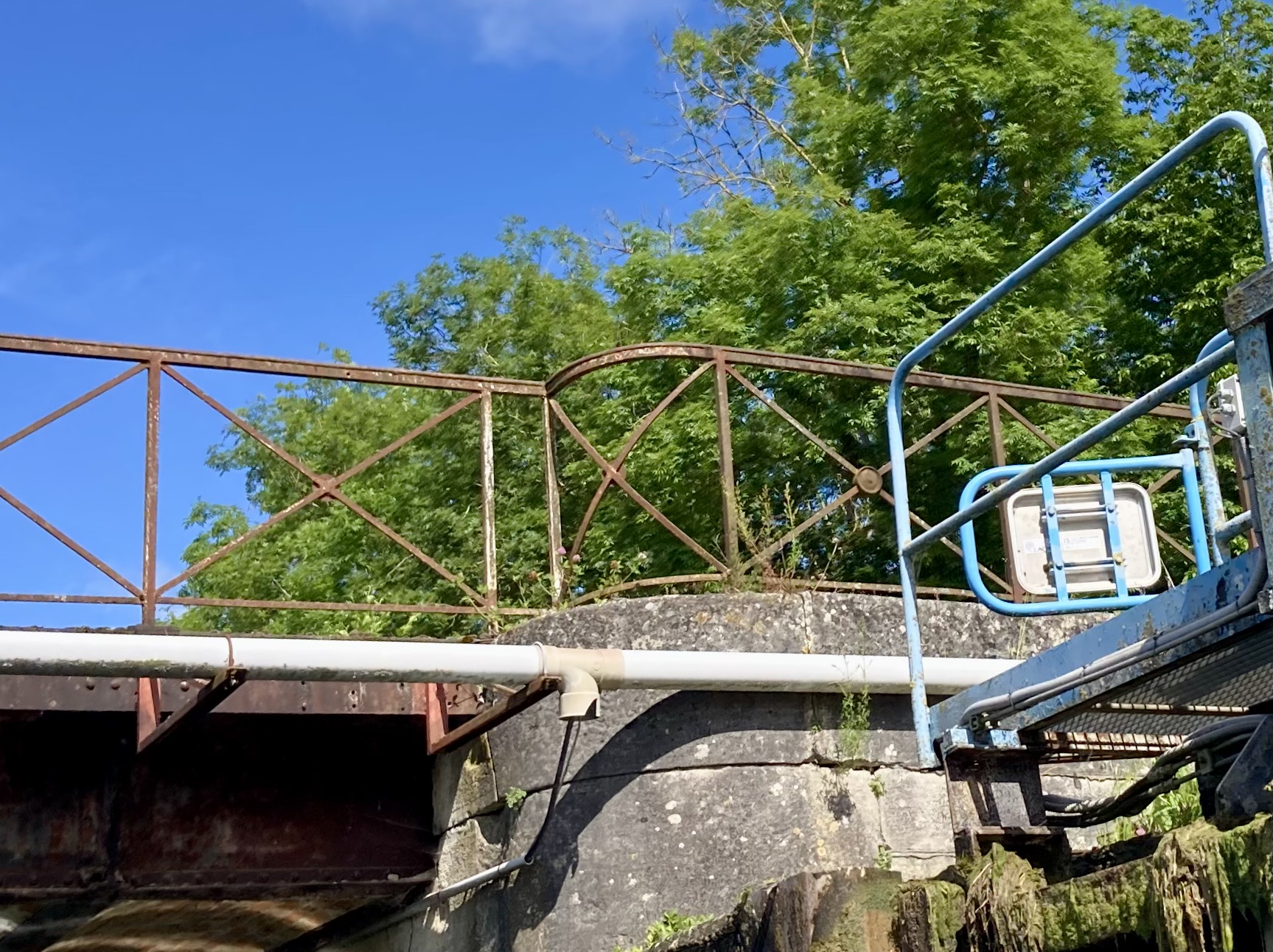

Time and again grasses and weeds along the edge of the locks became spectacular floral pictures against the sky. And yet again there was a new bridge detail – this time the rounded railing at each end of the bridge. Saint Dizier was famous for its metal work, so no surprise to find this so close to the town.
The third photo shows some more of the work to renovate the banks – wooden boards hold in new earth covered in hessian and punctuated by new reed plants – which will hopefully take root and strengthen the edges of the canal.
At the next lock I made a phone call to the control centre. We were a few kilometres from what has become known as Bad Boys lock! In the past there were groups of youths who enjoyed throwing things at the barges that passed by, and in breaking what lock infrastructure they could.
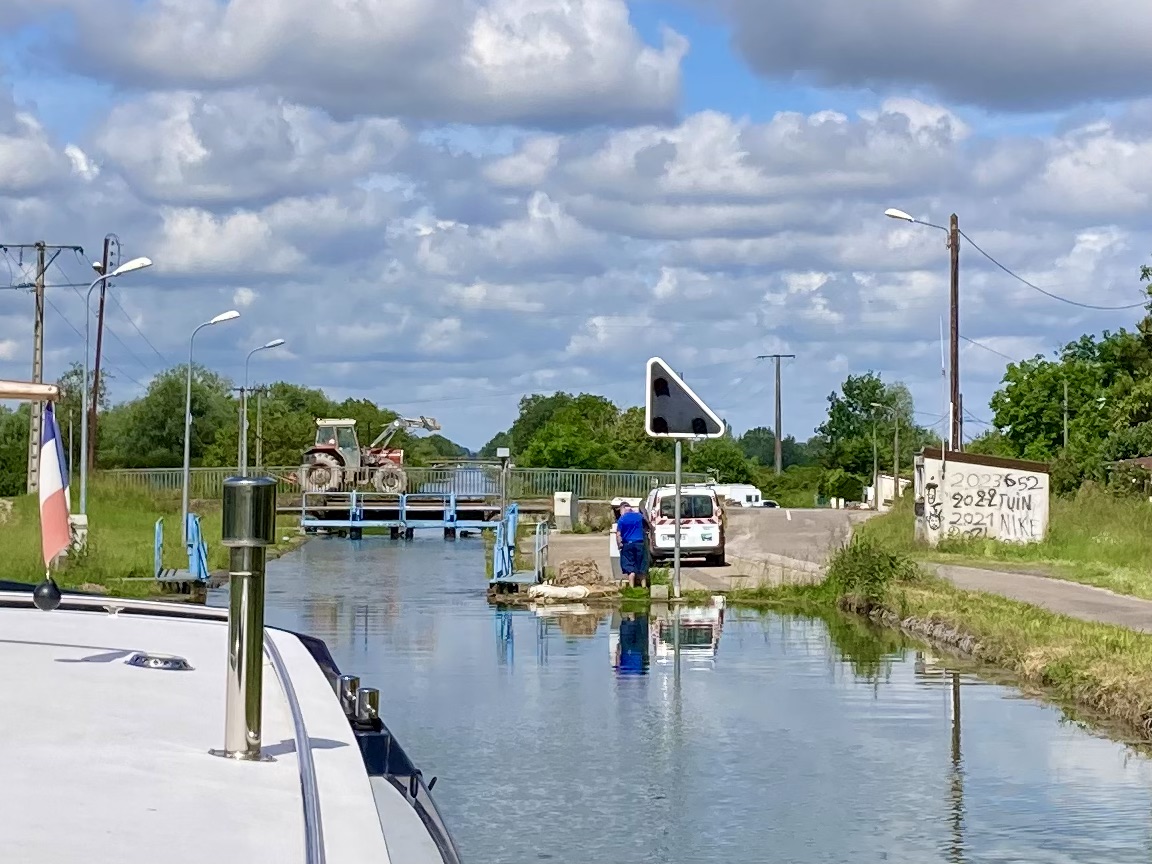
This means that the tele commanders and traffic lights no longer work at this lock and it is necessary to ask an éclusier to come and operate the lock. Our éclusier arrived just before we did, saving a potentially long wait.
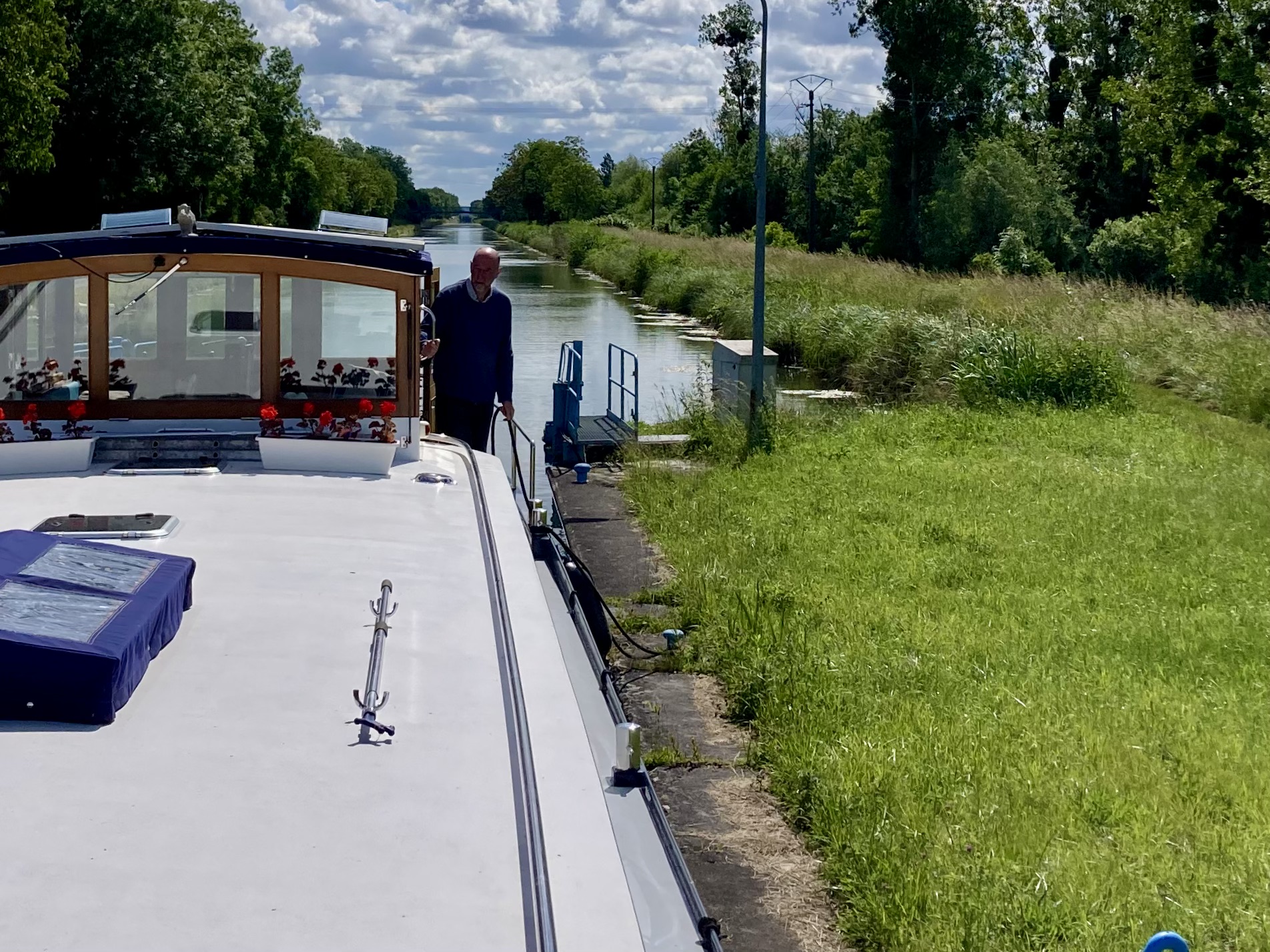

We went through the lock with no trouble, and no sign of any boys at all, bad or good!
For a change, and because of a slightly longer cruising day, the Captain had planned a stop for lunch at Orconte quay; just two more locks and 4 kms until we would be there – an hour and a half at our tranquil speed!
The last lock held a piece of history, a mooring lesson for me, and a surprise intruder into the lock.
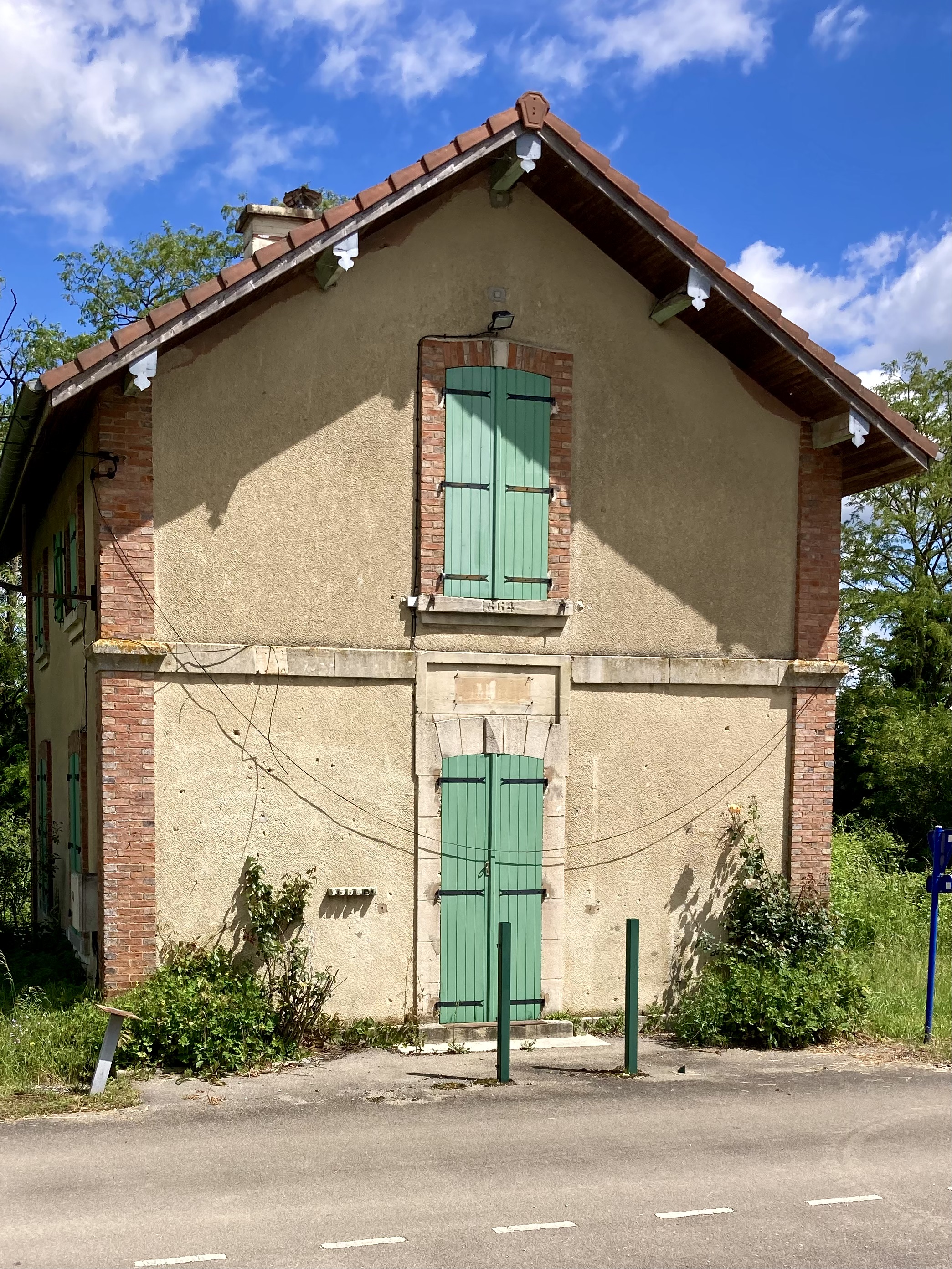

The history was in the old lock house – built in 1864 according to the date carved into the window sill. Lock houses further up towards the tunnel were built in 1881, 1883, 1885 – some twenty years later. This reflects the building of the canal. initially open in 1870 from Vitry to Donjeux, and at the end of the century being extended up to the top and through the tunnel – to meet work on a canal coming up from the Saône side.
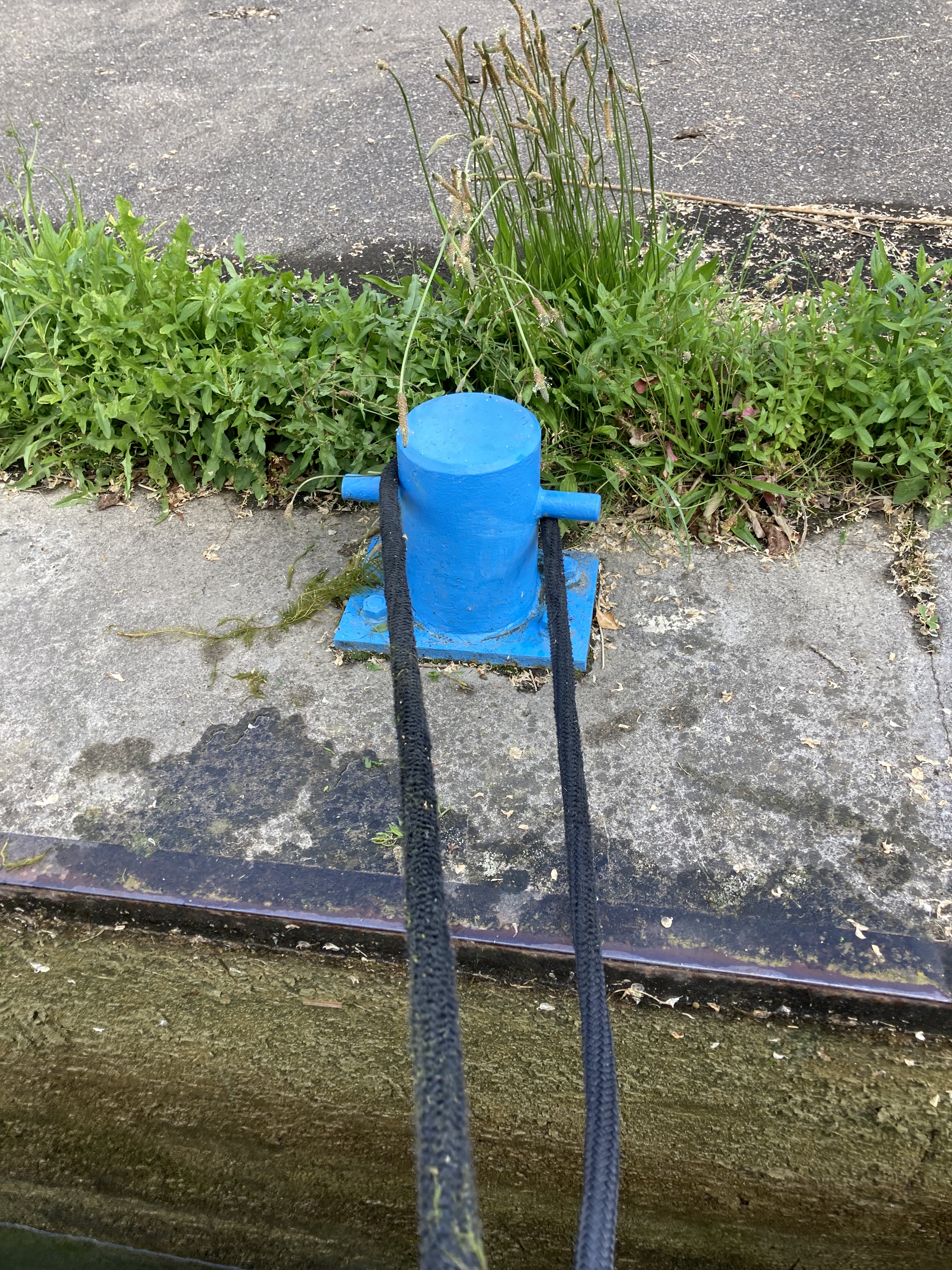
The mooring lesson was to crew from the Captain. These bollards, with their skinny projecting arms, can make it difficult to cast off from the bottom of a lock. The rope easily gets caught round one arm or the other! So I learnt that as I go down in the lock I should loop my rope above one of the arms, making it simply to flip it off later.
And the surprise intruder is, I think, obvious from the photo. A small tree floating in the canal had been swept forward into the path of the closing gates, and was caught there, projecting out about 4′ into mid air Ince the lock had emptied.
Phew – time for lunch.

As we approached Orconte we went through a ‘turning circle’. I have been trying to catch a good photographic representation of one of these circular widening in the canal, allowing space for barges to turn round.
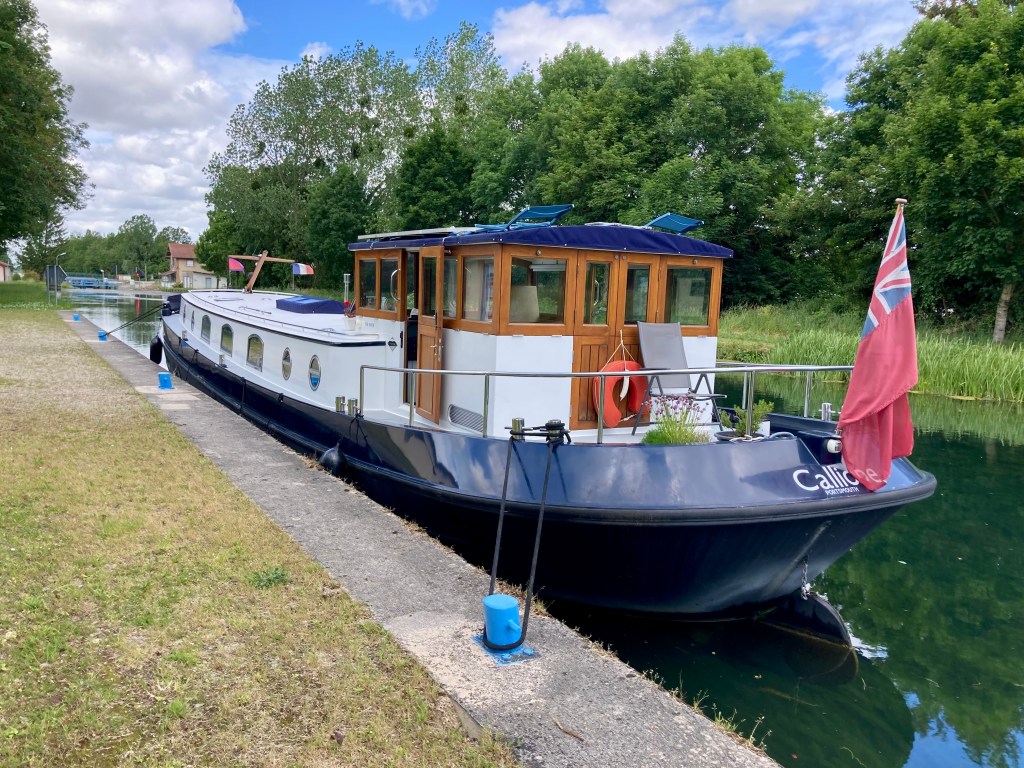
Here we are tied up to Orconte quay where there are basic ‘port’ facilities – toilet, shower, and, as described in our map book, “a tub for washing clothes”

This quay is just before a lock. As we were having lunch we were surprised to see the éclusier arrive in his van, and then realised that a boat was at the bottom of the lock.

It was not just any boat – it was a big commercial barge – probably no longer carrying cargo, but being converted into living space.
She steamed past our window, making rather too much wake!
Lunch over we proceeded at our own stately pace through the last two locks of the day to Écriennes and a small 20m place to moor, out in the country, and just right for a restful last night on the Canal Entre Champagne et Bourgogne for Calliope and crew.

Vitry-le-Francois
16 days before we were facing 71 locks down to Vitry; 21 days before we were facing the complete 114 up and down set of locks. Now we had just 4 to go, over 9kms. It actually felt quite sad to be leaving this canal, definitely one of our favourites.

It was a very wet grey day for this last day. We were off at 0900 as usual and into the lock at Écriennes, next to the previous night’s mooring. We had a nice colourful lock, even though it was raining hard.
Let it rain! We are ready for it – not quite ‘singing in the rain’ but certainly smiling.

As are the intrepid French, with their parapluies.
Overall it was a calm journey with not much except rain to be seen. We didn’t pass any boats, cows, silos or lavoirs for me to mention!
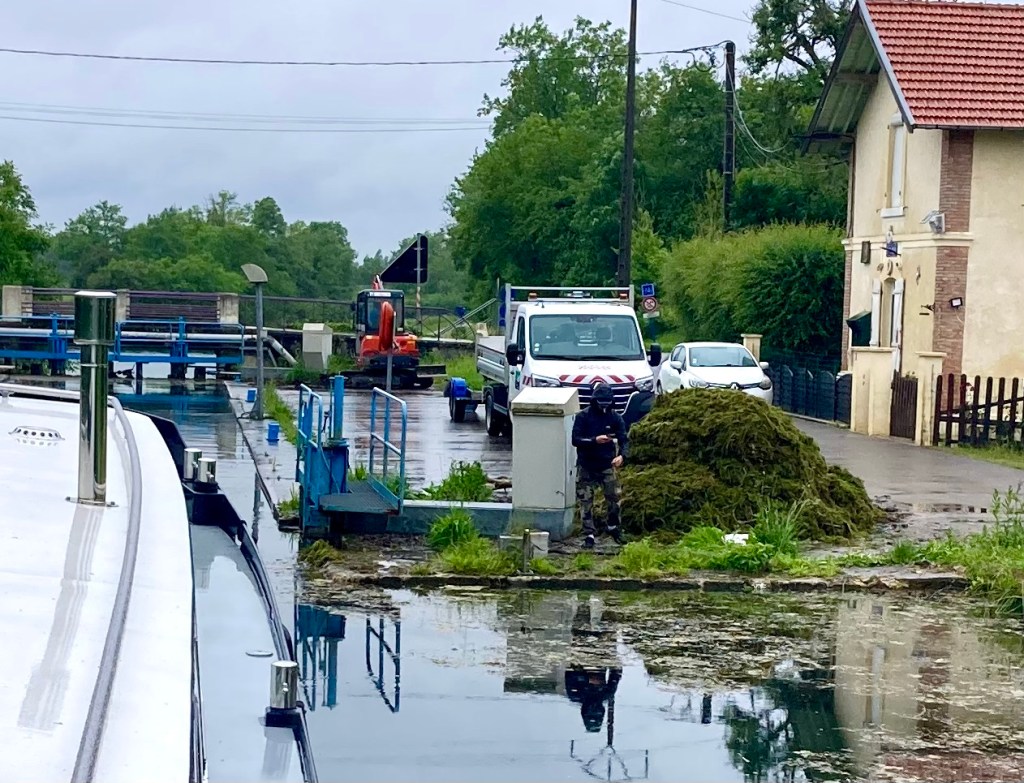
It got a bit busier at Lock 70. As we approached there were no lights on the traffic signal and we could see a VNF van in attendance; was it an out of order lock?
It turned out to be switched off while the team had a major clear out of weed from the lock; excellent!
The poor guys were soaking wet, working through the rain. They had removed a small mountain of weed as you can see, and were just packing up to go to the next lock in their programme so we did not have to wait.
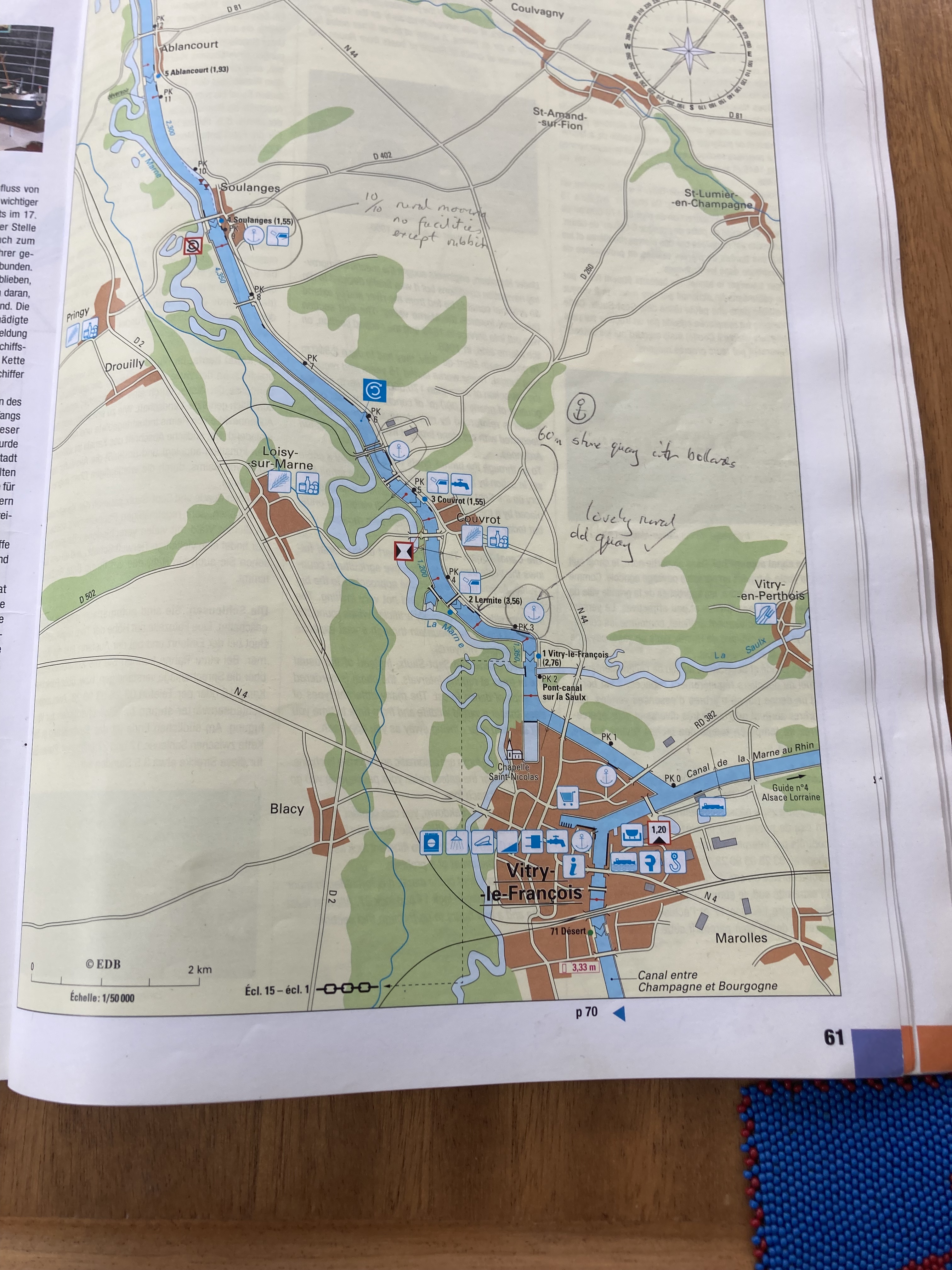

Calliope was doing well through the final kilometres; we would soon be handing in the remote control that had seen us through 170 locks so far,
And then the industrial urban landscape of Vitry-le-Francois and Écluse 71, Desert, were in sight.

A green light welcomed us and a sign told us we were ‘quitting’ the Canal Entre Champagne et Bourgogne.

Another sign told us what to do next, including returning our trusty telecommand.


I did what I thought I was being told to do, following the red, green and blue arrows and popping the telecommand into the slot, where it fell with a satisfying clunk.
Stu gave the blue lever its correct upward ‘shove’ …… and nothing happened.
We both tried several times, and then I noticed that we were to phone the control centre.
That did have a result. We would have to wait for the éclusier to arrive and let us out of the canal! But it wasn’t known how long it would be.

I went and checked; yes, we now had the double red ‘en panne’ sign.

We waited less than half an hour; not bad at all given that we were at the very end of the stretch that the éclusier had to cover. We were soon going down the last 3.33m of the total 239m from the tunnel to here.

I cannot resist just telling you about the edges of this lock! When it is full the water runs over the lower level; where the bollards are. This ‘encourages’ the boat to float against the edge.
And with the bollards in recesses, tucked almost under you, it is quite fun trying to catch them.
It is a bit of a nightmare coming up too, as we know from our 2016 experience.
But every challenge is manageable.
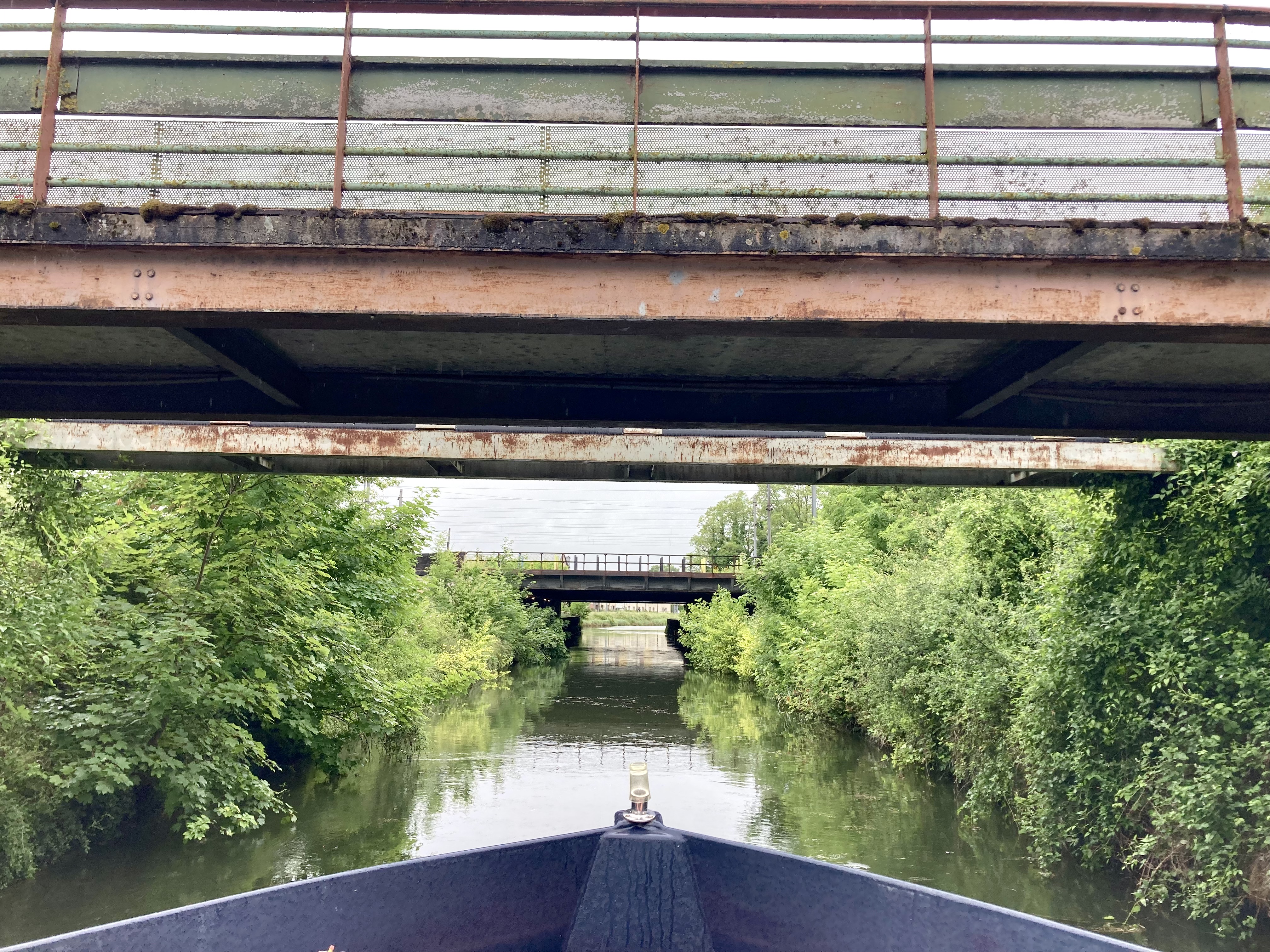
And then? Well of you looked at the map just above you might have noticed three bridges between the last lock and the end of the canal.
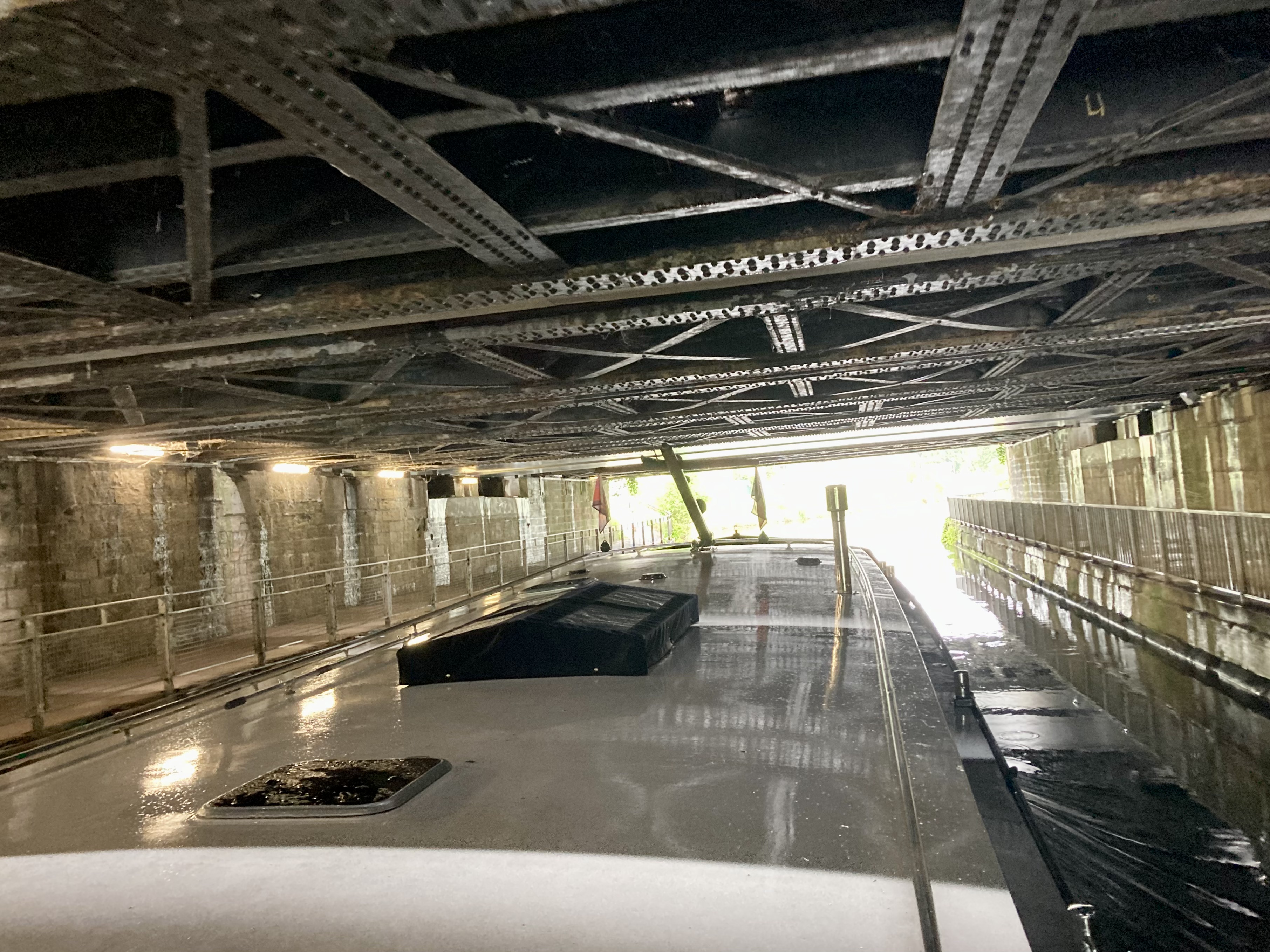
So I am able to add in a couple more bridge photos!
And that’s it. The end of our wonderful journey on one of our favourite canals.
Next up is the Canal Lateral à La Marne, so we will not be saying goodbye to that great river just yet.
A Marne Appendix
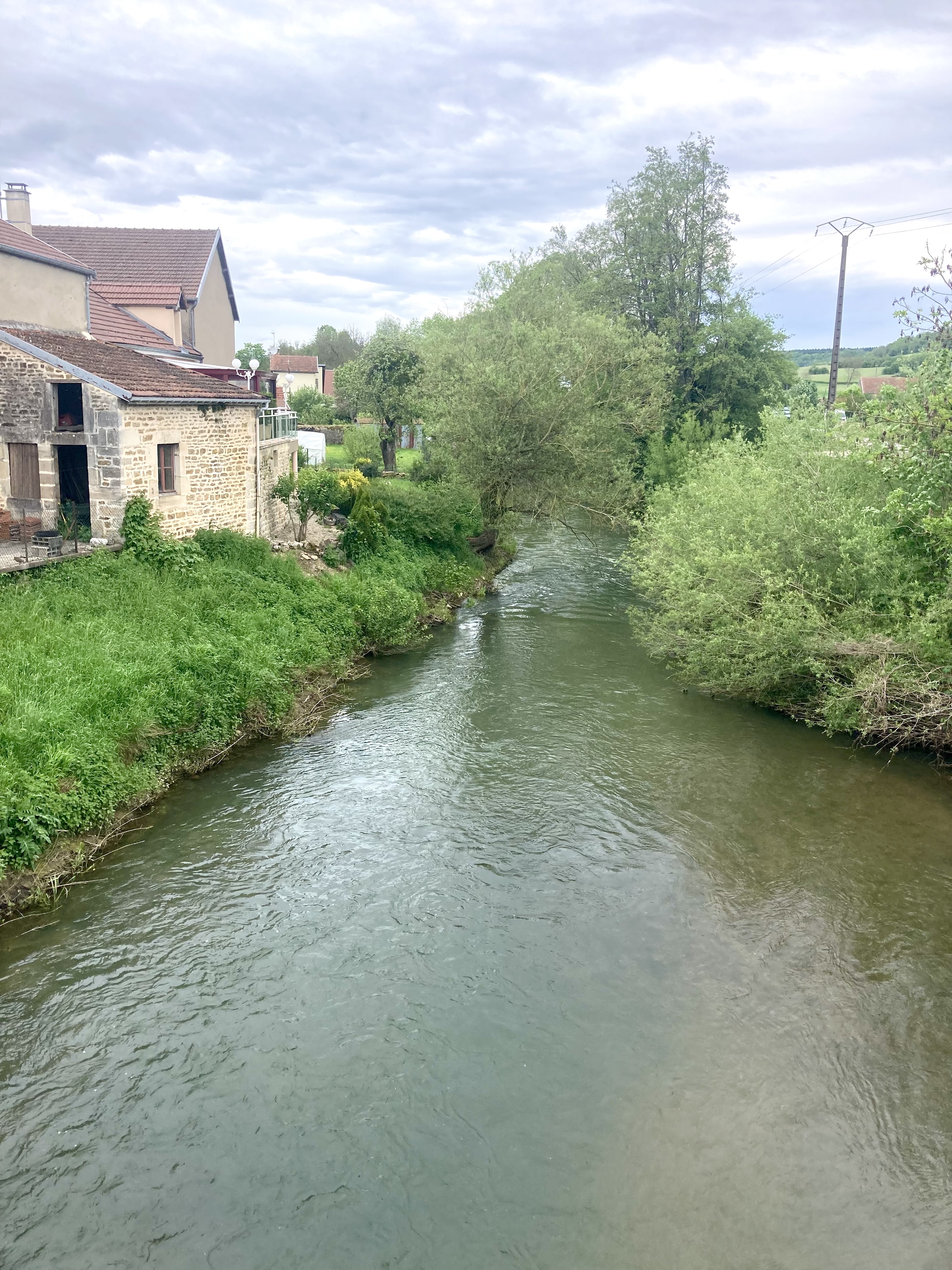
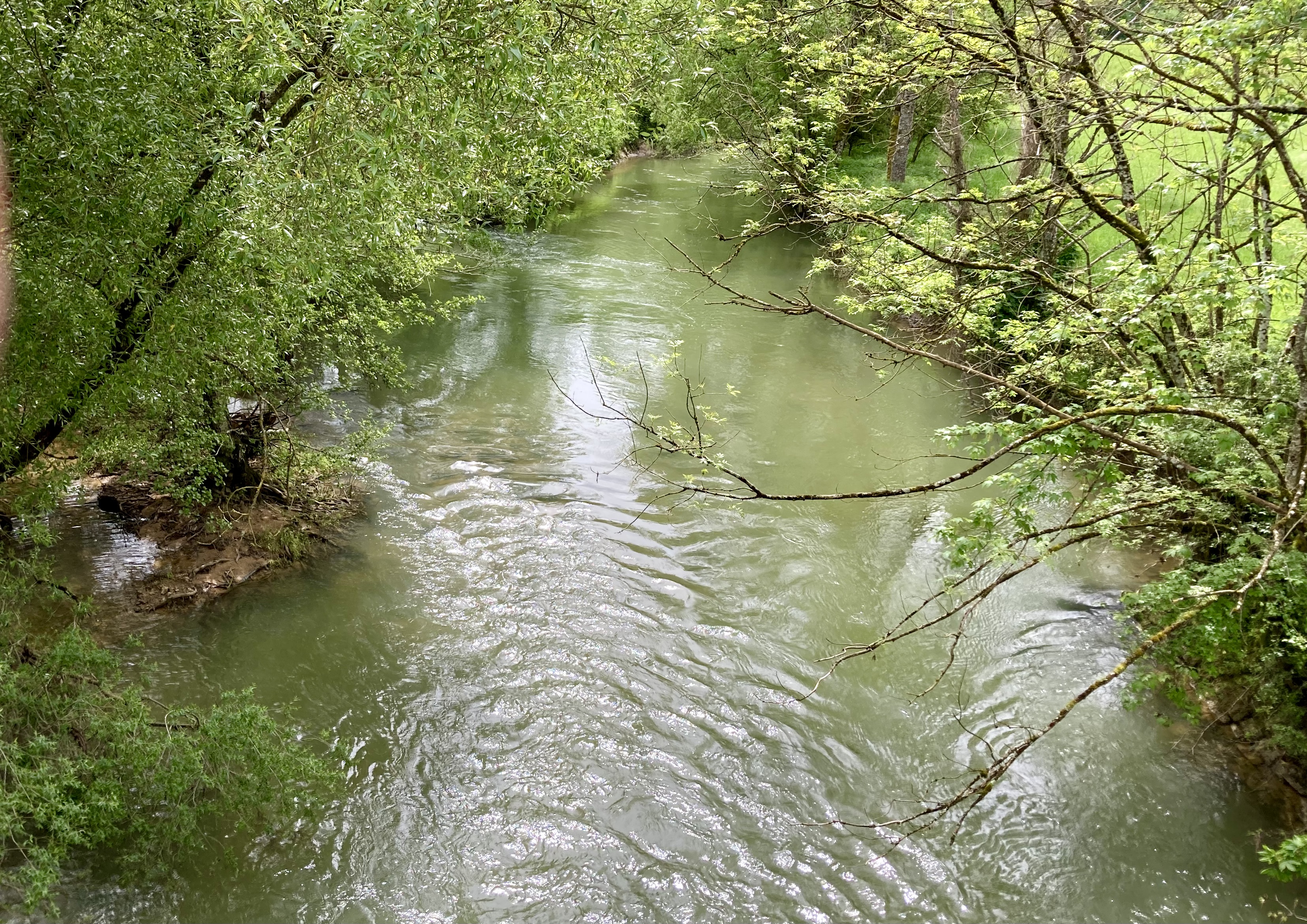
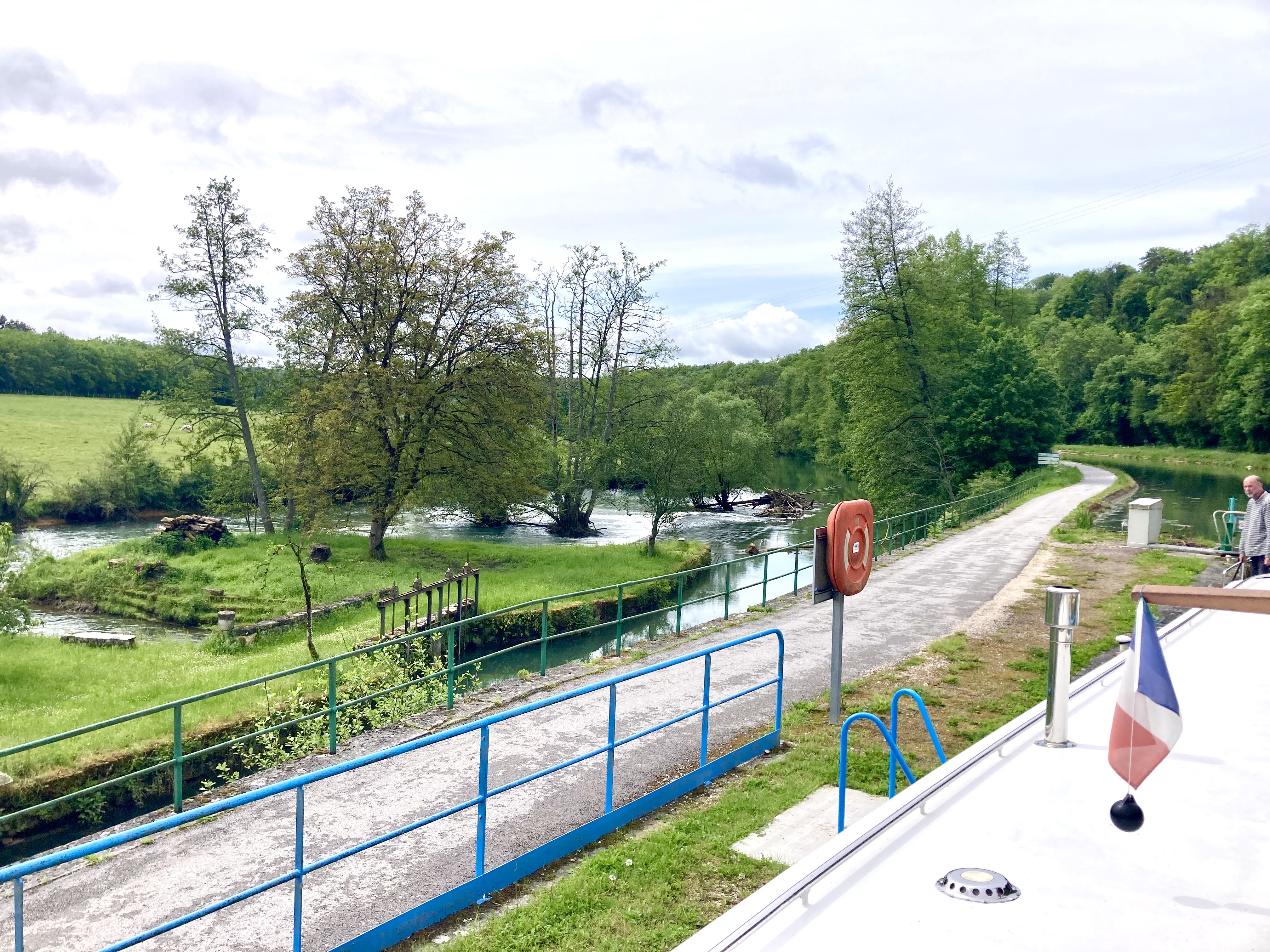
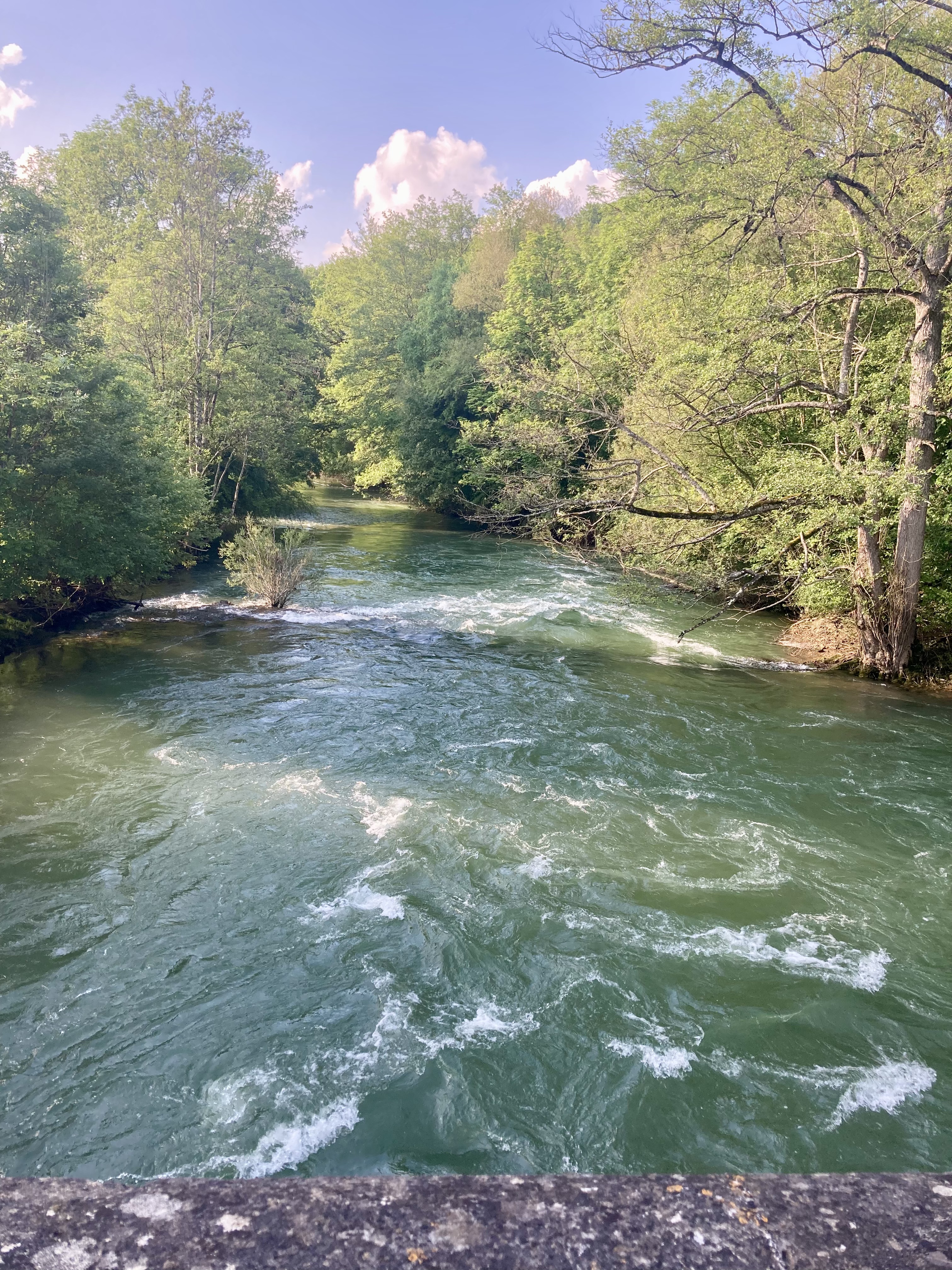
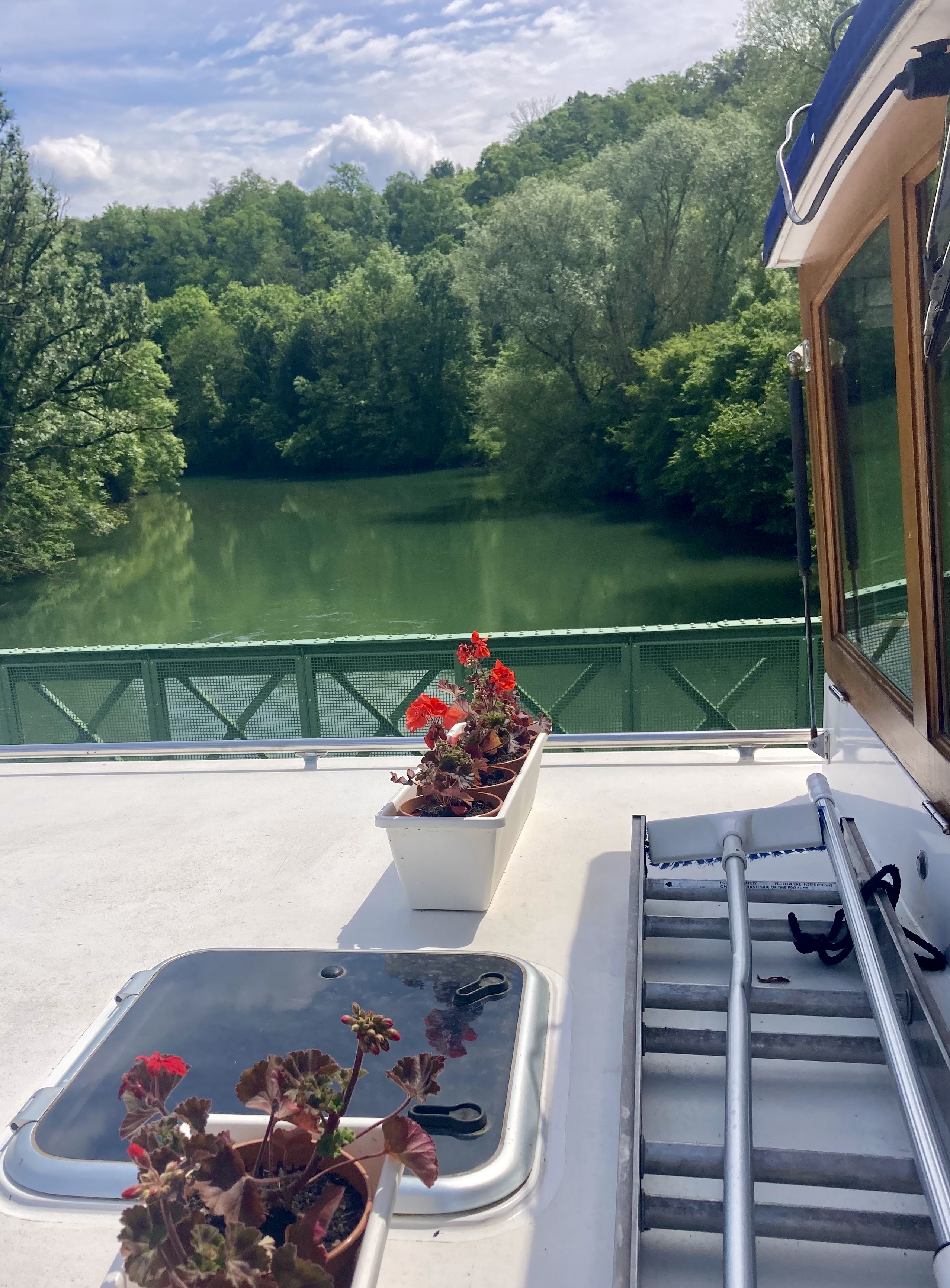
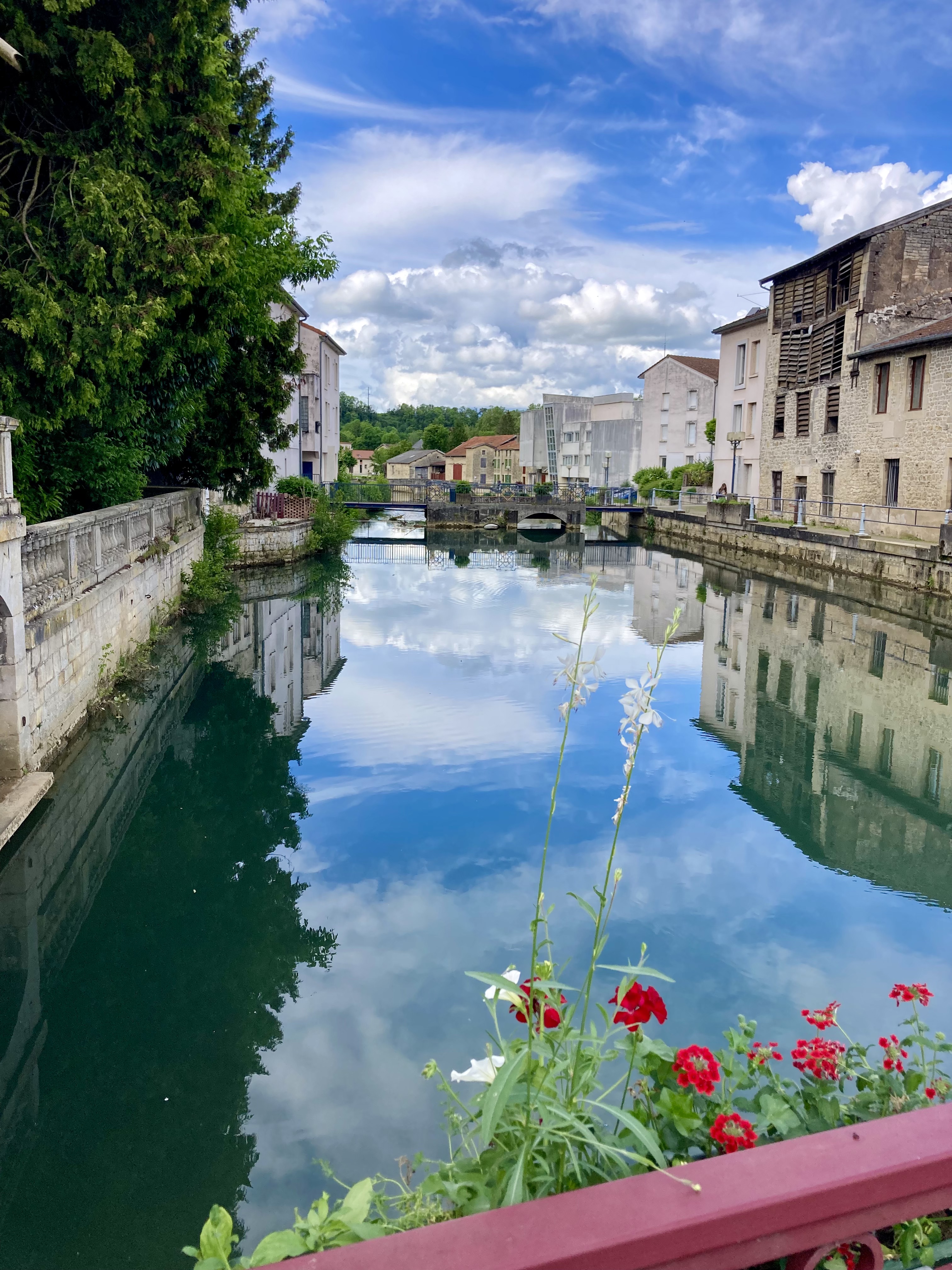
I mentioned that I would bring together a set of photos showing how the Marne changed in size and shape as we came down. By the end of this canal the Marne still had a lot of growing and flowing to do as she went onwards towards the Seine and Paris.
But here is a small collection from Langres to Vitry, and a final one taken a few miles further on at Chalons-en-Champagne, originally known as Chalons-sur-Marne, and part of the next blog edition.





 goodshipcalliope