
[Cruise it slowly if you have time!]
11th to 23rd June 2024
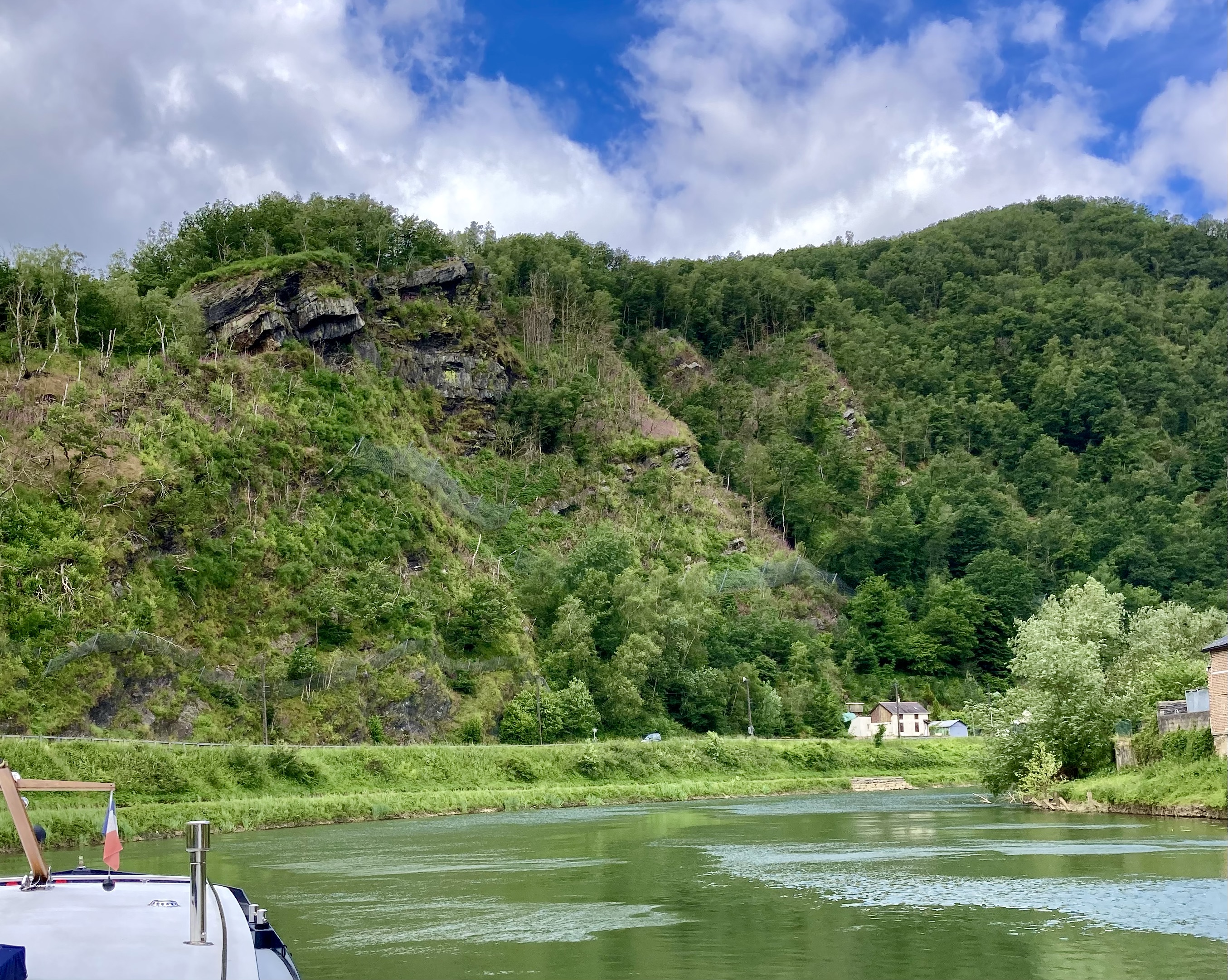
We love La Meuse. This is our third time on the river – once up and once down before. We only stopped at 6 places this time, so if you are interested in knowing more about our experience of La Meuse here are two links for the Northwards direction, going down as far as Namur in 2019 and going further, to Liege, in 2020.
The journey up, joining at Namur and going to the top at Troussey, is in three sections – The Magnificent Meuse 1, 2, and 3. That should help me make this post shorter!
We were on a planned trip from Saint-Jean-de-Losne on the Saône to Diksmuide in Belgium where we had an appointment with an excellent boat yard. It was time for the 5-yearly lift out, hull clean and blacking.
This is why we did not spend longer on the Meuse – that and the fact that the upper Meuse, from Verdun to Saint Mihiel, was closed due to ‘atterisements’. This translates to landings, so I am guessing it means running aground. Anyway we could not use that section of the river for our journey from the South.

We therefore joined the Meuse from the Canal Des Ardennes.
We were very happy with this diversion as it was the first time we had cruised the whole length of this fascinating and beautiful canal.
There is more about that journey here!
Charleville-Mezières
Calliope left the Canal Des Ardennes and joined the Meuse on a fine day. After just a kilometre and a half we were at our first river écluse (lock), running into the channel that separates the écluses from the weirs.
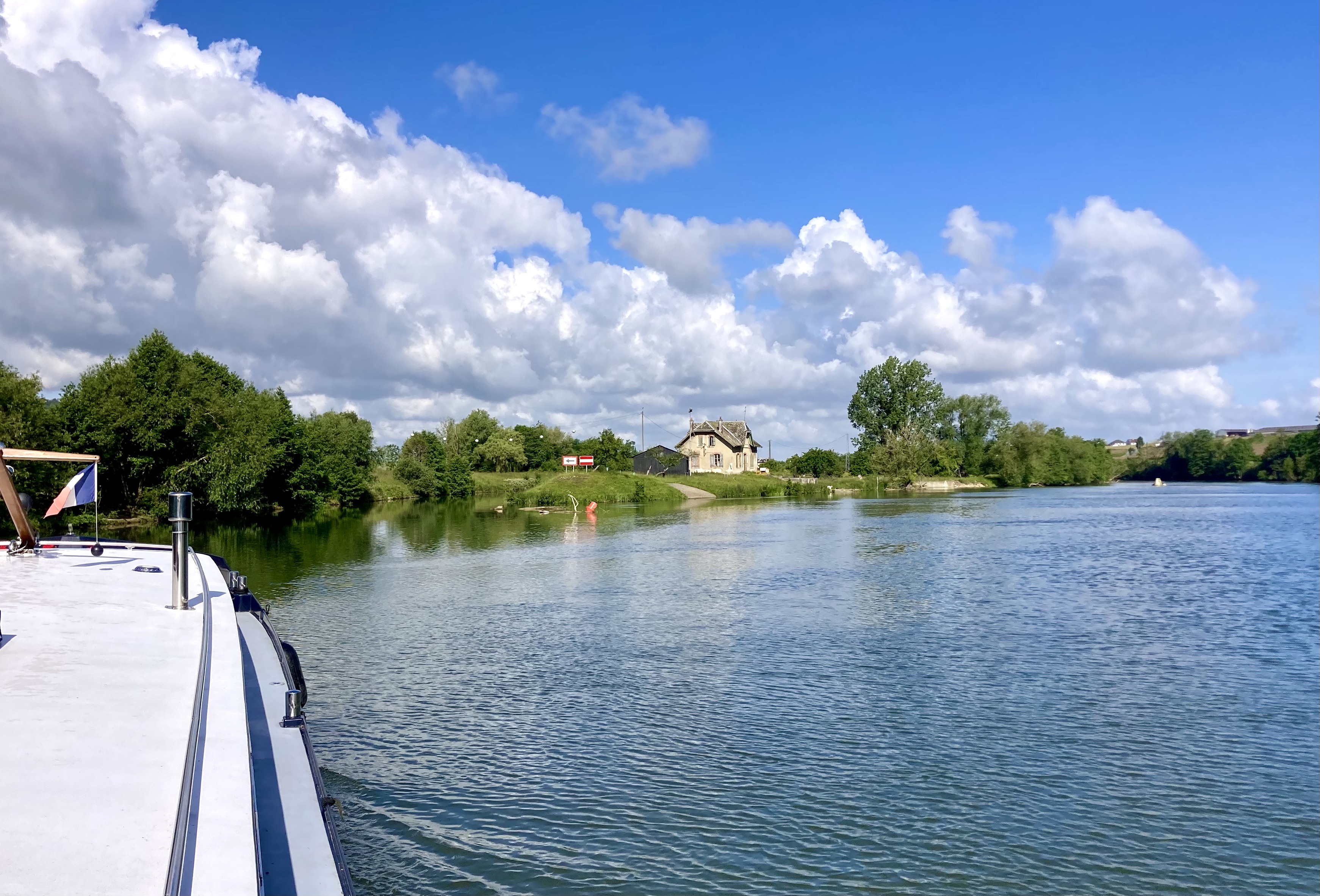
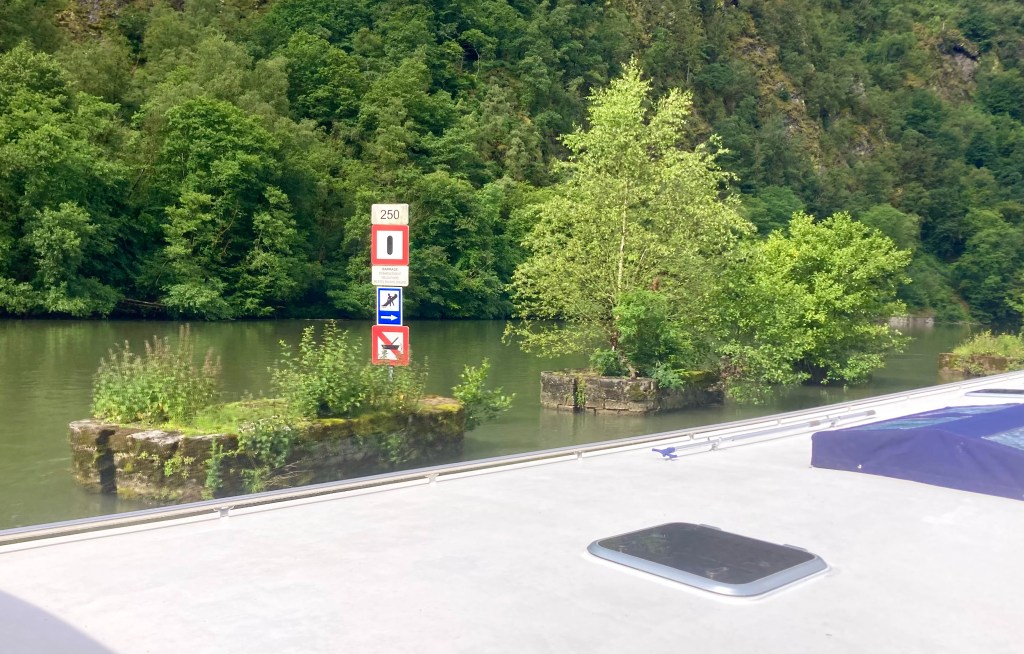
The channel we needed is to the left of the red buoy; you can just about see the black arrow telling us to go that way, and the No Entry sign to its right.
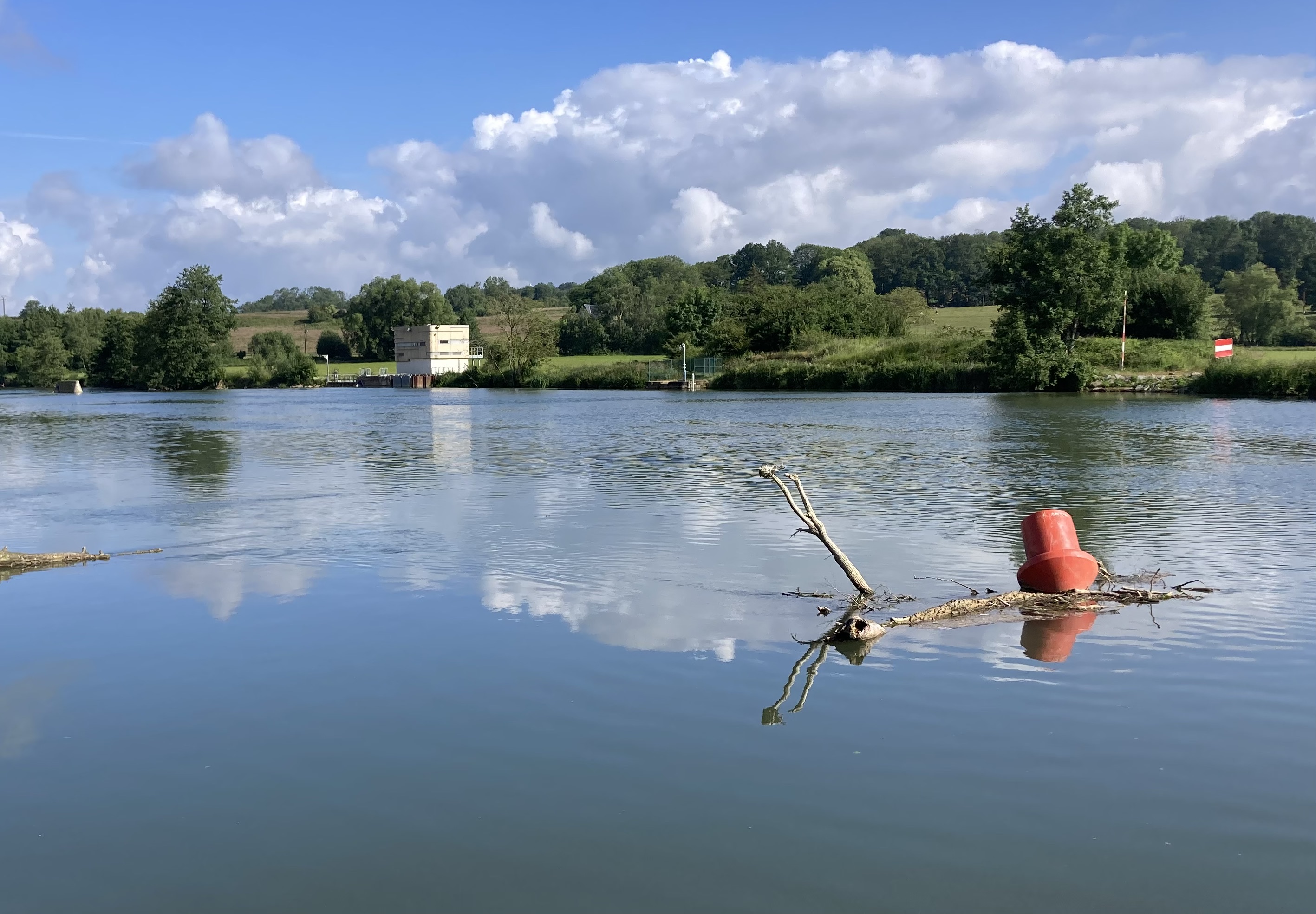


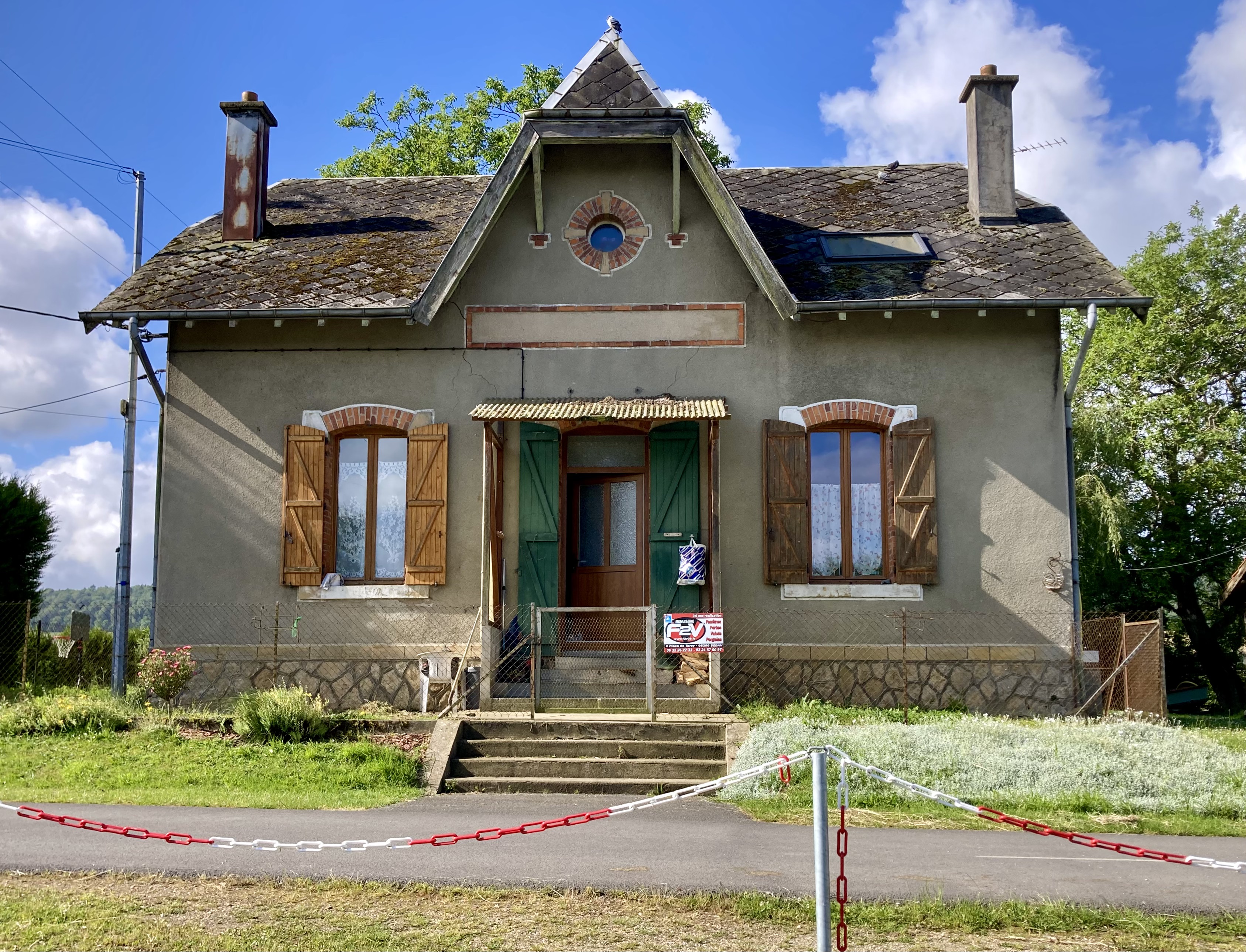


On the Canal Des Ardennes the locks had been 9m shorter and 0.6m narrower, so the first look at Dom-Le-Menil felt quite grand, although only just over 1m deep! The height of the walls in the lock and the bollards in the walls are reminders that the river can flow a lot deeper, although the flow is so well managed these days that it rarely happens.
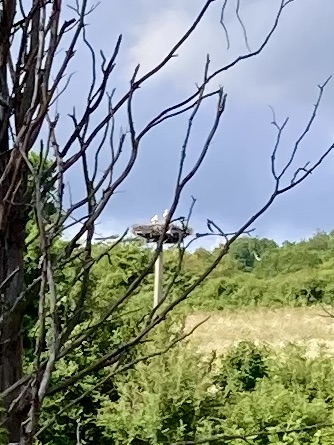
We pass all sorts of wildlife as we cruise, especially birds.
We could its as a good day if we see a kingfisher or a grebe, but this was an especially good day we saw two storks on a nest.
Yes, I promise you that this rather blurred photo is of two storks on their nest at the top of a pole.
The 17kms journey downstream to Charleville seemed to speed by. Naturally the current was with us and although the revs on the engine were the same as usual we were travelling about twice as fast as on the canal.
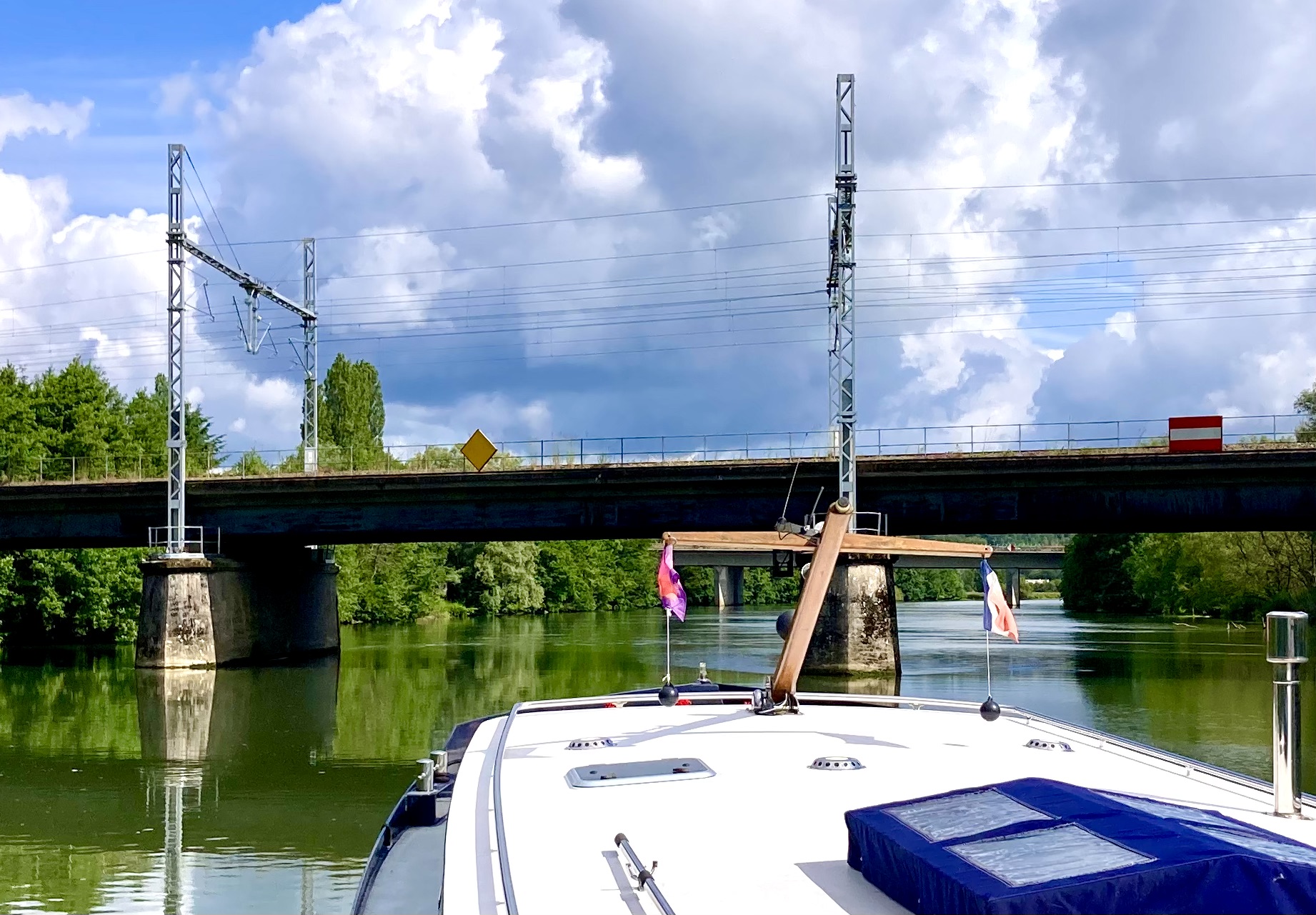

I am known for mentioning too many bridges in my blogs! I’ve just realised that it might be genetic – several of my great great uncles and Gt.gt gt grandfathers were bridge and railway engineers in South America and Africa in the 19th century.
Anyway here is one quick mention of the idiosyncrasy of bridge signs. The signs for the above two bridges look similar. However the photo on the left shows Calliope heading for the span with one yellow diamond, which means two-way traffic. Whereas the photo on the right shows us heading for the span with two yellow diamonds, which means one-way traffic going our way. Yes – that is correct.
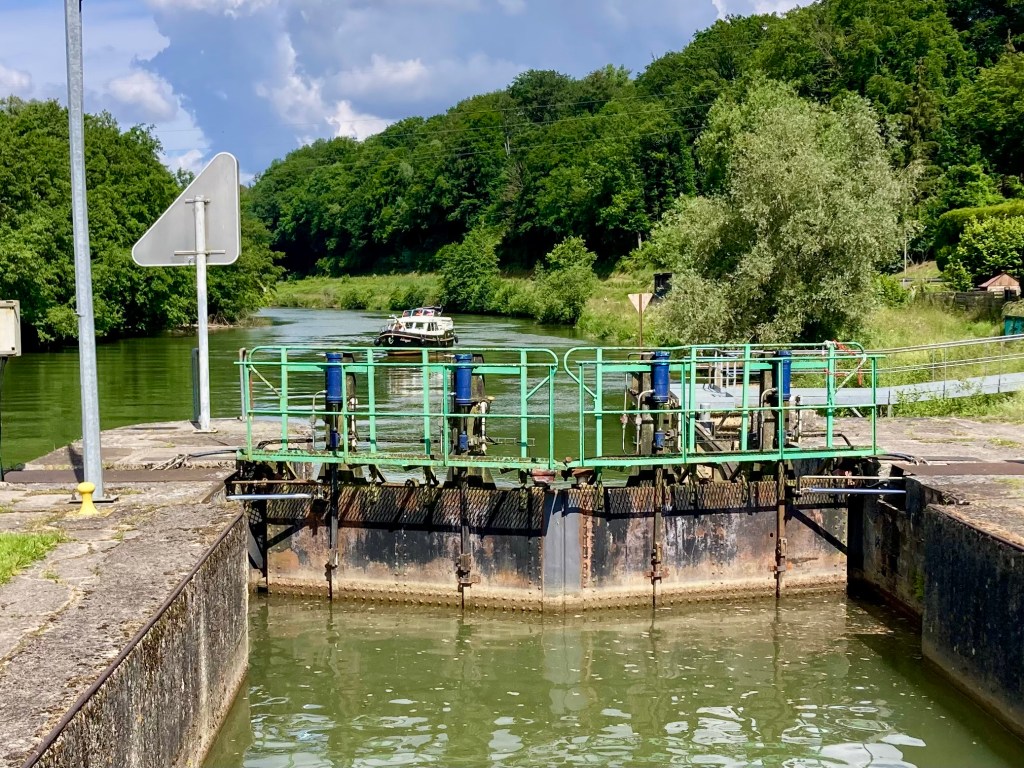
There was only one more lock between us and Charleville.
We thought we were alone on the river so it was quite a surprise at this lock to find two boats coming towards us.
It was a nice calm place to wait.
The next lock brought us into Charleville. We have been through it a couple of times before and know that it has very deep walls, even though the actual water drop is only 3.4m

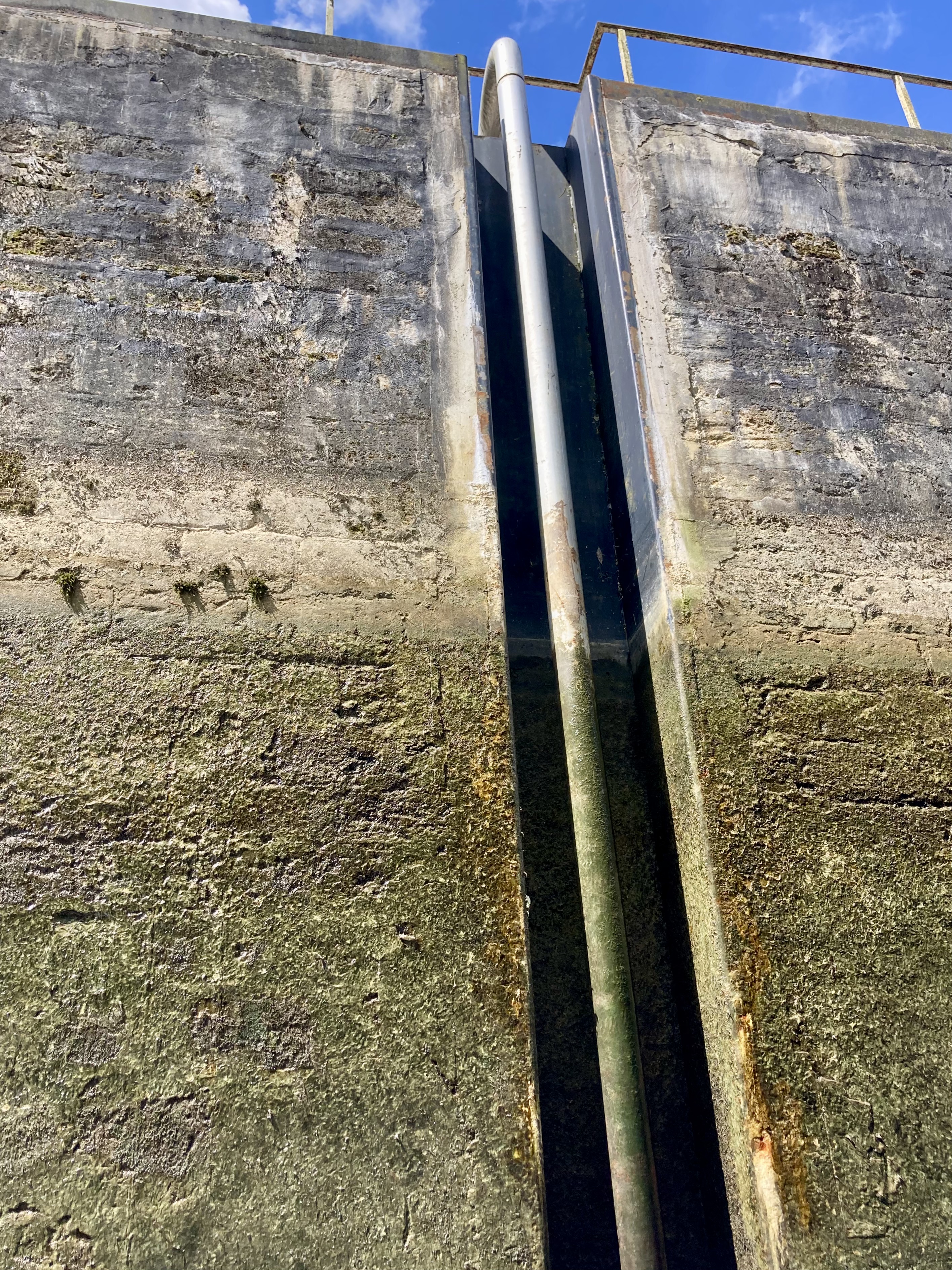

Luckily it has sliding poles to put your ropes round, and then gently slide to the bottom. And these ones are perfectly spaced for Calliope so Stewart and I had one each, fore and aft.

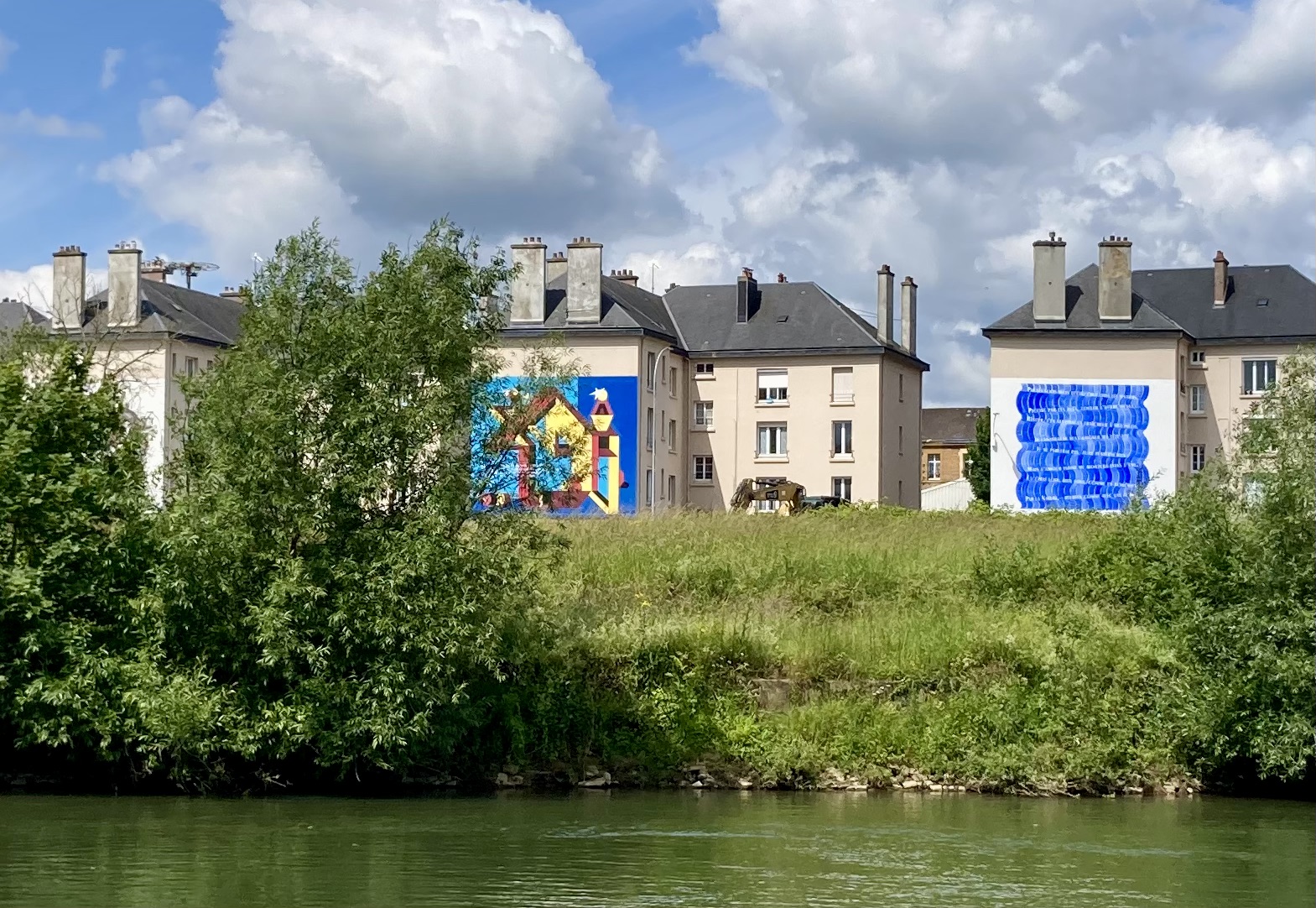
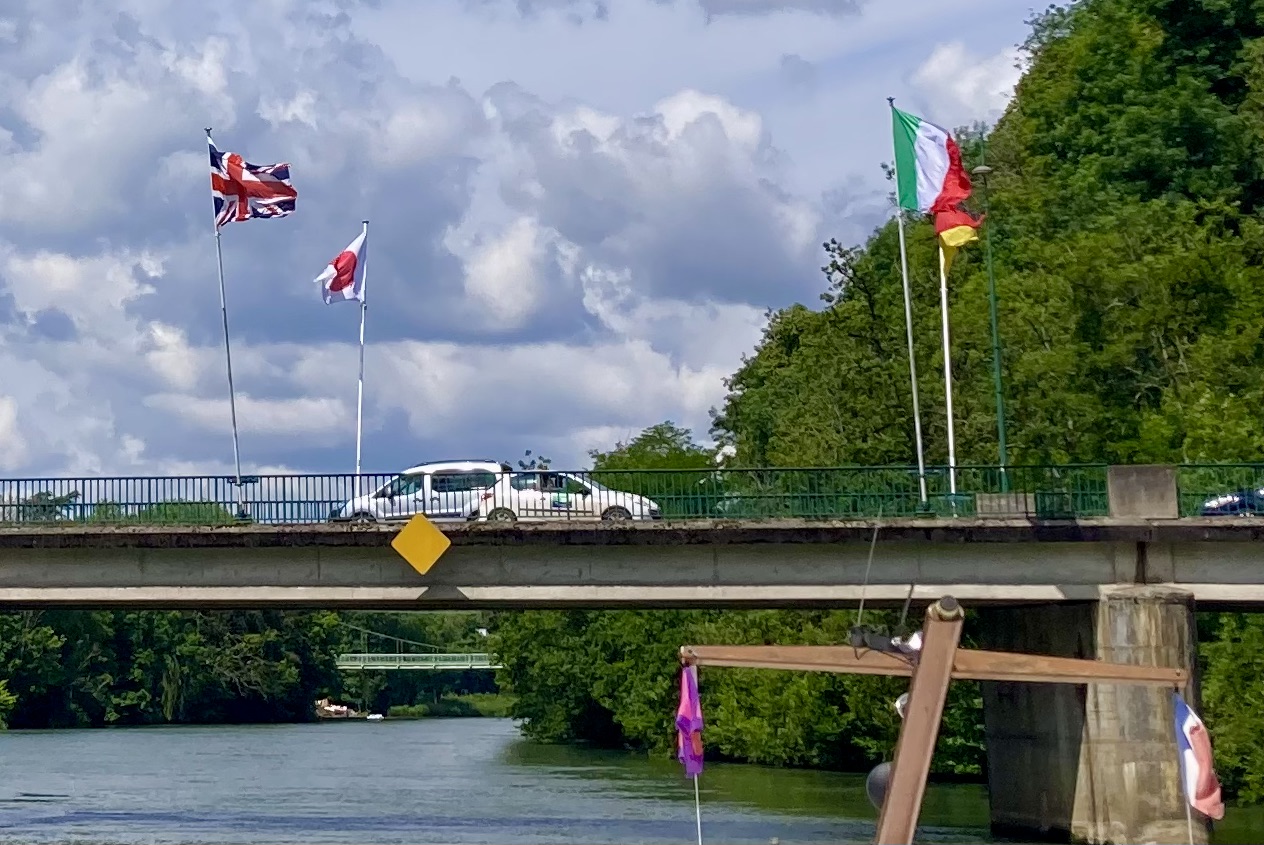
This lock is beside one of the old gates into Meziere, and not much before the bright welcoming street art adorning a line of houses, and the bridge into the port area, flying multi-national flags including the Union Jack. I think it must be in honour of the Olympics, due to take place in Paris in a few weeks time.
We sort of knew what to expect from the moorings in Charleville. There is a marina, more suited to cabin cruisers and smaller boats, and a lovely long pontoon for any boat, but more suited too those over 15m.
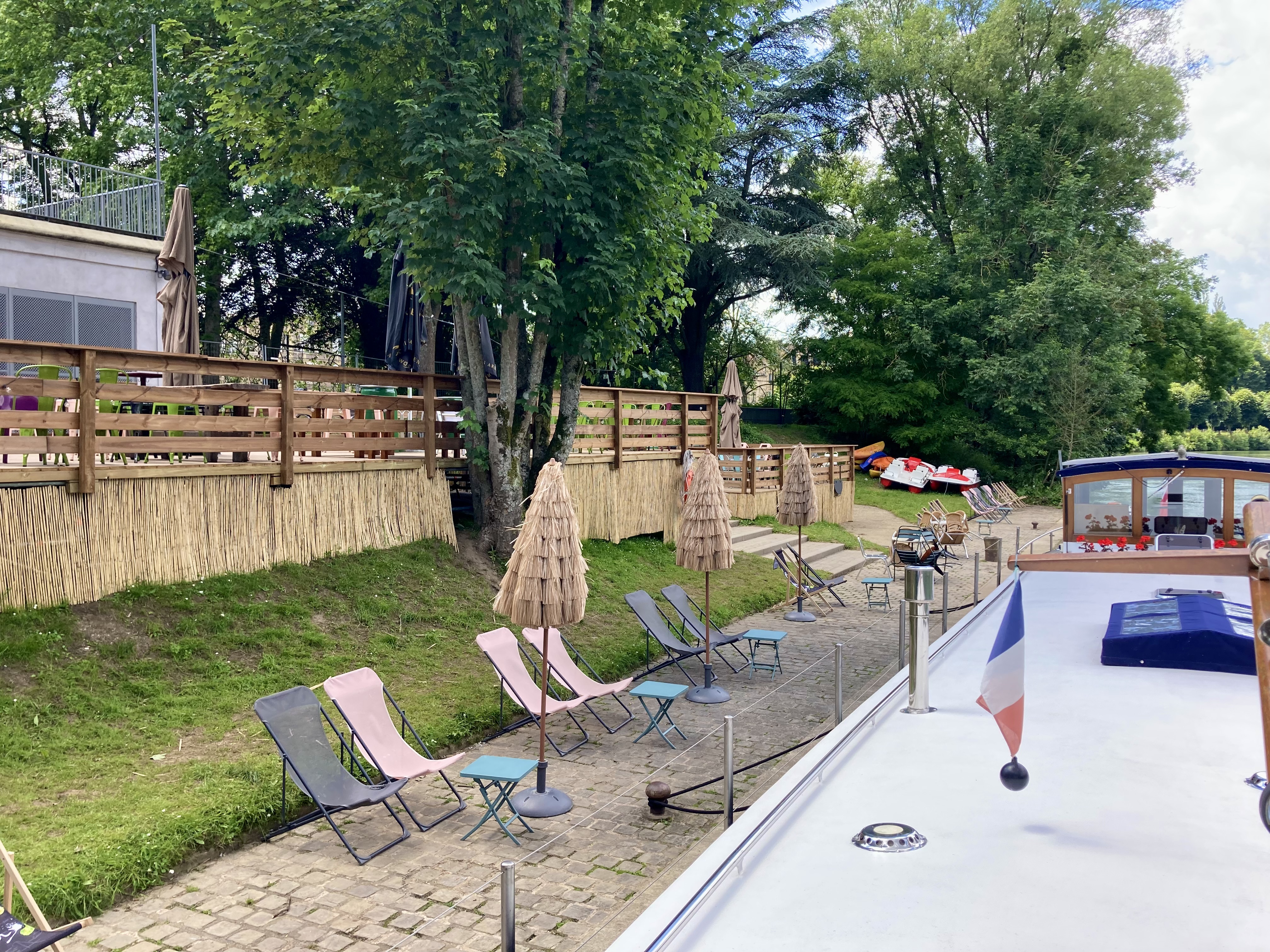
When we arrived the pontoon was unexpectedly full, but the quay opposite, under a pizza bar, was empty and we had moored there before, so we glided in and tied up. It was quickly clear that this is now very ,much a going concern, although closed as we arrived. I walked up to find the owner, a lovely guy called Max, who said he was not open until 1200 the following day and that we were welcome to stay there until then. So we did.
Then it was off to the pontoon opposite to find out if any boats could move up and make space, or if anyone was leaving soon, and we were lucky. A Dutch cabin cruiser at the end of the pontoon was leaving next morning at 9am and it was agreed we would take his place.
We wanted to be settled as we had visitors arriving next day for a couple of nights and there was some food shopping to get done!
Then we settled into a nice afternoon and evening on our special mooring, right next to the passerelle (footbridge) across the river, so had plenty of people looking in!

Next morning, just before 0900, we saw our Dutch friend leave and Captain Stu took Calliope over to her new berth where she would stay for the next three nights.
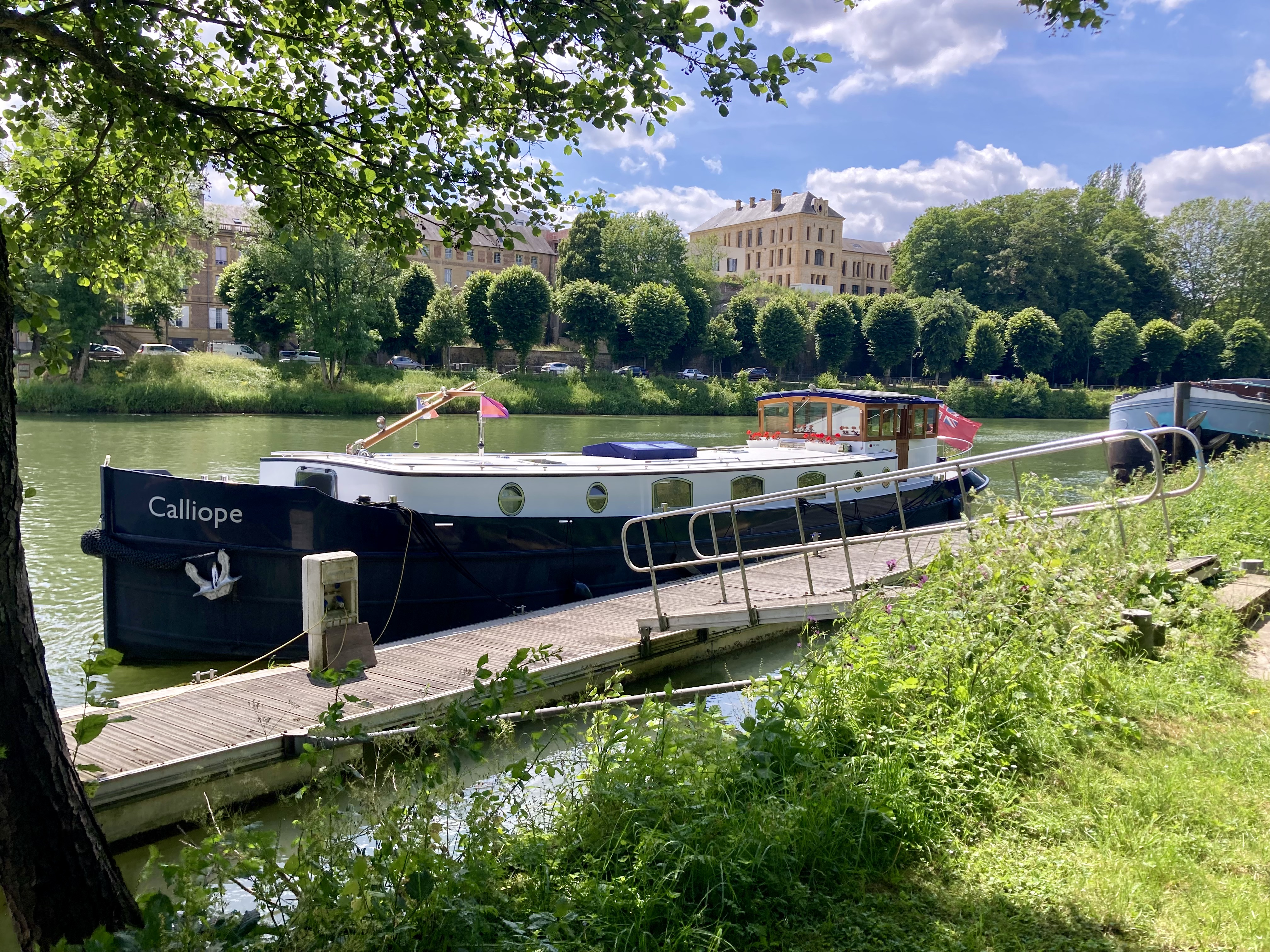
I show this second mooring as well in case you are ever looking to moor in Charleville. We are right at the back of a long pleasant shaded pontoon, with plentiful bornes for water and electricity. There is a well run camper van site almost alongside and the reception for the latter also acts as Capitainerie. It’s where you go to pay your mooring fee etc.
I’ll not detail the time with our guests; just add a few photos to give an idea of this rather interesting city, founded by Charles Gonzaga in 1606.
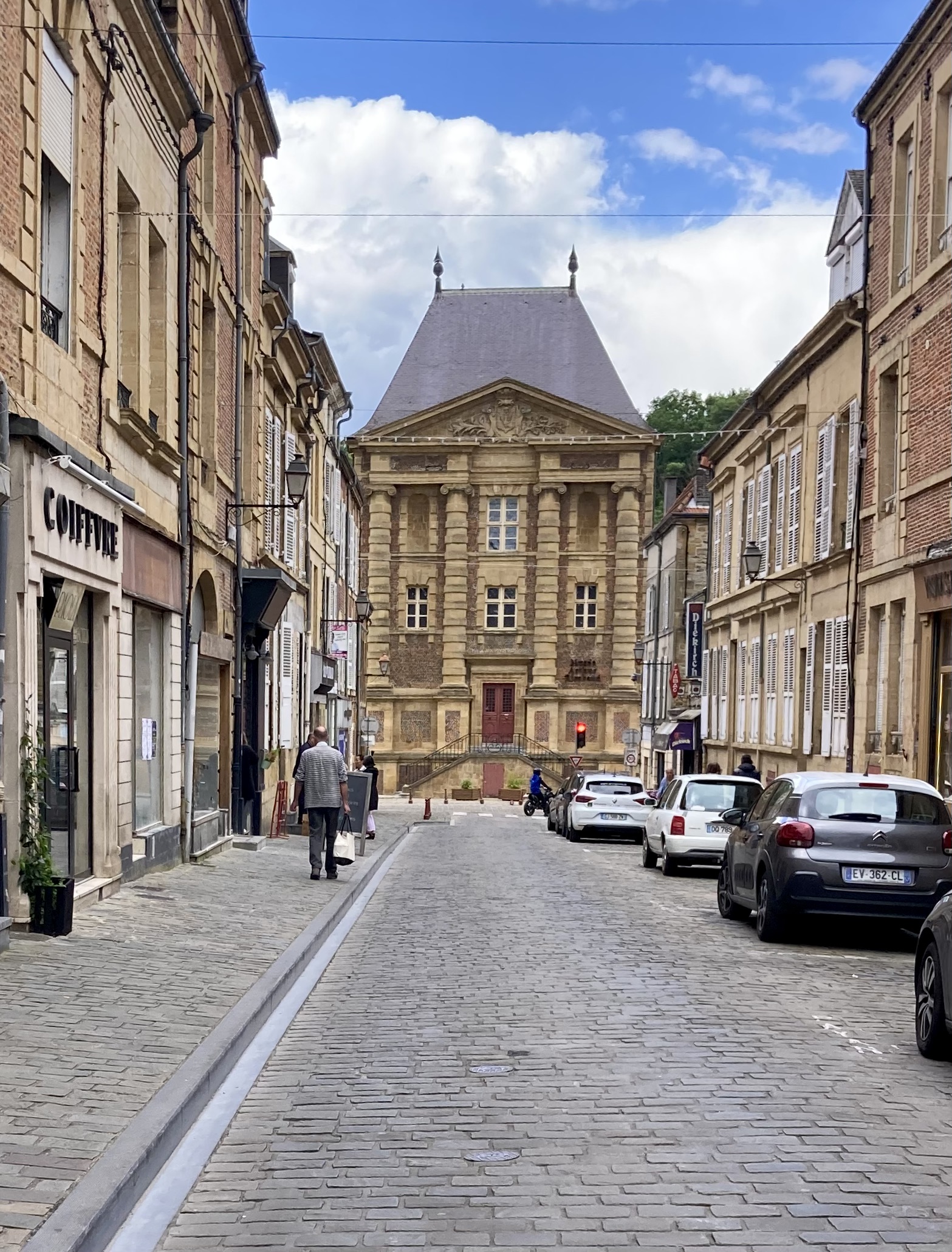


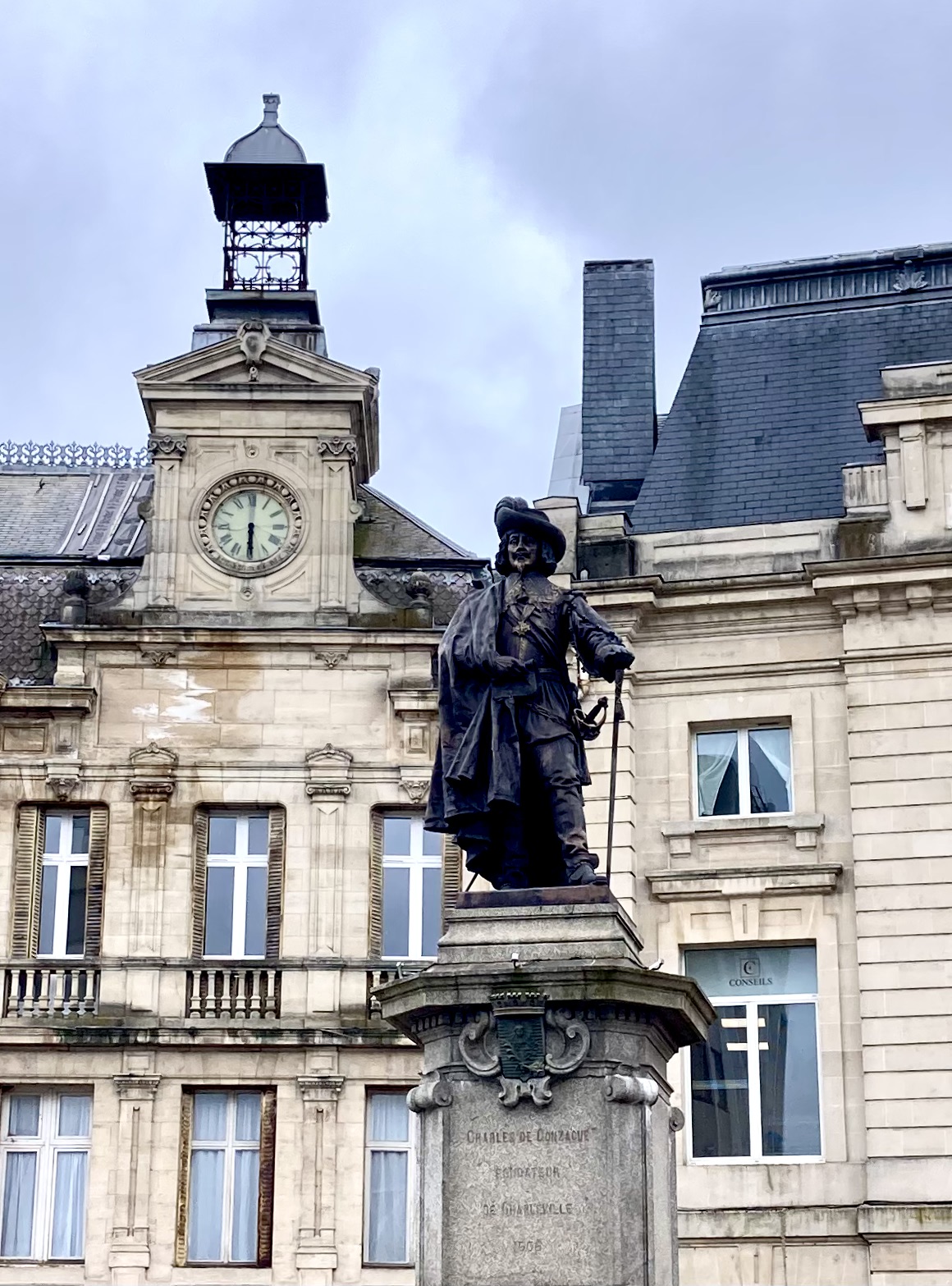

There’s a. bit of old and a bit of new; two photos include the huge Place Ducal, (the main square), set out in great grandeur by Charles who is immortalised on the photo bottom left.
There are also photos of the old city mill (top left), now a museum to one of the town’s famous sons, the poet Arthur Rimbauld; a modern installation showing break dancing to recognise its inclusion as an Olympic sport; and the pizza bar in full swing.
We had four nights in Charleville. It is a good place to stop for a while. And then we were off to meet more friends downstream.
Monthermé
This rather dismal photo describes the grey start to what became a glorious day – not in terms of weather, but because we met our good mates.
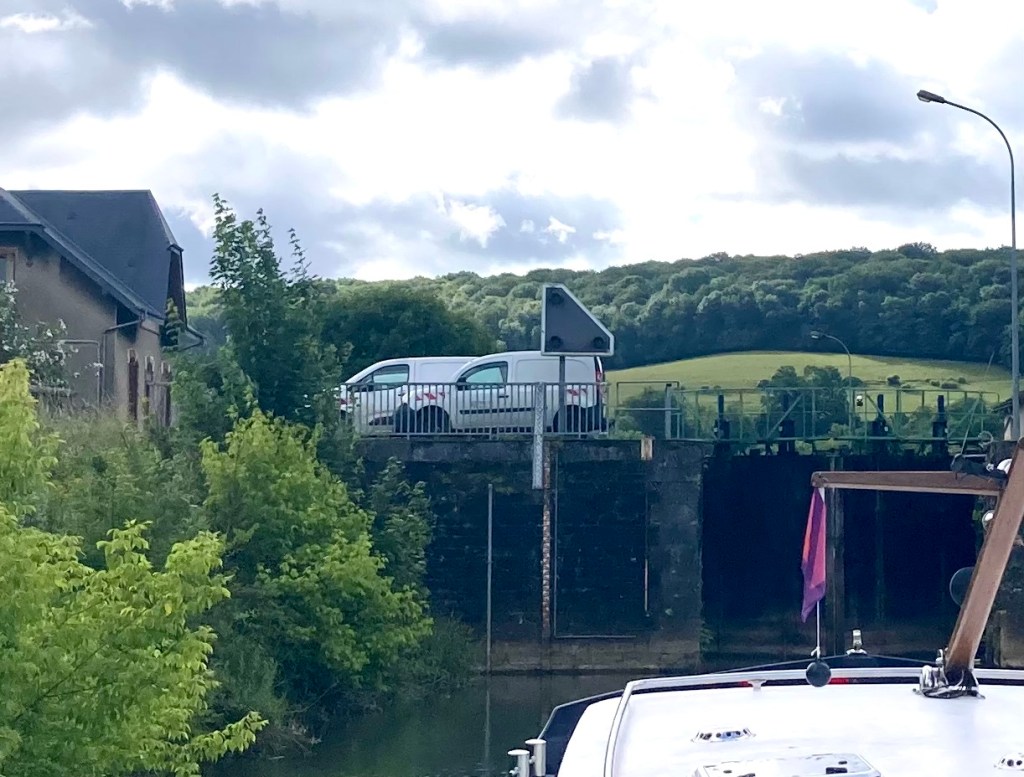
We arrived at our first lock dead on 0900, when the locks open on this stitch off the river, for a quick getaway, only to find no lights on the signal.
We waited a bit, but they did not come, so it was a phone call to the VNF, and another wait for 20 minutes until they could get to us.
This is not a complaint! The VNF teams cover long sections of waterways and if they have been helping someone several miles away it is good karma to relax and wait, enjoy the flora and fauna around, and be thankful for your life on the water.
[Philosophy lesson over}
By the time we got away the skies were beginning to lighten and the sun even got out long enough to lights up the gleaming metal min-dome on this church, the église de Monty Notre-Dame.
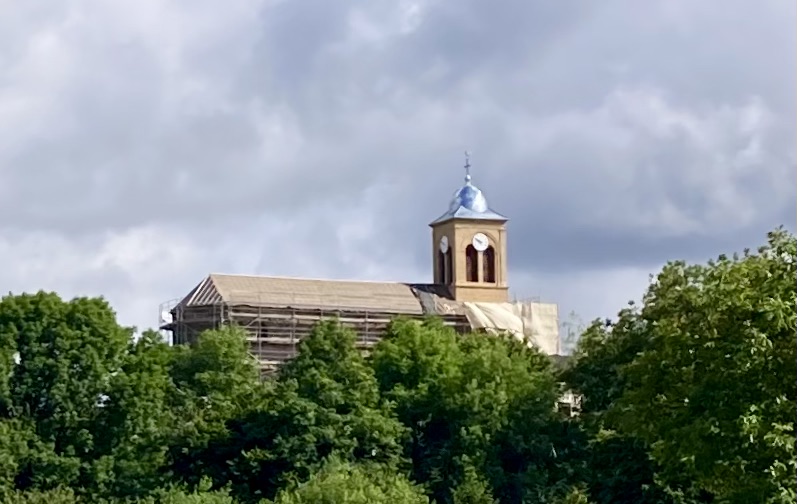
We swept on down the river, soon reaching the lock at Joigny. There is a nice mooring pontoon here, but we were not stopping today.

You do, however, have to stop in locks, and this one at Joigny has a shocking reminder of just how high the water can get on this river!
The top marker is 1995 – not so very long ago. IN fact all three floods were in the 1990s, a time when you would have expected modern water management via weirs, sluices, locks and barrages to have prevented this.
Some of the houses at Joigny, just below the lock, were evidently built with floods in mind, a bit higher up on the bank!
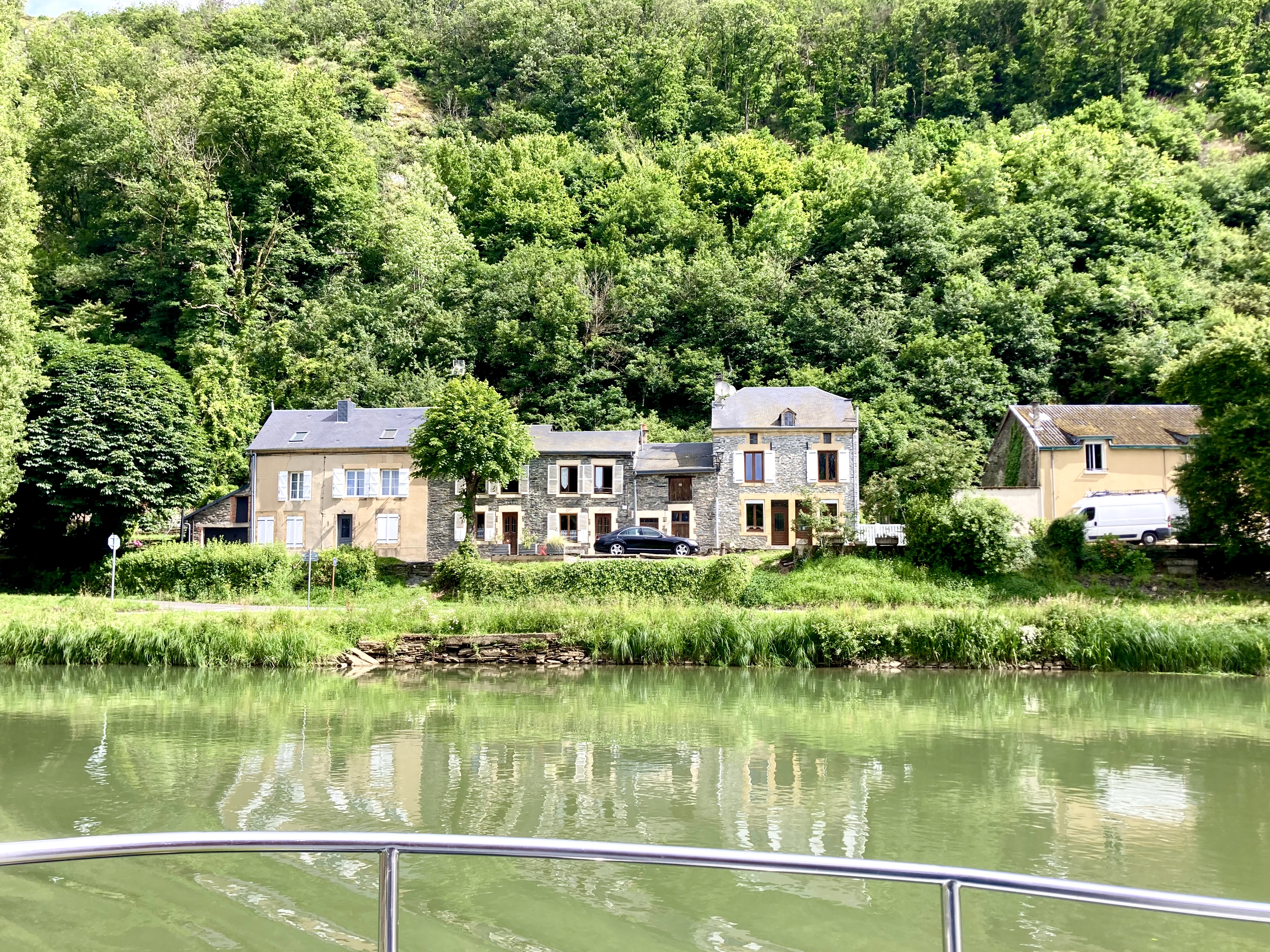
Nonetheless I think they would have had water running through the ground floors back in the nineties.
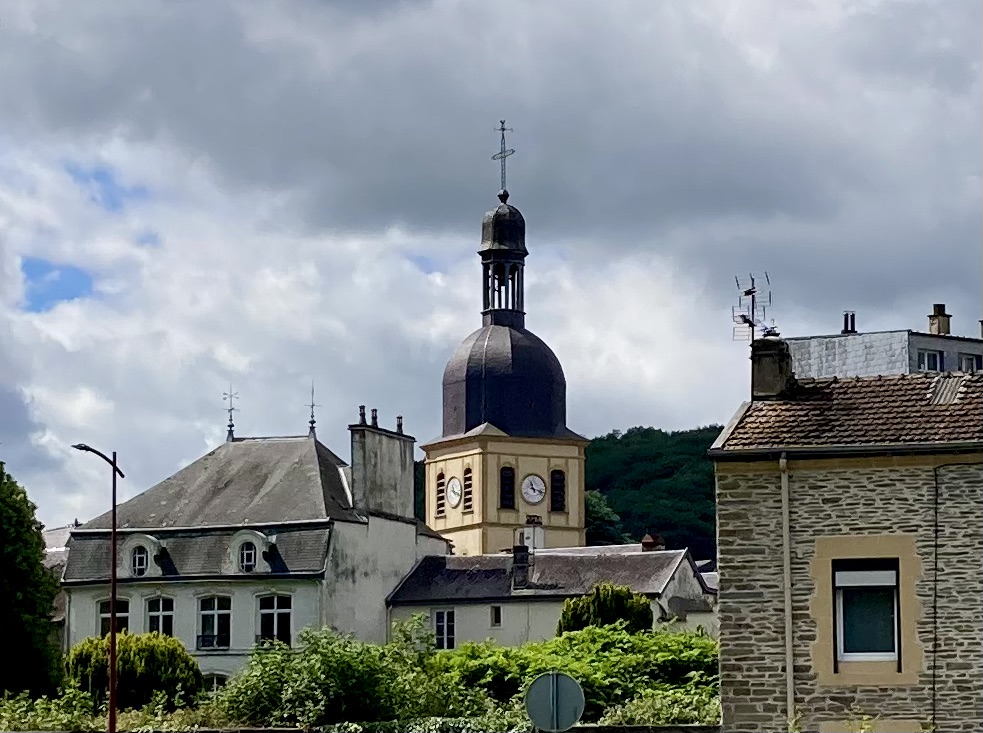
Bogny-sur-Meuse, a few kilometres further on, had certainly taken measures against rising waters. The church was well away from the river, and houses closer were almost on stilts.
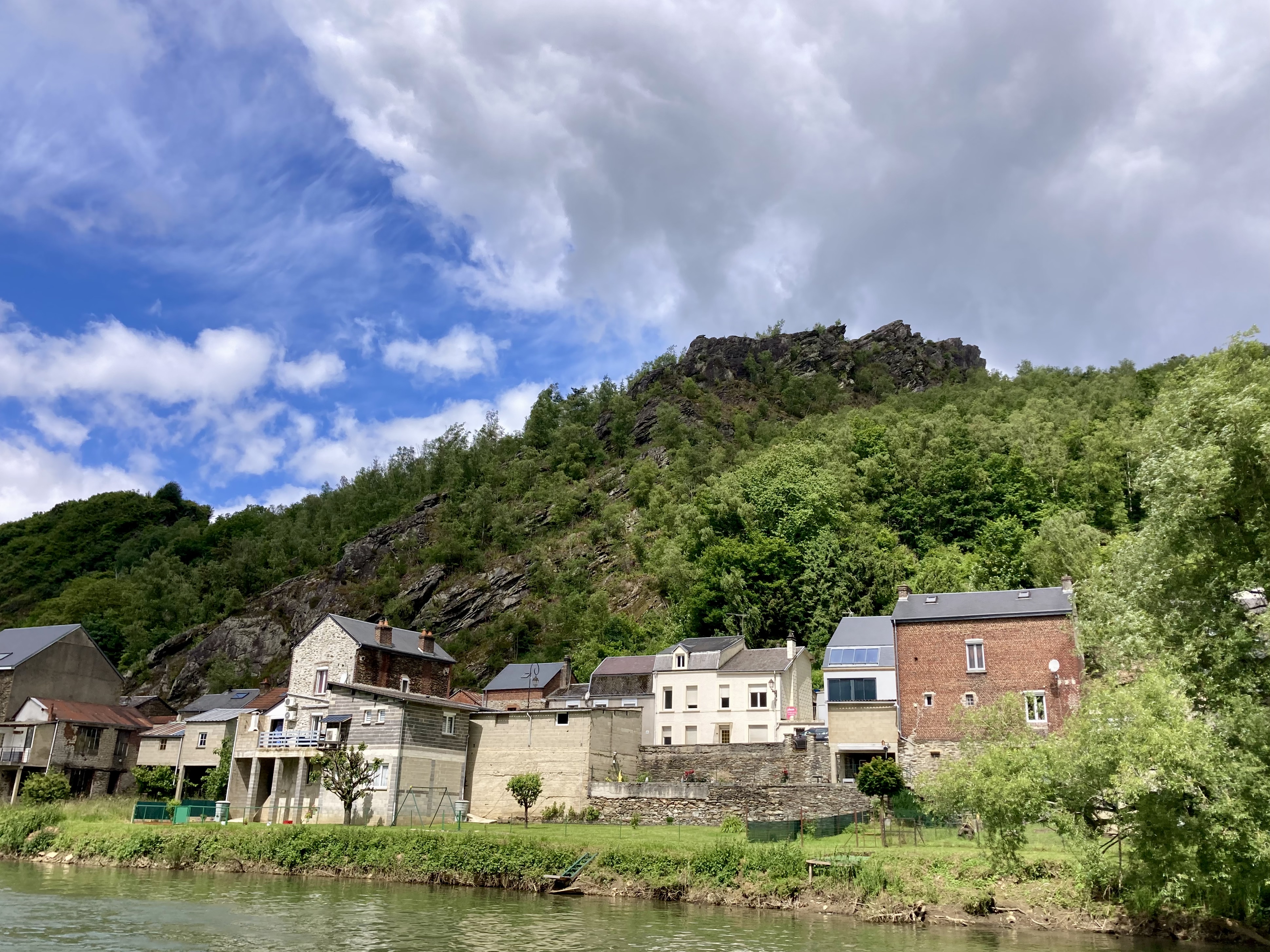

Who can blame them from living here? It is one of the most beautiful rivers in France that we have cruised on. There is mile upon mile of green hills sloping down to the water and tranquility all around.
We were now nearing our destination for the next two days, Monthermé. This is a town we have passed twice before and been struck by its attractiveness, but it had not fitted in with previous mooring plans.

This time however we were definitely stopping, to meet up with two good boating mates –

– three if you count the dog!
It was so good to see them all again. Both nights there managed to be very social shared meals, and masses of catch up chat on everything from bow thrusters to boulangeries.
On our second day walking expeditions set forth in opposite directions. Sally and TinTin climbed to the top of the valley side opposite – extremely high!
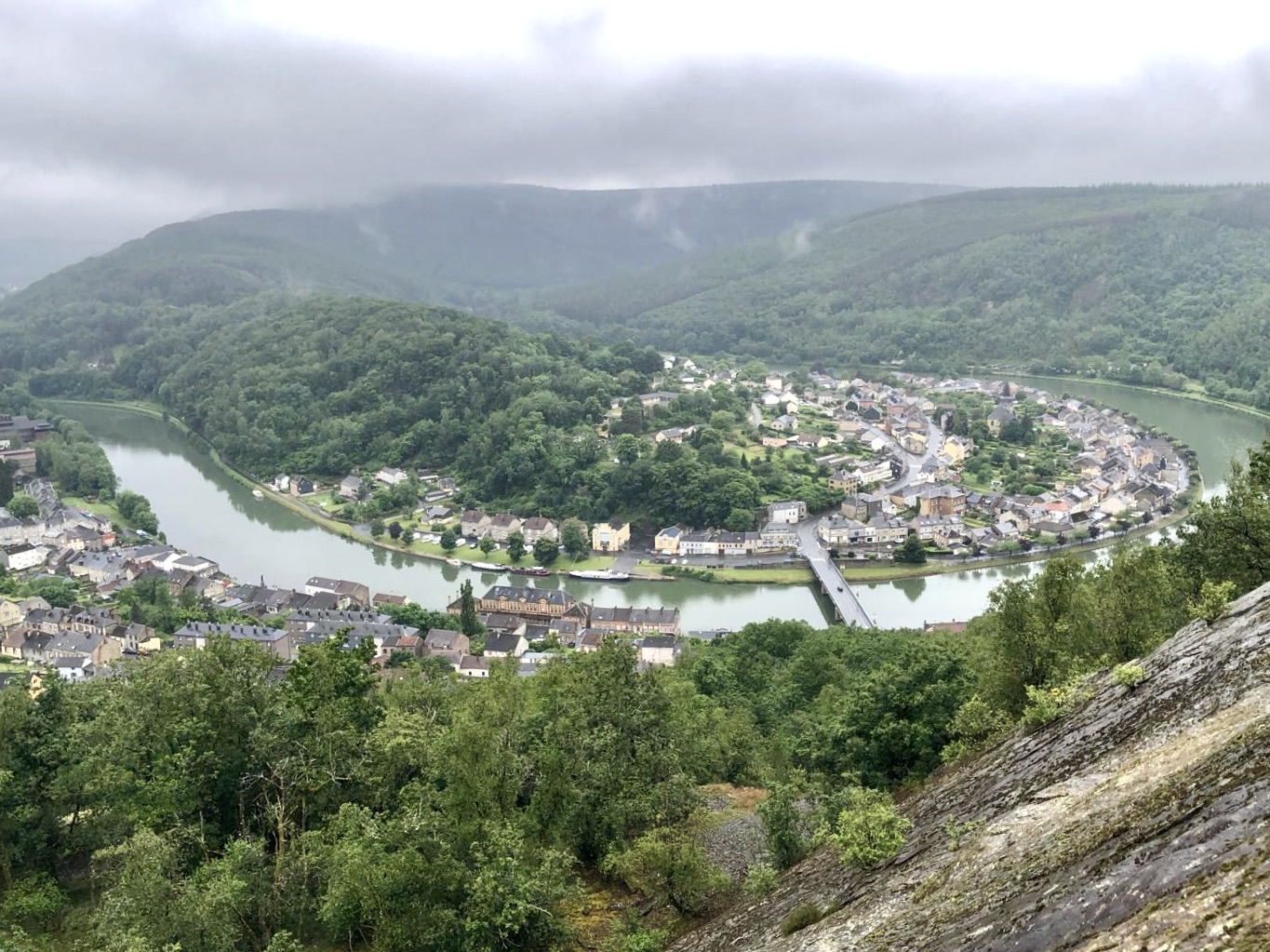
Despite the rather miserable misty weather she was able to get this splendid photo from the top, showing the loop in the river and our two tiny boats moored below.
Meanwhile Stewart and I were less intrepid and walked instead to the local supermarket for a larder refill.
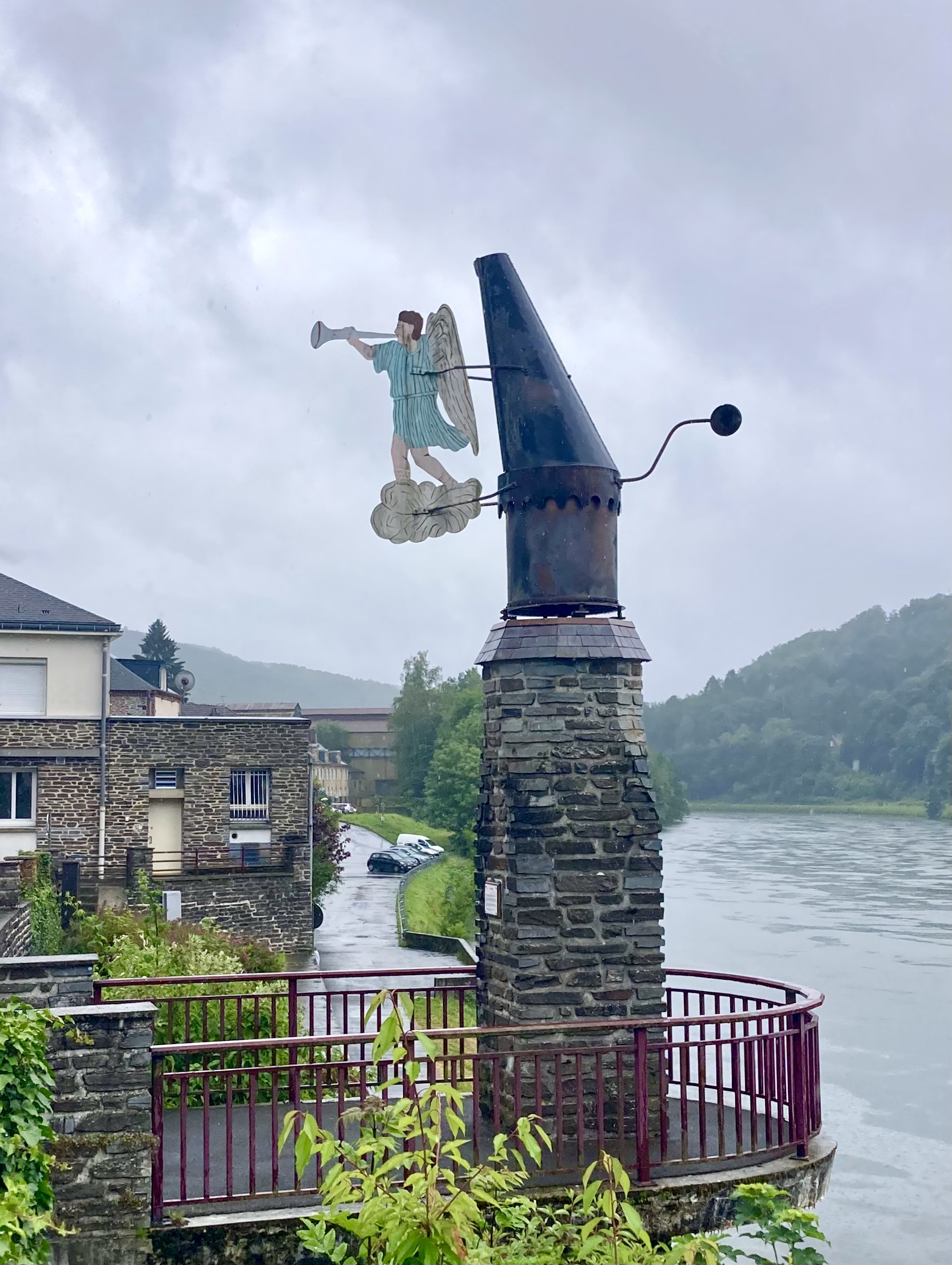

The photo gallery of our trip is less impressive, but quite interesting nonetheless. Own the left is a weather vane – the last remnant of a large brewery that stood on this spot beside the river. It was built around 1810 by M. and Mme. Hazard-Rousseau and was brewing for 150 years. Then, soon after it closed, it was demolished to allow the much needed widening of the road.
On the right is Laval-Dieu Abbey, founded in 867 by the Archbishop of Reims at the mouth of the Semoy river, where it flows into the Meuse. It is due to the growth of this abbey over centuries that the town of Monthermé came into being. It is open to visitors three afternoons a week in the summer, but not while we were there.
The next morning Calliope and crew had to carry on down the Meuse (sounds like a 1960’s comedy film).
So with a little sadness in our hearts we waved goodbye to Pavot crew, turned in the river (we always moor pointing upriver if possible, especially if there’s a bit of a flow) and we’re off.

Near Fumay

It was still grey and cloudy when we left Monthermé but the superb scenery of the Meuse valley made up for that. When you pass another boat you become even more aware of how small we are in comparison.
Our plans were to moor at Revin which is a nice port to stop in; that did not happen as after several phone calls and email to the ‘harbourmaster’ and tourist office we ascertained that there was no room for us that night.
In the meantime we were passing by lots of delightful and intriguing sights. Here are a few.


Soon after Monthermé is the old village of Laifour, dwarfed beneath the strangely named hill tops of Les Dames de Meuse. Legend tells that three adulterous wives were turned into these huge rocks, and forever stare down at the river below.

The rail bridges spannbning the river are almost as spectacular as the scenery! I never tire of seeing them come into view; shame it was such a dull day for the photo.
By now we were not far from Revin, and knew that we would be continuing a bit further.

The sign int the lock outside Revin provides information in three languages about what is ahead for those going to the harbour.
But for those continuing it is good to have a map and to see that you will be going through a tunnel and straight into a lock, when the way his clear.
We have been here before a couple of times so have an idea of what it is going to be like, but I don’t think we have had to wait midstream on a flowing current. Much like a normal lock we had signalled our arrival with the remote control and had green and red lights showing that the way was being prepared for us.
We are pretty patient sailors, expecting to wait and take our turn at whatever the next obstacle is.
But on this occasion we were beginning to give up hope. There is nothing to m for up to while waiting for the tunnel, which is round to the right behind the small boat. And with the current it’s not an easy ‘wallow’.

After 20 minutes we were beginning to think maybe something was wrong; it shouldn’t take that long to prepare the lock, and give time for any boat coming towards us. And then there she was! The boat that must have arrived at the lock at the other end of the tunnel just before we pressed our remote control!
Now we were back on track, and for a little fun I have included a video of our passage through the tunnel.
Once through then tunnel we were well one the way to Plan B – Fumay.
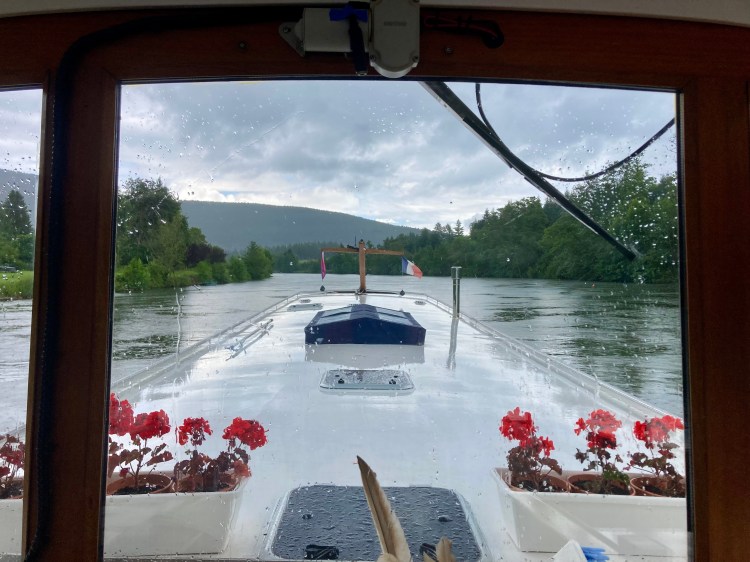
The skies, which had threatened to rain all day, finally opened and we had a bit of a dousing.
In some ways I quite like it to rain – it helps to clean the cabin roof!
As we got closer to Fumay the valley sides began to change.
Further downriver was full of slate mines for centuries. I am not sure if this rock formation signal slate within, but certainly different to the tree ,lined slopes we had become used to.

As we closed in on Fumay we began to wonder whether the long quay there might also be full. Was there a Plan C?
I looked up the DBA mooring guide and found that just before Fumay was a high wall we could tie up against, a couple of hundred yards before the lock. That sounded ideal to us.

And there is was, just whiting for us. It’s an interesting operation getting a role round a bollard set back under railings, but manageable.

IdeaL; one of the most peaceful moorings we have ever found. All we could hear was the weir and some birds. “This is why we do it”, we said to each other.
Vireux-Wallerand
As we had not stopped at Revin we had a shorter cruise to the next night’s stop – just 16.5kms. The locks open at 0900 and we were so close we could wait until the lights came on, cast off, and by the time Captain Stu had turned Calliope round to face downstream again the lock gates were open.

Once in the lock I could look back at the weir that was the background to my dreams the night before. Weirs are one of the great attractions of locks on rivers (compared to canals). Almost every lock is accompanied by a weir!
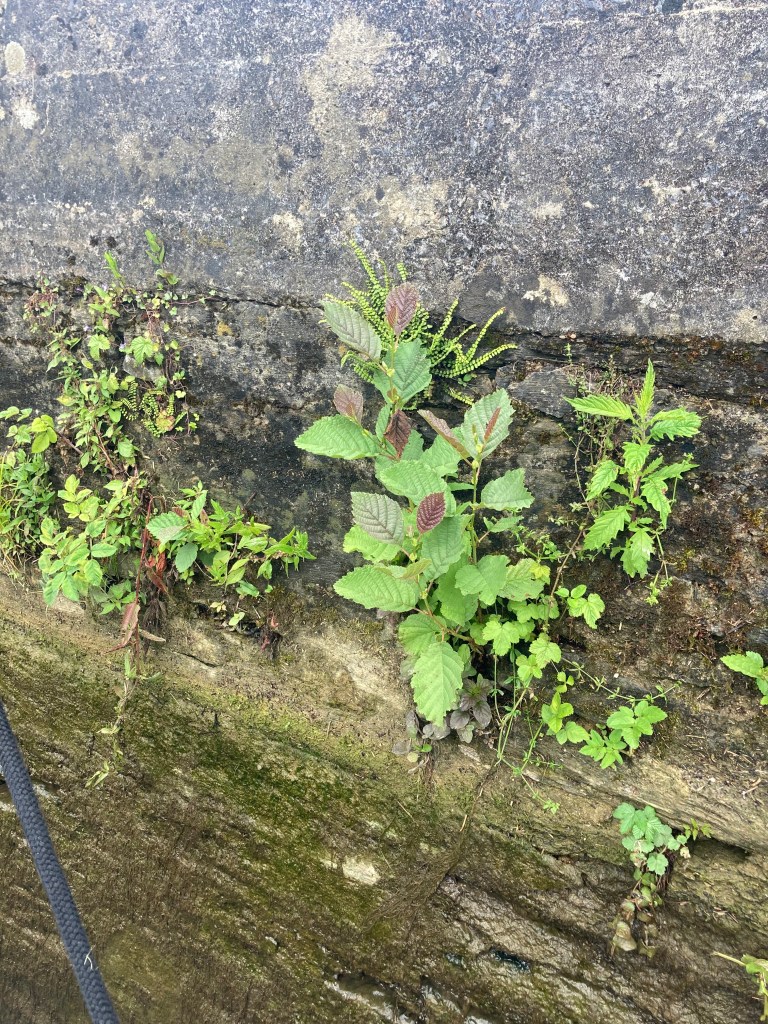
The old walls in the wonderfully named l’Uf lock (named after the tall rock beside it) played host to bright greenery, and a few flowers too.


The river wound round the Roche de l’Uf and arrived at Fumay quay. The row of slate roofs is a reminder of the important industry that built Fumay up in the past.

And look how much space we would have had if we had continued into town the previous day! But we loved the more rural mooring and we have stopped at Fumay before – a pleasant and interesting place, worth visiting if you have not been there.
It has a famous little butcher who makes the best boudin blanc!

Round the next bend of the Meuse is the small town off Haybes.
Just before the town is a short diversion from the river to the next lock. Most of these river lock approaches have a ‘Gard’ at the upstream end.
Big wooden beams could be slotted into these to hold back flood water, sending it down the main river.
The old markings in the stone presumably mark the height of the water above normal levels.
No stopping at Haybes today, another place worth spending a few days if we had had the time on this trip. Then through the next ‘gard’ and into the Fépion lock approach, where the day that had started so well had a minor hiccough.
First the cloud descended and it became increasingly wet. That is not a problem; those who know me know that I rather thriver in any kind of water!
And there was a nice bright light on the lock system, so pressing our remote control should get the gates opening for us soon.
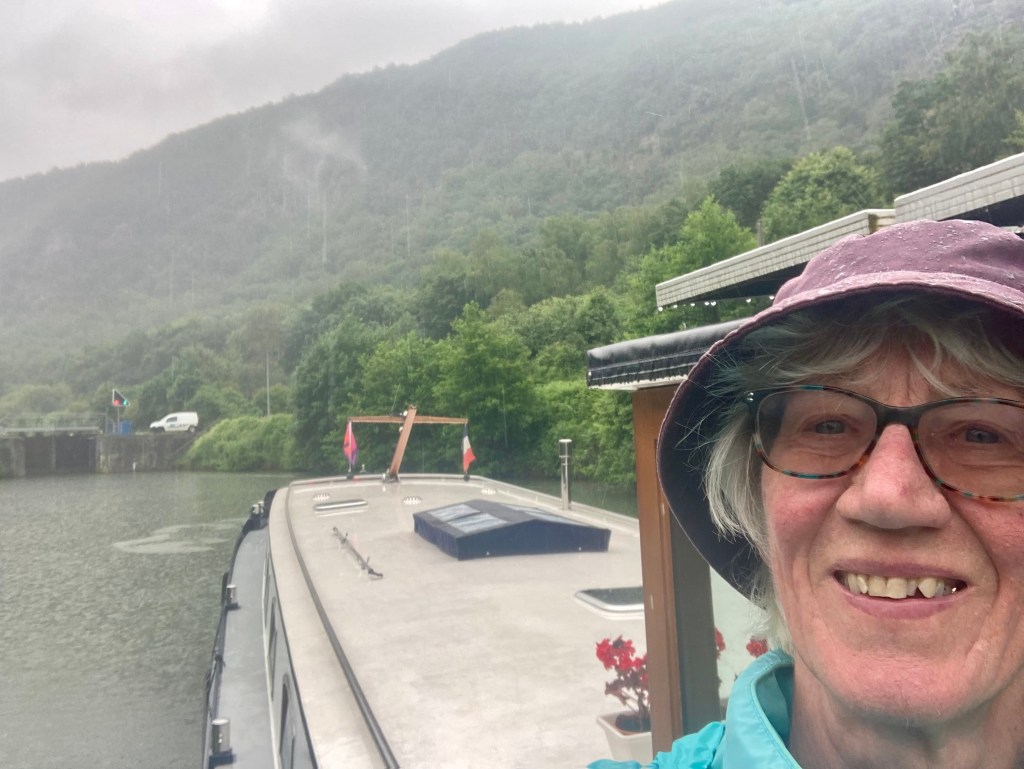
Unfortunately nothing happened. Many presses of the relevant button had no effect. We looked for the sign to indicate the optimum place to use the remote; had we passed it? In the end we phoned for help. After about half an hour the welcome little white Visuris van arrived and put helper stopped out into the rain to put things right.
While Calliope was in the lock we discovered the problem. Our remote control had run out of battery! We had been using it since we started on the uphill flight of the Canal Des Ardennes only 10 days before, but many many locks had been operated from it since then.
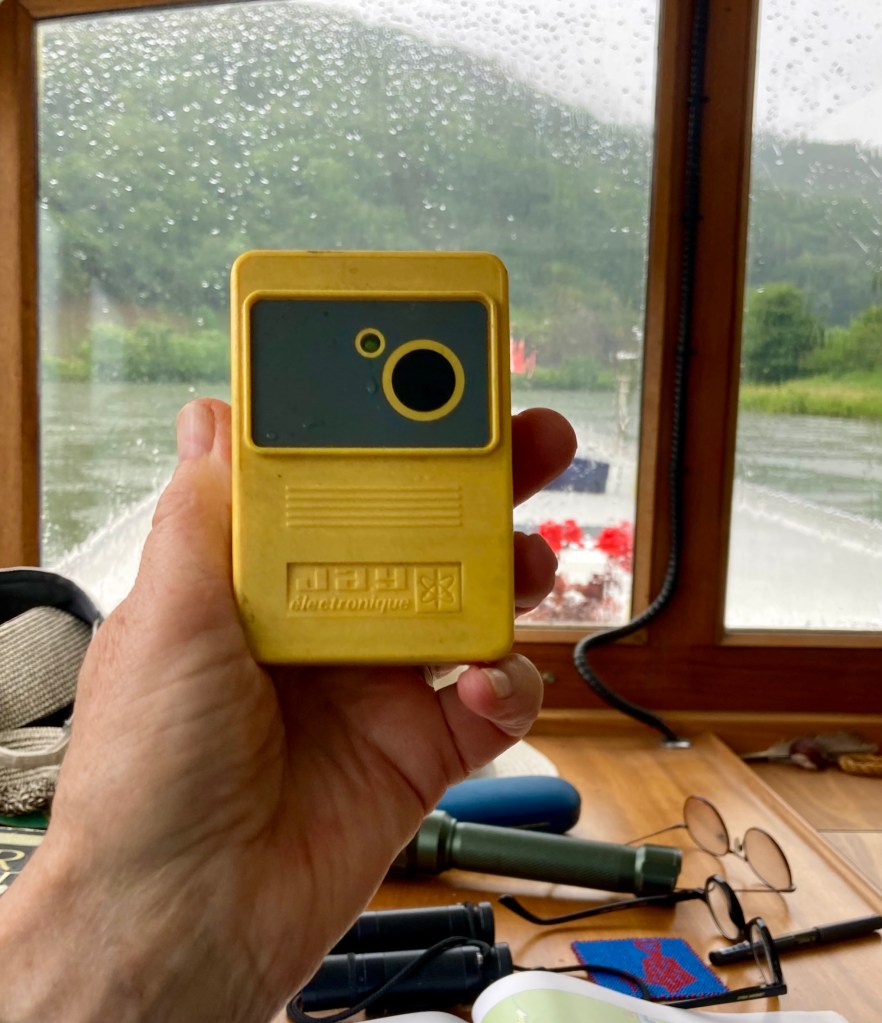
We were handed a new one and were on our way, with crew dancing a wet weather jig of enjoyment at the result. 🤣

After this short delay we had just 8 kms to go for the day and would get there before lunch time. It was still raining when we arrived at Vireux-Wallerand, but the quay was completely empty … and the excellent Belgian style friterie van was still there – supper sorted!

I quickly went ot the Capitainerie and paid for two nights; we were giving ourselves a day off for relaxation, shopping, and, as it turned out, socialising.
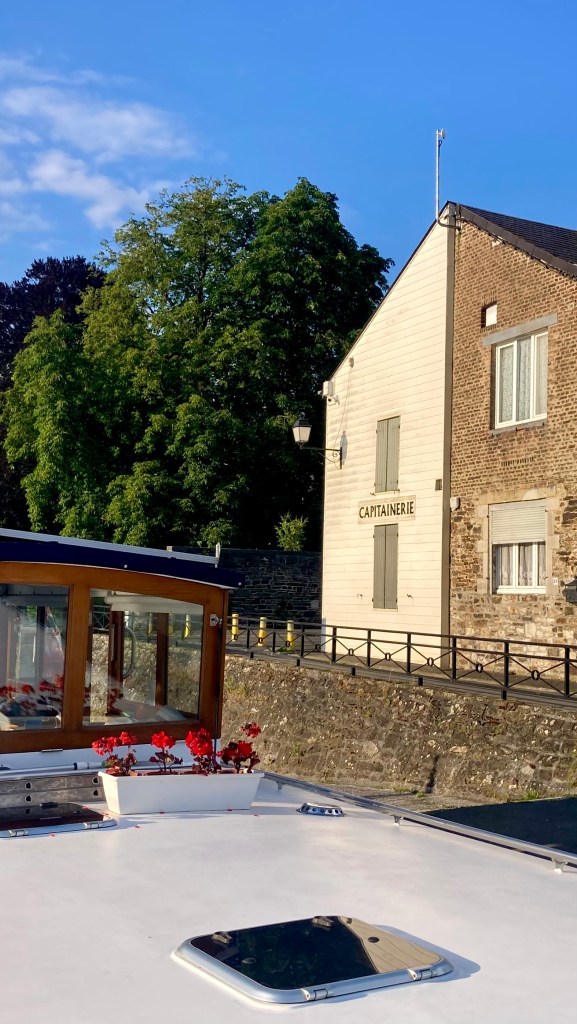
At 1600 it had stopped raining, giving us a dry run to the supermarket, and a sunnier photo of the mooring.
We had an ideal position at the end of the quay, and right next to the Capitainerie.
By now another boat had joined us on the quay, and the next day it would be full from end to end. We had arrived at the right time..
The walk to the shop looked rather boring on the map, but it turned out to be much nicer, over the bridge to neighbouring Vireux-Molhain, along a river path, and, only for the last part, up on a busy road.
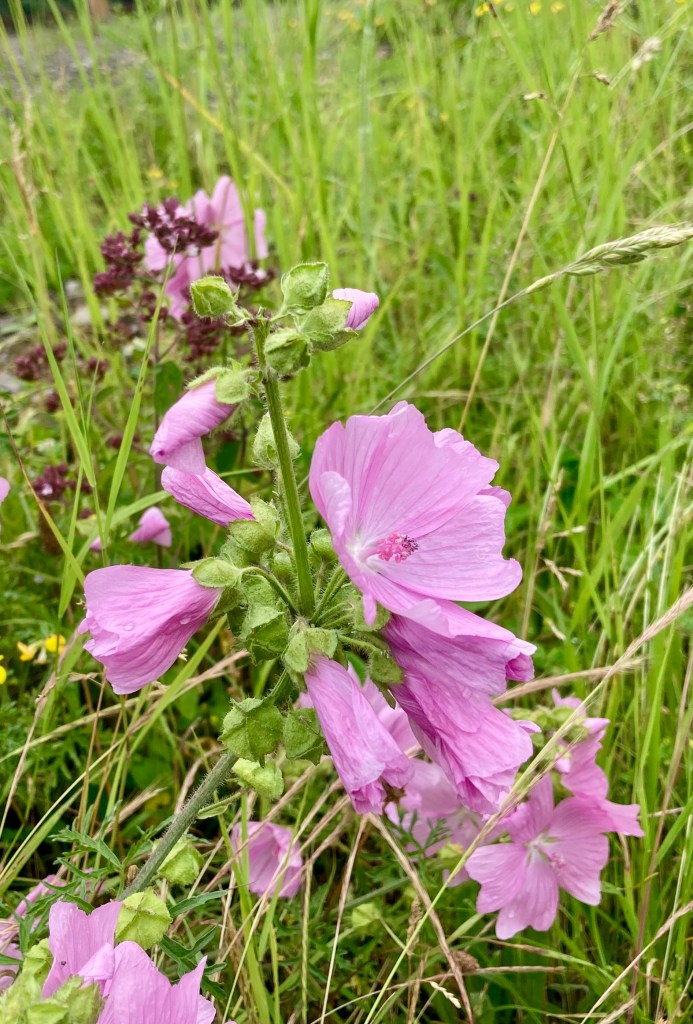

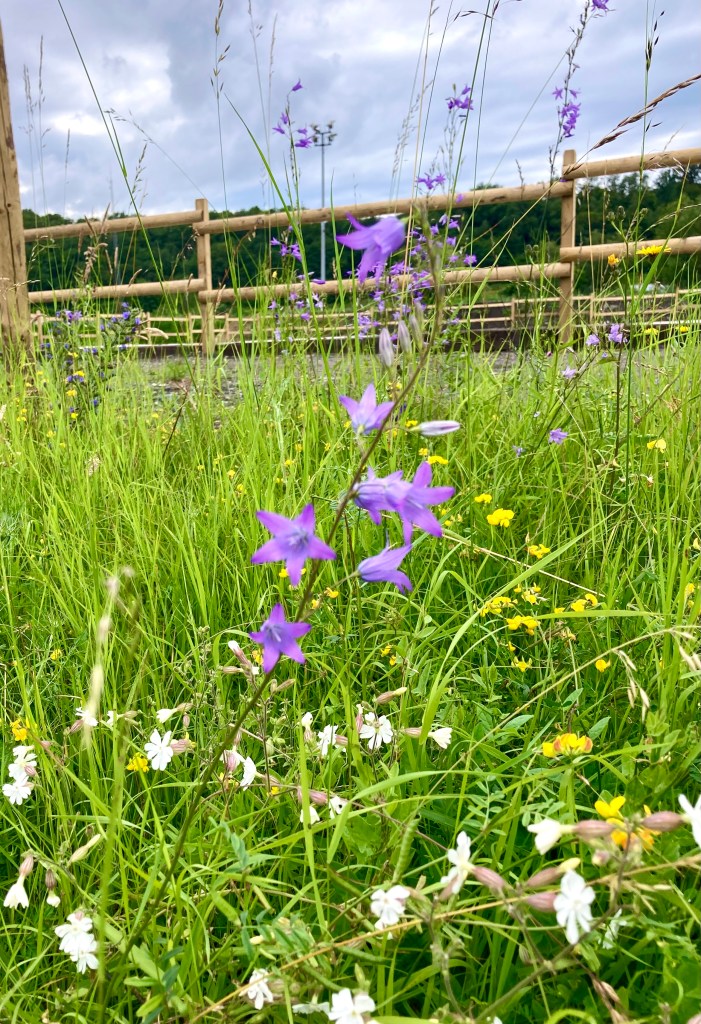

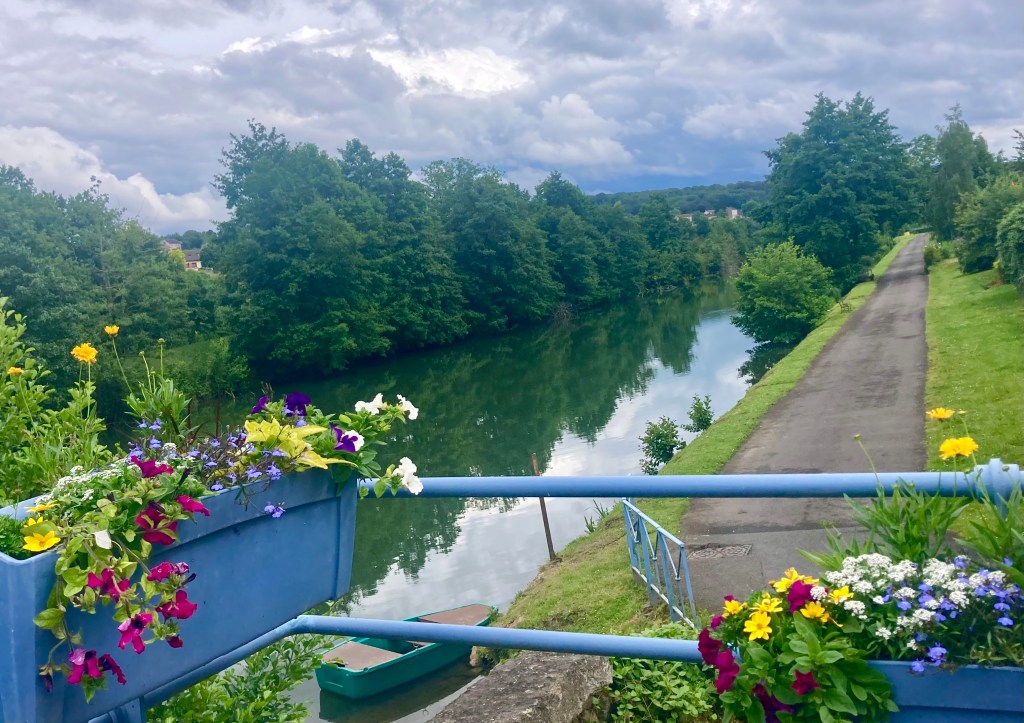
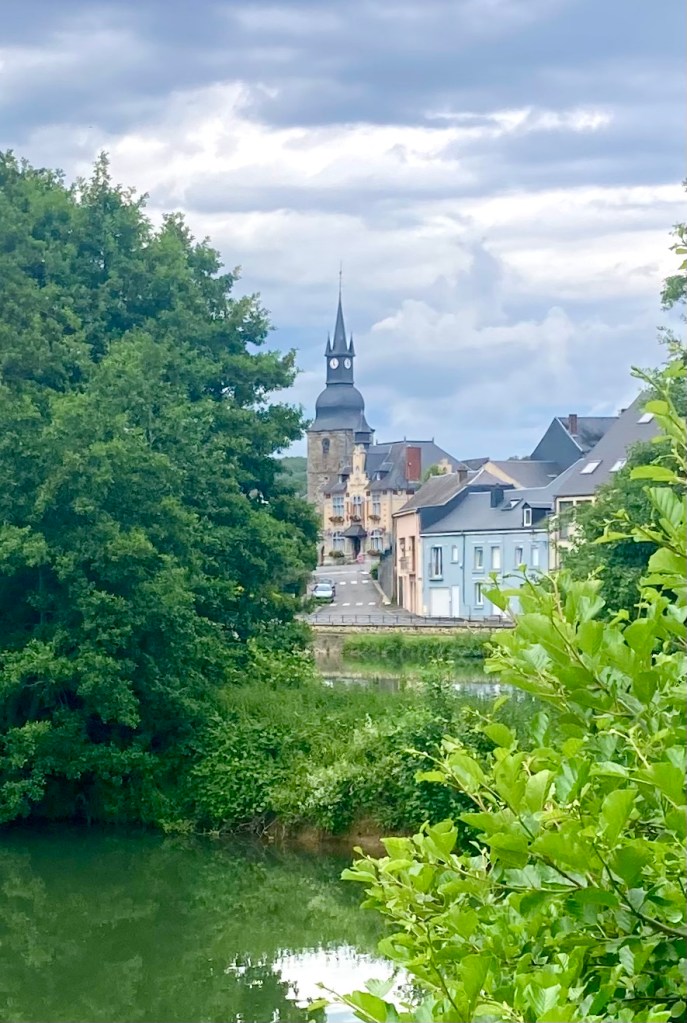

Our frittur supper was a great success – filled all the empty spaces and more. So next day we thought we had better walk some of it off.
Opposite the mooring there is a big hill with a look out at the top. That looked like the place to go! So armed with Google maps we began our ascent.
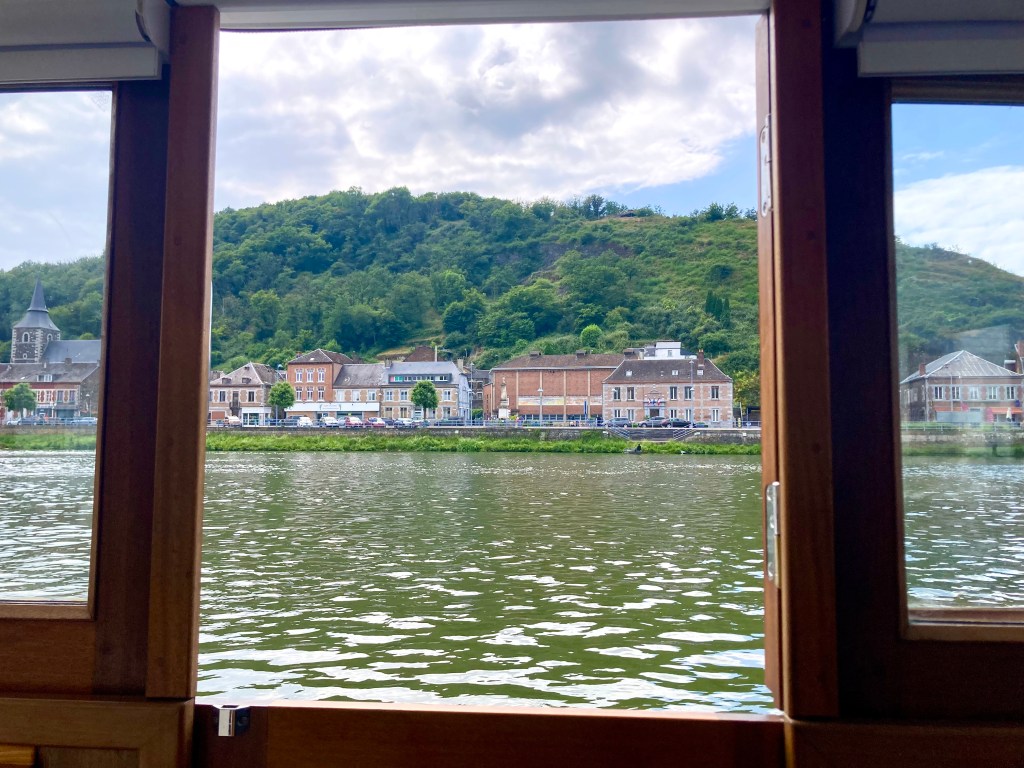
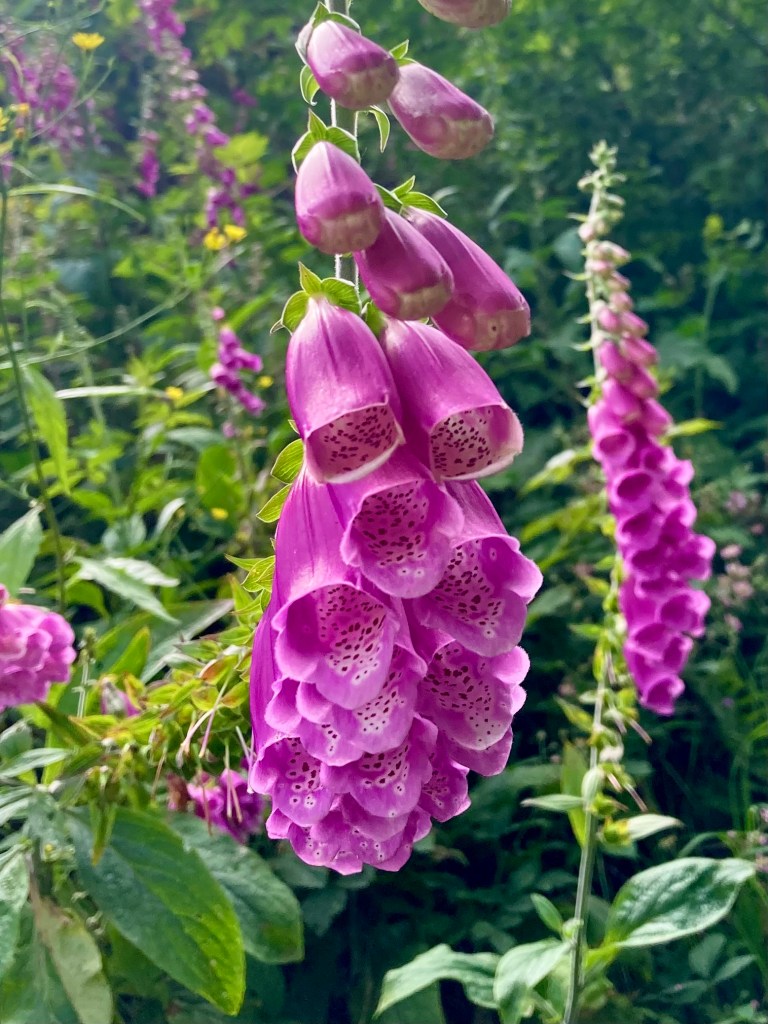

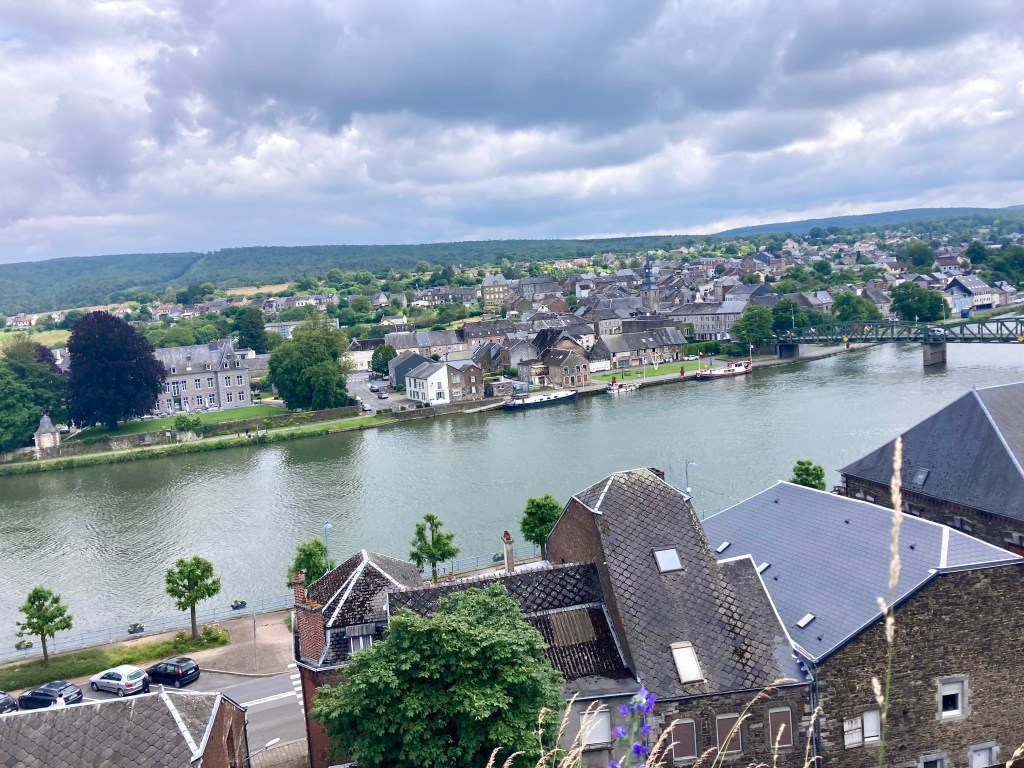
Half way up, or maybe less, we had a good view over the rooftops to Calliope. Then there were mass fox gloves, paths that didn’t exist, much going and froing and asking of locals for the way to the top.

We never did find the way to the top, but it was a good workout.
And the way down was easier!
There were two treats in store for us when we got back to water level.
Firstly the local swan family turned up in a different formation. One or more cygnets were hitching lifts aboard mum/dad.
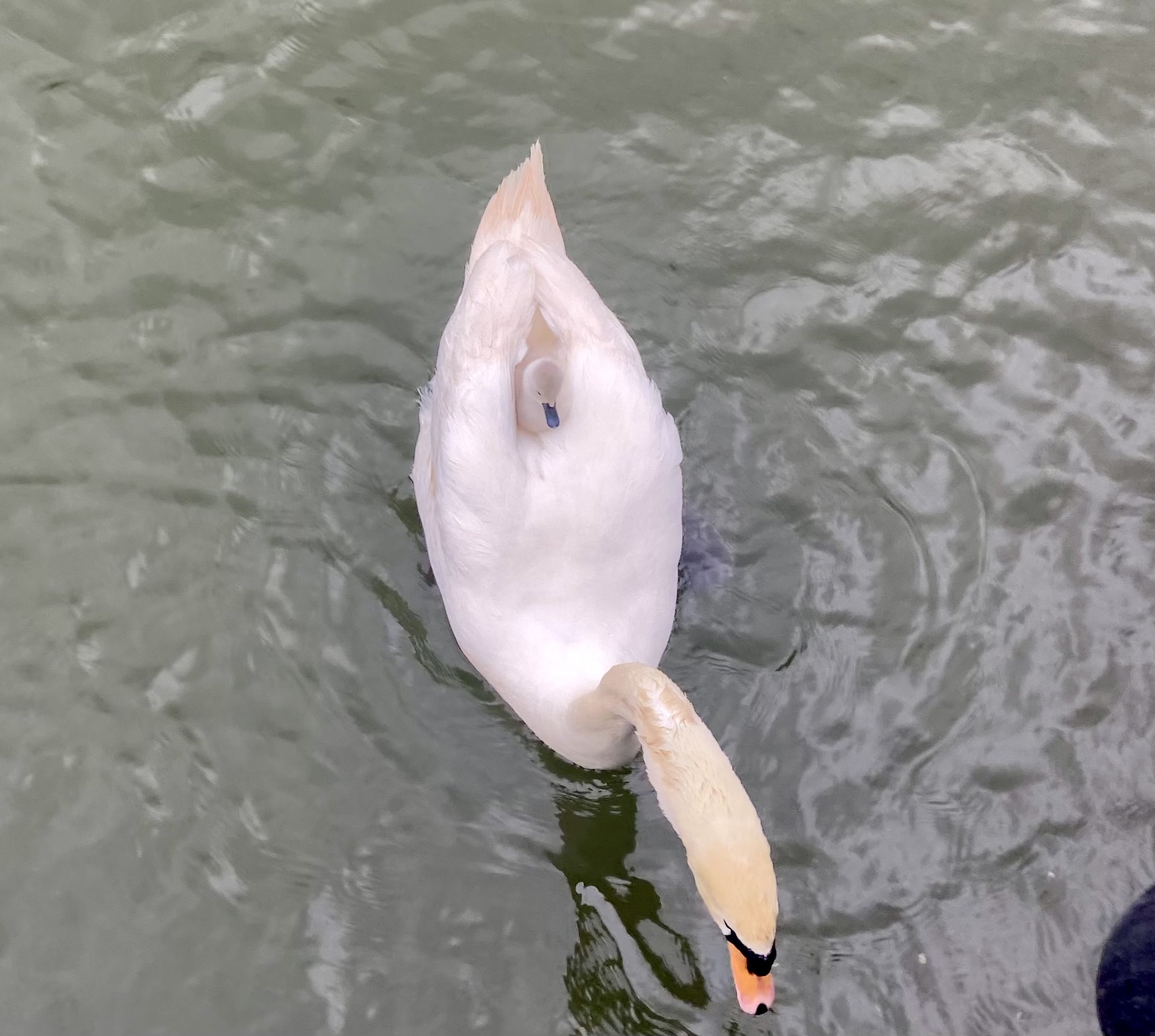
It’s such lovely sight, so I have used a big photo.
Secondly when we got back to Calliope we discovered that sister Piper vessel Tadham Castle had arrived!

We had not seen them for about three years and we would have just one evening to catch up with all the intervening years cruising tales!
We were soon all together in Calliope’s wheelhouse, sharing wine and stories of the waterways.
Waulsort
Only two more stops before we were to leave the Meuse. The first was at Waulsort – another favourite of ours, and quite an unusual set of moorings. But first we had to get there. And that would include a short tunnel as well as 6 locks, our re-entry into Belgium, and sharing the river with big commercial barges again.
All of these are fine – in fact they are good. We enjoy the changing requirements of the water; it keeps us on our toes.
At the first lock we were surprised to see an éclusier (lock keeper) come out of the lock house and make a phone call – remember we had been travelling by tele-comnmand (remote control) for almost a fortnight be then.
It turned out that he was calling the next lock 5 kms away to say we were coming; the next lock is called Ham and is the entry point to the Ham tunnel, or Souterraine de Ham-sur-Meuse to give it its official title. The lock keeper there also acts as traffic co-ordinator for the tunnel as it is only 6.5m wide.
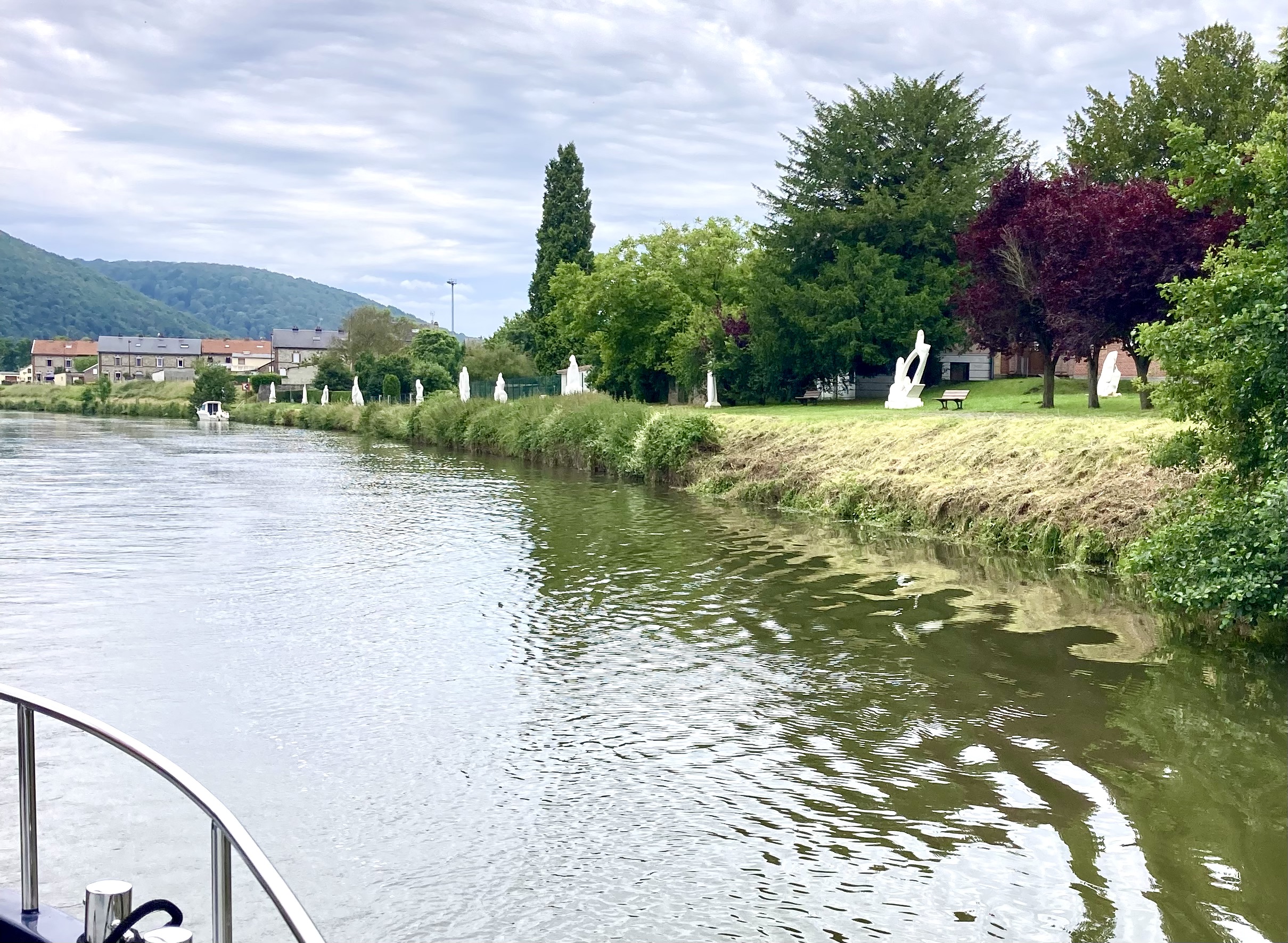
Before we reached Ham went past Aubrives – a village noted for its sculptor, George Favaudon. The riverbank is a perfect exhibition space for his work – not seen too well in the photo, but you can find out more about him and see this work close up at this link.

Soon we were at the Ham lock. Here we were met by the next écluiser and handed in the remote control – before we descended 3.2m!
From now on we would be using the VHF or phone to contact the locks.

Next it was into the cut leading to the tunnel, past a set lot stone steps, full of history, and through the 564m length – it was easy to see the light at each end of the tunnel this time!

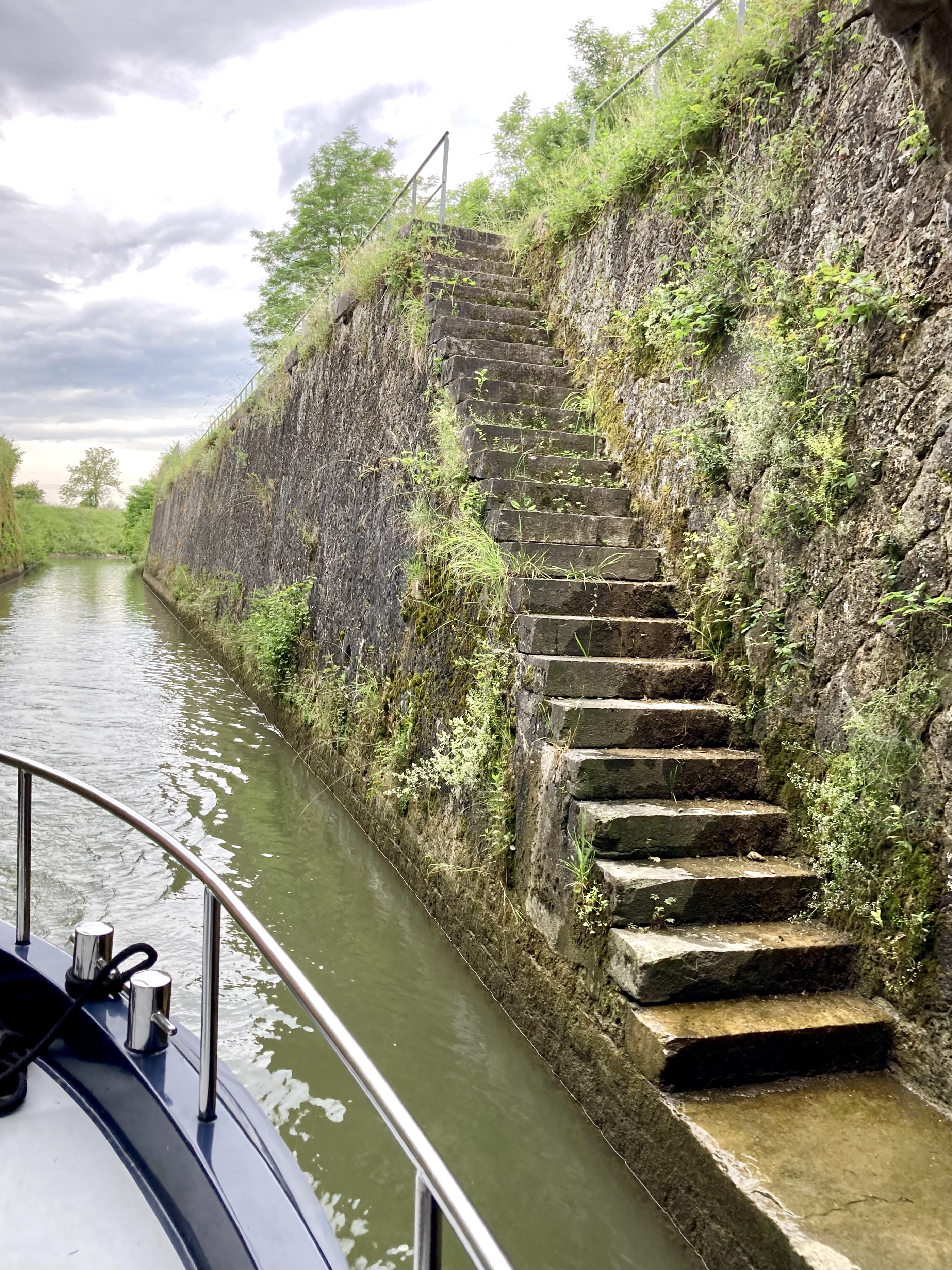

On leaving the tunnel it is just 250m to Les 3 Fontaines lock, and another 3.2m down.
Dropping back onto the river here takes you round a wide curve with a fortress above – the Citadelle de Charlemont – which in its day controlled the Meuse valley.

It is on the edge of Givet, almost at the French/Belgian border; no passports or customs declarations required these days! Although we have stopped at Givet before, and been fascinated by its history, this time we continued on our way – just 10 kms to go, and all downstream!

Now we were passing the big modern Ro-Ro port basins of Givet, and their large commercial barges. The river somehow changes, becoming a ‘grand gabarit’, or motorway equivalent of the waterways.
Our our last French lock for a while – les 4 Cheminées – was about twice as long and twice as wide as those we had been travelling through.
What a feeling of space!

We passed by the old ‘Douane’ or Customs point and had entered the Wallonia region of Belgium, where the daily language is still French and easier for us than the Dutch that was to come in Flanders.

Now there were just 2 locks – Hastière, where we had to wait a while for a big commercial barge to come up and through the approach until we had our green light, and then on to Waulsort.

There shouldn’t really be much more to say, but we did have to wait (20. minutes) at Waulsort lock as well. The red and green lights had us on hold until three or four cabin cruisers appeared; it’s good that the éclusier gathers us leisure boats together and does not waste the lock resources of water and electricity.

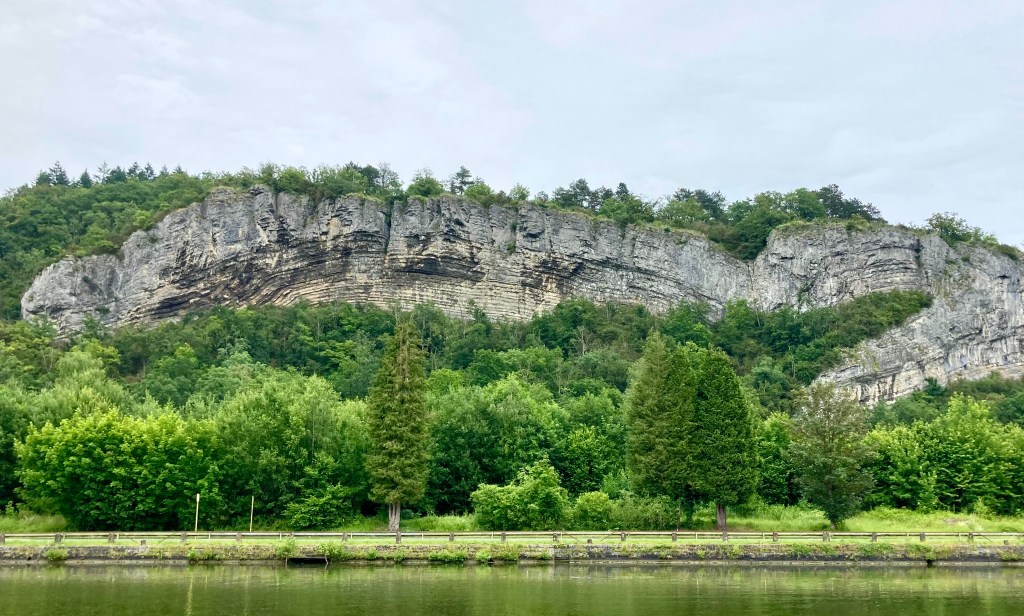
And it gave me time to enjoy the reappearance of the densely wooded valley slopes, get a good photo of the marvellous rock formations in the area, and also of the Wallonia crest once we were in the lock.


The moorings at Waulsort are interesting. Two long long pontoons, each about 100m long, are somehow anchored out in the river, allowing boats to moor both sides of each. It is a lovely place to be – truly midstream – so we stayed two nights!
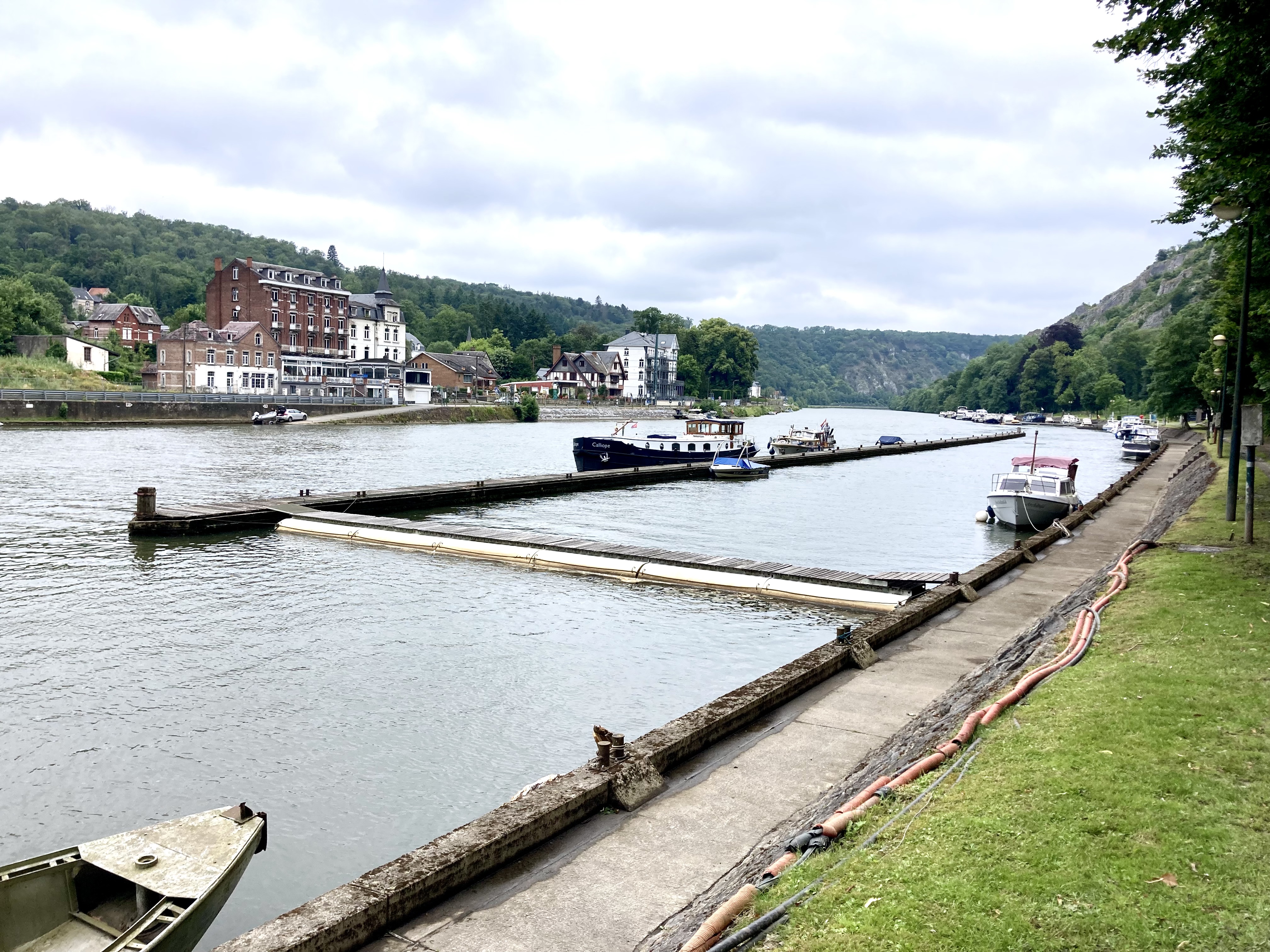
Here we are on the upstream pontoon, having turned to moor facing upstream. The down stream pontoon is way in the distance, and obviously a bit more popular with the other boats!
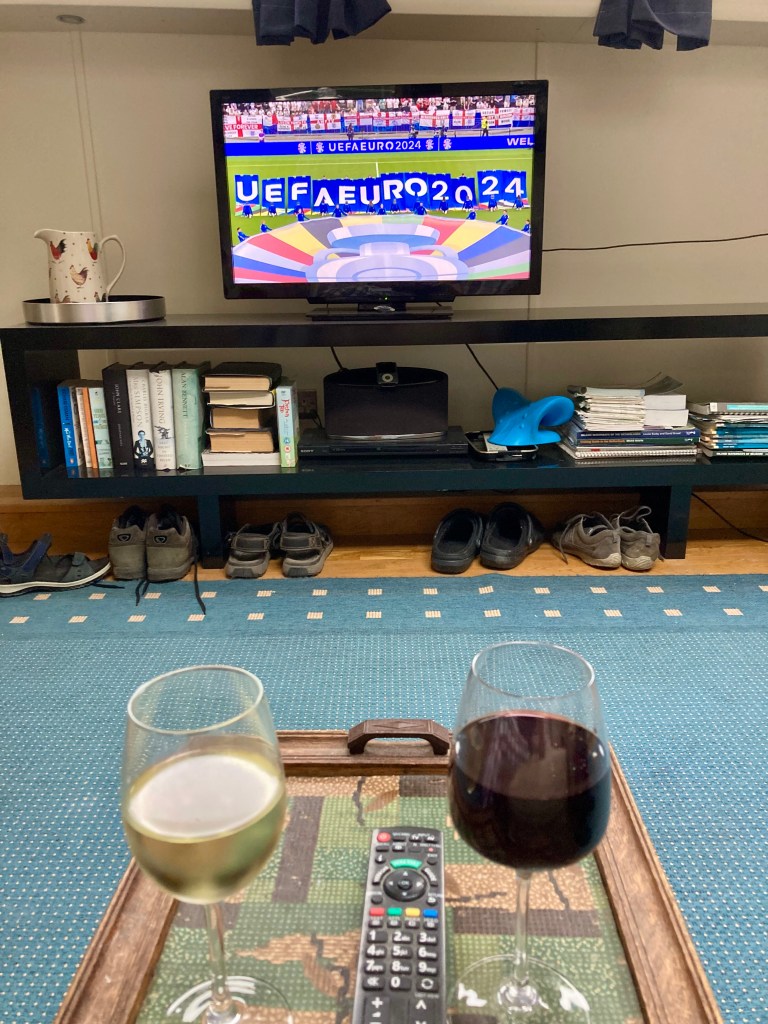
We arrived in time to settle down to watch England take another step towards the Euros final; they eventually came second – a good result!
Red and white wine was the closest we came to the red and white of the England flag!
Our day off at Waulsort was spent relaxing on board and, when the rain stopped, walking along the bank and into the dripping woods. One of the delights of this mooring is being almost marooned on the East bank – although there is a little manually operated ferry to get to the other side, and we have walked the few kilometres back to Hastière to buy bread from another good bakery.
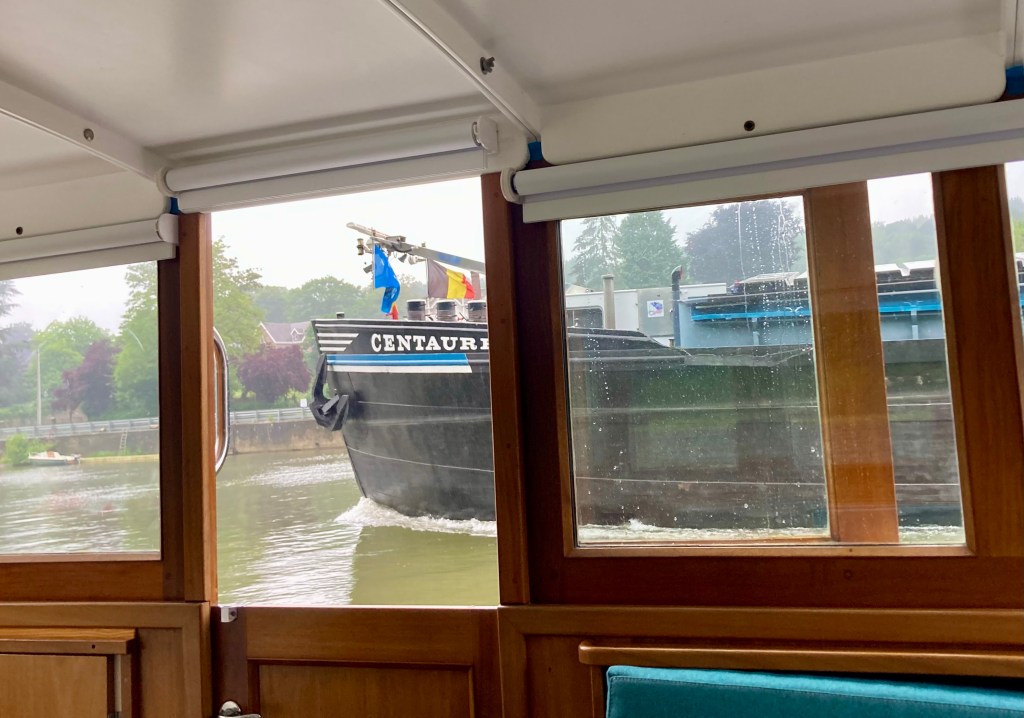
There was also the enjoyment of watching the commercial barges go by, saying in their speed, their cargo, and their magnificence.
I never tire of watching them.
Overall it was a restful break, full of the blues and greens of nature.
The Captain was at peace with the world.
[Note the change to the Belgian (red/yellow/black) courtesy flag.]

And the weather was definitely taking a change for the better on our last night at Waulsort. It should be good cruising next day.

Profondville
Now we were onto our last full day and night of the glorious Meuse. Stu turned Calliope to go with the current and we watched the river valley slide past as we headed for the first lock, about 7 kms away.
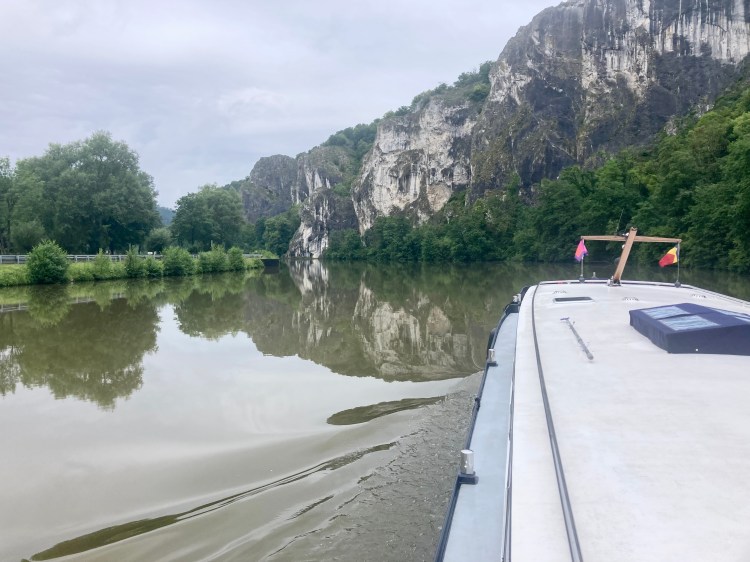
The sky was overcast again, but clear enough to see the Rochers de Freyr on our right and the Chateau de Freyr on our left.
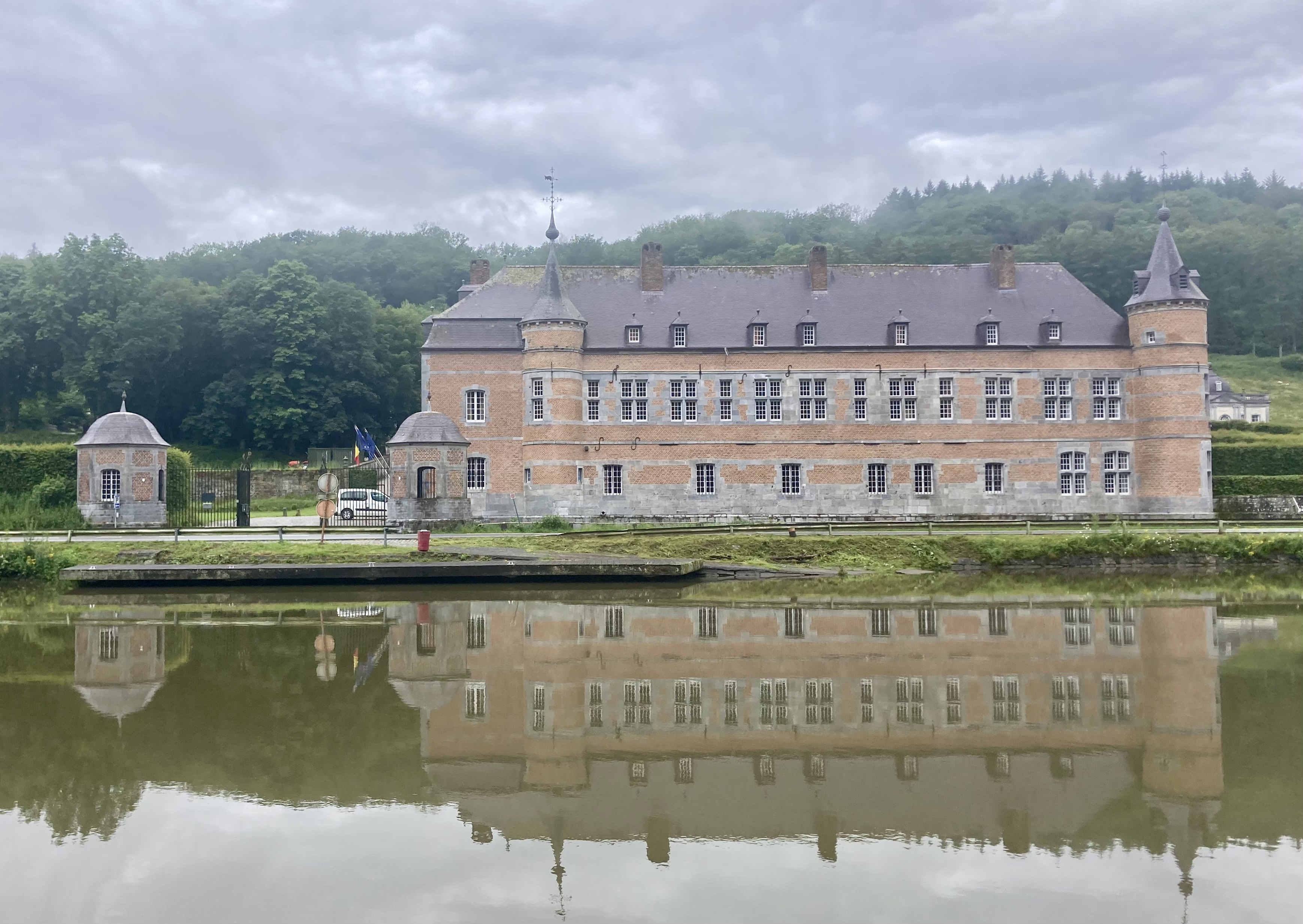
We seemed to be all alone on the peaceful water – until we went past the little port under the bridge at Anseremme ….

The port is just over a kilometre from the Anseremme lock and I had radioed the éclusier to say we were on our way and would like to go avalant – down stream. I was. not sure of her answer but understood enough to know that she was expecting us and that another boat was involved – maybe coming towards us.
When we reached the lock we understood! Five leisure boats were already on the lock, also waiting to go avalant – and more than that, they were waiting for us to join them!
They had left Anseremme port together, to go downstream, and the éclusier made them all wait for us!
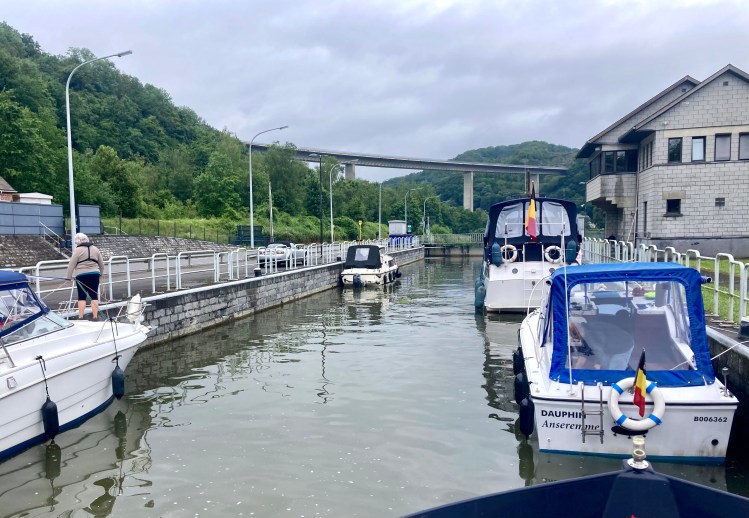
They made us welcome and we ended up going through another 4 locks with them, gradually getting to know them and chatting when we had the chance.
In between locks we all progressed at our own pace, with us at the back of the flotilla. As always we passed many interesting sights and I cannot include them all.

But this beautiful launch, attached to a luxury hotel, had attracted our attention the night before when it cruised up past our mooring at dusk, with a white gloved waiter serving dinner to a few select guests.
And then we were gong through Dinant – famous for Mr Saxe, who invented the saxophone, and for Leffe Abbey, where Leffe beer is still brewed.


This is not the Leffe Abbey – it is not possible to get a good photo of it from the river. But the unusual shaped steeple on the main church, and the rows of colourful saxophones that decorate the streets and bridges, make up for it.
With Namur and its lock astern of us all we turned towards Houx lock and Hun lock.
We were getting into a routine now, each Captain knowing which part of the lock they would stop at, and with an accepted order of leaving the lock when the gates opened.
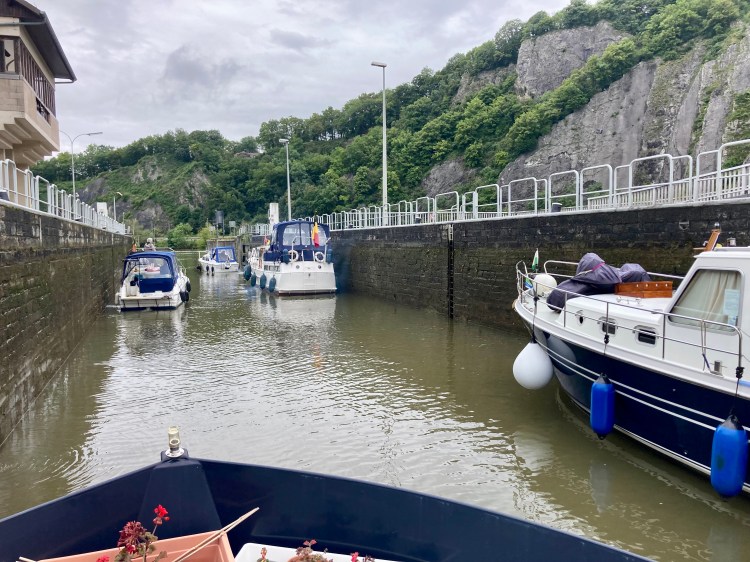
Riviere lock was the last one we would share with them; we said au revoir and watched them dash off into the distance while we slowly cruised towards Profondville.
There is always that little bit of PMT – Pre Mooring Tension – wondering if the quay or pontoon that you are aiming for will be full or empty.
Our luck held; the small quay at Profondville was empty and waiting for us!.

As you can see in the photo the weather had closed in a bit again and it was ‘coats on’ to go and do a little shopping.
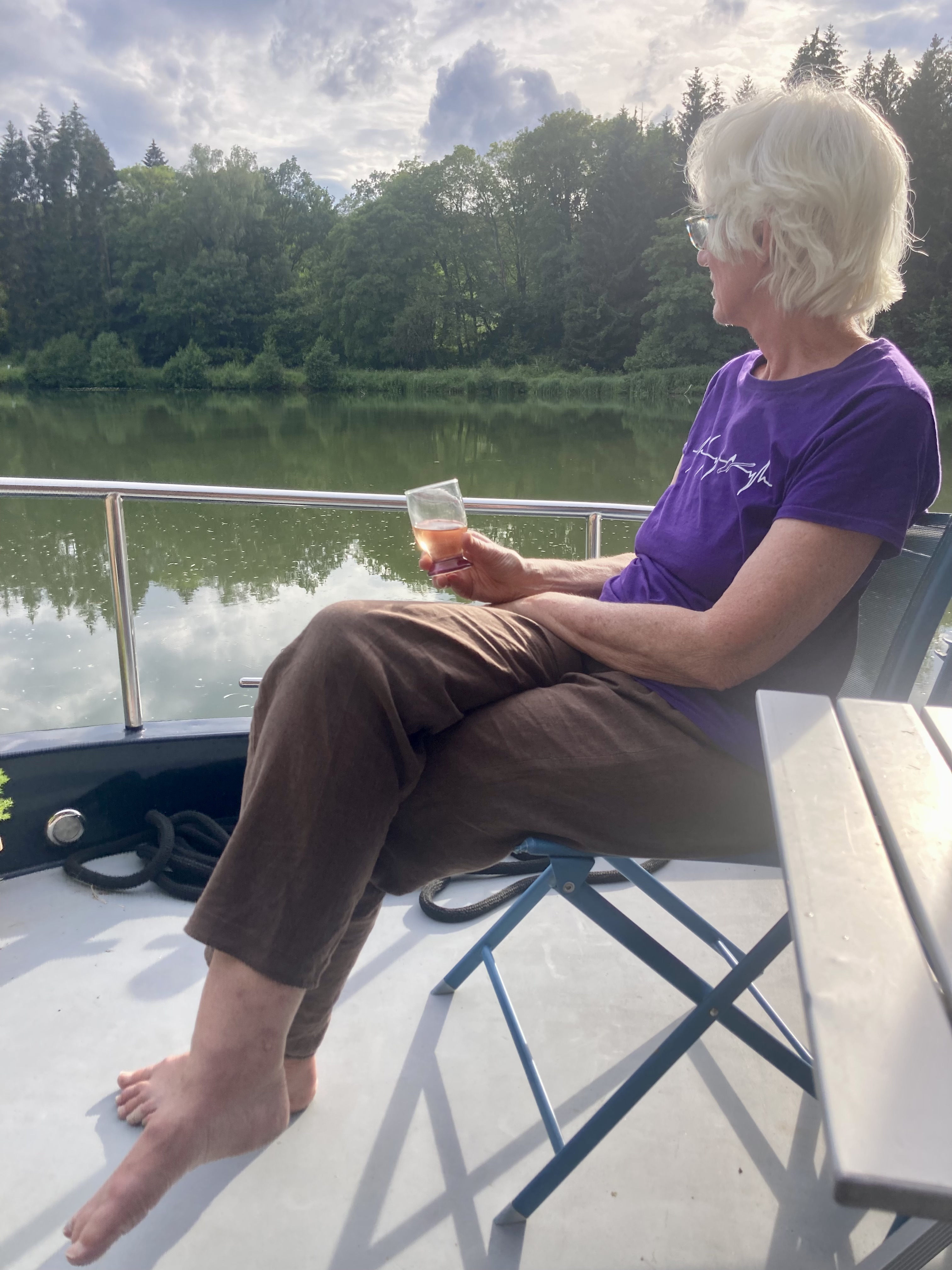
But the skies cleared again. Look at these photos of our evening, complete with water skiers passing by and a glass of wine on the back deck.!
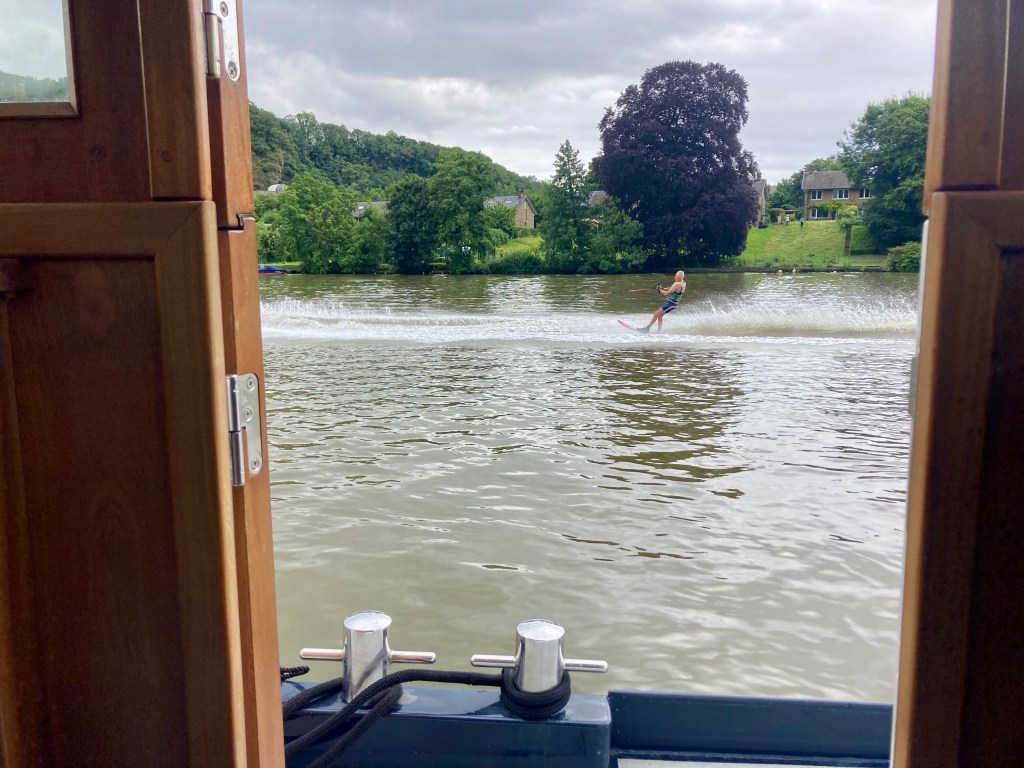
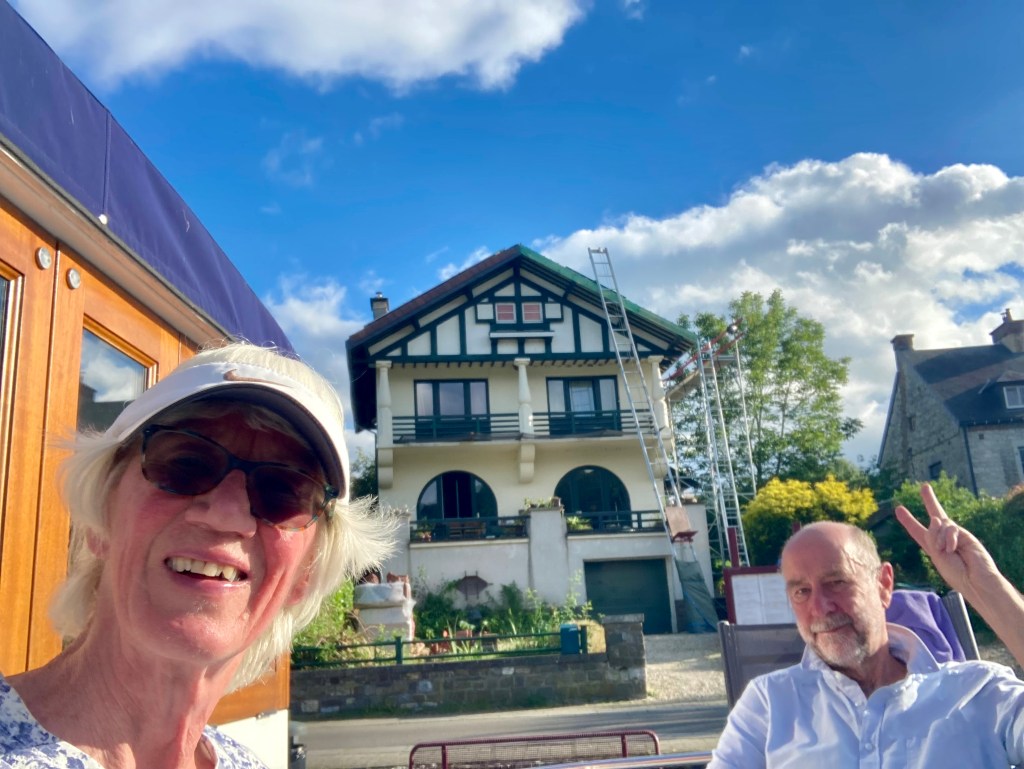
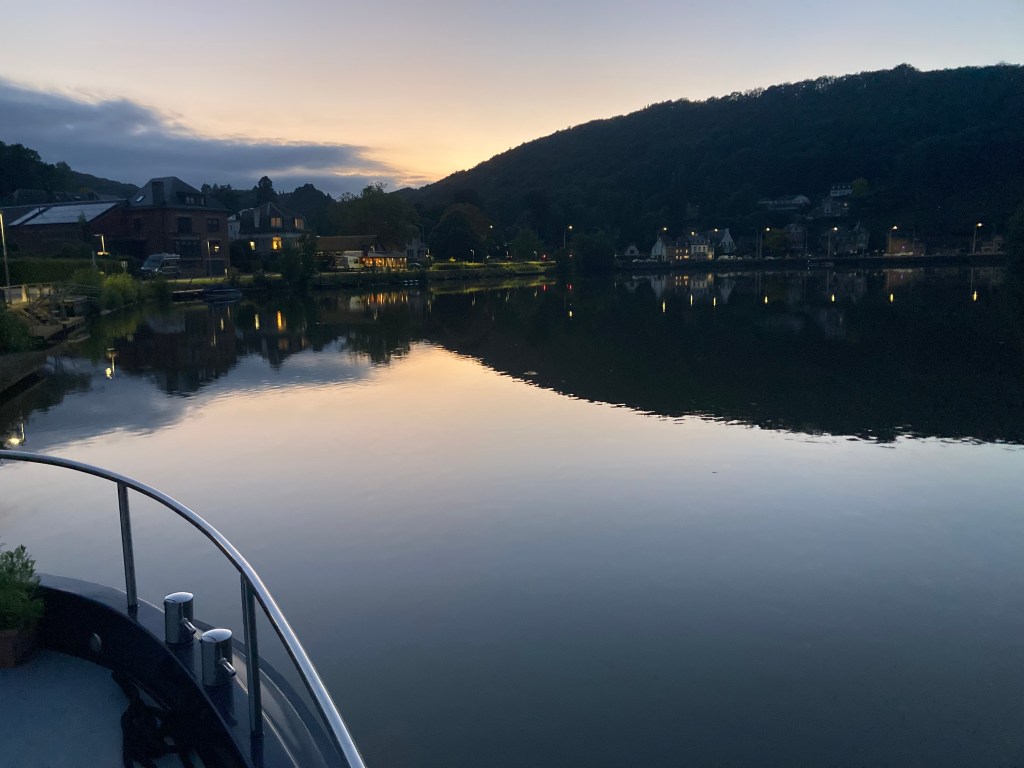
A beautiful end to our nights on the Meuse.
We had 10 kilometers to cover to reach the mouth of the Sambre at Namur and turn off the Meuse. And once onto the Sambre we had a bit of a journey to reach our next hoped for mooring, Floreffe.
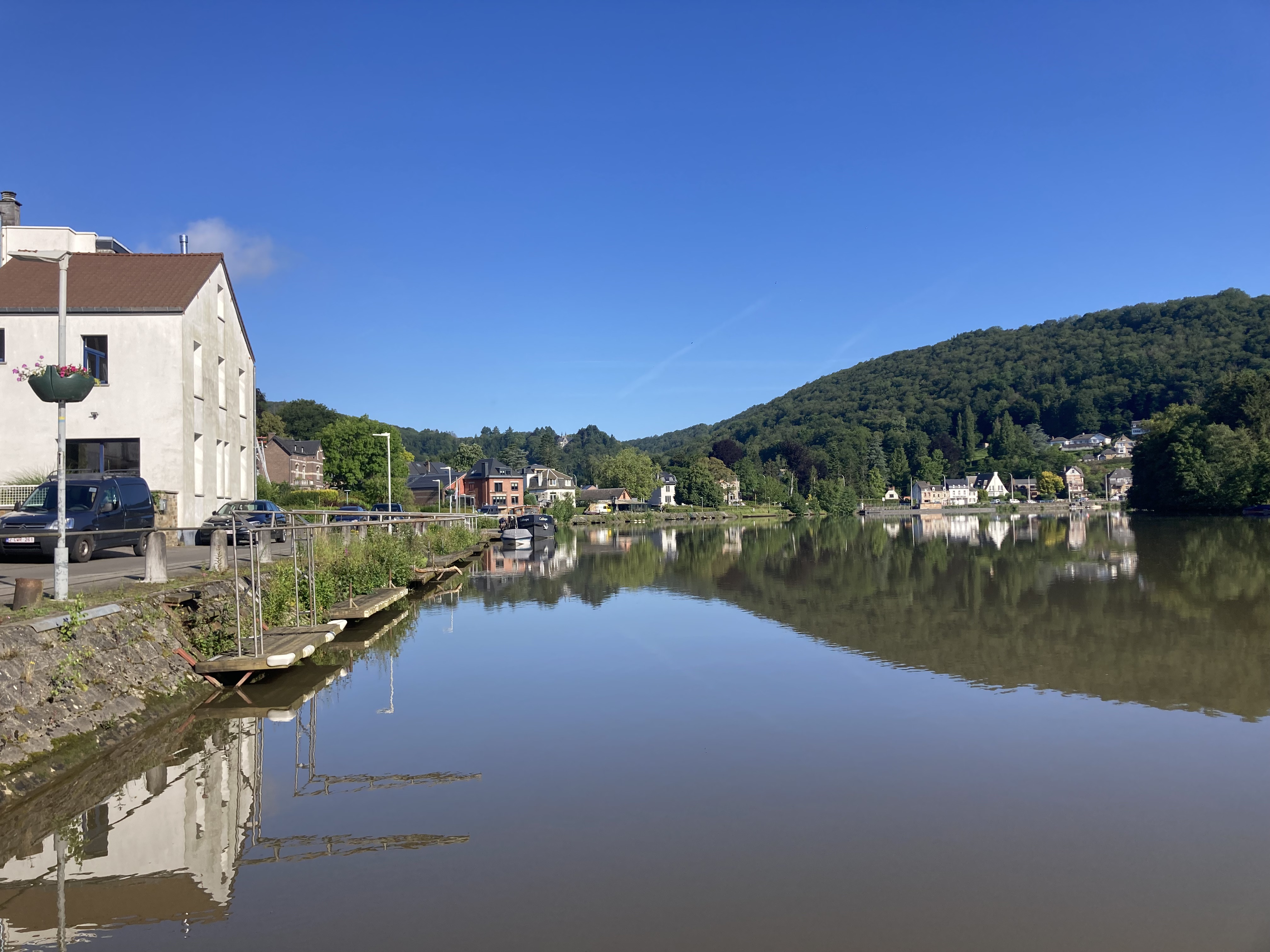
So we were up and ready to go next day, still with blue skies – hooray. This is the same view astern that is shown above at dusk from the night before. It is all so lovely!
The style of houses down to Namur seemed to change – they became a bit Gothic and turreted. There were so many that I would have loved to own.


There were just two Meuse locks to negotiate before we turned off – and they had very different lock houses.

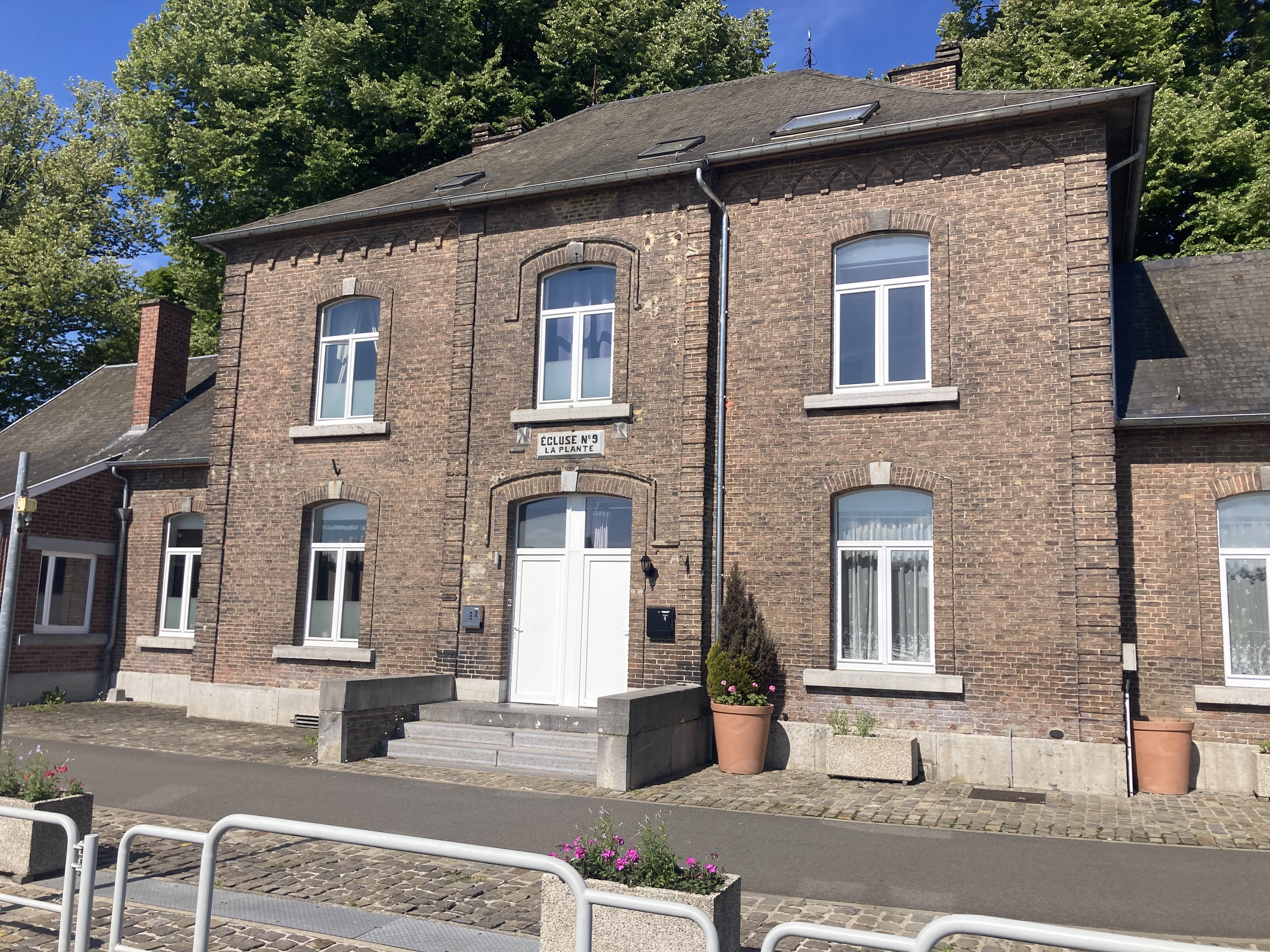
Tailfer, on the left, seems very grand. Looking at the map I cannot see a reason why this location deserved such grandeur for the lock keeper.
la Plant on the right is the closest lock to Namur, so it may be understandable that this one os bigger than the norm. And both are considerably bigger than those we have seen further up the river and on the canals. I wish I knew the history!

The éclusier at la Plant came down from his office on high and chatted to us.
He made sure we managed to tie up to the bollards, which are close to railings and can make line throwing a bit difficult.
Merci Monsieur.
And that’s it. We arrived in Namur, under the huge fortress …..

….. spotted the turning into the Sambre between the buildings old and new …..
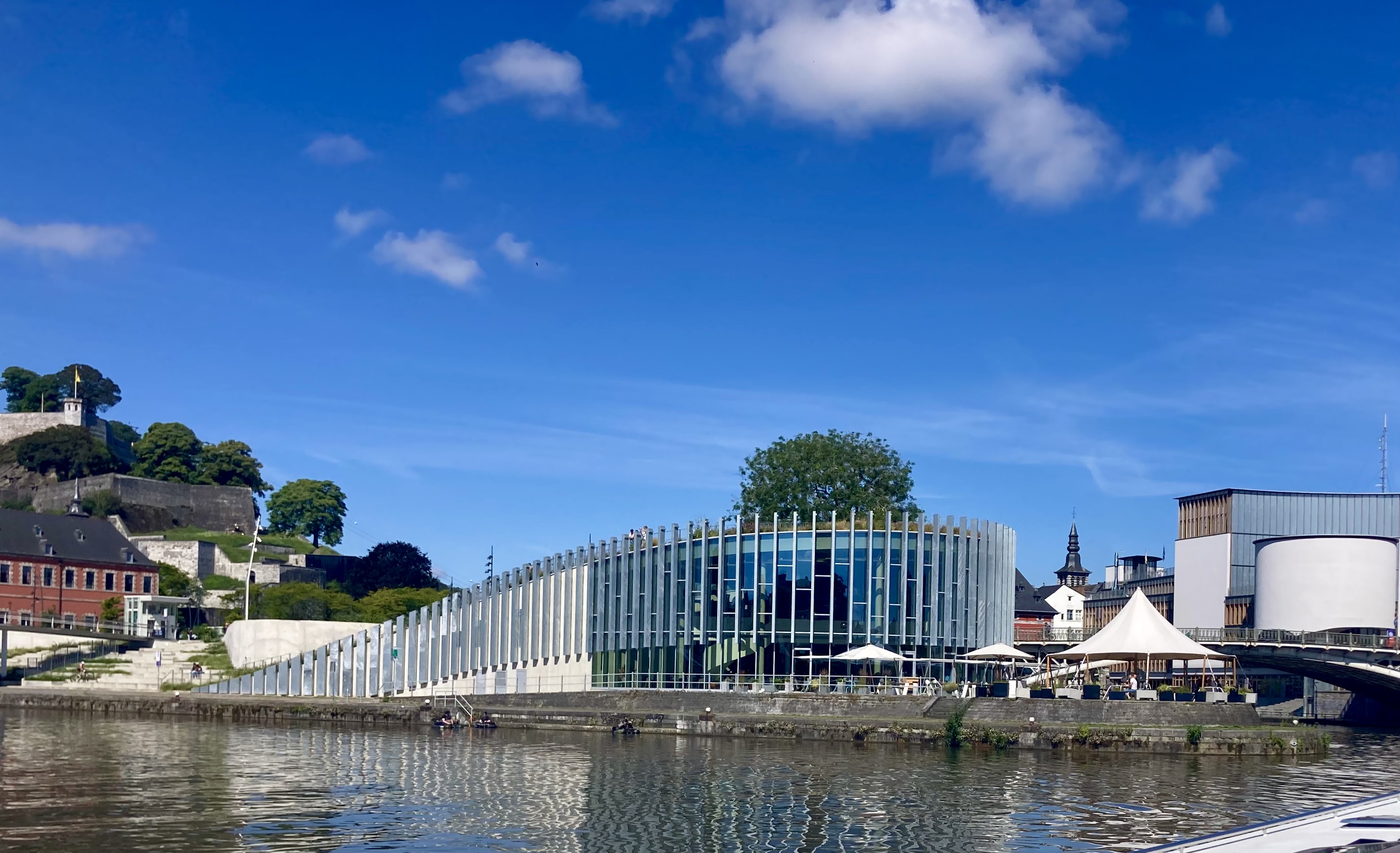
…. and turned onto the Sambre.

Good bye La Meuse; we have loved our time with you yet again.
 goodshipcalliope